Meditation: The Completest of Guides

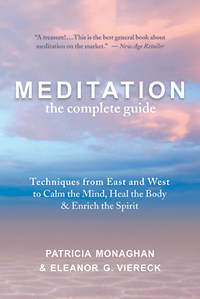
I know it will sound like the start of some sort of silly advertisement, but when I first pulled my copy of “Meditation: The Complete Guide” out of the envelope from New World Library I found myself thinking, “Complete guide? We’ll see about that.” Well consider me soundly put in my place because Patricia Monaghan and Eleanor G. Viereck couldn’t have created a more complete resource without shipping actual living meditation instructors to your home. Honestly, the thoroughness of their book would border on ridiculous if it didn’t create such an amazing resource.

“Meditation: The Complete Guide” begins with an introductory section that discusses meditation in general, why people practice meditation, what kind of meditation practice might work best for you, and more. For those who may be curious, following the suggestions in this section of the book, my top types of meditation practice would be biofeedback and/or Qigong followed closely by Yoga and/or Tai Chi.

The rest is divided into 10 parts and you just won’t believe everything to be found: trance dancing, drumming, ritual body postures, Yoga Asanas, Yoga breathing, Yoga meditation, Mantra, Yantra, Vipassana, loving-kindness, Zazen, Zen in action, Haiku, brush painting, Tai Chi, Qigong, the Mussar Movement, Hitbodedut, contemplative prayer, Hesychasm, Taize singing, Quaker worship, Sufi breathing, Sufi dancing, candle meditation, inspirational reading, free-form meditation groups, labyrinth walking, prayer beads, biofeedback, sketching from nature, needle crafts, journaling, dialogues with self, visualization, sports as meditation, gardening, pilgrimage, and nature. Whew! My fingers are exhausted! And each of these things includes a checklist for practice and resources specific to the type of meditation being discussed.

I would imagine whether a beginner, or someone with an established practice they enjoy, anyone with an interest in meditation would find “Meditation: The Complete Guide” a valuable resource.

Old Sir Christmas

By John Matthews and Caitlin Matthews from their book The Winter Solstice: The Sacred Traditions of Christmas (used here with the Quest Books permission)

The Birth of Santa Claus

His story is a complex one. Many will know that Santa means saint, and is of modern usage. Others will tell us that the nearest point of origin for Santa Claus – in time, anyway – is St. Nicholas of Patara, a third-century Bishop of Myra, near the present-day village of Demre in Asia Minor. Born in Turkey to a wealthy family around A.D. 270 he became well known for his anonymous gifts to the poor. Tradition has it that he left these offerings in the houses of selected recipients, sneaking in during the night to leave money or food in the shoes or stockings of children – though it is doubtful whether they would have worn either in that hot land, assuming they could afford such luxuries anyway. However, such is the tradition, and it is from this that we derive the custom of hanging stockings by the fireplace, while in various countries such as Austria, Germany, Switzerland, Belgium, and Holland, December 6th, St. Nicholas’s official day, is also Children’s Day, and is considered just as important as Christmas Day itself. In fact, it is only in comparatively recent times that we have conflated the two dates – the 6th and the 25th – making the latter a general festival for the exchanging of gifts.

Good Old Saint Nick

If we go back to the Middle Ages, about 1,200 years after St. Nicholas actually lived, we can see how this might have begun. In the words of Naogeorgus, the author of the Latin Vita Sant Nicolai (Life of St. Nicholas):

The mothers all their children
on the eve do cause to fast,
And when they every one
at night in sense sleep are cast,
Both apples, nuts,
and prayers they bring,
and other things beside,
As caps, and shoes, and petticoats,
with kirtles they hide,
And in the morning found,
they say: “St. Nicholas
this brought.”

This has most of the ideas that we associate with the figure of Santa Claus, but there is another, stranger story told of St. Nicholas, which actually points the way to his true origin far more clearly:

An Asiatic gentleman, sending his two sons to Athens for education, ordered them to wait on the bishop for his benediction. On arriving at Myra with their baggage, theytook up their lodgings at an inn, proposing to defer their visit till the morrow; but, in the meantime, the innkeeper, to secure their effects to himself killed the young gentlemen, cut them into pieces, salted them, and intended to sell them for pickled pork. St. Nicholas, being favoured with a sight of their proceedings in a vision, went to the inn, and reproached the landlord with the crime, who, immediately confessing it, entreated the saint to pray to heaven for his pardon. The bishop, moved by his confession and contrition, besought forgiveness for him, and supplicated restoration of life to the children. Scarcely had he finished, when the pieces reunited, and the resuscitated youths threw themselves from the brine tub at the feet of the bishop; he raised them up, blessed them, and sent them to Athens, with great joy to prosecute their studies.

A.T. Hampson: Popular Customs and Superstitions of the Middle Ages

On one level this story may be regarded as nothing more than a pious anecdote illustrating the sanctity and goodness of the saint. But there is more to it than that. The notion of a person being dismembered and put back together, as portrayed in this tale, again derives from a far older time, and when it is placed in conjunction with certain other factors, a surprising new image begins to appear that has all the characteristics of the traditional Santa without any of its later overtones of bishops and Christianity.

The Gift Givers

In comes I, Old Father Christmas.
Welcome – or welcome not,
I hope Old Father Christmas
Will never be forgot.

The Longparish Mummers’ Play

Santa Claus is really only the latest of many figures which have come to be associated with bringing gifts on the night of December 25th. In France presents are given on New Year’s Day and called entrennes, a name that can be traced back to the strenae, green branches, exchanged between people at the Roman feast of the goddess Strenia. In Sicily it is an old woman named Strina who brings gifts at Christmas, continuing a tradition that began in the days of the Roman Empire.

The figure who stands behind the jolly old man of Christmas is older even than this, however. In fact, his story takes us back to the beginning of recorded history, when some other characters climbed up trees of a different kind, and returned with gifts for everyone. These were not toys or perfume or watches, but messages concerning the year to come, or the turning of the seasons, or the fate of the world. These people were the shamans, who performed the functions of priest, historian and record keeper, scientist, and magician. Of course there were shamans all over the world, and in most cases they performed the same or similar functions, but, for obvious reasons, it is those who originated in the far North – anywhere from Lapland to Siberia– that interest us most in this context. It is these people who often wore bells on their ritual costumes, who shinned up the central polesof their skin tents, and who returned with the gigts of prophecy and wonder from the Otherworlds. Its is to these people that we have to look for the first appearance of the figure who, thousands of years later, evolved into the jolly old man of Christmas himself, Santa Claus.

If we look for a moment at some of those similarities we can catch a glimpse of the evolution of one into the other. If we dip our hands into Santa’s sack – so like the shaman’s bag of tricks – the first thing we find are the bells that jingle on the harness of the eight magical reindeer. Contemporary accounts of northern shamans, including those of the Altaic and Buryat regions of Siberia and those of the Finns and Laplanders, again and again emphasize the importance of bells in their traditional costumes. These form a double function; as noise-makers to announce the presence of the shaman as he enters the spirit world, and to frighten off any unfriendly spirits who might be lying in wait for him. In addition, iron disks representing the sun or curved in the shape of the moon represent the importance solar and lunar rites among these Northern people– and important point in our consideration of the Solstice itself.

Red Robes and Firelight

Reaching into the sack again we find a red robe or cloak, trimmed with white. Many authorities on shamanic tradition have commented on the importance of the color red in the shaman’s costume. This is, on one level, significant of the sacred blood that links all human beings and that is also perceived as a link between humans and animals, and between the shaman and the earth. It is also, of course, a symbol of fire, that most powerful of magical weapons, as well as the gift of warmth and life to all, especially significant in such cold lands as those we are considering here.

Next in the sack we find a burning brand that signifies the eternal light and the warmth without which all life would perish. The shamans possessed this gift of fire, which initially perhaps they alone had the power to kindle (the number of flint fire-lighters found among shamans’ bundles alone is enough to suggest this) and which was a gift they brought to the tribal people they served. It was believed that these gifts were entrusted to them for the people by the gods and spirits of the land. Here, the symbolism of red fire in the white desert of Winter is a vital image. Is it stretching the point too far to see an echo of this in the red and white costume and white beard of a certain other figure? Certainly the importance of these colors throughout the northern world is beyond question.

Dipping into the sack again we find reindeer with bells on their harnesses, who can fly through the sky and cover vast distances in no time at all. This is yet another echo of the shaman’s journey into and through the heavens, in search of the gifts of fire and prophecy. In addition, there is the obvious importance of reindeer to the people of Lapland and Siberia is obvious. To these people the reindeer not only provided a source of food but also skins for clothing and tents, sinews for thread, bones for needles, and, when rendered down, fat for rush lights and
glue to mend pots and fix spearheads in place.

So Santa is an old man dressed in red who comes out of the dark forest of the North on a sleigh pulled by reindeer. It is significant then that the shamans hunted the reindeer, ran with them in spirit Corm, drew their shapes on rocks with red ochre as a means of capturing them, even saw them as a symbol of the newly born sun of Midwinter. A wonderful modern poem speaks of the hunting of spirit deer, who, impervious to the hunter’s arrows, were a symbolic reference point for hunting the real creatures:

A red deer comes over the hill,
Shoot your arrows as you will,
The deer will stand there still!

Alison Mcleay: Solstice

The Shaman in the Tree

Consider the image of the shaman climbing down through the smoke hole of a skin tent with bells jingling, bearing in his hands a red painted wooden reindeer. The shamans saw to it that the sun returned from that point when, at the very edge of the horizon, it dipped and, for a moment, was gone. Then, summoned by the ancient language of the elements, it returned. Sun images were hung on a tree, that also formed the central pole of the tent and represented the axis of the world, the connection which leads to the heavens the final destination of the shaman who was, indeed, the midwife of the sun.

Imagine some of the questions asked of the shaman. As Alison Mcleay put it in her wonderful evocation of the Solstice in a radio broadcast she made in 1985:

Shaman, will the sun be reborn?
Will we have a good harvest?
Will we catch enough fish, will
there be enough meat to eat,
will the reindeer drop enough
offspring to keep us through another year?
What will the new year
bring for us, for me?
Tell us, shaman, make your
journey and bring us the
gifts of your seeing?
You are the bringer of gifts,
the protector, the magician,
the future is yours to see, the
gifts of the future and the past
—tell, us shaman, tell us.

Sacrifices were hung on the living tree: animals, birds, perhaps once even humans, such as Odin hanging on the windy tree of Yggdrasil to bring back the gifts of the runes. Odin’s eight-legged horse Sleipnyr may also be linked with Santa’s sleigh and its eight reindeer. And that song – next out of the sack:

0 the rising of the sun, and the running of
the deer, The playing of the merry organ,
sweet singing in the choir

The Holly and The Ivy

These are old images, stolen by a later time, and reflect two aspects married under the Solstice tree: the running deer who were the totem creatures of many different Northern tribal groups, and the singing of carols in the stone forests of the Christian world. The old ways were not wholly forgotten, not even after the coming of the Christ child, who brought the gifts of light and eternal life to the world, and who received gifts from the wandering wise men – the Magi of biblical and pre-biblical tradition. They too contribute to the image of Santa the gift bringer, and, as we have seen, there is more to them than meets the eye.

About John Matthews:
John Matthews is an international authority on Celtic folklore, the Western mystery tradition, and the Grail legends, and is one of the great culture-bearers of our times. He has written over forty books on the Arthurian legends, esoteric wisdom, and the Grail. His Quest Book “The Winter Solstice” won the Benjamin Franklin Award in 1998. With his wife and frequent coauthor Caitlin, John established the Foundation of Inspirational and Oracular Studies. To visit the author’s website, www.hallowquest.org.uk

Geek Month in Review: November 2011

By JB Sanders

Some interesting reading as the snow falls…

Stars over Crater Lake
Another amazing time-lapse video of the star-scape over Crater Lake. Watch for the vault of the heavens view reflected in the smooth surface of the lake about 2/3 of the way into the video. And for the photography geeks out there, details on equipment used at the end of the video.

They Might Be Giants Slashdot Interview
There’s a lot of Geek in this link: pre-eminent indie-rockers They Might Be Giants, Slashdot and Science! For those who might need a reminder, They Might Be Giants are an odd-ball rock band from way back in the 80’s who gave us such songs as “Istanbul (not Constantinople)”, “Particle Man”, “Birdhouse in Your Soul”, and “Boss of Me” (better known as the theme song of the TV show “Malcom in the Middle”). So why are they Geeky (capital G)? Because these guys are HUGE geeks. They used USENET groups in 1992 to send notices to their fans about upcoming gigs. They created Dial-a-Song, basically an answering machine people could call to listen to their new music (and some fake ads). They created one of the first artist-owned online music stores, selling MP3s directly to fans before most record companies knew about this Internet thing. I could go on.

This is a Good Sign
More and more kids are getting into the Maker Movement — which is basically Mad Scientist Training Camp, as far as I can see. There are more kids getting into creating things, buying circuit boards and soldering them together, for instance, or making their own marshmallow cannons. Great trend!

Electric-powered Multi-copter Manned Flight
Some German scientists/hobbyists built and flew the first manned multi-copter. What’s a multi-copter, you say? It’s a vehicle that produces lift (and flight) via multiple helicopter-like rotors. It’s like a hovercraft that flies. Watch the video to see what I mean. Interestingly, this is all done via electric motors. The folks behind it estimate that a one hour flight on the final device would cost about 6 euros of electricity to run.

Extreme Light Infrastructure
Or ELI for short! Scientists want to build a laser to “rip a hole in space-time”. Yeah, it’s another start to a scifi movie. To do this, they want to concentrate 10 lasers wielding 200 petawatts of power into one spot for a trillionth of a second. Fun!

Fake Mars Mission Returns from Fake Mars
Remember that Fake Mars Mission I mentioned a few Geek Reviews ago? Where they finally reached Fake Mars? No? Here’s the link:

Well, the Fake Mars crew is back from Fake Mars. It appears to have been a great success. No murders, for instance. When you consider that 6 guys just spent 520 days in the same space as a bus, stabbing a guy for taking the last pudding cup doesn’t seem that out there. The other great success was that they didn’t leave their fake spacecraft, even though they could at any time — so it’s at least more successful than the Bio-Dome (1 or 2).

288,000 Jelly Beans, One Singer and a Stop-Motion Camera
How to make a music video that’s both simple and amazingly artful. I never imagined that jelly beans could also do surreal sound-scapes, too. The link includes the video, and a behind-the-scenes look at how it was all done. One shocking factoid from the behind-the-scenes video: no green screen was used. The singer lay on top of a glass case over the jelly beans to make the video. Yeah.

3D Volumetric Projection
This is the very early steps towards those cool scifi holograms we’ve seen for 40 years in the theater — only for real! Right now they’re limited to just 10 rotational voxels, but the prof working on it hopes to use over 100 projectors (small ones, I’m guessing) to provide real, crisp resolution.

http://www.youtube.com/watch?v=ijOK_hb18kE

Global Village Construction Set
This group has created and posted the plans for 50 different industrial machines that they consider crucial for a “small civilization with modern comforts”. It includes a 3D printer, and the ability to build a very modern village.

Video Time Machine
Pick a year, and watch what comes up on the screen. It’s a giant archive of the video culture, organized by year, and randomized for your amusement. Sports clips, commercials, video games, news casts, movies, and music.

It’s a Polaroid! Sort-of
So there’s this camera that gives you an immediate print of what you photographed? Sound familiar? Like 1948 all over again? Well, it’s not. The same company that brought you the instant film camera now is coming out with a digital camera (14MP) that’s tied to an instant printer in the same unit. I’m not sure if this is a genius move or using new technology to do something old-fashioned.

Darwin and Human Emotions
Did you know that Darwin conducted an experiment (over 150 years ago) to see whether the facial expressions of human emotions were recognized or used the same regardless of cultural background. He did! They do! And now there’s an international experiment being conducted to further study this effect, only involving as many people as can get to the online website and take the test.

An Airship That Goes Anywhere
I’m sure I’ve posted about this before, but this is the first real video of a working prototype I’ve seen. This company makes what’s called a Hybrid Airship — the hybrid part is because it’s a little like a plane, a helicopter and a regular (helium-filled, thank you) airship. It can take off and land without the need of a runway (or even land, if you’ve got the water-gear on). It can stay aloft for up to 3 weeks at a time (yes WEEKS), and the full version will be 1000 feet long and be able to carry over 1000 tons. I mean, wow! Sure, you’ve heard that all before. How serious is this? The US military has bought a few.

Acoustic Ruler Using iPhone
This is kind of wild. This guy made an iPhone app that measures distance just using acoustics. It has two modes: two phones or 1 (w/headphones). You put one iPhone where you want to measure to, and the first phone where you want to measure from, they play some tones and calculate the difference. Or the same using the headphones.

Amazing Fly-over of Earth
From the International Space Station. For best results, put on HD, full-screen it, and turn up the volume on the trippy musical score.

Raise the Ice Shields!
The capital city of Mongolia, Ulan Bator, is planning on creating artificial glaciers that will very slowly melt over the course of the summer to help cool the city. Read about how they plan on doing that:

Ghost Mountains Explained
And before you get up on your high-horse about silly paranormal photos and PhotoShop, hush. These are mountains in Antarctica, buried under 4 km of ice. Scientists have finally figured out how mountains exist where everyone thought it was just a barren flat wasteland of ice. The article includes a link to an animated explanation.

New Maps of the Moon
Higher resolution topographic maps of the moon are now available, including false-color images showing detail up to 100 meters.

Giant Robot Snake
Designers have created a giant robot snake 35 feet long (because THAT was necessary), and even better, it’s based on a 50-foot long prehistoric serpent. Watch the video so you can see the very realistic movement of the giant robot snake, and also the guy in the spider-leg car (no, I’m not kidding).

Computer Legends First Computers
Speaking of giants, this article asks several giants of the computer age about their first computer experiences. See what Vint Cerf, William Gibson and others remember.

Building the World’s Largest Tesla Coils
Or how to do man-made lightning. By “world’s largest”, they mean tesla coils 10 stories tall, and 260 feet apart. Yes, there is a video.

The 2,100-Year-Old Wrist Watch
Remember the Antikythera mechanism? So last century, right? Well how about this wrist-watch version? Watchmaker’s Hublot have put together a concept piece that replicates the Antikythera’s inner workings in miniature, with a handy time-keeping circuit to show you the time, too. It can accurately show the motions of the 5 planetary objects the Greeks knew about 2200 years ago and predict eclipses. Full video from the watchmaker’s detailing their work.

Worlds lightest material
Remember aerogel? The stuff that’s super-light and non-conductive? Weighs almost nothing? So last century.

They’re Just Cake Sprinkles
Ever wonder how many cake sprinkles you’d need to make a photo-realistic mosaic? About 221,184.

Flying Robots Build Tower
I know, it sounds soooo 2236, but really, it’s happening today.

Earthscraper Concept Taking Off
Yes, that’s “earth scraper” as opposed to skyscraper. The idea is to build down (which has happened before). In this case, the idea is to build down BIG. Like arcology big.

Not sure what an arcology is? Try this:

Miniatur Wunderland
Think you have a nifty model train set? Think you’ve seen some great miniature setups? Think again. Let’s try 12,000 meters of track (yes, that’s 12 km), 200,000 human figurines or 300,000 lights.


Those pesky time travelers, always trying “fix” things. This guy was caught outside the Large Hadron Collider and admitted to sabotage, claiming to be from the future and intent on stopping it from discovering things and destroying the world.

The priceless quote from the article? “Mr Cole was taken to a secure mental health facility in Geneva but later disappeared from his cell. Police are baffled, but not that bothered.”

About John:
John’s a geek from way back. He’s been floating between various computer-related jobs for years, until he settled into doing tech support in higher ed. Now he rules the Macs on campus with an iron hand (really, it’s on his desk).

Geek Credentials:
RPG: Blue box D&D, lead minis, been to GenCon in Milwaukee.
Computer: TRS-80 Color Computer, Amiga 1000, UNIX system w/reel-to-reel backup tape
Card games: bought Magic cards at GenCon in 1993
Science: Met Phil Plait, got time on a mainframe for astronomy project in 1983
His Blog: http://glenandtyler.blogspot.com

Sounds Like Winter

By Marcy Lovitch

Not really “feeling it” this holiday season? Tired of hearing the same old Christmas music wherever you go? Worry not. There’s actually a plethora of wintry and non-denominational treasures that you haven’t heard a million times on Muzac at the mall.

Pop/Rock

Being single at the holidays can be a drag, especially when it’s not by choice. You can take solace in the 80s’ sounding ballad, “Early Winter” by Gwen Stefani,from her 2006 solo album “The Sweet Escape”. It examines lost love as autumn fades into the colder, darker days of winter. On the other hand, if you did the dumping, then assuage your guilt with Taylor Swift, exploring regret, apology and the pain of leaving a relationship in “Back to December”.

Beloved rock songstresses who evoke the contemplative mood of the cold season include Tori Amos with her reflective “Winter,” a beautiful ballad on solo piano with Tori’s soulful lyrics (“Little Earthquakes”, 1992). Equally cool is Sarah McLachlan’s “Wintersong” album featuring 12 tracks about wintertime including a the glistening gems “Wintersong,” “Song for a Winter’s Night” and a cover of the Joni Mitchell classic, “River.”

Ambient Instrumental

If you’d rather chill without lyrics, there are plenty of ambient, new age and solo piano albums to explore. Grab a cup of hot cocoa, a cozy blanket and the beautiful piano solos from Michele de Wilton new release, “Snow Angel”. Tracks like “Snowfall,” “In the Bleak MidWinter” “WinterBlueGreen,” and the story of The Ice Maiden in “Waltz for Gerda and Kay,” will transport you into a winter wonderland for the soul.

Award winning artist and extraordinary voice Seay offers with “A Winter Blessing: Songs for the Season”, a festive, seasonal album celebrating all things winter and the holidays. Filled with Seay’s spectacular vocals, your heart will be filled with magic, love and light.

Beloved international concert pianist Danny Wright offers an evergreen favorite with “An Intimate Christmas”, bursting with both traditional carols and original compositions written for people whose stories moved him to create. If loneliness is what ails you, this album wraps its metaphorical arms around you and brings a quiet solace.

Windham Hill Records’ Winter’s Solstice collections (there are six volumes) offer relaxing instrumental selections from various Ambient, New Age and Jazz artists. Pianists George Winston, Liz Story and guitarist William Ackerman are just a few contributors to this mood-setting music series. It’s the perfect background accompaniment while curled up in front of a fire.

Retro classics

Once you’ve rocked and lulled through the selections above, perhaps you’ll be ready to get back out there in the spirit of the season. Consider revisiting a few of these old faves; so many artists have covered these songs that you can pick and choose your favorite versions.

“Baby It’s Cold Outside,” a pop standard by Broadway and Hollywood composer Frank Loesser never fails to get you in a snuggly, romantic state of mind. Some notable versions include the duet with Ella Fitzgerald and Louie Armstrong; the Bette Midler version (joined by James Caan) from the 1991 film, “For the Boys”, and the pairing of James Taylor and Natalie Cole.

Another timeless standard “Let It Snow” gets a big band-y, jazzy treatment from crooner Michael Bublé. Diana Krall gives the tune a more intimate treatment. For something even slower and more low key, check out John Legend’s cut of the Sammy Cahn/Jule Styne song.

“I’ve Got My Love to Keep Me Warm” by Irving Berlin has been sung by some of the best in the business: Billie Holliday, Judy Garland, Rosemary Clooney and Frank Sinatra, among others. Canadian songstress Lily Frost delivers a stylized, cabaret style version off of her album, “Lily Swings”. But perhaps the best of all is Rat Packer, King of Cool, Dean Martin’s swingy, smooth as silk recording….just press play on that one, and — in no time at all — you’ll be wanting to drag your sweetie – or some lucky stranger – over to the mistletoe.

About Marcy Lovitch:
Marcy Lovitch is a New York-based freelance writer; she is not crazy about Christmas music. She’s a contributor at: http://hiltonshead.blogspot.com/

An Introduction to “The Old Sod”

Excerpt from “The Old Sod: The Odd Life and Inner Work of William G. Gray” By Alan Richardson and Marcus Claridge. Skylight Press, 2011 (reprinted here with permission)

“OK so I’m an old sod, an old bastard, a thousand different kinds of shit if you like, but I am a human being who loved the esoteric Tradition I tried to serve… Perhaps I didn’t do very well with what I’d got but I did my best…”

[letter to Alan Richardson, 19th Sept. 1989]

William G. Gray was a real magician, a kind of primeval spirit who worked his magic as an extension of the Life Force, not as a sop to ego. No-one who met him had any doubt that he was in touch with supra-human sources of wisdom, or that from his home in a dowdy back-street of Cheltenham he was bringing through energies from other dimensions that would one day influence us all. He reeked of psychism like he often reeked of incense, could give you the uncomfortable feeling that he could see right through you and beyond, and had been to places in spirit that we could scarcely imagine. He had powers of low-key prophecy which he often demonstrated, which were often accurate, and he turned some of the convoluted magical systems that had endured for centuries inside-out and upside-down, thus making it simpler for the rest of us to work with Light. Many of the books on magic and the kabbalah which appear today owe a huge if unrecognised debt to his pioneering writing. If nothing else, he was a true original in everything he did. In some ways he was larger than life, and many people were fearful of him. In other ways he had exasperating and unapologetic human quirks which could make him seem very small, depending on where you stood – or sometimes rather appealing if you didn’t get blasted by his ire.

Anyone who ever met Bill Gray must laugh at the books churned out by the self-styled witches, magicians and urban shamans who, a generation later, imagine they are High Priests, mighty adepts, or 21st Century brujos. What empty figures they are in comparison, clutching their amulet-filled power pouches or dream-catchers, communing with their power animals while riding their dainty silver broomsticks through crystal-singing candy-floss Otherworlds where everything is eternally positive and ineffably, irritatingly, nice – and always with at least one eye on achieving a few sound-bites on local tv.

As Bill might have said when asked if they raised any real power: “Raise power? That lot couldn’t raise so much as a good fart between them!”

Yet if there is anything evolutionary about the current urge to revitalise the present by looking at the patterns of the past, and the increasing notions that there are harmonic energies within the Earth and ourselves that can be worked with – whether through green eco-movements, the Celtic Revival or the Wiccan arts – then it is due in no small degree to the work that was done by an old bastard who lived near the bus station in a faded town in Gloucestershire.

At least Bill Gray could raise power. Power that could make your eyes water and your fillings ache, and seep out into the world to change it. That’s what real magicians do. Whether he could always handle it with love or wisdom, is another issue. He made many enemies. Even his friends often winced at his antics. Yet now, a decade after his death, both friends and enemies remain united in their recognition of the fact that – whatever his mortal faults – he was a one-off, and that holy magic flowed through his veins like blood.

Bill was hard. He could intimidate. A real sod at times. He wrote brilliant letters, but when it came to books he often fell out with his editors. Yet they tolerated a lot because they knew that he was in a different league to the other writers on their lists who simply made it up as they went along. Underneath the dense and often abrasive prose, with the alliteration he felt would help get concepts embedded in the readers’ mind, it was quite obvious to them that here was a new level of insight into the theory, practice, philosophy and sheer experience of Magic, and how it impinged upon the world. Here was a real magician.

He seemed to know everything, although he rarely bought a book or plundered the library:

“Do you know why Aleister Crowley spelled magick with a ‘k’?” he asked Alan Richardson once, and the young man perked up because he had read exactly that only days before and saw a rare chance to impress the old mage.

“Actually Bill I do. Not only did he want to distinguish the medieval, supernatural and spiritual art of Magic from mere conjuring, but the ‘k’ referred to the Greek word -”

But Gray wouldn’t let him continue. He had already worked it out himself, intuited it, and proceeded to explain at great length because the lecture was in his head just waiting for an audience. And although it wasn’t exactly what Crowley had said, it was impressively close. All to do with sex.

So for those of who are new to the topic, what do we mean by magic, as practised by real magicians? – regardless of which spelling they use. And why, of all things, did we call his biography The Old Sod?

Bill himself wrote of magic:

Definition of Magic is largely a matter of individual opinion…Fundamentally it remains what it always was: Man’s most determined effort to establish an actual working relationship through himself between his Inner and Outer states of being. By magic, Man shows that he is not content to be simply a pawn in the Great Game, but wants to play on his own account. Man the meddler becomes Man the Magician, and so learns the rules the hard way, for magic is concerned with Doing, while mysticism is concerned with Being.
[Magical Ritual Methods, Helios 1969]

Compare this with Crowley’s:

From the nature of things… life is a sacrament; in other words, all our acts are magical acts. Our spiritual consciousness acts through the will and its instruments upon material objects, in order to produce changes which will result in… new conditions of consciousness.
[The Confessions of Aleister Crowley Bantam Books 1970, page 110]

It was once an art. It was an integral part of Religion. As Bill further explained:

“The word Magic… had root connections with greatness, (Maj) and mastery (Magister), and providing this might be understood in the sense of spiritual development and self-mastery, it seemed a reasonable description of the Path I intended to follow. Orthodox religions of all descriptions rejected Magic as a dangerous rival, yet Magic was inclusive of religion… Religion was collective whereas Magic was individual, and I was all for individualism… I would find my own faith through whatever I might learn of Magic and its practical purposes.”

As to the title The Old Sod

It was partly because he really could be, in the British vernacular, an old sod. That is to say, an extremely awkward character; a bit of a bastard. However it is a term that can be used with admiration and very deep affection also, akin to Americans calling someone an old fart. Second, it also refers to sod as a clump of earth, and has allusions to the pioneering Earth Magic which underlay a lot of his inner work. Bill was aware of both of these usages and grudgingly accepted them. But it never seemed to enter his head that it also referred to his role as the founder of the Sangreal Sodality – the latter word meaning a confraternity of like-minded souls. And beneath these there is perhaps a fourth reason: by calling him this, we could keep him at a slight distance, and not get sucked into the sort of fawning that so often mars the art of biography. We owe the man and his magic a huge debt, and want to repay this as fully and honestly as we can, but we were not totally blinded by his light.

Did Bill have any dark secrets? Well he certainly looked into and possibly explored many dark and secret areas of the psyche, but that is the path of anyone hell-bent on the getting of wisdom. William G. Gray could be and was a mighty magician, but he was also human, with many of the prejudices of his class, age and locale. He lived in Cheltenham for gods sake! and that alone explains much.

Next, to get the current (and tedious) spiritual and political correctness out of the way, Was he sexist, homophobic or racist?

Sexist? No. Not at all. Although hardly what you might call a Ladies’ Man, he could get on extremely well with women, and some – younger ones in particular – often found him immensely charming and loveable. Whatever his faults, none of the younger generation of women ever took him to task for being sexist, although his contemporaries might disagree.

Homophobic? No. We knew a number of gay people in common, who were involved in magical activities, and he never once took issue with their sexuality. In fact he didn’t really understand gay issues much, and the only weak part of his classic Ladder of Lights is when he gives some absurd advice to gay men and lesbian women as to how they might ‘get straight’.

Racist? Well, yes. No denying it. His use of the term ‘Nigerian’ as a euphemism for the obvious became tiresome very quickly. Yes he was a racist – although he modified the term in his later years to ‘racialist’, and this is something that must be looked at in some detail. But right from the start it is worth bearing in mind that one of his most respectful and meaningful encounters in South Africa was with Credo Mutwa, the famous Zulu medicine man, author of Indaba my Children and My People. They got on famously, expressed mutual admiration, and he spoke of it later with great pride. So the issue is not that simple, and we shouldn’t brand and reject him with the bald word ‘racist’ without looking at the whole issue.

For various reasons – legal, moral, literary and magical – we decided that it wouldn’t really be advisable to publish Bill’s autobiography verbatim. So we took the best bits in which he explained things in his own inimitable way, and turned the rest of it into a third person biography in which we could use the memories and comments of those who had known and worked with him. But as he wrote to Marcia Pickands, one of the inheritors of his Magic:

“For gods sake don’t make me out to be any kind of ‘Master-Figure’ with any kind of ‘powers’ or faculties other than those of human understanding. I have simply written what I have seen by the Inner Light afforded me. If this helps others well and good, and if it doesn’t I’m sorry but it’s all I’ve got. What I’ve written is for others to make their own way with and do a lot better than I possibly can. The more they can do with it the happier I’ll be.”
[29th July 1986]

Right then Bill, we won’t make you out to be any kind of Master-Figure as you term it. But you did have talents that went a little further than everyday human understanding; you did have an enormous impact on a wide range of people, either directly or indirectly; you weren’t quite as modest and self-effacing as the above quote might imply; and you could be so bloody difficult that we, who sort of idolised you, will let you have your say in all the important things relating to Magic, but also take this chance to make you listen. Just for once. Blast us to buggery if you want, but be aware that we’ve written according to the inner light that you sparked within us. We are determined to make that light grow. If readers can use it to find their own Holy Grails through the inspiration of your work and example, then we will be more than happy.

10 Questions with Varla Ventura

1. So Weiser Books just launched two lines of ebooks, Paranormal Parlor and Magical Creatures. Can you tell my readers a little bit about those two lines?
Magical Creatures is a collection of stories from out-of-print and public domain books and includes such delightful beings as mermaids; goblins, pookas, and other members of the fairy kingdom; vampires; werewolves; and even mummies! Most of these are “fiction” or folkloric. Paranormal Parlor covers the wonderful world of psychic and supernatural—from old Victorian séances to classic ghost stories.

2. You’re the official curator of these two lines of books. What does that job entail?
I comb through volumes of stories, folktales, and true accounts to find hidden gems with secrets of their own. Sometimes the story is more in the author or the creation of the story. Once I have picked out the pieces I write a little about each book and author into an introduction, trying to put it in modern context. Not all the books are outstanding literary works—sometimes they are just quirky enough to be collectible, which is really what this project is all about. Being a lover of the strange and the forgotten, it is truly a labor of love.

3. What are a couple of your favorite books from the two collections?
From the Magical Creatures collection one of my absolute favorites is Polidori’s “Vampyre, A Tale”. One could argue it isn’t the finest vampire story ever written, but it has tons of cultural and pop-cultural significance. Polidori was Lord Byron’s personal physician and was there the fated night that Byron, Percy Bysshe Shelley, and Mary (Wollstonecraft) Shelley were gathered round the fire, conspiring to write their own ghost stories. This story was born that night. In addition, this was the first vampire novel written and published in English, which pre-dates Bram Stoker’s “Dracula” by seventy years.

From the Paranormal Parlor collection I think the stand-out is this novel, “Jap-Herron”, which was written entirely via the Ouija board. Sounds interesting enough on its own, but it turns out the author and her medium were channeling the ghost of Mark Twain and they claimed this was a novel he had been waiting to write since he died seven years before. The author, Emily Grant Hutchings, claimed that Twain identified her as “the one” to be his scribe. It went to press but was pulled immediately from the stands because Twain’s publisher and daughter sued Hutchings and her publisher.

4. Not only are you the curator for these lines of ebooks, you’re also an author. You wrote “Beyond Bizarre: Frightening Facts and Blood-Curdling True Tales” and “Book of the Bizarre: Freaky Facts & Strange Stories”. What are these books like?
These are collections themselves, probably why Weiser’s publisher thought of me for the first of these e-book collections. They are books of supernatural stories, hauntings, ghost encounters, UFO sightings, strange laws still on the books, bizarre news stories, weird medical conditions, and all manner of sea shanties, rock and roll horror stories and basically truth-is-stranger-than fiction kind of stuff. The kind of thing you read or hear about and then think it isn’t true, and then you investigate further and discover not only is it true, but it is way weirder than you first thought.

5. How did you get interested in, for lack of a better phrase, “the bizarre”?
I was kind of raised in a freaky household. We played a lot with Ouija boards and Tarot cards, celebrated Halloween like most families celebrate Christmas. Seriously, one year my mom kept us out of school until after Halloween so we could fully participate in the costume making and pumpkin sculpting. So I kind of always had an unusual outlook on things. I love freaking people out and I was at a party spouting some weird story and my friend said, “Hey, why don’t you put all your crazy stories together into a book?”

6. Care to entertain my readers with a favorite “freaky fact”?
In 1971 a man in Pennsylvania sued Satan—sighting The Devil himself as cause for all of the man’s ill luck. It was thrown out of court on the grounds that it could not be proved that Satan lived in Pennsylvania at the time.

7. Will these two lines of books from Weiser only ever be released as ebooks? Where can my readers go to buy and download them?
As far as I know there are no immediate plans to make them print books, though I would guess that if one in particular were enormously popular it might be considered. The idea is for someone to be able to collect these inexpensively and amass a collection at their fingertips. They are currently available on Amazon for Kindle, B&N’s Nook and in the Apple store for the any of their reading devices. You can search by the names of the collections, individual title, or by my name.

8. Are there going to be more books added to these collections? Any that you can tell us about now?
Oh yes! Many, many more. We haven’t even scratched the surface of what there is to come. Most of these first ones are personal favorites, but I have begun now to start exploring for new books through a variety of channels—references from the backs of my favorite old volumes of books, recommendations from friends and readers, and online searches. Among the next round, which will be released in early December, we have a ghost story by Charles Dickens, a holiday kidnapping story by L. Frank Baum, a collection of Pooka tales, and a fabulous publication circa 1900 all about a series of séances that took place in San Francisco.

9. And what about you? Will there be more books from you for my readers to look forward to?
I am pretty immersed in unearthing and resurrecting these volumes of forgotten lore, but when I surface I am sure to be half-way through my next manuscript. I have a ton of ideas, and am constantly gathering stories.

10. Parting shot! Ask us here at The Magical Buffet any one question.
Have you ever seen a ghost?

Nope, but it isn’t for a lack of trying.

About Varla Ventura:
Varla Ventura is the author of “The Book of the Bizarre” and “Beyond Bizarre” and is a lover of all things odd and unusual and truly freaky. Her favorite holiday is Halloween, which she celebrates almost every day. She lives in the attic of an old Victorian in San Francisco. She can be found online at http://www.huffingtonpost.com/varla-ventura, http://varlaventura.wordpress.com/, and http://facebook.com/varla.ventura.

Cat’s Eye Tarot

Tomorrow is Thanksgiving, and with that holiday starts for many people a very stressful time of year. For some, tomorrow’s holiday may be less relaxing day off, and more a tension filled exercise in restraint. You know, restraining yourself from telling Aunt Edna what you really think about her vintage coupon collection. As a bit of a preemptive salve to potentially frayed nerves I found something playful, whimsical, and all around anti-stress inducing, the “Cat’s Eye Tarot” by Debra M. Givin, DVM and published by U.S. Games Systems.

I’m not what you call a “cat person”, although Deborah Blake’s house of adorable cats is slowing chipping away at my hardened heart. Yet upon opening up “Cat’s Eye Tarot” the first words to come out of my cold, bitter, cat hair allergic mouth was, “Awwwwww…….how cute!” Yes Givin, a practicing veterinarian, has created an adorable deck of tarot cards. However before you write off “Cat’s Eye Tarot” as some sort of kitschy theme deck possessing no other value than cuddly cat art, let’s go to the accompanying book for some additional insights.

Givin admits that “the images in ‘Cat’s Eye Tarot’ are simple and uncluttered” and that there are “few, if any, esoteric symbols.” Her choice to work with cats was thoughtful and not just born out of affection for felines. She points out that, “cats are pleasing to the eye, complex in their behaviors, and mysterious in their motivation; an idea model for a visually evocative medium like the tarot.” Color in the deck is used to convey suit energies with “solid practical brown tabbies” for pentacles, “sweet black and white” for cups, “talkative Siamese” for swords, and “flashy red tabbies” for wands. Usual suit symbols are replaced with reptiles, fish, birds, and mice for wands, cups, swords, and pentacles respectively. All were chosen because they are natural prey for cats. See? There is a lot more going on here than just some cute cat artwork. But now let’s get to the de-stressing exercise of checking out some of that artwork…..

I was enchanted at the way The Fool and The Star not only mirrored the art of the traditional tarot, but managed to capture the feelings those two cards convey.

The Fool
The Star

And most readers know my personal favorite tarot card is The Hanged Man, so I couldn’t resist sharing the adorable The Hanged Kitty card.

The Hanged Kitty

Who’s the cutest little representation of sacrifice? You are kitty! That’s right, you are! Why yes, I did just do baby talk to a tarot card. Wanna’ make something of it? In the fullest of disclosures I must admit to one weird mental hiccup that this Hanged Kitty card triggers in my mind. For some reason every time I say “The Hanged Kitty”, in my horrible mind I think, “hung like a kitty”. Honestly, I’m not sure anyone would ever make the boast of being “hung like a kitty”, but alas it is forever entwined with the beautiful, innocent, and pure The Hanged Kitty card.

This review took an odd, and perhaps unfortunate turn…..

Ditch Your Inner Critic

Ditch Your Inner Critic: Five Practical Ways to Stop Beating Yourself Up So your Inner Superstar is Free to Shine

By Amy Ahlers

“If only I were thin enough, rich enough, better-looking…THEN I could stop being so hard on myself.” Have you ever had that thought? If only your circumstances were different you could then magically shift your internal dialogue into an empowering, nurturing, loving one, right? After more than a decade of coaching people from every walk of life, I finally got it: we are hard on ourselves despite our external circumstances.

We beat ourselves up for both the big things and for the tiniest imperfections. And all this punishment isn’t helping us become more successful or to feel more fulfilled or even to get more done.

And who can blame us for being so hard on ourselves? Women have a lot on their plates: careers, romance, kids, health . . . the list goes on and on. We’re supposed to bring home the bacon, fry it up in a pan, have incredible sex with our partners (never letting him forget he’s a man — that is, assuming he is a man), get the laundry and housework done, have healthy, accomplished kids, and a tight butt and perky boobs to boot. And it’s no easier for men. The demands of modern life make us feel like we’re supposed to enjoy being pulled in a million directions at the same time. And that we’re supposed to be as flexible as Gumby on muscle relaxers. But we’re only human.

What would happen if we gave ourselves a break?

First, it is vital that you identify the critical, catty, judgmental voice in your head as your very own Inner Critic. And I’ve got news for you: Your Inner Critic is a Big Fat Liar! She/he tells you Big Fat Lies to try to maintain the status quo and keep you in your comfort zones – even if your comfort zones aren’t all that comfortable.

If you want to take control of your happiness, it’s time to take Your Inner Critic out of the driver’s seat.

Try the five tips below to ditch Your Inner Critic:

Tip One: Identify Your Inner Critic’s Top 10 List of places, situations, and environments where she/he likes to show up and criticize. Is it at work? Social events? In bed? Whenever you look in the mirror? Once you know what circumstances are likely to trigger Your Inner Critic, you can be better prepared to deal with that voice.

Tip Two: Draw, doodle or sketch a picture of Your Inner Critic. Is he pudgy with big glasses? Perfectly pressed in pink? A slob with a cigarette in one hand and a martini in the other? Don’t worry if you think you can’t draw. No one will ever see this but you, so go for it! Having a mental image of the voice that tortures you – particularly a funny image – can instantly take away some of Your Inner Critic’s power.

Tip Three: Get to know Your Inner Critic on a deeper level. Notice what makes him louder, and notice what diminishes her power. What happens if you just yell “Shut up!”? What if you just look her calmly in the eye and reassure her that everything is going to be all right? Maybe he needs a compliment every now and then? After all, Inner Critics need love too.

Tip Four: What are Your Inner Critic’s favorite Big Fat Lies about you? What does he/she say to you over and over? Is it, “You’re a Failure,” “You’re Unlovable,” or “You’re Not Enough?” Your Inner Critic will collect evidence to make the case that you’re not good enough, even twisting things around when necessary. Your Inner Critic will do everything possible to back up those favorite punishing, disappointing, sad stories about you and your worth, so it’s up to you to remember the good stuff about you, no matter how convincing she/he seems.

Tip Five: Do this powerfully simple three step process to see through Your Inner Critic’s Big Fat Lies:
Step One: Ask yourself, “What is my Inner Mean Girl/Inner Critic saying?” Give voice to the Big Fat Lies you are believing. Speak them – get them out of the darkness and into the light so they can be healed. Don’t hold back here . . . rant! Let it out!
Step Two: Close your eyes, take a deep breath, and ask yourself, “What does my Inner Wisdom know?” Sink into the land of your Inner Wisdom’s Truth. This is the place that feels grounded. It feels like home. Really let the Truth wash all over you and disintegrate the Big Fat Lies. Ahhh . . . that feels better!
Step Three: Lock in your Inner Wisdom’s Truth by repeating it (aloud if possible) accompanied by a physical gesture that reinforces the message. My Inner Wisdom has me lightly touch my heart; I have one client who waves his hand as though he were testifying in church and another who touches her belly. This gesture becomes your touchstone, reminding you to step into Truth and feel better.

Shifting your focus to your Inner Wisdom will always bring you in line with your Truth and Compassion, and you will always feel better. As you practice this process more and more, you’ll find your Inner Superstar coming to life.

Here’s the Truth: You are a Superstar.

And I know, because my Inner Wisdom told me so.

About Amy Ahlers:
Amy Ahlers, the Wake-Up Call Coach, is on a mission to wake up your Inner Superstar so you shine bright. She is a celebrated certified success coach, the CEO of Wake-Up Call Coaching, the cocreator of Inner Mean Girl Reform School, and the innovator of many teleseminars such as the Women Masters and the New Man, New Woman, New Life, where she has spoken alongside luminaries such as Marianne Williamson, Neale Donald Walsch, Barbara Marx Hubbard, SARK, Lisa Nichols, Marci Shimoff, Peggy McColl, and many, many more.

Amy has been a featured expert for ABC TV, for The Washington Post, The Huffington Post, the Oakland Tribune, and many radio shows. She received the 2011 Women Who Dare award from Girls Inc. for her work with women in the field of health and wellness, and she leads workshops to inspire women to stop being hard on themselves and to wake up to their true magnificence. Amy resides in the San Francisco Bay Area with her beloved husband, Rob, their beautiful daughter, Annabella, and their relentlessly energetic mutt, Dozer.

Based on the book “Big Fat Lies Women Tell Themselves: Ditch Your Inner Critic and Wake Up Your Inner Superstar” © 2011 by Amy Ahlers. Printed with permission of New World Library, Novato, CA. www.newworldlibrary.com

10 Questions with Kenaz Filan

1. For my readers who may not be familiar, what is Voodoo?
Voodoo is a family of spiritual and magical practices which draw inspiration from the religions of Dahomey – an area comprising modern-day Benin and parts of Togo. Both in Africa and in the African Diaspora, they have incorporated many other traditions as well: there is a strong influence from Kongo and Bantu (central/southern African) and Yorubaland (modern-day Nigeria), combined with a large helping of Freemasonry and Roman Catholicism. Among the traditions which arise from this root are Vodu Dominicano and Vodu Cubano (Cuban and Dominican Vodou), Haitian Vodou, Beninois Vodun, and New Orleans Voodoo.

2. What drew you to Voodoo?
In 1994 I encountered a spirit who identified himself as “Legba” and who told me I was going to become an initiate in Haitian Vodou. At that time Vodou was not really accessible to non-Haitians living in the US, and so I was skeptical.

Then, in 1999, as Vodou was becoming more popular, Legba showed up again and told me it was time for me to travel to Haiti. I informed him that this would be impossible since I had a job and a long-term girlfriend. Within a few days my boss died and the law firm closed. I came home to tell my girlfriend that, only to discover she was moving out and moving in with a guy she met at her job. My path thus cleared, I was able to travel to Haiti and get a lave tet from Danise David of Cyvadier: in 2003 I was initiated by Edeline St. Amand (Mambo Azan Taye) and Hugue Pierre (Houngan Si Gan Temps) in Société la Belle Venus #2 of Jacmel, Haiti and Brooklyn, New York as Houngan Si Pwen Coquille du Mer. And so my journey to Gineh began.

3. How does the Voodoo of New Orleans differ from Haitian and other schools of Voodoo?
Much modern day New Orleans Voodoo begins with Charles Massicot Gandolfo, proprietor of the New Orleans Voodoo Museum. Inspired by Robert Tallant’s 1940s work on New Orleans folklore and religion (Gumbo Ya-Ya, Voodoo in New Orleans and The Voodoo Queen: a Biography of Marie Laveau), Gandolfo’s Voodoo Museum aimed at the tourist trade: he hired practitioners of Santeria, Palo Mayombe and other African Diaspora traditions as well as initiates in Haitian Vodou to work for him. He also, in the best New Orleans tradition, was never one to let the facts get in the way of a good story.

As a result, many people complain that New Orleans Voodoo is a creation for tourists and doesn’t have authentic “roots.” But New Orleans rootworkers have always done a lot of business aimed at the tourist trade – the Crescent City has always been a tourist town, and people came to get mojo hands, gris-gris bags and other spells designed to bring back lovers and ensure gambling luck.

I’d even argue that this only serves to make New Orleans Voodoo an authentically American spiritual tradition: America has never been good about keeping business and religion separate. A religion which began as a money-making venture aimed at the tourists, but which went on to become a serious and even somewhat respectable spiritual tradition – how American is that?!

4. Your latest book, “The New Orleans Voodoo Handbook”, contains a whole lot of information about New Orleans aside from its Voodoo. The history, the music, and the food all feature prominently. How much influence did these factors have on what is considered New Orleans Voodoo today?
Blues music can be traced back to the Griots of Mali; gris-gris bags come from the “gerrygerrys” carried by the Mande slaves who were brought to New Orleans Voodoo is a product of its culture – or more precisely, of a unique blending of cultures.

5. New Orleans in the past and present has been the home to an amazing cast of characters. Who are a few of your favorite New Orleans people and why?
I am very impressed by Sallie Ann Glassman and Priestess Miriam Chamani. Both are strong, intelligent independent women who heard the Crescent City’s call and answered it. (Sallie Ann is from Indiana, while Priestess Miriam is from Chicago). Both have added new strains of magic to the local practice – Sallie Ann is strongly influenced by Thelema, while Miriam learned Belizean folk magic from her late husband. And both have given back a great deal to the community.

Fred “Chicken Man” Staten was an… impressive… fellow. Long before Ozzy Osbourne did his dove-decapitating trick, Chicken Man made a name for himself biting the heads off chickens. Yet beneath his sideshow geek exterior was a sensitive and tender-hearted fellow (save where chickens were concerned, I guess) who regularly offered aid and counsel to lovelorn tourists and to kids growing up on the Crescent City’s mean streets. He was scorned by many as a “mere showman” – but they forgot that Marie Laveau held dances for bored locals!

As far as New Orleans writers go, my all-time favorite is John Kennedy Toole. Confederacy of Dunces is far and away the greatest book about New Orleans and its ever-changing cast of characters. Ignatius J. Reilly, the book’s protagonist, is one of the greatest literary creations since Don Quixote.

6. The book you wrote with Raven Kaldera, “Drawing Down the Spirits: The Traditions and Techniques of Spirit Possession” features a lot of personal experiences. Did you two ever discuss how much of your own lives you were willing to share?
That is always an issue with me. I’m by nature a private and introverted person: I would rather write about facts, figures and events than share my deepest feelings with the world. Yet in “Drawing Down the Spirits” we found ourselves describing our experiences and providing a lot of sometimes unflattering personal information.

Ultimately, we decided the most important thing we could do with “Drawing Down the Spirits” is provide a guide for people who were experiencing trance possession. This meant we needed to talk about our mistakes so that they didn’t repeat them: it also meant that we had to describe some of our personal interactions with spirit. This wasn’t always a comfortable or an easy process, but I think we did a reasonably good job of describing trance possession for an interested audience. Hopefully some of our readers were able to learn from our errors and go on to make new errors of their own 😉

7. What do you feel is the biggest misconception about Voodoo? Would you like to take a moment here to clear it up?
Where to begin, where to begin? How about I list a few of the big ones:

Flesh-eating zombies come from George Romero, not Haitian Vodou. In Haiti a zombie is typically someone who has been “zombified” through drugs and ritual and who works as a manual laborer. I’ve also seen the term used to describe the spirit of a dead person who is called upon to do magical work I love Night of the Living Dead as much as the next guy – but it’s not Wade Davis’s Serpent and the Rainbow. (And while we’re on the topic, Davis’s book is fabulous but the Wes Craven movie it “inspired” is truly awful – Wes should have stuck to Elm Street and stayed away from Haiti).

“Drumbeat-driven voodoo orgies” are not part of Vodou. The only time sex and magic get mixed in Vodou is before fets or after initiations. You are expected to refrain from sex for 24 hours before a fet (spirit party) and 41 days after your initiation. So it’s not about licentious behavior but about abstinence! The problem is that black people have traditionally been eroticized by uptight Protestants: they saw people dancing and figured it had to have something to do with sex since “everyone knows those colored folks are hot-blooded.” (This isn’t just distasteful, by the way: it’s outright dangerous. Lynching was justified as a way of protecting white maidens from lust-crazed black men, while rape of black women was justified by saying “those savages don’t place any value on chastity.”)

Perhaps my biggest concern is the idea that you have to be initiated in Vodou to serve the lwa. This started when one notorious online personality decided to make a career out of selling Vodou Initiation Tours. The fact is that most people do not need the responsibilities that come with initiation to the Vodou priesthood, and they certainly don’t need to spend thousands of dollars to light a candle for the spirits. The Priesthood should be the culmination of one’s service to the lwa and entry into the next level, not the beginning.

8. Jambalaya, pralines, or beignets?
It depends. I don’t generally have that much of a sweet tooth, but I make an exception for pralines. Jambalaya is a rib-sticking bowl of pure nutritional goodness, depending on who is cooking it and what they threw in today’s batch. And beignets are the perfect accompaniment to one of the Big Easy’s greatest specialties – coffee with chicory.

9. What other projects are you working on that my readers can be on the look out for?
I’m working on a follow-up to “Drawing Down the Spirits” with Raven Kaldera. This is tentatively titled “Talking with the Spirits: a Guide to Personal Gnosis”. After that I’m hoping to follow up “Power of the Poppy” with a guide to stimulants in historical and contemporary culture – that book has the working title: “Speed: 4,000 years of Life in the Fast Lane”. And after that who knows: inspiration strikes when and where it will and we never know where it will take us.

10. Parting Shot! Ask us here at The Magical Buffet any one question.
What subject(s) would you like to see me cover next? Writing is a lonely business: it’s hard to determine what your audience wants and easy to take it personally when your work gets a less than enthusiastic reception. I’m always interested in hearing what people want to read and writing something that meets their needs.

I’m thrilled to hear you’re doing a follow up to “Drawing Down the Spirits” with Raven Kaldera and I’m very interested in the book about stimulants that you’re working on too! I love the historical context that you give to the subject matter of all or your books, which means that if you find something interesting enough to write about it, odds are very good that I’m going to want to read it!

About Kenaz Filan:
Kenaz Filan is the author of six books through Inner Traditions/Park Street Press, the most recent being “The New Orleans Voodoo Handbook”. The former managing editor of “newWitch” and an initiated Houngan Si Pwen in Haitian Vodou, Filan has written about Haitian Vodou, trance possession and the shamanic and medicinal uses of poppies. Filan has also published essays in various magazines, including “Renaissance” and “Mysteries” and is a regular contributor to “Witches and Pagans”.

You can learn more at http://www.kenazfilan.com and http://kenazfilan.blogspot.com.

Fun with Flummery!

On October 14, 2011 I published a review of Ellen Evert Hopman’s latest book “Scottish Herbs and Fairy Lore”. If you missed the review, feel free to give it a read now, but to sum up; it had a ton of information and I really liked it. One of the things I really enjoyed was that Hopman included recipes for some traditional Scottish dishes. As most of you know, I do love to try new foods, so Jim and I decided to try the recipe for flummery that appeared in the book.

Now Hopman didn’t go into extensive detail about the flummery, and there wasn’t an image or photo of the dish, so I decided to poke around online to see what I could learn about a proper flummery and what it looks like.

Wikipedia describes it thusly, “Flummery is a sweet soft pudding that is made from stewed fruit and thickened with cornstarch. Traditional British flummeries were, like porridge, often oatmeal-based and cooked to achieve a smooth and gelatinous texture; sugar and milk were typically added and occasionally orange flower water. The dish is typically bland in nature. The dish gained stature in the 17th century where it was prepared in elaborate molds and served with applause from the dining audience.

The word also came to mean generally dishes made with milk, eggs and flour in the late seventeenth and during the nineteenth centuries. In Australia post World War II, flummery was known as a mousse dessert made with beaten evaporated milk, sugar and gelatine. Also made using jelly crystals, mousse flummery became established as an inexpensive alternative to traditional cream-based mousse in Australia.”

Much to my surprise there was a whole world of flummery recipes out there of assorted origins and ingredients. I found several Irish flummery recipes that were very similar to the Scottish one in “Scottish Herbs and Fairy Lore”, but there were dozens of recipes that shared almost none of the same ingredients to the recipe I was using. So what is the flummery recipe from Hopman’s book?

Flummery

1/3 cup sliced almonds
1/4 cup oatmeal
1 cup heavy cream
4 tablespoons honey
1/4 whisky (we used Drambuie)
2 teaspoons lemon juice
1-2 cups berries

Toast the almonds and oatmeal in a pan until slightly browned. Set aside.

Whip the cream until it is smooth, but not stiff.

Warm the honey very slightly so that it will run easily.

Fold the honey, whisky, half of the toasted almonds and oatmeal, and half of the berries plus the lemon juice into the cream.

Mix thoroughly, but lightly, and spoon into individual glasses. Sprinkle with remaining almonds, oatmeal and berries on top.

Chill and serve.

Serves 4-6

Behold! Flummery!

Despite many internet sources touting the blandness of flummery, that was not the case with what we made. It was lighter than a pudding, but denser than a mousse, rich and creamy laced with the faint but distinct flavor of the Drambuie. The berries added a tart flavor and the toasted oats and almond blended in great. It was like a bad ass version of a yogurt, berries, and granola parfait.

There you have it folks, flummery. A tasty treat and just one of the many reasons I enjoyed “Scottish Herbs and Fairy Lore”! If any of you guys try the recipe out, or have your own flummery knowledge, share it with us in the comments!