Red Shambhala: Magic, Prophecy, and Geopolitics in the Heart of Asia

Where on Earth do I begin? “Red Shambhala: Magic, Prophecy, and Geopolitics in the Heart of Asia” by Andrei Znamenski was totally alien to me. Knowledge of Tibetan Buddhism? Minimal. Familiarity with the politics of Eurasia in the 1920’s and 1930’s? Nonexistent. An understanding of the variety of interpretations of Shambhala and its associated prophecies? Nope. Are you now frightened of this daunting book? Well don’t be.

Author Andrei Znamenski breaks everything down to its most basic parts to help bring order to this chaos. He begins by explaining the assorted legends, myths, and religious tales of Shambhala and its association with those living in Mongolia, Tibet, and surrounding lands. To sum up, Shambhala is a legendary kingdom hidden somewhere in Inner Asia. It’s considered a land of purity and enlightenment and home for a more spiritually advanced and possibly technologically advanced civilization. Of course most modern Buddhists consider Shambhala a spiritual place to be found within oneself, but Znamenski carefully outlines a period of time when Shambhala was considered an actual location that those of pure intention could find.

The next layer to be added to “Red Shambhala” is an explanation of the Bolshevik revolution that took place in 1917. This was when the Bolsheviks, a faction of the Marxist Russian Social Democratic Labour Party, came to power during the October Revolution phase of the Russian Revolution of 1917. The Bolsheviks were an organization consisting primarily of workers who considered themselves the leaders of the revolutionary working class of Russia. This is where Znamenski starts to introduce you to some of the future players in the quest for Shambhala.

What comes next is the unbelievable true life story of how the idea of Shambhala was a tool used in assorted political and megalomaniacal schemes all focused on the conquest of Mongolia and Tibet. Alexander Barchenko wants to find Shambhala to learn the sacred wisdom there and believes by introducing the elite of Red Russia to the knowledge of Shambhala he will be able to make the Communist project in Russia less violent. The elite see Barchenko’s theological journey to Inner Asia as a chance to plant the seeds of Communism in other lands. Baron Roman von Ungern-Sternberg travels to the east, and uses the legend of Shambhala as a tool to unite the nomads of Mongolia in an effort to restore monarchies. The Roerichs, Nicholas, his wife Helena, and their son George, attempt to establish a Buddhist-Communist theocracy. Nicholas poses as the reincarnation of the fifth Dalai Lama, obviously not counting on the politically shrewd living Dalai Lama of the time. And those are just a taste of the eccentric, larger than life characters that really truly lived, and very much tried their hand at king making and empire building.

After reading “Red Shambhala” you’ll come away with new insights into the history of Communism, Tibetan Buddhism, and the use of propaganda. They say real life can be stranger than fiction, and Andrei Znamenski’s research proves that phrase to be very, very true.

“Red Shambhala” releases in June 2011.

10 Questions with Brad Warner

1. In October 2010 I interviewed Grace Schireson, author of “Zen Women”. I asked her to explain the difference between Zen Buddhism and other branches of Buddhism. Her response was:

“What isn’t Zen? It is the branch of Buddhism that emerged after Buddhism wed Taoism in China. It is said that Zen is not dependent on words or scriptures (as many other Buddhist practices are), and that it is a direct pointing to Buddha as one’s own life. The word Zen actually means meditation. The basis of all Zen practices is meditation rather than studying Buddhist scripture or belief in a system. In Zen you are expected to meditate and just get it with little explanation of what the ‘it’ is.”

In order to provide my readers with as complete a picture of Zen as possible, I’d like to ask you if you agree with her description or have anything to add to it.

Like she says, Zen means meditation. I usually explain it as a reform movement that began as a response to the way Buddhism was becoming more like a religion with a focus on ritual and dogma. The originators of Zen stripped it down to just the meditation practice.

Later on a huge body of Zen literature developed. But even the Zen literature isn’t about dogma or belief. It consists mainly of attempts by Zen teachers to express their experience of meditation in writing. A certain amount of ritual exists in Zen. But even Zen ritual is in the service of the meditation practice.

2. What made you decide to write about your experiences in studying and practicing Zen Buddhism?

I had been a wanna-be writer since junior high school. I used to write science fiction stories and make comic books. I was also a songwriter. I worked for a film and TV production company in Japan and I wrote a number of scripts and things. They were all rejected. But some of the ideas in them found their way into our movies and TV shows, un-credited.

I also wrote several novels, which I was never able to get published. So I wrote about my Zen experience mostly out of frustration. I didn’t want to quit writing. So I just wrote about Zen to keep myself in practice. I never really intended the book that became Hardcore Zen for publication. I thought I would give it to my nephew who was 14 at the time and very interested in philosophy. I only sent it out to publishers because I knew how to do that by then. I never thought anyone would want to publish a book about punk rock, monster movies and Zen.

3. In your books, you share a lot about your own life, but your 2009 book “Zen Wrapped in Karma Dipped in Chocolate” is incredibly intimate. You discuss your mother’s passing, your job ending, the unraveling of your marriage, and more. Was it hard to share so much of yourself? Did you ever look at the screen and think, “Should I really be talking about this with the anonymous public?”

It was very hard. The ending of the book was especially brutal. I was between apartments at the time and the people at the San Francisco Zen Center were kind enough to provide me a room for a few weeks while I had nowhere to live. I remember sitting in that room typing and re-typing and re-re-typing the last chapter. I had headaches and all sorts of stuff over that one.

I felt that it was necessary to really turn myself inside out for that book. I had to get at everything, expose everything. I still feel that was really an important book. I hate being grandiose. But I think it’s not just important to me, but important to the history of Buddhism. No Buddhist teacher has ever written a book that intimate.

People think all those books with wildly imaginative descriptions of some guy’s supposed enlightened state are really important. But those books are just science fiction novels for people who don’t like reading about space ships. Zen Wrapped in Karma is about what it’s really, actually like to be a Zen teacher.

4. I haven’t gotten to read it yet, but your latest book is ” Sex, Sin, and Zen: A Buddhist Exploration of Sex from Celibacy to Polyamory and Everything in Between”. Speaking of incredibly intimate, how did you feel tackling the subject of sexuality in a culture that is pretty obsessed with it in one way or another?

It felt good, mostly. I think that book was really necessary. People are really hung-up about sex. The Buddhist view says that sex is important and should be taken seriously. But it also says that washing the dishes is important and should be taken seriously. We have a really unbalanced view of sex. We focus on it to the point that we lose focus on everything else. And we still make a mess of our sex lives.

I think the Zen approach can help. You take a vow not to misuse sexuality. But that’s a very open thing. Nobody tells you what constitutes misuse of sexuality. You have to figure that out for yourself, because everybody’s actual experience is different. So you are the only one who can determine what is or is not a misuse of sexuality in your specific case.

5. On my Facebook page one day I said that I found reading books about Zen very relaxing, but found meditation very stressful. A bunch of people “liked” that status. Are my friends and I freaks (totally not out of the question), or is this something you hear from other people?

Meditation can seem stressful and books about meditation can seem relaxing. That’s because lots of books about meditation are kind of like fantasy novels. They provide you with a kind of escapist dream.

The problem is that that dream is actually taxing your brain. It feels relaxing at the moment. But it’s exciting you, stimulating you. The act of reading itself is relaxing. But the material is creating a kind of tension.

Meditation, on the other hand, exposes you to yourself. You become acutely aware of the stress you have. I don’t think meditation produces stress, except perhaps if you’re really ambitious about having some kind of mystical experience. That can be stressful! But when you simply sit and allow yourself to be as you are, you start seeing stuff you’ve ignored. Some of that is stress.

In becoming aware of this stress, you simultaneously begin to see what you can do about it. Sometimes you resist. I know I do. For example, you might come to realize that some activity you had thought was harmless was actually doing damage. You’ll realize that you have to stop doing that thing. But if you’re like me, you often don’t want to stop. So a certain degree of stree appears right there. But it’s a very useful type of stress.

6. Obviously I’m not expert on Zen, but it seems to place a lot of focus on the here and now, this moment, and now this moment, and this one. How contentment can be found in exactly this moment. So how do Zen Buddhists approach issues that make this moment obviously less than content? For instance I have my personal hang up with the situation in Zimbabwe, where a president has run amok and gone from liberator to oppressor (complete with the beatings and torture and all that the job of oppressor entails). How would a Zen Buddhist in Zimbabwe behave? Should they be content in the moment? Does Zen mean passive acceptance of the status quo?

I don’t know how a Zen Buddhist in Zimbabwe should behave because I’m not a Zen Buddhist in Zimbabwe. The only thing I could do would be to speculate. But that kind of speculation would be useless. I don’t even know enough about the superficial details of the situation, let alone what it really feels like to live in it.

The question for me would be more along the lines of, what can I do about the situation in Zimbabwe? What concrete things can I do that might have some effect? If there are things I can do, I would do them. Once I had done those things, I would try to set the matter aside. It doesn’t do any real good to worry about things I can’t change. I can sit and think about concrete ways that I might be able to change those things. And that does some good. Maybe a lot of good. But just fretting about it doesn’t help anything.

When it comes to your own stressful situations, that’s what I try to focus on. Getting worried about other people’s troubles in far away places is a kind of abstraction. If you can do something for those people, do it. We place a lot of value in our culture on “being concerned.” But most of what constitutes “being concerned” is a lot like the way some people are “concerned” over their favorite soap operas. We watch it and fret about it. But we don’t really do much of anything.

7. Your books are filled with amusing footnotes. I’m prone to inserting odd thoughts parenthetically into my articles (You know, like this.) What was New World Library’s reaction when they first saw your wise cracking footnotes?

I think New World Library liked the footnotes. Some people think they’re funny. Some people hate them. I have fun with them. But I’m trying to get away from it because everyone is doing footnotes now.

8. For my readers who aren’t familiar with you or your work, they may not realize that you’re also a big fan of Japanese giant monster movies, even having worked for Tsuburaya Productions (home of the original Godzilla). I have to ask, in your opinion, what is the best giant monster movie of all time? (Thank you in advance for potentially making my holiday shopping much easier!)

I have to correct you there. Tsuburaya Productions didn’t make Godzilla. But even people in Japan think they did. Eiji Tsuburaya, who founded the company, directed the special effects on all the classic Godzilla movies. But he did that while working for another company called Toho. The stuff Tsuburaya Productions makes is a lot like Godzilla. Their big character is Ultraman, a superhero who is as big as Godzilla and fights Godzilla type monsters.

My favorite Japanese monster movie used to be called “Monster Zero”. That’s how I knew it as a kid. Then they released it to video as “Godzilla Vs Monster Zero”. And now they have put it out on DVD as “Invasion of Astro Monster”. It’s so confusing! It’s about aliens from Planet X who use mind control to make Godzilla and Rodan attack Tokyo and send their own monster Ghidorah the three-headed monster to help them out. The star of the film is Nick Adams, who was a hot up and coming actor in the fifties who had fallen on hard times by 1965 when the film was made. So he traveled to Japan and did a few monster films there. That story is really interesting in itself.

9. Given your punk rock background, comfort with using curse words in your writing, your honesty about your personal life, and general disdain for many of the Zen groups to be found in the United States, would you say you get a lot of angry letters and emails, or an epic amount of angry letters and emails?

I get a few. Not as many as you might imagine. I tend to focus on the angry ones and make a big deal out of some of them because they’re often from people who would like to consider themselves unflappable serene Buddhists. They’re sort of funny.

Ever since I started the blog, though, most of the angry people just leave comments. I get an epic amount of angry comments on my blog. There was even an article in Tricycle magazine about the comments on my blog. People just vent on there like crazy. Some of it is really petty and insulting. At the moment I’m not even reading my comments section because it got really nasty.

Certain things tend to set people off. It’s a blog on the Internet, so if I say anything about people being on the Internet too much, the commenters get angry about that. If I say things that seem to go against the prevailing notion that all Buddhists should accept anything that anyone claims is Buddhism, people get upset about that too. Like when I’ve been critical of some of the stuff that strikes me as abuses of Buddhism, using words like “Buddhism” and “Zen” to sell things that have nothing to do with Buddhism or Zen, people get angry about that.

10. Parting shot! Ask us here at The Magical Buffet any one question.

Why “Magic Buffet?” Is that like “Magic Bullet?”

I guess the question is, “Magic Bullet” like the infomercial blender or “Magic Bullet”, like the bullet which struck President Kennedy in the back and exited through his throat? Actually, it doesn’t matter. It’s not like either of those things. At least I hope….

About Brad Warner:
Brad Warner is a Zen priest, filmmaker, blogger, and Japanese monster-movie marketer. He’s the author of “Hardcore Zen”, “Sit Down & Shut Up”, “Zen Wrapped in Karma Dipped in Chocolate” and most recently “Sex, Sin & Zen”. His writing appears in media ranging from Tricycle and Shambhala Sun to Suicidegirls.com. Visit him online at www.hardcorezen.blogspot.com.

10 Questions with Grace Schireson

1. I won’t start by asking, “What is Zen?” I’ve been lead to believe that by asking, Zen will already be lost. So instead, could you explain to my readers the difference between Zen and other branches of Buddhism?

What isn’t Zen? It is the branch of Buddhism that emerged after Buddhism wed Taoism in China. It is said that Zen is not dependent on words or scriptures (as many other Buddhist practices are),and that it is a direct pointing to Buddha as one’s own life. The word Zen actually means meditation. The basis of all Zen practices is meditation rather than studying Buddhist scripture or belief in a system. In Zen you are expected to meditate and just get it with little explanation of what the “it” is.

2. Until seeing your book on the shelf in a bookstore I hadn’t realized that you really don’t hear that much about women in Buddhism, and even less when discussing Zen. How is it that women show up so infrequently in Buddhist texts?

Buddhism emerged from Hinduism. Hindus believe(d) that to be born a woman was a punishment for poor behavior in a previous lifetime. Since you have been doomed to the lower rungs of humanity as a woman, it is hard to understand why/how you might have anything to say. While the Buddha and his emerging religion tried to establish themselves as less superstitious and more egalitarian, considering women as chattel was part of the surrounding culture in India. In China, there were different beliefs about women, but they boiled down to the same treatment—women belonged to their fathers first, their husband’s second, and their son’s third. If they missed having sons, they belonged to their brothers. Because women were historically seen as lesser beings across Asia (and pretty much all over the world), much of this treatment crept into the Buddhist religion. It was difficult for women to get an education, to travel or to be respected as the leader of a community. Buddhist women who did manage to enter training and succeed in teaching a community were later erased by misogynistic monks establishing an all male lineage. In Zen “lineage” became the measure of authenticity. All Zen teachers claimed to trace their teacher’s credentials back to his teacher’s credentials and so on back to the Buddha. This “lineage” myth erased the contributions of women, and coincidentally, established beyond a doubt that men could fully reproduce or single handedly father men, eliminating a need for women at all.

3. What provoked your interest in seeking out the stories of the women who practiced Zen?

When I became ordained by my male teacher I realized I had no idea how to embody the job of Zen priest. There were a few Western teachers for me to emulate, but unlike the rich literature describing the Zen patriarchs, there was almost nothing suggesting the archetype of the female Zen master. Note that the word “master” itself is a gendered word. There is no equivalent engendered female term for female “master” or “mastery.”

4. What can modern Zen practitioners learn from Zen’s female ancestors?

What we call Zen in the West is entirely based on the teachings developed by Asian male monastics. It is as if we were to base the science of developing team spirit entirely on the techniques of Army boot camp. Army boot camp is just one way of training young men, it does not represent a thorough or complete synthesis of motivational training. Currently, the way Zen is taught is from the perspective of male monastic training. It does not include training from married teachers about integrating spiritual training and family life. It does not include training on how to make use of spiritual development in the world of work outside the monastery gates. Currently in the West, more than 50% of Buddhist practitioners are women, and more than 50% of Buddhists adults are married. Wouldn’t it be wise to find relevant training experience? Many female Zen ancestors had been married prior to entering training, many of them practiced within a family setting, and often the female Zen masters needed to support themselves financially through work in the community. This makes the training and teaching of female Zen masters applicable to the style of Buddhism that is evolving in the West with many Zen Buddhist teachers married and working in the world and Zen students and practitioners doing the same.

5. Is there anything that women in particular, Zen practitioners or not, can learn from these women?

The most important learning is the Nike slogan: “Just do it.” How do we tap into our own wisdom and power and not be submerged by only serving as the caregivers or beauty queens we are often programmed to become? We also cannot get lost in anger or woundedness about the fact that women are not given full opportunity. We need to note that this unfairness towards women is still sometimes true, get our shit together and accomplish what it is that matters to us. Throughout history women have used ingenuity and endurance to accomplish amazing things, this should be no less true for those of us today who have both legal and economic power that were unavailable just 100 years ago.

6. Your book, “Zen Women”, is filled with all sorts of fantastic stories about early female Zen practitioners. Do you have a personal favorite?

I love Otagaki Rengetsu who lost husbands, children, family and her home by the time she was 30 years old. After all those losses, she maintained her spiritual practice as her basis, and she transformed her losses into beautiful art. She did not repress her pain, or use positive thoughts to banish it; instead she contained her suffering within the compassionate, concentrated and flexible mind that she generated with her Buddhist meditative practice. This Buddha mind absorbed and transformed her pain suffering from which she produce beautiful poetry that expressed her losses in the most subtle tones. By not fully articulating or describing her own personal story, she invites us to join her where we accept and allow ourselves to be touched and understood. For example in a poem to her children who had died so young she wrote the following poem:

To My Beloved Children

My final message:
Flowers blooming
With all their heart
In lovely Sakurai village.

In this poem she names an historical site, Sakurai village, where a samurai lord said good-bye to his samurai son as they went off to die in battle. And yet, now the place is made lovely by each person—whether infant or samurai—blooming completely as him/herself within the web of human love and loss. All we can do is be completely ourselves, and add our presence, our brief flowering scent to the village which becomes beautified by our being.

7. Since women have sometimes had an awkward history within Buddhism, I’m curious if you’ve seen any criticism of your focus on Zen women?

Yes, there has been criticism, but not from the direction of trying to redeem Buddhism’s past mistakes. I have seen two critical reviews by readers, who both said they had not read the whole book; both criticized the view as “not Zen enough.” Interesting criticism from a layman to a Zen Abbess (me). One critique from a woman, suggested that I had not sufficiently honored the traditional heroic Zen women. Obviously, she did not read the book. I did not spend 10 years of my life studying and writing about these women because I wanted to devalue their contribution.

8. In “Zen Women” you discuss “The Appearance of the Zen Zombie” which discusses what I think may be a common belief about how Zen practitioners, male or female, behave. Can you explain what a “Zen Zombie” is for my readers?

The Zen Zombie is a Zen student or a Zen teacher or practice leader who has decided to eliminate or repress feelings in the interest of trying to be like a Zen person. They walk around in Zen robes, at Zen centers, trying to look beyond feelings and holier-than-thou. Obviously, this is an occupational hazard for all religions. If you want to know what the opposite iteration of Zen practice is, refer back to question 6 and reread how Rengetsu integrated—rather than repressed—painful feelings.

9. Last question, many of my readers spend time pondering how to survive the inevitable zombie apocalypse, but I don’t think any of them have considered a possible Zen Zombie uprising. Any survival tips?

I believe the Zombies have reached their peak strength and are on the decline. But just in case, if you meet any Buddhists who say that feelings don’t matter, and there is NO self, women should run immediately to their nearest chocolate shop or head for your favorite clothing shop for a quick dose of self affirmation. Men may instead select from the following options: sports, watches or cars.

10. Parting shot! Ask us here at The Magical Buffet any one question!

How do you balance the buffet—inclusion of many spiritual options– with encouraging selection of one practice so that spiritual seekers may develop depth and commitment?

Honestly, I don’t. That said, I don’t do anything to hinder or dissuade any of my readers from choosing one practice to explore in depth. I’m fairly certain that many of my readers already have committed to a singular practice, and really only read The Magical Buffet for the rum jokes.

About Grace Schireson:
Abbess Myoan Grace Schireson is the founder and head teacher of the Empty Nest Zen Group, Modesto Valley Heartland Zen Group, and the Fresno River Zen Group. Grace is a Dharma heir in the lineage of the great Shunryu Suzuki-roshi—founder of the San Francisco Zen Center. Grace has practiced Zen meditation for more than 35 years and is author of the book “Zen Women: Beyond Tea Ladies, Iron Maidens and Macho Masters”. In the United States she has undergone her Soto Zen training with Sojun Mel Weitsman-roshi of Berkeley Zen Center—from who she received Dharma transmission from in 2005. Grace also has trained in Rinzai Zen in Japan under Keido Fukushima-roshi, retired abbot of Tofuku-ji Monastery located in Kyoto. She has taught classes on Zen throughout the United States and has also been trained as a clinical psychologist—teaching Asian methods of quieting the mind using techniques suitable for Westerners.

To learn more about Abbess Schireson and Empty Nest Zen, visit their website.

Everyday Dharma Challenge: The Conclusion

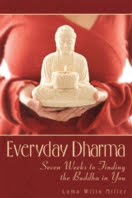
What a bizarre seven weeks this has been! I’ve attempted to be as honest and plain spoken about my experiences as possible, and hopefully at least some of you found my seven week project entertaining if not enlightening. “Everyday Dharma: Seven Weeks to Finding the Buddha in You” by Lama Willa Miller packs a lot of information into seven easily digestible weeks. I admitted to a little rushing on my part, and I would not encourage it for others who may decide to pick up Lama Willa’s book. When everything is said and done, you can easily progress through the book in seven weeks, but to truly learn the lessons can take a lifetime. So do as I say, not as I do if you give it a try. And if some of you guys do give it a try, email me and let me know how it goes!

However, now that my seven week journey is behind me, what did I learn from this that I still carry with me? For your convenience, here’s my list:

One, meditating is hard. Hard, hard, hard. Your body fights sitting still, your mind rushes with memories and thoughts, and it doesn’t get easier quickly. At least in my case. No amount of statues or candles to look at, mental visualizations, or words said aloud make it any easier. At this point I meditate with my eyes open staring at a blank wall, and a good meditation session is five minutes, with the first two being me doing nothing but thinking “in” when I breathe in and “out” when I breathe out, all the while pulling my brain on track. I can’t say that I still meditate daily like I did when I was working my way through the book, but I still manage to make attempts regularly, probably three times a week.

Two, saying things out loud makes me feel dorky. Even when I’m by myself. No matter how beautiful or heart felt the prayer, or whatever is, I feel stupid. First thing I did when I completed this book was to stop saying anything when I attempted to meditate.

Three, people don’t spend enough time thinking about things. At least not the important things. Sure, I think about our finances, our social calendar, etc. and those things seem important, but they really aren’t. They’re parts of the big things, the things we should really think about. Everyday now I try to think about who I want to be and what I want to do and regardless of how small the action is, I try my hardest to do things that support my beliefs. Whether it’s approaching my job with a fresh focus of realizing how many people’s days I make easier by being at the office and doing my job, or taking the time to cook dinner for friends, these two things are important, and by luck, things like that help with the less important parts. If you take a moment to think about it, the ripple of the actions we take go further than we originally thought.

Four, Buddhism is an amazingly approachable and adaptable faith. For all of its seemingly exotic trappings, at it’s core it is very simple. No wonder why I find more and more people who include Buddhism in their spiritual practices!

Five, writing about all of this was WAY harder than I imagined it would be when I decided to give this a go. Seriously. Several times while attempting to write about my week I yearned for the days of unreadable legislation!

There you have it! Before you ask, I have no idea what I’m going to do next. I have a few ideas kicking around that would be educational for me and entertaining for you guys, but much of it depends on my health and these northeastern winters. However, do not despair for there will be more weird adventures on the horizon.

I’d like to take a minute to extend many, many expressions of gratitude to Xochi Adame, publicist extraordinaire for Quest Books, and Lama Willa Miller, an amazingly generous and patient author who put up with 7 weeks of my ramblings. Thank you both so very much! Also, remember that you have the opportunity to and talk with Lama Willa Miller at the September 11, 2010 Magical Buffet of Authors!

Everyday Dharma Challenge: Week Seven

(normal text is Rebecca, italicized text is Lama Willa Miller)

Well here we are Buddhism fans, week seven of my “Everyday Dharma” challenge. This is the final week which covers self-discipline, enthusiasm, and wisdom. So far each week has still been manageable with regards to time you need to devote to it. Writing everything up takes much longer than actually doing any of the exercises from the book. I’m still struggling with the meditation. I’ll be curious to see if I keep trying to do it after I complete this week. Let’s dive in, shall we?

Day one discussed self-discipline, a thing I sorely lack. However, the self-discipline that Lama Willa talks about isn’t making sure you clean the bathroom or take out the garbage every week. This is spiritual self-discipline, which oddly I find less intimidating. Self-discipline with regards to “Everyday Dharma” is “the art of living life within spiritual boundaries.” The boundaries Lama Willa discusses are the Buddha’s ten moral imperatives: practice nonviolence, respect property, be sexually responsible, be honest and direct, speak with kindness, make peace, speak meaningfully, be loving and forgiving in spirit, be generous of heart, keep your perspective in line with truth. When you give any of these any thought, you realize that they’re much harder than they appear at first glance. However, still easier than me cleaning the apartment weekly! The exercise was to pick three moral imperatives to observe the rest of the week. These can be Buddha’s or of your own design. I picked be honest and direct, be loving and forgiving in spirit, be generous of heart. They seem simple enough on paper, much more challenging to do.

Good choices. Moral imperatives are rich ways of working with our daily habits of body and mind. The purpose of working with moral imperatives is not about trying to be perfect, but about developing mindfulness. Mindfulness is a simply a state of paying attention. When we carry around a moral imperative, we begin to become more mindful of our actions, our speech and our internal attitudes. So, for example, Rebecca is working with being more honest and direct. When we carry a vow like that around, we begin to think about our speech. We start to pay attention to the subtleties of what we say, and our reflex habits of responding in conversation. For example, when someone asks me, “How’s it going?”, I may answer “fine” just out of habit, even though I am feeling lousy. By doing this, it may seem as if I am saving the other person the burden of my troubles. But what if I really told him or her that I am having a hard day? It might open up a whole different direction in our conversation. It might help us connect in a more real and straightforward way. Because it feels hard, we don’t always try this kind of openness. But if we don’t try it, we don’t discover what will happen. Honesty is not always easy. But it a deep practice to try to live with honesty. It builds self-discipline internally, and it makes you a more trustworthy friend.

Day two dealt with enthusiasm and how battling laziness and complacency are key to a spiritual practice. The exercise for the day was working with discouragement. You say what you’re discouraged about, then the reasons you’re falling short, and finally you reevaluate these reasons. I will readily admit to being discouraged, unfortunately I find I can’t sum it up as a simple statement of thing. I suspect that many people would agree with me that sometimes things aren’t so easy to define.

This is a good point and I’m glad you brought it up, Rebecca. This can go on the list for things to explore more here if there is ever a second edition! Actually, if there is ever another edition, it will probably not resemble the first one all that much. It is interesting that once you write something, you discover that there is another, completely different book inside you.

Back to discouragement. There’s a certain kind of sluggishness that goes along with discouragement. Perhaps that is why the Buddha classified it as a type of laziness. When we are feeling discouraged, we just feel frozen. It is easy to complain about the external conditions. These conditions are making us feel discouraged. Or our we take the problem on ourselves: We feel inadequate, and that makes us feel discouraged.

But, there is a usefulness to discouragement. We can look at discouragement as a kind of internal constellation in which we temporarily forget the powerful potential of our own will. When we forget our will, it seems as if we cannot change conditions. But if we use the experience of discouragement as a way of remembering, it becomes like a spur. Just by noticing we are feeling discouraged, we take the first step. From noticing comes remembering. What we remember is that we possess will. When we remember the power of will, discouragement spurs us to reconfigure our priorities, think creatively and take action. If we see can see a part of discouragement that spurs, it helps us reclaim our power from external conditions. With that reclaimed power, we can come up with solutions and alternatives, and find a reserve to keep going in the face of difficulties.

Day three was about the important qualities of curiosity, carefulness, and concentration, and how they support enthusiasm. Although Lama Willa discusses these three things, it is concentration that the day was really about. Meditation requires concentration, a thing that I lack. My mind does not like to quiet down and often it feels as if it fights me the whole way. The exercise was practicing meditation while gazing at an object. I have found that meditating with my eyes open has helped prior to now. Adding an object does not make it any easier or harder.

Generally, Tibetan forms of instruction recommend meditation with eyes open. At first, this can seem distracting to some individuals. But after awhile, the mind learns to settle down with a visual field. Open eyes let in light, leaving the mind brighter and more alert. Because you are more alert, dullness does not sneak as easily into your meditation. In addition, the open-eyed gaze mirrors our ordinary, waking experience, so meditation is more easily integrated into life off the cushion. Open eyes lead to open.

Day four was the first of three days dealing with wisdom. “Wisdom,” Lama Willa explains, “in Buddhism, does not refer only to kitchen-table wisdom. It refers to that part of our mind that knows truth – not partial truths, but the whole truth.” It’s difficult to sum up the whole of what she was talking about, but I’ll give it a try. Essentially truth can only be understood through the nondual wisdom in which the knower (you) and the known (truth) become one. You find this in losing yourself, being in the zone. The exercise was to perform a simple repetitive activity and try to become absorbed in it and become one with the activity. This is harder than it sounds!

This exercise is a practice of meditation in motion, or active meditation. Ironically, active meditation is best accomplished when you just let go completely into what you are doing. That means not even trying to be absorbed in your activity. As long as we are trying to be absorbed, that state will avoid us. But you have to start somewhere, so you begin by trying to become absorbed. Eventually, you need to let the activity “do” you.

Day five discussed wisdom as being innate. That’s right folks, right now you are wise. Not a wise ass. Lama Willa explains, “Innate wisdom is more than an idea; it exists within and of you. It is too intimate to be known with mind, because it is the mind, in its quintessential sense. Wisdom is awareness, the bare, naked, aware, conscious nature of mind.” Therefore your wisdom is your awareness. The exercise for the day was to meditate on your essence, your awareness. As per usual, I struggled with my chattering mind. I must be hyper aware! Look at all the nonsense in my head!

You have showed perseverance these past several weeks! Meditation is not even about making thought go away, but about discovering a new relationship to thought. Contrary to how it may seem, mental chattering is a normal and natural experience when you begin meditation. At first, it seems as if the clattering will simply not slow down, and it seems as if it is preventing us from meditating. But if we persist in practice, two extraordinary things happen. I say “extraordinary” because these things really change us on a deep level.

First, over time and with practice, we get more skilled in relaxation. As we learn to relax physically more deeply when we sit down to meditate, our mind begins to relax and let go. As our mind relaxes, our mind’s chatter settles out. It becomes more like a flow, rather than incessant agitation. Still, it does not go away.

Which brings us to the second thing that happens. Thought does not go away, but as we develop a regular practice, we gradually discover that thought and meditation can peacefully co-exist. The mind can be focusing on something—like your breathing for example—and still experience thought, without getting hooked by thought. Even though thought occurs, it does not disturb the focus necessarily. The only thing that becomes disturbing is when we get “caught” by a thought and follow after it. What we discover here is that focus, and the mental tranquility that comes from focusing, can co-exist with thought. In short, it is possible find a reservoir of peacefulness under the waves of the chattering mind and learn to rest there. It seems hard to believe that this could happen when you first start to meditate. That is why persistence is critical.

Day six examined the three qualities of awareness: luminosity (In this case, “it does not mean that awareness is glowing with some kind of physical light. Awareness is simply and naturally a light unto itself. While experiences change, the light-unto-itself quality of the mind does not.), emptiness (“To say that awareness has the quality of emptiness means that, while awareness is luminous, it is not a thing. It has no inherent identity.), and unimpededness (To say awareness is unimpeded means that awareness is without limits or without an edge). The thing that Lama Willa stresses is that awareness is all of these things at the same time. So if what you’re experiencing in your awareness has all three qualities, then you know you’re onto something. The exercise for the day was again meditation looking for these qualities. As you probably expect by now, it did not go so well for me. It did help to have something I’m supposed to think about, but that focus didn’t last.

Keep it up. It takes time for meditation practice to unfold. I hope that in these seven weeks, you have “tasted” your inner Buddha!

Day seven was processing the journey. This day was about reflecting on the past seven weeks. The exercise was essentially to examine what you’ve done, what practices you will continue, what goals to set, etc. Let’s talk about this next week with my big ol’ summary/book review type article, okay? It’s agreed then, see you all next week.

Congratulations Rebecca on completing the course! It has been a wonderful and educational journey for me to be witness to your responses, your persistent practice and your enthusiasm!

About Lama Willa:
Lama Willa Miller is a meditation teacher in the Tibetan Buddhist tradition. She has studied and practiced meditation for the last twenty years, training with Venerable Kalu Rinpoche, Venerable Dilgo Khentse Rinpoche, Lama Norlha Rinpoche, Khenpo Tsultrim Gyatso Rinpoche, Bokar Rinpoche, and other teachers.

She completed two seminary trainings [three-year retreats] at Kagyu Thubten Choling in upstate New York, becoming authorized as a lama, a Buddhist minister, upon completion of her training. Before and after her retreats, she spent time in Nepal, Tibet, and India, studying Buddhism and engaging in service work.

She currently lives in Arlington, MA with her husband and two dogs, where she writes, teaches Tibetan Buddhist practice and meditation, principally with Natural Dharma Fellowship. She is also working towards a PhD at Harvard University.

Lama Willa is author of the book “Everyday Dharma: Seven Weeks to Finding the Buddha in You” (2009, Quest Books), a practical guide for getting started on the spiritual path. Visit her website here.

To follow Lama Willa on Twitter, go to http://twitter.com/lamawilla.

On Facebook? Join the Everyday Dharma Facebook group

Everyday Dharma Challenge: Week Six

(normal text is Rebecca, italicized text is Lama Willa Miller)

It’s that time again! The “Everyday Dharma” challenge is back! This is where I’m sharing my progress of going through the book “Everyday Dharma: Seven Weeks to Finding the Buddha in You” by Lama Willa Miller. Week six was about growing your assets. Padmasambhava, who brought Buddhism to Tibet, developed a list of seven assets that are mastered on the path to awakening. These are trust, contentment, conscience, integrity, self-discipline, enthusiasm, and wisdom. I had the sneaking suspicion that this would not be any easy week!

Day one discussed trust because as Lama Willa says, “Trust is important for the spiritual path in that it is like a key. It opens the mind to possibility for growth and evolution.” There was a focus on trying to have a more open and flexible mind like a child’s. The exercise for the day was to enter into the state of mind that you had as a young child. Now I can get in touch with what I call “my inner 13 year-old” pretty easily, however rolling back to a true childlike state of trust is a bit more challenging. I can feel it in fleeting moments.

At some level, though it might be a deep level, we remember when the world was new to us. There was a time, as children, when we woke up to a world when we did things for the first time: we touched snow for the first time, or went on our first merry-go-round. As time goes on, however, we start to think we have experienced things before, that the world’s newness and novelty has worn off. From the point of view of our day to day experience, this might seem to be true. But it is worth pausing a moment and examining this. This is a perspective that relies on our memories of what we experienced before, but not so much on what we are experiencing now. When we look at things from the point of view of what we are experiencing now, however, we find a new way of being. From the point of view of this moment, things are fresh. We have never experienced this moment before. This moment is fresh, new, alive and completely unique. This very configuration of sounds and sights and feelings is fresh. This moment of touching snow, for example, is like touching it for the first time. Tibetan Buddhist teachings have a word for this. The word is “soma”, which means fresh and new. When we experience the world through the lens of “soma”, nothing is boring or old. The deeper truth is that the world is still new to us. When we get in touch with the wide-eyed openness we had as a child, we are actually more in touch with truth.

Day two was about how to trust wisely. This was about people and things are provisionally trustworthy and ultimately trustworthy. Anyone or thing that helps you on your spiritual path is trustworthy, however due to the impermanent and fluid nature of everything, these are only provisionally trustworthy. However wisdom-nature, yours and others, are ultimately trustworthy because wisdom-nature never departs. Lama Willa also explains the three developmental stages of trust that the Buddha taught: intuition, confidence, and certainty. The exercise for the day was to consider the things you can trust provisionally and ultimately in your own life.

I think it is important for us, as human beings to find a place of refuge in our lives. We need to feel safe and secure to flourish, to live up to our full potential. Unfortunately, we often take refuge in the wrong things, giving our heart and soul away to something unreliable and ephemeral, such as an addiction, money or an individual. Wise trust is an attitude the recognizes that our deepest place of trust is not in the ephemeral and changing world or in any one individual, but in our internal, unchanging wisdom-nature, or Buddha-nature. This is place of refuge that is deep and reliable, even when the world is going to pieces around us.

Because other people also have this wisdom-nature, we have good reason to trust them. But we also need to be wise about that trust, and not invest our heart and soul blindly. Confident relationships are based on a realistic point of view that takes things slowly. We have to know what and who we are trusting, even while looking beneath the surface to recognize their deeper nature, the one that mirrors our own.

Day three examined contentment. Lama Willa explains that “contentment in Tibetan is chok shepa, literally ‘knowing enough’. It means being satisfied with whatever you have, knowing that you do not need that new car, that big house, that person to make yourself content. Spiritual contentment implies being carefree, unattached, and unencumbered.” To achieve this Lama Willa discusses the practice called “equal taste”, which is working to realize that although suffering and happiness appear different; their core is a single taste, a single essence that transcends difference. The exercise for the day was to examine times when you’re happy or sad and look beyond the feeling to the core of the experiencer. This one really stumped me. I mean, I suppose when I’m happy I’m me, and when I’m sad I’m still me. So I am the same person regardless of the emotion I’m experiencing. However, I find happy and sad to be too far apart from each other to find an “equal taste”.

Don’t give up! Keep probing the question. When you are happy, try turning your mind inwards and asking “who is experiencing this state of happiness?” In other words, try to “see” the experiencer directly. When you are in a sad mood, try the same thing. You cannot think your way to an answer here. This is an intuitive exercise, not an analytical one. You actually have to try to catch the “I” that is experiencing pleasure or pain directly in the moment by looking inwards. The point is not to see the relative, constructed self [that person who is made up of our name, our age, our identity] but instead to see the experiencer of the emotion of happiness or the emotion of suffering right in the raw moment. We are not looking at the emotion, but looking at the experiencer of the emotion, so it does not matter how far apart the states of emotion are. The experiencer is still there. It is this mysterious “I” that we are looking at.

Day four was about appreciation helping cut through discontent. When you are discontented Lama Willa offers two methods to help. The first method is the path of analysis. Instead of obsessing over what you are not content with, ask yourself if you can do anything to change the situation for the better. If the answer is yes, there is no point in obsessing about it. If the answer is no, there is no point in obsessing about it because there is nothing you can do to change the situation. The second method is to interrupt your inner dialogue and think about the things you may normally overlook, but cherish in your life. Lama Willa says, “If you have to obsess, appreciate obsessively.” The exercise for the day was to consider the things you appreciate and think about what your life would be like without these things. This will help fill you with appreciation. From my experience, it works. Although I’m a worrier by nature, so it’s sometimes tough to derail my mind.

There is so much in every person’s life to be grateful for. Tangible things like food and clothing, and intangible things such as little daily interactions and coming home to our family. I was recently reading an article by some psychologists on gratitude. These researchers have found evidence that people who are grateful for their life, their friends and their family tend to also be (measureably!) happier and healthier.

Day five dealt with your conscience. According to Lama Willa, “Conscience, as a spiritual asset, is a moral radar that intuits right and wrong. Since a spiritual journey is focused on serving humanity, intuiting right and wrong comes down to intuiting help and harm.” Essentially we’re here to help and serve our fellow man; if we can’t help we should at least focus on not causing harm. We should endeavor to develop a spiritual gentleness. The exercise for the day is to identify your hard social edges, the mental, verbal, and physical patterns that put a wall between yourself and others. You’re then supposed to envision yourself softening and imagining an encounter where you let go of that habit. This is actually very complex for me. I suspect that my sarcasm could be said is something that creates hard edges and potentially builds walls, however, I think that most people who know me would argue that this is not the case. I certainly don’t think I use sarcasm in that way.

I think of a sense of humor as being a generally flexible and intuitive quality. But I suppose, as in the case of sarcasm and satire, it might be “edgy” as well. For the most part, we can rely on our internal feelings for this exercise. In Day 5, we pay attention to those moments when we feel rigid and tight inside. When we feel rigid and tight, that is sometimes an indicator of something in us that is blocked and not flowing easily. At these moments, our “hard edges” reveal themselves to us. When we act and speak at those moments, we sometimes inadvertently shut people out or shut them down. I notice this kind of rigid energy in myself sometimes when I feel anticipatory, such as before speaking in front of a group. Or when we are challenged by a situation or person, this rigid resistance comes up in the mind. The practice of “softening”, as taught by Atisha, is helpful to dissolve our rigid ways of acting, speaking and thinking. In this exercise we change our energy from rigid and fearful to receptive, compassionate and responsive. It takes self-awareness cultivated on a daily basis to begin to identify the rigid mind creeping up, and to replace it with a softer more spacious mind-frame.

Day six was about your spiritual integrity. “Spiritual integrity is the quality of being that prioritizes the transference of dreams into reality, the quality of being that does not settle for less than becoming transparent, honest, and whole now, or at least in the near future,” writes Lama Willa. She doesn’t tell you to radically overhaul your life all at once, but instead to make small changes and take small risks to help you live your life in harmony with the intentions and aspirations that you value most. The exercise was to reflect on if your life reflects the values that you hold most dearly. You’re then to decide on one small risk you’re willing to take this week to help bring your life more in line with your aspirations and intentions. I’ll be honest with all of you, I couldn’t figure out a small risk to take. I don’t feel like I’m living my life absolutely fully to my ideals, but apparently I’m close enough that I can’t think of anything small to try right now.

For me, the small risks sometimes come not in the form of doing, but rather of undoing. Many of us (especially those of us with a “yes” that leaps out of our mouths, seemingly with a mind of its own) can have a tendency to take on too much. It can feel risky to let go of that extra something that is taking our energy and focus away the core commitments of our life. For that kind of person, taking small risks can be just saying “no” sometimes, cutting down on the quantity of our activities, and focusing more on doing some deeply meaningful and fulfilling activities well, rather than many things poorly.

Day seven explored self-inquiry. Lama Willa states that “asking the question (who am I?) is an essential Buddhist practice because, no matter how good we are at philosophical speculation, we all live, breathe, act, speak, and function as if we believed in the existence of a self. That would not be so terrible, except that clinging to the notion of self causes our greatest sufferings and is the single biggest hindrance to developing universal love. It is the barrier that keeps us from recognizing out interdependence with the rest of humanity.” Repeatedly asking yourself, who am I, while in meditation is one of the best ways loosen your habit of grasping at your character traits, body and thoughts as if they were a solid self. You see your selflessness. The exercise for the day was to meditate and then abruptly ask yourself who is meditating. I must just not be there yet, because this did nothing but make me feel self-conscious and awkward. Maybe with time….

Yes, this takes time. Sometimes following along with a guided meditation makes the meditation of self-inquiry easier. Here’s a link to this meditation [and others from the book] on is iTunes!

This week has certainly given me a lot to reflect on! Stay tuned for the last week!

See you next week, Rebecca!

About Lama Willa:
Lama Willa Miller is a meditation teacher in the Tibetan Buddhist tradition. She has studied and practiced meditation for the last twenty years, training with Venerable Kalu Rinpoche, Venerable Dilgo Khentse Rinpoche, Lama Norlha Rinpoche, Khenpo Tsultrim Gyatso Rinpoche, Bokar Rinpoche, and other teachers.

She completed two seminary trainings [three-year retreats] at Kagyu Thubten Choling in upstate New York, becoming authorized as a lama, a Buddhist minister, upon completion of her training. Before and after her retreats, she spent time in Nepal, Tibet, and India, studying Buddhism and engaging in service work.

She currently lives in Arlington, MA with her husband and two dogs, where she writes, teaches Tibetan Buddhist practice and meditation, principally with Natural Dharma Fellowship. She is also working towards a PhD at Harvard University.

Lama Willa is author of the book “Everyday Dharma: Seven Weeks to Finding the Buddha in You” (2009, Quest Books), a practical guide for getting started on the spiritual path. Visit her website here.

To follow Lama Willa on Twitter, go to http://twitter.com/lamawilla.

On Facebook? Join the Everyday Dharma Facebook group.

Everyday Dharma Challenge: Week Five

(normal text is Rebecca, italicized text is Lama Willa Miller)

Hello again friends! Here we are at week five of my “Everyday Dharma” challenge. Only weeks away from finding my inner Buddha! Consider yourself warned! If you have no clue what I’m talking about, go back to the introduction.

Day one was “Begin with Action”. Instead of feeling overwhelmed by goals, or putting things on hold until you get your act together, Lama Willa encourages you to take action immediately. Every day you can take small actions that help you take a small step towards putting your aspirations and intentions into action. The exercise for the day was to take a moment a few times a day to check in with your actions and consider what kind of future you’re creating with them. What kind of karma you’re creating. I tried this and at first thought how pointless most of my actions during the average day feel. However, with a little more thought I realized that almost every action, regardless of how mundane, does in fact touch people’s lives. Doing the dishes let’s my husband get more rest while he’s sick. Doing my paperwork at the office promptly and accurately allows others to do their jobs better. Even spending time reading an online blog matters, it encourages the people who create it to continue with their endeavor. There are truly thousands of times a day that my seemingly mundane actions help and encourage others.

That’s true. What we do always matters. Lately, I have been thinking about another angle on this, inspired by an ancient Mahayana Buddhist practice. In this practice, you make daily actions into prayer. We usually dismiss our small, everyday activities as insignificant. But it does not have to be this way. We can make every action count. When we eat, we can think “May this food satisfy all hungry beings”. When we sing, “May this melody bring harmony to the hearts of all beings.” When we drive, “May all beings travel the road to enlightenment.” When we watch a movie, “May all beings experience the joy of losing the self.” The possibilities here are endless. This is a way to join our actions with our aspiration to be of service to the wider world. This is a way to bring every little moment onto the path to awakening. An action done with neutrality is a ‘sleeping action’ and an action done with intention and mindfulness is an ‘awake action’. There’s a big difference. Awake actions help make our life more full and meaningful. They make our life into prayer.

Day two discussed becoming “other-centered”. Many people, and I definitely include myself here, are focused on their selves. What do I want? What do I need? This day Lama Willa explains the importance of shifting our perspective to focus on others, and their needs and desires. To put yourself in another person’s place. The exercise for the day is the next time you get irritated by someone else’s actions ask yourself “How does the person with whom I am now irritated experience this moment?” People, as I love to say, are people. How do they experience the moment? They think I’m an obnoxious irritating person, much the way I feel about them at that moment. Humans are fantastic creatures that way.

Thinking about how other people experience the moment is a wonderful exercise in getting outside of ourselves. When we are wrapped up in ourselves, we miss so much, and we give into our own reactivity. If we care only about our own perspective, for example, we think irritation is justified. But in truth, irritation is just a reactive habit. Irritation tells us much more about ourselves than it does about the other person! We can either go along as we have, reacting, becoming irritated, and being unhappy, or we can begin to shake ourselves out of the narrow focus on ‘me’ and ‘my wants’ to ‘the other’ and ‘her/his wants’. It is much more interesting to think about the perspective of the other, and more liberating. But because we have not trained much in the past to do this, we need to make considerable effort in that direction. Shifting the center from self to other takes effort, especially in the beginning.

Day three dealt with generosity and sacrifice. Lama Willa explains that “in the Buddhist context, generosity – the attitude and actions of giving – is the very first quality a seeker on the path works to perfect.” She says that “sacrifice implies both exchange and purpose,” and stresses the importance of making an empathetic sacrifice as opposed to an ambivalent one. I’ll admit, all this talk about sacrifice had me a little concerned about what the exercise for the day would be. Turns out it was a simple exercise that Lama Willa calls the “smiling experiment”. You make a conscious effort to smile at the people you interact with and cross paths with while making an inner wish for their well-being. I found it surprising how often even when I smiled I wasn’t giving it my full attention. Smiling is harder than you would suspect!

It has been shown in psychological studies that the act of smiling at someone makes us happier. Therefore, we don’t always have to wait until we are happy to smile!

Day four discussed the many ways to give. Yup, more giving, are we all seeing a trend here? Lama Willa explains the different ways you can give: material giving (I suspect we can all figure that one out), giving protection (Relax, she’s not asking you to become a vigilante. Protection, in this context, is helping someone feel safe or helping them become safe. Not necessarily running around looking for a gun man to get in front of.), giving ease and comfort (You know, like giving a friend a hug when they need it.), and offering encouragement (Which again, I assume we can all figure that one out.) The exercise for the day was offering encouragement to someone striving to accomplish something. I’m actually not too shabby at this one.

You got it. Giving—or I am also calling it magnanimity here– is the theme of this chapter. On the bodhisattva path, generosity is the very first and most basic step to enlightenment. Why is that? It has something to do with the power of generosity to remedy desire and grasping. Why do we care about getting rid of alleviating grasping? For one, grasping interferes with our experience of natural ease. We are predisposed to want what we don’t have. It is probably somewhat instinctual. But it is also the root of our suffering in so many ways. The more we grasp after something, the more it seems to slip through our fingers. We are left only with an uncomfortable feeling of neediness. Our biggest mistake is that we think this feeling of neediness comes about because we didn’t get the thing we wanted. This is a conventional perspective, but it is not a true perspective. The truth is our neediness predates the ‘not getting’. We are predisposed to feel as if we don’t have enough. That is why people who have everything material they could wish for are often not happy. Until we loosen the grip that neediness has on our minds, we cannot become truly at ease. This brings us to the second way that desire and grasping gets in our way on the spiritual path: it keeps us from developing true empathy. If we are not at ease because we are feeling needy, we stay rooted in place of self-centeredness. When we are self-centered, it is difficult for us to imaginatively place ourselves in another’s shoes, the root of empathy.

So methods that shake us out of the grasping mind put us in a state of relaxation. They are powerful methods that have repercussions in our immediate environment. Generosity is one of those methods. It naturally remedies our mental habit of grasping. Just by giving of our selves—our time, our resources, our attention– we undermine this deep-rooted belief that we somehow do not have enough, and suddenly we feel more at ease. What a paradox that by giving, we feel wealthier and happier!

Day five was about paying attention. Lama Willa says that “the act of being attentive is a form of ‘paying’ our presence forward. When we are simply and directly attentive to another person – to their interests, their needs, their dreams, or merely to their presence – we offer them something lasting and deeply significant.” She highlights more ways to give: sharing knowledge, helping the sick, repaying kindness, offering assistance, listening, and giving victory to others. The exercise for the day was to consider all the ways of giving that have been covered these past few days and decide on your target mode of giving. It should be one you think will be difficult for you. Then look for the opportunity to try it out. I’m guessing helping the sick or giving victory to others would be the hardest for me, however I haven’t had the opportunity to try it out.

Giving victory to others is on my list too. I have always found giving victory to others to be a most challenging—and subtle— practice. It is so counter-intuitive. I remember when I first started to try this as practice, it was big surprise that it was so helpful, psychologically and emotionally speaking. We grow up believing that we should not give victory to others. Rather, it is much better to come out on top. We take this belief right into our subtlest ways of interacting, speaking and thinking. This brings us a lot of invisible trouble and suffering. If we always want to come out on top, where does that leave other people? The more you examine your subtle attitudes about being on top and winning, the more you notice that you unconsciously—or perhaps sometimes consciously– put others down, simply out of a habit of wanting to be smarter, wiser or ‘better’ than they are. In order to give victory to others, you have to reverse this attitude and wish them to come out on top. When you really practice this, it is remarkable. Conflicts are easily resolved, and people begin to really trust you, because you are no longer always rooting for yourself: you are rooting for others. But it requires a brutal sense of self-honesty to make this practice really work for you. You have to be willing to go into the shadows.

Day six talked about trying to “move from haphazard giving to conscious and purposeful giving” by following the Five Steps of Giving. One, look for a need or an opportunity. Two, Plan. Three, Give. Four, do not expect thanks. Five, rejoice and dedicate (Dedicate here means to “mentally dedicate your action of giving to the fulfillment of your spiritual journey.).” You guessed it; the exercise for the day is to follow the Five Steps of Giving. I can’t claim I found momentous needs to help fill, but I did try to think about the work I did at the office. To remember how everything I do makes all the other employees’ lives easier. I’ve been enjoying my job much more since starting this book.

Yay! This is gratifying to read. The signs of success in spiritual practice are not necessarily dramatic and soaring moments of benevolence or wisdom. The deep signs are in everyday moments: real awakening unfolds as our everyday experience becomes more meaningful and we become more grounded in love and wisdom.

Day seven discussed spiritual sacrifice. It’s about building compassion through the “Contemplation on Giving and Receiving”. And yes you clever readers, the exercise for the day was the “Contemplation on Giving and Receiving”. You start with The Three Arrivals, then say your Awakening Prayer, relax and breathe. You then visualize someone you know who is currently suffering from illness, mental anguish, or other difficulties. Consider what it must be like to be that person and develop the heartfelt wish to relieve this person of suffering. Engage in pulling in pain as your breathe in and sending out love when you breathe out for at least ten breaths. Here’s the deal folks, anytime I need to speak out loud it ruins it for me. What should be a contemplative endeavor becomes awkward when I’m supposed to recite things out loud. Same thing happens with I attempt magical practices. If I talk out loud, I immediately feel stupid. This exercise became much more effective when I quit saying my Awakening Prayer out loud. The universe can hear my thoughts, right?

I’m glad you have adapted this practice to make it work for you! Yes, silent prayers are heard. I’m glad you brought this up. This goes for all the practices in this book: adaptation and flexibility is a virtue.

And with that, it’s onto week six! Almost there! See you next week!

About Lama Willa:
Lama Willa Miller is a meditation teacher in the Tibetan Buddhist tradition. She has studied and practiced meditation for the last twenty years, training with Venerable Kalu Rinpoche, Venerable Dilgo Khentse Rinpoche, Lama Norlha Rinpoche, Khenpo Tsultrim Gyatso Rinpoche, Bokar Rinpoche, and other teachers.

She completed two seminary trainings [three-year retreats] at Kagyu Thubten Choling in upstate New York, becoming authorized as a lama, a Buddhist minister, upon completion of her training. Before and after her retreats, she spent time in Nepal, Tibet, and India, studying Buddhism and engaging in service work.

She currently lives in Arlington, MA with her husband and two dogs, where she writes, teaches Tibetan Buddhist practice and meditation, principally with Natural Dharma Fellowship. She is also working towards a PhD at Harvard University.

Lama Willa is author of the book “Everyday Dharma: Seven Weeks to Finding the Buddha in You” (2009, Quest Books), a practical guide for getting started on the spiritual path. Visit her website here.

To follow Lama Willa on Twitter, go to http://twitter.com/lamawilla.

On Facebook? Join the Everyday Dharma Facebook group.

Everyday Dharma Challenge: Week Four

(normal text is Rebecca, italicized text is Lama Willa Miller)

Here we are at week four of my “Everyday Dharma” challenge. For those of you just tuning in, check out my previous posts to get caught up. I’m at the halfway point! I hope you’re all finding my journey amusing and enlightening. I’ll admit, it’s a lot harder to bring the funny when discussing this stuff than I thought it would be when I set out. Sorry folks! On the other hand, I’m halfway to getting my Buddha on! Let’s focus on the positives. With no further ado, let’s look at week four.

This whole week was about growing love. As Lama Willa says, “A spiritual journey takes courage and vision at the outset, but to sustain such courage and vision you need fuel: a love that is correspondingly courageous and visionary.” With day one we considered love. The exercise was to find out what love means to you. You finished the following sentences, what was in the text is in bold.

Love is (list some adjectives) exhilarating, liberating, and compassionate.
Love is never needlessly cruel.
I find it easy to love my husband.
My definition of love is that love is a thing that allows you to be your authentic self.

I like your definition! Why is thinking about how we define love useful? For one, we carry around, and therefore act on, definitions that we rarely evaluate. Assumptions about love, and other aspects of our affective life, often remain hidden from us. Many of these definitions are cultural, and some may be related to our personal history. We rarely bring these to light and then as: is this assumption useful? Is it even true? When we figure out how we define love, we can begin think about whether the assumptions therein are useful and true.

Once we have some definitions to work with, we can begin to think about how we might redefine love consciously in a way that is true, and that is useful. We can explore a deep definition of love that we feel great about living by. Another reason to think through our definitions is to discover the vision of universal love’s fruition, such as the qualities you mention– exhilarating, liberating, compassionate. If we look at what we mean by ‘love’, we often find something liberating there, but we may not have worked hard to cultivate love’s liberating power. Spiritual practice should help us grow love in order to unfurl its ability to free us from suffering.

Day two discussed two myths about love. Lama Willa explains that “you cannot effectively accept and love others unless you initially accept and love yourself”. The first myth was that you do not deserve to be loved, when the truth is everyone is worthy of love. The second myth was that no one ever really loved me or loves me now, when the truth is that you have been loved in the past and are loved now. The exercise for the day was to identify benefactors. In this context a benefactor is someone who has loved and cared for you. That one is easy, my husband.

Benefactors can be found in the most unexpected places. Even a pet can be a benefactor. If you have felt loved by someone or even an animal, just once, they are a benefactor for you and have reminded you that you are loved. Pets do a great job of ‘benefacting’ non-verbally! (Was that a neologism?) The term ‘benefactor’, used in this sense is inspired by some of the practices developed by American Buddhist teacher John Makrasnky. He does a great job of discussing benefactors thoroughly in his book Awakening through Love.

Day three addressed two more myths about love. Myth one was that love is something that “happens” to people, the truth is that love needs to be cultivated. When I first read this I was ready to call B.S. I mean, my love for my husband just “happened”. However, further reading has Lama Willa explaining that “love is a choice that sometimes happens to people. Even when it “happens” to someone, it will quickly “unhappen” without cultivation.” And she’s right, my love for my husband just happened, but what if we had never carved out time to spend together when I worked my crazy retail schedules, what if we didn’t take the time now to let each know that they mattered? I suspect Lama Willa is right, our love would potentially “unhappen”. Myth two was that you say to yourself, “I gave everything I had to him/her/it and now I have nothing left to give,” when the truth is that no matter what your personal history, you are capable of love. The exercise for the day was to forgive small harms. You attempt to make a commitment to forgive a person who made you feel harmed, angry, and/or hurt. Since I try to keep The Magical Buffet a positive place, and the fact that anyone anywhere can read this, I’m not going to share with you all who I’m attempting to forgive. I’m a woman, I have a laundry list of people, who as Kathy Griffin would say, can suck it. I’ve picked a few who I will endeavor to take a little less of a Kathy Griffin philosophy with.

Forgiveness is one of the most powerful spiritual practices around, and Buddhism is deeply concerned with its cultivation [touché, Brit Hume!]. Buddhism teaches that forbearance—or patience—is an essential key to enlightened living. Forbearance includes the practice of being tolerant and forgiving in the face of harm. Forgiving runs contrary to much of our cultural conditioning: we are taught that by putting other people down [especially those that have—in our view—harmed us], we become stronger. But the opposite is the case. By forgiving, we become stronger. Many of us also are inclined to believe that those who forgive are weak. But that is not true, because forgiving is not easy. Anyone can hold onto a grudge. It takes a strong person to forgive.

But being forgiving does not mean tolerating the continuation of harm. There is real injustice in the world, real falsity, and real cruelty, and wherever injustice, falsity and cruelty exist, they need to be addressed and challenged. But anger and spite may not be the most stable place from which to challenge the world’s injustices. Forbearance, an attitude that includes an element of forgiveness, is a more stable ground to start from. Forbearance is not an attitude ‘what this person did is okay’. It is rather the recognition that people are not merely what they do. They act under the influence of a lifetime of conditioning. Forbearance also means entertaining the possibility that our own reactivity plays a big role in ‘harm’. Therefore, it is usually not enough to blame a person for harm—the picture is much more complex than that. If you acknowledge such a possibility, you create a space where challenge and arriving at justice can take place effectively.

Day four discussed universal love. Lama Willa examines universal love by outlining it’s qualities: universal love melts boundaries, universal love evens terrain, and universal love tears up contracts. The exercise for the day was assessing boundaries. I’m going excerpt the whole exercise here because honestly, the exercise really puts things into perspective.

“Consider: What kind of boundaries do you place around your feelings? Are there people whom you do not love because of what they do or have done? What kind of “ifs” do you put on love? Now consider, is it possible to love someone with no “ifs”? Consider whether it is possible to love without agreeing with or condoning another’s actions. Are there any valid reasons to withhold love?

Now think of one person from whom you withhold the feeling of love, not entirely but somewhat. Can you imagine what it would be like to push your boundary out with this person and let yourself feel a love with fewer conditions, at least sometimes? Visualize for yourself what this would be like. What do you gain by withholding love? What do you lose by giving it?”

Again, I’m not going to share with you the individuals I’m thinking of, but I will tell you that the exercise did resonate with me. If you think I’m being nicer to you, it’s totally a coincidence….I would never think of you that way.

I have found it to be life-changing practice to push my boundaries around love (always understood here to be platonic!). This can be done in the simplest of ways, by noticing how we approach people every day, especially those who we don’t necessarily cherish. What would happen if we tried to be a little warmer, and a little kinder? This kind of constant attention to our attitude pays off, because we discover that it actually feels really good to be kind. It is much more enjoyable than being cold or neutral. We can work on this in so many small ways.

Day five continued examining the idea of universal love. Universal love is nonjudgmental, selfless, compassionate, and joyous. The exercise for the day was to contemplate overcoming the judging mind. “Consider: In what ways does judgment get in the way of loving those closest to you? Is your love clouded by judgment? What is worse, the tendency to find fault in others or the faults you judge others to have?” I know that I judge people, but I am definitely more harsh in judging myself. Does that make me slightly more enlightened than those who judge others but find no fault in themselves? Here’s hoping!

I’m glad you brought up self-judgment. I did not address that in this section of the book, but self-judgment is also something to work on. In fact, if we are harsh on ourselves, we tend to be harsh on others too. These two are of a piece. When you begin to soften your judgment of others, you discover that others—even those people we have not previously considered special– are very precious and special in many ways. We cannot discover that special treasure in others if we put all of our energy into judging them. Once we begin to discover the preciousness of others, we can entertain the idea that we too are precious. It can go the other way as well: we can also work on letting go of self judgment, and use that as a door to letting go of our judgment of others.

Day six discussed four ways of perceiving others. Every person is your only child. Every person is your parent. Every person is your best friend. Everyone is a sage. Essentially the exercise for the day was to try and view your social interactions with this new angle of perception to attempt to widen the scope of love to include more people.

In the context of Buddhist doctrine, this practice is sometimes expressed within the context of reincarnation. From the point of view of reincarnation, this is not the first or only life we have lived. When we meet someone, we are never meeting them for the first time. We have met many times before, over the course of many lives. From this wider perspective of many lifetimes, people around us have literally been our mothers, fathers, sisters, best friends, teachers and helpers before. From that point of view, they are not strangers, so we should not treat them that way. We should reserve a place in our heart for all of them.

Even if you do not believe in reincarnation, it can be a helpful exercise to imagine the web of relationships that connects all of us in this life. From the point of view of being connected to everyone through degrees of closeness [I prefer that to degrees of separation], we are all of one human family.

Day seven was “Growing Your Love through Contemplation”. The text for the day was basically detailing the meditation that was the exercise for the day. To sum it up, you focus on someone you love, so that you can feel the love, and then let the feeling grow and radiate out of you. Now I was honest about my difficulties with meditation, well it’s worse when I’m supposed to follow a progression of things. It’s much easier for me to think in, out, with my breath than to go through a whole mental script. However, I made my best attempt here.

It can take many repetitions [perhaps 20 times] sitting down with a practice to memorize it and become really relaxed with it, without needing to rely on instructions. It is worth the effort. The key is to take a considerable time to do each step, really relaxing into each instruction for a few minutes so that you can get its flavor and meaning. For those readers out there encountering these meditation practices for the first time, guided meditations for the book are on iTunes! It can help to have a voice guiding you through these meditations at first because then you do not have to keep glancing at the book.

Week four, done! See you next week!

Congrats on finishing Week 4: You are more than half-way!

About Lama Willa:
Lama Willa Miller is a meditation teacher in the Tibetan Buddhist tradition. She has studied and practiced meditation for the last twenty years, training with Venerable Kalu Rinpoche, Venerable Dilgo Khentse Rinpoche, Lama Norlha Rinpoche, Khenpo Tsultrim Gyatso Rinpoche, Bokar Rinpoche, and other teachers.

She completed two seminary trainings [three-year retreats] at Kagyu Thubten Choling in upstate New York, becoming authorized as a lama, a Buddhist minister, upon completion of her training. Before and after her retreats, she spent time in Nepal, Tibet, and India, studying Buddhism and engaging in service work.

She currently lives in Arlington, MA with her husband and two dogs, where she writes, teaches Tibetan Buddhist practice and meditation, principally with Natural Dharma Fellowship. She is also working towards a PhD at Harvard University.

Lama Willa is author of the book “Everyday Dharma: Seven Weeks to Finding the Buddha in You” (2009, Quest Books), a practical guide for getting started on the spiritual path. Visit her website here.

To follow Lama Willa on Twitter, go to http://twitter.com/lamawilla.

On Facebook? Join the Everyday Dharma Facebook group.

Everyday Dharma Challenge: Week Three

(normal text is Rebecca, italicized text is Lama Willa Miller)

Here we are at week three of my “Everyday Dharma” challenge! I’m going to be honest with you, due to some health issues I did fall behind and did some bulk catching up. It’s not right, but it’s okay. Since I’m on a schedule I felt obliged to do it that way, but for the reader at home who may decide to work through this book (perhaps based on what they’ve been reading here) take your time. It really is easy to budget in the time for “Everyday Dharma”, just not so much when you lose days at a time to doctors. With that out of the way, let’s start at day one.

I hope you are feeling better, Rebecca!

Day one was “Finding a Place of Refuge”. This one was pretty straight forward. Everyone needs a place of peace in their home for relaxation, contemplation, and meditation. Prior to starting this, that place had been in our “guest” room. I apply the air quotes because as anyone who has lived in an apartment knows, a “guest” room is really a storage room that on a good day has space for a guest. These days it is truly a dumping ground, making it less than optimal for my already precarious meditation habit. After some thought I’ve decided to use my bedroom, that way I can always close the door to hide away from the temptation of “Family Guy” or “NCIS” reruns that inevitably sidetrack me in the living room.

Sounds good. I’m familiar with that “guest room”! We have one of those in our house. It houses my husband’s guitar collection, the big blue exercise ball, miscellany that will not fit elsewhere.

There is something empowering about developing a relationship with a place where we meditate or practice. We can make a meditation place in any room, but a clean and uncluttered space helps us keep our minds uncluttered when we meditate. When we begin to associate that place with meditation, it can become a kind of oasis in our own home. That being said, there’s an old Tibetan saying, “Wherever ‘here’ is—that’s the right place to meditate. Wherever ‘now’ is—that’s the right time to meditate”. Our external meditation spot is a symbol for the internal (potential) mediation spot we carry around all the time.

Day two was again, fairly straightforward. It’s “Adorning Your Space”. This was essentially “Pimp My Sacred Space”. Unfortunately, for those who liked the show “Pimp My Ride”, and fortunately for those serious about starting a meditation practice, instead of hydraulics and racing stripes you’re picking out a seat and setting up a shrine. The task for the day was to find something to sit on while in your sacred space, that would be a floor cushion in my bedroom, and to start creating your shrine. After some thought, I’ve decided to use the Hope Chest at the foot of my bed as my shrine. I leave the top empty except for my favorite Kwan Yin statue.

“Pimp my Sacred Space”. That’s clever! Spaces we arrange and adorn are powerful. They work on us, even when we are not conscious of it. For me, over time, the shrine has become more and more important as a powerful space. We now devote a room in our house to our shrine and meditation needs. We call it the shrine-room, and it is right down the hall from the ‘guest room’. The shrine itself is an old walnut cabinet bought on Craigslist. On its surface are pictures of benefactors and spiritual guides, symbolic offerings in silver bowls: rice, food, flowers, incense, a conch shell and water. Giving credit where it is due, my husband is the diligent maintainer of the shrine, and I am the lazy enjoyer of it. He dusts it, polishes the bowls, refreshes the water often, and also brews tea to offer several days of the week. Over the top of the shrine is a large thanka (a Tibetan painting, oil on cloth), of Vajrayogini, a Tibetan archetype (or deity) who inspires my meditation practice. In front of the shrine is a long table for spiritual books, my mala (an Asian rosary), and other useful items.

For 20 years or so I’ve been ‘detailing’ and ‘re-detailing’ my shrine. It has taken on various forms. The 1985 model was pretty simple—a picture, a candle, some incense. By 1992, it had morphed into considerable complexity: lots of objects and statues, dozens of picture, rocks, holy thises and thats. The 2010 model is leaning back towards simplicity. Keeping things simple seems to be more in line with where I am in my practice. I think most shrines have a history. They are an ongoing expression of the people around them.

To conclude, I believe a shrine—even when it is very simple— can be powerful. A shrine is powerful in a number of ways. It is a physical expression of what we are committed to and what we aspire to at a given time in life. As a physical expression, it reminds, invokes, and encourages. When we go through phases in our life– when it is difficult to show up “on the cushion” every day, difficult to meditate and difficult to pray– the shrine is still there as a reminder that we value inner development and freedom. It stands there, silently communicating to us the ideals of love, compassion, faith, forgiveness and wisdom even when we feel as if we cannot embody those ideals ourselves, even when our lives are hectic, even when things are upside down.

Day three dealt with offerings. Lama Willa explains that “In effect, offering is an act of honoring.” The exercise for the day is to make an offering to the representations on your shrine (with examples such as candles, flowers, or a bowl of clear water). I opt for a lighting a candle. Then you practice the Three Arrivals, back from week one, and recite your Awakening Prayer, from week two.

Yes, the practice of making offerings is an act of honoring. What does it mean ‘to honor’? I like the definition of ‘to honor’ as ‘to pay attention with respect’. When we pay attention to a symbol or set of symbols (like those arranged on a shrine) with respect, we reconnect with what those symbols represent, qualities like strength, compassion, wisdom, grace and so forth or truths like the truth of our inner wisdom nature, or ‘buddha nature’. In short, offering is a way of making, on a regular basis, a connection with qualities and truths. When we physically do something in the presence of the symbols on our shrine– like light a candle for example—we are expressing with the body a deep heartfelt respect for what is most valuable and true.

Day four was finishing up your creation. This was where you added things to personalize your shrine. Things that inspire, uplift, etc. I decided to set my copies of “An Introduction to Zen Buddhism” by D.T. Suzuki and “Zen Flesh, Zen Bones” compiled by Paul Reps and Nyogen Senzaki on my shrine to read for inspiration.

Trick it out, girl!

Day five was “Plumbing the Wisdom Nature through Introspection”. Lama Willa discusses how “introspective practices that deepen wisdom and love are helped by taking an interlude of seclusion, silence, and mental solitude.” You guessed it, the exercise for the day was to practice seclusion, silence, and solitude. I had no problem secluding myself away, or being silent, and I’m comfortable by myself in this state, but I readily admit that my mind had a lot of trouble quieting down. Every time it wandered, which was frequently, I would take a cleansing breath and try to silence it. My brain has a mind of its own!

Our challenge in meditation is not to rid the mind of thought, but rather to avoid getting hooked by thought. Thought is inevitable; getting hooked by thought not. We can learn to observe thought coalescing and dissipating, without getting too involved in it. By doing this, we eventually discover we are standing in space. Rather, we are the space in which thoughts unfold. We are a profound, selfless, vast space. When I say “we”, I don’t mean the conventional self; I mean the ultimate self, the Buddha-self, or as I call it in the book, the wisdom-nature. That profound, selfless, vast space—the wisdom nature– is not harmed, afflicted or bothered by any thought. It welcomes thought as an expression of itself.

Day six discussed breath meditation. Essentially, to help calm and clear your mind, you should focus on your breath as you meditate. When your mind wanders, you just refocus on your breath again. The exercise was to practice the Three Arrivals, recite your awakening prayer, and then meditate for five to ten minutes. I can’t claim that I had rousing success at this, but I did manage to stay put for five minutes, refocusing on my breath….a lot.

There’s no such thing as ‘unsuccessful’ meditation. Sometimes it is hard. Sometimes it is easy. But it is never unsuccessful. Every meditation session, even the hard ones, or perhaps especially the hard ones, are part of the trajectory of developing a good meditation practice. In some sessions, it seems like we are making “no progress”. It seems like we are lost in thought or we cannot concentrate. We lose track of the breath again and again. But every time we get distracted, we have that moment when we notice “I am distracted”. That moment cannot be underestimated. It is huge. It is the moment of mindfulness. Every time we have such a moment, we are laying the basis for sharpening skills in concentration, ease and relaxation that unfold over time. Even hard sessions are par for the course. If meditation weren’t hard, we would not have to practice it!

Day seven dealt with dedication. According to Lama Willa, “Dedication of your practice comes at the end of a spiritual activity to reinforce the connection between your inner work and its ultimate goal. You dedicate to the fulfillment of purpose. By mentally sealing an activity, such as your contemplation, with such a dedication, you ensure that the energy and time you spend goes towards fulfillment of your life-intention and aspirations.” As you may have guessed, the exercise for this day was to compose a Dedication Prayer. I hate to steal from the author, and I may change my mind and come up with something down the road, but I really liked the Dedication Prayer that she provided as an example, so for now it’s “This contemplation is dedicated to the awakening of my wisdom-nature for the good of the world and all beings within it.”

Glad you liked it. Congratulations on finishing Week Three!

And that’s week three! Four more weeks to go!

About Lama Willa:
Lama Willa Miller is a meditation teacher in the Tibetan Buddhist tradition. She has studied and practiced meditation for the last twenty years, training with Venerable Kalu Rinpoche, Venerable Dilgo Khentse Rinpoche, Lama Norlha Rinpoche, Khenpo Tsultrim Gyatso Rinpoche, Bokar Rinpoche, and other teachers.

She completed two seminary trainings [three-year retreats] at Kagyu Thubten Choling in upstate New York, becoming authorized as a lama, a Buddhist minister, upon completion of her training. Before and after her retreats, she spent time in Nepal, Tibet, and India, studying Buddhism and engaging in service work.

She currently lives in Arlington, MA with her husband and two dogs, where she writes, teaches Tibetan Buddhist practice and meditation, principally with Natural Dharma Fellowship. She is also working towards a PhD at Harvard University.

Lama Willa is author of the book “Everyday Dharma: Seven Weeks to Finding the Buddha in You” (2009, Quest Books), a practical guide for getting started on the spiritual path. Visit her website here.

To follow Lama Willa on Twitter, go to http://twitter.com/lamawilla.

On Facebook? Join the Everyday Dharma Facebook group.

Everyday Dharma Challenge: Week Two

(normal text is Rebecca, italicized text is Lama Willa Miller)

We’re at week two of my “Everyday Dharma” challenge. To bring you up to speed, I’ve decided to work my way through my copy of “Everyday Dharma: Seven Weeks to Finding the Buddha in You” by Lama Willa Miller, and the author has been kind enough to offer a response to each week. So what was week two like?

Day one was “Freedom is Communal”. This is a discussion of karma and how sages work to serve every human being. The exercise was “Contemplating Karma”. You are to relax and reflect on how your actions that day affected others. Not much to share with you all there.

Even if you don’t know it, you made ripples!

Day two was about your life-intention. “Actions begin with intention,” Lama Willa explains. She explains three types of life-intention: king-like (where you blaze a trail to enlightenment on your own and then take steps to help others), boatman-like (where spiritual life is a communal endeavor), and shepherd-like (where you put the betterment of others first). The exercise for day two was to determine what you serve and what you would like to serve. You list three things that in your daily life you find yourself serving (my job, my family, my homebody habits) and then you list three things you would like to serve as you move forward on your spiritual journey (my family, my fellow man, my creative endeavors).

Good job. Actions do begin with intention, sometimes unconscious sometimes conscious. It is an interesting exercise to occasionally look at how we actually spend our time and energy. When we look at where our time and energy goes, we discover what we are serving. Most of us spend considerable effort serving things we only half-care about, out of force of sheer habit or out of fear of taking a risk. Sometimes we are simply serving a habit, with no wider purpose, in a self-perpetuating cycle. One way to break that force of habit is to take time to pause and really consider, where am I putting my energy? How am I spending my time? Once we have honestly assessed where our time and energy goes, we can make a choice to re-harness it and send it to things we care about a lot.

In my own case, my weakness (one of countless ones I’m sure) is to take on too many projects. When I remind myself what I actually wish to serve, it helps me refocus my energy and let go of projects that are not in line with my heartfelt ideals. In a sense, that is what a life-intention does; it helps us focus our energy on what we believe in, which brings us to day three….

Day three was where the considerations from day two came to fruition; “Creating a Life-Intention”, essentially, coming up with your personal mission statement. Lama Willa explains, “In the Buddhist context, such statements of intention come under the heading of a ‘vow’ because it expresses a personal commitment to a life-purpose.” The exercise for the day was to compose your own life-intention. I vow to try and make people’s lives be better for having known me.

That is a beautiful intention, Rebecca. It is very much in line with the thinking of a bodhisattva (a compassionate sage). We can approach every interaction with the thought, ‘”How can I leave this person happier and better off than before we met?” What would that do to how we speak, how we move, what we do? Every interaction, every relationship would become opportunity to change the world. We underestimate the power of our daily interactions. What we do and say is not insignificant. The world does not change in huge movements; it changes bit by bit.

Day four was about aspirations. We all aspire to things, and this day was about defining those things and broadening their scope. The exercise for the day was to pick three aspirations (I hope that I my health improves. I aspire to spend more time enjoying the moment rather than worrying about the future. I pray that all of mine and my family’s needs are met.) and then expand those aspirations (I hope that everyone’s health improves. May everyone spend more time enjoying the moment rather than worry about the future. I pray that all families everywhere have their needs met.)

It is interesting to expand the focus of our wishes and prayers to include others. In fact, our own wishes are always a thread connecting us to others. What we wish for, others wish for also, in one way or another. When you include others, it becomes apparent that we have never been alone when wishing and praying, or for that matter when suffering. When we feel, it is always an expression of how so many others also feel. When we need, it is a reflection of others’ needs. When we suffer, it is a reflection of others’ suffering. So when we pray, we can pray for the happiness and fulfillment of all, not just ourselves.

Day five was composing your awakening prayer. An awakening prayer is a combination of your life-intention and aspirations worded as a prayer. May people’s lives be better for having known me. May myself, my family, and everyone’s family be blessed with health, happiness of the moment, and have their needs met.

Beautiful prayer.

Day six was about “Deep Prayer”. “Prayer is the next layer of the meditation sandwich you started making last week,” states Lama Willa. The entry this day outlined prayer techniques. Another point touched upon during this day that I felt was important to share. “In general you should pray to whatever or whomever feels right to you. If you believe in a higher power, call on that power when you pray. But you do not have to believe in a higher power to pray! Many Buddhists simply trust in the law of interpenetration when they pray, the idea that everything is connected and interdependent.” The exercise for the day was to practice the Three Arrivals (remember them?), then read your life-intention aloud, reflecting on each word, read your aspirations aloud, contemplating each one for a minute or two, then recite your awakening prayer. I’ve got to be honest here, this felt awkward, at best.

Honesty is a primary spiritual virtue, so bravo for that! Composing our own prayers and reciting them is not something that we are necessarily comfortable with the first time around. We may never before have put into words our deepest aspirations, hopes and dreams, much less say them aloud. This can feel contrived, initially. I think it is worth working with, however. Over time, it feels more natural, even nourishing.

In many religions, including Buddhism, followers are encouraged to memorize and recite prayers and aspirations that come from the texts and books of the tradition. This kind of prayer has its place. But in my experience, conventional prayer needs supplementation for three reasons.

First, good prayer is connected to the heart. When you recite prayers from a chosen text or tradition, you are letting someone else put words in your mouth. They might be very beautiful words, and there is nothing wrong with repeating them. But, this can become stale over time. To prevent prayer form becoming stale, we need to investigate what our heart needs and prays for.

Second, when you work with composing and reciting your own prayers and aspirations, you begin to explore values and yearnings you may have carried around for a long time, but not yet become fully conscious of. This is a way uncover and bring to light your soul’s subconscious call to wholeness. Once you bring this to light, you can begin to nourish your soul, or—in the language of the book—your wisdom-nature.

Third, deep prayer connects us to others. These values and yearnings are not just personal; they are a reflection of values and yearnings felt by many others. Prayer connects us to the aspirations of the human family. In this sense, prayer helps us develop intimacy with those around us.

Day seven was entitled “The Sage’s GPS”. Essentially this discussed how everyone can get lost, or feel lost trying to follow their spiritual path. We all know that a Global Positioning System can help you when you’re lost getting somewhere, well to help you when you’re lost on your spiritual journey you have Ground, Path, and Summit to help you. The Ground of your spiritual journey is your wisdom-nature. The Path of the spiritual journey includes all the ways your wisdom-nature is awakened and developed. The Summit is the fruition of your intention. The exercise for the day is contemplating all of these: The Ground, The Path, and The Summit. Consider them contemplated.

Now the question comes to mind, when are they going to make a car-installed version of the sage’s GPS? It might say things like, “Detour around self-absorption”.

And with that, we end week two. We’ll talk again next week!

See you then!

About Lama Willa:
Lama Willa Miller is a meditation teacher in the Tibetan Buddhist tradition. She has studied and practiced meditation for the last twenty years, training with Venerable Kalu Rinpoche, Venerable Dilgo Khentse Rinpoche, Lama Norlha Rinpoche, Khenpo Tsultrim Gyatso Rinpoche, Bokar Rinpoche, and other teachers.

She completed two seminary trainings [three-year retreats] at Kagyu Thubten Choling in upstate New York, becoming authorized as a lama, a Buddhist minister, upon completion of her training. Before and after her retreats, she spent time in Nepal, Tibet, and India, studying Buddhism and engaging in service work.

She currently lives in Arlington, MA with her husband and two dogs, where she writes, teaches Tibetan Buddhist practice and meditation, principally with Natural Dharma Fellowship. She is also working towards a PhD at Harvard University.

Lama Willa is author of the book “Everyday Dharma: Seven Weeks to Finding the Buddha in You” (2009, Quest Books), a practical guide for getting started on the spiritual path. Visit her website here.

To follow Lama Willa on Twitter, go to http://twitter.com/lamawilla.

On Facebook? Join the Everyday Dharma Facebook group.