
(normal text is Rebecca, italicized text is Lama Willa Miller)
Here we are at week three of my “Everyday Dharma” challenge! I’m going to be honest with you, due to some health issues I did fall behind and did some bulk catching up. It’s not right, but it’s okay. Since I’m on a schedule I felt obliged to do it that way, but for the reader at home who may decide to work through this book (perhaps based on what they’ve been reading here) take your time. It really is easy to budget in the time for “Everyday Dharma”, just not so much when you lose days at a time to doctors. With that out of the way, let’s start at day one.
I hope you are feeling better, Rebecca!
Day one was “Finding a Place of Refuge”. This one was pretty straight forward. Everyone needs a place of peace in their home for relaxation, contemplation, and meditation. Prior to starting this, that place had been in our “guest” room. I apply the air quotes because as anyone who has lived in an apartment knows, a “guest” room is really a storage room that on a good day has space for a guest. These days it is truly a dumping ground, making it less than optimal for my already precarious meditation habit. After some thought I’ve decided to use my bedroom, that way I can always close the door to hide away from the temptation of “Family Guy” or “NCIS” reruns that inevitably sidetrack me in the living room.
Sounds good. I’m familiar with that “guest room”! We have one of those in our house. It houses my husband’s guitar collection, the big blue exercise ball, miscellany that will not fit elsewhere.
There is something empowering about developing a relationship with a place where we meditate or practice. We can make a meditation place in any room, but a clean and uncluttered space helps us keep our minds uncluttered when we meditate. When we begin to associate that place with meditation, it can become a kind of oasis in our own home. That being said, there’s an old Tibetan saying, “Wherever ‘here’ is—that’s the right place to meditate. Wherever ‘now’ is—that’s the right time to meditate”. Our external meditation spot is a symbol for the internal (potential) mediation spot we carry around all the time.
Day two was again, fairly straightforward. It’s “Adorning Your Space”. This was essentially “Pimp My Sacred Space”. Unfortunately, for those who liked the show “Pimp My Ride”, and fortunately for those serious about starting a meditation practice, instead of hydraulics and racing stripes you’re picking out a seat and setting up a shrine. The task for the day was to find something to sit on while in your sacred space, that would be a floor cushion in my bedroom, and to start creating your shrine. After some thought, I’ve decided to use the Hope Chest at the foot of my bed as my shrine. I leave the top empty except for my favorite Kwan Yin statue.
“Pimp my Sacred Space”. That’s clever! Spaces we arrange and adorn are powerful. They work on us, even when we are not conscious of it. For me, over time, the shrine has become more and more important as a powerful space. We now devote a room in our house to our shrine and meditation needs. We call it the shrine-room, and it is right down the hall from the ‘guest room’. The shrine itself is an old walnut cabinet bought on Craigslist. On its surface are pictures of benefactors and spiritual guides, symbolic offerings in silver bowls: rice, food, flowers, incense, a conch shell and water. Giving credit where it is due, my husband is the diligent maintainer of the shrine, and I am the lazy enjoyer of it. He dusts it, polishes the bowls, refreshes the water often, and also brews tea to offer several days of the week. Over the top of the shrine is a large thanka (a Tibetan painting, oil on cloth), of Vajrayogini, a Tibetan archetype (or deity) who inspires my meditation practice. In front of the shrine is a long table for spiritual books, my mala (an Asian rosary), and other useful items.
 For 20 years or so I’ve been ‘detailing’ and ‘re-detailing’ my shrine. It has taken on various forms. The 1985 model was pretty simple—a picture, a candle, some incense. By 1992, it had morphed into considerable complexity: lots of objects and statues, dozens of picture, rocks, holy thises and thats. The 2010 model is leaning back towards simplicity. Keeping things simple seems to be more in line with where I am in my practice. I think most shrines have a history. They are an ongoing expression of the people around them.
To conclude, I believe a shrine—even when it is very simple— can be powerful. A shrine is powerful in a number of ways. It is a physical expression of what we are committed to and what we aspire to at a given time in life. As a physical expression, it reminds, invokes, and encourages. When we go through phases in our life– when it is difficult to show up “on the cushion” every day, difficult to meditate and difficult to pray– the shrine is still there as a reminder that we value inner development and freedom. It stands there, silently communicating to us the ideals of love, compassion, faith, forgiveness and wisdom even when we feel as if we cannot embody those ideals ourselves, even when our lives are hectic, even when things are upside down.
Day three dealt with offerings. Lama Willa explains that “In effect, offering is an act of honoring.” The exercise for the day is to make an offering to the representations on your shrine (with examples such as candles, flowers, or a bowl of clear water). I opt for a lighting a candle. Then you practice the Three Arrivals, back from week one, and recite your Awakening Prayer, from week two.
Yes, the practice of making offerings is an act of honoring. What does it mean ‘to honor’? I like the definition of ‘to honor’ as ‘to pay attention with respect’. When we pay attention to a symbol or set of symbols (like those arranged on a shrine) with respect, we reconnect with what those symbols represent, qualities like strength, compassion, wisdom, grace and so forth or truths like the truth of our inner wisdom nature, or ‘buddha nature’. In short, offering is a way of making, on a regular basis, a connection with qualities and truths. When we physically do something in the presence of the symbols on our shrine– like light a candle for example—we are expressing with the body a deep heartfelt respect for what is most valuable and true.
Day four was finishing up your creation. This was where you added things to personalize your shrine. Things that inspire, uplift, etc. I decided to set my copies of “An Introduction to Zen Buddhism” by D.T. Suzuki and “Zen Flesh, Zen Bones” compiled by Paul Reps and Nyogen Senzaki on my shrine to read for inspiration.
Trick it out, girl!
Day five was “Plumbing the Wisdom Nature through Introspection”. Lama Willa discusses how “introspective practices that deepen wisdom and love are helped by taking an interlude of seclusion, silence, and mental solitude.” You guessed it, the exercise for the day was to practice seclusion, silence, and solitude. I had no problem secluding myself away, or being silent, and I’m comfortable by myself in this state, but I readily admit that my mind had a lot of trouble quieting down. Every time it wandered, which was frequently, I would take a cleansing breath and try to silence it. My brain has a mind of its own!
Our challenge in meditation is not to rid the mind of thought, but rather to avoid getting hooked by thought. Thought is inevitable; getting hooked by thought not. We can learn to observe thought coalescing and dissipating, without getting too involved in it. By doing this, we eventually discover we are standing in space. Rather, we are the space in which thoughts unfold. We are a profound, selfless, vast space. When I say “we”, I don’t mean the conventional self; I mean the ultimate self, the Buddha-self, or as I call it in the book, the wisdom-nature. That profound, selfless, vast space—the wisdom nature– is not harmed, afflicted or bothered by any thought. It welcomes thought as an expression of itself.
Day six discussed breath meditation. Essentially, to help calm and clear your mind, you should focus on your breath as you meditate. When your mind wanders, you just refocus on your breath again. The exercise was to practice the Three Arrivals, recite your awakening prayer, and then meditate for five to ten minutes. I can’t claim that I had rousing success at this, but I did manage to stay put for five minutes, refocusing on my breath….a lot.
There’s no such thing as ‘unsuccessful’ meditation. Sometimes it is hard. Sometimes it is easy. But it is never unsuccessful. Every meditation session, even the hard ones, or perhaps especially the hard ones, are part of the trajectory of developing a good meditation practice. In some sessions, it seems like we are making “no progress”. It seems like we are lost in thought or we cannot concentrate. We lose track of the breath again and again. But every time we get distracted, we have that moment when we notice “I am distracted”. That moment cannot be underestimated. It is huge. It is the moment of mindfulness. Every time we have such a moment, we are laying the basis for sharpening skills in concentration, ease and relaxation that unfold over time. Even hard sessions are par for the course. If meditation weren’t hard, we would not have to practice it!
Day seven dealt with dedication. According to Lama Willa, “Dedication of your practice comes at the end of a spiritual activity to reinforce the connection between your inner work and its ultimate goal. You dedicate to the fulfillment of purpose. By mentally sealing an activity, such as your contemplation, with such a dedication, you ensure that the energy and time you spend goes towards fulfillment of your life-intention and aspirations.” As you may have guessed, the exercise for this day was to compose a Dedication Prayer. I hate to steal from the author, and I may change my mind and come up with something down the road, but I really liked the Dedication Prayer that she provided as an example, so for now it’s “This contemplation is dedicated to the awakening of my wisdom-nature for the good of the world and all beings within it.”
Glad you liked it. Congratulations on finishing Week Three!
And that’s week three! Four more weeks to go!
 About Lama Willa:
Lama Willa Miller is a meditation teacher in the Tibetan Buddhist tradition. She has studied and practiced meditation for the last twenty years, training with Venerable Kalu Rinpoche, Venerable Dilgo Khentse Rinpoche, Lama Norlha Rinpoche, Khenpo Tsultrim Gyatso Rinpoche, Bokar Rinpoche, and other teachers.
She completed two seminary trainings [three-year retreats] at Kagyu Thubten Choling in upstate New York, becoming authorized as a lama, a Buddhist minister, upon completion of her training. Before and after her retreats, she spent time in Nepal, Tibet, and India, studying Buddhism and engaging in service work.
She currently lives in Arlington, MA with her husband and two dogs, where she writes, teaches Tibetan Buddhist practice and meditation, principally with Natural Dharma Fellowship. She is also working towards a PhD at Harvard University.
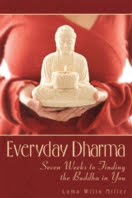
Lama Willa is author of the book “Everyday Dharma: Seven Weeks to Finding the Buddha in You” (2009, Quest Books), a practical guide for getting started on the spiritual path. Visit her website here.
To follow Lama Willa on Twitter, go to http://twitter.com/lamawilla.
On Facebook? Join the Everyday Dharma Facebook group.
You go, Dharma girl!