How to Manage an Effective Religious Organization

On a whim Career Press contacted me to see if I had any interest in receiving a review copy of “How to Manage an Effective Religious Organization: The Essential Guide to Improving Your Church, Synagogue, Mosque, or Temple” by Michael A. Sand. Now I don’t manage a religious organization, heck, I don’t even belong to a religious organization, but I jumped at the chance to check out the book. Why? Because I’m nosy. I wanted to see how effective religious organizations might be run, and since the author also wrote “How to Manage an Effective Nonprofit Organization” I figured he probably had a lot of insights since many religious organizations are nonprofits.

To say the book was eye opening is an understatement. I’ve attended events at assorted churches and temples throughout my life, but never in a zillion years would I have suspected the amount of effort that went on behind the scenes. Even if these organizations weren’t as effectively managed as they could be, if they were even halfway to effectively managed the amount of work involved is staggering.

It seems so simple on the outside looking in. You have a religious leader and they prepare sermons or rituals, perform weddings and funerals, and then you have some volunteers that I don’t know, keep the place clean and help out when needed. It’s not like I thought it was easy, it just seemed pretty straightforward. I would like to state now, for the record, that I am a dumb ass. Yes you have the stuff I mentioned previous, but what about by-laws? What about actually finding and keeping volunteers? What about budget, or fundraising for that matter? What about membership? The list goes on!

Fortunately Sand’s book is there to lay it all out for you. To me it was overwhelming, but it’s a book, the guidance is still there waiting for you after you catch your breath. “How to Manage an Effective Religious Organization” is not an exciting read, but it is incredibly thorough and detailed despite it’s compact size of 221 pages. Sand does his best to navigate the diverse religious landscape of America without stepping on any toes. Readers of The Buffet will be interested to know that along with the usual Judeo Christian suspects he also briefly touches on the Baha’i faith, the Quakers, and Wicca when discussing how different religious groups find leaders. However, if you’ve been looking for that truly common denominator between assorted faiths, how they can be effectively managed may be the link you’ve been waiting for. It’s an oddly comforting notion.

I honestly don’t know how many of you guys need to know how to effectively manage a religious organization, but if you’re like me and curious, you will definitely find “How to Manage an Effective Religious Organization” an interesting read.

Learning to Love Tea….and Their Leaves

Anyone who has read The Magical Buffet for a while knows that I love food and drink. When the opportunity presents itself to review a book that could potentially give me ideas of new things to eat or drink, I always go for it. And that is why I was thrilled that Llewellyn Worldwide sent me a copy of “Tea Leaf Reading for Beginners: Your Fortune in a Tea Cup” by Caroline Dow for me to take a look at.

There are a lot of books out there about tea leaf reading. For instance I own a copy of the second printing of “Tea Leaf Reading” by William W. Hewitt that Llewellyn published in 1992. My discerning teenage eye choose it because of the pretty gypsy woman peering into a tea cup on the cover. “Tea Leaf Reading” is a fine book. Total truth in advertising. Looking to learn about reading tea leaves? Try “Tea Leaf Reading”! However Caroline Dow gives you tea leaf reading and so much more!

Yes, “Tea Leaf Reading for Beginners” gives you everything you need to know to start attempting to read tea leaves. Part two of the book is an ample section on interpreting symbols, although Dow also encourages practice and intuition to determine what symbols mean to you personally. And let’s face it, that is the bulk of what most books about tea leaf reading are, a big ol’ glossary of symbols. Let’s take a look back at my “Tea Leaf Reading” book from the 90’s. It is 226 pages long with pages 25 to 205 being a glossary. I’m not complaining, I’m just pointing out what you can expect from most tea leaf reading books. “Tea Leaf Reading for Beginners” is 288 pages long with the glossary of symbols being pages 131 to 246. That leaves 128 pages of other stuff!

So what can you find in those other 128 pages? Tons. Of course there are the nuts and bolts of how to set up a reading, but there is also information about different types of tea, cups and saucers, herbal infusions and decoctions, tips for cooking with tea, suggestions for pairing different teas with food, ideas for tea parties and more! The first part of this book is so inspiring! I dare you to not be excited about tea after reading it!

Yet what I love best about Dow’s “Tea Leaf Reading for Beginners” is her overall attitude to the practice of reading tea leaves. It’s an event. It’s a magical experience, filled with wonderful stories. I’d say it’s theater, but I fear the jaded among you would then assume it’s a sham. It’s divination with a floor show. It’s a reason to get together with others and enjoy some tea.

Caroline Dow’s “Tea Leaf Reading for Beginners” is for those who want to learn to read tea leaves, but also for those who just want to learn to love tea.

The Vengeful Djinn Introduction

Not too long ago I received a review copy of “The Vengeful Djinn: Unveiling the Hidden Agendas of Genies” by Rosemary Ellen Guiley and Philip J. Imbrogno. I really enjoyed the book and set about trying to verbalize what the book was about and why it was a worthy read. The problem was, my mind kept wandering back to the introduction written by Philip J. Imbrogno. It was just so good at explaining the book, and it did so in such a way that I couldn’t wait to get into reading the book itself. On a whim I contacted Llewellyn, the publisher of “The Vengeful Djinn” about being able to publish Imbrogno’s introduction on The Magical Buffet for my readers, and much to my delight they said yes.

So without further ado, Philip J. Imbrogno’s introduction from “The Vengeful Djinn”!

INTRODUCTION

There has been a growing interest in the paranormal in the past several decades. Ghosts, poltergeists, spook lights, demons, angels, fairies, shadow people, strange creatures, and UFOs have become staples of movies and prime-time television shows. Our attraction to the supernatural is more than a passing fascination—claims of encounters with paranormal entities such as those mentioned above are not restricted to believers or wide-eyed dreamers. Accounts of sometimes frightening experiences are made by people from all walks of life—credible people—who report seemingly incredible things.

I have been investigating paranormal phenomena with an emphasis on UFOs for more than thirty years. I have found myself amazed and sometimes even confused by the variety of reports I’ve received. I’d often ask myself, “Where do these phenomena come from and where do they go when they aren’t seen?” The answer to this question can now be answered by new ideas in theoretical physics. One of these new ideas states that our universe is composed of not one, but multiple dimensions, some very close to our own and many far away in space and time. Periodically, several of these closer dimensions may interact with our world, resulting in the merging of several realities.

My investigations over the years have led me to believe that what we call “the paranormal” takes on a variety of guises, making us humans think we are witnessing multi-faceted phenomena. Actually, this may not be the case at all. In one of these other realities or dimensions close to our own is an intelligent, ancient race that has existed before humans walked the earth—beings with great power who throughout recorded history have been identified by every culture. The Native American shamans call them the “great tricksters,” and to the Hindu of India they are known as “deceivers.” In the West, they are called “devils” and “demons.” New Age spiritualists know them as “the con men of the universe.” This ancient race may be responsible for the majority of paranormal events witnessed over the centuries. We have known very little about them, for only one part of the world has historically documented them and their effect on the human race. Ancient Middle Eastern lore tell tales of a race of mysterious and highly intelligent creatures called the djinn. In the Qur’an, a surah entitled Al-djinn frequently mentions the djinn and refers to them as “God’s other people.” The word djinn is thought to be derived from the Arabic root janna, which means “hidden” and should not be confused with the Arabic word jannah, which means “paradise.”

In the West, the djinn are known as the genies of fairy tales, wish-giving entities trapped in bottles, lamps, and rings. The word genie usually conjures up exotic but harmless images, such as the 1960s television series I Dream of Jeannie, in which Barbara Eden played an obliging, well-meaning, and often ditzy genie freed from a bottle by an astronaut, played by Larry Hagman. “Genie” also has comical associations, such as in the Disney movie Aladdin, based on the tale from Arabian lore. In these depictions, genies may have a bit of prankster in them, but they seem benign, even helpful, and we in the West laugh at them. We have little knowledge and lack fear of the real race, the djinn.

Middle Eastern cultures have a considerably different view of the djinn, however. In many Islamic households, just speaking the name of the djinn will cause the bravest to flee in terror. They consider the djinn to be quite real and a great threat to humanity, causing misfortune, illness, possession, and even death. The djinn hide in the shadows, biding their time and watching us, looking for opportunities to strike, interacting with humans only when it suits their purpose. They are powerful shapeshifters and can live for thousands of years. To cross the djinn is to invite destruction.

My introduction to the world of the djinn began in the mid-1990s while I was traveling through the Middle East researching the Knights Templar and their connection to the Holy Grail. After two weeks of what seemed to be nothing more than a wild goose chase, I began to hear stories about the djinn. At first I had no idea what they were. An old friend, who later became my guide through some very perilous country there, explained the djinn as the origin of the Western “genie.” Like many westerners, I laughed, thinking of those jolly wish-granting spirits. Well, my host took the existence of the djinn very seriously—to him, they were very real. The djinn’s true nature and reality became evident to me as I collected a great deal of information on them and visited some of the places where they are reputed to enter our world. I realized they represent an aspect of the paranormal that had been largely untouched by western researchers. I also realized the djinn could be the hidden source of the diversity of paranormal events everywhere.

I briefly introduced the djinn in two of my previous books, Interdimensional Universe: The New Science of UFOs, Paranormal Phenomena, and Otherdimensional Beings and Files from the Edge: A Paranormal Investigator’s Explorations into High Strangeness. Although I didn’t go into much detail, I found the djinn attracted a lot of curiosity and attention among readers.

Several years ago, noted paranormal investigator Rosemary Ellen Guiley and I began investigating paranormal hot spots in New York that generate a great number of reports relating to UFOs and other types of phenomena. We have been exploring the possibility that in many of these high strangeness locations, portals that connect our world to an unseen world exist. When I mentioned my research on the djinn to Rosemary, she told me she was very interested in them due to her research into angels, demons, fairies, and shadow people. After many long discussions, things began falling into place; we could see the connections among parallel dimensions, the emergence of paranormal phenomena, and the race of ancient beings that exist in a reality very close to our own. During our research, we gathered evidence of the djinn in the Western Hemisphere and applied it to paranormal and UFO phenomena. The result is an interesting and compelling picture that raises many questions about what people are really experiencing. Are the djinn behind our paranormal encounters and experiences? Are they behind some of the terrifying experiences people report? If so, what is their purpose? According to ancient lore, the djinn once occupied this world, and they seek to reclaim it. Are they using paranormal avenues to invade our reality? Is their reality merging with ours? We should consider all of these possibilities. There may be a dark agenda below the surface of our experiences, and we fail to see it because we’re preoccupied with the superficial characteristics of the experiences themselves. No one has the complete solution to this cosmic puzzle yet, but I believe we are offering a number of important pieces to solve the mystery.

This book will take you on an adventure into a world of the unseen, hidden from us in the shadows for countless centuries. We present to you the truth about the race of beings you thought only existed in your imagination—or your nightmares. If you choose to fear anything in your life, fear the djinn. Enter their world…if you dare!

–Philip J. Imbrogno

Excerpt reproduced from The Vengeful Djinn by Rosemary Ellen Guiley and Philip J. Imbrogno © 2011 Llewellyn Worldwide, Ltd. 2143 Wooddale Drive, Woodbury MN 55125-2989. Used with the permission of the publisher. All rights reserved.

Pluralism Project Photo Contest

The Pluralism Project at Harvard University has announced their 2nd Annual Pluralism Project Photo Contest. I’m sharing their press release because I think this is an excellent opportunity for many of the wonderful individuals and organizations that The Magical Buffet has worked with to come out and mingle with other communities. Albeit virtual mingling, through photos. Feh! The folks over at The Pluralism Project are doing some great work and I want to give my readers the opportunity to be a part of it!

Here’s the info:

We invite you and your students, networks, and organizations to participate in our second annual Pluralism Project Photo Contest. We are looking for high-resolution digital images that convey the vibrancy of religious diversity in the USA. We are particularly interested in images in the following categories:

* Religious practices and rituals
* Religious centers, including festivals, center openings, and parades
* Participation of religious groups in American civic life
* Interfaith encounter or social action
* Women’s leadership and participation
* Emerging leadership within Muslim and Sikh communities
* Historic and present day images of the Atheist/Humanist, Bahá’í, Confucian, Native American, Shinto, Taoist, and Zoroastrian communities in the US

One grand-prize winner will be selected; the winning photographer will receive a $250 cash prize and an extended exposé in the spotlight on our homepage,
www.pluralism.org.

All winning photos will be featured in our forthcoming online publication, On Common Ground: World Religions in America 2.0 and on our homepage slideshow over the course of one year, beginning September 1, 2011. The photographer’s name, as well as the location of the image will accompany any digitally published images.

In order to participate, you must:

* be the photographer of the image
* grant the Pluralism Project rights to use the image on our website
* have the permission of those persons in the picture, if applicable

Entries must be submitted via email to contest@pluralism.org by 5 PM on August 1, 2011. Photos should be sent as an attachment. Please put “contest” in the subject line.

In the body of the email, please include:

* your name and title
* relationship to the Pluralism Project, if any
* addresses – mailing and email
* phone number
* a brief caption, including location of the image(s), when the image(s) was/were taken, and what is happening (2-3 sentences)
* a brief statement indicating that you were the photographer, and that you grant the Pluralism Project the rights to use the image(s) on our website, if selected.

Submissions of more than 10 photos should be sent on CD-ROM to:
The Pluralism Project
2011 Photo Contest
2 Arrow Street, 4th Floor
Cambridge, MA 02138

Information also available at: http://www.pluralism.org/pages/contest

The Small Town Pagan’s Survival Guide

There is no way for me to write this review and not be sad. If you read my April 12th article “A Nice Guy and Some Special Ladies in my Life” then you already heard part of this story, but those who have not, here it is.

While flipping through a magazine I saw that a book called “The Small Town Pagan’s Survival Guide: How to Thrive in Any Community” was coming out in June 2011. Without having even read the book I knew this would be excellent subject matter for an interview, so I reached out to Llewellyn Publications and secured a review copy of the book and my foot in the door for an interview with the author Bronwen Forbes. Under 72 hours later I learned that she had passed away. Ultimately I was saddened that I had missed the opportunity to interview a woman who had touched so many lives. Then I received my copy of “The Small Town Pagan’s Survival Guide”.

This book gives us a glimpse at a woman who lived an extremely full life, and she shares it in intimate detail. From divorces to workplace harassment, to meeting the love of her life, raising a small child, and moving around the country, it is there on the page for all to read and learn from. Forbes’ writing is honest, often times humorous, and authoritative. Just her experiences alone would have made “The Small Town Pagan’s Survival Guide” a worthwhile book, but she didn’t stop there.

Not only did Forbes recount her own experiences and lessons learned from moving to small town in Missouri from the suburbs of Washington, DC, but she surveyed and interviewed roughly 50 other people who identified themselves as Pagans residing in small towns. The book is filled with direct quotes from the surveys as well as insights gained from examining the survey results as a whole.

I was surprised to realize that “The Small Town Pagan’s Survival Guide” contained information that was useful for Pagans in smaller towns, but also Pagans in cities. There’s information for Pagans looking to start discussion groups or considering forming a coven. It would even be helpful for someone who perhaps hasn’t fully decided if they’re Pagan or not. This book has information and reflections that just about any Pagan would be able to take something away from. I also think the book is a worthwhile read for folks like me who are not Pagan, but are always looking for a better understanding of Pagan spirituality and the people who practice it.

But I’ll always wonder about that interview…..

“The Small Town Pagan’s Survival Guide” releases in June 2011.

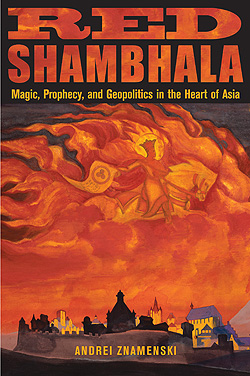
Red Shambhala: Magic, Prophecy, and Geopolitics in the Heart of Asia

Where on Earth do I begin? “Red Shambhala: Magic, Prophecy, and Geopolitics in the Heart of Asia” by Andrei Znamenski was totally alien to me. Knowledge of Tibetan Buddhism? Minimal. Familiarity with the politics of Eurasia in the 1920’s and 1930’s? Nonexistent. An understanding of the variety of interpretations of Shambhala and its associated prophecies? Nope. Are you now frightened of this daunting book? Well don’t be.

Author Andrei Znamenski breaks everything down to its most basic parts to help bring order to this chaos. He begins by explaining the assorted legends, myths, and religious tales of Shambhala and its association with those living in Mongolia, Tibet, and surrounding lands. To sum up, Shambhala is a legendary kingdom hidden somewhere in Inner Asia. It’s considered a land of purity and enlightenment and home for a more spiritually advanced and possibly technologically advanced civilization. Of course most modern Buddhists consider Shambhala a spiritual place to be found within oneself, but Znamenski carefully outlines a period of time when Shambhala was considered an actual location that those of pure intention could find.

The next layer to be added to “Red Shambhala” is an explanation of the Bolshevik revolution that took place in 1917. This was when the Bolsheviks, a faction of the Marxist Russian Social Democratic Labour Party, came to power during the October Revolution phase of the Russian Revolution of 1917. The Bolsheviks were an organization consisting primarily of workers who considered themselves the leaders of the revolutionary working class of Russia. This is where Znamenski starts to introduce you to some of the future players in the quest for Shambhala.

What comes next is the unbelievable true life story of how the idea of Shambhala was a tool used in assorted political and megalomaniacal schemes all focused on the conquest of Mongolia and Tibet. Alexander Barchenko wants to find Shambhala to learn the sacred wisdom there and believes by introducing the elite of Red Russia to the knowledge of Shambhala he will be able to make the Communist project in Russia less violent. The elite see Barchenko’s theological journey to Inner Asia as a chance to plant the seeds of Communism in other lands. Baron Roman von Ungern-Sternberg travels to the east, and uses the legend of Shambhala as a tool to unite the nomads of Mongolia in an effort to restore monarchies. The Roerichs, Nicholas, his wife Helena, and their son George, attempt to establish a Buddhist-Communist theocracy. Nicholas poses as the reincarnation of the fifth Dalai Lama, obviously not counting on the politically shrewd living Dalai Lama of the time. And those are just a taste of the eccentric, larger than life characters that really truly lived, and very much tried their hand at king making and empire building.

After reading “Red Shambhala” you’ll come away with new insights into the history of Communism, Tibetan Buddhism, and the use of propaganda. They say real life can be stranger than fiction, and Andrei Znamenski’s research proves that phrase to be very, very true.

“Red Shambhala” releases in June 2011.

10 Questions with Megan Don

1. For readers who aren’t familiar with her, can you tell my readers a little bit about Teresa of Avila?

Teresa of Avila was a 16th century Spanish mystic and Carmelite nun, who was renowned for her astute insight into the workings of the human soul and who came into her realized self after many years of following her spiritual path. Do not be fooled by her outer nun role, she was a powerful woman who spoke her mind, and who engaged in the fullness of her passionate heart. She was guided to a vocation of reform, that is, reforming the Carmelite Order, for both women and men, returning it to the original intention of “tending to the garden of the soul.” She established seventeen new monasteries along the length and breadth of Spain, which included buying and selling real estate, fundraising to pay for the properties, and ensuring that each monastery had an income so they were self supporting. She was a dynamic powerhouse of energy and manifestation, and at the same time nurtured a deeply spiritual connection with her Inner Beloved. She says, that the only way she achieved so much was through the absolute reliance upon the divine. She is the perfect example for us today as we align ourselves with both our inner and outer world and all that needs to be tended to in order to live upon this earth in a wholesome way.

2. What made you decide to focus your research on her?

I did not decide. I think she or the Beloved did, or both. One evening being awoken from sleep, I was given a vision of Teresa’s life. I knew it was her, I knew the stones of the monastery walls I was seeing, and in the morning I knew I had to visit Avila, Spain and also to study her writings. Within six months I was in Avila, and while there I was making some notes about my experiences. It was then I realized that I would be writing a book on her. Not being a writer, this was a little perplexing, so I said if a book was to be written then the Spirit needed to write it, as I had no idea what to do. I therefore, see this book as a gift I was given and which I gift onwards and outwards to the world. It has been an extraordinary journey, for which I am very grateful.

3. Your book “Meditations with Teresa of Avila: A Journey into the Sacred” contains hundreds of quotes attributed to Teresa of Avila. Do you have a particular favorite?

I think I will need to extend this to two favorites:

I can find nothing to compare with the great beauty of a soul and its infinite capacity…the soul is nothing but a paradise in which the Beloved takes delight.

We have not been taught self-love in our culture, and here Teresa is pointing to an inner beauty so profound and so infinite that I think there are very few who can touch this or believe it. While meditating at her birthplace in Avila, I was given the experience of this quote, of knowing how infinitely we are loved, and that is, the whole of our being. There is no distinction between ego and the divine self, we are loved completely exactly as we are. After many years, it still touches my soul deeply when I revisit this experience, and it is something that I wish every soul on earth could know and experience.

Outside this castle neither security nor peace will be found…[the soul] should avoid going about to strange houses since its own is so filled with blessings.

Teresa described the soul as being like a luminous crystal castle, and here she reiterates the need for us all to draw deep within our own beings. It is within that we will find we have everything and more than what we need. We are so filled with blessings and yet we still seek to be blessed and loved from the outside of ourselves. It is interesting that our true source of happiness lies within and yet we prefer to experience unhappiness through a constant seeking without.

4. What do you hope readers take away from your book?

The book has been written so that it can be experienced, that is, there are quotes from Teresa’s work, then a short exposition relating her wisdom to our contemporary living, and then a meditation in order that we can experience and embody the teachings given. My hope is that the book will provide a transformational experience for the readers, that it will relate to, and open their lives to the greater reality that they are, and most of all, that they will come to know the Inner Beloved and the love of self.

5. In your book you discuss how it can be read for group study. Have you heard from readers who have done this? What were their experiences?

Yes, the response has been wonderful. Groups (and individuals) have been most grateful for the accessibility to Teresa’s teachings. Her original writings can be a little laborious at times, and they are also ensconced in 16th century terminology that is not so appealing to the modern mind. People were aware that Teresa held a key for their spiritual path but were previously unable to access her, so being able to enter her wisdom in a very practical way, relating it to their everyday living has been appreciated.

There has also been a lot of appreciation to know of Teresa’s struggles in her life, as these struggles are still ones we face today. Teresa fought her way through a quagmire of fear and self-doubt (for many years), and she struggled with belief in her self and her spiritual experiences. She had to release old friends who no longer supported her life and she had to stand up in the face of much criticism by colleagues and fellow spirit travelers. Many of us have also experienced these same challenges and to read of her story and her overcoming these things brings hope to us all. Teresa was a woman of great courage, though she is quick to say, it was the Spirit who gave her the courage. And this is what the readers have relayed, that they were given a newfound courage to step out on their pathway and to follow their inner guidance.

6. “Meditations with Teresa of Avila” is divided into seven “dwellings”. What is the significance of the “seven dwelling places”?

The seven dwellings are places in which the soul travels as it makes its journey back to the Beloved. As said above, Teresa saw the soul as a luminous crystal castle, and within this castle there are the seven dwellings and within the dwellings there are rooms upon rooms. As we enter each dwelling we come closer and closer to the Inner Beloved and the center of the soul. These dwellings are pathways or a spiritual map, if you like, taking you through different stages upon your journey. We enter the dwelling of Awakening, The Return, Self Knowledge, Interior Recollection, Surrender, Betrothal, and finally The Sacred Marriage. Though it is important to note that the journey is not linear. We enter different dwellings at different times according to the needs of our soul. For instance, the Awakening is not a one-time visit, but something that happens over and over again, and as our journey continues the experiences become more subtle and more refined. So it is more like a circular journey into the infinity of our being, a journey that never ends. As Teresa said, I think God too is on a journey.

7. On your website, www.mysticpeace.com, I see you have pilgrimages planned for Assisi, Italy in May, Ireland in June, Ireland again in July, and Avila, Spain in September! What kind of work goes into putting together all these trips?

A lot of work, and I love it. Of course, there are the very practical details to work out, such as schedules, where and when we will stay, eat, and take ferry rides and so on. Plus tending to everyone’s practical needs and questions before and during the pilgrimage. And then there is the very spiritual nature of the journey to attend to; being led to the places that are spiritually powerful and have a resonance that is alive and living; and opening to the wisdom contained therein and how it may relate to our own souls and journeys. There are also themes for every pilgrimage, for instance, the upcoming pilgrimage to Assisi, Italy, is “Remembering Your Sacred Work,” and one of the pilgrimages to Ireland is “Living as an Elder,” so I also do much preparation around these themes and recommend reading prior to journeying so everyone can have a full experience. Fortunately, I have been granted the gifts of administrator and the ability to tend to details, as well as the ability to open to the mystic wisdoms.

Something so magically potent occurs when on a pilgrimage. For me, it is the body connecting with the body of the land you are walking on, praying with, and listening to. I have many people return and participate in different pilgrimages with me each year. We form an inner bond that is very sacred. These same people are also often in Spiritual Direction with me, so the experiences together are exquisitely rich. There are no words to describe the deep transformations that people experience – it is deeply humbling to be a sacred witness.

8. You have another book called “Sacred Companions, Sacred Community: Reflections with Clare of Assisi”. Who was Clare of Assisi, and what can we learn from her?

Clare of Assisi was Francis of Assisi’s spiritual companion. Perhaps the most understated enlightened woman of our Christian heritage. As Richard Rohr speaks in the foreword of my book (and I paraphrase here), it is a travesty that she has been so overshadowed by Francis and the male order of Franciscans, and he calls for a return to the feminine wisdom of Clare and her sisters as a way to bring back a fragment of sanity and calm to our world.

Clare was extremely masterful at creating community, and if she had had her way, the Franciscan community would have been one of both women and men, and not segregated. Francis unfortunately bailed on this idea, as I believe, his attraction to Clare was so great that he didn’t know what to do with all his passion and feelings, and therefore, best to separate and be safe. Clare was not at all happy about this, but Francis was a stubborn and willful man and so a different history was created.

I speak of Clare as being the first propagator of Non-Violent Communication. For her, kindness of speech was imperative in creating a harmonious community, and also compassion of the heart. Her writings give great wisdom into community harmony and living. She also writes profoundly about her mystical world and her relationship with the divine love. She writes, Place your mind before the mirror of eternity, place your soul in the brilliance of glory, place your heart in the figure of the divine substance, and through contemplation, transform your entire being into the image of the Godhead itself. Her own commitment to her contemplative and prayer time raised her consciousness and image into the light body of love. This divine love affair and her great love for Francis I cannot separate – they were one and the same – yet she had a pathway of needing to release attachment to Francis over and over again, even to the point of his death.

I cannot emphasize enough the quiet power of this woman. It is my joy to bring her wisdom forward and to lead people to her home in Assisi – there she is readily felt and known, as is her companion and love, Francis.

9. What’s next? Do you have any upcoming projects my readers can look forward to?

Ah yes, it is indeed a wonderful journey. I have been studying the Gnostic Gospels and other related Gnostic texts, unveiling the great wisdom of the early Christian communities, along with the mysteries of Mary Magdalene and the feminine teachings. Joining with this, my Celtic heritage has re-emerged and my childhood gifts of working with the animal and tree spirits and elemental beings. I am finding these traditions so effortlessly join together, and when we remember Mary Magdalene’s many years of teaching and living in Southern France and the great Celtic and Druid presence throughout France, it makes sense for this re-emergence and re-union if you will. So I envision another book revealing this work and my experiences, and pilgrimages to these areas also.

I also have a great interest in community, and opening the way as a house of hospitality for people to come and enter into their sacred self even more deeply, for varying lengths of time, and drawing on the work and themes as reiterated above. So readers may watch for something of this nature being created in the future.

10. Parting shot! Ask us here at The Buffet any one question.

The first question that came to me was, “Can we create a special Magical Buffet Pilgrimage, where readers can come and journey together into these sacred wisdoms?”

Just a thought. Can you imagine the logistics of that – even first off deciding the place? Next year I head to Glastonbury in May/June and then Chartres Cathedral and Mont St. Michel in France in September. Perhaps a Magical Buffet contingent can descend and then ascend together?

By the way, love what you are doing at Magical Buffet – brava!

See, I think you give me too much credit. I see The Magical Buffet Pilgrimage going to Puerto Rico for the religious for me experience of the Taste of Rum Festival, or maybe going across town to a friend’s house for an action movie marathon. I’m not a very exciting lady!

About Megan Don:
Megan Don is the author of “Meditations with Teresa of Avila”. She is a spiritual counselor and teacher of “The Pathway of the Mystic.” She leads pilgrimages to Avila, Spain and other sacred sites in Europe. Megan devotes herself to awakening the mystic within humanity and teaches an embodied spirituality that honors all traditions. She divides her time between the United States and Europe. Visit her online at www.mysticpeace.com.

The Mystical Pathway to Peace

By Megan Don

“It is in your power to live and to die with this peace.” – Teresa of Avila

Our society is fraught with conflict, be it political, religious or personal. It might even be said that we, as a human race, thrive on conflict, as it seems to be a precursor to our growth and change. It provides a stimulus for disintegration of old thoughts and ways of being and regeneration for new modalities and paradigms. From the rebel teenager, to the warring couple, to international peacekeeping efforts or the political terrorist, their aim is the same – to overthrow, or keep at bay, what they perceive as a hindering force to their right to freedom (whatever that may be). But what is the real freedom we all seek? And can we not find another more peaceful method of change? First, we need to look at the nature of conflict and to see how and where it arises.

Teresa of Avila (1515-1582), Spanish mystic and Carmelite nun, was very familiar with conflict. From a young age Teresa experienced a dichotomous inner relationship with herself. She developed a deep respect for the spiritual life through her father’s influence, but she also cultivated a great taste for the materialistic life through the nobility of her mother. She was ultimately split into two different modes of being and was unable to reconcile these two influences until late in her life, even while living in the monastery.

Conflict became as a personal paradigm for Teresa. She was incredibly strong-willed and began the battle with her own ego, which she clearly perceived as constantly rallying against the greater will of God. This caused her much internal pain and a sense of division, as she was unable to surrender her own thoughts and will. In her resistance, she felt the ego struggling to remain in control, and yet, she distinctly felt the pull of her inner spirit. This spirit was inviting her to another place – the place of freedom and peace. Separation from God was the cause of Teresa’s conflict, and only when she was able to join her soul with the divine spirit did she find peace. It was through surrendering the ego, not annihilating it, that enabled this to occur. It was not an immediate release however, but a gradual remembering and relearning by her soul.

As with Teresa, I believe that the paradigm of conflict is paramount in our society. The ego has been living a life of separation from the spirit, causing conflict to occur. On a personal developmental level change frequently occurs after a great inner tension and conflict has been felt and lived. On a political level that same tension and conflict causes a change in leadership and power, but unfortunately is often manifested and affected through violence and war. This framework and partnership of change and conflict now needs to be dismantled.

This regenerative process of change can be affected in a loving way. The great beauty about Jesus was that he brought the message of truth and love. Truth without love is harsh. Love without truth can become sentimental. The two together can bring about long-lasting and effective change, both in a personal and societal context. The truth can revolutionize the way we love and the way we love can revolutionize the way we live.

Acting in a loving and compassionate way was very important to Teresa and became the foundation for the success of her communal monasteries. Let us take this same concern into our workplace, into our homes, and into any situation that requires a breaking down of the old ways. Above all, let us be kind to one another and our selves. If we can affect a gentle process of change internally, then we can also manifest this in our external environment.

Teresa’s lifelong quest, though lived over four centuries ago, is still an example and inspiration for us to follow today. We can carry placards in the street demanding peace not war, but of what use is that if we are still warring within our own selves. We each have the responsibility to look deeply within and to be honest about the state of our own being. We each need to see how we are in conflict with the natural state of our soul. We need to look and see where we are split in our lives. Where we find conflict in our lives let us look deeply for the origin, and surrender it to God. Where we find places of unrest and lack of peace, let us surrender this too. In turning to our interior life we can lovingly heal any splits that may have occurred throughout our lifetime. We can release ourselves from the dichotomous relationship that so many of us have become accustomed to.

The definition then, of real freedom is inner peace, known through acceptance and surrender. And the way of truth and love is the way of change. Like Teresa, we can become examples of what it means to live a wholesome life, surrendered to the divine will, and living in peace on this planet.

Megan Don is the author of Meditations with Saint Teresa of Avila: A Journey into the Sacred.
Based on the book Meditations with Teresa of Avila © 2011 by Megan Don. Printed with permission of New World Library, Novato, CA. www.newworldlibrary.com

Liked what you saw? Then stay tuned! On Thursday May 12th we’ll be back with 10 Questions with Megan Don! We’ll talk about her book, Teresa of Avila, and her other work!

Victory, it’s Sweet Like Honey

Long time readers know I love it when I’m right. I love it when I get there first. Whether it’s beating Perez Hilton to bringing attention to Movember, or beating MTV to introducing Raven Digitalis, I always get a kick out of it. I’ve always been a fan of the underdog, and now that I’m an underdog in the overcrowded blog-o-sphere, I can’t help but occasionally cheer myself on.

All of this brings me to “The Honey Prescription”. Thanks to Healing Arts Press I received a review copy of “The Honey Prescription” by Nathaniel Altman, and in June 2010 I published my review of the book. I admitted that the book’s attention to science and abundance of information in general won me over. For those of you who didn’t see the review the first time around can click here to give it a go. I think you’ll like it.

Anyway, what got published on April 12, 2011 on the BBC News website? This! Yep, “Manuka honey ‘could help fight superbugs”. That’s right folks, thanks to Healing Arts Press and Nathaniel Altman, I beat the BBC. Okay, I know it’s not me really beating them, but darn it, let me just savor for a moment the idea of scooping the BBC!

10 Questions with Miguel Conner: The Other Nine Questions

Hey! Wondering why there are only nine questions instead of ten? Did you miss question one? Click here to get caught up!

2. What made you decide to start a radio show devoted to discussing Gnosticism?

Ironically, I had just been excommunicated from a Gnostic church for something I hadn’t done (I’m not a 30th level magician…only in the World of Warcraft!). At the same time, I had started listening to an Internet station called Freethoughtmedia.com, mainly an avenue for New Atheism and Humanistic issues. I was feeling isolated so I sent the owner of the station a proposal to produce a handful of shows on Gnosticism—a series of interviews that would educate as well as dispel many misunderstandings on the ancient heretics. He accepted, assuming that the enemy of his enemy was his friend. Before I knew it, I was falling down a deep rabbit hole with Alice and Sophia. And I’m still falling after four years!

3. Your book “Voices of Gnosticism” is a collection of transcripts of interviews from your show, and does a fantastic job of introducing all facets of Gnosticism to the reader. When did you realize, or what made you decide, there would be value in collecting these interviews into a book?

The idea surfaced in the vast expanse of my head and was proposed by several listeners throughout the years. A few stenographers even offered to transcribe the interviews. I never paid much attention, falling into the cynical yet neo-utopian view that less people were reading and cyberspace was the new and true Library of Alexandria. I finally took a small Red Pill when Andrew Phillip Smith approached me with a sound and lucid vision of an Aeon Byte book based my most prolific guests. Since Andrew had been a guest many times, author of several books that had influenced me, editor of The Gnostic Journal who I had written for, and owner of a publishing company, I knew he couldn’t be an Archon and was onto something. The rest is heresy.

4. As an old school music fan, who would sit and write down lyrics to songs by playing second after second on a tape player, starting and stopping, starting and stopping, I know that transcribing from audio to text can take an insanely long time. How long did it take for you to transcribe all these interviews?

It was agonizing! I hated having to think of poor Andrew spending hours transcribing each interview! I know he started with a voice recognition software, but then he got the usual ‘too’s’ instead of ‘to’s’ and so forth, while Greek words came out all Greek to him; so he eventually did it the hard way, but he did an august job. Even then, it took months of us working together to match the vocals of the interviews to the transcripts. It’s not easy getting 60+ thousand words from audio to print, let me inform you! And I would advise for anyone undertaking such a venture to make sure the publisher and author agree on whether to use UK or American English…it will save you a lot of time and headaches and bad jokes based what is considered dirty in each culture.

5. Your interviews contain a wealth of information and you do an excellent job of really getting to the heart of your interviewee’s research. How much independent research did you need to do for these interviews?

I invest large sums of time and effort with each guest, regardless of their status or how much I agree with their premises. For one, I am passionate about all subjects dealing with the occult and comparative religion. I want to learn along with my guests. Furthermore, I understand how much hard work each guest puts into their books, movies or doctrines, so why shouldn’t they get the same respect? Not only do I read their respective work for the interview, I study all of their other efforts and everything I can about the subject at hand (even if I’m comfortably familiar with it). By the time of the interview, I want to be their virtual stalker or single white female.

6. Out of all the interviews you’ve done, do you have a favorite? If so, why does it stand out for you?

Why, this is my favorite interview! Me…me…me!

7. Is it odd for you to now be interviewed? How is the transition from interviewer to interviewee working out for you?

Okay, I admit it! You’re killing me softly with your song! The hunter has become the hunted! I’ve always envisioned myself as a cyber-Socrates, except a million times dumber, midwifing truths from my guests and handing those babies to my listeners. It is my greatest hope that they can nurture these truths into viable spiritual systems that will induce higher states of consciousness.

Besides, what can I say that could ever surpass any of my astral guests who emanate themselves from their Pleromas down into Aeon Byte every week? Uh, I like Pina Coladas and getting caught in the rain?

8. If my readers want to learn more about Gnosticism, where do you suggest they start? I’d recommend your book “Voices of Gnosticism” and certainly the “Dictionary of Gnosticism” by Andrew Phillip Smith, who was kind enough to contribute to my website as well as write a wonderful forward for your book.

Good choice for books, I say, I say! That’s another difficult question, since ultimately Gnosticism is a very personal faith even when you do find those with the same Etch A Sketch mysticism as yours. Gnostics are always the perennial strangers in an estranged land. J. Krishnamurti once said truth is a pathless land. I like to say gnosis is a pathless labyrinth. You just don’t know exactly how the song of Sophia will strike you or what teaching of an Aeon wearing mammal skins will stimulate your Divine Spark. I certainly would suggest that if a person is interested in Gnosticism, they approach it for what it is and not for what it isn’t. Many people enter the Esoterica because they are rebelling against a former religion. They end up roleplaying instead of fully participating in the mystery, their hearts still so filled with negativity that it cannot be filled with light.

Having babbled that sermon, it goes without saying that one should either own Bentley Layton’s The Gnostic Scriptures or Marvin Meyer’s The Nag Hammadi Scriptures. Since modern Gnostics have their usual suspects they propose, I’m going to go ahead and throw a few curveballs: Elements of Gnosticism by Stuart Holroyd because it’s a concise and approachable history of the Gnostics in a little over a hundred pages; The Gnostics: Myth, Ritual & Diversity in Early Christianity by David Brakke because he takes one of the best snapshots of the rise and fall of the Gnostics; The Gnostic Religion by Hans Jonas because he reveals that the socio-political world of the Roman Empire that early Christians and Gnostics struggled in eerily parallels our modern times, and thus why the Gnostic spirit is very important today; Valis by Philip K. Dick because he captured the essence of Gnosticism and translated it into a modern context; and Alice’s Adventures in Wonderland by Lewis Carroll because the story of Alice is the story of Sophia is the story of each one of us.

And definitely watch The Matrix, The Truman Show, Inception, Total Recall, all at the same time and several times, while reading out loud the poetry of William Blake with a Jungian analyst sitting next to you on the couch.

Like I always say on Aeon Byte, you know you have taken the Red Pill when you start writing your own Gospel and living your own myth, as the Gnostics did throughout history even if history erased much of their wonders.

9. What’s next? Do you have any upcoming projects my readers should be aware of?

I have just released the second edition of my futuristic yet very Gnostic-themed vampire saga, Stargazer (available at Amazon!). I’m working on releasing the sequel sometime late this year or early next year. I have a couple of embryonic projects for a scholarly book on the Gnostics, and there is a good possibility Aeon Byte might go completely live soon with callers and 1-800 numbers commercials for Cialis (but I haven’t bitten completely yet). If you include the actual show, writing articles for different periodicals, and making battle plans with Sophia, I don’t even have time to look for where I put those $#%@ Red Pills.

10. Parting shot! Ask us here at The Magical Buffet any one question.

Ah…that feels good! I can ask questions! How come you don’t have a “Gnosticism” category at the Magical Buffet? Is this some sort of prejudice? Hating on the Gnostics feels good but Yaldabaoth forbid we ruffle the feathers of Wiccans so we give them two categories, eh? Don’t think for a second that this sense of persecution is inflating my sense of self-importance! I’m pulling off my microphone and walking off the set! You’re out of order! This court is out of order! Wiccans are out of order! This whole buffet is outta order!

Alas you have caught me Miguel! The Magical Buffet has partnered up with the Wiccans in an effort to suppress information about Gnosticism ever reaching the public at large. Smart ass! You know what? I don’t feel like a jerk anymore for question number one! That’s right? I said it!

About Miguel Conner:
Miguel Conner is host of “Aeon Byte Gnostic Radio”, the only topical and guest radio show on Gnosticism and its brethren in mystical heresy, ancient and modern. He is the author of the critically acclaimed, popular, and Philip K. Dick-ish vampire epic, “The Queen of Darkness” (re-released as “Stargazer” in 2011). His articles, fiction, and reviews have appeared in such publication as “The Stygian Vortex”, “The Gnostic Journal”, “Houston Public News”, “The Extreme”, “The Cimmerian Journal”, “Examiner” and many others. He lives in the lawful dystopia of Chicago with his family, patiently waiting for the beginning of the world.

Miguel’s website is: http://www.thegodabovegod.com

Where Aeon Byte broadcasts and blog: http://www.aeonbytegnosticradio.com

Voices of Gnosticism Homepage: http://voicesofgnosticism.blogspot.com

Stargazer Novel homepage: http://stargazervampirenovel.blogspot.com