10 Questions with Claude Lecouteux

A little note here from me (Rebecca). Claude Lecouteux, in my opinion, is a certified bad ass. His book “The Return of the Dead: Ghosts, Ancestors, and the Transparent Veil of the Pagan Mind” became an all-time favorite of mine as soon as I read it. In the two years since of doing book reviews “The Return of the Dead” is still one of my favorites to recommend. Lecouteux’s latest book, “Phantom Armies of the Night: The Wild Hunt and Ghostly Processions of the Undead” is simply amazing. I’d say go buy it now but I want you to stick around because it was my extremely giddy honor to get to interview Claude Lecouteux and I want everyone to read that. Seriously, like every single person ever, because I got to interview Claude Lecouteux!

Crap, what did I actually set out here to say? Oh yeah. Claude Lecouteux is French and as such English is not his native language so some of the phrasing and use of language may seem “off”. Since the only French I know comes from the song “Lady Marmalade”, I was impressed at how good his answers came across.

1. With previous books such as “Witches, Werewolves, and Fairies” and “The Return of the Dead” it seems like much of your work has now culminated in your new book “The Wild Hunt and Ghostly Processions of the Undead”. Is that the case?

It is not the case. The field of my research is so large that I was constrained to go step by step. “The Return of the Dead” showed me the different facets of the believes connected with the death and the dead. This book was a first approach, the basis of my other investigations: I could not say and explain all the ramifications of the subject just in one book.

In “Witches, Werewolves, and Fairies” I found the answer to a question that bored me: what returns? A shape? A corpse? A soul in human form? The answer was the alter ego, the root of the believe in an external soul.

The “Phantom Armies of the Night” explores the return of troops of dead and tries to show that we are confronted with a blend of different legends which roots are the believe in a life after the life, the dangers for the livings to meet such troops, what often involves an obligation, and a warning: don’t have an unsocial behaviour, don’t transgress the moral codex of the community.

2. For readers unfamiliar with the term, could you describe what The Wild Hunt is?

The Wild Hunt is a band of the dead whose passage over the earth at certain times of the year is accompanied by diverse phenomena. The leader of that Hunt is a giant or a devil or a warning rider. Unfortunately the Wild Hunt was confused with the legend of the Wild Hunter.

3. How does The Wild Hunt differ from other troops of the dead or phantom armies that show up in folklore and mythology?

The Wild Hunt differs from the other troops through its highly Christian character and through its message: be careful in all you act! A bad life involves the damnation, the members of the Hunt are sinners.

4. With so many versions of The Wild Hunt and associated processions of the undead how did you go about sorting through all of it to find the definitive stories?

I search first the common points, then the sources of the differences, I compare all the testimonies I have found and analyze the part the Medieval church plays in the variations. A myth is the result of all its variations.

5. One of things I find fascinating in your books is how you show the role Christianity has played in shaping and/or distorting Pagan folklore. While researching your books do you find this an interesting puzzle to work out or just a frustrating obstacle in getting to the heart of a particular legend?

I found it an interesting enigma. I am like a detective investigating for traces. One of the aims of my studies is to raise the veil of the Christian distortions.

6. You kick off “Phantom Armies of the Night” discussing “The Good Women Who Roam the Night”. Although later in the book they are sometimes associated with leading unbaptized children who have died (obviously an unpleasant thought), and of course there is the mandatory demonization by Christianity, at the heart they seem like perhaps the only group discussed that doesn’t do harm or act as a harbinger of bad things to come. Is that correct, because I may opt to see if they’ll eat at my house this year.

You are right! The good woman leading a troop of dead children is not a harbinger of bad things to come. And if the good women, three in number, visit your home and if you have done what they expected, you’ll be happy and lucky.

7. My readers may not be aware, but you are French and live in Paris. Your latest book, “Phantom Armies”, was actually published in French in 1999 under the title “Chasses fantastiques et cohorts de la nuit au moyen age”. Do you get nervous about having your work translated into other languages?

I am not nervous if I can read the translation before publication. But it’s not always the case. My books were translated in 12 languages – Chinese, Czech, etc. – so that I have no control. I just understand the west and north European languages.

8. Since your work is published in France and then America, what are some upcoming projects that my readers can look forward to in either country, or both?

Jon Graham will translate two other books of mine: my analysis of the poltergeists and my Dictionary of the magical and medicinal stones and gems.

In France the next book is entitled “The poisonous maiden”, an anthology of legends and fairy tales of the Middle Ages; this is a part of my corpus of research, like my other anthologies on Werewolves, Dwarfs, Vampires and other selections I published.

The translation of Franz Obert’s “Tales of Transylvania” (collected 1856) I made with my wife will appear soon.

My last project I began 1995 is a Dictionary of the magical words and formulas; to day 1000 entries!

9. You conclude “Phantom Armies of the Night” by saying, “As you will have guessed, an investigation such as ours here is an attempt at discovery. We cannot reach a conclusion, and to reach one would be presumptuous, as long as so many texts remain to be exhumed, so many testimonies remain to be pulled from unpublished archives that are piled on library shelves.” With the book already being 12 years-old, does this mean perhaps we can look forward to an updated edition in the future?

It depends not from me but from the editors!

Karin Ueltschi, a friend of mine, wrote her PhD on the subject; I was in the jury and I can say her book (published in 2008) can be considered as the updated edition of my study.

10. Parting shot! Ask us here at The Magical Buffet any one question.

Hi! It’s Rebecca again. I think the kind of joke of asking me a question got lost in translation, so I’ll use this space to share a few final thoughts.

1. Buy “Phantom Armies of the Night”.
2. Please Inner Traditions, hurry and publish an English version of “The Poisonous Maiden”!
3. When you do publish it (soon), for goodness sake keep the title “The Poisonous Maiden”! What a great title!
4. I get a review copy of that, right?

About Claude Lecouteux:
Claude Lecouteux is a former professor of medieval literature and civilization at the Sorbonne. He is the author of numerous books on medieval and pagan afterlife beliefs, including “The Return of the Dead”, “The Secret History of Vampires”, and “Witches, Werewolves, and Fairies”. He lives in Paris.

Doctor Dee….The Opera

Who is John Dee? That can be a complicated question. He is different things to each person familiar with him. Like all complex things, let’s go to the anonymous folks at Wikipedia for the general gist.

John Dee was a noted English mathematician, astronomer, astrologer, occultist, navigator, imperialist and consultant to Queen Elizabeth I. He devoted much of his life to the study of alchemy, divination and Hermetic philosophy.

Dee straddled the worlds of science and magic just as they were becoming distinguishable. One of the most learned men of his age, he had been invited to lecture on advanced algebra at the University of Paris while still in his early twenties. Dee was an ardent promoter of mathematics and a respected astronomer, as well as a leading expert in navigation, having trained many of those who would conduct England’s voyages of discovery.

Simultaneously with these efforts, Dee immersed himself in the worlds of magic, astrology and Hermetic philosophy. He devoted much time and effort in the last thirty years or so of his life to attempting to commune with angels in order to learn the universal language of creation and bring about the pre-apocalyptic unity of mankind. A student of the Renaissance Neo-Platonism of Marsilio Ficino, Dee did not draw distinctions between his mathematical research and his investigations into Hermetic magic, angel summoning and divination. Instead he considered all of his activities to constitute different facets of the same quest: the search for a transcendent understanding of the divine forms which underlie the visible world, which Dee called “pure verities”.

Dee’s high status as a scholar also allowed him to play a role in Elizabethan politics. He served as an occasional adviser and tutor to Elizabeth I and nurtured relationships with her ministers Francis Walsingham and William Cecil. Dee also tutored and enjoyed patronage relationships with Sir Philip Sidney, his uncle Robert Dudley, 1st Earl of Leicester, and Edward Dyer. He also enjoyed patronage from Sir Christopher Hatton.

Damon Albarn is a British singer/songwriter/producer that you may know best as the front man for Blur and the Gorillaz. He is also preparing for the debut of an opera that he collaborated with theater director Rufus Norris on about the life of John Dee. Intriguing, no?

BBC News reports, “This concoction of Renaissance ideas and a human story is being brought to life with an eclectic musical composition – featuring medieval instruments, West African drummer Tony Allen, and Damon Albarn’s unmistakable vocals.” Albarn goes on in the article to explain that he feels Dee has been “whitewashed” out of history, and is quoted as saying, “It’s just amazing how much colour there is in his ideas. Just imagine the English now if we had kept that spirit in our hearts.”

The opera is called Doctor Dee and will be debuting in July at the Manchester International Festival.

Rebels & Devils

It’s only an anthology, I thought. A nice way to ease myself into the writings that Original Falcon publishes. Sure it’s titled “Rebels & Devils: The Psychology of Liberation”, but still, it’s just an anthology. Then, as you might suspect, the anthology kicked my ass.

“Rebels & Devils” features the writings of Robert Anton Wilson, William S. Burroughs, Timothy Leary, Ph.D., Phil Hine, Aleister Crowley, Osho, and more. I suspect you’re getting the tone now, right? Trailblazers of a sort, people who left behind the status quo. In short, rebels and devils.

What does it mean to be a rebel? How do you become a devil? These questions are asked and sometimes answered not just in the typical short essay format (An absolute stunner of an essay comes from Diana Rose Hartmann titled “The Calling of the Holy Whore”. Dare I call it a must read for every woman? I dare.), but also in the form of interviews (I loved Christopher S. Hyatt, Ph.D interviewing Israel Regardie!), fiction (Look forward to “Paradise Mislaid” by William S. Burroughs), poetry (I enjoyed “Prelude to a One-Night Stand” by Adam Matza. “I need a body-sized condom, to protect me from your malaise, and you from mine.” Rough.), and even a comic strip from Christopher S. Hyatt, Ph.D and S. Jason Black called “VoodooMan”.

“Rebels & Devils” dedicates a section of the book to “The World of Chaos”, which includes discussing the practice of Chaos Magic. If you buy this book and only bother to read “Beyond the Event Horizon: Responses to Chaos Culture” by Phil Hine and “Undoing Yourself with Chaos Magic” by Robert F. Williams, Jr., you will come away with the best understanding of Chaos Magic that the uninitiated can hope to attain. At least that was the case for me!

So hopefully now you’re psyched. You’re chomping at the bit, ready to dive in. Consider this a word of warning, this book WILL kick your ass. Am I in charge of my destiny? Do I only focus on myself, leaving others to fend for themselves? Is that a good or bad thing? Am I weak in ways I didn’t realize? These are just some of the thoughts that raced through my mind while reading this book. If it were a website, it would be NSFW (not safe for work). All manner of very adult themes are at play in “Rebels & Devils”. However, if you’re willing to take it on; if you’re ready to be confronted by ideas you’ve never encountered before, presented in some extremely outside of the normal comfort zone kind of way, you will be rewarded at the end of the journey.

Coming Soon, TempleFest!

Looking for something to do this Saturday and you live in the South Hampton, NH area? Then rejoice because I have got some good news for you! This Saturday, June 18, 2011, will be TempleFest!

This outdoor event starts at 10am with an opening ritual and the day concludes with a Midsummer main ritual that starts at 7:30pm. What goes on in between those two events? I’m glad you asked.

There will be vendors; including FairySpa (who you may remember from my article about Celebrate Samhain), Haunted Woodcrafts (aka Mike Dolan, aka one of the members of Featherscale), Cucina Aurora (aka Dawn Hunt, aka the wonderful lady who has shared great articles with us about Shepherd’s Pie and Spinach Quiche), and more!

There is also a packed schedule of speakers; including Christopher Penczak and Steve Kenson (who you may recall I went all fangirl on at Celebrate Samhain). But wait, what’s that one? At 4:30pm? “Protection from Evil: Religion, Folklore, & Myth” with Rebecca Elson. Holy crap! That’s me!

Admission is $25 if you pre-register, but hurry, the last day to pre-register is tomorrow, June 15, 2011. After that it will be $30 for the day.

To learn more, visit the TempleFest website! I hope to see some of you there! And for those of you who can’t make it, don’t worry, I’ll be sure to let you know how it went!

10 Questions with Alferian Gwydion MacLir

Just a little note. When we originally did this interview, we were under the impression that Alferian’s book “Wandlore” would not be available until the beginning of July. However if you head on over to Amazon.com you’ll see it’s available now!

1. Readers may not know this, but you were the very first interview done for The Magical Buffet. You were “10 Questions with a Druid“. Why on earth did you agree to do that interview?

Why not? It was fun and I’m always interested in talking about druidry.

2. Back in 2006 when I interviewed you I put your Bardic skills to the test by requesting you write a poem about The Magical Buffet. In response, you wrote this:

There once was a girl named Rebecca
Whose tastes ranged from London to Mecca
She offered up choices
From alchemy to oysters
In a buffet for magical trekkers.

I’m here to challenge you again and put your Bardic work to the test by asking for a second verse. Are you up to the task?

Gosh! I had totally forgotten that. Well, it’s a limerick so doesn’t have a second verse. How about free verse…

Magical Buffet
Car on a magical train
The Hogwarts Express —
The train of all desires —
Blue, and the buffet full of
Sandwitches
And apple Pythagoras
Genmai cha
Eye of newt
We eat Cornish pasties and
Drink coffee
Hot, black arts sweet,
Then go back to looking
Out the windows
As the landscape of magic
And the castles of imagination
Steam past.

3. In 2006 we also talked about the Avalon School for Druidic Studies. I was so enthusiastic about it and sad to discover the website for it is gone. Can you share with me and my readers what happened with it?

The board of governors and I closed it down mainly because I did not feel I had the time or skills to keep on herding cats. As many people have said, it was an idea ahead of its time. What is needed, as I’ve always said, is a physical location. Sort of, if you build it they will come. Some of those involved in the project thought online learning would draw students, but at the present moment druids are spread rather thinly and most of them haven’t any money. My thought was to present druidic ideas in a formal way, but entirely open, so you did not need to belong to an order to study it. No “secrets.” But you do need money, competent administrative staff, and time to draw students.

There are a number of other folks out there running magical schools of one sort or another, and I really have respect for them. Last year I tried teaching at the Grey School of Wizardry and was very impressed with the administration and the teachers. I enjoyed the students too, and was sorry to leave, but I need to focus my energies on my writing. In fact, what happened after I closed Avalon Center was that I began writing a novel that is set at a druid university. It starts as a “school days” novel, as so many have, and follows the heroine as she grows up. It is meant to be a series. Although it is somewhat the same idea as the “Harry Potter” books, it is not intended to be a fantasy about magic. Rather, it is intended to present real magic as the subject of study in the schools. This gives me a chance to develop my idea of a magical school, without the hard work of manifesting using real people. Much easier if you can just create the people you need. The first novel in the series is titled “Emily Glass and the Alchemist’s Secret” and it is a bit steampunk, though not dystopian, nor set in Victorian England. I won’t say any more. You will just have to read it.

4. Enough about the past, you’ve got a wonderful book, “Wandlore: The Art of Crafting the Ultimate Magical Tool”, that is coming out in July! Let’s first talk about how you started making wands?

It was 1998 or so that I made my first wand, when I was studying in the Ovate grade of OBOD (the Order of Bards, Ovates, and Druids). The grade work includes a good deal of work with the trees and ogham signary, so I was talking to a lot of trees. The oghams are a system of signs used by the Irish bards of old. Among other things, each signifies a different tree. I’ve always talked to trees so far as I can remember but in this case I was getting to know the character of each type of tree in a more methodical way. An oak dryad is different from an elm dryad, and both of those are very different from a poplar or birch. So, the study of the old bardic lore of the trees and their correspondences quite naturally led me to my calling as a Wandmaker. It definitely was a calling too. My spiritual guides told me that part of my purpose was to reintroduce the art of wandmaking into the present magical culture.

That along with my fiction writing is what I feel called to do with my life – principally. Obviously there is a lot else. Steampunk for instance.

5. And then how did the book “Wandlore” come about?

I accumulated a lot of the lore on my website – the Bardwood Wandry – and at some point a druid friend of mine told me that I really should write a book on the subject. After about five years, here it is. Writing “Wandlore” helped me to articulate a lot of the ideas I have had over the years – things that I accepted intuitively and had never tried to explain to others. The elemental structure of the four principal parts of a wand for example. Those parts are, the point, the shaft, the handle, and the pommel. They correspond respectively to fire, air, earth, and water. Why? Well, let me tell you why.

The pommel which is often set with a stone or a large rounded shape, is used as the reservoir of spiritual energy or prana within the wand. It is elementally water and yin, while the point is the opposite – fire, the energy of will, and yang. The handle which contacts the wizard’s hand is earth because it draws on the immediate physical and material control of the user. The shaft is air due to its role as the conducting medium of prana. Magic is cast through the air, as it were, both in the literal sense of material air uniting and connecting all things on earth, and in a psychological sense in which it is the thoughts of the wizard that conduct the will, the non-verbal power of desire.

6. The amount of detail and just raw piles of information in the book is staggering. How long did it take to do all the research?

Several lifetimes. I drew upon the work of many others, as you probably noticed if you read the bibliography. The book collects a lot of information that has been scattered around in magical circles for a generation or more. Everything from tree lore, to stone lore, and the mysteries of magical beasts. One of the techniques I adopted from the famous Mr. Nitrogenous P. Ollivander is the use of magical cores in my wands. I had to do a lot of research on that subject with my Elven sources. I have three Elvish friends who very kindly made their own knowledge available to me. Some of it was general knowledge of how magic works, and some was particular lore about wands. They advise me in all my magical work, and confirmed that the use of spiritual inclusions from astral beasts was a long-established practice, not just the stuff of fiction.

Anyway, magical cores. The use of phoenix feather, unicorn hair, griffin feather, etc. etc. has a perfectly good basis in real magic, quite apart from the “Harry Potter” books. In the fictional world of J. K. Rowling, one is led to believe that the wand’s magic comes from the unicorn hair or phoenix feather. This is only partly true. The magic in a magic wand comes from the mage using it. It does not bestow magical power on the wizard, as seems to be the case to some extent in the Harry Potter books. But the inclusion of bodily ephemera of mythical beasts adds their character to the wand. A wand of wood with an animal core and a stone reservoir in the pommel unites all three of the major kingdoms: animal, vegetable, and mineral. The parts used, however, are a bit off in the fictional world of Ms. Rowling. She, for example, has Ollivander using “dragon’s heartstrings” which is a horrible idea. If there is one thing you must not do when taking body parts from a magical animal it is to kill it or dissect it. Heart muscle, which I presume is what she means, would be nothing but trouble. That’s the sort of thing you would use to create a cursed object. It is the scales of the dragon that are used in wands. Dragons shed their skin like snakes and the scales can be harvested by a wandmaker or general apothecary of magical ingredients. I know a very nice shop in the netherworld where I get mine. Saves a lot of time.

The aspects of druidry that enter into my practice, in the process of enchantment and in the work with tree spirits (dryads) come from the Order of Bards, Ovates, and Druids and my studies within the order. Druidry forms the framework of my magical practices, and I have also adopted a few ideas and ritual forms from the Hermetic tradition.

So, there was some original research and there was a lot of comparing of older sources and testing them. The actual writing of the book took about four years I think, including the better part of a year to revise the whole thing after Elysia Gallo, the Llewellyn editor and her colleagues gave me feedback. I’m very grateful for that help because it is really the editor that makes a good book a great book.

7. Now that your book “Wandlore” is about to release, have you been flooded with requests from people looking to have you craft a wand for them?

Ha! Ha! Ha! No. I doubt if anyone who has seen the book on offer knows about my website. They would have to search for my name I think. I’ve put the web address of Bardwood.com in the book, so when people actually come to read it, the word might get out. Bardwood Wandry is, at present, just me. I would like to engage an apprentice or two, but I’ve been too busy to advertise. My clients have to be very patient. It usually takes me months to turn an order around. I always have something in the works. I’ve been making a fire staff from one of my druid brothers just lately and the dental work on the dragon head at the top is taking far, far longer than I ever imagined it would. Teeth. Teeth!

8. Um, ahem (cough), err, um….any chance you would craft me a magical wand?

Why not? All you need to do is go to the web shop and come up with a design you like. You can choose from the ones in the photos there, or you can come up with your own design in consultation with me. Bespoke wands are my specialty. I’ve priced them in three ranges – pocket wands, regular length wands, and extra long wands. There is an additional charge for making them “fancy” which means elaborate carving, animals, goddesses etc. I will generally throw in a few leaves and spirals and an inscription without counting it as fancy. And I do make staves, but that’s a different story. Much more laborious than a wand, and as such, considerably more expensive.

9. So what do you say, want to do another interview 5 years from now?

Absolutely. You don’t need to wait that long! Perhaps when “Emily Glass” comes out we can do it again.

10. Parting shot! Ask us here at The Magical Buffet any one question.

Okay, tell me what you would like in a wand: wood, length, core, stone (if any), carving, symbols, inscription. Design your own wand!

I definitely like the more “traditional” (and by my air quoted traditional, I mean as portrayed in popular culture) style wands. So, a standard size and straight. Since I don’t have a magical practice, I don’t know after that! Relatively simple with perhaps some carving along and around it. Not being very magical myself, I generally leave magical intuition to the crafts people who make things for me. Thus far, they’ve done better at it than if I suggested something myself!

About Alferian Gwydion MacLir:
Dr. Alferian Gwydion MacLir was born in a zeppelin over the south of France in 1830 — in his most recent incarnation that is. Like most time lords, he tends to change his appearance from time to time. Living with one foot in the Netherworld, Dr. MacLir sometimes forgets where or when he is and is chronically absentminded and distracted. He cannot abide doing nothing but always has to be creating something. Even when reading for pleasure, he is taking mental notes for his books. He has been a wand maker for eleven centuries and a Druid since about the 3rd century B.C.E. He is a card-carrying member of the Order of Bards, Ovates, and Druids (OBOD) a traditional British Druid order. He might be a Freemason, but if he were, he wouldn’t tell you because it’s a secret. He might also be a secret agent but there again, you wouldn’t know.

Presently he lives, writes, makes wands, and builds steampunk mods at his home, Bardwood Lodge, a small and hardly noticeable place in the Lake District of Terre des Lacs in the northern oak savannahs of upper-middle North America — approximately 44.92° N Latitude and 93.3° W Longitude. He has a lovable cat named Minerva and a large collection of extraordinary hats. The doctor travels often and spends the Winters at the MacLir family castle Llyranwyddllyneth in Gorias, mainly because it is always summer there. Certainly not for the plumbing. When he doesn’t have his nose in a book or his clothes covered in wood chips, he is probably at a cafe writing, girl-watching, or asleep in his hammock.

Recharge your Magick, Refresh your Spirit

by Melanie Marquis

Our magickal rituals are meant to be enriching, transformative experiences that have a real effect on both our inner world and the world at large. When our rituals become routine, however, it’s easy to switch from active participant to automatic bystander, simply going through the motions without really feeling (or working) the magick. As this rut develops gradually over time, it can be hard to realize just how deep of a hole we’re getting ourselves into. A failed spell, a backfiring charm, an empty and unfulfilling sabbat ceremony—these magickal mishaps shake us up and open our eyes to the fact that our practice is missing something. We become aware of a sense of disconnect, an inner knowing that, magickally speaking, things just aren’t like they used to be.

If this sounds familiar, look up! It’s very possible to recharge your magick and refresh your spirit, and it’s a journey you’ll likely enjoy. In fact, it’s a journey you will likely never end, as continued progress is the true key to satisfying, effective magick. Designing your own road forward is what my new book “The Witch’s Bag of Tricks” (June 2011, Llewellyn Publications) is all about. I believe we have not only an ability, but a duty, to make our magick the best it can possibly be, and to use that magick for the best things we can possibly imagine. If you’ve been feeling any less than totally powerful and enthusiastic when it comes to your craft, it’s time to boost your strength and rekindle the flame in a big way. Here are a few tips and tricks you can try right now to start revamping your magickal practice and renewing your spirituality.

Relocate!

Simply finding a new place in which to work our magick is often refreshing. Our craft is very much tied to the earth, and taking your magick to a new environment can be a source of inspiration and fresh power. Try this. Go out alone or with a group to a natural place or to the middle of a city—where you go is up to you, as long as it is a place you have never (or rarely) practiced magick before, and as long as it is a place where you feel safe doing so. Take in your surroundings with all your senses; tune in to the energies around you. What power sources do you sense in the area? What do you see? Are there any stones, plants, or water features that could perhaps be useful in a bit of magick? What thoughts and images are swirling through your head? What does this particular place suggest to you? On the spot, craft a ritual or spell using elements of this new environment. You might request the help of local nature spirits, or pick up a handful of soil to use in a prosperity spell. You might cast your charm into a stick you find lying on the ground, then toss the stick into a nearby creek to seal the spell. You might find a special stone that appeals to you and craft it into a luck-bringing talisman. Let the new environment guide your magick, and you’ll benefit not only from the spontaneity of the act, but also from the renewed sense of connection to the earth you’ll experience.

Skip the Tools!

Another easy way to recharge your practice is to do what you usually do, only without the aid of any ritual tools. The tools of magick are primarily intended to aid the spellcaster in performing the internal, spiritual, emotional, and mental actions of the magickal process. They are somewhat of an outer trapping, helpful but not necessary. When we rely too heavily on our magickal tools, we can lose focus of the true heart of spellwork, our attentions directed instead to the wand in our hand, the pentacle on the altar, the candle before us. Put yourself back in the center of the action by skipping the tools altogether every now and then and giving one of your favorite spells a go using nothing more or less than the enormous magickal power that lies within you.

Does the original spell call for a potion to be blended, or a talisman created? Ask yourself what the particular function of each ingredient and each direction in the original spell is, then decide how you can perform that same function using only your consciousness, will, and intent to direct and manipulate the magickal energy. You’ll become more aware of the essential steps of the magickal process, and as your technique improves, your spells will be more successful.

Rise to the Challenge!

When our magick has been a bit mediocre, we can lose faith fast. We begin to doubt our abilities and we may even hesitate to use them. If your spellwork hasn’t been quite up to par, don’t avoid it or ignore it. Face it head on and get to the bottom of it, so that you can clear your way back up to the top! One helpful technique is to test and track your magickal activity. Don’t just cast spells. Take notes, experiment, record results, and evaluate your magick. Try performing several spells with the same goal, a week or so apart, and see which sort of spell works best for you. For example, you might cast a prosperity spell using a candle as the main focal point, envisioning the growing flame of wealth. If the spell yields no results within whatever time period you specify, try another method, perhaps using a tarot card as a wealth-bringing talisman. If you still have no results, try a spell using image magick. Note what spells give you the best results.

Another exercise to try tests your banishing magick ability. Try this the next time you have some really hard-to-wash pans to scrub. Perform a banishing charm on one side of the pan, using a blast of psychic energy to separate the layer of crud and direct it away from the pan’s surface. Now scrub each side of the pan in equal measure, using the sponge with a uniform pressure. Which side cleans easiest? Did your banishing charm have any effect, or could your charmswork use some polishing?

What other experiments can you think of? Testing our magick and tracking results, noting successes and failures alike, allows us to see the “big picture” of our magickal development. Once we collect enough data from our magickal “experiments,” larger patterns become apparent. We’re aware of strengths we can utilize and weaknesses on which to work. We’re inspired to further our learning and empowered to make the most of our magick, which in turn, makes our magick more exciting, fulfilling, successful, and fun.

Next Steps

Whether you take your magick to new places, work it with only the bare essentials, or put it to the test through experimentation, trying new ways to shake up your magick routine and learning new techniques to improve your spellcasting will reinvigorate your practice. What other new tricks might you try? Are you curious to discover just how powerful your magick can be? From one witch to another, I urge you to go for it! Even the tiniest step forward can make us eager once more to sprint ahead on our own personal path to greater magickal and spiritual fulfillment.

About Melanie Marquis:
Melanie Marquis is a lifelong practitioner of magick, the author of “The Witch’s Bag of Tricks” (June 2011, Llewellyn Publications), and the founder of United Witches global coven. Her new book offers lots of ways to reinvigorate your craft and put the spark back in your spellwork. Visit her online at www.melaniemarquis.com.

10 Questions with Sasha Graham

1. What got you started in learning about tarot?

I was born on Halloween. My Iowa grandmother always called me her good witch of the east. I thought since I was a Halloween baby, reading tarot should be my automatic skill or some sort of birthright. Buying my first deck at age 12, I was completely overwhelmed. Part of the reason I wrote Tarot Diva was to hopefully make tarot more accessible to people. Easier for them to grasp.

2. Can you tell my readers what a Tarot Diva is? How is it different from being a tarot reader?

A tarot diva is anyone, male or female, who uses a deck of tarot to illuminate, inspire and empower his or her lives. A tarot diva knows that ultimate knowledge, be it self-knowledge, spiritual knowledge or creative knowledge ultimately resides inside herself. Knowing this lies within, she uses tarot to help her access this divine knowledge.

A tarot reader becomes a tarot diva when she uses tarot to empower herself. A tarot diva puts herself to the test by being as good a reader for herself as she is for her clients. There are loads of tarot diva’s walking around out there!

3. Can the philosophy and perspective of the Tarot Diva be followed by a man, or is being a Tarot Diva just for women?

Men can totally use Tarot Diva! I call them Tarot Devos. Every single sentence in my book can apply to a man. The simple fact of the matter is statically, more women than men read tarot. I attend an annual tarot conference of about 200 tarot practitioners. Something like 98 percent of attendees are women. Tarot is a field dominated by women!

I had no problem writing from a female perspective to a mostly female audience. I adore Hemmingway. Do I let the fact he’s writing from a macho, male point of view keep me from enjoying his work? No way. I trust my male audience enough to understand this as well. Any male reader who is curious enough will open my book and have fun with it.

4. In your book “Tarot Diva” you use images from many different tarot decks, and in the book you talk about exploring the variety of decks that are available. What are some of your favorite tarot decks?

I’m a book collector (tarot, fiction and cookbooks) but not much of a tarot deck collector.

My favorite all time deck is – no surprise – The Halloween Deck by Kippling West. Loves! J’adore! Bowing to it!

Usually, I read with the Rider Waite. Plus, I focused so much on Rider Waite while writing Tarot Diva, it is as if we’ve been glued/fused together.

I’ll examine deeper subconscious issues with Patrick Valenza’s genius Deviant Moon or sometimes when I’m feeling “moody.”

5. Being a Tarot Diva is definitely more than a hobby, it’s like a lifestyle. In your book you suggest recipes for foods that you feel reflect certain cards and aspects of the tarot. What’s your favorite recipe from the book?

Ohhhhh, that’s such a hard question because I really put in recipes I love and cook all the time!!!

In the fall, when I’m entertaining a small groups, I love to serve Strength’s Warm Garlic, Brie and Chutney. It works great for like 4 – 6 people.

I serve the Empress Goat Cheese and Cherry Salad for lunch for girlfriends all the time – any season it is purrrrrrfection!

My husband and I worked for years (we are still tinkering) to perfect our Lover’s French Onion Soup. We both love it so much and the smell of caramelized onions is soooooooo divine! We use chicken stock in the summer for a lighter version and beef stock in the winter for a heartier feel.

The Fool’s Croque Madame is my Sunday morning special when I really feel like indulging myself and pretending I’m at a café in Paris.

Gee, can you tell I love to eat??

6. Your book has all kinds of wonderful quotes from women in it. Who are some of your favorite divas, tarot or otherwise?

Madonna all the way! I think the moment my first teenage hormone popped was the second Borderline was released. I can mark every moment of my life by her songs.

Now that Madge is slowing down, I live for Lady Gaga, Katy Perry and Beyonce. Give me a strong woman in a pair of stilettos, false eyelashes and a poppy song and she’ll have me dancing around the living room in no time.

I adore all the Broadway Diva’s like Pattie LuPone and Julie Andrews.

Fierce female writers like Toni Morrison and Jeanette Winterson.

My personal tarot diva’s include the phenomenal Rachel Pollack and the amazing Corrine Kenner. I idolize them both.

I searched for quotes from Madeline Albright cause I think she is one hell of a diva. Sadly, I couldn’t find any that would apply to the book.

Such an honor to quote these amazing women!!!

7. What are your thoughts on the rise in popularity of the “oracle deck” (decks designed for intuitive or psychic work that do not necessarily follow the traditional tarot template)?

Interesting question. Any device that increases psychic or intuitive work is a good thing. I just adore the history, occult and otherwise, attached to tarot decks. The Trumps who sprang to life in the Renaissance really float my boat.

8. What do you feel is the best advice you can offer to someone considering learning tarot?

Don’t be afraid to read the card. Trust yourself and your first instinct. Allow yourself to weave stories about what you see. Don’t be indecisive. Take risks.

Then take this exact same advice for cards and apply it to your life.

9. With your book “Tarot Diva” now out for public consumption, have you considered doing a “Tarot Diva” tarot deck?

You know, I’ve been asked this question. Unless a seriously gifted artist came knocking at my door, I don’t know this is something I’d pursue. There are so many amazing decks out there. What would I really have to add? The power of tarot comes when it takes shape in your subconscious. I have no idea how I could put that on a card. It would be like painting a dream . . .

10. Parting shot! Ask us here at The Magical Buffet any one question.

Okay, I’ve got a good one. Where do you think Tarot is going? What direction is it moving in?

It’s hard to say because my perspective is skewed. I get loads of emails from readers, authors, and publishers about tarot, so in my mind, tarot seems to be on an upward trend. However, I’m not sure outside of my warm, wonderful, Buffet bubble. If me and my blog achieved global domination (and it is on the “to do” list), I would definitely make certain that tarot had every opportunity to achieve “market saturation” (as the ad execs would say).

About Sasha Graham:
Sasha Graham was born in Saranac Lake, NY, to a free spirited hippie mother and moved 27 times during her childhood. Settling in Manhattan in the late 80’s, Sasha acted in B-horror films, received a BA in Literature at Hunter College and began working with Tarot. Sasha now organizes tarot events, teaches tarot classes and provides tarot outreach to young people all over NYC. You can learn more at www.sashagraham.com

Attention Albany, NY area readers! Sasha Graham will be at The Book House of Stuyvesant Plaza on Saturday June 4, 2011 at 3pm signing books and doing one card tarot readings! For more information, visit The Book House of Stuyvesant Plaza website!

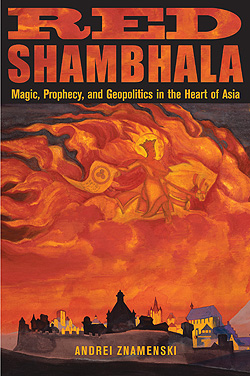
Red Shambhala: Magic, Prophecy, and Geopolitics in the Heart of Asia

Where on Earth do I begin? “Red Shambhala: Magic, Prophecy, and Geopolitics in the Heart of Asia” by Andrei Znamenski was totally alien to me. Knowledge of Tibetan Buddhism? Minimal. Familiarity with the politics of Eurasia in the 1920’s and 1930’s? Nonexistent. An understanding of the variety of interpretations of Shambhala and its associated prophecies? Nope. Are you now frightened of this daunting book? Well don’t be.

Author Andrei Znamenski breaks everything down to its most basic parts to help bring order to this chaos. He begins by explaining the assorted legends, myths, and religious tales of Shambhala and its association with those living in Mongolia, Tibet, and surrounding lands. To sum up, Shambhala is a legendary kingdom hidden somewhere in Inner Asia. It’s considered a land of purity and enlightenment and home for a more spiritually advanced and possibly technologically advanced civilization. Of course most modern Buddhists consider Shambhala a spiritual place to be found within oneself, but Znamenski carefully outlines a period of time when Shambhala was considered an actual location that those of pure intention could find.

The next layer to be added to “Red Shambhala” is an explanation of the Bolshevik revolution that took place in 1917. This was when the Bolsheviks, a faction of the Marxist Russian Social Democratic Labour Party, came to power during the October Revolution phase of the Russian Revolution of 1917. The Bolsheviks were an organization consisting primarily of workers who considered themselves the leaders of the revolutionary working class of Russia. This is where Znamenski starts to introduce you to some of the future players in the quest for Shambhala.

What comes next is the unbelievable true life story of how the idea of Shambhala was a tool used in assorted political and megalomaniacal schemes all focused on the conquest of Mongolia and Tibet. Alexander Barchenko wants to find Shambhala to learn the sacred wisdom there and believes by introducing the elite of Red Russia to the knowledge of Shambhala he will be able to make the Communist project in Russia less violent. The elite see Barchenko’s theological journey to Inner Asia as a chance to plant the seeds of Communism in other lands. Baron Roman von Ungern-Sternberg travels to the east, and uses the legend of Shambhala as a tool to unite the nomads of Mongolia in an effort to restore monarchies. The Roerichs, Nicholas, his wife Helena, and their son George, attempt to establish a Buddhist-Communist theocracy. Nicholas poses as the reincarnation of the fifth Dalai Lama, obviously not counting on the politically shrewd living Dalai Lama of the time. And those are just a taste of the eccentric, larger than life characters that really truly lived, and very much tried their hand at king making and empire building.

After reading “Red Shambhala” you’ll come away with new insights into the history of Communism, Tibetan Buddhism, and the use of propaganda. They say real life can be stranger than fiction, and Andrei Znamenski’s research proves that phrase to be very, very true.

“Red Shambhala” releases in June 2011.

An Introduction to Meditation

By Jason Compton
(This article originally appeared on the Gates of Mysticism website and is published here with the author and site’s permission)

Many people believe they know what meditation is, and they do, but only in the most basic sense. If you look up meditation you will find such simple explanations as what I pulled from Wikipedia in about thirty seconds: Meditation refers to any of a family of practices in which the practitioner trains his or her mind or self-induces a mode of consciousness in order to realize some benefit. The Wikipedia article then goes on to state that it is an internal practice, lists history, and lists the benefits of meditation in a way which doesn’t explore what I feel meditation is all about. The definition and content of such articles are essentially true, but there is far more to meditation than simply going into a hyper-internalized state of being, and the benefits range from the personal to the metaphysical and occult. My goal for this article is to take you a bit beyond the basic definition of the word and show you the benefits of meditation as well as give you an insider look into the practice.

To me, meditation isn’t a focusing of the mind per se, it is adjusting your mind to exercise it in a way that goes beyond the bounds of what a mind in its normal awake state can do. Sometimes this means focusing it, sometimes calming it, sometimes shutting it off as much as possible, and yet other times heightening it’s activity to accomplish things you couldn’t do with normal awareness. I also meditate simply to re-center myself after a chaotic day, a practice which is commonly called grounding in occult practices, or to look inside myself to do inner reflection and introspect.

One thing I do in a meditative state everyday is I stop focusing on random thoughts, and instead focus purely on my senses. This brings me to (what I discovered a few years ago) what scientists and hypnotists describe as a light meditative state in which parts of the brain stop doing what they normally do to enhance a singular purpose of the mind. It took me a full year to learn to go into this state when I was young, and I use it primarily to keep my mind sharp and to sense things around me, and see the world in a different light. A bird becomes more than a bird, for example, it becomes a vibration of sound and light which can be observed in impressive detail. Memory improves when I am in this state and I can remember exacting details of the bird that I was not able to remember before. I can do the same thing when I focus on energy as well and while in this state it becomes much easier to work with energy closer to the physical level of existence, a practice which I do every day mostly to pick up details I would otherwise miss in the world around me.

A different kind of meditative state that I go into is focusing the center of my awareness elsewhere other than my head. When I say awareness I am talking about the physical place people feel that their awareness is located, including their self awareness. Most people feel their center of awareness just behind the eyes and nose close to the center of the head. What this meditation does is move that center of awareness to other parts of the body or, more impressively, out of the body altogether in what for lack of a better term I call a mental projection. Note this is far different than an astral projection in that the body does not need to be in a mind awake body asleep state associated with a projection (or, indeed, what most people consider a meditation,) for this to occur. Since I am focusing primarily on a single point, this is a meditative state which, I learned a few years ago from reading up on hypnotherapy and a few scientific studies, re-focuses the brain and puts much of it into an “automatic” mode, more specifically motor control. I have found that I can still move around while the center of my awareness was elsewhere. This has brought me leaps and bounds in my personal development for helping people heal, distance healing while typing on the computer, and exploring the universe in general.

A third kind of meditation I go into I use for personal development, personal healing, and Astral Projection. This meditative state requires that I be in a very comfortable position, preferably laying down, to accomplish. I later learned the specifics of what goes on during this. My brain slows the parts of itself that control motor functions down so I can focus purely on thought. During this time I can move my awareness throughout my conscious mind and focus in on particular thoughts I am having, stop those thoughts, make them run faster, and explore the how’s and why’s I am having them. This is the most powerful form of introspection that I undertake and I personally believe that it has helped stop me from becoming stark raving mad. I can also explore my subconscious in a deeper form of this state, and that has also helped clear me of many personal problems I used to have.

To me, meditation is a way of exploring both myself and the world around me through a different set of eyes, both physical and metaphysical. I can interact with parts of myself and the energy and thoughts around me through meditation, which I do on a daily basis and for many reasons such as healing others, helping myself, and finally learning about the universe around me. I have a personal quest for knowledge and self improvement which, without meditation, would be difficult, long, and I dare say impossible. Meditation is powerful tool that can be used for things besides the occult, you can look at yourself in a new way and view the world around you with eyes that see the world in a different way, and you can use meditation to calm yourself after a tough day.

There are many resources on meditation out there. None of them are wrong in their approach and I find that finding the correct approach for you is a very personal journey. I personally suggest the works of Franz Bardon as a starting point, and you can also look into specific classes in your local area, as having a teacher walk you through meditation is a wonderful and enlightening experience which I believe everyone can benefit from trying. Seeing a hypnotherapist or just someone who has a hypnology license is also a great way to get into a meditative state, though it can get expensive. I suggest lots of research into metaphysical sites as people on spiritual paths have been exploring meditation the longest and hardest, and finding someone with many hours or even years of meditation under their belt is a great starting point. A bit of advice is to find out how many hours of meditation the teacher has undergone, as someone can have done years of meditation yet not racked up as much experience as someone who is a monk but only had meditated for a month.

It is also important to keep in mind that experiences that you have in a meditative state, including going under hypnosis, can be very powerful and compelling. An open mind is required when going into the deeper meditative states since what you are seeing can be representative visuals. What I mean is that you may see yourself in a house from long ago, but that might not necessarily be you that you are seeing and the house might not have ever even existed. Your subconscious could be trying to communicate something to your conscious mind and when it does it often uses visualizations and representations, and in more powerful cases it will communicate thoughts and ideas directly without using words. These ideas can come in the form of you getting a sudden idea in the center of your awareness suddenly that didn’t come from your conscious. Sometimes these experiences can cause people to pull out of a meditation very suddenly as they don’t recognize what is going on. If you do have an experience that scares you or you don’t understand there are many avenues for you to explore what the experience is or what it means. A psychologist, if one is easily accessible to you, is a good step as sometimes scary experiences can represent inner conflict or troubling memories and pain that we have.

I have had many troubling experiences myself during meditation, each time I got through them I ended up a better person for it. One time I found myself in my inner mind and being the extremely troubled lad that I was, I found myself surrounded by things that wished me harm. After fighting them off and dealing with the how’s and why’s they were there I became a much calmer person, and felt much more at peace with myself and the world around me. The first troubling experience you have is always the hardest to work through, but once you do it will become easier and easier to work through them until you find that these experiences are years between each other.

This is not to say that all experiences when you meditate are going to be negative experiences, or that each time you meditate you are going to be doing introspection. The truth is that meditation is different for each individual and the experiences they have when they go further into the recesses of their mind vary greatly. If you are having troubling experiences it would be best to take it as a sign that there are simply some things inside yourself that you need to work out. You cannot truly be harmed by anything you see in a meditative state unless you allow yourself to be harmed, just remember that what you are seeing is a part of yourself and face it boldly.

Most experiences are going to be enjoyable and teach you more about yourself. I once found myself in the presence of a beautiful dragon during meditation. The dragon made me feel protected and safe, and I also felt a lot of love coming from it. After working with it for a long while I found a way to bring up this part of myself at any time and it has boosted my confidence and improved my demeanor.

Another experience that I had was probably one of the most powerful and compelling Astral Projections I have ever had. I was seeing just how far down my mind I could go one day, exploring the extremes of my mind when suddenly I found that I was approaching a blue and white ring of light. Part of why I went this deep into my mind was to explore if I could emerge on the other side and this felt like a validation of that theory. When I went through it I saw a beautiful phoenix on the other side and a calm but surprised voice on the other side spoke my name. The love that I felt from this being was so powerful that I was shook to my core, and I was pulled right out of the projection (much to my dismay.) I knew I wasn’t in my mind anymore at that point because I could no longer feel myself or my inner workings around me, as I had become very familiar with in projections.

The above experiences show two extremes of a specific form of meditation where you go deep inside yourself. It is the most common form of meditation and perhaps the one that changes people the most. I hope some of you reading this has took something out of it, and that it peaks your interest in trying out this very helpful practice.

About Jason Compton:
Jason Compton is a general practitioner of the occult and combines a few practices to form a loose likeness to what Franz Bardon teaches in his books. He loves painting miniature figures, playing video games, and is currently making plans to write books both for literary and informative purposes. You can find him at http://www.gatesofmysticism.net or anywhere on the net where occult sites can be found under the online alias of Spectral Dragon or variations thereof.

King Solomon Oracle Cards

Every now and then I come across this problem. I see a product that looks cool. I ask the publisher if I can have a copy to consider for reviewing on this lovely website. They send said product, and it is just a wonderful as I anticipated. Then I am thoroughly unable to write a review.

By now the “King Solomon Oracle Cards” by Itzhak Mizrahi and Orna Ben-Shoshan from U.S. Games Systems are pretty old news. I’m pretty sure I’ve been sitting on them for at least a month! So why no review? Sheer inability on my part.

I like the art by Orna Ben-Shoshan. The coloring is vibrant, and yet the art conveys a soothing feel. I like the work of Itzhak Mizrahi. I appreciate how hard it is to come up with something new, and that the deck isn’t pretending to be a play on the traditional tarot deck. The “King Solomon Oracle Cards” are their own deck. A deck unto itself. Lastly, there are four amulet cards that also come with the deck. As per the included booklet, “These are your own personal sacred amulets that you may keep at home or carry with you wherever you go. These charms were written in Angel’s Writing and ancient Goatic symbols by the kabbalist Itzhak Mizrahi.” There is nothing more impressive looking than an amulet. Seriously. I love the included amulet cards and have them on my bulletin board so I can take breaks to look at them when I write.

Amulet One - Livelihood

That’s what I’ve got folks! After a month of handling the “King Solomon Oracle Cards”, a month of looking at the beautiful cards that I scanned into my computer for this review, a month of reading and rereading the over 40 page booklet included with the cards, I’ve got one paragraph to share.

Perhaps after reading this micro review some of you will be inspired to seek out these cards, and hopefully you’ll be able to do a better job of articulating just how wonderful they are.