Astrology in Different Cultures

Do you guys remember when I shared “Astrologically Inspired Cocktails”? Well it turns out an astrology website in Australia did and reached out to me. They were like, hey, that’s a fun little infographic you shared. We’ve got one about astrology in different cultures, are you interested? Duh, of course I was and here we are.

So a big thank you to the folks at Astrology.com.au for the cool looking infographic to share! You should check out the full article on their site!

Astrology in Different Cultures

Traditional Magic Spells for Protection & Healing Review and Giveaway

I have a hard time writing reviews for Claude Lecouteux’s books. They’re all dense tomes of knowledge, meticulously researched, and loaded with excerpts and references from medieval texts. One doesn’t casually breeze through one of his books, you slowly follow the path that he lays out before you. And his latest “Traditional Magic Spells for Protection and Healing” is no exception.

As usual Lecouteux turns his scholar’s eye towards highlighting the intersection of Christianity and Pagan beliefs, this time with medical practices tossed in. In medieval times health issues were a matter of body, the spiritual world, and spiritual concerns. Not only does Lecouteux outline means of diagnosis, but addresses the cures whether you’re being afflicted with an evil spell, or tormented by a demon. Incantations against wolf bite, using alum in water to help someone regain their speech, charms against demons, and obviously so much more!

“Traditional Magic Spells for Protection and Healing” is a must for magic nerds like myself. Honestly, every Claude Lecouteux book is a must own.

You can learn more here.

Guess what? Due to a mix up at Inner Traditions I have a copy of “Traditional Magic Spells for Protection and Healing” to give away!

The winner will be selected via the Rafflecopter contest below on Sunday, April 29th at 11:59 PM Eastern time. Good luck!

a Rafflecopter giveaway

10 Questions with Judy Hall

1. What first sparked your interest in crystals?

I’ve been attracted by crystals since I was very small. My grandparents lived in the English Lake District and I spent a lot of time walking there with my grandfather picking up ‘shiny things.’ I amassed a wonderful collection of Quartzes. Later I found a rather strange mineral shop in Southend and bought masses of crystals from him. However, he wouldn’t identify anything so, when I found there was no crystal directory available, I ended up writing The Crystal Bible to record my experiences with them. Things snowballed from there.

2. What’s your favorite thing about working with crystals?

I love to work intuitively with them so that they can reveal themselves to me. I’ve been an astrologer for fifty years and always placed crystals on birthcharts when doing karmic readings to balance out the energies. This expanded into sharing them with workshop participants. Now I spend a great deal of time talking to crystal skulls and crystal dragons. It takes me into the multidimensional multiverse, a great place to explore.

3. You’re written so many books about the world of crystals, what sets your latest book, “The Crystal Seer” apart from the others?

(Judy Hall refrained from answering this question, so allow me to insert a little info/review here.) “The Crystal Seer” features content from Hall’s previous release “101 Power Crystals”. It is compact, full color 176 pages of beautiful photos and of course loads of info about crystals! It is a sturdy hardcover that will travel well in purses and messenger bags for crystal identification on the go. It’s good stuff!

4. These days you’ll find crystals in everything from skincare to bottled water. Do you find this further infusion of crystals into items beyond jewelry a good thing?

Crystals have always been in the most surprising of places, even the sparkplugs in your car and the paint on your walls. So this expansion doesn’t surprise me. But, as I believe that there is no such thing as ‘one crystal fits all’ I do feel you need to find the right product for you in order to gain benefit.

5. What’s one of your favorite crystals, and why?

The one crystal I wouldn’t be without is a Brandenberg Amethyst. It literally does everything I could ever require of it – and more.

6. Where do you get most of your crystals? (stores, websites, rock shows, etc.)

From all over the place! I still go out and pick them up from a very special crystal mountain – and any beach I happen to be on. I also buy from trusted websites, wholesalers, rock shows, favourite stores. I’m fortunate in that I’m often sent new crystals to assess. There are some lovely crystal suppliers out there.

7. If someone wants to start using crystals, where do you think they should begin?

Well, once they’ve cleansed and asked the crystal to work with them (how to do this is on my website www.judyhall.co.uk and in virtually all my books), I suggest they ask the crystal how it wants to work with them. Learning to listen to your crystals brings out the best in them. Having said that, I do have an online crystal course and several books that teach the basics. After that, you can follow your heart. Oh yes, and buy my Crystal Companion, it’s the best guide I’ve written. (see no.9)

8. What do you do when you’re not working with, or writing about, crystals?

I visit sacred sites, which are one of my great passions, although of course that often involves crystals (see my Crystals and Sacred Sites book). Quite often from the comfort of my armchair courtesy of a crystal. I travel as often as possible as I really enjoy seeing new places. I’m just off to see some amazing huge rock balls in Romania that are, allegedly, still growing. Really looking forward to that! I also play as often as possible with my great granddaughter who is four, that’s a great way to take a different view of the world. I devour books and I enjoy splashing paint on canvass to see what occurs.

9. What’s next? Do you have any upcoming projects my readers can look forward to?

Yes, my ‘Crystal Companion’ came out on 5th April. This is a book I am really excited about. It brings together information on crystals, introducing many of the latest finds, with how I personally work with them. It’s been colour-themed for the various areas of life in which you can use crystals so if someone works through it they’ll have explored just about every crystal possibility.

10. Parting shot! Ask us at The Magical Buffet any one question?

Well, rather than a question, I have a suggestion. How about asking all your subscribers to dedicate a crystal to world peace and hold it for just a minute a day. It could make such a difference at this troubled time.

(You heard the lady!)

About Judy Hall:
Judy Hall (Dorset, England) is a successful Mind-Body-Spirit author with over 45 MBS books to her credit including the million copy selling “Crystal Bible (volumes 1 and 2)”, “Encyclopedia of Crystals”, “101 Power Crystals”, “Crystals and Sacred Sites”, “The Crystal Seer”, “Crystal Prescriptions”, and “The Crystal Wisdom Healing Oracle”. A trained healer and counselor, Judy has been psychic all her life and has a wide experience of many systems of divination and natural healing methods. Judy has a B.Ed in Religious Studies with an extensive knowledge of world religions and mythology and an M.A. in Cultural Astronomy and Astrology at Bath Spa University. Her expertise are past life readings and regression; soul healing, reincarnation, astrology and psychology, divination and crystal lore. Judy has appeared four times in the Watkins list of the 100 most influential spiritual living writers and was voted the 2014 Kindred Spirit MBS personality of the year. An internationally known author, psychic, and healer, Judy conducts workshops in her native England and internationally. Her books have been translated into sixteen languages. You can learn more about her and her work at her website.

Witches & Wizards

You may remember when I wrote about “Human Tribe” I suggested that perhaps it’s my nosy nature but I’m always curious about people. Let me add that I’m particularly interested in the lives of historic magical practitioners, which is why when offered the chance to read “Witches and Wizards: The Real-life Stories Behind the Occult’s Greatest Legends” by Lucy Cavendish I jumped at the chance.

Let me start with, any of the subjects in “Witches and Wizards” is worthy of a whole book unto themselves. Many of them do have whole books dedicated to them! However something about the mix of types and eras makes for an interesting “big picture” look at magical practitioners that shaped our world. Inside you’ll read about Merlin, Aleister Crowley, Doreen Valiente, John Dee, the witches (or not witches) of Salem, Massachusetts and of course more.

I hate to sound like a total book nerd, but I also love the physical format of the book too. It’s small, hardcover with no slip cover, just a cover with beautiful cover art on it. This book is going to last, and better still it says, “The Supernatural Series Book One” at the top. This hopefully means I can look forward to a shelf full of these attractive and interesting books.

You can learn more about “Witches and Wizards” here.

Practical Magic Review and Giveaway!

Let’s be totally real here. There are hundreds, probably thousands, of beginner’s guides to magic and witchcraft. I could easily recommend a couple before ever having read “Practical Magic: A Beginner’s Guide to Crystals, Horoscopes, Psychics, and Spells” by Nikki Van De Car. However I’m here to tell you that THIS is the one you give to others (and possibly as a gift to yourself too).

“Practical Magic” briefly touches on every little thing that floats in the realm of magic. Chakras, herbs, crystals, astrology, Pagan holidays, auras, tarot, lucid dreaming, and even more are covered in this 176 page book. The author’s writing is clear and accessible. She makes every topic interesting and a thing you would want to explore more in depth.

The reason this is THE gift to give is not only the broad scope, but this book is BEAUTIFUL. I mean absolutely stunning. Hard cover, heavy paper stock, full color and loaded with fabulous illustrations by Katie Vernon. The whole look of the book is magical in appearance.

This photo doesn't do the art justice.

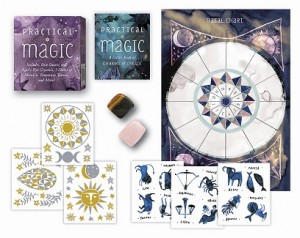
Not to get all infomercial on you, but wait, there’s more! You know how stores have those irresistible little boxes with different themes at the checkout? I’m a sucker for those and there is one that goes with “Practical Magic”! This little gem is packed with goodies: a piece of rose quartz and tiger’s eye, a fill in astrological chart with adorable stickers, three sheets of temporary tattoos, and of course a tiny 48 page book to help you put it all to use!

Look at all of it!

You can learn more about “Practical Magic” here: http://www.runningpress.com/book/practical-magic/9780762463077

But don’t leave this post yet! The great folks at Running Press gave me a “Practical Magic” book and kit to give away to one lucky Magical Buffet reader! Just do what the nice Rafflecopter below asks and you’ll be entered! Starts now, ends at 11:59pm Eastern time on Sept. 4, 2017. Open internationally, must be 18 or older to enter.

a Rafflecopter giveaway

The Book of Thoth – Special, Shiny Edition

You guys, this is some serious book porn that is about to happen. Prepare yourself. Lock the door, close the curtains, and then continue on to read this press release from Red Wheel/Weiser.

Aleister Crowley’s The Book of Thoth endures as one of the most definitive volumes on the tarot ever written. This classic text describes the philosophy and use of Aleister Crowley’s Thoth Tarot, a deck designed by Crowley and painted by Lady Frieda Harris. The Thoth Tarot has become one of the bestselling tarot decks in the world. It is also one of the most original interpretations of the tarot, incorporating astrological, numerological, Egyptian, and Qabalistic symbolism. While there are many other useful guides to this famous tarot deck, there are no others that explain the deck in its designer’s own words.


This new facsimile edition of The Book of Thoth is a faithful reproduction of the Samuel Weiser Inc. 1969 edition, which in turn was a facsimile of the original O.T.O. edition printed in 1944. The text is digitally restored, printed on a heavy, coated stock, and features revised color plates and black and white illustrations of the Thoth Tarot based on new photography of the original art, courtesy of the O.T.O. and The Warburg Institute. The book text block is smyth sewn, with a rounded back, and headbands. Printed endpaper reproduces the Egyptian motif from the board covers of the 1944 edition. The cover is quality cloth over boards with gold stamping on the spine, and is wrapped with a jacket which again features updated art while matching the original design. Weiser Books takes pride in the release of this new hardcover reprint on the event of our 60th anniversary in publishing.

“The Book of Thoth” releases in September. The super, sexy $60 hardcover edition is limited to 3,000 copies, so you may want to head over the Red Wheel/Weiser website to order your copy today!

Secret Medicines from Your Garden

This book has been out for over a year. Over a year! I even read it as soon as it came out, and yet it has taken all this time to share my thoughts on it. “Secret Medicines from Your Garden: Plants for Healing, Spirituality & Magic” by Ellen Evert Hopman is still in print, so it’s still worth sharing.

Reading “Secret Medicines from Your Garden” makes you feel like the author is personally leading you on a wilderness adventure. Hopman regales you with anecdotes from her spiritual journey and herbalism training. She doesn’t just tell you about herbs and their meanings and uses, she trains you to intuit a plants purpose. Not only do you learn about the physical natural world, but Hopman discusses plant spirits, herbal astrology, and more. Of course the book is filled with ways to use all that nature has to offer such as poultices, tinctures, and food.

I would say “Secret Medicines from Your Garden” is a surprisingly engaging book, and I dare say it’s my favorite of all of Ellen Evert Hopman’s books. (And considering how many great books she’s written, that’s saying something).

Learn more here.

Wicca: Plain & Simple

There are like a gazillion Wicca/Witchcraft for beginner type books out there. It’s a subject that is not in short supply of being discussed. So when I got a review copy of “Wicca, Plain & Simple” by Leanna Greenaway my response was, I’m sure this doesn’t suck, but I’m not going to bother. However I then noticed that it contained a foreword from Judika Illes, of whom I’m a huge fan, and I was like, guess I’m reading this book now! And so I read it.

And I was impressed. “Wicca, Plain & Simple” is a compact 127 pages, but I’ll be damned if Leanna Greenaway doesn’t manage to hit all the bases and more. Greenaway highlights the flexibility of Wicca and gives readers an amazing sampling of all the magical arts a modern Witch may have interest in, along with the variety of tools they’ll need. She manages to handily condense modern Wiccan ethics and philosophy and highlights them throughout the book.

Now, just like all the “Plain & Simple” books, this one has the tagline line, “The Only Book You’ll Ever Need”. This is absolutely not true. Once the beginning Witch reads “Wicca, Plain & Simple” they will have a road map to follow to pursue whatever Witchcraft paths they wish. “Wicca, Plain & Simple” by Leanna Greenaway is a great for those interested in starting the Wiccan journey, but certainly not necessary for the more established practitioner.

To learn more, visit here.

Deconstructing Gurdjieff: Introduction

By Tobias Churton

Caveat Lector*

Biographers of Gurdjieff are faced with a serious problem: the extreme scarcity of authentic independent documentation of Gurdjieff’s life both up to his appearance in Moscow in 1912-13 and between that time and the Russian Revolution in 1917. Gurdjieff was at least forty years old in 1917, his mind, self-appointed destiny, and fundamental attitudes already fully shaped by previous experience. As regards factual support for that experience, Gurdjieff’s name finds its way into barely a handful of official documents, themselves not wholly reliable. Seismic tumults from the collapse of the old Russian Empire, aggravated by the twentieth century’s immense conflicts and totalitarian vandalism, have sundered and fragmented the historic continuity that might otherwise have yielded collaborative resources from the Caucasus and Transcaucasia regions in which Gurdjieff grew up. Gurdjieff destroyed his own papers during a protracted personal crisis in 1930. We have no volume of Gurdjieff ’s letters or diaries, however slim, to consult. Personal reminiscences of followers, often highly subjective, are frequently at variance with one another and with verifiable facts.

Self-perceived as a man apart, a kind of spy in a confused, damned world, Gurdjieff persistently objectified the human beings around him; the first thing Gurdjieff ’s most influential follower P. D. (Pyotr Demianovich) Ouspensky noticed about his teacher in Moscow in 1915 was that Gurdjieff was always acting. Gurdjieff was many men and appeared in many disguises. Was he hiding something, or was he hiding from something?
In the Introduction to Meetings with Remarkable Men, written after 1924 and published after his death, Gurdjieff explains that part of his purpose in writing the book is to save himself future trouble in having to answer questions from interlocutors concerning his life and, especially, his beliefs. He complains that such questions have been vexatious to concentration on other more pressing matters and regards these questions merely as ones put by “idle curiosity.” Those interested in his personal life are described as “shameless idlers.” To satisfy their curiosity he has nonetheless, “in revising the material destined for this series [he means this book]” decided to present it “in the form of separate independent tales, and to insert in them various ideas which can serve as answers to all the questions often put to me.” The questions put to him are, he says, to do with the “remarkable men” he has encountered; “marvels” seen in the East; questions of the immortality of the soul; whether or not man has free will; the cause of suffering; the credibility of “occult and spiritualistic sciences”; the nature of hypnotism, magnetism, and telepathy; how he first became concerned with such questions; and what then led him to the system practiced in the institute bearing his name.

Gurdjieff, conscious of writing a “new kind” of book, deliberately shaped and reshaped elements of his life and imagination as illustrations or parables of his system. He dramatized ideas. The ideas might be real but individual characters may not be, though their behavior may be truthful regarding human nature or Gurdjieff’s ideas of ideal or misguided action, observed from experience.

The cooked-up book is what the dramatist Bertolt Brecht (1898-1956) would call a lehrstücke, a “learning-play” or experimental teaching piece wherein actors adopt roles, postures, and attitudes that exceed conventional distinctions between stage and audience, between idea, image, event, and reality, fact and fiction. Brecht famously declared, “Realism does not consist in reproducing reality, but in showing how things really are.”

In the case of Gurdjieff’s book, Gurdjieff is principal actor as well as narrator, and elements of his experiences, fantasies, prior reading, and thoughts–and what he considers the fantasies and expectations of his readers–play the parts; Gurdjieff “sings their tune.” We can see why Gurdjieff has most appealed to actors, dancers, musicians, painters, impresarios, and storytellers, those especially conscious of the role of symbol and its encoding in artificial forms of address. Artists get or “cotton on” to congenial aspects of Gurdjieff, whereas more prosaic, sometimes troubled minds–perhaps his principal following–struggle with it all, often for years, perennially taking the “black devil” too literally, perhaps too respectfully.

Gurdjieff’s idea of science was that of the ancient Magi, not the modern classroom. He barely ever disguised his loathing for what today is called, without irony, higher education. I personally suspect he had a chip on his shoulder about never having graduated from university, so vehement were his repeated digs at “wiseacreing,” an ungainly word (in translation) that occurs with tiresome, arguably obsessive repetitiveness throughout all his writings and talks; followers have picked the word up and scatter it like buckshot from on high at critics. Gurdjieff was a “university of life” type of graduate, cynical about cynics. Perhaps to lend authority to conviction, he even invented from the store of reality and myth the archetypal sacred university of wisdom–the Sarmoung Brotherhood–a body of such exalted spiritual purity and genuine universality of insight that its denizens would never soil their elegant hands with the muck of modern education reliant on paper qualifications and bookish memory learning.

Unlike the professional talkers and establishment-acceptable pundits, the self-taught apparently polymathic, autodidact Gurdjieff could turn his hand to anything and persuade people to do things they never dreamed of doing. He was the man you’d think you’d want in a real crisis. He talked the talk because, as far as he was concerned, he had walked the walk. Unfortunately for historians and biographers he mostly fictionalized the walk. He didn’t want people to follow his footsteps, but to find their own.

Gurdjieff’s “Men” are remarkable insofar as they have recognized that the true value of life comes only when that life consciously acquires mythic dimensions, when one, with feet on the ground, has yet traversed the stars and touched the beyond. Remarkable men have seen something unremarkable men have not. Such men should engage our attention. Was Gurdjieff himself one of them?

*“Reader Beware”

To learn more click here.

About Tobias Churton:
Britain’s leading scholar of Western Esotericism, Tobias Churton is a world authority on Gnosticism, Hermeticism, and Rosicrucianism. An Honorary Fellow of Exeter University, where he is a faculty lecturer, he holds a master’s degree in Theology from Brasenose College, Oxford, and is the author of many books, including Aleister Crowley: The Beast in Berlin and Occult Paris. He lives in the heart of England.

Deconstructing Gurdjieff by Tobias Churton © 2017 Inner Traditions. Printed with permission from the publisher Inner Traditions International. www.InnerTraditions.com


A Sandra Kynes Double Header

I love Sandra Kynes. She’s an insanely prolific writer whose work never seems repetitive, is always accessible to the average reader even while being scholarly, and despite my only sporadic support she always personally mails a copy of each of her new books. And you know, I don’t seem to see people talking about her as much as she deserves. I’m hopefully going to remedy that now with a Sandra Kynes book review double header. These two book go together great, and I hope after reading this little article you’ll be inspired to pick them both up!

First, get ready to get excited about gardening because I’ll be talking about “The Herb Gardener’s Essential Guide”. On the cover it also reads, “Creating Herbal Remedies & Oils for Health & Healing.” But it doesn’t do just that. Kynes takes you from how to design your garden, whether it’s a single pot or a whole backyard, to understanding your soil, recommended tools, garden maintenance, and more! Seriously, it’s like a super interesting gardening show in the palm of your hand!

Once you’re through that you get to harvest. Kynes discusses the best way to store your herbs based on type and intended use. This is also where she gets into the nitty gritty of making herbal remedies, and as usual, she leaves no stone unturned. Teas, infusions, infusion oils, infusing with essential oils, decoctions, tinctures, bath oils and salts, compresses, creams, diffusers, powders and capsules, foot soaks, ointments, salves, balms, and still more! If that wasn’t enough ways to use your herbs, Kynes also devotes time to culinary uses of herbs for good health, such as cooking oils, butters, and breads.

Then she has a nice selection of profiles for assorted herbs. It includes the herb’s uses, including precautions and contradictions, and their preferred growing environments. There is also a handy appendix that lets you look up herbs by the ailment they treat.

Maybe it’s just me, but “The Herb Gardener’s Essential Guide” got me really excited about herb and herbal gardening.

The other book I’d like to address is “Plant Magic: A Year of Green Wisdom for Pagans & Wiccans”. This book is a reminder that Sandra Kynes is one of the queens of cataloging connections and correspondences. After all, she did write the book “Llewellyn’s Complete Book of Correspondences: A Comprehensive & Cross Referenced Resource for Pagans & Wiccans”. Whereas “Complete Correspondences” covered anything and everything you can imagine, “Plant Magic” pulls the huge interconnected web in to focus solely on plants.

The book is primarily broken down into the 12 month of the year. Each month features “On the Calendar” (essentially holidays like New Year’s Day and Samhain), “In the Garden”, (highlighting plants that bloom during that month), “In the Wild” (profiling plants that can be found in the wild that month), “In the House” (offering ideas of things to do with plants that are appropriate for the month). Of course there is a handy appendix that’s a plant list/quick guide, and one full of magical correspondences. If you are a Wiccan, Pagan, or magical practitioner that’s into plants, I would call this book a must.

For more information on “The Herb Gardener’s Essential Guide”, visit here.

For more information on “Plant Magic”, visit here.