A Magical Buffet of Authors

It started simple enough, author Deborah Blake sent me an email saying she was going to be in the Saratoga Springs, NY area and did I know of anywhere she could do a book signing. Having worked at the Saratoga Springs, NY Barnes and Noble as a Department Manager I immediately mentioned it as an option.

Six months later I found myself in the Barnes and Noble café with my friend and former co-worker Crystal Jenkins, who is now the Community Relations Manager at the Saratoga Springs store. However, in the months between talking to Deborah and that evening in the café, a single author book signing event wasn’t what I was there to pitch. I had realized that I had connections, and Crystal had experience and a store.

As we sipped our coffee I handed her a sheet of paper, “Here is a list of authors that I am friendly with that live within a 4 hour driving radius of this store.” On the sheet were 10 authors that read like a fantastic whose who of Magical Buffet contributors. And with that, an event was born!

Out of those 10 authors, 7 authors have committed to an event that had never been tried before, in a town they may or may not have ever heard of, and without any compensation for travel or lodging. The enthusiasm they have shown makes me feel humble and like the luckiest blogger in the world. Also, the excitement and appreciation Crystal at Barnes and Noble has expressed makes me feel like a rock star, and when she suggested calling the event “A Magical Buffet of Authors”, well, see the previous humble and lucky comments.

With all of that out of the way, I am here to proudly announce the first ever Magical Buffet “branded” event!

A Magical Buffet of Authors

Date: Saturday September 11, 2010
Time: 2 – 6 pm
Location: Barnes and Noble 3029 State Route 50 Saratoga Springs, NY 12866 For more info, here’s their website.

But enough of the teasing, let’s do this thing!

Here are the participating authors (with personal Rebecca notes italicized).

Deborah Blake is the author of “Circle, Coven and Grove: A Year of Magickal Practice” (Llewellyn 2007), “Everyday Witch A to Z: An Amusing, Inspiring & Informative Guide to the Wonderful World of Witchcraft” (Llewellyn 2008), “The Goddess is in the Details: Wisdom for the Everyday Witch” (Llewellyn 2009), and the forthcoming “Everyday Witch A to Z Spellbook” (2010) and “Witchcraft on a Shoestring” (2010). She has published numerous articles in Pagan publications. Her award-winning short story, “Dead and (Mostly) Gone” is included in the “Pagan Anthology of Short Fiction: 13 Prize Winning Tales” (Llewellyn, 2008). Deborah can be found on the web here.

What can I say about Deborah Blake that hasn’t already been said? What could have easily been a brief exchange when she did a 10 questions interview for the site back in September 2008, instead became a wonderful friendship. She’s been a constant supporter of all things Buffet. Deborah is funny, warm, and a huge fan of chocolate. You should buy all of her books, but particularly “The Goddess is in the Details” (my favorite) and “Witchcraft on a Shoestring” (if it’s available), and you should bring her Choxie chocolates from Target. Did you know there is no Target in Oneonta, NY?

Gordie Little has spent 36 years in radio; 8 years as a Crime Victims Advocate; and has written 653 weekly newspaper columns for the Press-Republican newspaper in Plattsburgh, NY. He has done more than 700, 90-minute television documentaries in the North Country region of New York State and loves to study all things paranormal and has written “true” ghost stories for many years. His new book, entitled “Ghosts of Clinton County,” was published by North Country Books in Utica, NY.

I met Gordie Little at last year’s Northern New York Paranormal Expo where his first book of ghost stories, “Ghosts of Clinton County”, was unveiled. Since then he was kind of enough to share a story about “Spicy Italian Ghosts” with my readers. Gordie has infectious enthusiasm, so be careful, it truly is contagious. Also, this is true, Gordie will send you an unexpected email, seemingly at random, that says nothing but that he appreciates you. If you meet him, you will buy his book, seriously, consider yourself warned.

David J. Pitkin has sought understanding of the mysteries surrounding life and death following an experience with a ghost in 1968. In the process, he has written 7 books, beginning with “Saratoga County Ghosts” in 1998. Fascinated with the unconscious mind and on evidence for consciousness surviving body death, he published his first metaphysical novel, “The Highest Mountain”, in 2007. He also has completed two books of New York State ghost stories, and one detailing over 200 tales in the northeast US and Canada. In the process, he has interviewed over 1,100 people, whose stories make up his fascinating rendition of ghost stories. His book “New England Ghosts” releases September 1, 2010.

I love, love, love David Pitkin. Way back in October 2006, when The Magical Buffet was a monthly online e-zine, David contributed the very first guest authored feature article “The Art of Telling a Ghost Story”. He did this even though our website was still just a page holder where people could subscribe and our subscribers numbered around 50, as opposed to the over 500 that it is today. He treated me as a professional, despite all indicators to the contrary. I’ve been a devoted Pitkin fan ever since. If you’ve never met David in person, be prepared to get charmed right off your feet. Whether at a book signing with about 4 customers (like the signing I’ve been to) or at Barnes and Noble surrounded by dozens of readers (like the time he did a reading while I worked at Barnes and Noble) he treats each person as an honored guest. That probably explains why Saratoga loves him so.

Maria Kay Simms, a professional astrologer for nearly 30 years, is the former elected Chair of National Council for Geocosmic Research, Inc., a prestigious non-profit organization for astrologers best known for its rigorous 4-level certification program. Maria holds the Level 4, or CA NCGR, and she also holds the PMAFA, professional certification from American Federation of Astrologers. Maria is author of two popular ACS personalized reports, “Planetary Guide to Your Future” and “Your Magical Child”, and is the creator of the ACS art charts, and is a contributor to the “Electronic Astrologer Reveals Your Future” software program. Her books include “Your Magical Child”, “Moon Tides, Soul Passages”, and “Future Signs”. Her “Dial Detective” is considered to be a classic in the astrologica specialties of Cosmobiology and Uranian Astrology. Maria can be found on the web here.

These days it’s not uncommon to read a book review on The Magical Buffet, but back in 2007 it seemed ludicrous to think anyone would want to hear my thoughts on books, let alone have a publisher send me a book to read! That was until Starcrafts Publishing sent me a copy of Maria Simms “Moon Tides, Soul Passages”. That opened the door and now I receive books and samples from publishers regularly. I would recommend getting your hands on a copy of “Moon Tides, Soul Passages”. As I said back in 2007, “Are you Wiccan? Are you interested in astrology? Are you interested in the moon? Are you interested in mythology?” If you answered yes to any of those questions, get a copy, you’ll love it!

Ellen Evert Hopman has been active in American Druidism since 1984. She is co-chief of the Order of the Whiteoak (Ord na Darach Gile), a popular author of Druidry-related titles including: “Priestess of the Forest: A Druid Journey” and “The Druid Isle” (Llewellyn), “A Druids Herbal of Sacred Tree Medicine” (Destiny Books), and “Walking the World in Wonder: A Children’s Herbal” (Healing Arts Press) and a master herbalist. She lives in Massachusetts. Ellen can be found on the web here.

Words simply cannot express the gratitude I have for having Ellen Evert Hopman in my life. She wrote the award winning article “Female Druids” for The Buffet back when we were still a monthly online e-zine, and once we converted to the new blog format she has regularly contributed articles about tree medicine, magic, and lore. And her books! “A Druids Herbal of Sacred Tree Medicine” is fantastic! Now she’s also branching into fiction, giving people an enjoyable story that teaches others about Druidism. Ellen is one of the authors that continually treats me, and The Magical Buffet, as a valuable media platform. Prove her right by getting a book signed, we’d both love it.

Gail Wood started her writing career early when a story she wrote in the first grade was posted on the board by her teacher. The story was about Jo-Jo the monkey. Her mother saved that story for Gail! Currently she lives in a 100+ year old house with her partner Mike and their two dogs. Mike shares her spiritual interests and is an exceptionally fine priest, following the ecstatic path of Gaia.

Gail is the author of “Rituals of the Dark Moon: 13 Rites for a Magical Path” published by Llewellyn in 2001. She is also the author of “The Wild God: Adventures with the Sacred Masculine” from Spilled Candy, as well as the forthcoming “Ecstatic Witch: The Path of Shamanic Witchcraft” from Red Wheel/Weiser. She contributed a chapter entitled “Sweet Dreams” to “Cakes and Ale for the Pagan Soul” edited by Patricia Telesco (Crossing, 2005). Her short writings have appeared in Sagewoman magazine and several Llewellyn Annuals including “The Witches Calendar”, “The Spell-A-Day Almanac” and “The Tarot Annual”. Gail can be found on the web here.

I met Gail Wood at this year’s Oneonta Spiritual Arts Fair. She is just so darn loveable! I already mentioned that she is more photogenic than Deborah Blake or myself. Just as an FYI, saying things like that in a public forum is a sure way to insure receiving articles to publish in the future. I’m just saying a little flattery gets you everywhere. Also, she writes really nice things inside the books she autographs. Like what? Only one way to find out, show up and pick up one of her books!
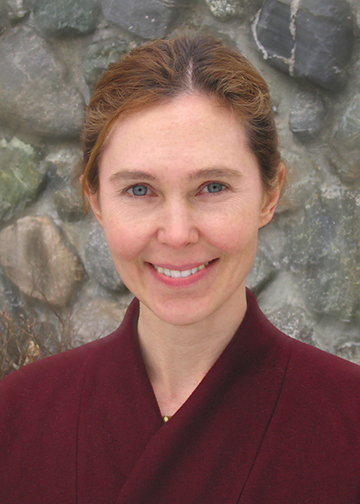
Lama Willa Miller is a meditation teacher in the Tibetan Buddhist tradition. She has studied and practiced meditation for the last twenty years, training with Venerable Kalu Rinpoche, Venerable Dilgo Khentse Rinpoche, Lama Norlha Rinpoche, Khenpo Tsultrim Gyatso Rinpoche, Bokar Rinpoche, and other teachers. She completed two seminary trainings [three-year retreats] at Kagyu Thubten Choling in upstate New York, becoming authorized as a lama, a Buddhist minister, upon completion of her training. Before and after her retreats, she spent time in Nepal, Tibet, and India, studying Buddhism and engaging in service work. She currently lives with her husband and two dogs, where she writes, teaches Tibetan Buddhist practice and meditation, principally with Natural Dharma Fellowship. She is also working towards a PhD at Harvard University.

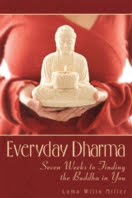
Lama Willa is author of the book “Everyday Dharma: Seven Weeks to Finding the Buddha in You” (2009, Quest Books), a practical guide for getting started on the spiritual path. Lama Willa can be found on the web here.

So, remember when I thought it would be fun, and funny, to publicly write about going through the book “Everyday Dharma: Seven Weeks to Finding the Buddha in You”? Well, the “Everyday Dharma” challenge is still going on! What on earth would make a highly educated spiritual author put up with me? I couldn’t tell you. What I can say is that regardless of me telling people to suck it, implying that there are people I don’t like, and comparing setting up your home altar to the television show “Pimp My Ride”, she just keeps contributing to The Magical Buffet. True story, I was telling some of my friends how in one of my early “Everyday Dharma” posts I said that considering all the trouble my body gives me I treat it awesome and that I treat my body better then it treats me, and how her response was basically, well it’s good to see you treat your body well. I explained to my friends that her response showed why she is a Lama and I’m just an asshole. Crazier than all of that is that she is willing to be seen in public with me! I suspect no one will want to miss out on THAT!

As you can see, we have a diverse and lively bunch lined up. They will be speaking, taking questions, and of course, signing books. I hope that some of you will be able to come out and show some love to many of the folks that have made The Magical Buffet the website that it is today.

Everyday Dharma Challenge: Week Five

(normal text is Rebecca, italicized text is Lama Willa Miller)

Hello again friends! Here we are at week five of my “Everyday Dharma” challenge. Only weeks away from finding my inner Buddha! Consider yourself warned! If you have no clue what I’m talking about, go back to the introduction.

Day one was “Begin with Action”. Instead of feeling overwhelmed by goals, or putting things on hold until you get your act together, Lama Willa encourages you to take action immediately. Every day you can take small actions that help you take a small step towards putting your aspirations and intentions into action. The exercise for the day was to take a moment a few times a day to check in with your actions and consider what kind of future you’re creating with them. What kind of karma you’re creating. I tried this and at first thought how pointless most of my actions during the average day feel. However, with a little more thought I realized that almost every action, regardless of how mundane, does in fact touch people’s lives. Doing the dishes let’s my husband get more rest while he’s sick. Doing my paperwork at the office promptly and accurately allows others to do their jobs better. Even spending time reading an online blog matters, it encourages the people who create it to continue with their endeavor. There are truly thousands of times a day that my seemingly mundane actions help and encourage others.

That’s true. What we do always matters. Lately, I have been thinking about another angle on this, inspired by an ancient Mahayana Buddhist practice. In this practice, you make daily actions into prayer. We usually dismiss our small, everyday activities as insignificant. But it does not have to be this way. We can make every action count. When we eat, we can think “May this food satisfy all hungry beings”. When we sing, “May this melody bring harmony to the hearts of all beings.” When we drive, “May all beings travel the road to enlightenment.” When we watch a movie, “May all beings experience the joy of losing the self.” The possibilities here are endless. This is a way to join our actions with our aspiration to be of service to the wider world. This is a way to bring every little moment onto the path to awakening. An action done with neutrality is a ‘sleeping action’ and an action done with intention and mindfulness is an ‘awake action’. There’s a big difference. Awake actions help make our life more full and meaningful. They make our life into prayer.

Day two discussed becoming “other-centered”. Many people, and I definitely include myself here, are focused on their selves. What do I want? What do I need? This day Lama Willa explains the importance of shifting our perspective to focus on others, and their needs and desires. To put yourself in another person’s place. The exercise for the day is the next time you get irritated by someone else’s actions ask yourself “How does the person with whom I am now irritated experience this moment?” People, as I love to say, are people. How do they experience the moment? They think I’m an obnoxious irritating person, much the way I feel about them at that moment. Humans are fantastic creatures that way.

Thinking about how other people experience the moment is a wonderful exercise in getting outside of ourselves. When we are wrapped up in ourselves, we miss so much, and we give into our own reactivity. If we care only about our own perspective, for example, we think irritation is justified. But in truth, irritation is just a reactive habit. Irritation tells us much more about ourselves than it does about the other person! We can either go along as we have, reacting, becoming irritated, and being unhappy, or we can begin to shake ourselves out of the narrow focus on ‘me’ and ‘my wants’ to ‘the other’ and ‘her/his wants’. It is much more interesting to think about the perspective of the other, and more liberating. But because we have not trained much in the past to do this, we need to make considerable effort in that direction. Shifting the center from self to other takes effort, especially in the beginning.

Day three dealt with generosity and sacrifice. Lama Willa explains that “in the Buddhist context, generosity – the attitude and actions of giving – is the very first quality a seeker on the path works to perfect.” She says that “sacrifice implies both exchange and purpose,” and stresses the importance of making an empathetic sacrifice as opposed to an ambivalent one. I’ll admit, all this talk about sacrifice had me a little concerned about what the exercise for the day would be. Turns out it was a simple exercise that Lama Willa calls the “smiling experiment”. You make a conscious effort to smile at the people you interact with and cross paths with while making an inner wish for their well-being. I found it surprising how often even when I smiled I wasn’t giving it my full attention. Smiling is harder than you would suspect!

It has been shown in psychological studies that the act of smiling at someone makes us happier. Therefore, we don’t always have to wait until we are happy to smile!

Day four discussed the many ways to give. Yup, more giving, are we all seeing a trend here? Lama Willa explains the different ways you can give: material giving (I suspect we can all figure that one out), giving protection (Relax, she’s not asking you to become a vigilante. Protection, in this context, is helping someone feel safe or helping them become safe. Not necessarily running around looking for a gun man to get in front of.), giving ease and comfort (You know, like giving a friend a hug when they need it.), and offering encouragement (Which again, I assume we can all figure that one out.) The exercise for the day was offering encouragement to someone striving to accomplish something. I’m actually not too shabby at this one.

You got it. Giving—or I am also calling it magnanimity here– is the theme of this chapter. On the bodhisattva path, generosity is the very first and most basic step to enlightenment. Why is that? It has something to do with the power of generosity to remedy desire and grasping. Why do we care about getting rid of alleviating grasping? For one, grasping interferes with our experience of natural ease. We are predisposed to want what we don’t have. It is probably somewhat instinctual. But it is also the root of our suffering in so many ways. The more we grasp after something, the more it seems to slip through our fingers. We are left only with an uncomfortable feeling of neediness. Our biggest mistake is that we think this feeling of neediness comes about because we didn’t get the thing we wanted. This is a conventional perspective, but it is not a true perspective. The truth is our neediness predates the ‘not getting’. We are predisposed to feel as if we don’t have enough. That is why people who have everything material they could wish for are often not happy. Until we loosen the grip that neediness has on our minds, we cannot become truly at ease. This brings us to the second way that desire and grasping gets in our way on the spiritual path: it keeps us from developing true empathy. If we are not at ease because we are feeling needy, we stay rooted in place of self-centeredness. When we are self-centered, it is difficult for us to imaginatively place ourselves in another’s shoes, the root of empathy.

So methods that shake us out of the grasping mind put us in a state of relaxation. They are powerful methods that have repercussions in our immediate environment. Generosity is one of those methods. It naturally remedies our mental habit of grasping. Just by giving of our selves—our time, our resources, our attention– we undermine this deep-rooted belief that we somehow do not have enough, and suddenly we feel more at ease. What a paradox that by giving, we feel wealthier and happier!

Day five was about paying attention. Lama Willa says that “the act of being attentive is a form of ‘paying’ our presence forward. When we are simply and directly attentive to another person – to their interests, their needs, their dreams, or merely to their presence – we offer them something lasting and deeply significant.” She highlights more ways to give: sharing knowledge, helping the sick, repaying kindness, offering assistance, listening, and giving victory to others. The exercise for the day was to consider all the ways of giving that have been covered these past few days and decide on your target mode of giving. It should be one you think will be difficult for you. Then look for the opportunity to try it out. I’m guessing helping the sick or giving victory to others would be the hardest for me, however I haven’t had the opportunity to try it out.

Giving victory to others is on my list too. I have always found giving victory to others to be a most challenging—and subtle— practice. It is so counter-intuitive. I remember when I first started to try this as practice, it was big surprise that it was so helpful, psychologically and emotionally speaking. We grow up believing that we should not give victory to others. Rather, it is much better to come out on top. We take this belief right into our subtlest ways of interacting, speaking and thinking. This brings us a lot of invisible trouble and suffering. If we always want to come out on top, where does that leave other people? The more you examine your subtle attitudes about being on top and winning, the more you notice that you unconsciously—or perhaps sometimes consciously– put others down, simply out of a habit of wanting to be smarter, wiser or ‘better’ than they are. In order to give victory to others, you have to reverse this attitude and wish them to come out on top. When you really practice this, it is remarkable. Conflicts are easily resolved, and people begin to really trust you, because you are no longer always rooting for yourself: you are rooting for others. But it requires a brutal sense of self-honesty to make this practice really work for you. You have to be willing to go into the shadows.

Day six talked about trying to “move from haphazard giving to conscious and purposeful giving” by following the Five Steps of Giving. One, look for a need or an opportunity. Two, Plan. Three, Give. Four, do not expect thanks. Five, rejoice and dedicate (Dedicate here means to “mentally dedicate your action of giving to the fulfillment of your spiritual journey.).” You guessed it; the exercise for the day is to follow the Five Steps of Giving. I can’t claim I found momentous needs to help fill, but I did try to think about the work I did at the office. To remember how everything I do makes all the other employees’ lives easier. I’ve been enjoying my job much more since starting this book.

Yay! This is gratifying to read. The signs of success in spiritual practice are not necessarily dramatic and soaring moments of benevolence or wisdom. The deep signs are in everyday moments: real awakening unfolds as our everyday experience becomes more meaningful and we become more grounded in love and wisdom.

Day seven discussed spiritual sacrifice. It’s about building compassion through the “Contemplation on Giving and Receiving”. And yes you clever readers, the exercise for the day was the “Contemplation on Giving and Receiving”. You start with The Three Arrivals, then say your Awakening Prayer, relax and breathe. You then visualize someone you know who is currently suffering from illness, mental anguish, or other difficulties. Consider what it must be like to be that person and develop the heartfelt wish to relieve this person of suffering. Engage in pulling in pain as your breathe in and sending out love when you breathe out for at least ten breaths. Here’s the deal folks, anytime I need to speak out loud it ruins it for me. What should be a contemplative endeavor becomes awkward when I’m supposed to recite things out loud. Same thing happens with I attempt magical practices. If I talk out loud, I immediately feel stupid. This exercise became much more effective when I quit saying my Awakening Prayer out loud. The universe can hear my thoughts, right?

I’m glad you have adapted this practice to make it work for you! Yes, silent prayers are heard. I’m glad you brought this up. This goes for all the practices in this book: adaptation and flexibility is a virtue.

And with that, it’s onto week six! Almost there! See you next week!

About Lama Willa:
Lama Willa Miller is a meditation teacher in the Tibetan Buddhist tradition. She has studied and practiced meditation for the last twenty years, training with Venerable Kalu Rinpoche, Venerable Dilgo Khentse Rinpoche, Lama Norlha Rinpoche, Khenpo Tsultrim Gyatso Rinpoche, Bokar Rinpoche, and other teachers.

She completed two seminary trainings [three-year retreats] at Kagyu Thubten Choling in upstate New York, becoming authorized as a lama, a Buddhist minister, upon completion of her training. Before and after her retreats, she spent time in Nepal, Tibet, and India, studying Buddhism and engaging in service work.

She currently lives in Arlington, MA with her husband and two dogs, where she writes, teaches Tibetan Buddhist practice and meditation, principally with Natural Dharma Fellowship. She is also working towards a PhD at Harvard University.

Lama Willa is author of the book “Everyday Dharma: Seven Weeks to Finding the Buddha in You” (2009, Quest Books), a practical guide for getting started on the spiritual path. Visit her website here.

To follow Lama Willa on Twitter, go to http://twitter.com/lamawilla.

On Facebook? Join the Everyday Dharma Facebook group.

Sumer’ Is A Comin’ In

By Lady Passion

“Summer is a comin’ in,
Loudly sing ‘Cuckoo’!
Seeds grow, and meadows blow —
The forest springs anew…”

— English translation, earliest printed European folksong

Many know the bare-bones basics of planting by the lunar cycle (plant during the moon’s waxing or full phase, and weed and harvest during the waning or new moon times), etc. However, there are many ancient wise words whose efficacy we can rely on to remember what to do when and that convey profound religious meanings, as well. For example, consider the deep spiritual implications contained in the following Old English seed-sowing rhyme:

Four seeds in a hole.
One for the rook, and one for the crow.
One to rot, and one to grow.
Four seeds in a hole.

To many gardeners and farmers, putting quadruple seeds into a single hole is an
arbitrary waste of time and effort to be roundly rejected. What a frustrating
slowing down of frenetic activity! I mean, the gall of it all to be charged to
carefully count out four minute seeds per poke — why not three or five, instead?
They consider it a waste of space as well — some hackneyed, old wives’ folly
that will inevitably result in the shoots competing against each other when
struggling to sprout, as they’ve obviously been planted in too confined a place.

Yet, this country charm packs perceptive wisdom in its seemingly simplistic,
sing song verse. The first two lines teach, respectively, that each seed stands for
one of the four Elements — the very Earth, Air, Fire, and Water that plants
require in order to germinate, blossom, and thrive, and that precise patience from
planting to fruition is required in order to coax any life form from seed to its fullest
expression.

The inclusion of rook and crow acknowledges the inherent give-and-take
reciprocity that comprises Life. Birds may, in fact, eat one or two of the seeds
post-planting — and this is just, as things of the wing deserve their portion from
human labor, for we depend on their eating bugs that pester us when we’re
weeding a field. More subtly, though, it warns of the likelihood that the Air itself
at once the bringer of rains that water our rows may as swiftly waft aloft a seed or
two, despite our attempts to prevent it.

The reference to rot reminds that, as with corrupt people, not all seeds are viable.
As some folks wallow in sorrow, drown in drink, or mold with madness, some
seeds resist nurturing: They shrink from the brink of greatness, decompose in
fertile soil, and never know their full potential.

Thus, by Fate or whim of Chance, but one in four seeds sown is likely to beat the
odds and burst though the earthen ceiling; to bloom as it should and we desire.
This tenacious tendril equates with the 1% of humans that are truly spiritual
they who accept and even embrace the unique quirkiness of their genetic
predispositions and the whisperings of their conscience derived from their ethical
directives.

These suffer no less than others the buffeting by modern perils; they simply
choose to do so with grace. And, duly tempered by the Elements and their
ongoing experiences, transcend the slings and arrows of their environment to
become strong, free — lush of self.

The charm concludes reiterating how it began, in a cycle, a round that proves
perpetual impermanence. It ends stressing the importance of not eschewing the
nature of Nature.

In the Craft, as in Life, two types of folks exist: Those who see simplicity in the
complex, and those who see complexity in the painfully simple.

It’s easy for many these days to see the forest but not the trees — to insist that
folk magic is essentially simple, and hence, fail to consider, see, and even
disdain the ancients’ ability to impart insight in a few strokes, minimal lines.

Equally easy it is for their opposite kind to flog a metaphor past all semblance of
reasonableness — to create meaning out of whole-cloth for the sake of sounding
clever.

But transparent as a petal it should be that, during this time of food and herbal
medicine-wont, eroded land and floral extinctions, any who would plant or nurture
the uncontaminated remainder heed the wisdom of ages past — both to nurture
the plants and trees that can save them, and for the spiritual ‘juice’ rhyme charms
can provide their soul.

About the Author:
Lady Passion is co-author of The Goodly Spellbook: Olde Spells For Modern Problems. She’s been an R.N. for 24 years, and High Priestess of the 501(c)(3) religious nonprofit Coven Oldenwilde in Asheville, NC for 16 years. She may be reached at: oldenwilde.org.

Everyday Dharma Challenge: Week Four

(normal text is Rebecca, italicized text is Lama Willa Miller)

Here we are at week four of my “Everyday Dharma” challenge. For those of you just tuning in, check out my previous posts to get caught up. I’m at the halfway point! I hope you’re all finding my journey amusing and enlightening. I’ll admit, it’s a lot harder to bring the funny when discussing this stuff than I thought it would be when I set out. Sorry folks! On the other hand, I’m halfway to getting my Buddha on! Let’s focus on the positives. With no further ado, let’s look at week four.

This whole week was about growing love. As Lama Willa says, “A spiritual journey takes courage and vision at the outset, but to sustain such courage and vision you need fuel: a love that is correspondingly courageous and visionary.” With day one we considered love. The exercise was to find out what love means to you. You finished the following sentences, what was in the text is in bold.

Love is (list some adjectives) exhilarating, liberating, and compassionate.
Love is never needlessly cruel.
I find it easy to love my husband.
My definition of love is that love is a thing that allows you to be your authentic self.

I like your definition! Why is thinking about how we define love useful? For one, we carry around, and therefore act on, definitions that we rarely evaluate. Assumptions about love, and other aspects of our affective life, often remain hidden from us. Many of these definitions are cultural, and some may be related to our personal history. We rarely bring these to light and then as: is this assumption useful? Is it even true? When we figure out how we define love, we can begin think about whether the assumptions therein are useful and true.

Once we have some definitions to work with, we can begin to think about how we might redefine love consciously in a way that is true, and that is useful. We can explore a deep definition of love that we feel great about living by. Another reason to think through our definitions is to discover the vision of universal love’s fruition, such as the qualities you mention– exhilarating, liberating, compassionate. If we look at what we mean by ‘love’, we often find something liberating there, but we may not have worked hard to cultivate love’s liberating power. Spiritual practice should help us grow love in order to unfurl its ability to free us from suffering.

Day two discussed two myths about love. Lama Willa explains that “you cannot effectively accept and love others unless you initially accept and love yourself”. The first myth was that you do not deserve to be loved, when the truth is everyone is worthy of love. The second myth was that no one ever really loved me or loves me now, when the truth is that you have been loved in the past and are loved now. The exercise for the day was to identify benefactors. In this context a benefactor is someone who has loved and cared for you. That one is easy, my husband.

Benefactors can be found in the most unexpected places. Even a pet can be a benefactor. If you have felt loved by someone or even an animal, just once, they are a benefactor for you and have reminded you that you are loved. Pets do a great job of ‘benefacting’ non-verbally! (Was that a neologism?) The term ‘benefactor’, used in this sense is inspired by some of the practices developed by American Buddhist teacher John Makrasnky. He does a great job of discussing benefactors thoroughly in his book Awakening through Love.

Day three addressed two more myths about love. Myth one was that love is something that “happens” to people, the truth is that love needs to be cultivated. When I first read this I was ready to call B.S. I mean, my love for my husband just “happened”. However, further reading has Lama Willa explaining that “love is a choice that sometimes happens to people. Even when it “happens” to someone, it will quickly “unhappen” without cultivation.” And she’s right, my love for my husband just happened, but what if we had never carved out time to spend together when I worked my crazy retail schedules, what if we didn’t take the time now to let each know that they mattered? I suspect Lama Willa is right, our love would potentially “unhappen”. Myth two was that you say to yourself, “I gave everything I had to him/her/it and now I have nothing left to give,” when the truth is that no matter what your personal history, you are capable of love. The exercise for the day was to forgive small harms. You attempt to make a commitment to forgive a person who made you feel harmed, angry, and/or hurt. Since I try to keep The Magical Buffet a positive place, and the fact that anyone anywhere can read this, I’m not going to share with you all who I’m attempting to forgive. I’m a woman, I have a laundry list of people, who as Kathy Griffin would say, can suck it. I’ve picked a few who I will endeavor to take a little less of a Kathy Griffin philosophy with.

Forgiveness is one of the most powerful spiritual practices around, and Buddhism is deeply concerned with its cultivation [touché, Brit Hume!]. Buddhism teaches that forbearance—or patience—is an essential key to enlightened living. Forbearance includes the practice of being tolerant and forgiving in the face of harm. Forgiving runs contrary to much of our cultural conditioning: we are taught that by putting other people down [especially those that have—in our view—harmed us], we become stronger. But the opposite is the case. By forgiving, we become stronger. Many of us also are inclined to believe that those who forgive are weak. But that is not true, because forgiving is not easy. Anyone can hold onto a grudge. It takes a strong person to forgive.

But being forgiving does not mean tolerating the continuation of harm. There is real injustice in the world, real falsity, and real cruelty, and wherever injustice, falsity and cruelty exist, they need to be addressed and challenged. But anger and spite may not be the most stable place from which to challenge the world’s injustices. Forbearance, an attitude that includes an element of forgiveness, is a more stable ground to start from. Forbearance is not an attitude ‘what this person did is okay’. It is rather the recognition that people are not merely what they do. They act under the influence of a lifetime of conditioning. Forbearance also means entertaining the possibility that our own reactivity plays a big role in ‘harm’. Therefore, it is usually not enough to blame a person for harm—the picture is much more complex than that. If you acknowledge such a possibility, you create a space where challenge and arriving at justice can take place effectively.

Day four discussed universal love. Lama Willa examines universal love by outlining it’s qualities: universal love melts boundaries, universal love evens terrain, and universal love tears up contracts. The exercise for the day was assessing boundaries. I’m going excerpt the whole exercise here because honestly, the exercise really puts things into perspective.

“Consider: What kind of boundaries do you place around your feelings? Are there people whom you do not love because of what they do or have done? What kind of “ifs” do you put on love? Now consider, is it possible to love someone with no “ifs”? Consider whether it is possible to love without agreeing with or condoning another’s actions. Are there any valid reasons to withhold love?

Now think of one person from whom you withhold the feeling of love, not entirely but somewhat. Can you imagine what it would be like to push your boundary out with this person and let yourself feel a love with fewer conditions, at least sometimes? Visualize for yourself what this would be like. What do you gain by withholding love? What do you lose by giving it?”

Again, I’m not going to share with you the individuals I’m thinking of, but I will tell you that the exercise did resonate with me. If you think I’m being nicer to you, it’s totally a coincidence….I would never think of you that way.

I have found it to be life-changing practice to push my boundaries around love (always understood here to be platonic!). This can be done in the simplest of ways, by noticing how we approach people every day, especially those who we don’t necessarily cherish. What would happen if we tried to be a little warmer, and a little kinder? This kind of constant attention to our attitude pays off, because we discover that it actually feels really good to be kind. It is much more enjoyable than being cold or neutral. We can work on this in so many small ways.

Day five continued examining the idea of universal love. Universal love is nonjudgmental, selfless, compassionate, and joyous. The exercise for the day was to contemplate overcoming the judging mind. “Consider: In what ways does judgment get in the way of loving those closest to you? Is your love clouded by judgment? What is worse, the tendency to find fault in others or the faults you judge others to have?” I know that I judge people, but I am definitely more harsh in judging myself. Does that make me slightly more enlightened than those who judge others but find no fault in themselves? Here’s hoping!

I’m glad you brought up self-judgment. I did not address that in this section of the book, but self-judgment is also something to work on. In fact, if we are harsh on ourselves, we tend to be harsh on others too. These two are of a piece. When you begin to soften your judgment of others, you discover that others—even those people we have not previously considered special– are very precious and special in many ways. We cannot discover that special treasure in others if we put all of our energy into judging them. Once we begin to discover the preciousness of others, we can entertain the idea that we too are precious. It can go the other way as well: we can also work on letting go of self judgment, and use that as a door to letting go of our judgment of others.

Day six discussed four ways of perceiving others. Every person is your only child. Every person is your parent. Every person is your best friend. Everyone is a sage. Essentially the exercise for the day was to try and view your social interactions with this new angle of perception to attempt to widen the scope of love to include more people.

In the context of Buddhist doctrine, this practice is sometimes expressed within the context of reincarnation. From the point of view of reincarnation, this is not the first or only life we have lived. When we meet someone, we are never meeting them for the first time. We have met many times before, over the course of many lives. From this wider perspective of many lifetimes, people around us have literally been our mothers, fathers, sisters, best friends, teachers and helpers before. From that point of view, they are not strangers, so we should not treat them that way. We should reserve a place in our heart for all of them.

Even if you do not believe in reincarnation, it can be a helpful exercise to imagine the web of relationships that connects all of us in this life. From the point of view of being connected to everyone through degrees of closeness [I prefer that to degrees of separation], we are all of one human family.

Day seven was “Growing Your Love through Contemplation”. The text for the day was basically detailing the meditation that was the exercise for the day. To sum it up, you focus on someone you love, so that you can feel the love, and then let the feeling grow and radiate out of you. Now I was honest about my difficulties with meditation, well it’s worse when I’m supposed to follow a progression of things. It’s much easier for me to think in, out, with my breath than to go through a whole mental script. However, I made my best attempt here.

It can take many repetitions [perhaps 20 times] sitting down with a practice to memorize it and become really relaxed with it, without needing to rely on instructions. It is worth the effort. The key is to take a considerable time to do each step, really relaxing into each instruction for a few minutes so that you can get its flavor and meaning. For those readers out there encountering these meditation practices for the first time, guided meditations for the book are on iTunes! It can help to have a voice guiding you through these meditations at first because then you do not have to keep glancing at the book.

Week four, done! See you next week!

Congrats on finishing Week 4: You are more than half-way!

About Lama Willa:
Lama Willa Miller is a meditation teacher in the Tibetan Buddhist tradition. She has studied and practiced meditation for the last twenty years, training with Venerable Kalu Rinpoche, Venerable Dilgo Khentse Rinpoche, Lama Norlha Rinpoche, Khenpo Tsultrim Gyatso Rinpoche, Bokar Rinpoche, and other teachers.

She completed two seminary trainings [three-year retreats] at Kagyu Thubten Choling in upstate New York, becoming authorized as a lama, a Buddhist minister, upon completion of her training. Before and after her retreats, she spent time in Nepal, Tibet, and India, studying Buddhism and engaging in service work.

She currently lives in Arlington, MA with her husband and two dogs, where she writes, teaches Tibetan Buddhist practice and meditation, principally with Natural Dharma Fellowship. She is also working towards a PhD at Harvard University.

Lama Willa is author of the book “Everyday Dharma: Seven Weeks to Finding the Buddha in You” (2009, Quest Books), a practical guide for getting started on the spiritual path. Visit her website here.

To follow Lama Willa on Twitter, go to http://twitter.com/lamawilla.

On Facebook? Join the Everyday Dharma Facebook group.

Everyday Dharma Challenge: Week Three

(normal text is Rebecca, italicized text is Lama Willa Miller)

Here we are at week three of my “Everyday Dharma” challenge! I’m going to be honest with you, due to some health issues I did fall behind and did some bulk catching up. It’s not right, but it’s okay. Since I’m on a schedule I felt obliged to do it that way, but for the reader at home who may decide to work through this book (perhaps based on what they’ve been reading here) take your time. It really is easy to budget in the time for “Everyday Dharma”, just not so much when you lose days at a time to doctors. With that out of the way, let’s start at day one.

I hope you are feeling better, Rebecca!

Day one was “Finding a Place of Refuge”. This one was pretty straight forward. Everyone needs a place of peace in their home for relaxation, contemplation, and meditation. Prior to starting this, that place had been in our “guest” room. I apply the air quotes because as anyone who has lived in an apartment knows, a “guest” room is really a storage room that on a good day has space for a guest. These days it is truly a dumping ground, making it less than optimal for my already precarious meditation habit. After some thought I’ve decided to use my bedroom, that way I can always close the door to hide away from the temptation of “Family Guy” or “NCIS” reruns that inevitably sidetrack me in the living room.

Sounds good. I’m familiar with that “guest room”! We have one of those in our house. It houses my husband’s guitar collection, the big blue exercise ball, miscellany that will not fit elsewhere.

There is something empowering about developing a relationship with a place where we meditate or practice. We can make a meditation place in any room, but a clean and uncluttered space helps us keep our minds uncluttered when we meditate. When we begin to associate that place with meditation, it can become a kind of oasis in our own home. That being said, there’s an old Tibetan saying, “Wherever ‘here’ is—that’s the right place to meditate. Wherever ‘now’ is—that’s the right time to meditate”. Our external meditation spot is a symbol for the internal (potential) mediation spot we carry around all the time.

Day two was again, fairly straightforward. It’s “Adorning Your Space”. This was essentially “Pimp My Sacred Space”. Unfortunately, for those who liked the show “Pimp My Ride”, and fortunately for those serious about starting a meditation practice, instead of hydraulics and racing stripes you’re picking out a seat and setting up a shrine. The task for the day was to find something to sit on while in your sacred space, that would be a floor cushion in my bedroom, and to start creating your shrine. After some thought, I’ve decided to use the Hope Chest at the foot of my bed as my shrine. I leave the top empty except for my favorite Kwan Yin statue.

“Pimp my Sacred Space”. That’s clever! Spaces we arrange and adorn are powerful. They work on us, even when we are not conscious of it. For me, over time, the shrine has become more and more important as a powerful space. We now devote a room in our house to our shrine and meditation needs. We call it the shrine-room, and it is right down the hall from the ‘guest room’. The shrine itself is an old walnut cabinet bought on Craigslist. On its surface are pictures of benefactors and spiritual guides, symbolic offerings in silver bowls: rice, food, flowers, incense, a conch shell and water. Giving credit where it is due, my husband is the diligent maintainer of the shrine, and I am the lazy enjoyer of it. He dusts it, polishes the bowls, refreshes the water often, and also brews tea to offer several days of the week. Over the top of the shrine is a large thanka (a Tibetan painting, oil on cloth), of Vajrayogini, a Tibetan archetype (or deity) who inspires my meditation practice. In front of the shrine is a long table for spiritual books, my mala (an Asian rosary), and other useful items.

For 20 years or so I’ve been ‘detailing’ and ‘re-detailing’ my shrine. It has taken on various forms. The 1985 model was pretty simple—a picture, a candle, some incense. By 1992, it had morphed into considerable complexity: lots of objects and statues, dozens of picture, rocks, holy thises and thats. The 2010 model is leaning back towards simplicity. Keeping things simple seems to be more in line with where I am in my practice. I think most shrines have a history. They are an ongoing expression of the people around them.

To conclude, I believe a shrine—even when it is very simple— can be powerful. A shrine is powerful in a number of ways. It is a physical expression of what we are committed to and what we aspire to at a given time in life. As a physical expression, it reminds, invokes, and encourages. When we go through phases in our life– when it is difficult to show up “on the cushion” every day, difficult to meditate and difficult to pray– the shrine is still there as a reminder that we value inner development and freedom. It stands there, silently communicating to us the ideals of love, compassion, faith, forgiveness and wisdom even when we feel as if we cannot embody those ideals ourselves, even when our lives are hectic, even when things are upside down.

Day three dealt with offerings. Lama Willa explains that “In effect, offering is an act of honoring.” The exercise for the day is to make an offering to the representations on your shrine (with examples such as candles, flowers, or a bowl of clear water). I opt for a lighting a candle. Then you practice the Three Arrivals, back from week one, and recite your Awakening Prayer, from week two.

Yes, the practice of making offerings is an act of honoring. What does it mean ‘to honor’? I like the definition of ‘to honor’ as ‘to pay attention with respect’. When we pay attention to a symbol or set of symbols (like those arranged on a shrine) with respect, we reconnect with what those symbols represent, qualities like strength, compassion, wisdom, grace and so forth or truths like the truth of our inner wisdom nature, or ‘buddha nature’. In short, offering is a way of making, on a regular basis, a connection with qualities and truths. When we physically do something in the presence of the symbols on our shrine– like light a candle for example—we are expressing with the body a deep heartfelt respect for what is most valuable and true.

Day four was finishing up your creation. This was where you added things to personalize your shrine. Things that inspire, uplift, etc. I decided to set my copies of “An Introduction to Zen Buddhism” by D.T. Suzuki and “Zen Flesh, Zen Bones” compiled by Paul Reps and Nyogen Senzaki on my shrine to read for inspiration.

Trick it out, girl!

Day five was “Plumbing the Wisdom Nature through Introspection”. Lama Willa discusses how “introspective practices that deepen wisdom and love are helped by taking an interlude of seclusion, silence, and mental solitude.” You guessed it, the exercise for the day was to practice seclusion, silence, and solitude. I had no problem secluding myself away, or being silent, and I’m comfortable by myself in this state, but I readily admit that my mind had a lot of trouble quieting down. Every time it wandered, which was frequently, I would take a cleansing breath and try to silence it. My brain has a mind of its own!

Our challenge in meditation is not to rid the mind of thought, but rather to avoid getting hooked by thought. Thought is inevitable; getting hooked by thought not. We can learn to observe thought coalescing and dissipating, without getting too involved in it. By doing this, we eventually discover we are standing in space. Rather, we are the space in which thoughts unfold. We are a profound, selfless, vast space. When I say “we”, I don’t mean the conventional self; I mean the ultimate self, the Buddha-self, or as I call it in the book, the wisdom-nature. That profound, selfless, vast space—the wisdom nature– is not harmed, afflicted or bothered by any thought. It welcomes thought as an expression of itself.

Day six discussed breath meditation. Essentially, to help calm and clear your mind, you should focus on your breath as you meditate. When your mind wanders, you just refocus on your breath again. The exercise was to practice the Three Arrivals, recite your awakening prayer, and then meditate for five to ten minutes. I can’t claim that I had rousing success at this, but I did manage to stay put for five minutes, refocusing on my breath….a lot.

There’s no such thing as ‘unsuccessful’ meditation. Sometimes it is hard. Sometimes it is easy. But it is never unsuccessful. Every meditation session, even the hard ones, or perhaps especially the hard ones, are part of the trajectory of developing a good meditation practice. In some sessions, it seems like we are making “no progress”. It seems like we are lost in thought or we cannot concentrate. We lose track of the breath again and again. But every time we get distracted, we have that moment when we notice “I am distracted”. That moment cannot be underestimated. It is huge. It is the moment of mindfulness. Every time we have such a moment, we are laying the basis for sharpening skills in concentration, ease and relaxation that unfold over time. Even hard sessions are par for the course. If meditation weren’t hard, we would not have to practice it!

Day seven dealt with dedication. According to Lama Willa, “Dedication of your practice comes at the end of a spiritual activity to reinforce the connection between your inner work and its ultimate goal. You dedicate to the fulfillment of purpose. By mentally sealing an activity, such as your contemplation, with such a dedication, you ensure that the energy and time you spend goes towards fulfillment of your life-intention and aspirations.” As you may have guessed, the exercise for this day was to compose a Dedication Prayer. I hate to steal from the author, and I may change my mind and come up with something down the road, but I really liked the Dedication Prayer that she provided as an example, so for now it’s “This contemplation is dedicated to the awakening of my wisdom-nature for the good of the world and all beings within it.”

Glad you liked it. Congratulations on finishing Week Three!

And that’s week three! Four more weeks to go!

About Lama Willa:
Lama Willa Miller is a meditation teacher in the Tibetan Buddhist tradition. She has studied and practiced meditation for the last twenty years, training with Venerable Kalu Rinpoche, Venerable Dilgo Khentse Rinpoche, Lama Norlha Rinpoche, Khenpo Tsultrim Gyatso Rinpoche, Bokar Rinpoche, and other teachers.

She completed two seminary trainings [three-year retreats] at Kagyu Thubten Choling in upstate New York, becoming authorized as a lama, a Buddhist minister, upon completion of her training. Before and after her retreats, she spent time in Nepal, Tibet, and India, studying Buddhism and engaging in service work.

She currently lives in Arlington, MA with her husband and two dogs, where she writes, teaches Tibetan Buddhist practice and meditation, principally with Natural Dharma Fellowship. She is also working towards a PhD at Harvard University.

Lama Willa is author of the book “Everyday Dharma: Seven Weeks to Finding the Buddha in You” (2009, Quest Books), a practical guide for getting started on the spiritual path. Visit her website here.

To follow Lama Willa on Twitter, go to http://twitter.com/lamawilla.

On Facebook? Join the Everyday Dharma Facebook group.

Everyday Dharma Challenge: Week Two

(normal text is Rebecca, italicized text is Lama Willa Miller)

We’re at week two of my “Everyday Dharma” challenge. To bring you up to speed, I’ve decided to work my way through my copy of “Everyday Dharma: Seven Weeks to Finding the Buddha in You” by Lama Willa Miller, and the author has been kind enough to offer a response to each week. So what was week two like?

Day one was “Freedom is Communal”. This is a discussion of karma and how sages work to serve every human being. The exercise was “Contemplating Karma”. You are to relax and reflect on how your actions that day affected others. Not much to share with you all there.

Even if you don’t know it, you made ripples!

Day two was about your life-intention. “Actions begin with intention,” Lama Willa explains. She explains three types of life-intention: king-like (where you blaze a trail to enlightenment on your own and then take steps to help others), boatman-like (where spiritual life is a communal endeavor), and shepherd-like (where you put the betterment of others first). The exercise for day two was to determine what you serve and what you would like to serve. You list three things that in your daily life you find yourself serving (my job, my family, my homebody habits) and then you list three things you would like to serve as you move forward on your spiritual journey (my family, my fellow man, my creative endeavors).

Good job. Actions do begin with intention, sometimes unconscious sometimes conscious. It is an interesting exercise to occasionally look at how we actually spend our time and energy. When we look at where our time and energy goes, we discover what we are serving. Most of us spend considerable effort serving things we only half-care about, out of force of sheer habit or out of fear of taking a risk. Sometimes we are simply serving a habit, with no wider purpose, in a self-perpetuating cycle. One way to break that force of habit is to take time to pause and really consider, where am I putting my energy? How am I spending my time? Once we have honestly assessed where our time and energy goes, we can make a choice to re-harness it and send it to things we care about a lot.

In my own case, my weakness (one of countless ones I’m sure) is to take on too many projects. When I remind myself what I actually wish to serve, it helps me refocus my energy and let go of projects that are not in line with my heartfelt ideals. In a sense, that is what a life-intention does; it helps us focus our energy on what we believe in, which brings us to day three….

Day three was where the considerations from day two came to fruition; “Creating a Life-Intention”, essentially, coming up with your personal mission statement. Lama Willa explains, “In the Buddhist context, such statements of intention come under the heading of a ‘vow’ because it expresses a personal commitment to a life-purpose.” The exercise for the day was to compose your own life-intention. I vow to try and make people’s lives be better for having known me.

That is a beautiful intention, Rebecca. It is very much in line with the thinking of a bodhisattva (a compassionate sage). We can approach every interaction with the thought, ‘”How can I leave this person happier and better off than before we met?” What would that do to how we speak, how we move, what we do? Every interaction, every relationship would become opportunity to change the world. We underestimate the power of our daily interactions. What we do and say is not insignificant. The world does not change in huge movements; it changes bit by bit.

Day four was about aspirations. We all aspire to things, and this day was about defining those things and broadening their scope. The exercise for the day was to pick three aspirations (I hope that I my health improves. I aspire to spend more time enjoying the moment rather than worrying about the future. I pray that all of mine and my family’s needs are met.) and then expand those aspirations (I hope that everyone’s health improves. May everyone spend more time enjoying the moment rather than worry about the future. I pray that all families everywhere have their needs met.)

It is interesting to expand the focus of our wishes and prayers to include others. In fact, our own wishes are always a thread connecting us to others. What we wish for, others wish for also, in one way or another. When you include others, it becomes apparent that we have never been alone when wishing and praying, or for that matter when suffering. When we feel, it is always an expression of how so many others also feel. When we need, it is a reflection of others’ needs. When we suffer, it is a reflection of others’ suffering. So when we pray, we can pray for the happiness and fulfillment of all, not just ourselves.

Day five was composing your awakening prayer. An awakening prayer is a combination of your life-intention and aspirations worded as a prayer. May people’s lives be better for having known me. May myself, my family, and everyone’s family be blessed with health, happiness of the moment, and have their needs met.

Beautiful prayer.

Day six was about “Deep Prayer”. “Prayer is the next layer of the meditation sandwich you started making last week,” states Lama Willa. The entry this day outlined prayer techniques. Another point touched upon during this day that I felt was important to share. “In general you should pray to whatever or whomever feels right to you. If you believe in a higher power, call on that power when you pray. But you do not have to believe in a higher power to pray! Many Buddhists simply trust in the law of interpenetration when they pray, the idea that everything is connected and interdependent.” The exercise for the day was to practice the Three Arrivals (remember them?), then read your life-intention aloud, reflecting on each word, read your aspirations aloud, contemplating each one for a minute or two, then recite your awakening prayer. I’ve got to be honest here, this felt awkward, at best.

Honesty is a primary spiritual virtue, so bravo for that! Composing our own prayers and reciting them is not something that we are necessarily comfortable with the first time around. We may never before have put into words our deepest aspirations, hopes and dreams, much less say them aloud. This can feel contrived, initially. I think it is worth working with, however. Over time, it feels more natural, even nourishing.

In many religions, including Buddhism, followers are encouraged to memorize and recite prayers and aspirations that come from the texts and books of the tradition. This kind of prayer has its place. But in my experience, conventional prayer needs supplementation for three reasons.

First, good prayer is connected to the heart. When you recite prayers from a chosen text or tradition, you are letting someone else put words in your mouth. They might be very beautiful words, and there is nothing wrong with repeating them. But, this can become stale over time. To prevent prayer form becoming stale, we need to investigate what our heart needs and prays for.

Second, when you work with composing and reciting your own prayers and aspirations, you begin to explore values and yearnings you may have carried around for a long time, but not yet become fully conscious of. This is a way uncover and bring to light your soul’s subconscious call to wholeness. Once you bring this to light, you can begin to nourish your soul, or—in the language of the book—your wisdom-nature.

Third, deep prayer connects us to others. These values and yearnings are not just personal; they are a reflection of values and yearnings felt by many others. Prayer connects us to the aspirations of the human family. In this sense, prayer helps us develop intimacy with those around us.

Day seven was entitled “The Sage’s GPS”. Essentially this discussed how everyone can get lost, or feel lost trying to follow their spiritual path. We all know that a Global Positioning System can help you when you’re lost getting somewhere, well to help you when you’re lost on your spiritual journey you have Ground, Path, and Summit to help you. The Ground of your spiritual journey is your wisdom-nature. The Path of the spiritual journey includes all the ways your wisdom-nature is awakened and developed. The Summit is the fruition of your intention. The exercise for the day is contemplating all of these: The Ground, The Path, and The Summit. Consider them contemplated.

Now the question comes to mind, when are they going to make a car-installed version of the sage’s GPS? It might say things like, “Detour around self-absorption”.

And with that, we end week two. We’ll talk again next week!

See you then!

About Lama Willa:
Lama Willa Miller is a meditation teacher in the Tibetan Buddhist tradition. She has studied and practiced meditation for the last twenty years, training with Venerable Kalu Rinpoche, Venerable Dilgo Khentse Rinpoche, Lama Norlha Rinpoche, Khenpo Tsultrim Gyatso Rinpoche, Bokar Rinpoche, and other teachers.

She completed two seminary trainings [three-year retreats] at Kagyu Thubten Choling in upstate New York, becoming authorized as a lama, a Buddhist minister, upon completion of her training. Before and after her retreats, she spent time in Nepal, Tibet, and India, studying Buddhism and engaging in service work.

She currently lives in Arlington, MA with her husband and two dogs, where she writes, teaches Tibetan Buddhist practice and meditation, principally with Natural Dharma Fellowship. She is also working towards a PhD at Harvard University.

Lama Willa is author of the book “Everyday Dharma: Seven Weeks to Finding the Buddha in You” (2009, Quest Books), a practical guide for getting started on the spiritual path. Visit her website here.

To follow Lama Willa on Twitter, go to http://twitter.com/lamawilla.

On Facebook? Join the Everyday Dharma Facebook group.

Everyday Dharma Challenge: Week One

(normal text is Rebecca, italicized text is Lama Willa Miller)

Well, I just completed my first week of the “Everyday Dharma” challenge. Technically I am now one seventh of the way to finding the Buddha in me! So, what was the first week like?

It was quite manageable. “Everyday Dharma” is broken up into seven chapters, one for each week. Within those chapters, text is broken down into individual days, complete with a spot to write the day’s date at the beginning of each! Each day has a passage to read, an exercise to try, and a quotation relevant to the text and exercise for that day. I found it easy to budget a little time in the evenings to devote to this. I don’t know how the next six weeks will play out, but this first week was rather low impact as far as time consumption goes.

Day one was about your wisdom-nature. The idea is that essentially we’re all already walking around with enlightenment inside of us. We are all already sages, we just haven’t recognized it. The exercise for the day was to reflect on your wisdom-nature, which was to answer the question when have you felt deeply at home in your own skin? I actually struggled with this quite a bit, as I continued reading the exercise I came across this text, “You may not even be able to find something that is a self when you try to hold onto it. Even that is not a problem! If you find nothing, rest in the groundlessness of the experience of not finding. As a famous Buddhist parable goes, ‘Not Finding is finding’.” Not finding, check!

Good start! If the spiritual path is not disorienting, nothing is happening. ‘Not finding is finding’ means that ‘not finding’— a moment of being lost or disoriented— is the first step to non-conceptual knowing, the knowing that experience things as they are. When you look inside and cannot find a ‘self’ or an ‘I’ or an answer, you are close to seeing the selfless inner Buddha, which is too boundless to be grasped or ‘found’ by our conceptual mind. It is beyond being a self or an object of thought, beyond duality, beyond concepts, and beyond subject-object dichotomies.

Such a non-conceptual realization only comes about when we let go of grasping. As soon as we have ‘found’, we have grasped onto something, and we are lost in dualism. Therefore, not finding is a sign of being on the way to a deeper finding, free from a finder or something to be found. We find enlightenment not through striving, finding and attaining, but rather by letting go: by not striving, not finding, and not attaining. The more you give up, the closer you get. The less bound by structure (oriented), the more possibility for freedom. You’re in good company with the sages, Rebecca!

Day two was about struggle and how it’s a sign you desire to awaken. Basically, if we’re at peace and content, we would already have found our enlightenment. Our angst comes from the fact that we know that not all is well, that we want peace and freedom. So my angst is a friendly reminder that I want freedom. Lama Willa says, “The challenge of the seeker is to recognize the potential of that tremendous drive for freedom and channel it constructively. The spiritual journey is about not eliminating angst but learning to make it work for you.” The exercise was to analyze struggle by considering an issue you struggle with and in a calm state ask yourself, “When I was struggling, when I was discontent, what was the cause of my struggle? Was it caused by outer conditions? My mind? My body?” My ultimate source of struggle currently is my health, which is delightful mix of all of the above. Not sure what to do with that.

I’m glad you brought up health, Rebecca, because it is something every one of us struggles with or will struggle with someday. The Buddha classified illness as one of four inevitable human sufferings (he called them “the four great rivers of suffering”) that everyone must face by virtue of being alive. The others are birth, aging, and death. In a human life, not one of us will escape these experiences. Being in a body means we are going to be born, get sick and eventually die. Even if we die young, we still experience some process of aging, along with the changes and occasional losses that brings.

Because these four sufferings are so ubiquitous, they became a primary concern of the Buddha. He was interested in suffering because it is a universal condition, and he made it the subject of his very first sermon and many other sermons after that. Today, the human condition has not changed much. We still wonder, how can we best cope with these and other various forms of human suffering? When we are ill, for example, is medicine enough to relieve us? To answer this question, it can help us to distinguish between pain and suffering, as related but distinct experiences. If pain alone were the problem, medicine and other kinds of palliative measures would be enough. We would rely on these measures to address the pain and we would then be fine. Right?

But pain alone is not the problem. On top of physical pain, almost immediately, comes another kind of pain, a second-order pain called—in Buddhist texts— dukha, or suffering. Dukha includes not just the illness, but the mind’s reaction to illness. When we are un-well, we don’t just think, “I am ill. I may as well just be content with that. No problem!” Instead, we have a great deal of difficulty accepting it. Even when we know we have no choice (we can’t ‘think’ ourselves well!), it is difficult for us to be happy. The illness is accompanied by thoughts: Why me? Why now? How did this happen? We feel frustrated. That frustration again feeds our resistance, and the cycle continues. After all, it seems to us that un-wellness interferes with our life, our longevity and our plans, so why would we not resist it?

But, the Buddha pointed out an alternative to the cycle of struggle. He pointed out that it is not actually the un-wellness itself that interferes with our life and happiness. Illness, aging, loss, and death are unavoidable but they are not inherently the problem. The problem lies with our inability to trace the causes of suffering, and to find deep acceptance. Unless we intervene in some skillful way, pain always turns into suffering. This process unfolds not from external conditions, but from a set of unconscious, internal conditions. He called these internal conditions “root afflictions” (or we could say “basic cognitive-emotional tendencies”) and classified them as three: ignorance, attachment and aversion. Ignorance is our most basic tendency to bifurcate the world into a dualistic place, a place where there is a “self” separate from a “world out there”. On the basis of that root ignorance, we give rise to the tendency to cling (attachment) and the tendency to resist (aversion). It is these that make pain into suffering. We resist un-wellness, and as soon as we do, we engage in a push and pull with our experience. We feed attachment to wellness and aversion to un-wellness. We are struggling. From struggle with our pain, comes suffering.

Finding an alternative to this struggle relies on discovering that that we have a choice. The first step is to notice there is a difference between pain and suffering. Pain is inevitable; suffering is optional. So when you are struggling with health, explore whether the health condition (the body) is really the ultimate source, our whether the way we meet the health condition (the mind) is the source. This is the first exercise the Buddha had his monks do: explore suffering and its causes.

The second step is to notice we have a choice between acceptance and resistance. We don’t have to resist all the time, just because that is what we have done before. We can work on acceptance, not as a door to becoming passive, but as a door to releasing the grip struggle has on our life a bit. When we release the struggle, even a bit, we can begin to explore the ways pain is useful. It is useful in many ways: for developing compassion for others, for reminding us of impermanence, and for helping us let go of attachment. From that, one can even develop gratitude for pain and un-wellness. Much more could be said about that. Maybe the next book.

Day three was about caring and how it is a sign of compassion. The exercise was to observe your thoughts and drives. Throughout the day you need to ask yourself, what am I caring about at this exact moment? Where is my energy going? Afterwards you ask yourself, What do I really want to care about? You’re asked to list three things you want to channel your energy towards during your spiritual journey. Friendship, The Magical Buffet, self exploration. Next!

Beautiful. Almost anything can become the Path. Friendship as Path, Blog as Path, Self-exploration as Path. You’re on your way!

Day four was where meditation was introduced. Curses! The exercise was meditation on the three arrivals. Actually, this wasn’t that bad. It instructed you to relax your body, focus on your breath, and try to settle your mind into the present moment. Lama Willa tells you to aim for five quality minutes. I don’t know how good my five minutes were with regards to quality, but five minutes was doable.

Meditation can be profoundly simple. We tend to make meditation harder than it is, but it isn’t (or shouldn’t be) a big project. It is not primarily a practice, but a way of being present. To be present in a certain way, once you catch on, is easy. It just takes some patience and perseverance in the beginning to catch on.

In the practice of the three arrivals, you are just learning to be present in a certain way. You land in this place, in this body, in this breath, in this moment (a reality we often are not fully inhabiting!) and stay there for awhile. Being fully present, without a lot of complication, is profoundly healing. It is also a much deeper practice than it first appears to be. To know that, you have to stick with it and “plumb the present moment”, again and again, the way an ice-fisherman drops his line again and again. This is one of my favorite all-time—or real-time!— meditations, because it is so easy to do. It only takes a bit of intention and mindfulness to find an island of calm in this present moment, to replenish, and recharge.

Day five was about your body, it’s your temple you know! The exercise was to do the three arrivals meditation from day four and then contemplate on the gift that is your body. After your meditation you’re supposed to write out three things that you will do to repay your body for all it does for you. Despite my admitted health issues, I treat my body pretty darn good. Not too much or too little of anything. Honestly, I treat my body better than it treats me. Screw you body! I’m not “repaying” you! You owe me!

Glad to hear you are already on to this one! Say a little prayer for the rest of us as we clean up our temples.

Day six was about admiration and how it’s a sign that you’re gifted. If you’re like me, you constantly compare yourself to others and come up wanting. You find people every day that embody qualities you wish you had. Lama Willa explains that we think we’re not gifted, “But you are gifted – it comes with your wisdom-nature. How do you know that? Because you could not recognize a gifted person if you were not gifted yourself.” The exercise was recognizing your innate qualities. You think about someone you admire, what is one quality you admire in that person? Then you are to think of a time when you manifested that quality in yourself. This is quite difficult for me. As you’ll see in the next paragraph, with most people I admire, their wit is the thing I admire most. Which makes for a pretty boring, non-inspirational response to the question. It’s like, whenever I make a witty turn of phrase I’ve channeled that quality. Not very Buddha-like I suspect.

I’ll beg to differ. What’s un-Buddha-like about humor? I’ll argue that bringing happiness and laughter, with skillful intention, is Buddha-like. Without a sense of humor on the spiritual path, we’d never make it. We’d wallow and die in our earnestness. Humor can be therapeutic, deconstructive of the ego, even enlightening. It has a way of breaking up our usual way of looking at things. It is structure-shattering. I think that ‘breaking up’ activity is what makes us feel free in a moment of laughter. That freedom is not unrelated to the freedom of awakening, the liberation that results from loosing track of the self. Humor loosens us up for bigger things. It also challenges us to be connected to the minds of others (we have to think about what would make them laugh, right?), and reminds us not to take ourselves so seriously. It depends on the motivation and compassion behind it. I think the key to making wit a spiritual virtue lies in motivation, and of course partly in talent. You have both, so keep it up for our benefit, Rebecca!

Day seven was about the power of emulation. Lama Willa explains that you don’t have to impersonate someone to achieve spiritual success, but rather that you can learn selectively from the examples set by the people you meet in life. You’re asked to pick three personal heroes, list what about that person inspires you, underline some of the words that reveal the hero’s strength. Here are three of my personal heroes and their traits: Kathy Griffin, wit, work ethic, fearlessness persistence, accessibility, Aaron McGruder, wit, fearlessness, intellect, Kuan Yin, compassion, selflessness, devotion.

Thank you for sharing your personal heroes with us. One of my spiritual heroes was my grandmother Bessie. She embodied a sweetness that is difficult to capture in words. When I knew her as a child, she was a big, slow-moving, white-haired, buxom woman with a smile that would melt a glacier. She was nice to me of course, being her grandchild, but that is not what impressed me. What impressed me was the way she viewed the world and people we would call “strangers”.

For Bessie, the world was basically a benevolent place. At least, that is how my child’s mind perceived her. It was not that she was naïve, but she had a way of seeing through the world’s roughness to some deeper gold. She smiled at strangers in the supermarket, was kind to her neighbors, and left the postman chocolates every holiday. She always assumed the best right from the first moment of meeting someone, and because of that, the best emerged much of the time.

It is interesting that personal heroes can teach us by what they do not say. I never heard Bessie utter a disparaging word about anyone, something that really stuck with me as I grew older and was exposed to the harshness of the world. That is something that is really not so easy for a person to avoid! I now realize that took a lot of self-control and intentionality on her part. It is so very easy for us to resort to blaming when something goes wrong. This is a strategy that never works, and somehow she had discovered that. She showed me that it is possible to adhere to one’s truth without looking for blame. It is also possible to forgive, without enabling. She embodied that. Maybe she learned that through facing hardships growing up in the early part of last century in a rural community. She lost her parents early, had her first child in a tent in a logging camp in Idaho, and worked hard as one of the few women to become a school principal in the 1930’s.

Her life was not easy. She had just realized that having a hard life was not an excuse for bitterness. It was instead a reason to be grateful for the good things one has. Dear Grandma Bessie was a deep teacher for me. She taught me that the world is not perfect, but we don’t have to take world’s imperfections personally.

And that concludes week one. See you here next week!

About Lama Willa:
Lama Willa Miller is a meditation teacher in the Tibetan Buddhist tradition. She has studied and practiced meditation for the last twenty years, training with Venerable Kalu Rinpoche, Venerable Dilgo Khentse Rinpoche, Lama Norlha Rinpoche, Khenpo Tsultrim Gyatso Rinpoche, Bokar Rinpoche, and other teachers.

She completed two seminary trainings [three-year retreats] at Kagyu Thubten Choling in upstate New York, becoming authorized as a lama, a Buddhist minister, upon completion of her training. Before and after her retreats, she spent time in Nepal, Tibet, and India, studying Buddhism and engaging in service work.

She currently lives in Arlington, MA with her husband and two dogs, where she writes, teaches Tibetan Buddhist practice and meditation, principally with Natural Dharma Fellowship. She is also working towards a PhD at Harvard University.

Lama Willa is author of the book “Everyday Dharma: Seven Weeks to Finding the Buddha in You” (2009, Quest Books), a practical guide for getting started on the spiritual path. Visit her website here.

To follow Lama Willa on Twitter, go to http://twitter.com/lamawilla.

On Facebook? Join the Everyday Dharma Facebook group.

Everyday Dharma Challenge: The Introduction

After completing “The Colbert Healthcare Challenge“, where I read the now horribly irrelevant 1018 page House healthcare bill and shared what little I learned with Buffet readers, many asked what was next. I had never received so much feedback and support as I did when I undertook the challenge of reading that monster. This caused me to realize that much like when reading a book, watching a television show, or seeing a movie, people liked it when the main character actually does something. Since I’m the closest thing to a main character that The Magical Buffet has, I thought, well I better not just rest on my laurels, I had better do something. Thankfully, a package from Quest Books arrived with just the thing I was looking for.

“Everyday Dharma: Seven Weeks to Finding the Buddha in You” by Lama Willa Miller. I’m always interested in learning more about different spiritualities, I had already been struggling to develop some sort of meditation practice, and it took me more than seven weeks to read the House healthcare bill. Sold! I decided that the next thing I was going to tackle would be going through Lama Willa’s book day by day, and sharing the results of each week with everyone here on The Magical Buffet.

I’m extra excited about this project because by some incredible luck the author, Lama Willa Miller, has agreed to offer her thoughts about each of my weeks! How does a Lama respond to references to Kathy Griffin’s suck it philosophy? We’ll soon find out.

Now I should take a moment for full disclosure. First, I have actually already completed all seven weeks. It made more sense, and makes things more convenient for a busy author (That would be Lama Willa, not me.) to have it all at once to look at. So I’ll be publishing one a week, but yes, this won’t be in “real time”. Also, I feel I should point out that I am fairly familiar with Buddhism. I’m by no means an expert, but I know more than some. Lama Willa comes from a Tibetan Buddhist background, I’m more knowledgeable about Zen Buddhism. I have more of a preference for Japan’s Rinzai school of Zen Buddhism than Tibetan Buddhism. Lastly, I am horrible at meditating. Just awful. This makes my affection for Zen extra especially funny and wrong.

With all that out of the way, there is nothing else left to say but to stay tuned for Rebecca’s “Everyday Dharma” challenge! Buddhism may never be the same!

10 Questions with Ellen Evert Hopman

1. First off, we’ve been in contact for around 2 years, how is it possible that I’ve never done an interview with you? Am I the worst or what?

We live in “interesting times” and such things often get overlooked. Do not fret, all is forgiven!

2. My readers know you from your nonfiction work that has been featured on the site: assorted tree folklore, a review of “A Druid’s Herbal of Sacred Tree Medicine”, and your award winning essay “Female Druids”. What they may not know is that you’re also an accomplished fiction writer. How did you evolve into also writing fiction?

I don’t think I had a whole lot of say in the matter. I am convinced that the Spirits are “using me” for lack of a more elegant term. I am one of those people who has to write every day or I feel that I am not living up to my life’s purpose.

Tackling fiction was terrifying at first. I was not an English major and my training has mostly come from reading voraciously since the age of five. I have now penned three novels. Happily I seem to have found a certain rhythm to the writing. After the first one or two chapters the characters take over and then all I have to do is follow them around. I am just a scribe, recording their actions and what they speak about. It’s rather like watching a movie unfold.

All three novels take place in late Iron Age Ireland and Scotland. Only two are in print at this moment, “Priestess of the Forest: A Druid Journey” deals with the very first encounters between the indigenous Celtic tribes of Ireland and their Druids, with the Christian missionaries. It takes place several centuries before Patrick. He gets all the press but there were missionaries from Gaul and Coptic monks from Egypt actively converting people several centuries before Patrick appeared on the scene. It is written from the point of view of the Druids and includes rituals and ancient Celtic beliefs and practices. It also deals with the concept of sacred land as it was once understood by our European ancestors. Something we need to re-learn as a species if we are to have a future on this planet.

The second book continues where the first one left off. “The Druid Isle” deals with sacred water and the mystical voyages of the Celts called immrama. It takes place in the Hebrides of Scotland on a real island where I was privileged to spend time in 1983. That island was once a holy place of the Druids but was taken over by Christians in the fifth century.

The third book does not have an official title yet and it is sitting on the publisher’s desk awaiting approval. It deals with sacred fire on the land and in the sky. The three books make up a trilogy that honors Land, Sea and Sky, the mystical “Three Worlds” of the Indo-Europeans which form the basis of Indo-European cosmology.

3. In 2008 “Priestess of the Forest: A Druid Journey” was published. Now the next book in the series, “The Druid Isle”, has released. Without giving too much away, what can readers expect from the new book?

“Priestess of the Forest: A Druid Journey” is an introduction to rituals for all the holy days and life passages as understood from a Druid perspective. “The Druid Isle” goes more deeply into the actual training of a Druid or Fili (sacred poet). I would hope that the reader would understand Indo-European spirituality a bit more deeply after reading the second book.

4. “Priestess of the Forest” and “The Druid Isle” are fictional stories, but were carefully researched. What kinds of factual things can readers learn from these two books?

There are details such as clothing, food, housing, weapons and relationships that are researched. However, much of it comes from my own imagination, vision or intuition, or from whatever Spirits are guiding this process. For example, “Priestess of the Forest” came out in February of 2008. In April of 2008 British archaeologists announced the discovery of the very first Druid grave.

In my book the characters had shown me a Druid funeral rite which involved the herb Artemisia as a drink and as incense. When the archaeologists opened the grave they found inside a container that had last held Artemisia tea.

So far nothing quite as dramatic has happened with “The Druid Isle”; however one interesting thing did come to my attention after I finished the work. The characters of the second book showed me how the Fili (sacred poets) of Ireland made a peaceful transition to accepting the Christians and one of the major characters in that process is named Lucius. Shortly after I wrote the book I learned that the very first Pagan Celtic king to build a Christian church on his land was named Lucius. He was British.

These little confirmations show me that maybe somehow I am on the right track with all of this.

5. Do you feel that perhaps readers learn more from a compelling fictional story, rather than reading straight nonfiction?

The Druids were and still are intellectuals. Once thing most Druids of today have in common is that we are avid readers and generally highly educated. In ancient times it was exactly the same. However, there are many folk out there who would rather read a fast paced novel with lots of warrior action and romance in it and get their history and teachings as a by product. Not everyone gets joy out of hefty scholarly literature.

There are people who have thanked me for writing the books because they just didn’t have the temperament to read the scholarly tomes. I feel these books are a painless way into the mindset of the Druids and also a little primer on how to be a practicing Druid of today.

6. Now that “The Druid Isle” is published, what’s your next project that my readers can look forward to?

As I mentioned there is a third Druidic novel waiting to be accepted by the publisher. I am also putting the finishing touches on a book of Highland herbs and Scottish lore.

I have a new herbal that came out this month that teaches a person how to make simple and inexpensive first aid remedies from spices and foods found in the kitchen. It’s called “Making Kitchen Medicines – A Practical Guide”. You can order it here (eventually it will be at Amazon, Barnes and noble and other places)

7. Because my readers may be curious, you’re a Druid Priestess. How is a Druid different from a Wiccan or Pagan?

“Pagan” is a generic term that covers many different paths; Wicca, Witchcraft, Druidism, Asatru, etc. I wrote a book called “Being a Pagan – Druids, Wiccans, and Witches Today” (with Lawrence Bond) that explores all the many paths and permutations of Paganism. In case anyone is interested you can find all my books on my website www.elleneverthopman.com

Here is a definition of Paganism from The Papal Apology Project, an international effort that I was a part of some years ago;

“Modern Paganism (sometimes referred to as “Neo-Paganism” to distinguish it from original and indigenous pre-Christian folk traditions) is a revival and reconstruction of ancient Nature-based religions, adapted for the modern world. Paganism is an umbrella term denoting a collection of natural religions of the living Earth. Pagans generally view humanity as a functional organ within the greater organism of all Life, rather than as something special, created separate and “above” the rest of the natural world. Pagans seek not to conquer Nature, but to harmonize and integrate with Her. Paganism should be regarded as “Green Religion,” just as we have “Green Politics” and “Green Economics.”

See more here.

“Wicca” is a modern religion that was invented in the 1930’s primarily by Gerald Gardner but with the help and inspiration of a number of others. If you want to learn how it was put together the best book I have read is Ronald Hutton’s “The Triumph of the Moon”. Wicca is duo-theistic and posits that “all the Gods are one God and all the Goddesses are one Goddess”. Wiccans cast circles and call in the four directions. Wiccans are cheerfully eclectic and find no harm in invoking Pan, Thor and Kwan Yin into the same ritual.

“Druidism”, at least the kind that I practice, is firmly grounded in the folklore, language, music, art, religion, archaeology, beliefs, prayers, hymns and incantations of the ancient Celts. There are other types of Druids who are more Wiccan and some Druids who are actually practicing Masonry with a paper thin veneer of Celtic flavoring, but the type of Druidism I practice honors the Three Worlds of Land, Sea and Sky and addresses only the Celtic deities. We make offerings to water, fire and trees and try to use actual charms and incantations from genuine Celtic sources.

8. If any of my readers wanted to learn more about Druidism, where would you suggest they start?

I would suggest going to the Whiteoak website and checking out the basic reading list. It was put together by fifty or more Druids specifically to cover all aspects of our beliefs, history and practices. When you have read five or more of the books feel free to apply to our discussion list (which is by invitation only). We also have a teaching program that leads to initiation for those who are so inclined. But the first step is always to do the reading and then get on to the discussion list.

As a shameless self promotion I have to plug my own books, each of which is designed to instruct the reader in basic Druid spirituality. “A Druid’s Herbal for the Sacred Earth Year” takes you through the seasons and teaches the appropriate herbs to use for ceremonies and life passages such as weddings, funerals, house blessings, etc., giving the spiritual and medicinal properties of all the herbs.

“A Druid’s Herbal of Sacred Tree Medicine” teaches about the Irish, pre-Roman, Ogham alphabet and specifically the oldest version which is called the Tree Ogham because the letters are all named for trees. In that book I teach the spirituality and medicinal uses of trees. I also teach about the Celtic Fire Festivals; Samhain, Imbolc, Beltaine and Lughnasad, and include a primer on Ogham tree divination.

These and more of my books can be found on my website. As an author I really appreciate it when people go through my site to purchase books!

9. Have you found any portrayals of Druids in popular culture that you liked?

Not really. That’s a sad statement but I find that Druids are usually portrayed as men and often as violent, murderous creatures. Female Druids are generally ignored and overlooked by popular writers. I wrote an article on female Druids that you published a while back (thank you!) and I hope people will read it to see what they have been missing;

10. Parting shot! Ask us here at The Magical Buffet any one question.

I’d like everyone to look deep inside and ask themselves what kind of world they really want for all the Earth’s creatures. And then call your representatives and demand that they listen!

About Ellen:
Ellen Evert Hopman has been active in American Druidism since 1984. She is co-chief of the Order of the Whiteoak (Ord na Darach Gile), a popular author of Druidry-related titles including Priestess of the Forest: A Druid Journey and The Druid Isle (Llewellyn), and a master herbalist. She lives in Massachusetts.

To learn more, visit her website, The Order of the WhiteOak (the Druid Order of which she is Co-Chief), Shrine of the Goddess Brighid (that she co-created with J. Craig Melia), Llewlleyn, and Dreamz-Work Productions (where you can get your copy of “Making Kitchen Medicines” which will soon be available from Amazon, Barnes and Noble and other outlets).

What I Learned from Twitter (or How Talking to Strangers Can be Good)

Many of you may remember that back on September 22, 2009 I wrote about how Facebook gave me some startling revelations about myself. In fact, until my recent interview with The Vigilant Citizen it had been the most read article in the history of The Magical Buffet. I had another odd moment of insight thanks to the recent addition of a list feature on Twitter.

I’m guessing most of you are familiar with Twitter, but in case you’re not, let Wikipedia school you. (Seriously, for every problem there is a Wikipedia solution.) “Twitter is a free social networking and micro-blogging service that enables its users to send and read messages known as tweets. Tweets are text-based posts of up to 140 characters displayed on the author’s profile page and delivered to the author’s subscribers who are known as followers.”

Not too long ago Twitter added a feature where you can create lists of people you follow. It’s a handy way to keep up with different groups of friends on Twitter. Let’s use The Magical Buffet’s Twitter as an example. Currently I’m following 188 different individuals or organizations on Twitter. It’s nearly impossible for me to keep up with all the tweets these guys generate, as much as I wish I could! Now obviously I definitely want to keep up with all the tweets from people who contribute to The Magical Buffet, so I created a list called “Friends of the Buffet”. Then I made sure that every person who has contributed to The Magical Buffet in some way is on that list. When I click on that list it shows me only their tweets. Better still, other users can opt to follow my list. Right now there is one person who wants to keeps up with my friends. Thank you ma’am!

Now all of that explanation is the set up for this tidbit of information. When someone puts you on a list, you know about it. There is a part on your page that shows how many lists your Twitter feed is a part of. Currently The Magical Buffet is part of 13 different lists. The interesting thing is the names of the lists. Some are expected, like paganwiccanspiritual, pagan-occult-etc, spirit, and pagan-2. I find myself flattered to be on lists titled people-to-follow and friends, and tickled by being included on lists of occulty-people, this-that-and-more, and mutans. However, one Twitter user, @HipGnosis23, has The Magical Buffet on 4 different lists: social-change, creatives, philo-sophia, and bloggers. I found myself truly flattered, whoever this guy is; he seems to really get the Buffet. How much can a person learn about someone from their tweets? This guy seemed to do all right by it. Can you find a kindred creative spirit from ricocheting tweets?

I decided to find out who this guy is that seems to understand The Magical Buffet from my seemingly nonsensical Twitter page. Obviously I could go to his Twitter profile and from there go to his website and learn all kinds of stuff, but where is the fun in that? Wouldn’t it be more fun to just send this guy a direct message on Twitter to the effect of, who the heck are you? However, you can only use 140 characters in a direct message, and I wanted to actually give the guy a little context so I sent him the following direct message:

“Strange question, do you have an email address I can contact you at? I’m working on an unusual essay for my website and would like your help.”

He replied, “Sure” and provided me an email address.

And so I sent him all the text that you just read to find out who the heck this guy is, what he does, and how he decided what lists The Magical Buffet should be in.

And here’s what he had to say…..

I use Twitter’s list function to sort through streams of hand-picked users about certain subjects. I’m good at deciding who will talk about what, I think. The Magical Buffet seemed like an interesting account to follow and I listed it under “philo-sophia” (literally “lover of wisdom”); “social-change,” as I could glance through her past tweets and get an idea of her views on society. I could see that she was passionate about issues like equality, personal freedom (and also personal responsibility,) and also about individual expressions of spirituality and open exploration of being.

I have several public lists, some of which have quite a few subscribers. I take pride in cultivating them. I maintain a list of occult-oriented Tweeters, my musicians-producers list (rather self-explanatory) and several others, including an extensive list of interesting bloggers of which The Magical Buffet is a member.

To my own introduction, I am known as HipGnosis: I am a musician. A performer of music. A producer of music. A purveyor of music. You bring the booze, I’ll bring the beats, I guess is the general theme of this part of the presentation. If you’re ever down for a journey in sound, check out my wed 10 pm CST/11 pm EST/4 am GMT show on http://glitch.fm or check my mixes at http://hipgnosisdjsets.tk. I put a lot of stuff up there, also at http://music.hipgnosis.us where you can download stuff directly from me on the cheap. Also I’m on iTunes. But enough about that…

I spend a lot of time on Twitter and Facebook and IRC (instant relay chat). I know it. My followers and friends certainly know it, as they see my tweets flood through their streams all day each day, and I chat in IRC or leave comments on walls or generally make a nuisance of myself somehow.

I get a bit ranty sometimes, but I try to keep it as tin-foil-hat-ranty as possible. It’s the least I can do for all you wonderful people. I’m not ashamed of how much time I spend on these social networks; I have some incredible interactions with people through this new medium of communication.

A lot can be expressed in 140 characters or less. Sometimes, I’ll sacrifice a few of those characters to post links to music or videos, to articles and interesting websites. I also give music away and just talk with friends. We discuss philosophy, politics, food, books, art. A lot of the time I rant about whatever is making me angry at that particular moment. Not that I’m an angry person… I just get carried away easily. Apparently people enjoy it, or maybe they want me to shut up and make more music, after what just happened to me.

Recently, I was working for a few hours at a local non-profit organization, and my house was broken into. The burglars took my laptop and some minor electronic equipment and random prescription medicines (including some Prozac! Yum!) Well, I was devastated, as you may imagine. This was not just any laptop, but a music workstation that I use for performance and making music that I share with my friends and supporters. I announced what happened on Twitter and Facebook and immediately received an outpouring of sympathy and support.

At the suggestion of one of my friends in the http://glitch.fm IRC channel, I set up a paypal donation page and asked across these networks if anyone would be willing to chip in. I really didn’t expect this, not to this extent.

In approximately 24 hours, so much generosity and such a spirit of community was shown to me. With donations from my friends and supporters on these two social networks, I was able to raise the money to purchase a new laptop and have it delivered in time for my performance at Winter Music Conference in Miami (March 23-27, 2010).

Without this incredible show of love and generosity, I would have had to cancel or rely on borrowing equipment for the show on the 27th. This has enabled me to continue and grow further, and I owe it to these wonderful people.

Rebecca here at The Magical Buffet is one of those wonderful people, reminding me (and hopefully you) to remember that the world is a beautiful place despite ugly things that can happen. There are amazing things that can be done when we work together, when we are generous and kind and respectful to one another.

I have always had a problem when people referred to people they may spend hours each day chatting with as “online friends.” Of course their “IRL friends” (in real life) are in a separate category, because you have met them and smelled them and touched them. I am humbled by what just happened to me, and I owe it all to my friends. Not my “online friends.” these are just friends.