
1. What first sparked your interest in crystals?
I’ve been collecting rocks since about as far back as I can remember. My grandfather was the first person to give me a proper mineral specimen (a piece of quartz from Hot Springs, Arkansas–if you look at the color plates in The Seven Archetypal Stones you’ll find it pictured there). I’ve been hooked ever since.
2. How do you go about researching crystals for your books?
It always starts with an idea that holds my interest. I really only write about things that excite me, which is why I haven’t done a “crystals for beginners” book yet. Once I’ve got an idea, I try to map it out from all angles. Examining the mineral kingdom through the lenses of language, culture, history, spirituality and religion, medicine, art, industry, science, etc. allows me to look for connections between mineral science and the metaphysics of crystal energy.
As for the how-to part of my research, I have a large part of my library devoted solely to minerals (getting closer to 400 books on rocks every day…), so I usually start there. Depending on the topic, I try to get as close to primary sources as possible, looking for the oldest and most reliable written accounts that I can access. Books that capture historic gemstone use, such as those by Lecouteux and Kunz, are invaluable. I try to compare the information in these with modern crystal mystics, like Katrina Raphaell, Naisha Ahsian, and Judy Hall, to name just a few. Next, I look for the threads of mineral science that unite them, perhaps by seeking common themes grouped around particular constituent elements or crystal systems. Ultimately, research for every project is unique, and it is guided by the overarching theme of the work itself.
3. How do you incorporate crystals into your everyday life?
I often say that there is no horizontal surface in my home without a crystal (or five). The mineral kingdom is a big support system for me. I keep crystals around my house, in my pockets, in the car, on my desk, and around my neck. I incorporate them into my daily meditation and use them for gem therapy protocols on myself and clients. Most importantly, I try to just take time out of my everyday experience and listen to the stones themselves.
4. I always say, “When in doubt, quartz!” Is it just me or is a good, clear quartz crystal the Swiss Army knife of the crystal kingdom?
Quartz is wonderful as an all-purpose tool. In gemstone therapy, we use quartz for a lot of basic treatments because it is said to offer the full spectrum of life-force to us. From the cultural and historical perspective, few stones have been held in such high regard as universally as quartz crystal. Even through the lens of mineral science, we see that the crystallography, optics, and other properties of quartz lend tremendous potential to this stone. It is a profound healer, teacher, and guide on our path, and for that reason it is often esteemed as the “master” mineral. I think part of what makes quartz so versatile is that it is easily programmed or charged to hold virtually any intention, and it is a master of reflecting our own psychological and spiritual makeup so we can better ourselves through crystal healing.
 5. What inspired your latest book Stones of the Goddess: Crystals for the Divine Feminine?
Stones of the Goddess started as a persistent idea that I kept trying to sweep to the back of my head so I could focus on other projects. You see, the idea of Earth-as-Mother is cross-cultural; we find it throughout the ancient world, and it is even extant in scientific literature today (albeit metaphorically) through ideas such as the Gaia Hypothesis. If we conceive of the planet as the embodiment of the Great Mother, rock and stone are part and parcel of Her body. The mineral kingdom becomes a powerful conduit through which we can experience the love, power, and wisdom of the Goddess. Further, there is an extraordinary amount of folklore that links rocks and minerals to myths and themes associated with the Divine Feminine.
I admit that I was skeptical about writing this book at the onset because the idea for Stones of the Goddess felt a little out of place next to some of my other titles. Thankfully, after chatting with one of the editors at Inner Traditions about it at the International New Age Trade Show two years ago, I felt encouraged that there would be an audience. That really paved the way for the manuscript to take form.
6. Were you concerned that there could be backlash with you being a male writing about the Divine Feminine?
I’ve been transparent about this idea from the inception of the book. I totally understand that as someone who identifies as male, there will be concepts, experiences, and feelings that I’ll never fully grasp. However, I’ve cultivated a personal relationship with the Divine Feminine through daily practice for almost twenty years now. I think it’s fair for me to write from the perspective of a scholar and practitioner, so long as I own my maleness. Since I have a public vehicle to honor the Divine Feminine, I really want to do that as respectfully and sincerely as possible, and whenever there is an opportunity to cede my space at the table for someone who identifies as female to take the spotlight and have her voice heard, I will do so. Ultimately, I hope that conversations about the Divine Feminine lead us all–male, female, or otherwise–to act in ways that honor our inner Divine Feminine and Divine Masculine.
7. Stones of the Goddess is a huge, full color book LOADED with some seriously sexy photos of crystals. Are those all from your collection? (Actually, how large is your collection?)
Thank you for your kind words about the photos. My partner, Steven, is a talented photographer who has worked on all my books so far. We decided to create scenes that were evocative of spells, rituals, and sacred spaces with the images for Stones of the Goddess. It’s definitely our most beautiful collaboration yet.
Sadly, not all the stones pictured in the book are mine. Some of my most beloved tools are a little less photogenic than we needed, or they’d been photographed for other books. Although I managed to borrow a couple of stones from friends, many of the crystals (and the props like candles, herbs, statues, and more) were graciously loaned to us for photos by my friend Miranda, owner of Avalon, a historic metaphysical store near downtown Orlando.
As for the size of my collection, it’s at the point where I really can’t keep track. I can tell you this much, I wouldn’t want to get trapped underneath all my rocks and minerals if they were piled together.
8. You also wrote Foundations of Reiki Ryoho: A Manual of Shoden and Okuden. Do you feel there is an overlap with your work with crystals and Reiki?
I get asked a lot about crystals and Reiki together. In my earlier days, I often combined the two in my everyday practice, but these days I tend to allow each modality to stand on its own. The understanding of energy, and the sensitivity to subtle energies overall, have certainly enriched both my awareness of crystals and my Reiki practice.
In spite of a theoretical overlap of the theory behind crystals and Reiki, I do keep them separate. Right now there is a big trend in the modern metaphysical milieu to equate Reiki with energy healing of almost any variety. This is can be helpful when broaching the topic with the general populace, but it ultimately does a disservice to Reiki itself. The practice of Reiki, called Usui Reiki Ryoho, or “Usui’s Reiki Healing Method,” is a spiritual practice in and of itself–a complete system that doesn’t require any add-ons, substitutions, or deletions. A lot of the fundamentals of traditional Reiki practice are misunderstood or omitted entirely, and my hope is that we can reclaim these tools and teachings to maintain the integrity of the system for future generations.
9. What’s next? Do you have any upcoming projects my readers can look forward to?
I’m always working on something new! Next year I’ll have a manual of practical crystal healing (much more than just a crystals 101 book) coming out. For this year, I’m focused a little more on travel and teaching. I’ll be on the road a lot, so there will be a better opportunity to connect with my readers. And eventually I’ve got two sequels to Stones of the Goddess planned, too.
10. Parting shot! Ask us here at The Buffet any one question.
If you could have any Goddess over for tea, who would it be and why?
I’ve given this question a lot of thought by contemplating my own personal altar. I have 4 goddesses on my altar: Kwan Yin, Santa Muerte, Medusa, and Kali. I think I’d have tea with Kwan Yin and Santa Muerte. I feel they would be soothing, thoughtful companions. On the other hand, I think doing some hard drinking with Medusa and Kali would be fun. Definitely a sitting at the bar trash talking good time would be had by all!
 About Nicholas Pearson:
Nicholas Pearson has been immersed in all aspects of the mineral kingdom for more than 20 years. He began teaching crystal workshops in high school, later studying mineral science at Stetson University while pursuing a degree in music. He worked for several years at the Gillespie Museum, home to the largest mineral collection in the southern United States. A certified teacher and practitioner of Usui Reiki Ryoho, he teaches crystal and Reiki classes throughout the United States. He lives in Orlando, Florida. www.theluminouspearl.com
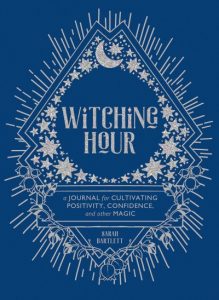 I’m not a big fan of journaling or keeping a diary. I was made to do it when I was young and in therapy. As an adult I’ve tried it out and generally find it a depressing chore. (Fortunately, with the prevalence of cognitive behavioral therapy, therapists these days don’t mention journaling.) That’s why if I’m going to use a journal, I like one designed with structure and purpose. One like “Witching Hour: A Journal for Cultivating Positivity, Confidence, and other Magic” by Sarah Bartlett.
 About the Author:

 With that in mind you’ll understand why I was excited to read “Joseph Campbell: Correspondence 1927-1987”. This is a never before available collection of written conversations between Campbell and some amazing people, such as Alan Watts, Bill Moyers, Thomas Mann. These letters give insight into Campbell’s relationships, life, and influence on others. Alongside the correspondence are plenty of great photos.
 Murphy-Hiscock states the goals of self-care as “healthy mind, healthy body, and healthy spirit.” At the beginning of the book she offers the simple definition of self-care as “self-care is any activity you do deliberately to take care of your mental, emotional or physical health.” She goes on to explain that the concept of self-care is compatible with magic “because magic is about listening to what’s inside you and the messages the Divine and nature have for you.” “The Witch’s Book of Self-Care” is truly proof of this because I feel it would appeal to people who practice magic looking for ideas for self-care, AND people who practice self-care looking to explore magic.
 As most readers know, I love me some books about crystals! So obviously I was excited when St. Martin’s Press reached out to me about a new book regarding crystals that releases February 19th, “Crystals: A Guide to Using the Crystal Compass for Energy, Healing, and Reclaiming Your Power” by Aisha Amarfio. It did not disappoint.

 “The Big Book of Runes and Rune Magic: How to Interpret Runes, Rune Lore, and the Art of Runecasting” by Edred Thorsson is 320 pages of EVERYTHING rune. Thorsson has written THE book on runes. Actually, he has written over two dozen books about runes and all that research has culminated in “The Big Book of Runes and Rune Magic”.
 I don’t even know where to begin. When we were there, they were offering 9 different meads, 2 ciders, 2 beer/mead hybrids that they did with Brown’s Brewing, one carbonated hard cider/mead blend that they did with Indian Ladder Farms, AND a switchel. What’s better AND worse is that it is all also available for purchase, with the tasting room being the only place you can purchase many of the products. I spent SO much money.
 Odin’s Tears, which is quite dry and uses caramelized honey, doesn’t involve the oak of their other meads, and is still a deliciously smooth drink.
 Staghorn, which has the sweetness of honey balanced with foraged sumac (not the poisonous variety). An impressive and unexpected twist.
 When we were there, they had two ciders, a classic and Cassis. The classic is a semi-dry hard cider. The Cassis is made with black currants and that gives it a great twist on the flavor and again, a beautiful color.

