Soldier of Love

I’m embarrassed to admit this, however despite owning nearly every Sade album I did not realize Sade was a band, not just a person. I’m totally annoyed at myself for not knowing this basic fact. In case you too weren’t aware, Sade is a band that took their name from their lead singer, Helen Folasade Adu, who is generally called Sade. Curse you Wikipedia! I wish I had never gone to your Sade entry looking for fun facts for this article! Here’s my fun fact, according to Wikipedia, the Sade entry is “a candidate for speedy deletion. It may be deleted after Friday, 19 February 2010.”

With that out of the way, let’s talk Sade. There are some bands that never really change their sound, and most of the time I poke fun at them. I realize now that I’m just being stupid. Many bands and artists that I like tend to keep the same core sound; Flogging Molly, Run DMC, Jack Johnson and of course, Sade. Yes, I’m telling you that the new Sade album is very similar to previous albums. However I’m also telling you that you should go out and buy this album anyway.

Why? Because it has been ten years, yes ten long years since the last Sade album “Lovers Rock”. In those ten years music has experienced many changes, for better or worse: producers leaning heavily on auto tune, rap artists working with live bands, not just two turn tables and a microphone, artists like Duffy and Amy Winehouse evoking the best of the 60’s and 70’s girl group sounds. All of it can cause you to wonder what Sade’s sound will be like in this new environment. Wonder no longer because I’m here to assure you that Sade has chosen to do what they do best. “Soldier of Love” is almost rebellious in it’s maintaining of the Sade status quo.

Smokey voice? Check. Smooth sounds that you can still tap your foot too? Check. Horn section? Check. Songs exclusively about love? Check. Heck, the lead singer even looks the same as ten years ago! Perhaps she got a hold of whatever technology kept Dick Clark from visibly aging for an obscene length of time.

If you’re like me, and you enjoyed previous Sade albums, do yourself a favor and go buy the latest one. You won’t regret it.

And here, submitted for your approval, the title track “Soldier of Love”.

Witches and Wiccans and Pagans, Oh My: A Report from Pantheacon

By Deborah Blake

Last week I crossed the entire width of the country, leaving behind my beloved cats (and my internet connection) and travelling from snowy upstate New York to sunny San Jose. I made this same trek two years ago for the same reason: to go to Pantheacon.

If you are a Pagan, going to Pantheacon is a little like going to Mecca. There are many (over a thousand, I believe, and maybe multiple thousands) Witches, Wiccans, Pagans and other cool spiritually-oriented folk who decend on the Doubletree Hotel in downtown San Jose in February for four days of workshops, rituals, parties, and socializing, all with a Pagan slant.

If you like that kind of thing, you will love Pantheacon.

I have a confession to make; I am not a social person. (Yes, I hear you all gasp in amazement.) I tend to be overwhelmed by crowds and over-loaded by all the psychic energy that goes with them. You will never find me at a rock concert. But thankfully, Pagan gatherings are an acception to this rule. And Pantheacon, for whatever reason, is the uber-exception. I always come away from it with more energy than I went in with.

There are probably a couple of reasons for this. The first is simple: I get to meet my fans. As an author, I tend to sit and write in a vacuum (no, not an actual vacuum…that would be very difficult). Other than the occasional email or Twitter exchange, I rarely know whether or not my books are having a positive impact on those I write them for. But all that changes at Pcon.

This year, I gave two workshops, one on “Crafting and Casting the Perfect Spell,” and the other on “Witchcraft on a Shoestring.” Both went really well, and I had the great pleasure of meeting a number of folks who read and enjoyed my books. I sold a bunch of the books that are already out, and signed them for people until my hand went numb—an author’s dream! And hopefully, some of the people who came to my workshops who haven’t read my books will now be curious and go take a look. As an author, there is nothing more satisfying than shaking the hand of one of your readers.

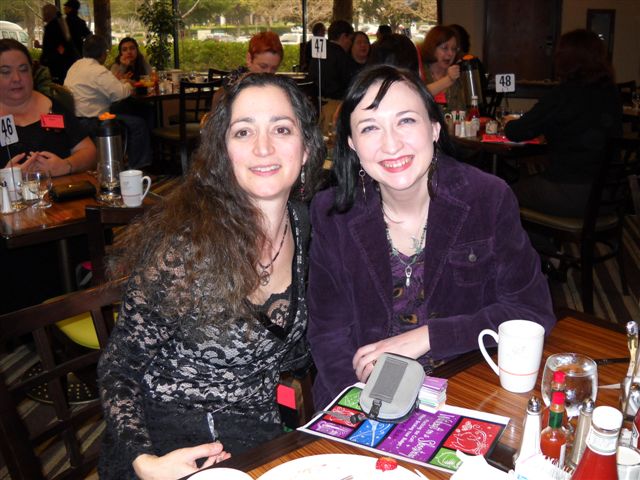
Deborah Blake and Llewellyn Editor Elysia Gallo

But there were other highlights as well. I got to have breakfast with my wonderful editor from Llewellyn, Elysia Gallo (we were supposed to have dinner the night before, but she had problems with her flight—a lot of folks had a hard time getting in because of bad weather across the country). We caught up on personal things and also spent some time discussing the cover colors for book number five, coming out in September. I adore this woman, and we only get to meet in person at Pcon, so I was really jazzed to be able to spend time with her.

Z. Budapest and Llewellyn Editor Elysia Gallo (the closest I'll get to having someone as bad as a Z. Budapest on my website)

Another highlight of the event was my invitation to a surprise 70th birthday party for one of the founders of modern witchcraft, Z. Budapest. (I would have blogged about this earlier…but it was a SEKRIT.) Z’s partner Bobbie had asked me and Elysia to lure Z. away from their room with an invite to have a drink at the bar, so Bobbie could get everything set up for the party. And then, of course, Elysia didn’t make her plane and had to catch a later one, leaving it all up to me. The pressure! But thankfully, I managed to pull it off, and when Z. and I walked back to her room an hour later, she was completely surprised! And Elysia even got there in time to get a piece of cake. Whew. It was a huge honor for me to be included in the company of many of the movers and shakers of the Pagan community, and it was all a lot of fun. (And, of course, there was cake.)

One of my goals this year was to try and attend a ritual workshop. I love my group, Blue Moon Circle, and our rituals are satisfying and magical. But there is something truly wonderful about a LARGE gathering of Pagans all creating magic together, and I hoped to attend a group ritual while at the convention. I decided to go to a Brigid Healing Ritual given by Selena Fox, another major Pagan leader (she spearheaded the fight to get the armed forces to allow the pentacle to be used on gravestones at the Arlington National Cemetery). I have written articles for her CIRCLE magazine, but I’d never had the chance to meet her or see her work.

Let me tell you—the ritual more than met my expectations. Selena did a wonderful job of tying together many different styles and approaches, even going so far as to invite a few other folks (including me) to invoke the Goddess in their own particular way. We did healing work for self, then for others, and then for the planet, and followed up by sending lots of energy to a man who is currently involved in a six-year legal battle for Pagan rights. The whole ritual was fabulous from start to finish, and by the time we were done, I was tingling from head to toe. Afterward, I went up and introduced myself and complemented her on the ritual, and she was wonderfully gracious and kind. (And then I got to hang out with her at Z’s party later, which was a bonus. A very nice lady.)

I also went to an interesting workshop on the dark side of fairy tales, given by new Llewellyn author, Kenny Klein. Kenny was a great speaker, and I got some interesting ideas for possible future novels. Later, I went to the vendors room and bought a copy of his book, THROUGH THE FAERIE GLASS, which he was kind enough to sign for me. I also picked up a few gifts for the Blue Mooners at home, including an ABC Book of Shadows for pal Robin’s kids, and a few cool stones in the shapes of cats and bats and such.

One of the greatest pleasures of Pantheacon for me is sharing the event with my step-daughter Jennifer, also a Pagan (and a member of Blue Moon Circle, although she moved to Miami 5 months ago). Jenn flew out from Florida and met me there, and we got to hang out together when we weren’t doing our separate things. As usual, she helped me with my presentations (I always refer to her as “My Entourage”) and made the entire trip easier and more fun. This year I left early to go visit with family in San Diego, so I missed some of the workshops I would have gone to, and didn’t get to meet everyone I’d hoped to. But all in all, it was a wonderful trip.

I highly recommend Pantheacon to anyone who can make it there. People come from all over the country to learn and laugh and love together in the company of those who feel and believe as they do. I truly believe that it is something that every Pagan should experience at least once in his or her lifetime. And hey, maybe you’ll meet me there some year. Blessed be!

About Deborah:
Deborah Blake is the author of “Circle, Coven and Grove: A Year of Magickal Practice” (Llewellyn 2007), “Everyday Witch A to Z: An Amusing, Inspiring & Informative Guide to the Wonderful World of Witchcraft” (Llewellyn 2008), “The Goddess is in the Details: Wisdom for the Everyday Witch” (Llewellyn2009), and the forthcoming “Everyday Witch A to Z Spellbook” (2010) and “Witchcraft on a Shoestring” (2010). She has published numerous articles in Pagan publications. Her award-winning short story, “Dead and (Mostly) Gone” is included in the “Pagan Anthology of Short Fiction: 13 Prize Winning Tales” (Llewellyn, 2008). Deborah is currently working on her third novel and hopes to find both an agent and a publisher for her fiction soon. Deborah can be found on the web at www.deborahblakehps.com

A Love Letter to Froggy

Article by Rebecca
Image by Will Hobbs (www.sirwilliamwesley.com)

Funny thing about kids, you never can guess what stuffed animal they’ll latch onto. It’s rarely what you would suspect. In my case it was a stuffed beagle that I called “Beans” and showed my affection for by repeatedly chewing off his nose. When good friends of mine had a son, my husband and I bought him a teddy bear. Not just any teddy bear, a Brookstone n-a-p teddy bear. This teddy bear is made out of the softest, most cuddly materials available to man. (They don’t carry the exact bear anymore, but here’s a link to a comparable bear.) In fact, as most parents know, that kid was showered in adorable stuffed animals ranging from traditional, like our teddy bear, to traditional, like the stuffed animals his parents cuddled as kids. In that sea of plush cuddlies what does the kid latch onto? A plush frog. He calls him “Froggy” or perhaps “Froggie”. I would ask him, but he is just learning to spell now, no need to add more stress to that process. Now I have nothing against Froggy (Froggie), he was adorable right from the start, even if now the child’s affections have left him a little matted and stinky. Hey, I chewed the nose off of my doll, repeatedly, I’m not judging. All of this is an elaborate introduction to why I’ve decided to discuss the symbolism of frogs and toads.

As you may suspect, I have a very elaborate creative process. One that is sustained primarily by celebrity gossip websites, the television show “Better Off Ted”, and rum. I’ll let you in on the “behind-the-scenes” process for this article. I realized, hey, it has been a while since I wrote about some sort of symbol. I pulled down a big stack of books filled with symbols and started flipping through them. While flipping through my copy of “The Complete Encyclopedia of Signs & Symbols” by Mark O’Connell and Raje Airey I came across an entry for frogs and toads. I immediately went “Froggy!” (or perhaps “Froggie!”) Because anyone who has spent time around little kids knows that you start to talk like them. Thusly, a frog, regardless of how life-like the illustration, or very real it is, they are Froggy (or maybe Froggie). Much the way I and his mother say that we are going to “Eat. Eat.” and “Play. Play.” despite the fact that even the child no longer speaks with that young a voice. So as odd as this may seem, somehow my simple quest to write about a symbol has turned into a bit of an open letter of affection to Jacob…the first little kid that didn’t seem to hate me on sight. (Aunt Rebecca loves you. And as soon as you’re old enough, I will loan you all of my Chow Yun Fat movies, because that’s how much I care. Just don’t tell Mom and Dad.) With that abnormal show of affection out of the way, let’s examine the symbolism surrounding this amphibian that a 3 year-old can’t go to sleep without.

First, since I’ll be looking at both frogs and toads, the obvious question is, what is the difference between frogs and toads. Typing that question into Google brought me to, I swear I’m not making this up, allaboutfrogs.org. They say:

One of the most common questions is, “What is the difference between Frogs and Toads?” Most are surprised to hear that all Toads actually are Frogs!

Hey, I am surprised! Good job allaboutfrogs.org! Armed with this new internet information I will proceed to discuss both frogs and toads. As surprised as I was by allaboutfrogs.org’s info, I am far more surprised at all the different associations for frogs and toads. Who knew frogs had more going for them than plush animals and Kermit?

Let’s start with the general “frogs and toads are bad” angle. Toads, with their habit of avoiding the sun and preference of damp dark places seem an unsavory lot. It doesn’t help that their secretions can be toxic. In European superstition the toad was linked with death, and was often shown in art with a skull or skeleton. The Church, with their 7 Deadly Sins, took frogs and toads (generally associated with fertility in most cultures) and used them in art that personified lust. Art associated with lust shows a naked woman with snakes and toads feeding on her breasts and genitals. It is really just a hop between all that death and evil sexuality to lead straight into the link between frogs and toads and witches and witchcraft. The stereotypical old world “witch” had the skin appearance of a toad. Common folklore lists frogs and toads as familiars of witches and the Devil, and a creature that witches can transform themselves into. During the Great Plague of 1563 dried toads were used as amulets in England when Dr. George Thomson claimed to have cured himself by using one to absorb the “putrefactive ferment”. I can’t help but wonder if good Dr. Thomson thought toads so evil and loathsome that surely they would interact with the vileness of the Plague.

Enough about Medieval Europe and the Church and all those Western hang ups. For much of the world the frog and toad are good things. As you may remember from your school biology lessons, frogs lay many eggs. I don’t quite know how modern man feels about that, but back when humans were just trying make sense of the natural world many eggs equaled fertility. Egypt has Heket (Heqet, Hekit), the frog goddess of birth and fertility. She’s often depicted as an attractive woman with the head of a frog. Frogs like the water, and rain makes the land fertile, thusly frogs are rainmakers. The Chinese and Peruvians used frog images to call up rain showers, and the Mayans and Aztecs viewed the frog as a water deity whose croaking predicted and made rain. The frog was the lord of the earth and represented the curative powers of water for the Celts.

Another basic frog fact is that they go through a transformation: egg, tadpole, and frog. The moon, as we all know, goes through transformations as well, it’s phases. Mix those two things together and you can see how in Japan the frog is associated with lunar eclipses and in China, instead of the “man in the moon”, they have a toad in the moon. It’s believed that from the frog’s natural ability to transform is how it became to be featured prominently in folklore and fairy tales. Kiss the frog and it transforms into a handsome prince or beautiful princess, or conversely, be a misbehaving prince or princess and get changed into a frog. The Chinese and Japanese associate frogs with magic.

However, the Chinese take it up another level. In China the frog is associated with magic and is the face of the moon. Knowing that you can see how the adorable Chinese Moon Frog came into being. He’s the adorable frog with the coin in his mouth that you see in curio shops. The Chinese Moon Frog attracts wealth and longevity. Sometimes the frog has a coin in its mouth which attracts wealth and wards off evil spirits. In an almost perfect blending of all the aspects of frog symbolism, in Roman times frog amulets were used to protect homes and their occupants and to sustain romance and love.

Only time will tell what Froggy (or Froggie) will bring into Jacob’s life. The frog is fraught with perils, but offers up rich rewards. I guess Kermit was right, “It’s not that easy being green.”

A Valentine for You

My husband and I don’t really make a big deal out of Valentine’s Day, or our wedding anniversary for that matter. We never really talked about it, but somehow we ended up on the same page. I know it’s going to sound corny, but I swear it is true, when you spend everyday being grateful that you’re with the one you love, you tend to not really care about holidays or events designed to make you feel the thing you are already feeling. However, there is one fun Valentine’s Day tradition that I would like to share with you.

I don’t know how it started, or when, but one year I was at some store right after Valentine’s Day and they had a bunch of their kids Valentine cards on sale. You know, the little ones you gave and received in elementary school. I was struck by how funny and horrible many of them were. On a whim I bought a box, I can’t remember what they were anymore, and decided I would give them to my friends for Valentine’s Day the next year. And thus was born a tradition known as “Rebecca’s Inappropriate Valentines”.

Some years are more horrible and inappropriate than others. I’ve done Lord of the Rings, perfect for geeks while being pretty awful, Pirates of the Caribbean, also good for my friends while still being rather off, Cartoon Network, which were actually just kind of good, and many more. One year I was sorely tempted by Crocodile Hunter Valentine’s cards that were on sale after his death, but I decided that those could potentially cross the line of “inappropriately funny” and land squarely under the banner of “in poor taste”.

This year’s cards were taking advantage of the Iron Man craze of the previous year. Of course, with a new film on the way timeliness isn’t where the inappropriateness comes from. However, there are many other ways this year’s batch were inappropriate. Firstly, Tony Stark wishing anyone a sincere and cheerful Valentine’s Day is just funny. Next, you have the always super G-rated text that all children’s cards have. That is always a gimme for Valentine inappropriateness. Lastly, these cards did not only have the sleek, red Iron Man from the movie, they also had the chunky, clunky, original suit as well. He hopes you “Have a Heavy Metal Valentine’s Day!”

Happy Valentine’s Day from The Magical Buffet!

The Sixties Were Awesome: Morgan’s Tarot

I’m enchanted by “Morgan’s Tarot”. I had never heard of this deck before getting an email from U.S. Games Systems, but after seeing it first hand, I don’t know how I hadn’t heard about this before. “Morgan’s Tarot” was originally published in 1970; created by Morgan Robbins and illustrated by Darshan Chorpash. It was republished again in 1983, and it has just been brought back again. Anyone who has seen this deck in any of its printings knows what I mean, once you see it, you can’t possibly forget.

Morgan Robbins created a 1970’s counterculture/new age deck of cards. Despite being called “tarot”, the cards are not hippy reinventions of the traditional Major and Minor Arcana. Instead, they’re fun, thoughtful, and mind bending cards that force you to look within to find their true meaning. I suspect the format would be called an “oracle deck” these days, where you draw a card and reflect on it’s meaning. And yes, there will be reflection with this deck, it’s impossible to avoid. With cards that say things such as, “It is not what you do that counts, it is…where your head is at.”, “There is no you.”, or “I come from a different planet.”, there is nothing to do but look within for a meaning. Of course it does come with a little booklet that offers some ideas about the cards. However, even those require their own bit of personal interpretation. For example, the “I come from a different planet.” card has a blurb in the booklet that reads, “Psychologically, the card might express the individual’s feeling of alienation or separation from the environment.” But that’s straight forward you say to yourself. What on earth is Rebecca talking about? Well, the second part of it’s blurb goes on to say, “In reality, of course, having come from Arcantmycin, the sixteenth planet in the Wycloxian systems of Andromeda, you are having great difficulty acting like an earthling, especially since your memory was wiped out at birth and you don’t realize you’re an alien. Still, knowledge of your origin might enable you to adapt to the ways of the natives.” The 60’s must have been awesome! Speaking of the 60’s, a warning for you squares, you will find cards such as “Grass”, “Mushroom”, and “Drug Dragged” in this deck. The 60’s were awesome!

The booklet does give you instructions on how to basically do a tarot spread with “Morgan’s Tarot”, and I’m sure that would be a good time, but what I really love is the second suggestion given for a use of the cards. “With two or more players, shuffle and deal an appropriate number of cards (five or seven are excellent numbers). The first player leads any card he chooses. The second player lays a card on top of the first, perhaps as an appropriate comment on this card. The play continues with the remainder of the cards. The object of the game is for everyone to win!” This does deserve another round of “The 70’s really were awesome!”, but I have to say in all honesty I thought this was rather clever. Certainly not for everyone’s taste, but I found it appealing. Very Zen after a fashion.

I can’t let this review end without taking a moment to discuss the art by Darshan Chorpash. All the cards are done in black and white in a very freehand ink style. Imagine the most endearing, darling art images you can muster from the 1960’s, times it by two, and you’ll get the illustrations for this deck. The exact words I uttered, the moment I pulled the “Morgan’s Tarot” box out of the mailer envelope, after seeing the “Love” card on the back were, “Oh my God, that is so cute.” Not what my husband is used to hearing around the house he looked over at me, so I showed him the back of the box. Even he had to admit that it was charming.

When it comes to tarot, I’m a bit of traditionalist, which is hysterical since I’m horribly ignorant about the meanings and symbolism found in tarot. Yet I remain oddly snobbish. That said, maybe that’s why I would call “Morgan’s Tarot” my favorite deck, after the obvious “Universal Waite Tarot” and the “Smith-Waite Tarot” decks. It’s an entirely different beast. It’s whimsical and fun, but also makes you ask yourself difficult questions like “Who am I”? Or harder still, “Tomato, Potato, Eggplant.” That’s it, the 60’s were awesome.

Religion and Mythology

For those of you who are new to The Magical Buffet, you may not be aware that in October 2006, when we launched The Magical Buffet, it was actually a monthly e-zine. Once a month our subscribers would have all the content emailed to them. Since it was trying to follow a magazine-like format, I decided there should be a letter from the publisher, like most magazines have.

When we relaunched The Magical Buffet into it’s new blog format, all of the old e-zine articles migrated over. This means even if you’re new, with a little time you could read all the content you may have missed from the “old days”. However my opening letters to my readers did not make it over to the new blog. I didn’t worry about it because they’re “just letters”, they’re not “real writing”. But as time passed I started to wonder, was something missing by them not being here on the blog?

So recently I started to read them again. In truth, as a new reader you’re probably not missing out on too much. The letters were generally just filled with gratitude. Thank you letters of the most earnest kind, published in response to the surprising outpouring of support and faith that I received, and continue to receive today. I’ve always prided myself on loyalty, and it made me happy to see that many of the people who I thanked in those letters are people and organizations that I still interact with today. It felt good to think that maybe I’ve done all right after all.

That said, there were a few letters that stood out. These were letters that I found offered up a piece of who I am and what I believe to my readers. Things that I thought I would like anyone who reads The Magical Buffet at any point to know about me, the person behind the keyboard.

This is one of those letters……

“Religion without myth not only fails to work, it also fails to offer man the promise of unity with the transpersonal and eternal.” C.G. Jung

“BETHANY (rubbing her temples): Two thirds of me wants to forget about this and go home. You know, yesterday I wasn’t sure God even existed. And now I’m up to my ass in Christian Mythology.

RUFUS: Let me let you in on a little inside info. God hates it when it’s referred to as mythology.” Kevin Smith’s film Dogma

What is religion? What is mythology? Is there a difference? Not to me. They say history is written by the winners and it’s safe to say that Judeo Christian beliefs won over let’s say for example the pantheonic beliefs of the ancient Romans. That which is generally considered mythology, at one point was fervently believed in as religion, as much as Christianity or Judaism is today. Is it fair to say that just because a mythological deity isn’t actively worshipped in the mainstream that it’s mythology, while the epic stories of The Bible are most assuredly religion? Absolutely not, and I reckon that there are some Goddess worshippers reading this that will tell you that straight up! An individual’s faith and belief are what makes a group of mythological tales a religion. It’s in the stories of a faith that its tenants are demonstrated. A religion that is a rule book doesn’t work. It has to incorporate stories, myths if you will, to transform a set of rules into a living breathing creation.

So what is “Magical Buffet Mythology”? It’s where I retell some of the definitive stories of various deities, and perhaps events, etc. Last month was Artemis, this month is Kuan Yin. For most, Artemis is considered myth, for over half the global population Kuan Yin is considered religion. Both are called “Magical Buffet Mythology”. Why? Because for one, it’s safe to say that my particular interpretations shouldn’t be considered the definitive versions of these tales! I’m a sarcastic person and it’s in these columns that I let my snarky flag fly! Also, a myth is just one believer away from a religion in my book. Who am I to decide which one is which?

I hope that everyone continues to enjoy the “Magical Buffet Mythology” columns. I certainly enjoy doing them. I also hope that everyone keeps an open mind about religion verses mythology and that no one takes offense to my personal views on the topic. After all, it’s just one opinionated dish along the buffet line.

Until next month,
Rebecca Elson
Publisher, The Magical Buffet

This was the second letter from the publisher that I wrote. Everything was new, and much like l am in real life, I just wanted everyone to like me. I feared that a column known as “Magical Buffet Mythology” that I was planning on using to discuss all kinds of noteworthy and little known deities had the potential of insulting someone about their personal beliefs. That would be the exact opposite of what I was hoping to do with my newly founded e-zine. When I decided to follow up my Artemis article with an article about Kuan Yin, a personal favorite of mine and a deity actively prayed to by probably half the global population, I grew concerned. This letter was written to express my personal views on mythology and religion. Since I didn’t lose any subscribers, it must have done the trick. Or perhaps even better, my readers didn’t have those kinds of hang ups.

With the new blog format you see that I do in fact have a category for religion and for mythology. To be honest, I’m sure how what I call mythology or religion these days. Most of the time, I categorize the articles as both. However, when I write about a deity, even in this new format, I still title every one “Magical Buffet Mythology”. And hopefully my new readers also don’t have those kinds of hang ups.

What I Learned from the 2010 Grammy Awards Show

Last night I watched the 2010 Grammy Awards. I know they were on Sunday, but I knew the show would run past my bedtime, so I recorded them. I figured instead of trying to compete to be one of the first blogs to discuss the awards show, which would have been impossible anyway, I would instead be writing fully informed by not only having watched the show, but also having had a full day of reflecting on other people’s opinions.

And there are loads of things I could address here. For instance, I thought Colbert was good, but I was bummed that he won best comedy album instead of Spinal Tap or Kathy Griffin. I found the performance from Green Day with the cast of the upcoming musical “American Idiot”, based on Green Day’s “American Idiot” album, fantastic. However, despite the addition of Sir Elton John, I found Lady Gaga’s performance at the opening of the show pretty average. Not being familiar with Beyonce’s live performances, I was impressed with the sheer abundance of feminine rage that she channeled. And let’s face it, Pink performing like a professional member of Cirque du Soleil while singing live is an act that I’m sure no one wanted to follow.

As you can see, there are loads to discuss without even touching on the fashion of the evening, which I will leave to the capable ladies at Go Fug Yourself, or the potential greater symbolism to be found at the event, which I’m sure The Vigilant Citizen will address at some point.

However, there was one theme to the event that no one seems to have commented on, and that was really driven home by one particular performance.

The song “Bridge Over Troubled Water”, written by Paul Simon and performed originally by the duo Simon and Garfunkel, is now 40 years-old. It has been covered by dozens of artists, including: Aretha Franklin, Elvis Presley, Johnny Cash, Annie Lenox, and many, many more. Sunday night at the Grammy Awards the song was performed by Mary J. Blige (sometimes referred to as the “Queen of Hip Hop Soul”), Andrea Bocelli (an Italian pop tenor), and David Foster (a Canadian musician, record producer, composer, singer, songwriter and arranger). Although it’s not unheard of for an operatic tenor to perform with a pop artist (I mean who hasn’t Luciano Pavarotti performed with?), this vocal pairing was quite striking.

I still remember in high school when I first I heard about Mary J. Blige. She was a hairdresser from Yonkers, NY who got lucky, and the world of R&B was never the same. Regardless how many powerful female vocalists have come after her, to me there is only one Mary J. Blige. How different her young life must have been compared to Bocelli. Diagnosed with glaucoma at an early age, the Italian lost his eyesight permanently at the age of twelve. Music, if media sources are to be believed, was the only thing that provided him comfort. Although I’ve never seen or heard it anywhere, I imagine that a young Blige, a high school drop out living in Yonkers, probably found solace in music as well. Somehow these two amazingly different people came together and for one moment in time blended their voices together. Bocelli’s booming classical tenor wrapped around the rough thunderous vocals of Blige, and vice versa. Neither performer held back from their personal style, and yet classical and R&B married sublimely. It was one of those moments that made me step back and think, look what we humans can do. Two absolutely different people, coming from totally different backgrounds, carrying all of their own preconceptions, baggage, and scars, met on the common ground of music and created something new.

It’s what I love about us humans, the passion we put into carving out our identity and individuality can sometimes, unbeknownst to us, become a passion for becoming part of a greater group. How else can you explain country cutie Carrie Underwood getting her R&B on while performing “Earth Song”? Or punk/pop/rock drummer Travis Barker taking the stage with Lil’ Wayne, Eminem, and Drake? Popular culture sets trends or reflects what is trending in our culture, and if the Grammy Awards performances that I saw are in fact to be believed, many musical barriers are being breached. More importantly, these performances are showing that despite bending, blending, or breaking genres, the results need not be a bland homogenous mess. That perhaps the Seal of the United States of America just might have it right, e pluribus unum, out of many, one.

You can purchase this song on iTunes with all proceeds going to the Red Cross’ ongoing earthquake relief efforts in Haiti.

More of Obama’s Promises

Last night was President Obama’s State of the Union address. There has been no shortage of people analyzing every word, every gesture, and every possible reaction. YAWN! I thought the State of the Union would be a perfect time for some real random fun. That’s right; it’s time for the triumphant comeback of “President Obama’s 500 Promises”!

You may remember the fun I had with these cards back in April 2009. It’s a box of 510 cards that compile promises Obama made in interviews, debates, speeches, and on his website while campaigning to become President. Then you go to www.PolitiFact.com (remember, the one with the Pulitzer bitches!) and find out how Obama is doing at fulfilling that promise. Instead of watching all the media spin I opted to open up my box of 500 Promises and draw 3 cards at random. I then went to www.PolitiFact.com to see how the President is doing on fulfilling them.

1. Promise 48: Close the “donut hole” in Medicare prescription drug plan. Eliminate the “donut hole” in the Medicare Part D Prescription Drug Program that limits benefits for seniors with more than $2,250 but less than $5,100 in annual drug costs, meaning they end up paying full price for drugs while also paying drug plan premiums.

PolitiFacts says: In the Works. After months of talking about health care reform, the U.S. House of Representatives introduced major legislation to overhaul the nation’s health care system. House Democrats unveiled the 1,000-plus-page bill, called America’s Affordable Health Choices Act of 2009, on July 14, and it includes most of President Barack Obama’s key proposals on health reform.

One of Obama’s campaign pledges was to close the “doughnut hole” in the Medicare Part D Prescription Drug Program, a coverage gap that affects some seniors who have to pay for drugs that might otherwise be covered. The health care bill aims to slowly eliminate the gap, beginning with a $500 reduction in 2011 and completing phase-out by 2023. Under the House bill, that move would be paid for by requiring drug manufacturers to pay new rebates involving the Medicaid program.

We should be clear that there’s a long way to go — maybe months — before this bill becomes law. It has to get through the Senate, where many an ambitious House bill has seen its hopes dashed.

Nevertheless, the bill marks significant, measurable progress on Obama’s promise, and we rate it In the Works.

Promise 111: Allow all veterans back into the Veterans Administration. Sign an executive order ending the unfair ban on healthcare enrollment of certain groups of veterans, including ‘Priority 8’ veterans who often earn modest incomes and have no service-connected disability.

PolitiFacts says: Compromise. This promise had its roots in a government decision in 2003 that, due to limited resources and a mandate to provide quality and timely health care, the VA would prioritize those veterans who would be eligible to receive health care benefits. Priority was given, for example, to veterans with service-connected conditions, people with low income or those with special health care needs. The VA decided, however, to stop enrolling nondisabled “Priority 8” vets whose income exceeded some set thresholds.

During the campaign, Obama promised he would do away with those income thresholds. All veterans, he vowed, would be allowed back in the VA.

In May, President Obama proposed a $113 billion Veterans Affairs budget for 2010 that would make significant progress toward restoring eligibility to VA health care benefits for many “Priority 8” veterans.

According to the budget plan, “For the first time since January 2003, VA expands eligibility for VA health care to nondisabled veterans earning modest incomes. This expansion will bring nearly 550,000 eligible veterans into the VA health care system by 2013. The 2010 budget request provides the resources to achieve this level while maintaining high quality and timely care for lower-income and service-disabled veterans who currently rely on VA medical care.”

While 2013 is the longer-term goal, the 2010 veterans budget approved in July by the House Veterans Affairs Appropriations Committee included $533 million to expand eligibility for health care services to non-service disabled veterans. That amount would allow the VA to increase the income limit by 10 percent (to about $30,000, depending on where you live). The VA estimates it will translate to an additional 266,000 veterans who will enroll in the VA health care system.

The White House plan calls for relaxing the income thresholds more and more over the next several years.

That’s a big commitment. And by and large, it appears veterans leaders are pleased.

“The president is taking care of veterans,” said Joe Davis, national spokesman for Veterans of Foreign Wars. “He is following through on this provision.”

Still, Davis said, it will be interesting to see if the VA system is equipped to handle the additional people made eligible this year.

“It’s going to be difficult because of capacity,” Davis said. “But you have to start somewhere. Only time will tell if you can open it further.”

Testifying before the House Committee on Veterans’ Affairs, Eric K. Shinseki, secretary of the Veterans Affairs Department, said the VA is up to the task.

“The president’s decision to relax income thresholds established in 2003, which froze Priority Group 8 enrollments, has enabled many more veterans to access the excellent health care available through our Veterans Health Administration (VHA),” Shinseki said. “It has increased VA’s workload, but we are prepared to accommodate up to 500,000 enrollees, who are being phased in over the next four years.”

Clearly, Obama has made strides toward keeping his commitment on this promise. But in the campaign, he didn’t say he was going to phase in the changes. Look again at what Obama’s position paper stated:

“When troops serve, they are not divided by income classes or priority groups. Yet, today the VA is picking and choosing which veterans to serve. Barack Obama is committed to ending the unfair ban on health care enrollment of certain groups of veterans, including ‘Priority 8’ veterans who often earn modest incomes. He has voted to end this unfair policy, which has resulted in the VA turning away nearly one million veterans since 2003. As president, one of Barack Obama’s first acts will be signing an executive order reversing this ban.”

But it was not one of his first acts. Indeed, Obama has not signed an executive order reversing this ban, as he said he would. Instead, he has outlined a budget plan to relax income thresholds to allow more and more Priority 8 veterans to be eligible for health care benefits over time. And Obama didn’t make the change in one fell swoop as promised.

Perhaps Obama concluded that it was more sensible to roll out the changes over time so as not to overwhelm the VA system. And some would certainly argue the president is making steady progress toward keeping the substance of this promise. Nonetheless, Obama didn’t do it on the timetable he promised. And so we rule this one a Compromise.

Promise 255: Expand teacher mentoring programs and provide incentives for more planning time. Expand mentoring programs that pair experienced teachers with new recruits. Also provide incentives to give teachers paid common planning time so they can collaborate to share best practices.

PolitiFacts says: In the Works. President Barack Obama has packed a number of his campaign promises related to education into his “Race to the Top” program, which seeks to encourage innovative approaches to teaching and learning by having states compete for $4.35 billion worth of grants from the Department of Education. The program was funded through the Obama-backed economic stimulus package approved by Congress in February.

In a speech in Madison, Wis., on Nov. 4, Obama announced the criteria for states to win the grants. One of the goals, Obama said, is to create “alternate pathways to teaching for talented young people,” and he specifically cited as an example a program in Boston “where aspiring teachers work side-by-side with effective mentors in a yearlong residency.”

A notice from the Department of Education inviting applications talks about priority being given to states that provide effective support to teachers, and specifically mentions as examples “professional development, time for common planning and collaboration.”

That sounds to us like what Obama promised he would encourage if elected president.

Competition for the grants will be conducted in two rounds — the first starting this month and the second in June next year — with winners announced in April and September next year.

But by establishing a competitive grant program that encourages teacher mentor programs and paid planning time for teachers so they can collaborate to share best practices, we think that moves this promise to In the Works.

Two “In the Works” and one compromise. Not too shabby. It’s not too late to get your own box of “President Obama’s 500 Promises” and play along at home! We still have a few years left to track how he’s doing.

Crafting the Runes: A Venture into Self-Publishing

by Alaric Albertsson
Also appeared in The Heartland Spiritual Alliance newletter.

As I explained to my acquisitions editor over lunch last year, I needed a set of Anglo-Saxon runes for my next book, “Wyrdworking: The Path of a Saxon Sorcerer”. In addition to the book’s outline and a few sample chapters, I gave her several illustrations for the rune cards I hoped would be sold with the book.

Why cards instead of runes carved into little pebbles or bits of wood? Well, why not? The use of divinatory “rune stones” dates back to the early 1980’s – hardly what anyone would consider an ancient tradition –and I am pretty sure the early Saxons and Scandinavians would have made use of cardstock if they’d had it. Cards suited my purpose. Each rune card would include an illustrated conception of the corresponding passage of the 10th century Old English Rune Poem. One of my goals is to make the runes and their mysteries more accessible for people, and a significant percentage of my target audience is already familiar with the Tarot deck as a divination tool.

The illustrations were provided by Pagan artist Taren Martin. I wanted to work with him on this project not only because of his previous work, but also because he understood my vision. At least a dozen or more rune decks have been published over the years, but the overwhelming majority of these have been decks of the Elder Futhark, which lacks nine of the Anglo-Saxon runes. The decks frequently have illustrations which cannot be supported by the rune lore preserved in any of the Rune Poems. I wanted to create a deck that includes all of the English runes and, more importantly, a deck that remains true to the extant lore.
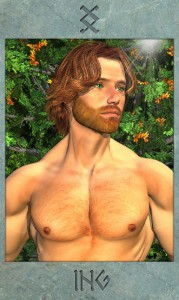
My acquisitions editor took my proposal back to Minnesota and I returned to Pittsburgh. For the next several months Taren and I continued working on the rune deck. I would send him a vague idea of what I wanted. Sometimes I was not sure of what I wanted, which was extremely frustrating for him. He would put together an image and send it to me, and I would then send it back explaining why that was not quite right. It is a testament to our friendship and to Taren’s enduring patience that I am alive to share this story today.

Meanwhile I continued working on the text for “Wyrdworking”. This book will present traditional Anglo-Saxon magic for our modern world. The chapters will cover herb magic, scrying, galdor and other magic techniques in addition to rune magic. At that time I was focused on the latter, and so the book and the rune deck were parallel projects.

In late spring I learned that the publishing house had rejected the deck. They wanted my book, just not the rune cards.

“But I can’t sell this book without the runes,” I protested to my acquisitions editor. “Thirty years ago I could do it. Maybe twenty years ago. But today every new age store in the United State sells the Elder Futhark. Most people are not going to the trouble to make their own runes when they can buy a set, even if that set is lacking almost a third of the symbols.”

My acquisitions editor, Elysia Gallo, understood and was sympathetic to my plight. In fact, hers was the most lovely rejection letter I have ever received. Unfortunately it was not within her power to overturn the decision. If the rune deck was to become a reality, Taren and I would have to pursue another course.

I was afraid Taren would be discouraged by the news but, if anything, he became even more determined to finish the rune deck. While he moved forward with the remaining cards, I talked to a few fellow authors about the problem. A publisher provides two essential things: capital and distribution. It soon became apparent that the publishers who could give us the distribution we wanted were unacceptable for other reasons. A couple of friends suggested we look into self publishing. The idea was not unreasonable. If we had to distribute and promote the deck ourselves, self publishing would generate much more income per deck sold.

While figuring all this out, I began to realize something else. It was time for me to turn the project over to Taren. I would still help him, but without the accompanying book, the rune deck was his baby. And so the cards became not just “the rune deck”, but the Martin Rune Deck.

In June, while I was at a book signing for “Travels Through Middle Earth” at Aquarius Books in Kansas City, my friend Barbara Criswell showed me Toby Evans’ Chakra Labyrinth Cards. Toby had decided to self publish when she created her chakra deck. I’ll readily admit that I know next to nothing about chakras, but I know a well crafted product when I see one, and Barbara told me that Toby had been very pleased with her printer.

Barbara Criswell is one of modern Paganism’s unsung heroes, so I’m going to sing a bit about her now. This woman has consistently supported the Kansas City metropolitan area’s Pagan community for decades. Twenty years ago when the Heartland Spiritual Alliance and other area organizations were trying to buy a Pagan campsite, Barbara offered space and promotion for fund raising projects to help bolster this monumental project. Around the same time she offered a meeting place for a discussion group known as Spirit Circle, which still convenes to this day. “When Travels Through Middle Earth” was published she threw a cake-and-lemonade party for me at the Heartland Pagan Festival to help promote the book, and then later invited me to speak at Aquarius Books where she showed me Toby’s Chakra Labyrinth Cards. She is a woman who puts her community first, and it is a great honor to be numbered among her friends.
So Barbara put me in touch with Toby Evans, I then introduced Toby to Taren and she introduced him to her printer in Hong Kong. This, of course, was not the end of the story.

The next thing Taren needed was investment capital. Notice how this has become “Taren” instead of “we”? Although I was still involved with the project and deeply supportive, I turned my attention back to “Wyrdworking” and began to devote most of my time to the book. I had signed a contract for the book now; I had a deadline. For the most part, the Martin Rune Deck was in Taren’s hands.

Scott DeRousse provided the investment capital. We had also considered soliciting multiple investors, but making a single payment each month is far preferable to paying back loans to a dozen different people. We now had another partner for the project. Anyone who knows Scott at all knows that he is the ultimate silent partner, but Taren acknowledged him in the accompanying booklet as a man “whose warmth and generosity knows no bounds”. That’s not entirely true; Scott’s generosity does know a few bounds. Fortunately the capital needed fell within that parameter.

I authored the aforementioned booklet. If you have ever bought a Tarot deck, you know the booklet I mean; the tiny brochure with an even tinier font that’s tucked into the box along with the cards. It was a challenge to describe the essential mysteries of the runes on pages only slightly larger than a business card. I do think the booklet gives the average customer enough information to get started, and he or she can always buy “Wyrdworking” when it’s released next year for a more comprehensive coverage of rune magic and divination.

It was just before Yule when Taren received five boxes of the Martin Rune Deck from the printer for his approval. If they were satisfactory, the entire order would be printed and delivered. To describe them as satisfactory would be an understatement; they were all that we had envisioned and more. Taren and I both felt that the final product validated the work and time we had invested in the deck.

The Martin Rune Deck can be used for divination or as a meditation tool. It is now available online through WolfDen Designs. Retailers should contact Taren Martin through the website under the Contact Us link for information about wholesale pricing.

About the Alaric:
Alaric Albertsson is the author of “Travels Through Middle Earth: The Path of a Saxon Pagon”. To learn more about Alaric visit his website.

The Name That Might Have Been

After much thought I realize that my website, The Magical Buffet, is suffering from a tangible set back. No matter how successful this website might ever be, regardless of how much notoriety I personally gain, The Magical Buffet will never be as successful as it could have been because I did not let the guys who create “Savage Worlds” name this website.

For those of you who don’t know what “Savage Worlds” is, it is a universal generic, role-playing game (Yes everyone, like “Dungeons and Dragons” in so much as you create characters and work together to create a story under the guidance of a game master. Did you not read my intro to gaming interview with Steve Kenson?) written by Shane Lacy Hensley, and published by Great White Games doing business as Pinnacle Entertainment Group. I don’t know who is responsible for this, but the simple fact is that the “Savage Worlds” folks know how to name things in a way that compells you to at least pick up one of their books, and as is the case in the Elson household, to buy said books.

Let’s first start with the name of their generic base game system “Savage Worlds”. What a fan-freakin-tastic name for a game! Seriously, you see a book with the words “Savage Worlds” on the spine, how do you not pick that up? Take a moment, reflect on that title. Say it out loud. Feel that tingle running down your spine? That’s what I’m talking about here.

However, that’s just the name of the generic rules system. The titles for books that use that system are equally admirable.

“The Savage World of Solomon Kane” – All the bad ass of Solomon Kane, now with the word “savage”. Enough said.

“Slipstream” – A perfect name for a pulp science fiction setting ala Buck Rogers or Flash Gordon.

“Sundered Skies!” – Damn right exclamation point. That exclamation point takes an appropriate title for a dark fantasy setting featuring a thousand floating islands and turns it up to eleven. It’s the “Spinal Tap” of game titles. (Because I made the eleven joke. Dial goes up to eleven. Get it now? Why am I talking to you?)

“Pirates of the Spanish Main” – Perhaps you didn’t read that right. I said, Pirates. of the. Spanish. Main. It’s Pirates of the Spanish Main for God’s sake! When what a thing is, is out right cool, you name it what it is. For instance, my stuffed schnauzer doll is inherently cool, thusly, I named it Schnauz. Yes, my schnauzer doll is inherently cool, occassionally I call him Schnauz Prime, and no, I do not want your opinion on the subject.

“Low Life: Rise of the Lowly” – If you saw that at your local game store how could you not think, what the heck is that, and pick it up? Sure the world is filled with descendants of cockroaches, worms, snack cakes, and stranded aliens, and that may not be your cup of tea. However, that title managed to get me, or my husband, or sometimes both of us, to pick up that book and check it out every time we visited Zombie Planet until we quit fighting the inevitable and just bought it.

“50 Fathoms” – Again, how do you resist looking at a game book titled “50 Fathoms”? From a company of sweet titles, this one definitely stands out. Just think about it, “50 Fathoms”. It’s simple, it’s moody, it says, Gamer, you WILL read my back cover.

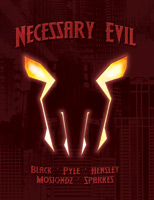
“Necessary Evil” – For the record, my favorite title for any game book ever. All the super heroes in the world are destroyed by an alien invasion leaving the protection of earth in the hands of the super villains left behind. I love the concept and the name is PERFECT.

“Rippers” – Oh “Rippers”, what a fantastic title you are. “The Cabal of evil formed under the leadership of the monstrous Jack the Ripper has the Victorian world on its knees and it’s up to you to fight back.” Again, great name for a great concept.

“Deadlands: Reloaded” – Heck, they even managed to take an already established and cool title, “Deadlands”, and make it extra cool when translating it for the “Savage Worlds” system! “Deadlands” is cool, “Deadlands: Reloaded” is legendary. (I feel I missed a Barney Stinson joke there.)

I feel my point is made, the “Savage Worlds” guys know how to name things. And so there you have it, an opportunity missed. I like to think that “The Magical Buffet” is a solid name, but I suspect if put in the hands of the “Savage Worlds” team it would have had a better name, one that would translate directly to “Wil Wheaton wrote about my website in his blog and thusly crashed our server.” Or perhaps “Rebecca will now be the new commentator on the television show ‘BattleBots’, oh crap that show was cancelled, never mind.” Perhaps one day, if I’m lucky, the “Savage Worlds” team will come up with an honorary, suitably bad ass sounding nickname for the website. Until then, I’ll pine away for the name that might have been.