Operation Meditation

By Brian Leaf

It’s 5:00 AM. I have to pee very badly. And I’d like to go meditate.

Someone else would simply get out of bed, pee, and blithely head off to their cushion.

Not me.

To do this, I must pull off a CIA operation.

I must remove the covers, inch by inch — in the dead of night our comforter sounds like a crinkly bag of potato chips. I must crawl to the edge of the bed (our bed is pinned against the wall to make room for Benji’s changing table). I must step off, and in the pitch-black, follow the border of the bed frame.

I must round the corner of the bed, where someone who designed our bed has very cruelly placed a jutting protuberance at exactly shin height. At five in the morning I forget this every time. I must stifle my cries. Power through the pain. Eyes tearing, I round the corner and toe the balance-beam width between Benji’s changing table and our bed, ever careful, ninja-like, to step lightly.

I am almost out. But now I face my greatest challenge. The small distance between me and the door, maybe five feet, is a minefield of creaky floorboards. Gwen has them memorized. For some reason I do not. At first I pause to consider my options, and then I panic, sprinting the short distance to the door. My feet land extra heavy, and the floorboards creak like mad…yet no one awakens. Hashtag grateful.

On the way out, I shut the door in one motion, careful that it does not squeak, promising to myself that today is the day I will remember to oil the hinges.

Failure in this operation is not an option. Benji is not sleeping more than two hours at a stretch. Neither, therefore, is Gwen. She is grumpy. I must not wake her or Benji.

If stage one of OPERATION MEDITATION goes well, I can leave the room with Benji and Gwen still asleep. Now I’m in the hallway. I must pass Noah’s doorway without him stirring. He can sense me. I must cloak my scent, my very energy signature. Any stirrings, and he will roll over and groggily say something like, “Dad, lie with me.” Which is lovely. Truly. But it’s not why I am out of bed. I am heading to my cushion to meditate. Plus, Noah’s bed is two inches too short for me. So I cannot stretch out my legs and I won’t fall asleep. I will lie there listening to him sleep. Content, but wishing I were meditating or asleep in my own bed.

Alternatively, he could wake up and be alert for the day. Unacceptable. Waking at five to cuddle or meditate is one thing. But art projects and Monopoly are another.

Before I can meditate I must pee. Meditation cannot happen otherwise. The bathroom is opposite Noah’s room. I shut his door. Do I also shut the bathroom door and risk a squeak? This one is a judgment call. More art than science. Today I leave it open.

I lift the toilet seat. I pee. To minimize noise, I aim just above the border of the water and the porcelain. Thirty-eight years of standing pees have trained me for this moment. I execute it flawlessly and lower the seat without a clank.

At this point I consider heading back to the lion’s den, back to my cozy flannel sheets. This is madness. Gwen and Benji are certain to stir.

Don’t do it, I thought-scream at myself as I turn left out of the bathroom. Past Noah’s room. Down the hallway. Into my bedroom. Over the creaky floorboards. Around the bed frame. I climb in. Under the crinkly comforter. Ahh. I close my eyes.

Benji stirs.

I am in big trouble.

About Brian Leaf:
Brian Leaf is the author of “Misadventures of a Parenting Yogi” and “Misadventures of a Garden State Yogi”, as well as the owner and director of the holistic New Leaf Learning Center in western Massachusetts. He has studied, practiced, and taught yoga, meditation, and Ayurveda for twenty-three years. Visit him online at http://www.misadventures-of-a-yogi.com.

Excerpted from the new book “Misadventures of a Parenting Yogi” ©2014 by Brian Leaf. Published with permission of New World Library http://www.newworldlibrary.com

Geek Month in Review: May 2014

By J.B. Sanders

May flowers!

Robo-snakes
Nothing else to add: robot snakes. With video and explanations. Creep factor 5!

How to Flood-proof Manhattan
Anyone else remember when this kind of thing seemed like science fiction? Yeah, me too. This time, especially after Hurricane Sandy, people are seriously talking about it.

Shipping Container Houses
Normally, when you hear that phrase, you picture stuff that is one step up from “shack” and many steps away from cool homes. Not so with the ones in this article. They look like something you see in Architectural Digest.

Concrete-Eating Robot
I know, it sounds like a bad scifi movie, or the name of a pulp novel from the ‘60s. Nope! It’s a robot, still in the design phase, which will disassemble a concrete building, breaking up the concrete into cement, sand and aggregate. All this is done right on the construction site, and it leaves the rebar naked and ready for re-use (or recycling). Pretty nifty!

Shell Grotto — Made by Who?
There’s a grotto in Kent, England, that is decorated with millions of seashells, 4.6 million to be precise. It was discovered in 1835 by some explorers, and when I say “discovered”, I mean it. No one knows who created the grotto, why the decorated it that way, or really much of anything else. It’s pretty snazzy, though.

Billion-User MMO Using VR? Yes, please!
So VR reviving tech company Oculus was recently purchased by Facebook. What are they going to do with all that money and computing power? Build an MMO that a billion simultaneous users can play, and since it’s Oculus, it’s going to be in VR. Sound like a scifi book you’ve read?

Self-Healing Plastic
Yup, it’s another step towards androids dreaming of electric sheep. Scientists have developed a polymer that has cappilaries, much like our own tissue, so that healing plastic will flow into and fill cracks.

Robot Hand and Arm Prosthetic Approved for Use
Cyber-enthusiasts rejoice! The FDA has approved the prosthetic for general use, after it was developed by DARPA. It’s capable of doing very fine manipulation, such as picking up an egg or zipping up a jacket.

Solar Roads
Sounds like a scifi novel, does’t it? This little company has devised hexagonal tiles that could be used instead of pavement, and the suckers are solar panels, generating power. They also have heating elements, so they can keep roads clear of snow and ice. And they have lights, so they can be used to create lines of light on the road, instead of paint. Going “holy crap!” yet? How about the designers estimate that if all 31,000 square miles of currently paved road was instead paved with their tiles, it would produce three times the electricity the entire country uses.

Better, much better video:

Largest Dinosaur Ever
Imagine something as big as 14 elephants. Or larger than several buses. HUGE.

Hover Bikes!
For real, even. There’s a company taking pre-orders for them. Not quite the flying cars of the 1950’s future, but close. So close!

The Sand Chart
In case you need a reference showing the approximate size of all the different kinds of grains of sand, here you are.

Oldest Living Things on Earth
It’s a photo book, travelogue, and text book, all in one. Photographer Rachel Sussman explores organisms, such as trees, lichen, fungi, and others, that surpass 2,000 years old. In fact, one of the organisms, a tree-root structure in Idaho, is over 80,000 years old.

About John:
John’s a geek from way back. He’s been floating between various computer-related jobs for years, until he settled into doing tech support in higher ed. Now he rules the Macs on campus with an iron hand (really, it’s on his desk).

Geek Credentials:
RPG: Blue box D&D, lead minis, been to GenCon in Milwaukee.
Computer: TRS-80 Color Computer, Amiga 1000, UNIX system w/reel-to-reel backup tape
Card games: bought Magic cards at GenCon in 1993
Science: Met Phil Plait, got time on a mainframe for astronomy project in 1983
His Blog:http://www.glenandtyler.com/

Father is the First Teacher

By Sara Wiseman

My bathing cap is too tight; it doesn’t hold the cascade of hair that someone’s piled on my head in order to squash it on, pull it tight until it covers my ears. When I take it off later, my hair will be sodden, snarled, and the long strands will catch in the cap, causing me to yelp in pain.

I wear it, because I want to pretend I am immune from the water: that even when I am submerged, my body will be safe from all that scary wetness.

If we wore goggles back then, I’d have put them on, too. But goggles haven’t been invented yet—at least not for child swimmers like me. I squint my eyes tightly against the sun, against the stinging chlorine, against the very large dollop of zinc oxide that has been applied to my nose in precaution against sunburn, and allow myself to descend into the whorling wet that awaits.

It’s summer, I’m at the pool, I’m maybe 4 or 5, and I’m learning to swim.

It’s not an easy surrender.

I gasp, my heart pounds, and I catch sign of myself in reflection: I’m a green-capped alien, the water is dangerously blue, every ripple like a flash of light along the pool’s floor, and I’m hang on to the only safety I know: my father’s arms, my father’s chest, my fathers’ neck, everything sturdy and comforting, covered with blond curling hair.

If he lets go, I’m sure I’ll die.

If I let go, I’m sure I’ll drown.

I’m learning to swim, he thinks.

I’m trying to survive, I’m sure.

My body is rigid with panic, my arms clamped tight around him, and yet we don’t stop. We go deeper: past my knees, past my waist, until I’m up to my neck in water.

And even as we submerge deeper, I hear his voice in my ear: relax, you’re doing fine, it’s okay to let go.

Relax. You’re doing fine. It’s okay to let go.

Which I realize now, many decades later and 12 years after his passing, were the only real lessons I ever needed to learn from him.

The father is also a part of our soul circle; of our primary circle. Many souls are lucky to know our fathers well and long; in this loving relationship, our fathers bestow upon us a trust in the world that cannot be taken away. When our father is here, when our father is in the house, all is right with the world.

Others recall different teachings from their fathers. There may be grave difficulties in the relationship: karmic wounds that are beyond forgiving.

Still others don’t know of their fathers, or their fathers flit in and out of their lives, undependable at best, heart- breaking at worst.

Sinking back into those long time ago memories, I can see other fathers at the pool now, encouraging, berating, training, teaching, ignoring, punishing, present, authentic, cruel, real, loving, gentle.

All those fathers, teaching lessons.

My own father took me continually to deeper depths, letting go of me even as I held on.

Relax. You’re doing fine. It’s okay to let go.

These are the soul lessons I’ve been working on, lately, with nary a swim cap in sight, feet fully on dry land.

You, as daughters and sons of other fathers, will have your own lessons to learn.

We all receive what we need, even on summer day in the pool.

What have you learned, in accepting or rejecting your own father’s teachings? The male energy moves in all of us, whether we are male or female.

It is a part of us, just as everything is a part of us. Take a moment now, and be grateful for what you’ve learned—the lessons your father taught you, and also those lessons he failed to teach. Allow yourself to open your heart to all of it. (Excerpted from “Living a Life of Gratitude”).

About Sara Wiseman:
Sara Wiseman is a spiritual teacher, intuitive and author of six insightful books on spirituality and intuition, including “Living a Life of Gratitude”. She is the founder of Intuition University, hosts the popular radio show Ask Sara, and is a top contributor to DailyOM, InspireMeToday, Aspire and more. Visit her at www.sarawiseman.com

Paradise in Plain Sight: Lessons from a Zen Garden

by Karen Maezen Miller

In the early summer of 1997, my husband and I found ourselves in the backyard of an empty house on a quiet street in Sierra Madre, a suburb of Los Angeles. The backyard was Southern California’s oldest private Japanese garden, an oasis of ponds and pines that had stood mostly intact since 1916. It seemed like paradise with our name written all over it. We knew in our bones that the place could only be ours, and with it, the little house alongside it. The next day we put money down and a month later, moved in.

Once we arrived, we hit the bookstores and local nurseries. We studied up on Japanese gardens: their esoteric architecture, history and symbolism; and the very special way to rake, weed, prune, plant and water. We sought opinions, called in experts, and asked for conservative estimates — ha! — to redo this or that. The more we learned, the more we doubted. It was too much work. We were fools, without the right tools, training, or time. No wonder no one wanted to buy this place but us. It wasn’t paradise, but a colossal pain in the neck.

One day I ran across a single line in a thick book that made it all simple. It told the original meaning of the word “paradise” before it became a mythical ideal, imaginary and unattainable. Before it pointed somewhere else.

The word “paradise” originally meant simply an enclosed area.

Inside the word are its old Persian roots: pairi-, meaning “around,” and -diz “to create (a wall).” The word was first given to carefully tended pleasure parks and menageries, the sporting ground of kings. Later, storytellers used the word in creation myths, and it came to mean the Eden of peace and plenty.

But looking at it straight on, I could plainly see. Paradise is a backyard. Not just my backyard, but everyone’s backyard: the entire world we live in, bounded only by how far we can see.

There was only one thing to do. I began to garden. I got scratched, tired, and dirty. I pouted and wept, cursing the enormity of the task. I was resentful and unappreciative. But when I ventured afield, sidelined by things that seemed much more entertaining or important, I always came back to this patch of patient earth. Time after time I realized that the living truth of life is taught to me right here, no farther than the ground beneath my feet.

Sixteen years later, I do not know the chemistry of soils or the biology of compost. I have not mastered the nomenclature; I do not know the right time or way to prune. What I have learned instead is this: paradise is a patch of weeds.

What loyal friends, these undesirables that infiltrate the lawn, insinuate between cracks, and luxuriate in the deep shade of my neglect. Weeds are everywhere, showing up every day, my most reliable underlings. Weeds keep me going.

The most common weeds in the yard are crabgrass, dandelion, and chickweed. The most common weeds in the world are greed, anger, and ignorance.

Here are ten things to do to spare your garden from stubborn entanglements:

1. Blame no one. Blame is a powerful barrier: like prickly thistle, it spreads pain and disaffection. Blame turns the garden into a menace.

2. Take no offense. Consider the energy we expend to prolong fictional injuries. How hard is it to get over what’s already over? I know: it’s hard. But there’s a way.

3. Forgive. Forgiveness reconciles the rift between self and other. Forgive someone today—forgive yourself today— and feel the rift recede. Suddenly, it’s much easier to move on.

4. Do not compare. Satisfy yourself with what you have in hand. It may not look like much, but this right here is everything.

5. Take off your gloves. A nurseryman once told me, “A real gardener doesn’t wear gloves.” Native intelligence flows through your fingertips, wisdom received in direct connection with the world, telling you know how deep to dig and how hard to pull, when to gather and when to release. Self-defenses make you timid and clumsy.

6. Forget yourself. The world needs a few less people to own their own greatness and few more to own their own humility. When you can face reality without camouflage, yours is the face of compassion.

7. Grow old. It isn’t easy, it’s effortless.

8. Have no answers. In Zen, we don’t find the answers; we lose the questions. It’s impossible to comprehend the marvel of what we are, or to understand the mystery of life’s impeccable genius. Weed out the confusion that comes from trying to understand.

9. Seek nothing. Just for one moment take my word that you lack nothing. Have faith in yourself and the ground where you stand.

10. Go back to 1. The gardener’s job is always just beginning.

See more of Karen Maezen Miller’s beautiful garden and learn more about “Paradise in Plain Sight: Lessons from a Zen Garden” in this four and a half minute video.

About Karen Maezen Miller:
Karen Maezen Miller is a Zen Buddhist priest and teacher at the Hazy Moon Zen Center in Los Angeles. She’s the author of Hand Wash Cold, Momma Zen, and most recently Paradise in Plain Sight. Visit her online at www.karenmaezenmiller.com.

Adapted from the book Paradise in Plain Sight ©2014 by Karen Maezen Miller. Printed with permission of New World Library, Novato, CA.

Television and Film

A cool sounding PBS show was brought to my attention recently, it’s called “On Story: Presented by Austin Film Festival”. It is currently in its fourth season and we all should be watching and here are 5 reasons why:

1. Support the Public Broadcasting System. They’re there for more than Sesame Street people!

2. The Austin Film Festival is bad ass. If they’re involved you know it’s a good time.

3. The third episode of the season features veteran screenwriters John August (X-Men First Class, Thor) and Ashley Miller (Big Fish, Charlie & The Chocolate Factory) deconstructing the 1979 film Alien’s pacing, tension, and craftsmanship.

4. In case that wasn’t enough, the fourth episode features House of Cards creator, Beau Willimon, who discusses writing for Netflix, working with David Fincher and delving into the psychology of narrative power struggles.

5. Do my endorsements mean anything to you?

Check with your local PBS stations to see if they carry “On Story”. However, if they don’t, there is no need to despair! You can watch episodes and clips at http://www.onstory.tv/.

Illy Presents a Liberatum Film

Those seeking creative inspiration should look no further, illy, the Trieste based Italian coffee company, is presenting Inspiring Creativity, a compilation of interviews captured on film by global multidisciplinary cultural organization Liberatum, which explores what creativity means and the catalysts that inspire it.

Featuring 21 artists and cultural figures from art, fashion, film, design, technology and music — Inspiring Creativity is an insider’s perspective on inspiration from the minds of well-known creative personalities including: Hans Zimmer, Inez and Vinoodh, James Franco, Joan Smalls, Johan Lindeberg, Jonas Mekas, Hans Ulrich Obrist, Karen Elson, Klaus Biesenbach, Lee Daniels, Lola Montes Schnabel, Marilyn Minter, Nico Muly, Mark Romanek, Tracey Emin, Moby, Paul Schrader, and Richard Saul Wurman.

Through the authentic interpretation and responses from these individuals, the overall project communicates what inspires creative thinking and behaviors for nurturing inspiration, while provoking thoughts on how culture, society, and technology continue to affect creativity.

You can view the 12 minute film right here:

Moonlight Tarot’s Question Corner: Mystical Answers to Mundane Inquiries

By Angela Kaufman, Moonlight Tarot LLC

The economic turmoil Americans have dealt with since 2008 has had some positive aspects. People are reinventing “career”. People who expected to be taken care of by a regular 9-5 job ‘til retirement do us part are taking inventory of their marketable skills and stepping up the plate in the biz world, taking matters into their own hands. Jared, the Querent for the month of May, is discouraged with his career and thus at an important crossroads. He asks for guidance this month to help reveal what direction he should take next.

Jared is dissatisfied with his current line of work, and wants to start a business as a professional psychic medium. You may wonder why a psychic would consult another psychic and the answer is simple, we all need an objective second opinion. Similarly a hair stylist may let someone else style their hair. Also in psychic reading the perspective of someone removed from the emotions in a current situation can be helpful. Jared is very talented and has always had a good connection to Spirit. He feels compelled to bring his abilities forth after years of experiences.

My initial impression from Jared’s reading is that he is racing. I literally see him in a car zooming down the road frantically, spinning the wheels and cutting corners too closely. I feel the pressure and panic, as if he is rushing a delivery to beat a deadline. Jared is not under a deadline per se but feels mounting pressure at his job, and is feeling burned out and anxious about going to work. Like many Americans, Jared is particularly in tune with the increasing demands the economy has put on those in corporate America. The cards reveal a positive potential flow for Jared if he is able to slow down and proceed with caution.

The first card is the 5 of Coins. This card suggests a recent financial hardship, the result of an interpersonal challenge that left him with less of an income or resources than he is used to. Challenged to make up for lost time it is no wonder he perceives the strain. This calamity is a part of the catalyst for Jared’s current situation. There is some dis-assembling and rebuilding going on his life and the road financially is rocky but navigable. Still this is not terrain you want to race through.

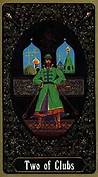
The next card is the 2 of Wands. This is the crucial focal point for Jared at this time. He needs to network more. His talent is a viable foundation but he needs connections from his peers to help pull him out of his shell. In particular he needs to explore ways to get the word out and paperwork, application, and education are all emphasized here. He has the seed of a plan but it is still in the growing phase and the written and planning aspects of his business need not be ignored. He will have a way to go before the final stages because he needs to take the idea he is conceiving and work to give it form. His vision is not yet complete and he will need the help of others to gain confidence and comfort to develop his plan. His reading skills are sharp but his networking, writing and communication skills may need to be further developed to cover the finer points of sole proprietorship. I also feel there is a choice at hand and he is on the fence about this. Knowing what he wants but not yet committed to the action to get it.

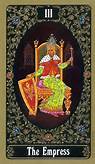
The final card is a Major Arcana card, the Empress numbered 3. This card suggests growth, abundance and success. It suggests he will need to expand his scope and reach. I also feel that female energy, perhaps a literal woman in his life, if not the energy of receptivity and nurturing, are at hand. He needs to work with his plan and nurture it, and the development will be slow but fruitful. The presence of an older woman who is a mentor or guide will also be helpful, someone of a practical earthy nature who can help him gain footing as a business person. The number three will also likely be significant, growth within three months or years or a process involving three major transition phases that are required to build to the point of completion.

This reading was conducted using the Russian Tarot of St. Petersburg. This deck is similar in most ways to the Rider Waite- Smith deck featured last month, as the Major Arcana have the same name and numbers. The Minor cards differ, as Pentacles are Coins, and Wands are Clubs. The basic outline follows the traditional Tarot most familiar with the Waite Smith deck will recognize, but if you have never seen this deck before, novice or veteran Tarot reader, you are in for a treat!

Using this deck is like conducting a reading with 78 Faberge eggs. What the images present in delicate detail the quality of card stock makes up for in sturdiness and even in this complex duality these cards carry the polarized energy of the best of Russian culture- tough as nails, but beautifully intricate. This deck is quite luminous and I favor its artistic quality to that of the Waite Smith deck. The background and borders are black and this brings a striking luminescence to the characters and scenes depicted on each of the fully illustrated cards. The artistic style is detailed and seems inspired by folk art in the tradition of beautiful minute details brought out through careful precision of applied dark and light creating a three dimensional quality that is difficult to find in Tarot art.

The way the colorful images pop out from their black background makes this a handy deck to use when you are learning or advancing intuitive practice. In particular it is reminiscent of the way clairvoyant images appear in my “mind’s eye”, a dark background on which bright and lively symbols suddenly emerge. Using the Russian Tarot of St. Petersburg is a lot like holding a working meditation in your hands. To further this effect, the central “scene” on each card is portrayed in an oval sphere framed by intricate floral design.

It is said that artist Yuri Shakov actually hand painted the miniature scenes on the cards- or at least the ones he contributed to, as the mystique of this deck is enhanced in some ways by the story that Shakov actually died before the deck was complete and the remaining cards were finished by an unknown artist. I do not know the detailed history of this deck but if this is to be taken at face value, I find absolutely no discrepancy among the quality or beauty of the various cards. There are symbols from Russian folk lore worked into the archetypes presented in this deck as well, and it mirrors Russian culture and history. The Devil’s face will bear a resemblance to a prominent historical figure, but don’t take my word, see for yourself! The accompanying booklet also weaves the connection between the artistic interpretations of the various Tarot cards and Russian folk lore, however I have not had the privilege of this comparison as my copy was acquired used without the companion book. This is no deterrent however and speaks well for the continuity of this deck in the world of Tarot as it is easy to use and adapt to without the instruction guide.

There is a stained glass effect from this artwork and the juxtaposition of light and dark gives physical and spiritual depth. The balance of optimism and strife are found in each card as the backdrop balances the bright palette used. This makes it easier to produce cards like Death, the Tower and the Devil for a live audience because the dark and light feel balanced in even the most challenging cards. They really are just too beautiful to be scary and the seriousness implied in their meaning is also not lost on the balance of dark and light in the Sun or 10 of Cups, as each carries a deep dark mystery along with the cheerful elements. The depiction of royalty among the King, Queens and Empress, Emperor etc. is also quite rich and luxurious. Many of the cards look like you could reach in and touch the fabrics, jewels, water or fire. This deck truly is a sensual treat. It helps the reader focus as well to have a plain black background, so that the images convey depth without overbearing confusion.

I chose this deck because this reading was conducted live and this is my default in person deck. I use this deck for in person readings for several reasons- it is a visual delight and feels like a trip through a museum of archetypes, and for its sturdiness. I mentioned the strength and quality of these cards before and it bears repeating. I acquired this deck used in 2009 and it still shows absolutely no sign of wear, bending, weathering, it literally feels like brand new. When clients are apprehensive about shuffling the deck for fear of ruining the cards this deck proves to them instantly they can do no harm. If I didn’t love this deck so much I would be interested in knowing just what measures it would take to destroy one of the cards, but even the thought of this as an experiment seems a sacrilege. It is also easy for clients to relate to the images in this deck as they are classic in some ways but they convey meaning in a way reminiscent of reading a book of illustrated folk tales. The Pentacles being Coins also helps clients grasp the association with work, career and valuables. The cards can be as deep or superficial as you want to make them. If you know the background of the archetypes or Russian lore there is plenty of room to pull deeper and more complex meanings from each card. If you don’t, it is simple enough to see the Five of Coins showing a disheartened couple looking over the rubble of their treasure and “get” the meaning of financial setback.

If there is one minor setback in using this deck it is the size of the cards and relative size of the artist’s detail. I have found that clients with arthritis or small hands struggle with traditional shuffling methods as the cards are a large size. The images, again reflecting the style of Russian folk art, have small details and people with visual impairments will be able to get the basic impression but may miss the finer details in the images. You can accommodate this by using this deck with a magnifying glass- which I don’t, but I do allow time for clients to lift and examine the cards to their liking- and by allowing freestyle shuffling- which I do and the readings are always just as accurate.

Best of luck to Jared as he finds his way to success and fulfillment!

More about this deck as well as purchasing information can be found here:
http://www.usgamesinc.com/Russian-Tarot/
Copyright 1996 U.S. Games Inc. Instruction Book by Cynthia Giles

Interested in being the Querent in next month’s column? Contact Angela at Trionfi78@gmail.com.

About Angela Kaufman:
Angela Kaufman has been exploring divination through Tarot cards for over a decade. She is a Certified Professional Tarot Reader and uses the Tarot and intuition to assist clients in exploring personal growth and development, and in accordance with New York State Law offers readings for entertainment purposes. Angela began providing readings on a professional, “Moonlighting” basis in order to provide affordable readings to those seeking guidance, inspiration and fun.

Angela is also co-author of the new book “Wicca, What’s the Real Deal? Breaking Through the Misconceptions.” (Schiffer Publishing, 2011) and Sacred Objects, Sacred Space; Everyday Tools for the Modern Day Witch (Schiffer Publishing 2013).

For more information on services offered by Moonlight Tarot LLC, visit http://www.moonlighttarotllc.com.

Moonlight Tarot is now part of The Psychic Connection! Check out the profile at: http://thepsychicconnection.net/moonlight-tarot-psychictarot-reader/
New callers register at: https://prodca.click4talk.com/c4a/usignup_page.php?c4a=30236
to receive your first five minutes FREE!

If you prefer a live reading, check out www.cafenolany.com for listing of Tarot events at Café Nola in Schenectady NY

Like Moonlight Tarot on Facebook: http://www.facebook.com/MoonlightTarotLlc

For more related to Tarot and Wicca, check out: Wicca, What’s the Real Deal? At www.wwtrd.webs.com

Internet Randomness & Fun

A couple of interesting things have passed through my inbox recently and I thought I’d share them with you.

First up is Amplifyd, a social activism start up that helps crowd-source political lobbying for people, communities and causes by having activists call and lobby local, regional or national representatives on your behalf. Here’s a cute little video that explains the concept:

You can learn more at their IndieGoGo page.

Next is an interesting entrant in the crowded social networking website category, RealSoulful.com. Unlike most social networking websites which focus heavily on the outward part of networking, RealSoulful is setting itself up to be a resource for the individual and hopefully create a more sincere community from that.

Users can create their own content, and I set up an account to see what it was like. I haven’t had a lot of time to interact with RealSoulful, just kind of poke around. What would normally be your homepage on other sites here is called “My Sanctuary”. There is a Vision Board that you can upload pictures to, and along the top there are options such as adding your mantra, expressing gratitude, setting intentions, typing journal entries, enter a prayer, share a random act of kindness you witnessed, and release a negative emotion. You have the option of sharing these with “Soul Central”, which is the community’s timeline/feed (like Facebook), and for those of you who cannot say good-bye to Facebook, RealSoulful also gives you the option to share all of those things on your Facebook as well.

I have to say that although I haven’t had much time to spend on the site it really does seem like it could be an interesting tool for someone looking for a more spiritual social media experience. There is even more to it than everything I mentioned here! To learn more, visit RealSoulful.com.

Lastly, quite a while back Self Magazine sent me this quick fun video that I’ve been sitting on because honestly, it got kind of lost in my inbox. But I have it now to share with you! Self Magazine answers the question, which is worse, artificial sweetener or real sugar?

Ask What is Working for Greater Results

By Jim Donovan

You’ve probably been to business meetings when the person leading the meeting said something like, “Chantal, sales in the Southwest are off 23% from last quarter. Frank, production orders in the Northeast are off 9%. What’s wrong guys?”

At this point both Chantal and Frank begin to defend their position and rattle off a series of “reasons” as to why things are the way they are. Weather delays, late deliveries, the flu, and the economy, are all blamed for the lackluster performance in both cases.

I remember back when I was in door-to-door sales, barely out of my teens, sitting with small groups of salespeople huddled together in diners, continuing on the conversation that started at our mandatory morning sales meeting, about why sales are down.

In these conversations you typically hear every excuse on earth except the one in which people take personal responsibility for the poor sales numbers. If you’ve ever seen the 1992 movie “Glengarry, Glen Ross,” with Jack Lemmon and a cast of other great actors, you may remember the scenes with all the salespeople blaming their lackluster performance on “the leads.” They go on and on about how, if the leads were better, they’d all be selling more.

One of the keys to achieving higher levels of success is to give up blame all together. When you take personal responsibility for the conditions in your life you are then empowered to change them. Until you are willing to do this you remain a victim of circumstances.

The types of meetings described above begin a steady stream of “reasons” (excuses) why things are not better. People begin looking for ways to place blame wherever they can and the entire conversation turns into a negative, finger-pointing exercise that produces little, if any, useful result.

The meetings continue along in this manner, with each department head explaining why business is not better and trying to find someplace to assign blame until, sufficiently demoralized, the managers return to their respective departments vowing to do better, feeling defeated, and sometimes not caring whether or not they do better.

While on the surface this seems quite normal, in practice it does little more than leave people feeling depressed and dejected. Yes, there is value in examining mistakes and learning from them, however, if you accept the centuries old idea that, “our minds move in the direction of our dominant thoughts,” as it was expressed by motivation legend Earl Nightingale, you will soon realize that these meetings cannot possibly result in anything but a negative outcome.

You can beat a problem to death in endless meetings but it will not alter the fact that something is not working. Why would you want to invest any more time in talking about things that do not work?

Yet, that’s exactly what’s taking place in meeting rooms and on shop floors in companies all across America everyday. With a steady barrage of negativity being dispersed at them, it’s no wonder that the level of employee engagement is at an all-time low. One the other side of the coin we have the employees themselves carrying this negative tone throughout the entire organization. These people are, according to Gallup, “The eighteen percent who are actively engaged in spreading ill-will throughout the company.

Simply replacing the “What’s wrong” question, with “What’s working,” will cause your mind to search for things that are going right and, as a result of the law of attraction (like attracts like), you will begin finding more and more things that are working. In the case of discussing strategies and activities, starting with what’s working enables you to build further improvements on a solid foundation that is already producing the desirable results. By focusing brainstorming sessions around what’s working and drilling further into that is what makes achieving quantum results possible.

In business meetings you can use this type of questioning to identify the actions and activities that are producing positive results and build upon that. You may be surprised to learn that some of what you’ve been doing does not work and, most likely, never will. Knowing this enables you to invest your time and resources in those activities that are working and stop wasting valuable assets on those that are not.

A law firm following this procedure, for example, may learn that the pile of money they’ve been sinking into Yellow Page advertising is not paying for itself while their YouTube and social media activity is going gangbusters. Knowing this enables them to reallocate marketing resources where they will do the most good.

If you consider the amount of time spent thinking, worrying and talking about what’s wrong you’ll soon realize it’s one of the most destructive things any organization can do. By changing your focus to what’s working, what’s going right, and what’s positive in a given situation, you’re in a better position to access your best and brightest ideas and take the actions that will produce the results you desire.

Following along this line of thinking, you can make a practice of noticing and commenting when people are doing something right. Be a value finder and, as the late motivational legend Zig Ziglar said, “Catch people doing things right.”

All too often the only time people are recognized at their job is when they’re being criticized for not reaching a goal or making a mistake. Unproductive practices like this contribute greatly to the frustrations and unhappiness people experience at work. I’m not suggesting that you ignore missed revenue targets or allow sloppy work to continue but, when at all possible, focus on what is working and the value the person brings to then organization. We all need to be recognized for the contribution we’re making at work.

Changing the tone of the conversation in the workplace in a more positive direction will go a long way toward increasing employee engagement and, as a result, increase productivity and happiness throughout your organization.

About Jim Donovan:
Jim Donovan speaks regularly to employees and executives at small business and large corporations. He is a frequent media guest and expert source on personal development, business success, and the spiritual laws that develop both. He lives in Bucks County, PA. His website is www.JimDonovan.com.

Based on the book “Happy @ Work: 60 Simple Ways to Stay Engaged and Be Successful”. Copyright © 2014 by Jim Donovan. Reprinted with permission from New World Library.www.NewWorldLibrary.com

Feng Shui Your Love Life

I received this fun, and informative, little video from Tess Whitehurst. In 2 minutes and 30 seconds she manages to drop a lot of Feng Shui knowledge! I think you guys are going to love it!

About Tess Whitehurst:
Tess Whitehurst is the author of “Magical Housekeeping”, “The Good Energy Book”, “The Art of Bliss”, “Magical Fashionista”, and the “Magic of Flowers”. She’s been practicing feng shui professionally in Los Angeles since 2005. Visit her online and sign up for her free monthly newsletter at www.tesswhitehurst.com, read her blog at www.enchantingtheday.blogspot.com, and connect with her on social media at facebook.com/TessWhitehurstAuthor and twitter.com/tesswhitehurst.

Geek Month in Review: April 2014

By JB Sanders

April showers!

Invisible Car
No, really! And it’s being used to help drivers navigate their giant-assed SUV’s, not avoid those bad-guy spies. Check out Land Rover’s video of their prototype. Watch the hood of the car vanish, and show you the road beneath the car. You know, so you don’t run over any bunnies or peasants. Unintentionally.

Glow-in-the-Dark Roads Now Here
The Netherlands has painted the first road with special glow-in-the-dark paint, eliminating the need for streetlights, and supposedly greatly enhancing driver safety. Bet it looks cool, too.

Giant Pyramids in the Middle of Nowhere – Modern Edition
The US military, paragons of strange architecture in the middle of the wilderness, built a strange pyramid building in the 1960’s as part of the antiballistic missile system. It’s weird looking.

European Towns Recreated in China
It’s weird, but it also seems like someone should be making travel plans and taking photos in “Europe”, to fake out all their friends. I’m waiting for someone to shout “challenge accepted!” Anytime…

Babbage’s Great Calculating Engine
Is it just me, or does the plan (in the link) of Babbage’s Calculating Engine look kinda … fractal?

How to Build Your Own Secret Bookcase Door
Yup, step-by-step instructions and photos included. It looks fairly easy. You’ll need your own bookcase, nook, tools, and DIY skills, though.

Acoustically Perfect Below-Ground Theater Unused for 70 Years
Right below a piano store in Boston, the theater closed in 1942 and never re-opened. For a cool $6 million you can probably get it back up and running.

Warhol Works Recovered from 30-year-old Amiga Disks
Did you know that Commodore Computers commissioned Andy Warhol to produce works for the release of the Amiga 1000? Yeah, neither did I. Handy folks have recovered copies of the work from 30-year-old disks, in what is apparently an “obscure format”. Probably something like AmigaPaint files (or whatever that program was called).

Behind the Scenes: 2001, a Space Odyssey
See Kubrick smoking at an acute angle (rotating set), guys in monkey suits (the ape kind), an obelisk, a moonscape set, and more!

About John:
John’s a geek from way back. He’s been floating between various computer-related jobs for years, until he settled into doing tech support in higher ed. Now he rules the Macs on campus with an iron hand (really, it’s on his desk).

Geek Credentials:
RPG: Blue box D&D, lead minis, been to GenCon in Milwaukee.
Computer: TRS-80 Color Computer, Amiga 1000, UNIX system w/reel-to-reel backup tape
Card games: bought Magic cards at GenCon in 1993
Science: Met Phil Plait, got time on a mainframe for astronomy project in 1983
His Blog:http://www.glenandtyler.com/