Finding Our Self Esteem and Getting Unstuck on This Path

by Leandra Witchwood

I grew up in a household where my extra efforts where sometimes scoffed at and ridiculed. Growing up this way I naturally believed that my extra efforts were silly and pointless. Even now after years of soul searching, meditation, and empowering myself; I still struggle with my less than healthy self-esteem. I now realize that it was my family’s insecurities mix with my own ability to hang on to the past that helped make me insecure.

I did not appreciate how common this issue is until I took a good look at our American culture. It happened while I was taking my most recent class on progressing in meditation. The instructor commented on how our American mind-set differs from the Tibetan mind-set. She revealed to me how our culture is based on “Your best is not good enough”, instead of “You did your best and that is good. Try it again tomorrow and you will do better.”

I immediately found this enlightening and empowering. It helped me remember that our mindset is not the only mindset available. It was freeing to know that I have the option to change. We don’t always contemplate the messages we receive from family, media, friends, and community. Unfortunately, these messages seep deeply into our psyche doing damage that is tough to mend. Over the past several weeks, I have been contemplating this reality and how one can conquer this subtle oppression.

Someone once told me this, “We are who we think, others think, we think, we are.” Some wisdoms are not always easy to grasp or express and this one defiantly has a “Whoa!” factor. To put it most simply, if we believe in ourselves and express our own inner strengths, others will pick up on this and it will become who we are to them. In turn they will treat is as confident and capable people thus encouraging our own confidence.

Our self-esteem is important in developing ourselves Magickally and spiritually. Recognizably it is counter-productive to achieve proficiency in Magick and spirituality without working on our inner blockages, like low self-esteem. When it comes to learning a spiritual path on your own and performing Magick, your healthy self-esteem is what drives our intentions home. You have to be willing to believe in yourself and your abilities 100%.

When I began this path several years ago, there were very few creditable people offering classes, apprenticeships, coven opportunities, etc. So much of what I learned in the beginning was on my own. Before I was able to find competent teachers with enough experience under their belts I read books, practiced what I read, kept a journal of my experiences and more. From what I can gather not much has changed for many people out there. Many beginners and many of those on the cusp of moving beyond the “101” stage are still limited to learning on their own.

So if we spend so much time practicing alone, reading alone, and learning alone why can’t we find some pride and empowerment in this? Doing so much work and finding the will and dedication without someone encouraging us is not easy. By taking these steps on your own shows you have the inner flicker of your own healthy self-esteem. You don’t have someone around to explain things to you or push further, you tapped into your own personal strength. I feel for people when I read how they feel stuck and can’t progress on their own. I immediately want to jump in and offer encouragement.

I feel we are placed here to help one another ascend. Here are some ways I was able to move forward, find my inner power and confidence. Perhaps you can benefit from the things as well.

1. Read – I don’t mean simply read things published by Pagan authors. Read fiction, periodicals, blogs, and subjects that may not pertain to your practice but have a sense of creativity. Read something that inspires, motivates, and above all challenges you.

2. Listen to Pagan and Spiritual Podcasts –There are so many Pagans out there chatting up the internet. Some you will agree with and some you will not. That doesn’t matter. The point is to open yourself up to other points of view and ideals. This is also a great way to practice non-judgmental listening. If we become too judgmental of how others practice we lose the point. Listen and learn with an open heart and mind.

3. Practice Staying in the Moment – This is a tough one, but it is essential. Breathing is a great way to practice. I found that I am able to adjust my thought patterns and emotions by simply focusing on my breath. Sometimes I will incorporate Yoga breathing techniques, which also seem to be effective.

4. Get Outside – Go camping, take a hike, listen to the birds, watch the clouds, study animals in their habitats without interpretation, or document the growth of your favorite tree or garden. Watch Nature in all her splendor and take time to realize her connections and cycles.

5. Create something – I have a few hobbies and crafts I enjoy from sewing to candle making to making herbal remedies to gardening. I find that when I engage myself in something creative I relax and think. There have been several occasions where I reached critical epiphanies while sewing a ritual robe or cooking up a healing salve.

6. Find a tough and experienced Teacher – I can’t stress this enough… find a tough and experienced teacher. Find someone who has been around for a minimum 10 years, Preferably someone with experience in leading others a public group. When you find someone with experience like this, you are likely to bypass the drama and head games that inexperienced and socially closed leaders tend to indulge. Our Elders are very important and from what I have seen we discredit them too quickly. Make sure the teacher you choose will challenge you mentally, spiritually, and emotionally. Don’t be afraid to ask questions and don’t be afraid to accept the challenge of learning something new. Finding a teacher is not always easy but when you find the right one you will be amazed at your growth.

7. Be Willing to Dedicate – Passive learning never does anyone any good. Personally, I see too much passive learning and engagement from the community. Maybe that sounds a little harsh but it is true. We tend to look for the easy answer and the quick fix. Truthfully, this path is filled with necessary lessons that are difficult but well worth the effort. Without these lessons, we would gain nothing. If we only look for the easy in everything, we end up with a very shallow spirituality. When the tough lessons hit you try your best to recognize where they hit you the hardest and find ways to stick with it. Dedication will deliver a deeper understanding of the spiritual experience.

8. Notice your own patterns – I had a man come to me a few years ago who wanted me to read his cards for him. As soon as I saw him I knew what he was looking for. He wanted to know what was following him around to make him have such bad luck. I also knew he was not willing to know the truth. As I read his cards, the uncomfortable truth was revealed. The cards said to him that he needed to change the way he lived his life and viewed/treated the people in his life. He needed to change his reactions to situations and he needed to release himself from negative redundant processes he had become blind to over the years. He was convinced that someone had cursed him, and that may be true. One of the most basic curses and hard-hitting curses is to bind someone to their own destructive behaviors. So if you feel you are stuck take a look at what you have been doing and perhaps try something new.

9. Don’t Quit – If you quit you fail. I don’t like using this word but I can’t describe it any other way. When you quit no one can help you. If you need to step away for a while then take the time you need, but don’t allow your frustration to drive you to ending your journey.

10. Help Others – There is a certain inner reward for doing something for someone else. Volunteer your time helping rescue wild animals, clearing hiking trails, reading to kids in the library, weeding a community garden, etc. Do it as a distraction, make the effort to give back, and give yourself the time to connect with other people even if they are not from a Pagan path.

These are only a few things we can try to move forward and become more confident within our practice. Through time and dedication, we can look back and see how we have changed. Most of us don’t change over night. Give yourself a break and give yourself some time. Change is usually scary and difficult for many people, but trying your best is all you can do. If you falter, try again. You will do better each time.

Do your best today. Try it again tomorrow and you will do better.

Bright Blessings!

About the Author:
Leandra Witchwood has served her local community as a Minister of Earth-Base Spirituality, an Animal Card Reader, Spiritual Counselor, Leader, Teacher, and much more. Leandra enjoys facilitating Labyrinth walks and educational seminars. She also teaches classes on mediation, Witchcraft, Wicca, and various Magickal techniques. Her spiritual teachings and readings are inspiring and revealing. Leandra is currently writing books and blogs to benefit the larger community.

To learn more, visit:http://leandrawitchwood.blogspot.com/
A Blog Post 1600 Years in the Making

Thanks to the efforts of The British Library, The National Library of Russia, St. Catherine’s Monastery, and the Leipzig University Library, you, yes you, can view the Codex Sinaiticus. These four institutions, along with scholars, conservators and curators reunited the entire manuscript in digital form and have made it available for the whole world to read and study….assuming they have internet access. So what is the Codex Sinaiticus?

The name Codex Sinaiticus translates to the Sinai Book. According to the Codex Sinaiticus Project, “During its history – particularly its modern history – parts of Codex Sinaiticus were also known by other names. The 43 leaves which are now at Leipzig University Library were published in 1846 as ‘Codex Frederico-Augustanus’ in honor of Frederick Augustus II, King of Saxony, who was the patron of the German Biblical scholar and editor of Codex Sinaiticus, Constantine Tischendorf. The 347 leaves now in The British Library were previously known as ‘Codex Sinaiticus Petropolitanus’, as they were kept in St Petersburg between 1863 and 1933.

Codex Sinaiticus is named after the Monastery of Saint Catherine, Mount Sinai, where it was preserved for many centuries. It is generally dated to the middle of the fourth century. Leaves and fragments of this manuscript were taken by Constantine Tischendorf on three occasions – in 1844, in 1853 and in 1859 – so that they might be published. The principal surviving portion of the Codex, comprising 347 leaves, was purchased from the Soviet government in 1933 and is now held by the British Library. A further 43 leaves are held at the University Library in Leipzig. Parts of six leaves are held at the National Library of Russia in St. Petersburg. Twelve leaves and forty fragments remain at Saint Catherine’s Monastery, recovered by the monks from the northern wall of the monastery in June 1975.

Codex Sinaiticus, a manuscript of the Christian Bible written in the middle of the fourth century, contains the earliest complete copy of the Christian New Testament. The hand-written text is in Greek. The New Testament appears in the original vernacular language (koine) and the Old Testament in the version, known as the Septuagint, which was adopted by early Greek-speaking Christians.”

So why is this so darn exciting? Think about it, it doesn’t get any older than this. This is THE oldest version of the Old and New Testament kicking around. Through the study of this, people more clever than I will be able to carefully trace the evolution of the Bible and of Christian belief. This is as close to the first person in the Biblical game of telephone as we’ll probably get, and I for one am excited to see what the original text was before it went through 1600 years of ears and mouths.
Also, the study of the physical manuscript offers insights into the evolution of books and book binding, and as we established back in May 2008, I think book binding is way cool.

Interested? Visit the Codex Sinaiticus website to learn more and read the manuscript. (Parts have already been translated to English, with more translations on the way.)

Happy Independence Day!

IN CONGRESS, July 4, 1776.

The unanimous Declaration of the thirteen united States of America,

When in the Course of human events, it becomes necessary for one people to dissolve the political bands which have connected them with another, and to assume among the powers of the earth, the separate and equal station to which the Laws of Nature and of Nature’s God entitle them, a decent respect to the opinions of mankind requires that they should declare the causes which impel them to the separation.

We hold these truths to be self-evident, that all men are created equal, that they are endowed by their Creator with certain unalienable Rights, that among these are Life, Liberty and the pursuit of Happiness.–That to secure these rights, Governments are instituted among Men, deriving their just powers from the consent of the governed, –That whenever any Form of Government becomes destructive of these ends, it is the Right of the People to alter or to abolish it, and to institute new Government, laying its foundation on such principles and organizing its powers in such form, as to them shall seem most likely to effect their Safety and Happiness. Prudence, indeed, will dictate that Governments long established should not be changed for light and transient causes; and accordingly all experience hath shewn, that mankind are more disposed to suffer, while evils are sufferable, than to right themselves by abolishing the forms to which they are accustomed. But when a long train of abuses and usurpations, pursuing invariably the same Object evinces a design to reduce them under absolute Despotism, it is their right, it is their duty, to throw off such Government, and to provide new Guards for their future security.–Such has been the patient sufferance of these Colonies; and such is now the necessity which constrains them to alter their former Systems of Government. The history of the present King of Great Britain is a history of repeated injuries and usurpations, all having in direct object the establishment of an absolute Tyranny over these States. To prove this, let Facts be submitted to a candid world.

He has refused his Assent to Laws, the most wholesome and necessary for the public good.
He has forbidden his Governors to pass Laws of immediate and pressing importance, unless suspended in their operation till his Assent should be obtained; and when so suspended, he has utterly neglected to attend to them.
He has refused to pass other Laws for the accommodation of large districts of people, unless those people would relinquish the right of Representation in the Legislature, a right inestimable to them and formidable to tyrants only.
He has called together legislative bodies at places unusual, uncomfortable, and distant from the depository of their public Records, for the sole purpose of fatiguing them into compliance with his measures.
He has dissolved Representative Houses repeatedly, for opposing with manly firmness his invasions on the rights of the people.
He has refused for a long time, after such dissolutions, to cause others to be elected; whereby the Legislative powers, incapable of Annihilation, have returned to the People at large for their exercise; the State remaining in the mean time exposed to all the dangers of invasion from without, and convulsions within.
He has endeavoured to prevent the population of these States; for that purpose obstructing the Laws for Naturalization of Foreigners; refusing to pass others to encourage their migrations hither, and raising the conditions of new Appropriations of Lands.
He has obstructed the Administration of Justice, by refusing his Assent to Laws for establishing Judiciary powers.
He has made Judges dependent on his Will alone, for the tenure of their offices, and the amount and payment of their salaries.
He has erected a multitude of New Offices, and sent hither swarms of Officers to harrass our people, and eat out their substance.
He has kept among us, in times of peace, Standing Armies without the Consent of our legislatures.
He has affected to render the Military independent of and superior to the Civil power.
He has combined with others to subject us to a jurisdiction foreign to our constitution, and unacknowledged by our laws; giving his Assent to their Acts of pretended Legislation:
For Quartering large bodies of armed troops among us:
For protecting them, by a mock Trial, from punishment for any Murders which they should commit on the Inhabitants of these States:
For cutting off our Trade with all parts of the world:
For imposing Taxes on us without our Consent:
For depriving us in many cases, of the benefits of Trial by Jury:
For transporting us beyond Seas to be tried for pretended offences
For abolishing the free System of English Laws in a neighbouring Province, establishing therein an Arbitrary government, and enlarging its Boundaries so as to render it at once an example and fit instrument for introducing the same absolute rule into these Colonies:
For taking away our Charters, abolishing our most valuable Laws, and altering fundamentally the Forms of our Governments:
For suspending our own Legislatures, and declaring themselves invested with power to legislate for us in all cases whatsoever.
He has abdicated Government here, by declaring us out of his Protection and waging War against us.
He has plundered our seas, ravaged our Coasts, burnt our towns, and destroyed the lives of our people.
He is at this time transporting large Armies of foreign Mercenaries to compleat the works of death, desolation and tyranny, already begun with circumstances of Cruelty & perfidy scarcely paralleled in the most barbarous ages, and totally unworthy the Head of a civilized nation.
He has constrained our fellow Citizens taken Captive on the high Seas to bear Arms against their Country, to become the executioners of their friends and Brethren, or to fall themselves by their Hands.
He has excited domestic insurrections amongst us, and has endeavoured to bring on the inhabitants of our frontiers, the merciless Indian Savages, whose known rule of warfare, is an undistinguished destruction of all ages, sexes and conditions.

In every stage of these Oppressions We have Petitioned for Redress in the most humble terms: Our repeated Petitions have been answered only by repeated injury. A Prince whose character is thus marked by every act which may define a Tyrant, is unfit to be the ruler of a free people.

Nor have We been wanting in attentions to our Brittish brethren. We have warned them from time to time of attempts by their legislature to extend an unwarrantable jurisdiction over us. We have reminded them of the circumstances of our emigration and settlement here. We have appealed to their native justice and magnanimity, and we have conjured them by the ties of our common kindred to disavow these usurpations, which, would inevitably interrupt our connections and correspondence. They too have been deaf to the voice of justice and of consanguinity. We must, therefore, acquiesce in the necessity, which denounces our Separation, and hold them, as we hold the rest of mankind, Enemies in War, in Peace Friends.

We, therefore, the Representatives of the united States of America, in General Congress, Assembled, appealing to the Supreme Judge of the world for the rectitude of our intentions, do, in the Name, and by Authority of the good People of these Colonies, solemnly publish and declare, That these United Colonies are, and of Right ought to be Free and Independent States; that they are Absolved from all Allegiance to the British Crown, and that all political connection between them and the State of Great Britain, is and ought to be totally dissolved; and that as Free and Independent States, they have full Power to levy War, conclude Peace, contract Alliances, establish Commerce, and to do all other Acts and Things which Independent States may of right do. And for the support of this Declaration, with a firm reliance on the protection of divine Providence, we mutually pledge to each other our Lives, our Fortunes and our sacred Honor.

To learn more, click here.

The Wiccan Rede Project: Artemisia Shira Tarantino

by Artemisia Shira Tarantino

The Wiccan Rede, an ethical tenet or basic spiritual principle of Wiccans, came about logically as a means to put into brief context Wiccans’ thoughts and feelings about our moral values and natural way of life. Although the origins of the Wiccan Rede are debatable, the most well known version is the one stated by author and Wiccan High Priestess Doreen Valiente, grandmother to a number of Wiccan traditions, back in the 1960s:

“An It Harm None, Do What Ye Will”

Today, the Rede serves as a backbone to our teachings and practices, helping us to maintain integrity as we perform our rites and magickal workings.

Wiccan Values

Wiccans have a history, however short, of meshing our values with self-love. In Wicca, it is very important for the practitioner to understand and love herself or himself in order to connect fully with the Goddess and the God. Wiccans generally believe that we each represent the Goddess and the God – therefore, we must treat ourselves and each other with respect and reverence.

Freedom is a very important part of Wicca. You may not necessarily hear “freedom” being discussed often in our covens and circles, but in practicing Wicca one must have “free will” in order to accomplish our set goals and manifest our intentions. Censoring our practices in any way inhibits the magick and energy that is so important to our work.

While taking that into consideration, we also have to remember that we need to balance our free will while respecting others, as all are the earthly versions of the Goddesses and Gods (this includes people, animals, and nature).

If I want to practice magick, I must make sure that my intent is to manifest something within my own environment, as opposed to forcing my intent upon another. For instance, if I want to create a positive atmosphere for protection, I will concentrate on bringing those protective gifts from the Universe to me, as opposed to creating an impediment for someone else. Following the Wiccan Rede, I would create a spell or ritual for protection that would surround me, rather than impose a barrier on the person or thing that I feel might harm me.

Magic and Wiccan Ethics

To understand ethics in Wicca, one must first understand magic.

To perform magic, one must have the ability to attune oneself to Nature. This may be as easy as listening carefully to oneself and to the rhythm of the Earth and its cycles, the wind, the atmosphere, animals, and people. This ability may come naturally to some, or may be learned (every person is different). Once one is attune, it is easier to grasp a deeper understanding the wholeness of the Universe (or the Goddess and the God) and all its components. To see through the eyes of others is the beginning of peace.

In Scott Cunningham’s’ Encyclopedia of Magical Herbs, he incorporates a list of eleven magical principles. This list is by far less known than the Wiccan Rede itself, but is an excellent primer to understanding ethics within one’s magical practice:

1. Magic is natural.
2. Harm none – not even yourself – through its use (Cunningham’s version of the Wiccan Rede).
3. Magic requires effort. You will receive what you put into it.
4. Magic is not usually instantaneous. Spells require time to be effective.
5. Magic should not be performed for pay.
6. Magic should never be used in jest or to inflate your ego.
7. Magic can be worked for your own gain, but only if it harms none.
8. Magic is a divine act.
9. Magic can be used for defense but should never be used for attack.
10. Magic is knowledge – not only of its way and laws, but also of its effectiveness. Do not believe that magic works – know it!
11. Magic is love. All magic should be performed out of love. The moment anger or hatred tinges your magic you have crossed the border into a dangerous world, one that will ultimately consume you.

I would also like to add that one should never perform magick on or for someone else without their permission. Even if it is for good – or if you feel it is in their best interest.

Ethics is a very important part of Wicca. While ethics has always been the basis for understanding the principles behind magical workings, Wiccans are just now beginning to discuss ethics on a full scale. There are now a select number of books, essays, and courses that focus specifically on Wiccan ethics. Being ethical takes effort; it cannot be left up to a single statement on paper or summed up in just a few words. It takes practice, compassion, personal judgment and instinct. One must learn to weigh all parts of the story (or spell or ritual) prior to settling on intent.

Alongside the Wiccan Rede, there are other ethical Wiccan tenets which were created to also be incorporated into magical workings and living a magical life, such as The Three-fold Law, similar to Hindu’s Karma, in that everything you do comes back to you three-fold. There is also a fairly new (circa 1974) set of 13 Principles of Wiccan Beliefs set forth by the American Council of Witches, which many covens and Wiccan temples have adapted and use to this day. But no ethical tenet is without its flaws.

An Inherent Flaw

As with people, any moral or value also has its weakness – no matter how good its intention. The short version of the Wiccan Rede states, “An It Harm None, Do As Ye Will.” There are a number of versions of the Rede, as it has been interpreted and re-interpreted. If we were to interpret the statement literally, it means that, as long as you don’t harm anyone, you can do what you will. But the downside of a literal translation leaves moral statements such as this open for loopholes. The Wiccan Rede is only a part of the whole picture. In theory, it sounds good. And on paper it may even represent perfection. But in practice, it is incomplete. One must honor the never ending cycle of giving and receiving. If the Wiccan Rede is the “please,” then where is the “thank you?”

Imagine needing fresh water where you live. Your area has none, but 50 miles north there is a fresh water reservoir. So you build a pipeline channeling the water to you, and now you and your fellow townspeople have fresh water where there was none before. However, that water had to come from somewhere. Little did you know that another set of townspeople 50 miles north had been counting on that water, which you have redirected. You may have more of it, but now they have less of it.

When we tap into the Universe seeking its gifts, even if we abide by the Wiccan Rede, we must remember that while we perform any action, there is a reaction. We must be mindful of this and be prepared to give back energy to the source from which it was borrowed. This is the principal behind what Wiccans call “grounding.”

One cannot perform magick without the use of Nature and the graces of the Goddesses and Gods. Therefore, when performing any kind of magick, one must be thankful for the elements and energies that she or he is borrowing from the surrounding Universe. All elements and energies are recyclable, and what comes from the earth and sky, should eventually return to earth and sky. Once you have raised energy, you must ground that energy and bring it back to its source.

The Wiccan Rede should be used as a jumping-off point, or a starting guideline, to the bigger picture of Wiccan principles and practices. But by the Rede alone one cannot live. Just as the Judeo-Christian ethical tenet The Golden Rule (Do Unto Others as You Wish Them to Do Unto You) does not present a full ethical picture of how to live one’s life, so does the Wiccan Rede lack a full-circle “big picture.”

Personal Responsibility and “The Truth”

A huge difference between Wiccans and the Judeo-Christian culture is where the angle of personal responsibility lay. In the Judeo-Christian culture, a believer is taught to submit to the Almighty One (God) and accept what has been given to them. This, in turn, is eventually taken for what some call “absolute truth” (a fixed, one-sighted and unbendable view of Truth). Interpretation of this ethic leads to define responsibility as falling in the hands of the Almighty One, and not the individual.

On the flip side, due to the importance of free will in magic in Wicca, and a number of other Pagan- or Nature-based religions, an individual is given power by placing more responsibility upon people themselves. It is the belief that the gifts that have been bestowed upon us by Divinity (whether it is the Universe, the God and Goddess, The Great Spirit, etc.) are to be used wisely and in accordance within our ethical framework. Furthermore, due to the recognition and use of free will, which naturally lends itself to individuality, we come upon what is called “relative truth,” a personal perception of the facts based on individual views and opinions. Relative truth enables us to bend reality, which is the very definition of magic. Observing a larger picture of relative truth, we see that there are many versions of what “truth” really is – perhaps as many as there are people in the world. But who is right and who is wrong? Wiccans may say – neither.

This is where the Wiccan Rede comes in. The first part, “An It Harm None…” describes the respect that one must give to others due to our inherent Divinity. And the second part of the Rede,“…Do What Ye Will” – the “free will” part of the statement – shows us that we are all individuals with different perceptions of life. How could one possibly work magic while following someone else’s will, or incorporate a value into our rituals that does not match our own? Throughout the whole process of working magic, people have a deep responsibility to both others (to harm none), and ourselves (to do what is necessary to fulfill our magical intent).

People from all walks of life, whether they believe in absolute truth or relative truth, are flawed. The day that humans are no longer flawed, is the day that we no longer need to create and follow any ethical tenets at all, let alone subscribe to any religion or set of values. Until that day, it is my unending, idealistic hope that we all coexist peacefully and not harm one another, while doing what we will to live our lives as best we see fit.

Peace and Blessed be,
Artemisia Shira Tarantino

Bibliography and References

Cunningham, Scott, Encyclopedia of Magical Herbs. (p. 10)
Valiente, Doreen, Witchcraft for Tomorrow. (pp. 36-46)
Online essay: The Wiccan Rede, A Historical Journey by John J. Coughlin, http://www.waningmoon.com/ethics/rede.shtml (Coughlin also has a book out called Ethics and the Craft)
Online essay: The Wiccan Rede, by Wren Walker, http://www.witchvox.com/va/dt_va.html?a=usfl&c=basics&id=2876
Online essay: That Old Black Magic: Getting Specific about Magical Ethics, Judy Harrow, M.S.,
http://home.att.net/~wiccanhistorian/bos/magickalethics.html

About the Author:
Shira, whose magical name is Artemisia Cybele, is a Witch in the Minoan Tradition (an ancient Crete tradition of the sacred Snake Goddess and Minotaur God), which is a derivative of the Gardnerian path. With a cultural background in Judaism, she has been Pagan all her life and has been a practicing Wiccan since the mid-1990’s – having immersed herself in Minoan studies since 2002. Shira studied under High Priestess Lady Chandara Anath as a member of Circle of the Crescent Moon (Initiation and Dedication), which was one of the original covens affiliated with Temple of the Evening Star [a 501 (c) 3 Wiccan organization] in New York.

Shira is the founder of Handfastings.org, a website that links people in the Pagan and Wiccan communities with ordained officiants. She first conceived Handfastings.org on Beltane of 2004. It is a free service to the community and helps to connect couples and families who are interested in being handfasted (wedded) with Pagan clergy. The website currently lists more than 70 legally ordained officiants from four countries.

Shira is a former instructor at the Woolston-Steen Theological Seminary. She developed core and elective curriculum, and taught Natural Magick 101. Sponsored by the established Aquarian Tabernacle Church, the Woolston-Steen Theological Seminary is one of the first accredited seminaries in the U.S. dedicated to Pagan theology and Wiccan studies – and the first of its kind to offer live online classes with audio/visual teacher-student interaction. Shira was thrilled to have been a part of this unique venture.

An artist and writer, Shira has been a non-profit fundraising and development professional since 1994. She is a former director of development of a number of New York-based non-profits and is now a volunteer consultant for charitable organizations. She is a graduate of the Fashion Institute of Technology where she studied advertising and communications along with fashion design.

Currently affiliated with the Church of Spiritual Humanism for the purposes of ordination, Shira has created Perfect Love Handfastings and is legally registered to perform handfasting ceremonies in New York City. In addition, she has studied Reiki and received her Level 1 attunement from Reiki Master Valerie Gaglione Schott, M.S., R.M.T., IARP of Westchester, NY.

As a Priestess of the Goddess, Shira considers herself to be a student of life and will forever welcome newfound knowledge and fresh experiences during her existence on this good Earth as Mother Gaia sees fit. She is in love with Wiccan ritual and helping to better all creatures of the planet through magic, meditation, love, tolerance, and understanding. She lives in Westchester, NY with her husband, their two cats, and gave birth to their first child early 2009.

Magical Buffet Mythology: Tlazolteotl

by Rebecca
illustrated by Will Hobbs

I like duality deities. I don’t know why, I just do. Perhaps it’s just true, opposites attract. All those creation/destruction deities just float my boat. So you can understand how excited I was when I discovered Tlazolteotl.

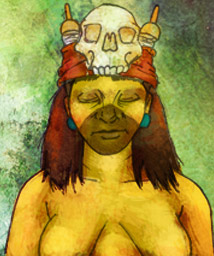
Tlazolteotl is the Aztec goddess of purification and filth. She gets you dirty, she gets you clean. Dirty, as in disease, dirt, and vices like gambling or adultery, and clean, as in steam baths and forgiving disease caused by misdeeds, particularly of a sexual nature (wink, wink). Tlazolteotl is a patroness of adulterers and midwives. I like this lady, she’s loaded with opposites! She inspires desires and forgives you when you indulge in them. Nice, right?

Tlazolteotl is sometimes depicted wearing the skin of a human sacrifice, a headdress that has a spindle of cotton, and carrying a grass broom. Other times she is naked and squatting, as if giving birth.
Through a priest you can confess your sins to Tlazolteotl, who will forgive them (she is known as She Who Eats Sin). There is a catch, unlike in other faiths that feature confession, you can only confess to Tlazolteotl once in your life. So you had better save it for a real doozey or when you’re very old!

The Nature of Reality

By Bob Makransky
(This essay originally appeared in the May 2009 Magical Almanac Ezine. Used here with the author’s permission.)

It’s difficult to understand what magic is without understanding the nature of the self and reality. This is not an irrelevant question which is best relegated to Philosophy 101 – meaningless, empty talk which philosophers debate about endlessly to no purpose. Rather, understanding what the self and reality really are cuts to the very heart of magic. It’s a question of everyday life, of where we focus our moment-to-moment attention. It is by scrutinizing this question and not allowing themselves to be fooled by superficial appearances that magicians obtain whatever advantage they have over most people, not by supernormal powers. It’s a sad commentary on the state of our society that the antics of so-called celebrities, and the latest fashions, buzz-words, and gadgets, are much more important to most people than the questions, “Who am I?”, “What am I?”, and “What the hell is going on here?”

A fundamental principle of magic is that reality – what we experience when we are awake – is but a specialized form of dreaming. Dreaming came first evolutionarily, and being awake is a later adaptation, rather than vice versa. We believe that what we experience when we are awake is real. However, it is also true that we believe that what we experience when we are asleep is real – at least while we are still dreaming. It is merely the belief that what we are experiencing is real that makes it real. This seems to be a very difficult point for people to understand. We indeed create our own realities. There is no outside reality impinging upon us, in spite of superficial appearances to the contrary. What we experience as the outside world, or reality, is no more real than the dreams we had last night.

Why then does the world that we experience while we are awake seem so real? This is due to our constant thinking, our constant inner dialogue, which holds our waking reality together for us. If our self-referent thinking stops, so too does our reality.

If you objectively examine the contents of your inventory of habitual thoughts you will discover that most of them consist of thoughts of glory – receiving approval and approbation from other people, and shame – hatred of your looks, your actions, and your feelings. Glory and shame are two sides of the same coin: the me-me-me coin. If you stop thinking these thoughts, then the “me” – the sense of a separated, continuing self who is alternately exalted and debased – ceases as well. When this lower self collapses, so too does the so-called real world.

There are other societies, magical societies, in which people don’t think as much as we do. The reality the members of these societies experience in their daily lives is more magical than ours is. The world of the Mayan Indians of Guatemala is a good example. Freidel-Schele-Parker, in their book Maya Cosmos, contrast the Spanish and Mayan world-views through their respective descriptions of the decisive battle in which Pedro Alvarado defeated Tecun Uman, the leader of the Kiche Mayans, on February 22, 1524:

“According to Alvarado, this was just another battle among many. In a letter to Cortez, he said that several thousand Kiche warriors approached his troops while they were taking a break for food and water. They let the Indians close the distance. Then they attacked and routed the Indian army, pursuing them until they were trapped against a mountain. … He mentioned that one of the Kiche chiefs was killed, but he did not even record his name. The Kiche account is told as if a totally different series of events had unfolded.”

The Kiche Mayan version is a battle between the magic and gods of the Mayan Indians and the magic and gods of the Spanish: the Virgin Mary and her attendant angels. In the Kiche version, Tecun Uman assembled an army of 8000 warriors to oppose the 700-man Spanish army, then he used magic to transform himself into an eagle and flew against Alvarado, but “he could not kill him because a very fair maiden defended him; they were anxious to enter, but as soon as they saw this maiden they fell to the earth and they could not get up from the ground, and then came many footless birds, and those birds had surrounded the maiden, and the Indians wanted to kill the maiden and those footless birds defended her and blinded them.”

Whose version of the battle is correct? The Spanish themselves credited their God and the protection of the Virgin Mary with their stunning victories against overwhelming odds, even if they weren’t able to get the same visual take on the thing that the Mayans got. Modern historians, whose worldview is even less magical than the sixteenth century Spanish view, try to explain the outcome in purely materialistic terms. From the magicians’ point of view, none of these views are correct; or rather, they all are, because people create their own realities based on what their social training and personal experience of the world have led them to expect. The reason why most modern people experience so little magic in their lives is because they’ve trained themselves to be closed-up and insensitive, and to expect life to be routine and dull.

Our constant thinking, and the customary moods and concerns which this thinking conjures up, is a screen which keeps our intuitive perception of the world under wraps. Without this screen the world becomes vivid and magical, teeming with life and meaning. My book Magical Living describes a simple technique for following feelings and for opening ourselves to the magic of the world. When following feelings we shift from the closed-up mindset of thinking awareness into a state of enhanced awareness in which we can feel what plants are feeling, sense emanations of power from the earth, interact with spirits, and so on. The world of enhanced awareness is a world of constant surprises and delight. However you couldn’t balance a checkbook or interview effectively for a job in this state. The point is that what blocks our magical perception of the world is our fear; and our anger; and our fear of our anger; and our anger at our fearfulness; etc. etc. That is our constant inner dialogue. This is the reality which most of us have created for ourselves.

In actual fact, there is nothing out there whatsoever. Reality actually consists of nothingness. Any reality which we perceive is our own invention: a gloss over the basic stuff of the universe, which is void. The Buddhists call this Shunyata, or emptiness. It’s sort of like the fact that a movie is actually colored celluloid with light passing through it. Now if we can go one step further and imagine that even the colored celluloid and light don’t exist either, then we’ve got a picture of what’s really going on. God doesn’t exist; the universe doesn’t exist; existence doesn’t exist. This happens to be the truth; but since truth doesn’t exist either, we may as well just let the subject lay.

Magic, in fact, is the only logical, reasonable, rational worldview since it is completely illogical, unreasonable, and irrational. An important principle of magic is that magic is a false view of reality, since reality can’t be viewed. It cannot be comprehended with the mind, by thinking. It can, however, be glimpsed with the feelings, by direct knowing.

It is important to understand what the self really is if we expect to understand what reality is. The myth of a separated lower self – a body – and the myth of an external reality arise together. These are two ways of looking at the same basic falsehood. In actual fact we are not separated from the world, and the world is not outside of us.

What fools us is our linear view of time. We mistakenly believe that things happen to us, and then we react to them. For example, first we get laid off from our job, and then we feel depressed and helpless. However from the magical point of view, the decision to feel depressed and helpless is primary – is made “first”. The getting laid off is conjured up “later” to justify our feelings of self-pity. Face it: there are lots of options – feelings we could conceivably feel in any given situation. For example, if we get laid off we could just as easily feel relieved, glad that one’s over, hopefully looking forward to a new career. The choice to feel self-pity about what happens to us is always a free choice.

The choice to feel self-pity at the things which happen to us – as if we didn’t bring them to us in the first place – is what creates the illusion of a separated self at odds with an outside reality. What we consider our self is just self-pity. Since this point is the entire basis of magical training, it bears repeating: the lower self is nothing more than self-pity, and when self-pity is eradicated the lower self dissolves also.

If we’re going to understand this point of view we have to get over our prejudice, which is all it is, about time being linear. The fact is that time is not linear. Survivors of near death experiences often report having seen every single event that ever happened to them during their lives flash by them in no time at all. Sometimes they report seeing everything that ever happened to them zip by, but still being able to see each scene discretely, in a few seconds’ time. Others report seeing each individual event of their entire lives in one, complete take. In any case, it would seem that we experience the thought forms of our lives twice: once in linear fashion over a lifetime, and then in a non-linear fashion at the moment of death.

This idea that time can be non-linear is easiest to see in dreams. Dream time is sequential, but not linear in the same sense in which waking time is linear. Dream time doesn’t have the same cause-and-effect inexorability that waking time has. This is because there is less importance in dreams, so everything is more here-and-now. We don’t feel moods and concerns as acutely in dream time as we do when we’re awake because we don’t think so much. Things happen too fast and too intensely in dreams to dwell upon. Everything is just too vivid and too now.

Infants and young children are basically doing what we adults would consider dreaming even while awake. Being awake – and our sense of linear time – are something we learn as we grow up. That’s why it seems to us that childhood lasted forever (while we were still children): because our sense of the passage of time wasn’t yet fully formed. Linear time is a byproduct of our ability to think.

In life-threatening situations, such as while we are having an automobile accident, or during a big earthquake, time slows way down. We can see everything that is happening with great clarity, in great detail, as if it were unfolding in slow motion. This slow motion perception of time is closer to the truth. It is more like dream time perception and less like our normal, everyday, gloss-over-things-quickly-and-superficially perception of time. However, we are incapable of acting in the normal way in this slow motion perception of time because we can’t think. If we are going to act or react in this frame of mind, we can only do so on intent, on our gut-level instinct, not on thought. Therefore the slow motion perception is not as useful in performing all the humdrum tasks of everyday life as is normal time perception; but it is the more useful form of perception in the practice of magic, where decisions have to be made faster than normal thinking allows.

When time slows down enough we lose our sense of separated selfhood and move into altered states of consciousness. Indeed, “timelessness” is how people usually describe such states. Altered states can occur due to shock, psychedelic drugs, or even spirits. Some spirits have the power to temporarily erase our self-pity so that we experience a state of selfless grace. Enlightenment is such a state – people who are enlightened can move into and out of timelessness and selflessness at will, by focusing their attention one way or the other. But even enlightened people don’t exist in a state of nirvana all day long. They have normal lives to lead too, and altered states are not particularly functional in everyday society.

Normal, everyday life is the battleground, the place where the real work has to be done, the place where it all begins and ends. Altered states can be inspiring, can give us a glimpse of the goal we are shooting for, but they are always temporary. The goal is to bring an awareness of timelessness and selflessness into the routines of our everyday lives. We do this by detaching from the self-important, self-pitying me-me-me with its endless fluster of moods and concerns.

The essential tenet of magic is that you create your own reality. This means that the things which happen to us are attracted by our moods and concerns. It’s only by controlling our moods and concerns, our thinking, that we can control our reality. Of course, this is a lot easier said than done. Our moods and concerns have a tremendous momentum of their own. To turn back that tide means to literally rewrite our personal history and to let go of the past; to release our expectations and let go of the future.

There are ways of doing this. One technique in particular, recapitulation, involves reliving our memories to discharge the energy pent up in them. There are also many other techniques for self-transformation. These usually take years and years of dedicated practice before we start seeing concrete results: controlling our realities by controlling our moods and concerns, our moment-to-moment thinking and moods.

The purpose of Creative Visualization is to take a short-cut to creating your own reality, without all the years of work. Creative Visualization is described in detail in my book Thought Forms. The point is that the difference between the magician’s reality and most people’s reality is that the magician makes a thoughtful, informed choice of what his or her reality will be. Most people, on the other hand, accept willy-nilly, unquestioningly, the version of reality inculcated by their society – their parents, teachers, church, government, academia, and the media. Neither is right or wrong, it’s all Shunyata, emptiness; but one choice leads to freedom, and the other leads to slavery.

About the author:
Bob Makransky is a systems analyst, computer programmer and professional astrologer. He lives on a farm in highland Guatemala where he is a Mayan priest and is head of the local blueberry growers’ association. Check out his free downloadable Mayan Horoscope software, free downloadable Planetary Hours calculator, free downloadable Primary Directions / celestial sphere mathematics textbook, complete instructions on how to channel by automatic writing and how to run past life regressions, articles, books, stories, cartoons, etc. etc. at www.dearbrutus.com.

Drawing Down the Spirits

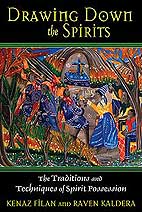
Are you ready to have your mind blown? Seriously, are you looking for a book that will force you to confront and/or reevaluate your thoughts on the very prospect of God or Gods themselves? Then you must, I repeat must, get your hands on a copy of “Drawing Down the Spirits: The Traditions and Techniques of Spirit Possession” by Kenaz Filan and Raven Kaldera.

Where to begin? First, I like the authors’ honesty and straight forward nature. There are ample texts out there that study the phenomena of spirit possession, the cultures that practice it, etc. Most of it is written from a perspective of trying to dissect it, to figure out why practitioners believe it’s happening and what’s really going on. This makes for intriguing reading. The authors here make it clear that this is not that kind of book.

The metaphysical preconceptions underlying this book are quite simple. The authors believe that possession is a real phenomenon; we also see the spirit world(s) as a real place, and that at least some instances of possession involve the displacement of the horse’s ego by an outside entity. We acknowledge scientific method as a useful tool, but we do not limit ourselves to this method, nor do we believe it can explain all possessions.

(These guys would get along with LeShan and his theories on the study of the paranormal.)

So with that out on the table by page 34, you might be inclined to think that “Drawing Down the Spirits” is going to become an odd how-to book, or a long winded retelling of first hand experiences. Boy howdy would you be wrong!

The book opens with a fantastically well written, in depth look at the history of spirit possession. This involves a retelling of the history of Spiritualism, Edgar Cayce, Madame Blavastky and Theosophy, and JZ Knight and Ramtha. This all leads into a geographical history lesson in spirit possession that covers Africa, Asia, Europe, the Middle East, and Oceania. I would gladly have purchased this book for the historical overview alone.

What follows is a compelling look at everything from what constitutes a genuine possession to cosmologies to safety tips to seriously, anything and everything you could ever want to know about spirit possession. Really, anything.
This book presents itself to the reader as a practical look at the phenomenon of spirit possession, and it is, but what really appealed to me was that it is impossible to read “Drawing Down the Spirits” and not spend some time thinking about your thoughts and relationships with God and/or Gods. Hidden within this informative, straight forward text, is a philosophical discourse that is fascinating. Once you open this book, you’ll find it hard to put down.

10 Questions with Alaric Albertsson

1. First, clarify for my readers, you follow the path of a Saxon Pagan. What are the Saxons? Does this differ from Celtic or Nordic paths?

Both “Saxon” and “Anglo-Saxon” are collective terms for the Germanic tribes that immigrated to Britain from the 3rd to 6th centuries. Their language and culture were similar to those of the Norse, although there are distinct differences. As Brian Branston points out in The Lost Gods of England (Thames and Hudson, 1957), the Saxon god Woden appears vastly different than the warrior-god described in the Norse Eddas. The Saxons were unrelated to the British Celts, although both cultures almost surely adopted some customs from each other.

2. What drew you to the spirituality of the Saxons?

This has been a long, spiraling journey for me. The first Pagans I met invoked Saxon gods and goddesses in their rituals. That was back in 1971. Over the years I explored and experimented with many expressions of Paganism, but I kept circling back like a moth around a flame. Buckland’s The Tree, a Saxon variation of Wicca, came out in 1974 and drew me back to the Anglo-Saxon gods, but it wasn’t what I was searching for. I believe that my gods – Ing Fréa in particular – have guided me over the years in my quest to reclaim Saxon spirituality.

3. What made you decide to write a book?

You’ll have to blame Christopher Penczak for that. Several years ago, while we were both at the Between the Worlds gathering, Christopher encouraged me to write a book about Saxon spirituality. At first I was hesitant, but after I played around with the idea for a while I realized that I wanted to write a book for people like myself – for that boy who was looking for guidance in the early 1970’s, and for those like him who are looking for guidance now. That’s when I began to seriously write Travels Through Middle Earth. And Christopher has been supportive and encouraging throughout this entire epic adventure. He has become a dear friend.

4. Your book is called “Travels Through Middle Earth: The Path of a Saxon Pagan”. What is the connection between Saxon spirituality and Tolkien?

Professor Tolkien’s stories were inspired by Saxon spirituality. His fictional wizard Gandalf was modeled after the god Woden, so if you’ve seen the movies you have a pretty good idea of Woden’s personality and nature. His elves and dwarves and orcs are incarnate personifications of Saxon spirits. The names and entire language used by the Rohirrim is Old English. And “Middle Earth” itself is simply the Saxon term (middangeard) for the physical world we live in.

I do think it’s important, though, to distinguish between Tolkien’s novels and true Saxon spirituality. Gandalf is a powerful being in The Lord of the Rings, but he is not a god. Woden, who inspired the character of Gandalf, is the leader of the Saxon gods.

5. Geek question! Who’s your favorite character from the Lord of the Rings books?

I would have to say the hobbits of the Fellowship, all four of them: Frodo, Sam, Merry and Pippin. They weren’t grand and flashy, and they had a hard time fully comprehending the events unfolding around them, but through it all they remained loyal to one another. Characters like Aragorn and Legolas were noble heirs, but the hobbits were plain folk, loyalty to each other with no thought of glory or reward.

6. I know it’s a waste of question, but I just want to say I’ve never consumed or even considered mead, but now that I’ve read a whole chapter of your book dedicated to it I totally want to try some.

Be sure to try a few varieties. “Mead” is as broad a term as “wine” and can vary as much as Dom Perignon does from Mogan David.

7. What challenges do you see facing the Pagan community? How can the community resolve those issues?

I think the biggest challenge we face – and we have been challenged by this for as long as I’ve been Pagan – is a tendency to believe in One True Path. Face it, most of us are still first-generation Pagans, and part of our baggage is the One Way Syndrome. I believe the central defining quality of Paganism is, or should be, an acceptance that there are many gods and many paths. My way is the best way for me. It may not be the best way for you. Superficially we all seem to agree with this, but on other levels I constantly see people behaving towards others in ugly, judgmental ways.

8. Where can someone learn more about Saxon spirituality? (After they’ve read your book, of course.)

For an enjoyable read I highly recommend Brian Bates’ The Real Middle Earth (Palgrave MacMillan, 2002). And although it’s a bit dry, the classic is Branston’s The Lost Gods of England. You might also want to check out Galina Krasskova’s Exploring the Northern Tradition (New Page, 2005).

9. What’s next?

You probably noticed the topic of magic was limited to one brief chapter in Travels Through Middle Earth: The Path of a Saxon Pagan. That was intentional. I believe too many Pagan books today place an inordinate emphasis on magic. I believe there is a hunger for alternative spirituality that doesn’t necessarily involve casting spells or raising power. So my first book focused on developing a personal spirituality, with only a cursory look at magic.

My current project is tentatively titled Wyrdworking: The Path of a Saxon Sorcerer. This is the magic book. But I sincerely hope readers who want to explore runes and worts and galdor will first build a solid spiritual foundation with what I’ve presented in Travels Through Middle Earth.

Initially I’d planned to write a separate rune book that would be sold with a deck of Anglo-Saxon rune cards. But Llewellyn turned down the card deck, and I don’t think I can sell a book about runes when the runes themselves aren’t available (the Anglo-Saxon runes have nine more characters than the commonly sold Elder Futhark runes). So I’m mashing the rune book together with the magic book. I’m pretty excited about it. Wyrdworking will be packed full of useful material for the aspiring Saxon sorcerer.

10. Parting shot! Ask us here at The Magical Buffet any one question.

Where can I find a publisher for a very nice deck of Anglo-Saxon rune cards? The man who did the art work for the deck has put in countless hours to ensure that each card illustrated the meaning of the relevant passage in the Anglo Saxon Rune Poem. I really want to see this deck eventually reach its intended audience. Maybe one of your subscribers has the answer?

One place you might want to contact is US Games, they publish loads of awesome decks (many of which get reviewed here on the website). Also, you could always save up some cash, maybe find a few investors, and publish the deck yourself. Thanks to the wonders of the world wide web, you can reach an international market fairly easily.

About the Alaric:
Alaric Albertsson is the author of “Travels Through Middle Earth: The Path of a Saxon Pagon”. To learn more about Alaric visit his website.

No, No, It’s Not October

As you may remember, last October I profiled Breast Cancer Action’s “Think Before You Pink” campaign. I had every intention of doing that again this October, and probably will, but something has come to my attention that can’t wait 4 months, it can’t wait four weeks, four hours, or four minutes.

Let me attempt to sum up a complex issue. What it comes down is this; corporations can hold the patent rights to genes. I found it a bit concerning when I learned this was being done with regards to food (you know, a corporation holds the patent on a gene to some super corn or what have you) but I became alarmed when I realized that a single corporation holds the patent rights to the human genes linked to cancer. Seriously, I can’t make this shit up.

What does it mean for a single corporation to hold the rights to the genes? Well, for starters, any science lab, university, or outside corporation has to pay Myriad (the corporation with the patent) for access to the gene for testing and experimentation. That makes it harder and more expensive for research to be done by anyone other than Myriad. Also, because they own the rights to the genes, they also own the rights to certain tests. This means it’s difficult to impossible for a woman to get a second opinion with regards to the test results.

It means research is limited and access is expensive and difficult to get. I’m not a scientist, but I suspect this all falls under the category of “Bad Things”, unless you’re a scientist working for Myriad, in which case, rock on.

Fortunately, the “Bad Girls of Breast Cancer” are on the job! Breast Cancer Action has joined up with the ACLU to file a lawsuit challenging the legality of patenting “human breast genes”. As far as I’m aware, Breast Cancer Action is the only breast cancer organization that has taken to arms against this dangerous situation.

If you would like to help, I encourage you to visit Breast Cancer Action’s website and make a donation. I know money is tight for most of us, but even $10 shows that you care and support their fight. Another way to help is to visit the ACLU’s website and make a donation to help them in all their fights to help Americans hold onto and regain their civil liberties.

Do me a favor; take 5 minutes to watch the following video. Thanks. (Next post will be something fun and possibly magic related…promise.)

And to prove I mean what I say, this email just showed up in my inbox (some of the content has been edited for privacy).

Please note that this donation will appear on your credit card statement as Network for Good, which processed this donation on behalf of Breast Cancer Action.

Your contribution is tax-deductible to the extent allowed by law. You may save or print this receipt for your records. This email certifies that you have made this donation as a charitable contribution and you are not receiving any goods or services in return. This receipt may be useful to you when completing your tax return.

Name: Rebecca Elson
Address:
City:
State/Province: NY
Zip/Postal Code:
Country: United States
E-mail:
Phone:

Method of Payment:
Name on Credit Card: Rebecca Elson
Credit Card Last 4 Digits:
Base Donation Amount: $15.00
Network for Good Grant: $0.45
Total Billed to Your Credit Card: $15.45
Tax Deductible Amount: $15.45
Date: Thu, 18 Jun 2009
Time: 5:26 PM EST
Transaction #:
Authorization:
Authorization Code:

Nonprofit Organization: Breast Cancer Action
Address: 55 New Montgomery St. Ste 323, San Francisco, CA 94105

Okay Bourdain, Now I Get It

If you’re like me, you love watching “No Reservations” on the Travel Channel with Anthony Bourdain. And if you do watch, you know that Bourdain has a thing for Vietnam, and even more specifically a Vietnamese noodle soup called pho (pronounced fuh, like duh with an f). Every time he’s anywhere in Vietnam you get treated to watching him and his cohorts slurping down this soup while an elaborate voice over explains why this is the soup to end all soups (I suspect the voice overs are because he doesn’t want to stop eating to discuss.).

Now many of my readers live in large cities and I suspect getting yourself a bowl of pho isn’t too rough if there’s any kind of Vietnamese population where you live. With a little research I found two places about 30 minutes from where I live that serve pho, so I picked the one that had good reviews for its pho and was located somewhere I felt confident I could find. So, at the end of May, for my birthday, my husband took me there for lunch so I could finally try pho.

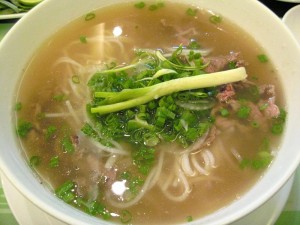
For those of you who are unfamiliar with pho, let me break it down for you, at least in respect to what I had. It’s a very complex broth soup, in the case of what I had, beef broth, that has rice noodles, a variety of onions (yes, there was heart burn, exquisite, delicious heart burn), and since I ordered the pho bo, which is pho with thinly sliced beef, there was a load of thin slices of beef in there. On the side you’re given a variety of things to add to customize the pho to your tastes. I got a plate with fresh bean sprouts, lime, hot peppers and basil, and a small dish that had a spicy chili sauce and I think fish sauce.

Never having had pho before, I first had a few tastes of it without adding anything. It was a yummy soup that tasted exotic and yet oddly familiar. Vietnam meets childhood broth soup. After a few tastes I decided the lime would be good in it and squeezed the wedge into the bowl. Also, since I like bean sprouts I put a bunch of those in right away. Not being able to handle overly spicy food I opted to skip the fresh hot peppers and I didn’t love the idea of fresh basil in the broth so I skipped on that. Since basil is a staple, I’m sure it tastes fine; it just didn’t seem to click for me. I enjoyed the pho like that for a while and then decided it was time to try out the sauces. I tasted both sauces, and the chili sauce was very spicy. I put in a healthy dollop of the fish sauce and a tiny touch of the chili sauce. For me, this is when the soup went from good to awesome. Ironically, my husband doesn’t care for fish sauce, so for him it went from awesome to okay.

And that’s how I enjoyed my pho bo. I thoroughly enjoyed it, but at the same time I couldn’t work up the near fanatical adoration for it that Bourdain possesses. I ate half the bowl and took the other half home. End of story? Guess again.

Once I was home, I kept thinking about the pho bo in my refrigerator. I thought about it so much that despite having a filling dinner I found myself heating up a small bowl of it for a snack later that night. And once it was gone, that’s when it began. I would find pho sneaking into my mind a lot. I found myself looking at the calendar, trying to figure out when I could get down to that restaurant again for more. And that’s when I realized what Bourdain was talking about, pho gets inside you, and I’m not just talking about in your belly when you eat it. It’s combination of home-cooked noodle soup memories from your childhood laced with exotic flavors from another land…it’s a heady mix indeed.

So yes Bourdain, now I get it.

Post Script: I recently got to go back for more pho. This time I had pho tom, which has shrimp instead of beef. Delicious!