Everyday Dharma Challenge: Week Four

(normal text is Rebecca, italicized text is Lama Willa Miller)

Here we are at week four of my “Everyday Dharma” challenge. For those of you just tuning in, check out my previous posts to get caught up. I’m at the halfway point! I hope you’re all finding my journey amusing and enlightening. I’ll admit, it’s a lot harder to bring the funny when discussing this stuff than I thought it would be when I set out. Sorry folks! On the other hand, I’m halfway to getting my Buddha on! Let’s focus on the positives. With no further ado, let’s look at week four.

This whole week was about growing love. As Lama Willa says, “A spiritual journey takes courage and vision at the outset, but to sustain such courage and vision you need fuel: a love that is correspondingly courageous and visionary.” With day one we considered love. The exercise was to find out what love means to you. You finished the following sentences, what was in the text is in bold.

Love is (list some adjectives) exhilarating, liberating, and compassionate.
Love is never needlessly cruel.
I find it easy to love my husband.
My definition of love is that love is a thing that allows you to be your authentic self.

I like your definition! Why is thinking about how we define love useful? For one, we carry around, and therefore act on, definitions that we rarely evaluate. Assumptions about love, and other aspects of our affective life, often remain hidden from us. Many of these definitions are cultural, and some may be related to our personal history. We rarely bring these to light and then as: is this assumption useful? Is it even true? When we figure out how we define love, we can begin think about whether the assumptions therein are useful and true.

Once we have some definitions to work with, we can begin to think about how we might redefine love consciously in a way that is true, and that is useful. We can explore a deep definition of love that we feel great about living by. Another reason to think through our definitions is to discover the vision of universal love’s fruition, such as the qualities you mention– exhilarating, liberating, compassionate. If we look at what we mean by ‘love’, we often find something liberating there, but we may not have worked hard to cultivate love’s liberating power. Spiritual practice should help us grow love in order to unfurl its ability to free us from suffering.

Day two discussed two myths about love. Lama Willa explains that “you cannot effectively accept and love others unless you initially accept and love yourself”. The first myth was that you do not deserve to be loved, when the truth is everyone is worthy of love. The second myth was that no one ever really loved me or loves me now, when the truth is that you have been loved in the past and are loved now. The exercise for the day was to identify benefactors. In this context a benefactor is someone who has loved and cared for you. That one is easy, my husband.

Benefactors can be found in the most unexpected places. Even a pet can be a benefactor. If you have felt loved by someone or even an animal, just once, they are a benefactor for you and have reminded you that you are loved. Pets do a great job of ‘benefacting’ non-verbally! (Was that a neologism?) The term ‘benefactor’, used in this sense is inspired by some of the practices developed by American Buddhist teacher John Makrasnky. He does a great job of discussing benefactors thoroughly in his book Awakening through Love.

Day three addressed two more myths about love. Myth one was that love is something that “happens” to people, the truth is that love needs to be cultivated. When I first read this I was ready to call B.S. I mean, my love for my husband just “happened”. However, further reading has Lama Willa explaining that “love is a choice that sometimes happens to people. Even when it “happens” to someone, it will quickly “unhappen” without cultivation.” And she’s right, my love for my husband just happened, but what if we had never carved out time to spend together when I worked my crazy retail schedules, what if we didn’t take the time now to let each know that they mattered? I suspect Lama Willa is right, our love would potentially “unhappen”. Myth two was that you say to yourself, “I gave everything I had to him/her/it and now I have nothing left to give,” when the truth is that no matter what your personal history, you are capable of love. The exercise for the day was to forgive small harms. You attempt to make a commitment to forgive a person who made you feel harmed, angry, and/or hurt. Since I try to keep The Magical Buffet a positive place, and the fact that anyone anywhere can read this, I’m not going to share with you all who I’m attempting to forgive. I’m a woman, I have a laundry list of people, who as Kathy Griffin would say, can suck it. I’ve picked a few who I will endeavor to take a little less of a Kathy Griffin philosophy with.

Forgiveness is one of the most powerful spiritual practices around, and Buddhism is deeply concerned with its cultivation [touché, Brit Hume!]. Buddhism teaches that forbearance—or patience—is an essential key to enlightened living. Forbearance includes the practice of being tolerant and forgiving in the face of harm. Forgiving runs contrary to much of our cultural conditioning: we are taught that by putting other people down [especially those that have—in our view—harmed us], we become stronger. But the opposite is the case. By forgiving, we become stronger. Many of us also are inclined to believe that those who forgive are weak. But that is not true, because forgiving is not easy. Anyone can hold onto a grudge. It takes a strong person to forgive.

But being forgiving does not mean tolerating the continuation of harm. There is real injustice in the world, real falsity, and real cruelty, and wherever injustice, falsity and cruelty exist, they need to be addressed and challenged. But anger and spite may not be the most stable place from which to challenge the world’s injustices. Forbearance, an attitude that includes an element of forgiveness, is a more stable ground to start from. Forbearance is not an attitude ‘what this person did is okay’. It is rather the recognition that people are not merely what they do. They act under the influence of a lifetime of conditioning. Forbearance also means entertaining the possibility that our own reactivity plays a big role in ‘harm’. Therefore, it is usually not enough to blame a person for harm—the picture is much more complex than that. If you acknowledge such a possibility, you create a space where challenge and arriving at justice can take place effectively.

Day four discussed universal love. Lama Willa examines universal love by outlining it’s qualities: universal love melts boundaries, universal love evens terrain, and universal love tears up contracts. The exercise for the day was assessing boundaries. I’m going excerpt the whole exercise here because honestly, the exercise really puts things into perspective.

“Consider: What kind of boundaries do you place around your feelings? Are there people whom you do not love because of what they do or have done? What kind of “ifs” do you put on love? Now consider, is it possible to love someone with no “ifs”? Consider whether it is possible to love without agreeing with or condoning another’s actions. Are there any valid reasons to withhold love?

Now think of one person from whom you withhold the feeling of love, not entirely but somewhat. Can you imagine what it would be like to push your boundary out with this person and let yourself feel a love with fewer conditions, at least sometimes? Visualize for yourself what this would be like. What do you gain by withholding love? What do you lose by giving it?”

Again, I’m not going to share with you the individuals I’m thinking of, but I will tell you that the exercise did resonate with me. If you think I’m being nicer to you, it’s totally a coincidence….I would never think of you that way.

I have found it to be life-changing practice to push my boundaries around love (always understood here to be platonic!). This can be done in the simplest of ways, by noticing how we approach people every day, especially those who we don’t necessarily cherish. What would happen if we tried to be a little warmer, and a little kinder? This kind of constant attention to our attitude pays off, because we discover that it actually feels really good to be kind. It is much more enjoyable than being cold or neutral. We can work on this in so many small ways.

Day five continued examining the idea of universal love. Universal love is nonjudgmental, selfless, compassionate, and joyous. The exercise for the day was to contemplate overcoming the judging mind. “Consider: In what ways does judgment get in the way of loving those closest to you? Is your love clouded by judgment? What is worse, the tendency to find fault in others or the faults you judge others to have?” I know that I judge people, but I am definitely more harsh in judging myself. Does that make me slightly more enlightened than those who judge others but find no fault in themselves? Here’s hoping!

I’m glad you brought up self-judgment. I did not address that in this section of the book, but self-judgment is also something to work on. In fact, if we are harsh on ourselves, we tend to be harsh on others too. These two are of a piece. When you begin to soften your judgment of others, you discover that others—even those people we have not previously considered special– are very precious and special in many ways. We cannot discover that special treasure in others if we put all of our energy into judging them. Once we begin to discover the preciousness of others, we can entertain the idea that we too are precious. It can go the other way as well: we can also work on letting go of self judgment, and use that as a door to letting go of our judgment of others.

Day six discussed four ways of perceiving others. Every person is your only child. Every person is your parent. Every person is your best friend. Everyone is a sage. Essentially the exercise for the day was to try and view your social interactions with this new angle of perception to attempt to widen the scope of love to include more people.

In the context of Buddhist doctrine, this practice is sometimes expressed within the context of reincarnation. From the point of view of reincarnation, this is not the first or only life we have lived. When we meet someone, we are never meeting them for the first time. We have met many times before, over the course of many lives. From this wider perspective of many lifetimes, people around us have literally been our mothers, fathers, sisters, best friends, teachers and helpers before. From that point of view, they are not strangers, so we should not treat them that way. We should reserve a place in our heart for all of them.

Even if you do not believe in reincarnation, it can be a helpful exercise to imagine the web of relationships that connects all of us in this life. From the point of view of being connected to everyone through degrees of closeness [I prefer that to degrees of separation], we are all of one human family.

Day seven was “Growing Your Love through Contemplation”. The text for the day was basically detailing the meditation that was the exercise for the day. To sum it up, you focus on someone you love, so that you can feel the love, and then let the feeling grow and radiate out of you. Now I was honest about my difficulties with meditation, well it’s worse when I’m supposed to follow a progression of things. It’s much easier for me to think in, out, with my breath than to go through a whole mental script. However, I made my best attempt here.

It can take many repetitions [perhaps 20 times] sitting down with a practice to memorize it and become really relaxed with it, without needing to rely on instructions. It is worth the effort. The key is to take a considerable time to do each step, really relaxing into each instruction for a few minutes so that you can get its flavor and meaning. For those readers out there encountering these meditation practices for the first time, guided meditations for the book are on iTunes! It can help to have a voice guiding you through these meditations at first because then you do not have to keep glancing at the book.

Week four, done! See you next week!

Congrats on finishing Week 4: You are more than half-way!

About Lama Willa:
Lama Willa Miller is a meditation teacher in the Tibetan Buddhist tradition. She has studied and practiced meditation for the last twenty years, training with Venerable Kalu Rinpoche, Venerable Dilgo Khentse Rinpoche, Lama Norlha Rinpoche, Khenpo Tsultrim Gyatso Rinpoche, Bokar Rinpoche, and other teachers.

She completed two seminary trainings [three-year retreats] at Kagyu Thubten Choling in upstate New York, becoming authorized as a lama, a Buddhist minister, upon completion of her training. Before and after her retreats, she spent time in Nepal, Tibet, and India, studying Buddhism and engaging in service work.

She currently lives in Arlington, MA with her husband and two dogs, where she writes, teaches Tibetan Buddhist practice and meditation, principally with Natural Dharma Fellowship. She is also working towards a PhD at Harvard University.

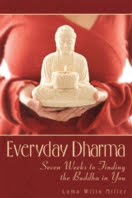
Lama Willa is author of the book “Everyday Dharma: Seven Weeks to Finding the Buddha in You” (2009, Quest Books), a practical guide for getting started on the spiritual path. Visit her website here.

To follow Lama Willa on Twitter, go to http://twitter.com/lamawilla.

On Facebook? Join the Everyday Dharma Facebook group.
Everyday Dharma Challenge: Week Three

(normal text is Rebecca, italicized text is Lama Willa Miller)

Here we are at week three of my “Everyday Dharma” challenge! I’m going to be honest with you, due to some health issues I did fall behind and did some bulk catching up. It’s not right, but it’s okay. Since I’m on a schedule I felt obliged to do it that way, but for the reader at home who may decide to work through this book (perhaps based on what they’ve been reading here) take your time. It really is easy to budget in the time for “Everyday Dharma”, just not so much when you lose days at a time to doctors. With that out of the way, let’s start at day one.

I hope you are feeling better, Rebecca!

Day one was “Finding a Place of Refuge”. This one was pretty straight forward. Everyone needs a place of peace in their home for relaxation, contemplation, and meditation. Prior to starting this, that place had been in our “guest” room. I apply the air quotes because as anyone who has lived in an apartment knows, a “guest” room is really a storage room that on a good day has space for a guest. These days it is truly a dumping ground, making it less than optimal for my already precarious meditation habit. After some thought I’ve decided to use my bedroom, that way I can always close the door to hide away from the temptation of “Family Guy” or “NCIS” reruns that inevitably sidetrack me in the living room.

Sounds good. I’m familiar with that “guest room”! We have one of those in our house. It houses my husband’s guitar collection, the big blue exercise ball, miscellany that will not fit elsewhere.

There is something empowering about developing a relationship with a place where we meditate or practice. We can make a meditation place in any room, but a clean and uncluttered space helps us keep our minds uncluttered when we meditate. When we begin to associate that place with meditation, it can become a kind of oasis in our own home. That being said, there’s an old Tibetan saying, “Wherever ‘here’ is—that’s the right place to meditate. Wherever ‘now’ is—that’s the right time to meditate”. Our external meditation spot is a symbol for the internal (potential) mediation spot we carry around all the time.

Day two was again, fairly straightforward. It’s “Adorning Your Space”. This was essentially “Pimp My Sacred Space”. Unfortunately, for those who liked the show “Pimp My Ride”, and fortunately for those serious about starting a meditation practice, instead of hydraulics and racing stripes you’re picking out a seat and setting up a shrine. The task for the day was to find something to sit on while in your sacred space, that would be a floor cushion in my bedroom, and to start creating your shrine. After some thought, I’ve decided to use the Hope Chest at the foot of my bed as my shrine. I leave the top empty except for my favorite Kwan Yin statue.

“Pimp my Sacred Space”. That’s clever! Spaces we arrange and adorn are powerful. They work on us, even when we are not conscious of it. For me, over time, the shrine has become more and more important as a powerful space. We now devote a room in our house to our shrine and meditation needs. We call it the shrine-room, and it is right down the hall from the ‘guest room’. The shrine itself is an old walnut cabinet bought on Craigslist. On its surface are pictures of benefactors and spiritual guides, symbolic offerings in silver bowls: rice, food, flowers, incense, a conch shell and water. Giving credit where it is due, my husband is the diligent maintainer of the shrine, and I am the lazy enjoyer of it. He dusts it, polishes the bowls, refreshes the water often, and also brews tea to offer several days of the week. Over the top of the shrine is a large thanka (a Tibetan painting, oil on cloth), of Vajrayogini, a Tibetan archetype (or deity) who inspires my meditation practice. In front of the shrine is a long table for spiritual books, my mala (an Asian rosary), and other useful items.

For 20 years or so I’ve been ‘detailing’ and ‘re-detailing’ my shrine. It has taken on various forms. The 1985 model was pretty simple—a picture, a candle, some incense. By 1992, it had morphed into considerable complexity: lots of objects and statues, dozens of picture, rocks, holy thises and thats. The 2010 model is leaning back towards simplicity. Keeping things simple seems to be more in line with where I am in my practice. I think most shrines have a history. They are an ongoing expression of the people around them.

To conclude, I believe a shrine—even when it is very simple— can be powerful. A shrine is powerful in a number of ways. It is a physical expression of what we are committed to and what we aspire to at a given time in life. As a physical expression, it reminds, invokes, and encourages. When we go through phases in our life– when it is difficult to show up “on the cushion” every day, difficult to meditate and difficult to pray– the shrine is still there as a reminder that we value inner development and freedom. It stands there, silently communicating to us the ideals of love, compassion, faith, forgiveness and wisdom even when we feel as if we cannot embody those ideals ourselves, even when our lives are hectic, even when things are upside down.

Day three dealt with offerings. Lama Willa explains that “In effect, offering is an act of honoring.” The exercise for the day is to make an offering to the representations on your shrine (with examples such as candles, flowers, or a bowl of clear water). I opt for a lighting a candle. Then you practice the Three Arrivals, back from week one, and recite your Awakening Prayer, from week two.

Yes, the practice of making offerings is an act of honoring. What does it mean ‘to honor’? I like the definition of ‘to honor’ as ‘to pay attention with respect’. When we pay attention to a symbol or set of symbols (like those arranged on a shrine) with respect, we reconnect with what those symbols represent, qualities like strength, compassion, wisdom, grace and so forth or truths like the truth of our inner wisdom nature, or ‘buddha nature’. In short, offering is a way of making, on a regular basis, a connection with qualities and truths. When we physically do something in the presence of the symbols on our shrine– like light a candle for example—we are expressing with the body a deep heartfelt respect for what is most valuable and true.

Day four was finishing up your creation. This was where you added things to personalize your shrine. Things that inspire, uplift, etc. I decided to set my copies of “An Introduction to Zen Buddhism” by D.T. Suzuki and “Zen Flesh, Zen Bones” compiled by Paul Reps and Nyogen Senzaki on my shrine to read for inspiration.

Trick it out, girl!

Day five was “Plumbing the Wisdom Nature through Introspection”. Lama Willa discusses how “introspective practices that deepen wisdom and love are helped by taking an interlude of seclusion, silence, and mental solitude.” You guessed it, the exercise for the day was to practice seclusion, silence, and solitude. I had no problem secluding myself away, or being silent, and I’m comfortable by myself in this state, but I readily admit that my mind had a lot of trouble quieting down. Every time it wandered, which was frequently, I would take a cleansing breath and try to silence it. My brain has a mind of its own!

Our challenge in meditation is not to rid the mind of thought, but rather to avoid getting hooked by thought. Thought is inevitable; getting hooked by thought not. We can learn to observe thought coalescing and dissipating, without getting too involved in it. By doing this, we eventually discover we are standing in space. Rather, we are the space in which thoughts unfold. We are a profound, selfless, vast space. When I say “we”, I don’t mean the conventional self; I mean the ultimate self, the Buddha-self, or as I call it in the book, the wisdom-nature. That profound, selfless, vast space—the wisdom nature– is not harmed, afflicted or bothered by any thought. It welcomes thought as an expression of itself.

Day six discussed breath meditation. Essentially, to help calm and clear your mind, you should focus on your breath as you meditate. When your mind wanders, you just refocus on your breath again. The exercise was to practice the Three Arrivals, recite your awakening prayer, and then meditate for five to ten minutes. I can’t claim that I had rousing success at this, but I did manage to stay put for five minutes, refocusing on my breath….a lot.

There’s no such thing as ‘unsuccessful’ meditation. Sometimes it is hard. Sometimes it is easy. But it is never unsuccessful. Every meditation session, even the hard ones, or perhaps especially the hard ones, are part of the trajectory of developing a good meditation practice. In some sessions, it seems like we are making “no progress”. It seems like we are lost in thought or we cannot concentrate. We lose track of the breath again and again. But every time we get distracted, we have that moment when we notice “I am distracted”. That moment cannot be underestimated. It is huge. It is the moment of mindfulness. Every time we have such a moment, we are laying the basis for sharpening skills in concentration, ease and relaxation that unfold over time. Even hard sessions are par for the course. If meditation weren’t hard, we would not have to practice it!

Day seven dealt with dedication. According to Lama Willa, “Dedication of your practice comes at the end of a spiritual activity to reinforce the connection between your inner work and its ultimate goal. You dedicate to the fulfillment of purpose. By mentally sealing an activity, such as your contemplation, with such a dedication, you ensure that the energy and time you spend goes towards fulfillment of your life-intention and aspirations.” As you may have guessed, the exercise for this day was to compose a Dedication Prayer. I hate to steal from the author, and I may change my mind and come up with something down the road, but I really liked the Dedication Prayer that she provided as an example, so for now it’s “This contemplation is dedicated to the awakening of my wisdom-nature for the good of the world and all beings within it.”

Glad you liked it. Congratulations on finishing Week Three!

And that’s week three! Four more weeks to go!

About Lama Willa:
Lama Willa Miller is a meditation teacher in the Tibetan Buddhist tradition. She has studied and practiced meditation for the last twenty years, training with Venerable Kalu Rinpoche, Venerable Dilgo Khentse Rinpoche, Lama Norlha Rinpoche, Khenpo Tsultrim Gyatso Rinpoche, Bokar Rinpoche, and other teachers.

She completed two seminary trainings [three-year retreats] at Kagyu Thubten Choling in upstate New York, becoming authorized as a lama, a Buddhist minister, upon completion of her training. Before and after her retreats, she spent time in Nepal, Tibet, and India, studying Buddhism and engaging in service work.

She currently lives in Arlington, MA with her husband and two dogs, where she writes, teaches Tibetan Buddhist practice and meditation, principally with Natural Dharma Fellowship. She is also working towards a PhD at Harvard University.

Lama Willa is author of the book “Everyday Dharma: Seven Weeks to Finding the Buddha in You” (2009, Quest Books), a practical guide for getting started on the spiritual path. Visit her website here.

To follow Lama Willa on Twitter, go to http://twitter.com/lamawilla.

On Facebook? Join the Everyday Dharma Facebook group.

Everyday Dharma Challenge: Week Two

(normal text is Rebecca, italicized text is Lama Willa Miller)

We’re at week two of my “Everyday Dharma” challenge. To bring you up to speed, I’ve decided to work my way through my copy of “Everyday Dharma: Seven Weeks to Finding the Buddha in You” by Lama Willa Miller, and the author has been kind enough to offer a response to each week. So what was week two like?

Day one was “Freedom is Communal”. This is a discussion of karma and how sages work to serve every human being. The exercise was “Contemplating Karma”. You are to relax and reflect on how your actions that day affected others. Not much to share with you all there.

Even if you don’t know it, you made ripples!

Day two was about your life-intention. “Actions begin with intention,” Lama Willa explains. She explains three types of life-intention: king-like (where you blaze a trail to enlightenment on your own and then take steps to help others), boatman-like (where spiritual life is a communal endeavor), and shepherd-like (where you put the betterment of others first). The exercise for day two was to determine what you serve and what you would like to serve. You list three things that in your daily life you find yourself serving (my job, my family, my homebody habits) and then you list three things you would like to serve as you move forward on your spiritual journey (my family, my fellow man, my creative endeavors).

Good job. Actions do begin with intention, sometimes unconscious sometimes conscious. It is an interesting exercise to occasionally look at how we actually spend our time and energy. When we look at where our time and energy goes, we discover what we are serving. Most of us spend considerable effort serving things we only half-care about, out of force of sheer habit or out of fear of taking a risk. Sometimes we are simply serving a habit, with no wider purpose, in a self-perpetuating cycle. One way to break that force of habit is to take time to pause and really consider, where am I putting my energy? How am I spending my time? Once we have honestly assessed where our time and energy goes, we can make a choice to re-harness it and send it to things we care about a lot.

In my own case, my weakness (one of countless ones I’m sure) is to take on too many projects. When I remind myself what I actually wish to serve, it helps me refocus my energy and let go of projects that are not in line with my heartfelt ideals. In a sense, that is what a life-intention does; it helps us focus our energy on what we believe in, which brings us to day three….

Day three was where the considerations from day two came to fruition; “Creating a Life-Intention”, essentially, coming up with your personal mission statement. Lama Willa explains, “In the Buddhist context, such statements of intention come under the heading of a ‘vow’ because it expresses a personal commitment to a life-purpose.” The exercise for the day was to compose your own life-intention. I vow to try and make people’s lives be better for having known me.

That is a beautiful intention, Rebecca. It is very much in line with the thinking of a bodhisattva (a compassionate sage). We can approach every interaction with the thought, ‘”How can I leave this person happier and better off than before we met?” What would that do to how we speak, how we move, what we do? Every interaction, every relationship would become opportunity to change the world. We underestimate the power of our daily interactions. What we do and say is not insignificant. The world does not change in huge movements; it changes bit by bit.

Day four was about aspirations. We all aspire to things, and this day was about defining those things and broadening their scope. The exercise for the day was to pick three aspirations (I hope that I my health improves. I aspire to spend more time enjoying the moment rather than worrying about the future. I pray that all of mine and my family’s needs are met.) and then expand those aspirations (I hope that everyone’s health improves. May everyone spend more time enjoying the moment rather than worry about the future. I pray that all families everywhere have their needs met.)

It is interesting to expand the focus of our wishes and prayers to include others. In fact, our own wishes are always a thread connecting us to others. What we wish for, others wish for also, in one way or another. When you include others, it becomes apparent that we have never been alone when wishing and praying, or for that matter when suffering. When we feel, it is always an expression of how so many others also feel. When we need, it is a reflection of others’ needs. When we suffer, it is a reflection of others’ suffering. So when we pray, we can pray for the happiness and fulfillment of all, not just ourselves.

Day five was composing your awakening prayer. An awakening prayer is a combination of your life-intention and aspirations worded as a prayer. May people’s lives be better for having known me. May myself, my family, and everyone’s family be blessed with health, happiness of the moment, and have their needs met.

Beautiful prayer.

Day six was about “Deep Prayer”. “Prayer is the next layer of the meditation sandwich you started making last week,” states Lama Willa. The entry this day outlined prayer techniques. Another point touched upon during this day that I felt was important to share. “In general you should pray to whatever or whomever feels right to you. If you believe in a higher power, call on that power when you pray. But you do not have to believe in a higher power to pray! Many Buddhists simply trust in the law of interpenetration when they pray, the idea that everything is connected and interdependent.” The exercise for the day was to practice the Three Arrivals (remember them?), then read your life-intention aloud, reflecting on each word, read your aspirations aloud, contemplating each one for a minute or two, then recite your awakening prayer. I’ve got to be honest here, this felt awkward, at best.

Honesty is a primary spiritual virtue, so bravo for that! Composing our own prayers and reciting them is not something that we are necessarily comfortable with the first time around. We may never before have put into words our deepest aspirations, hopes and dreams, much less say them aloud. This can feel contrived, initially. I think it is worth working with, however. Over time, it feels more natural, even nourishing.

In many religions, including Buddhism, followers are encouraged to memorize and recite prayers and aspirations that come from the texts and books of the tradition. This kind of prayer has its place. But in my experience, conventional prayer needs supplementation for three reasons.

First, good prayer is connected to the heart. When you recite prayers from a chosen text or tradition, you are letting someone else put words in your mouth. They might be very beautiful words, and there is nothing wrong with repeating them. But, this can become stale over time. To prevent prayer form becoming stale, we need to investigate what our heart needs and prays for.

Second, when you work with composing and reciting your own prayers and aspirations, you begin to explore values and yearnings you may have carried around for a long time, but not yet become fully conscious of. This is a way uncover and bring to light your soul’s subconscious call to wholeness. Once you bring this to light, you can begin to nourish your soul, or—in the language of the book—your wisdom-nature.

Third, deep prayer connects us to others. These values and yearnings are not just personal; they are a reflection of values and yearnings felt by many others. Prayer connects us to the aspirations of the human family. In this sense, prayer helps us develop intimacy with those around us.

Day seven was entitled “The Sage’s GPS”. Essentially this discussed how everyone can get lost, or feel lost trying to follow their spiritual path. We all know that a Global Positioning System can help you when you’re lost getting somewhere, well to help you when you’re lost on your spiritual journey you have Ground, Path, and Summit to help you. The Ground of your spiritual journey is your wisdom-nature. The Path of the spiritual journey includes all the ways your wisdom-nature is awakened and developed. The Summit is the fruition of your intention. The exercise for the day is contemplating all of these: The Ground, The Path, and The Summit. Consider them contemplated.

Now the question comes to mind, when are they going to make a car-installed version of the sage’s GPS? It might say things like, “Detour around self-absorption”.

And with that, we end week two. We’ll talk again next week!

See you then!

About Lama Willa:
Lama Willa Miller is a meditation teacher in the Tibetan Buddhist tradition. She has studied and practiced meditation for the last twenty years, training with Venerable Kalu Rinpoche, Venerable Dilgo Khentse Rinpoche, Lama Norlha Rinpoche, Khenpo Tsultrim Gyatso Rinpoche, Bokar Rinpoche, and other teachers.

She completed two seminary trainings [three-year retreats] at Kagyu Thubten Choling in upstate New York, becoming authorized as a lama, a Buddhist minister, upon completion of her training. Before and after her retreats, she spent time in Nepal, Tibet, and India, studying Buddhism and engaging in service work.

She currently lives in Arlington, MA with her husband and two dogs, where she writes, teaches Tibetan Buddhist practice and meditation, principally with Natural Dharma Fellowship. She is also working towards a PhD at Harvard University.

Lama Willa is author of the book “Everyday Dharma: Seven Weeks to Finding the Buddha in You” (2009, Quest Books), a practical guide for getting started on the spiritual path. Visit her website here.

To follow Lama Willa on Twitter, go to http://twitter.com/lamawilla.

On Facebook? Join the Everyday Dharma Facebook group.

Everyday Dharma Challenge: Week One

(normal text is Rebecca, italicized text is Lama Willa Miller)

Well, I just completed my first week of the “Everyday Dharma” challenge. Technically I am now one seventh of the way to finding the Buddha in me! So, what was the first week like?

It was quite manageable. “Everyday Dharma” is broken up into seven chapters, one for each week. Within those chapters, text is broken down into individual days, complete with a spot to write the day’s date at the beginning of each! Each day has a passage to read, an exercise to try, and a quotation relevant to the text and exercise for that day. I found it easy to budget a little time in the evenings to devote to this. I don’t know how the next six weeks will play out, but this first week was rather low impact as far as time consumption goes.

Day one was about your wisdom-nature. The idea is that essentially we’re all already walking around with enlightenment inside of us. We are all already sages, we just haven’t recognized it. The exercise for the day was to reflect on your wisdom-nature, which was to answer the question when have you felt deeply at home in your own skin? I actually struggled with this quite a bit, as I continued reading the exercise I came across this text, “You may not even be able to find something that is a self when you try to hold onto it. Even that is not a problem! If you find nothing, rest in the groundlessness of the experience of not finding. As a famous Buddhist parable goes, ‘Not Finding is finding’.” Not finding, check!

Good start! If the spiritual path is not disorienting, nothing is happening. ‘Not finding is finding’ means that ‘not finding’— a moment of being lost or disoriented— is the first step to non-conceptual knowing, the knowing that experience things as they are. When you look inside and cannot find a ‘self’ or an ‘I’ or an answer, you are close to seeing the selfless inner Buddha, which is too boundless to be grasped or ‘found’ by our conceptual mind. It is beyond being a self or an object of thought, beyond duality, beyond concepts, and beyond subject-object dichotomies.

Such a non-conceptual realization only comes about when we let go of grasping. As soon as we have ‘found’, we have grasped onto something, and we are lost in dualism. Therefore, not finding is a sign of being on the way to a deeper finding, free from a finder or something to be found. We find enlightenment not through striving, finding and attaining, but rather by letting go: by not striving, not finding, and not attaining. The more you give up, the closer you get. The less bound by structure (oriented), the more possibility for freedom. You’re in good company with the sages, Rebecca!

Day two was about struggle and how it’s a sign you desire to awaken. Basically, if we’re at peace and content, we would already have found our enlightenment. Our angst comes from the fact that we know that not all is well, that we want peace and freedom. So my angst is a friendly reminder that I want freedom. Lama Willa says, “The challenge of the seeker is to recognize the potential of that tremendous drive for freedom and channel it constructively. The spiritual journey is about not eliminating angst but learning to make it work for you.” The exercise was to analyze struggle by considering an issue you struggle with and in a calm state ask yourself, “When I was struggling, when I was discontent, what was the cause of my struggle? Was it caused by outer conditions? My mind? My body?” My ultimate source of struggle currently is my health, which is delightful mix of all of the above. Not sure what to do with that.

I’m glad you brought up health, Rebecca, because it is something every one of us struggles with or will struggle with someday. The Buddha classified illness as one of four inevitable human sufferings (he called them “the four great rivers of suffering”) that everyone must face by virtue of being alive. The others are birth, aging, and death. In a human life, not one of us will escape these experiences. Being in a body means we are going to be born, get sick and eventually die. Even if we die young, we still experience some process of aging, along with the changes and occasional losses that brings.

Because these four sufferings are so ubiquitous, they became a primary concern of the Buddha. He was interested in suffering because it is a universal condition, and he made it the subject of his very first sermon and many other sermons after that. Today, the human condition has not changed much. We still wonder, how can we best cope with these and other various forms of human suffering? When we are ill, for example, is medicine enough to relieve us? To answer this question, it can help us to distinguish between pain and suffering, as related but distinct experiences. If pain alone were the problem, medicine and other kinds of palliative measures would be enough. We would rely on these measures to address the pain and we would then be fine. Right?

But pain alone is not the problem. On top of physical pain, almost immediately, comes another kind of pain, a second-order pain called—in Buddhist texts— dukha, or suffering. Dukha includes not just the illness, but the mind’s reaction to illness. When we are un-well, we don’t just think, “I am ill. I may as well just be content with that. No problem!” Instead, we have a great deal of difficulty accepting it. Even when we know we have no choice (we can’t ‘think’ ourselves well!), it is difficult for us to be happy. The illness is accompanied by thoughts: Why me? Why now? How did this happen? We feel frustrated. That frustration again feeds our resistance, and the cycle continues. After all, it seems to us that un-wellness interferes with our life, our longevity and our plans, so why would we not resist it?

But, the Buddha pointed out an alternative to the cycle of struggle. He pointed out that it is not actually the un-wellness itself that interferes with our life and happiness. Illness, aging, loss, and death are unavoidable but they are not inherently the problem. The problem lies with our inability to trace the causes of suffering, and to find deep acceptance. Unless we intervene in some skillful way, pain always turns into suffering. This process unfolds not from external conditions, but from a set of unconscious, internal conditions. He called these internal conditions “root afflictions” (or we could say “basic cognitive-emotional tendencies”) and classified them as three: ignorance, attachment and aversion. Ignorance is our most basic tendency to bifurcate the world into a dualistic place, a place where there is a “self” separate from a “world out there”. On the basis of that root ignorance, we give rise to the tendency to cling (attachment) and the tendency to resist (aversion). It is these that make pain into suffering. We resist un-wellness, and as soon as we do, we engage in a push and pull with our experience. We feed attachment to wellness and aversion to un-wellness. We are struggling. From struggle with our pain, comes suffering.

Finding an alternative to this struggle relies on discovering that that we have a choice. The first step is to notice there is a difference between pain and suffering. Pain is inevitable; suffering is optional. So when you are struggling with health, explore whether the health condition (the body) is really the ultimate source, our whether the way we meet the health condition (the mind) is the source. This is the first exercise the Buddha had his monks do: explore suffering and its causes.

The second step is to notice we have a choice between acceptance and resistance. We don’t have to resist all the time, just because that is what we have done before. We can work on acceptance, not as a door to becoming passive, but as a door to releasing the grip struggle has on our life a bit. When we release the struggle, even a bit, we can begin to explore the ways pain is useful. It is useful in many ways: for developing compassion for others, for reminding us of impermanence, and for helping us let go of attachment. From that, one can even develop gratitude for pain and un-wellness. Much more could be said about that. Maybe the next book.

Day three was about caring and how it is a sign of compassion. The exercise was to observe your thoughts and drives. Throughout the day you need to ask yourself, what am I caring about at this exact moment? Where is my energy going? Afterwards you ask yourself, What do I really want to care about? You’re asked to list three things you want to channel your energy towards during your spiritual journey. Friendship, The Magical Buffet, self exploration. Next!

Beautiful. Almost anything can become the Path. Friendship as Path, Blog as Path, Self-exploration as Path. You’re on your way!

Day four was where meditation was introduced. Curses! The exercise was meditation on the three arrivals. Actually, this wasn’t that bad. It instructed you to relax your body, focus on your breath, and try to settle your mind into the present moment. Lama Willa tells you to aim for five quality minutes. I don’t know how good my five minutes were with regards to quality, but five minutes was doable.

Meditation can be profoundly simple. We tend to make meditation harder than it is, but it isn’t (or shouldn’t be) a big project. It is not primarily a practice, but a way of being present. To be present in a certain way, once you catch on, is easy. It just takes some patience and perseverance in the beginning to catch on.

In the practice of the three arrivals, you are just learning to be present in a certain way. You land in this place, in this body, in this breath, in this moment (a reality we often are not fully inhabiting!) and stay there for awhile. Being fully present, without a lot of complication, is profoundly healing. It is also a much deeper practice than it first appears to be. To know that, you have to stick with it and “plumb the present moment”, again and again, the way an ice-fisherman drops his line again and again. This is one of my favorite all-time—or real-time!— meditations, because it is so easy to do. It only takes a bit of intention and mindfulness to find an island of calm in this present moment, to replenish, and recharge.

Day five was about your body, it’s your temple you know! The exercise was to do the three arrivals meditation from day four and then contemplate on the gift that is your body. After your meditation you’re supposed to write out three things that you will do to repay your body for all it does for you. Despite my admitted health issues, I treat my body pretty darn good. Not too much or too little of anything. Honestly, I treat my body better than it treats me. Screw you body! I’m not “repaying” you! You owe me!

Glad to hear you are already on to this one! Say a little prayer for the rest of us as we clean up our temples.

Day six was about admiration and how it’s a sign that you’re gifted. If you’re like me, you constantly compare yourself to others and come up wanting. You find people every day that embody qualities you wish you had. Lama Willa explains that we think we’re not gifted, “But you are gifted – it comes with your wisdom-nature. How do you know that? Because you could not recognize a gifted person if you were not gifted yourself.” The exercise was recognizing your innate qualities. You think about someone you admire, what is one quality you admire in that person? Then you are to think of a time when you manifested that quality in yourself. This is quite difficult for me. As you’ll see in the next paragraph, with most people I admire, their wit is the thing I admire most. Which makes for a pretty boring, non-inspirational response to the question. It’s like, whenever I make a witty turn of phrase I’ve channeled that quality. Not very Buddha-like I suspect.

I’ll beg to differ. What’s un-Buddha-like about humor? I’ll argue that bringing happiness and laughter, with skillful intention, is Buddha-like. Without a sense of humor on the spiritual path, we’d never make it. We’d wallow and die in our earnestness. Humor can be therapeutic, deconstructive of the ego, even enlightening. It has a way of breaking up our usual way of looking at things. It is structure-shattering. I think that ‘breaking up’ activity is what makes us feel free in a moment of laughter. That freedom is not unrelated to the freedom of awakening, the liberation that results from loosing track of the self. Humor loosens us up for bigger things. It also challenges us to be connected to the minds of others (we have to think about what would make them laugh, right?), and reminds us not to take ourselves so seriously. It depends on the motivation and compassion behind it. I think the key to making wit a spiritual virtue lies in motivation, and of course partly in talent. You have both, so keep it up for our benefit, Rebecca!

Day seven was about the power of emulation. Lama Willa explains that you don’t have to impersonate someone to achieve spiritual success, but rather that you can learn selectively from the examples set by the people you meet in life. You’re asked to pick three personal heroes, list what about that person inspires you, underline some of the words that reveal the hero’s strength. Here are three of my personal heroes and their traits: Kathy Griffin, wit, work ethic, fearlessness persistence, accessibility, Aaron McGruder, wit, fearlessness, intellect, Kuan Yin, compassion, selflessness, devotion.

Thank you for sharing your personal heroes with us. One of my spiritual heroes was my grandmother Bessie. She embodied a sweetness that is difficult to capture in words. When I knew her as a child, she was a big, slow-moving, white-haired, buxom woman with a smile that would melt a glacier. She was nice to me of course, being her grandchild, but that is not what impressed me. What impressed me was the way she viewed the world and people we would call “strangers”.

For Bessie, the world was basically a benevolent place. At least, that is how my child’s mind perceived her. It was not that she was naïve, but she had a way of seeing through the world’s roughness to some deeper gold. She smiled at strangers in the supermarket, was kind to her neighbors, and left the postman chocolates every holiday. She always assumed the best right from the first moment of meeting someone, and because of that, the best emerged much of the time.

It is interesting that personal heroes can teach us by what they do not say. I never heard Bessie utter a disparaging word about anyone, something that really stuck with me as I grew older and was exposed to the harshness of the world. That is something that is really not so easy for a person to avoid! I now realize that took a lot of self-control and intentionality on her part. It is so very easy for us to resort to blaming when something goes wrong. This is a strategy that never works, and somehow she had discovered that. She showed me that it is possible to adhere to one’s truth without looking for blame. It is also possible to forgive, without enabling. She embodied that. Maybe she learned that through facing hardships growing up in the early part of last century in a rural community. She lost her parents early, had her first child in a tent in a logging camp in Idaho, and worked hard as one of the few women to become a school principal in the 1930’s.

Her life was not easy. She had just realized that having a hard life was not an excuse for bitterness. It was instead a reason to be grateful for the good things one has. Dear Grandma Bessie was a deep teacher for me. She taught me that the world is not perfect, but we don’t have to take world’s imperfections personally.

And that concludes week one. See you here next week!

About Lama Willa:
Lama Willa Miller is a meditation teacher in the Tibetan Buddhist tradition. She has studied and practiced meditation for the last twenty years, training with Venerable Kalu Rinpoche, Venerable Dilgo Khentse Rinpoche, Lama Norlha Rinpoche, Khenpo Tsultrim Gyatso Rinpoche, Bokar Rinpoche, and other teachers.

She completed two seminary trainings [three-year retreats] at Kagyu Thubten Choling in upstate New York, becoming authorized as a lama, a Buddhist minister, upon completion of her training. Before and after her retreats, she spent time in Nepal, Tibet, and India, studying Buddhism and engaging in service work.

She currently lives in Arlington, MA with her husband and two dogs, where she writes, teaches Tibetan Buddhist practice and meditation, principally with Natural Dharma Fellowship. She is also working towards a PhD at Harvard University.

Lama Willa is author of the book “Everyday Dharma: Seven Weeks to Finding the Buddha in You” (2009, Quest Books), a practical guide for getting started on the spiritual path. Visit her website here.

To follow Lama Willa on Twitter, go to http://twitter.com/lamawilla.

On Facebook? Join the Everyday Dharma Facebook group.

Mini Music Review Madness!

I seem to buy music in batches. I don’t know how it happens but somehow it does. Despite the amazing lack of music related posts, I’ve been listening to all kinds of good stuff recently. The problem is, I sit down to write about it and essentially come up with, “this album was great!” Although articles are generally shorter in a blog format, a one sentence music review might be too brief to consider an actual article.

In November I published a review of Passion Pit’s album “Manners”. It was easy to single that one out of the batch because of its quirky nature. I bought “Manners” at the same time as The Gossip’s “Music for Men” and Tegan and Sara’s “Sainthood”. Both of those albums were just as good as the Passion Pit album. However, when pressed to try and write about them I tended to come up with, “The lead vocalist of The Gossip, Beth Ditto, has a huge booming voice that when paired with the soul laced rock of the band creates musical magic,” and “Tegan and Sara create intelligent rock music that makes you want to roll down the windows of your car and turn the volume up.” All three albums were great, but for some reason I just couldn’t make proper reviews out of two of them. Trust me; it’s due to my ineptitude, not a poor quality product from The Gossip or Tegan and Sara.

Then, after my triumphant review of Sade’s new album “Soldier of Love”, which I call triumphant because it spent 3 weeks at #1 on the Billboard album charts, I again find myself in a music review pickle.

My recent batch of albums are varied: Weezer’s “Raditude”, Jay-Z’s “The Blueprint 3”, Johnny Cash’s “American VI: Ain’t No Grave”, and Florence and the Machine’s “Lungs”. Again I don’t know what to say about any one of them to make a proper music review, so I’m giving you my mini-reviews, and perhaps a video or two to round it out.

First up is Weezer’s “Raditude”. I love Weezer. Years ago I read an interview with the lead singer Rivers Cuomo about how he tried to create a mathematical equation for creating great pop music. All that geekiness with an electric guitar? I’ve been in love ever since. That said, I didn’t really care for Weezer’s previous album “Weezer aka The Red Album”. It was more experimental, which as a band was probably a good thing since internet rumor has it that Cuomo had been a bit of a control freak in the past, but not so great for me. I’m happy to say that with “Raditude”, I’m back full on into Weezer. Although I assume Cuomo abandoned his mathematical pop music musings, Weezer still crafts the best pop rock songs around. Whether it’s the anthemic “(If You’re Wondering If I Want You To) I Want You To”, or the catchy ironic “Can’t Stop Partying” featuring Lil’ Wayne, you’re guaranteed to sing along and tap your foot. Singing along + tapping foot=great Weezer album. Here, tap your foot and sing along!

Next up is Jay-Z. I’m not overly familiar with Jay-Z’s past work, but I heard a few songs off of his latest album, “The Blueprint 3”, and just caught the Jay-Z bug. I found the album on sale cheap and said, what the heck, and picked it up. I haven’t listened to a rap album to death this much since the Nas “Untitled” album! Although lyrically “The Blueprint 3” isn’t as thoughtful as the Nas album, it is loaded with clever rhymes, and the beats, the music with it makes me try to do “The Harlem Shake” while typing at my desk. However, the coolest part of the album is the track “D.O.A. (Death of Auto-Tune)”. If you want to feel like a certified bad ass, put on your sunglasses, roll down the windows of your car, and turn it up. Seriously, this is good stuff.

(On a totally random side note, does anyone recognize the chef in this video? I swear it looks like the chef that did the Anthony Bourdain episode where Bourdain decided to work the line at his restaurant after years out of the game. Of course I could wrong, it has been known to happen.)

Since this will be quick, let me take a moment to address “American VI: Ain’t No Grave”. I love Johnny Cash. I say I love loads of artists, but I LOVE Cash. Ask anyone that worked with me during my time in music retail, they will tell you I put up with a lot of crap, but if anyone said anything bad about Johnny Cash they were given a stern talking to. It actually reached the point where some of my co-workers knew my abbreviated monologue on the greatness that is Johnny Cash. Despite his age and health issues, my heart broke a little bit when I heard he died. “American VI” is fantastic. Producer Rick Rubin gave America the final musical moments of Cash’s life. It’s a thing of beauty.

That leaves Florence and the Machine’s album “Lungs”. The album is excellent. I keep reading it being described as Kate Bush meets Bjork. I personally see it more as Siouxsie Sioux meets Ida Maria (As an aside, Florence, if you ever see this, I would love to hear you cover “Kiss Them for Me”.) Florence has an amazing voice; she can do smoky (“Girl With One Eye), she can go with epic storytelling vocals (“Rabbit Heart”), she can rub a little funk on it (“You’ve Got the Love”), and can channel the inner rage in just the cutest way (“Kiss With a Fist”). The Machine is actually a rotating cast of musicians that help create the varying sounds from song to song. The constant on the album is Florence’s amazing voice and intelligent lyrics. I love the album so much I find myself wanting to feature every video I can find of them on You Tube! (By the way, the peeps at Wikipedia say this is a “break up” album. If that is true, this may be one of the best break up albums in recent history. Beating Amy Winehouse’s “Back in Black” is an impressive feat.) Okay, let’s go with adorable rage…..

And epic……

The Secret History of Vampires

Vampires. They’re everywhere you look these days. Not to sound all old grandma on you, but back in the day all a girl had to get her vampire fix with was a beat up VHS of “The Lost Boys”, a pirated copy of “Near Dark” (which was directed by Kathryn Bigelow, who just won the Oscar for “The Hurt Locker”, thank you very much), and some new type of game called “Vampire: The Masquerade”. It’s true young female readers, there was a time when rarely was a vampire pined for by adoring masses. They were bloody, they were cruel, and they never shined like Robert Pattinson covered in diamond dust. And no, I won’t be slamming on “Twilight” here. I get it. If I was 13 years-old again I could easily imagine me replacing my dreams of marrying Wil Wheaton or Jonathon Knight of New Kids on the Block with spending eternity with Edward. That is his name, right? Lord I am old.

However, for as jarring as it may be for 13 year-old girls to come to terms with Kiefer Sutherland biting into a guy’s skull like it’s an overly ripe cantaloupe, yes, Jack Bauer was once an evil vampire, it may be even harder for the collective consciousness of our society to get a handle on what vampires were like really way back in the day. There is a secret history of vampires, and there is only one man, in my opinion, who is qualified to educate us.

You may have guessed. Yes, Claude Lecouteux is back with “The Secret History of Vampires: Their Multiple Forms and Hidden Purposes”. Who is Claude Lecouteux? He’s the man who wrote “The Return of the Dead: Ghosts, Ancestors, and the Transparent Veil of the Pagan Mind”. Now do you remember? The guy who brought back revenants via his specialty of medieval literature and civilization. Yes, him.

And Lecouteux does it again. Using ample literary and sources of record he traces the evolution of the Western culture’s vampire. Would you think it morbid of me if I said I took great delight in reading about the precursors of the vampire? Well, I did. Fascinating folklore and testimony bring to light the unlife and times of The Summoner, The Knocker, The Visitor, The Famished, The Nonicide, The Appesart, The Nightmare, The Strangler, and the always creepy, The Chewer. Seriously, you’ll never think of chewing the same way after this. The same holds true for examining the many names that are related to vampires, of course ending with vampir.

Lecouteux leaves no stone unturned, and no perspective at the side lines, in his examination of the vampire. Whether discussing where vampires come from, the opinions of theologians and medical professionals, or examining the methods to destroy them, Lecouteux covers all the bases in a surprisingly concise manner. This makes “The Secret History of Vampires” an informative and engaging read.

My personal recommendation? If you don’t already own it, buy yourself a copy of “The Return of the Dead” and follow it up with getting “The Secret History of Vampires”. This pair of books are a must for anyone interested in things that go bump in the night.

Soldier of Love

I’m embarrassed to admit this, however despite owning nearly every Sade album I did not realize Sade was a band, not just a person. I’m totally annoyed at myself for not knowing this basic fact. In case you too weren’t aware, Sade is a band that took their name from their lead singer, Helen Folasade Adu, who is generally called Sade. Curse you Wikipedia! I wish I had never gone to your Sade entry looking for fun facts for this article! Here’s my fun fact, according to Wikipedia, the Sade entry is “a candidate for speedy deletion. It may be deleted after Friday, 19 February 2010.”

With that out of the way, let’s talk Sade. There are some bands that never really change their sound, and most of the time I poke fun at them. I realize now that I’m just being stupid. Many bands and artists that I like tend to keep the same core sound; Flogging Molly, Run DMC, Jack Johnson and of course, Sade. Yes, I’m telling you that the new Sade album is very similar to previous albums. However I’m also telling you that you should go out and buy this album anyway.

Why? Because it has been ten years, yes ten long years since the last Sade album “Lovers Rock”. In those ten years music has experienced many changes, for better or worse: producers leaning heavily on auto tune, rap artists working with live bands, not just two turn tables and a microphone, artists like Duffy and Amy Winehouse evoking the best of the 60’s and 70’s girl group sounds. All of it can cause you to wonder what Sade’s sound will be like in this new environment. Wonder no longer because I’m here to assure you that Sade has chosen to do what they do best. “Soldier of Love” is almost rebellious in it’s maintaining of the Sade status quo.

Smokey voice? Check. Smooth sounds that you can still tap your foot too? Check. Horn section? Check. Songs exclusively about love? Check. Heck, the lead singer even looks the same as ten years ago! Perhaps she got a hold of whatever technology kept Dick Clark from visibly aging for an obscene length of time.

If you’re like me, and you enjoyed previous Sade albums, do yourself a favor and go buy the latest one. You won’t regret it.

And here, submitted for your approval, the title track “Soldier of Love”.

Imperial Dragon Oracle

A while back Lynn, my friend at U.S. Games, asked if I have any interest in dragons. Of course I do, because really, who doesn’t? I’m glad I said yes because I got the wonderful surprise of a copy of the new “Imperial Dragon Oracle” by Andy Baggott and Peter Pracownik. Does the name Pracownik ring a bell for some of you? It should.

That’s right, if like me you were around for the big collectible card game boom, you’ll remember the game “Wyvern” (also done by U.S. Games). Pracownik was the artist who did all those beautiful cards. I never even played the game, but I still bought a few packs of the cards, just for the art. With that said, you now know why as far as I’m concerned this deck is worth owning just to look at. But for those of you who need more than that information, let’s talk specifics of the “Imperial Dragon Oracle”.

What we have is a 22 card deck of over-sized (when compared to the standard tarot deck) cards featuring the beautiful dragon artwork of Pracownik. I consider this oracle deck to be all killer, no filler. By that I mean you get 22 cards that coincide with the traditional tarot card deck’s Major Arcana. No Minor Arcana here, which is fine because honestly, just between you and me, I find the Minor Arcana a little boring. I mean the Major Arcana is where all the tarot coolness is found: The Fool, Death, The Emperor, The Hanged Man. So as much as I wouldn’t mind even more cards illustrated by Pracownik, I don’t feel as if I’m being deprived. (Before I get emails from people who are actually knowledgeable about tarot, unlike myself, I’m sure that all kinds of bad assedness abounds in the Minor Arcana, but I’m a rube so I focus on all the Major Arcana shininess. All better now?)
With the deck comes a nice little booklet that has a whole lot of information about dragons; history, myth, folklore, etc. That’s followed up with a very thoughtful, practical guide about how to prepare and begin working with the “Imperial Dragon Oracle”.

When everything is said and done, this is a great item for anyone who is interested in dragons in any way, shape, or form.

The Logos of the Aeon and the Shakti of the Age

“They died within two years of each other; she within the smog-enshrouded Middlesex Hospital, amid the massive bomb damage done to London by six years of war; he in the salt-sea air of Hastings, in a large and stately boarding house with the evocative and curiously apt name of Netherwood.

When the woman died, on 8 January 1946, taken by acute myeloid leukaemia, it had been quite unexpected. She was still young (a mere fifty-five) and had lived a decent life; eating healthy food, taking appropriate exercise in various dimensions, engaging in stimulating mental activity involving august spiritual beings, and she had once written a book about the nature of Purity.

When the man died of a lung infection, on 1 December 1947, unloved in any usual way, no one was at all surprised. In fact they marveled that he had lasted so long. He was seventy-two, had lived a life full of adventure, indecency, and excess; had wrestled with demons of the darkest kind; had been branded by the national press as the Wickedest Man in the World; and finally his drug-wracked body had just given up.”
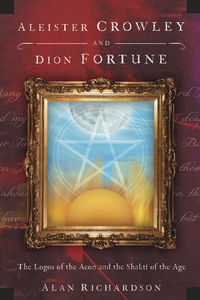
And so begins Alan Richardson’s “Aleister Crowley and Dion Fortune: The Logos of the Aeon and the Shakti of the Age”.

This book is described as a comparative biography of Crowley and Fortune (perhaps two of the best known occultists of the 20th century), and that’s a fair description. However, I feel it doesn’t do the book justice. The poetry of the writing, the nearly epic scope of the stories, the love, passion, and romanticism on the part of the author defy an easy summary, so forgive me for not trying. Richardson masterfully tells the stories of these two larger than life characters, all the while showing how their magical lives danced around each other; sometimes intersecting, other times diverging, but always close.

The book tells the stories of Crowley and Fortune’s lives in reverse, starting at death and going forward to their births (homage to training the Magickal Memory, remembering events in reverse sequence). Therefore, the book begins with Fortune and Crowley’s respective deaths in the Prologue, and then continues with seven chapters: Deaths and Afterward, The Wars of Their Worlds, Priests and Priestesses, Temples and Their Truths, Initiations and Other Awakenings, Falling to Earth and Other Trauma, and Past Lives and Similar Futures.

Although the author stresses that his book “is not meant as an exhaustive biography” on either of the subjects, I found (with my amateur level knowledge about Fortune and Crowley) that this book definitely hit all the marks, and certainly unearthed some extra information I had never heard before. At the very beginning of the book Richardson apologizes if the work seems to have a Dion Fortune bias, since he is an admirer, but stresses that he tried to treat both subjects with an even hand. I feel he succeeded. It is difficult to discuss Aleister Crowley. Generally, much like the man, people who write about him touch on the extremes of his character. I think fan and hater of Crowley alike will find the author’s treatment enlightening. Also, despite his concern that his affection for Fortune will color his writings about her, here too Richardson succeeds in offering the whole person, strengths and weaknesses alike.

This book tells the fascinating story of perhaps two of the best known, and best beloved by some, occult practioners of our time. Yes, their lives were fascinating, but only the talent of someone like Richardson can make them mythic.

Falling in Love with Passion Pit

There were these potato chips, which sadly you cannot find anymore, from Snyder’s of Hanover. They were steak and onion flavored. My husband loved them, and took great delight in introducing them to others. “You can’t just eat one, you have to try three,” he would tell people. Why three? Because the first time you tried them, the first chip was just bizarre, your taste buds were overwhelmed with the sheer weirdness of it all. The second chip, you would start to notice the steak flavor, and attempt to process it all. With the third chip you would realize they were great! A potato chip that tastes JUST like steak and onions! How perfect!

One can say much the same of Passion Pit’s first album “Manners”.

At a first listen, Passion Pit’s debut album “Manners” seems to be nothing but sounds that shouldn’t work together: high light male lead vocals, disco rhythms that could easily work for doing The Hustle, catchy pop hooks, and lyrics of a depth that they could be read aloud as poetry. I have to admit, when I played it through the first time I found it a confusing, but enjoyable experience. Having heard their song “The Reeling” on both of my favorite online radio stations (that would be Indie 103.1 and WEQX 102.7, thank you for asking) I was prepared for a more electronic, dance feel (Despite hearing it initially on “alternative” radio stations. Of course now I hear it on my favorite online dance station too, 1Dance.FM, thank you again for your interest.).

On a second listen, things started to mesh together nicely. The album is infectious. I can’t listen to it without tapping my foot or swaying in my chair. I realize that Passion Pit is almost like a Bee Gees 2.0, an updated, next generation version. And let me take this moment to proudly announce to the world that I love the Bee Gees, you hear that world? Love them! I had an awesome Bee Gees lunch box in elementary school and it’s one of my greatest regrets that I don’t have that lunch box here with me now. Ain’t no shame in liking some foot tapping tunes, and Passion Pit gives you the foot tapping fun of disco, with a hip, updated sound.

By the third listen I’m enamored. Passion Pit’s album “Manners” is high light male lead vocals, disco rhythms that could easily work for doing The Hustle, catchy pop hooks, and lyrics of a depth that they could be read aloud as poetry! How perfect!

“The Reeling” that is a link in the previous text goes to the official music video on You Tube, unfortunately they don’t allow embedding. I did however find this live performance from Passion Pit at a radio station, which I can embed….so I did.