
Long time readers know that I don’t discuss astrology books or review them very often. Astrology is hard and feels an awful lot like work to me. However, when the publicist at Rock Point (an imprint of The Quarto Group) emailed me about “Astrology for the Cosmic Soul: A Modern Guide to the Zodiac” by The Pulp Girls, I was sold.
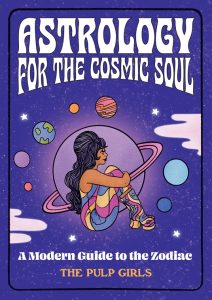 I’m not going to lie; it was the artwork that drew me in. The Pulp Girls wrote and illustrated “Astrology for the Cosmic Soul” and went with an adorable and psychedelic vibe. It turns out that their art is what they’re known for, running a business that sells their creations. (And holy crap do I want EVERYTHING on their website!)
Art aside, it turns out The Pulp Girls are also effective communicators. The book is written in a friendly, sassy voice that makes for an entertaining read. The authors also do a great job breaking down the complexity of astrology into easy to digest parts. Once you catch the basics of sun signs, moon signs, and rising signs, they discuss the practical side of astrology such as compatibilities and the stereotypical sign tropes versus the actual more nuanced way signs define people. After that, things get magical with tarot, lucky amulets, and grounding exercises. The end the book with “Just for Fun”, which is a whole lot of fun! Mixology for the signs (which sadly doesn’t involve actual alcohol), the signs as fairies, the signs as movie genres, and more!
 “Astrology for the Cosmic Soul” by The Pulp Girls is a fun introduction to astrology that would also be an excellent gift for an astrology enthusiast. If nothing else, this book has converted me to being a big fan of The Pulp Girls! It turns out they have a tarot deck that just released in October and I may have to check that out too!
You can learn more here.
Get your own copy here. (This is an affiliate link to my Bookshop, which supports independent bookstores throughout the United States. If you use this link to purchase the book, I will make a small commission at no additional cost to you.)
Do you enjoy The Magical Buffet? Considering supporting The Magical Buffet on Patreon! For only $5 a month you’ll receive monthly tarot/oracle forecasts, classes, and behind the scenes updates! Https://www.patreon.com/magicalbuffet
 “Happy Witch” comfortably walks the line with being positive without becoming toxic and being realistic without discouraging aspirations. Em divides the book into six chapters, which breaks down as:
 I’m not going to be coy, I’m a huge fan of Dawn Aurora Hunt. Not just as an author, or as
  “The Dharma Bum’s Guide to Western Literature: Finding Nirvana in the Classics” by Dean Sluyter is an entertaining and thought provoking read. Sluyter discusses expected classics, such as “The Great Gatsby”, “Adventures of Huckleberry Finn”, and “Moby Dick”, but also adds the unexpected like “The Cat in the Hat”, Frederick Douglass “The Slave Narrative”, and Rodgers and Hammerstein’s “Oklahoma!” “The Dharma Bum’s Guide” isn’t claiming these were written from a Buddhist perspective, but that the Dharma is so universal, it can be found in everything….including Western literature.
 Due to its nature, tarot is ripe for assorted interpretations. Decks can differ in art, theme, and/or purpose, but it is still tarot. However, no matter how far afield a deck my drift, its core, the heart of tarot resides with the Rider-Waite-Smith deck. So let me say, when I saw that Weiser was going to “reimagine” or “reinvent” the most influential tarot deck ever created, I couldn’t help but feel it could be a lazy cash grab by essentially creating their “own” Rider-Waite-Smith tarot to sell or just kind of bad.
 It’s feels weird to say, but Weiser has created the new traditional tarot deck. Since I started writing about magical and occult topics, when people would ask me a good tarot deck to start with, I would always suggest looking at where tarot began, the Rider-Waite-Smith deck. However, why would I do that now? “The Weiser Tarot” keeps the core of the tarot while making it better represent the diversity of tarot enthusiast today. Every person who loves tarot should have this deck in their collection.
 To put it simply, and in the most general terms, Santa Muerte is a death goddess. She represents death and everything that can entail: protection, vengeance, justice, innocence, wisdom, and much more. You can revere Her and pray to Her as a distant goddess, or you can have a transactional relationship where you curry favor and make deals. With all of this going on, Santa Muerte can be a confusing deity to work with. In comes “Secrets of Santa Muerte: A Guide to the Prayers, Spells, Rituals, and Hexes” by Cressida Stone.
 Not to sound too much like Jerry Seinfeld, but what’s the deal with Satanism? Particularly, what’s the deal with our culture’s hang up about it? The answer seems obvious to most. Satan equals evil, so Satanism equals bad. It appears to be basic math, but it’s not that straightforward when you look closer at the history of Satan and those who have chosen to ally themselves with the Devil. Fortunately, alternative culture journalist La Carmina has laid it all out for us in her book, “The Little Book of Satanism: A Guide to Satanic History, Culture, and Wisdom.”
 It’s time for 100% complete honesty. I had no intention of reading “The Hermetic Physician: The Magical Teachings of Giuliano Kremmerz and the Fraternity of Myriam” by Marco Daffi and translated by David Pantano. If you’re a Patron, you would know what books coming out pique my interest, and this wasn’t on the list. However, David Pantano reached out to me about endorsing his book and I was so flattered I couldn’t refuse.
  Tarot decks are wonderful, and versatile. They lend themselves to all sorts of reinvention, for better or worse. Today’s deck is for the better because it takes the mythic, fantasy setting of “The Elder Scrolls V: Skyrim” (an insanely popular video game) and meshes it nicely with the mythic, traditional tarot.
  Obviously, it is important for a tarot deck such as this to be well thought out, but if the artwork doesn’t do justice to the game, and the grand tradition of excellent tarot artwork, the deck is worthless. Fortunately, it was Erika Hollice’s artwork that first caught my eye, before I even realized I was looking at a deck based on a game I personally love. Hollice’s art deco, graphic, fantasy style translates wonderfully to the card. The only complaint that I have is in Insight Editions attempt to have the cards be matte, the cards tend to stick together, making for difficult shuffling.

 George Gemistos, who later called himself Plethon, lived from 1355 to 1452. In that time, he helped reawaken an interest in Plato’s works and Platonism. The church of the time was not a fan, and suspected Gemistos was a secret Neopagan, which was confirmed after his death when a Patriarch of the Eastern Orthodox Church got his hands on Plethon’s “Book of Laws.” The “Book of Laws” outlined a Neopagan religion based on Platonism, and so, the text was destroyed. Fortunately, parts of the text had already been copied by students, and the Church, in an effort to always have “proof” of Plethon’s heresies on hand, kept parts of the manuscript. Thus, today through the hard work of Opsopaus, we have “The Sacred Texts of Hellenic Polytheism”, which is based off of the table of contents and sixteen chapters of the “Book of Laws” as well as other texts by Plethon.