
It’s no secret that I’m a big fan of goddesses, and so I’ll admit the main reason I wanted to check out Jo Jayson’s “Self-Love through the Sacred Feminine” was because the cover art was beautiful and the subtitle is “A Guide through the Paintings & Channelings of Jo Jayson”. I figured a book full of art like what was on the cover was worth a look.
 “Self-Love through the Sacred Feminine: A Guide through the Paintings & Channelings of Jo Jayson” is a thoughtful exploration of what it is to identify as a woman. Jayson explores the lives/folklore and wisdom of Guinevere: The Queen, Mariamne of Magdala: The Magdalene, Brighid: Mother Goddess of Ireland, Isis: One Who is All, Mary: The Mother, Jeanne D’Arc: Maid of Orleans, Miriam: The Prophetess, Guan Yin: Mother of Compassion and Mercy, Morgan Le Fey: The Water Spirit, Artemis: Maiden of The Hunt, Kali Ma: The Dark Mother, Inanna: Star of Heaven and Earth, and Grandmother Spider: The Weaver.
First and foremost, the artwork is BEAUTIFUL! The book is hardcover with full color glossy pages, perfect for showcasing Jayson’s work. Each entry includes a brief history lesson and what we can learn from them. There is also a prayer and then some exercises you can work through. “Self-Love through the Sacred Feminine” is equal parts artbook, workbook, and history lesson. It’s wonderful book!
You can learn more here.
 As editor Mitch Horowitz says in his introduction, “Hall’s view of American history could be called transcendental.” He goes on to explain, “Within Hall’s writings on American history, particularly in his essays and book called The Secret Destiny of America, appears the principle that the U.S. serves – at his finest hours – as a vessel for primeval ideals of democracy, self-development, individual searching, and personal liberty. Hall located these ideals, in their earliest form, within ancient esoteric traditions, and he believed that such principles were preserved within the work of illuminated intellects, like Francis Bacon and Sir Walter Raleigh, as well as covert fraternities, including Freemasonry and Rosicrucianism, and enacted, albeit imperfectly, by America’s founders, many of whom were either Masons, such as Washington and Franklin, or were intimately steeped in ethical and individualistic philosophy, such as Paine and Jefferson.”
 So darn many of you expressed an interest in this book when I shared it on social media, and you were all right to be excited. “Tarot for the Fiction Writer: How 78 Cards Can Take You From Idea to Publication” by Paula Chaffee Scardamalia was I book I had been anxiously anticipating.
 “Crafting Love” explores 7 categories of love: romance, friends/teachers/mentors, family, nature (places and animals), self-love, others in the world, and the divine. Just reading her thoughts on the different ways we experience, express, and share love is gratifying and could have been a nice little book in and of itself. However, just like with “Crafting Calm”, Shannon offers loads of ideas and inspiration for things to create.
 I remember looking through the Weiser Books catalog and seeing “Witchbody” by Sabrina Scott. It was described as a graphic novel about everyday magic. I’m a fan of comic books, particularly in their collected form, commonly referred to as a “graphic novel”, so I had to check it out. Simply put, it’s amazing.
 Readdy approaches Thelema as a new religious movement, which may seem odd to those of us on the outside looking in, but he lays out a compelling argument for its inclusion as one. And as with all new religious movements, things always getting interesting after the passing of its founder, since this is when you learn if a religion is sustainable. That’s why “One Truth and One Spirit” focuses on the years following Crowley’s death in 1947.
 His biography is what compelled me to give it a try. “Born in Shiraz, Iran, 1934, where Saadi and Hafez grew up to be giants of Persian poetry. Raised in Tehran. Survived the first revolution in 1953 against the Shah. Within three days a coup d’etat happened, financed by the CIA, which I didn’t survive, because of losing fifteen friends. Also lost faith in my country. Then in 1955, with the help of my father, came to America, in which I have lived, worked and served to bring peace and harmony, trying to heal the pain and losses of my friends and my country. This book is about how far I have come from revolution to making love as a way of life. I have no regrets, only great hope for our family of mankind. No one is too small to rise and touch another soul. In the name of love and compassion, I stand before you.” Who says no to that? Certainly not me!
 The good news is, “Witchcraft Activism” gets the job done. Obviously if you’re a magical practitioner, the idea of effecting change with magic isn’t an outlandish idea. However, I was happy to see Salisbury clearly show the similarities (similarities that never occurred to me) between magic and activism. Both require a serious reflection on intention and the work of follow through. Salisbury has a background in activism and takes you step by step through any type of activism that may interest you: lobbying, letter writing, marches, and more. Then add to that an inspiring number of ways you can utilize magic to reinforce and improve on those actions! He discusses sigils, candle spells, spirit servitors, and of course, more.
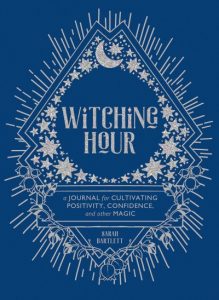 I’m not a big fan of journaling or keeping a diary. I was made to do it when I was young and in therapy. As an adult I’ve tried it out and generally find it a depressing chore. (Fortunately, with the prevalence of cognitive behavioral therapy, therapists these days don’t mention journaling.) That’s why if I’m going to use a journal, I like one designed with structure and purpose. One like “Witching Hour: A Journal for Cultivating Positivity, Confidence, and other Magic” by Sarah Bartlett.

