
 Learning tarot sucks. Okay, maybe that’s just me, but I have an AWFUL memory regardless of how interested I am in the subject I’m studying. I mean, after YEARS and YEARS I am finally starting to wrap my head around it. People learn in different ways. I’m at the point where I learn by doing. However, in the past when it comes to tarot, I’ve worked with flash cards and rote memorization. Perhaps my learning trajectory would have been different if years ago I had access to “How to Learn Tarot: A Guided Tarot Journal with Intuitive Prompts and Spreads” by Jess Carlson.
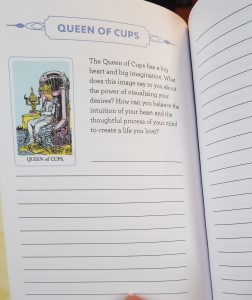 Carlson’s approach is simple in appearance, but has the potential to create personal, long-lasting, connections to the tarot. “How to Learn Tarot” dedicates a page to each tarot card, showing it in the corner of the page. She provides a prompt and encourages the reader to write down all their thoughts and associations with the card. No wrong answers. The act of writing helps you remember what you are learning, and creating an idea makes it personal to you. The back of the book includes keywords associated with each card, but Carlson encourages you to go through the entire journal, which includes exercises and sample spreads, before browsing the keywords.
Considering its full-color and trade paperback format, a suggested retail price of $14.99 is reasonable for a tool that would be great for beginning tarot fans or for more experienced readers looking to add depth to their readings.
Shop your local indie bookstore <---This is an affiliate link to IndieBound, which supports independent bookstores throughout the United States. If you use this link to purchase the book, I will make a small commission at no additional cost to you.
Do you enjoy The Magical Buffet? Considering supporting The Magical Buffet on Patreon! For only $5 a month you’ll receive monthly tarot/oracle forecasts, classes, and behind the scenes updates! https://www.patreon.com/magicalbuffet
 Today we are talking about an academic work exploring the Byzantine empire that is an accessible read and incredibly relevant for today. “Byzantine Intersectionality: Sexuality, Gender, & Race in the Middle Ages” by Roland Betancourt is an eye-opening, thought provoking work.
 This past Friday a single was released from Shunia’s forthcoming album. I listened to it at work and it was so uplifting and had such a great energy to it that I decided to share it! The song is “Sa Re Sa Sa” and it’s from Shunia’s self-titled album that is releasing January 15, 2021. They worked with Tony Award-winning producer Jamshied Sharifi on it.


 Gosden defines magic as “human connections with the universe, so that people are open to the workings of the universe and the universe is responsive to us. Magic is related to, but different from, the other two great strands of history, religion or science: the former focuses on a god or gods, the latter a distanced understanding of physical reality. Magic is one of the oldest world-views and yet is capable of constant renewal, so that a modern magic can help us to explore our physical and ethical connections to the world in a time of profound ecological crisis.”
 This should explain why when Princeton University Press reached out to me with regards to reviewing a book about Keith Haring, I didn’t care what it was, I just wanted it! (Also, Princeton University Press, who’s the scholarly blogger?) The book they sent me (which I did know what it was going to be) was “Haring-isms” edited by Larry Warsh. It is part of Princeton’s “ISM” series, where they try to capture the essence of a variety of artists by collecting their quotations into high quality, pocket-sized, hardcover books. Along with “Haring-isms” you can find “Arsham-isms”, “Basquiat-isms”, “Weiwei-isms”, and more.
 “A Kitchen Witch’s Guide to Recipes for Love & Romance” is an amazing exploration of love, food, and the author’s journey with both. The book is divided into 3 parts: Self-Love, Attracting Love, and Rekindling the Fires. All of this covers such topics as honesty, self-care, building friendship, dating, attracting romance, and more. Of course, along with all of that are recipes ranging from beginner to advanced. And you know what happens now, don’t you? I tell you about the recipe I tried!
 “The Pagan Book of the Dead” explores the afterlife from a variety of cultures and sources and how it evolved. Medieval Christian depictions of the afterlife were apparently the English-speaking world’s first torture porn. I have trouble handling horror (movies or books) and dude, the crazy ways a soul could be tortured was/is messed up! Rarely did I see anything about heaven, occasionally I would read about forgiveness, but primarily, that afterlife is all about torture. And although medieval Christianity takes the taco for discussing afterlife as primarily torture, they don’t own the exclusive rights to unhappily ever afters. In fact, one of the biggest features of “The Pagan Book of the Dead” is that unlike most of Lecouteux’s books, which focus on English, French, and German texts, this book also has texts from Arab countries, Nicaragua, and Asia. Believe me, they can be just as judgmental and punitive.
 If you’ve been a reader of The Magical Buffet for any time at all, you know that I am a lady that LOVES herself some Claude Lecouteux. He has written numerous books about medieval beliefs and magic (many that have been reviewed on this website!). This time he, and his co-editor Corinne Lecouteux, are exploring the various realms of the medieval world with “Travels to the Otherworld and Other Fantastic Realms.”
 Travelers’ tales open up an unusual world for us; they allow us to discover mythic geography and meet people from the far ends of the earth. In its own way, each tale reflects the reactions of the human being when faced with the unknown. The letters of Alexander of Macedonia to his mother Olympias and his teacher Aristotle are a perfect example of this. Out of these letters emerge alarming creatures of unparalleled strangeness.
 Many of you who follow The Magical Buffet on social media, particularly