The Blog of the Seven Veils

illustrated by Will Hobbs

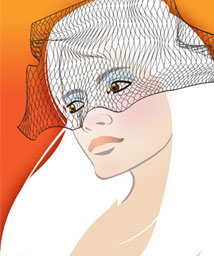
Veils. Has there ever been such a complex piece of cloth? Essentially a veil is just a piece of fabric that traditionally covers the hair and/or face, and yet it means many things to many people. For some a veil conjures up the image of sensual belly dance, for others an emblem of paying proper respect to their religious faith. Not everyone has taken the time to think about veils and their symbolism, but with such a long and varied history the only thing to be certain of is that everyone can find a veil they like.

According to my favorite anonymous resource, Wikipedia, the first recorded example of women wearing veils is in a legal text from the 13th century BCE, which stated that only Assyrian noble women were allowed to wear veils. Common women and prostitutes were forbidden from wearing them. In fact, the idea of women of higher status wearing veils was also practiced by the ancient Greeks.

In modern times, veils are often pinned to hats worn by widows at funerals and through whatever designated period of mourning is appropriate after the burial. And of course, everyone thinks about the wedding veil that brides wear. The veil is a symbol of purity and, if worn by the bride, when the bride’s face is revealed by the father lifting the veil, it’s a gesture of handing over possession of his daughter to the groom, when lifted by the groom, it signifies what will be taking place in the marriage bed, you know, when the clothing comes off!

Often times, in traditional Catholic or Christian churches, women are encouraged to cover their heads, which means that for many, attending church means wearing a hat or veil. Oddly, men are to remove their hats when attending church. Apparently it has something to do with Corinthians and how man is in the image of God, so he shouldn’t be all ashamed and covered, but woman is the glory of God…which you would think that would be good enough to show your hair, but what do I know? I wouldn’t have even known about Corinthians if it wasn’t for Wikipedia again!

Married Orthodox Jewish women, in compliance with the covering head requirement, related to the modest dress standard called tzeniut, cover their hair by using wigs, hats, and scarves (Which can be awfully veil like, right?). Why do they do it, what does it symbolize? I don’t know. I’m Jewish, but I’m what’s called in theological parlance a “bad Jew”. If any of my Jewish peeps know the skinny on the tzeniut and why Orthodox Jewish women cover their hair, leave an informative comment at the end of the article!

Let’s be honest, the war in Afghanistan has really introduced the concept of Muslim veiled women to the west. In fact, in the Muslim world the ladies rock so many varied veils that I can’t keep the names straight! And that’s why I’m just going to flat out quote the Wikipedia entry here.

“A variety of headdresses worn by Muslim women in accordance with hijab (the principle of dressing modestly) are sometimes referred to as veils. Many of these garments cover the hair, ears and throat, but do not cover the face. The khimar is a type of headscarf. The niqāb and burqa are two kinds of veils that cover most of the face except for a slit or hole for the eyes. The Afghan burqa covers the entire body, obscuring the face completely, except for a grille or netting over the eyes to allow the wearer to see. The boshiya is a veil that may be worn over a headscarf; it covers the entire face and is made of a sheer fabric so the wearer is able to see through it.”

Now if you think I’m a bad Jew, you won’t be amazed to learn that I’m super less than an expert on the Muslim faith, but here’s my stab at talking hijab. Women of Islam were instructed to cover themselves when they go out so that everyone will know they’re women and will be left alone and not harassed. I’ve also been given to believe that the basic concept is that because women are so hot (as in sexually attractive, not in measurable temperature) and that men are so easily distracted, that women being covered when in the presence of men who are not family is just the smart way of doing business. If any readers have the 411 on the practice and perhaps symbolism of this kind of veil, leave a message in the comments section so we can all learn something new!

Obviously these days discussing the veiling of Islamic women is an issue of religion, politics, and civil rights. Guess what I’m not going to do? Stick my head into the middle of all of it. Let me just say, there are days when the idea of not worrying about my clothes, hair, or make-up is appealing, as long as it’s my decision when to cover it up and when to flaunt it.

So what the heck do we have here? A symbol of purity, of mourning, of social status, of marital status, of faith, of sensuality. Now that’s a heck of a lot for one square of fabric!

The Wiccan Rede Project: Deborah Blake

The Wiccan Rede is arguably one of the most important tenets at the basis of modern Witchcraft practice. This is not to say that all Witches follow it, of course, although many of those I know do—even those who don’t call themselves Wiccans, per se. And there are many different versions, so saying you follow the Wiccan Rede is a little like a Christian saying they live by the word of the bible: one then has to ask, “Which bible?”

Just to be clear, I tend to use the shorter, simpler (and less ornate) version of the Rede:

Bide the Wiccan law ye must
In perfect love and perfect trust
These eight words the Rede fulfill
An it harm none, do as ye will
Lest in thy self defense it be
Ever mind the law of three
Follow this with mind and heart
And merrie ye meet and merrie ye part

To me, there are three simple but crucial pieces of spiritual “law” in this short poem: harm none, the law of three, and perfect love & perfect trust. Taken together, they pretty much sum up my take on Witchcraft. (Leaving aside, for a moment, the issue of connection with deity and nature, which is also at the core of my practice.) As you can probably tell, I am a lot less concerned with niceties like “kissing your hand times three” than I am with general attitude and behavior towards others and self.

“An it harm none, do as ye will.” On the surface, this is a rule that gives you permission to do pretty much anything you want, as long as whatever action you take does nothing to harm anyone else. Whoo hoo! Except, of course, that nothing is that simple. To begin with, it implies—and rightly so—that Witchcraft is a spiritual path based on personal responsibility. You are responsible for your actions towards others (this will be important for the next bit as well)—no blaming the devil, or even human nature. It is up to you to judge whether or not your actions will harm another, and act accordingly. This means constantly considering the consequences of everything you do. Suddenly seems a lot tougher, doesn’t it?

And then there is the often-ignored fact that “harm none” includes yourself. This means, in theory, that none of us should ever do anything that would have a negative effect on our health and well-being. (Thank goodness they decided that chocolate is health food!)

Can any of us truly live our lives every day without doing anything, no matter how small, that harms either ourselves or another? I doubt it. Even Gandhi couldn’t pull that one off, and he really tried. But what we can do is strive our best to attain that goal, and when we fall short, we can take responsibility for our actions and—if possible—undo whatever harm we might have done.

Say, for example, that you inadvertently hurt someone’s feelings by sayng something mean. First, you acknowledge that what you said was wrong, then you try to make that person feel better again. But then—and this is the important bit—you try not to do it again. It isn’t enough to say you’re sorry. Following the Wiccan Rede means doing your best to learn and grow, so you don’t make the same mistakes again.

“Ever mind the law of three.” Some Witches argue about whether or not there is really a threefold rule of returns, but most of them would agree that what you put out into the universe comes back to you, one way or the other. Call it the Law of Three, or Karma, but either way, it means that—at least in part—you are responsible for what you draw into your own life. This doesn’t mean that crappy things won’t happen to you, even if you are a nice person every minute of every day. But it does mean that a positive attitude is much more likely to result in a happy, prosperous, and fruitful life. And that a negative attitude will almost certainly circle back and bite you on the hind end.

It also means that if you purposely harm others (as you are forbidden to do), that harm will likely show back up on your doorstep one day. You will note that the Rede makes allowances for self-defense, however. You aren’t expected to sit back and let someone beat the crap out of you…but you’d better be sure you weren’t the one who started the fight!

Possibly the most important “law” in the Wiccan Rede, as far as I am concerned, is probably the most difficult one to follow. “Perfect love and perfect trust” is a concept that Wiccans talk about a lot—but what does it really mean?

For me (and I can only speak for myself in any of this), perfect love and perfect trust means that we accept each other as we are—imperfections, flaws and all—and love each other anyway. When we do so, we are channeling the love of the goddess and the god, and doing their work here on earth.

But it can be pretty hard to love some folks some of the time, and all folks all of the time, in an unconditional and nonjudgmental manner. Let’s face it—people can be difficult! (Not us, of course, but everyone else.) And this rule doesn’t mean you should just love other Witches, or people who follow your same belief system. Nope, sorry. It means everybody. Just like the “harm none” rule, there is no way we are going to be able to pull this one off, at least not all of the time.

But the point of walking a spiritual path—and the point of the Wiccan Rede—is to give us something to guide us as we live our lives. The gods don’t expect us to be perfect. I believe, however, that they expect us to work to be our best, and following the Rede to the best of our abilities is one way to try and do just that.

About the Author:
Deborah Blake is the author of Circle, Coven and Grove: A Year of Magickal Practice (Llewellyn 2007), Everyday Witch A to Z: An Amusing, Inspiring & Informative Guide to the Wonderful World of Witchcraft (Llewellyn 2008), The Goddess is in the Details: Wisdom for the Everyday Witch (Llewellyn2009), and the forthcoming Everyday Witch A to Z Spellbook (2010). She has published numerous articles in Pagan publications.

Her award-winning short story, “Dead and (Mostly) Gone” is included in the Pagan Anthology of Short Fiction: 13 Prize Winning Tales (Llewellyn, 2008). Deborah is currently working on her third novel and hopes to find both an agent and a publisher for her fiction soon. Deborah’s first novel, Witch Ever Way You Can, has been the winner or finalist in many RWA (Romance Writers of America) contests and received the EMILY “Best of the Best” Award. Her fiction is primarily Paranormal Romance, although she also writes Fantasy, Mystery and Young Adult.

Deborah had been interviewed on television, radio and podcast, and can be found online at Facebook, Twitter, My Space, and at her own website.

When not writing, Deborah runs The Artisans’ Guild, a cooperative shop she founded with a friend in 1999, and also works as a jewelry maker. She lives in a 100 year old farmhouse in rural upstate New York with five cats who supervise all her activities, both magickal and mundane.

This month Deborah will be presenting “The Real Witch: Witchcraft Basics for the Paranormal Author” on line. Click here to learn more.

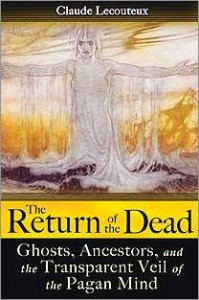
The Return of the Dead

My initial thoughts on “The Return of the Dead: Ghosts, Ancestors, and the Transparent Veil of the Pagan Mind” by Claude Lecouteux were, this is SO COOL! In case that’s not enough for you to go out and give this book a try, let me give you some details.

Now this isn’t my first rodeo, I’ve read all kinds of ghosty folklore type books. However, this book discusses revenants and ghosts from a whole new perspective, through the lens of medieval literature. When I first picked up the book I thought, a former professor of medieval literature wrote this book? Not what I’m used to seeing in the bios of what would be lumped into the ever growing “paranormal” book category. Once I started reading it, I was like, hell yeah, bust out those sagas professor!

How do I love thee “The Return of the Dead”? Let me count the ways. (See I can be all literature-like when I want to be.)

One, it’s nice to see Lecouteux giving revenants their due. Revenants are the animated corpses of the medieval era and honestly, they’re not discussed as much as I’d like. I found myself asking, when was the last time I read anything that even mentioned revenants? I’m not positive, but I think it was in my White Wolf gaming phase, before I moved to a town where all these gamer heathens play Hero and Dungeons and Dragons. Anyway, what I’m saying is that I suspect there are many out there that aren’t familiar with the term revenant, and that’s a shame. It’s a fantastic name for a truly creepy thing. If you’re interested in the paranormal, read this book and up your game by learning about some old school haunting.

Two, sagas. This book is loaded, jam-packed, nearly bursting at the seams with excerpts of sagas. From the “Saga of Kormak” to the “Saga of the Volsungs”, you will find great excerpts and explanations of the ancient literary traditions of medieval times. All with an eye to the restless dead. Sagas are cool, end of discussion.

Three, perspective. Thanks to thoughtful writing and well selected excerpts, I feel I have a better understanding of the medieval Pagan mind. I found it surprising, but how people view death and their dead offers great insight into their lives. All of you modern day Pagans that are interested in learning about the pre-church lives of medieval European citizenry should definitely check this book out.

Four, perspective. That’s what’s fantastic about perspectives, there can be more than one! Due to the time period this book focuses on, Lecouteux has to address the influence of the church. “The Return of the Dead” focuses equally on steps the church took to eliminate Pagan beliefs and how the citizens adapted to the church’s influence. I find the evolution of religions fascinating, making this my favorite thing about the book.

Here we are, at the end of my review. To sum up, and touch back on my initial thoughts. This is SO COOL!

The Wiccan Rede Project: Thuri Calafia

My take on the Wiccan Rede
By Thuri Calafia

Well, first I must say that I was several years down my path before I had any idea there was more to the Rede than the last eight words. To this day, that’s what I think of when I say I live by the Rede. And in that, I do, absolutely. When I did see the Rede in its entirety, as today, I find some that resonates deeply, and some that seems obscure or unnecessary. I’ve also noticed through the years, having seen “it” several times now, that there seem to be more than a few versions. As to this one, well, it seems silly to speak on the parts that hold no meaning for me, so I will comment only on that which resonates:

Bide the Wiccan laws ye must, In perfect love and perfect trust.
I can get behind the perfect love and trust thing, but other than the last 8 words of the Rede, I know of no “Wiccan laws,” although I suppose this piece of prose is laying them out for us. In that respect, no, I don’t follow all of the “laws” following. There is no absolute authority, no governing body in the Wiccan faith, and that’s a good thing. We see all too often in American politics and corporations (which are basically one and the same anymore) how easily power corrupts, especially when the millions are governed by the few.

Perfect love and perfect trust is somewhat relative, strange as that may sound. Do I hold a bunch of strangers in an open public circle in perfect love and perfect trust? Well, no. But I can hold my gods in perfect love and perfect trust when entering that circle, that they would not let me be somewhere where the energy is harmful to me.

In terms of one’s coven, I would have to submit that from personal experience to have perfect love and perfect trust of my covenmates would have to be a requirement, as least for me personally, to even consider being in coven with them to begin with. For me, a coven is a close, spiritual family. It’s deeper than family, actually, because a coven is a family by choice.

Live and let live- Fairly take and fairly give.
Live and let live has been a philosophy of mine since probably my late teens. Fairly take and fairly give is a tough judgment call… what is “fair” exactly, and who is in charge of determining that? I definitely believe in honesty and integrity, taking only that which I’ve earned or which belongs to me. Stealing is just stupid because it always comes back to bite you in the ass (see the threefold law). But “fairness”… that’s not so easy. Sometimes we can think life is being unfair to us, but perhaps it’s about a lesson our spirit is trying to learn. Then, what is actually a gift can be seen as a burden, when in fact it’s totally “fair” from the standpoint of our spiritual lessons.

Cast the Circle thrice about to keep all evil spirits out.
Hmmm, never heard of this one before reading this. Perhaps we do cast the circle thrice, in a sense, with our actions of purifying, charging, then casting. And yes, to keep evil out, but more importantly, to keep the energy in, until it’s ready to be released!

To bind the spell every time, Let the spell be spake in rhyme.
I’m sure many of us have had spells fly brightly when we didn’t use rhyme, but it’s also true that our gods, guardians, and other spirits love the sound of poetry. They also love candlelight and incense. I think there are many things that bind spells, however, the strongest being focus and intention. Whatever gets the practitioner into that energy pattern will work beautifully to help spells succeed, whether spoken in rhyme or not.

Soft of eye and light of touch-Speak little, listen much.
This just sounds to me like good manners, and having the good sense to know that you don’t know everything. I’m all for that!

Deosil go by the waxing Moon-Sing and dance the Wiccan rune.
In many traditions, it’s considered very important to move deosil if building, constructing. This keeps energy flowing in the right direction for its purpose. This also makes a lot of sense in terms of the moon “rule” here – during waxing moons is the time to do such actions. In some traditions, it’s no big deal if one moves widdershins momentarily, and in others it IS a big deal. I’m of the more laid-back camp, but still strive for that energy movement. As to the Wiccan Rune, I read the words to it in the Farrars’ Witches’ Bible. Didn’t really do it for me. I take this part as being somewhat symbolic – that if we want to raise energy, some of the best ways are with chanting, singing, and dancing.

Widdershins go when the Moon doth wane, And the Werewolf howls by the dread Wolfsbane.
The waning moon is considered very important for de-constructing or destroying. Again, it’s all about energy flow, just like with the waxing moon. Don’t know too much about werewolves, so I’ll refrain from comment on that one.

When the Lady’s Moon is new, Kiss the hand to her times two.
The only thing I can think this means is that we should show the goddess our love, respect, and reverence. This couplet may be speaking of saying devotionals, but I think I may be reaching a bit on that one. I must admit I haven’t a clue what these lines mean.

When the Moon rides at her peak, Then your heart’s desire seek.
Aaahh, yes. “Whenever you have need of anything, once in the month, and better it be when the moon is full…” These lines tell us that when we have need, to do our spellwork on the full moon to give it the most power. This could also be interpreted as the moon being at apogee – straight above us, which would be the most powerful time yet to cast a spell.

Heed ye flower, bush and tree-By the Lady blessed be.
For me this is about paying attention to my environment, and taking care of the planet. As one who holds the earth in reverence, I must do what I can to help the earth and show respect to all living things. In doing so, I am blessed by beautiful and healthy thriving life in my surroundings, and the certain knowledge that I have done right and have earned the Lady’s (and the Lord’s) respect.

Merry meet an merry part- Bright the cheeks an warm the heart.
Merry meet and merry part are common greetings and partings in the community in general and in circle also. A nice way to say, “I’m happy to see you!”

Mind the Threefold Law ye should-Three times bad and three times good.
Many believe that whatever we send out returns to us threefold. This is why you’ll rarely meet a Witch who’s ever cast a curse or done darker work without doing some serious homework and meditation about it. That’s not to say it never happens; just that if a Wiccan is going to engage in such activities, it’s usually considered wise to make sure no unnecessary harm befalls anyone, and many things have to be shifted into place in order to ensure that. It’s also why so many Wiccans are generous and kind and helpful. Not that we do good works just to for the hope of reward, but because if everything returns to you, it’s just so much wiser to have good returned than bad, and it begins the minute you do the action; it simply feels good to give, to help, to be kind. It’s a reward unto itself.

True in love ever be, Unless thy lover’s false to thee.
So… you can lie to your lover if your lover first lies to you? Nope. Personal responsibility is one of my soapbox issues. A common Wiccan saying that’s not in the Rede is “Give thy word sparingly and adhere to it like iron.” That is one of my most cherished guiding principles in life, for many reasons. So true in love I am, and if my lover lies to me, then it would have to be dealt with, but that doesn’t give me an excuse to break my word, though it would definitely strain, possibly end the relationship, depending on what the lie is about.

Perhaps this couplet is more about that old “an eye for an eye” principle, and I can certainly see where big lies could cause one to consider the relationship over, therefore there’s no longer a need to be “true.” In that case it’s simply an ending, however, like a breach of contract, and not an excuse to just go running around, causing harm and pain just to get even.

Eight words the Wiccan Rede fulfill-An it harm none, do what ye will.
A tough “law” to interpret, because everyone defines “harm” differently. I’ve known people who think I’m terribly unethical because I hunt, or have hunted in the past, although I do those actions ethically and with a great deal of respect to the animal, the environment, and the Goddess. I’ve also heard students call teachers on the carpet for smoking tobacco, because they’re harming themselves. So it really comes down to the individual’s definition of harm, and taking the responsibility to ensure our actions do not cause harm, which is still a pretty good guideline to live by.

About the author:
Thuri Calafia is a Wiccan High Priestess of many years standing, and the creator of the Circles System and School. She is the author of DEDICANT: A Witch’s Circle of Fire; A Course of Study in the Old Religion. Calafia is active in the Portland Pagan community, offering various workshops and priestess services, presenting regular Open Full Moon rituals and Witches’ Afternoon Teas, and teaching Circles Dedicant level classes. She is working on the second in the four-book series, INITIATE: A Witch’s Circle of Water. She lives with her beloved Labrador, Miss Alyssa Ramone.

The Wiccan Rede Project: Beverly Wilkes

The Rede
By Beverly Wilkes

When I received the email from Rebecca about the Wiccan Rede, it gave me a wonderful moment of nostalgia. I first learned about the Wiccan faith from some new friends in college one early fall night while we were hanging out at a bonfire by the river. I had never heard of it and asked a lot of questions trying to figure it all out with my limited knowledge of Christianity as my guide to compare. When William recited the Rede it was like a priest reading from the bible. He told me of the first witches and of magic. He was my mentor in many things and the leader of my coven.

What drew me to Wicca and why I keep these traditions is a complicated thing. I guess the clearest way to explain it is that Wicca completed me. I had gone to church with my parents and learned of the bible because my parents told me to. I never felt like any of it made sense. I felt like the religion was from a book. How could a book with its finite pages teach me about how to be a good person? Wicca is different. It doesn’t tell you how to be but rather helps you be.

“An it harm none, do as ye will.” A simple phrase that says so much. To be a good person, to be a happy person, just do what you want as long as it doesn’t harm you or anyone else. Once I accepted the idea that I did not have to please everyone around me, the world became a wonderful, beautiful place again. My sister has commented that she envies my ability to not care what others think of me. Others have asked me how I can do things like not wear makeup or how I can express myself the way I do without worrying what others may think. I say simply that no one is responsible for your happiness in this life but you.

Whether you believe in The Lord and Lady, or Buddha, or God, or any of the other thousands of possible deities that this world has known through the centuries, you have to decide how to interpret what they offer and act accordingly. For me, following a solitary path, The Lord and Lady are symbols of life’s cycle. They represent the seasons and the spirituality of man in a way that none of the other religions, at least those I know of, do. They make more sense to me and fill a place that I never knew was empty until I heard the Rede.

For a long time, I had not practiced, I had basically laxed in my faith. After I left my coven to move to West Virginia I continued for a time but eventually stopped unsure of myself and my belief. Then after moving again this time to New York I did not even keep an altar. A few years ago William, my mentor passed and I even began to question whether I had made the right choice. Recently, on the night of Samhain, I decided to renew my faith and once again honor the Lord and Lady. I had been thinking about the Sabbats and what they mean in relation to my life when of all things one of my cats, Min Yen, showed me my path. She was rooting around in a bookshelf, somewhere she is not supposed to be, and when I fussed at her she jumped down, knocking down a book on the way. A book that William gave me. “Eight Sabbats of Witches” by Janet and Stewart Farrar is a wonderful book and tool for any Wicca and I found myself reading it again within moments. Adding to that a recent gift of a tarot deck I found myself preparing for the ritual of the third and final harvest of the year and remembering my cherished loved ones who had passed. My faith was restored and I find myself writing this chaotic but hopefully helpful story for Rebecca’s readers. That said, blessed be to all.

About the Author:
My name is Beverly Wilkes. I hail from Glens Falls, New York. I’m a thirty-something with two kids who walk on all fours, are fuzzy, and don’t talk very well. I am currently obsessed with Facebook, and can be found there under same name and I have written/may write more fan fiction for “Supernatural” on the Fanfiction.net website under the pen name Almost Heaven.

A Blog Post 1600 Years in the Making

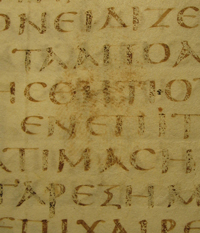
Thanks to the efforts of The British Library, The National Library of Russia, St. Catherine’s Monastery, and the Leipzig University Library, you, yes you, can view the Codex Sinaiticus. These four institutions, along with scholars, conservators and curators reunited the entire manuscript in digital form and have made it available for the whole world to read and study….assuming they have internet access. So what is the Codex Sinaiticus?

The name Codex Sinaiticus translates to the Sinai Book. According to the Codex Sinaiticus Project, “During its history – particularly its modern history – parts of Codex Sinaiticus were also known by other names. The 43 leaves which are now at Leipzig University Library were published in 1846 as ‘Codex Frederico-Augustanus’ in honor of Frederick Augustus II, King of Saxony, who was the patron of the German Biblical scholar and editor of Codex Sinaiticus, Constantine Tischendorf. The 347 leaves now in The British Library were previously known as ‘Codex Sinaiticus Petropolitanus’, as they were kept in St Petersburg between 1863 and 1933.

Codex Sinaiticus is named after the Monastery of Saint Catherine, Mount Sinai, where it was preserved for many centuries. It is generally dated to the middle of the fourth century. Leaves and fragments of this manuscript were taken by Constantine Tischendorf on three occasions – in 1844, in 1853 and in 1859 – so that they might be published. The principal surviving portion of the Codex, comprising 347 leaves, was purchased from the Soviet government in 1933 and is now held by the British Library. A further 43 leaves are held at the University Library in Leipzig. Parts of six leaves are held at the National Library of Russia in St. Petersburg. Twelve leaves and forty fragments remain at Saint Catherine’s Monastery, recovered by the monks from the northern wall of the monastery in June 1975.

Codex Sinaiticus, a manuscript of the Christian Bible written in the middle of the fourth century, contains the earliest complete copy of the Christian New Testament. The hand-written text is in Greek. The New Testament appears in the original vernacular language (koine) and the Old Testament in the version, known as the Septuagint, which was adopted by early Greek-speaking Christians.”

So why is this so darn exciting? Think about it, it doesn’t get any older than this. This is THE oldest version of the Old and New Testament kicking around. Through the study of this, people more clever than I will be able to carefully trace the evolution of the Bible and of Christian belief. This is as close to the first person in the Biblical game of telephone as we’ll probably get, and I for one am excited to see what the original text was before it went through 1600 years of ears and mouths.

Also, the study of the physical manuscript offers insights into the evolution of books and book binding, and as we established back in May 2008, I think book binding is way cool.

Interested? Visit the Codex Sinaiticus website to learn more and read the manuscript. (Parts have already been translated to English, with more translations on the way.)

The Wiccan Rede Project: Artemisia Shira Tarantino

by Artemisia Shira Tarantino

The Wiccan Rede, an ethical tenet or basic spiritual principle of Wiccans, came about logically as a means to put into brief context Wiccans’ thoughts and feelings about our moral values and natural way of life. Although the origins of the Wiccan Rede are debatable, the most well known version is the one stated by author and Wiccan High Priestess Doreen Valiente, grandmother to a number of Wiccan traditions, back in the 1960s:

“An It Harm None, Do What Ye Will”

Today, the Rede serves as a backbone to our teachings and practices, helping us to maintain integrity as we perform our rites and magickal workings.

Wiccan Values

Wiccans have a history, however short, of meshing our values with self-love. In Wicca, it is very important for the practitioner to understand and love herself or himself in order to connect fully with the Goddess and the God. Wiccans generally believe that we each represent the Goddess and the God – therefore, we must treat ourselves and each other with respect and reverence.

Freedom is a very important part of Wicca. You may not necessarily hear “freedom” being discussed often in our covens and circles, but in practicing Wicca one must have “free will” in order to accomplish our set goals and manifest our intentions. Censoring our practices in any way inhibits the magick and energy that is so important to our work.

While taking that into consideration, we also have to remember that we need to balance our free will while respecting others, as all are the earthly versions of the Goddesses and Gods (this includes people, animals, and nature).

If I want to practice magick, I must make sure that my intent is to manifest something within my own environment, as opposed to forcing my intent upon another. For instance, if I want to create a positive atmosphere for protection, I will concentrate on bringing those protective gifts from the Universe to me, as opposed to creating an impediment for someone else. Following the Wiccan Rede, I would create a spell or ritual for protection that would surround me, rather than impose a barrier on the person or thing that I feel might harm me.

Magic and Wiccan Ethics

To understand ethics in Wicca, one must first understand magic.

To perform magic, one must have the ability to attune oneself to Nature. This may be as easy as listening carefully to oneself and to the rhythm of the Earth and its cycles, the wind, the atmosphere, animals, and people. This ability may come naturally to some, or may be learned (every person is different). Once one is attune, it is easier to grasp a deeper understanding the wholeness of the Universe (or the Goddess and the God) and all its components. To see through the eyes of others is the beginning of peace.

In Scott Cunningham’s’ Encyclopedia of Magical Herbs, he incorporates a list of eleven magical principles. This list is by far less known than the Wiccan Rede itself, but is an excellent primer to understanding ethics within one’s magical practice:

1. Magic is natural.
2. Harm none – not even yourself – through its use (Cunningham’s version of the Wiccan Rede).
3. Magic requires effort. You will receive what you put into it.
4. Magic is not usually instantaneous. Spells require time to be effective.
5. Magic should not be performed for pay.
6. Magic should never be used in jest or to inflate your ego.
7. Magic can be worked for your own gain, but only if it harms none.
8. Magic is a divine act.
9. Magic can be used for defense but should never be used for attack.
10. Magic is knowledge – not only of its way and laws, but also of its effectiveness. Do not believe that magic works – know it!
11. Magic is love. All magic should be performed out of love. The moment anger or hatred tinges your magic you have crossed the border into a dangerous world, one that will ultimately consume you.

I would also like to add that one should never perform magick on or for someone else without their permission. Even if it is for good – or if you feel it is in their best interest.

Ethics is a very important part of Wicca. While ethics has always been the basis for understanding the principles behind magical workings, Wiccans are just now beginning to discuss ethics on a full scale. There are now a select number of books, essays, and courses that focus specifically on Wiccan ethics. Being ethical takes effort; it cannot be left up to a single statement on paper or summed up in just a few words. It takes practice, compassion, personal judgment and instinct. One must learn to weigh all parts of the story (or spell or ritual) prior to settling on intent.

Alongside the Wiccan Rede, there are other ethical Wiccan tenets which were created to also be incorporated into magical workings and living a magical life, such as The Three-fold Law, similar to Hindu’s Karma, in that everything you do comes back to you three-fold. There is also a fairly new (circa 1974) set of 13 Principles of Wiccan Beliefs set forth by the American Council of Witches, which many covens and Wiccan temples have adapted and use to this day. But no ethical tenet is without its flaws.

An Inherent Flaw

As with people, any moral or value also has its weakness – no matter how good its intention. The short version of the Wiccan Rede states, “An It Harm None, Do As Ye Will.” There are a number of versions of the Rede, as it has been interpreted and re-interpreted. If we were to interpret the statement literally, it means that, as long as you don’t harm anyone, you can do what you will. But the downside of a literal translation leaves moral statements such as this open for loopholes. The Wiccan Rede is only a part of the whole picture. In theory, it sounds good. And on paper it may even represent perfection. But in practice, it is incomplete. One must honor the never ending cycle of giving and receiving. If the Wiccan Rede is the “please,” then where is the “thank you?”

Imagine needing fresh water where you live. Your area has none, but 50 miles north there is a fresh water reservoir. So you build a pipeline channeling the water to you, and now you and your fellow townspeople have fresh water where there was none before. However, that water had to come from somewhere. Little did you know that another set of townspeople 50 miles north had been counting on that water, which you have redirected. You may have more of it, but now they have less of it.

When we tap into the Universe seeking its gifts, even if we abide by the Wiccan Rede, we must remember that while we perform any action, there is a reaction. We must be mindful of this and be prepared to give back energy to the source from which it was borrowed. This is the principal behind what Wiccans call “grounding.”

One cannot perform magick without the use of Nature and the graces of the Goddesses and Gods. Therefore, when performing any kind of magick, one must be thankful for the elements and energies that she or he is borrowing from the surrounding Universe. All elements and energies are recyclable, and what comes from the earth and sky, should eventually return to earth and sky. Once you have raised energy, you must ground that energy and bring it back to its source.

The Wiccan Rede should be used as a jumping-off point, or a starting guideline, to the bigger picture of Wiccan principles and practices. But by the Rede alone one cannot live. Just as the Judeo-Christian ethical tenet The Golden Rule (Do Unto Others as You Wish Them to Do Unto You) does not present a full ethical picture of how to live one’s life, so does the Wiccan Rede lack a full-circle “big picture.”

Personal Responsibility and “The Truth”

A huge difference between Wiccans and the Judeo-Christian culture is where the angle of personal responsibility lay. In the Judeo-Christian culture, a believer is taught to submit to the Almighty One (God) and accept what has been given to them. This, in turn, is eventually taken for what some call “absolute truth” (a fixed, one-sighted and unbendable view of Truth). Interpretation of this ethic leads to define responsibility as falling in the hands of the Almighty One, and not the individual.

On the flip side, due to the importance of free will in magic in Wicca, and a number of other Pagan- or Nature-based religions, an individual is given power by placing more responsibility upon people themselves. It is the belief that the gifts that have been bestowed upon us by Divinity (whether it is the Universe, the God and Goddess, The Great Spirit, etc.) are to be used wisely and in accordance within our ethical framework. Furthermore, due to the recognition and use of free will, which naturally lends itself to individuality, we come upon what is called “relative truth,” a personal perception of the facts based on individual views and opinions. Relative truth enables us to bend reality, which is the very definition of magic. Observing a larger picture of relative truth, we see that there are many versions of what “truth” really is – perhaps as many as there are people in the world. But who is right and who is wrong? Wiccans may say – neither.

This is where the Wiccan Rede comes in. The first part, “An It Harm None…” describes the respect that one must give to others due to our inherent Divinity. And the second part of the Rede,“…Do What Ye Will” – the “free will” part of the statement – shows us that we are all individuals with different perceptions of life. How could one possibly work magic while following someone else’s will, or incorporate a value into our rituals that does not match our own? Throughout the whole process of working magic, people have a deep responsibility to both others (to harm none), and ourselves (to do what is necessary to fulfill our magical intent).

People from all walks of life, whether they believe in absolute truth or relative truth, are flawed. The day that humans are no longer flawed, is the day that we no longer need to create and follow any ethical tenets at all, let alone subscribe to any religion or set of values. Until that day, it is my unending, idealistic hope that we all coexist peacefully and not harm one another, while doing what we will to live our lives as best we see fit.

Peace and Blessed be,
Artemisia Shira Tarantino

Bibliography and References

Cunningham, Scott, Encyclopedia of Magical Herbs. (p. 10)
Valiente, Doreen, Witchcraft for Tomorrow. (pp. 36-46)
Online essay: The Wiccan Rede, A Historical Journey by John J. Coughlin, http://www.waningmoon.com/ethics/rede.shtml (Coughlin also has a book out called Ethics and the Craft)
Online essay: The Wiccan Rede, by Wren Walker, http://www.witchvox.com/va/dt_va.html?a=usfl&c=basics&id=2876
Online essay: That Old Black Magic: Getting Specific about Magical Ethics, Judy Harrow, M.S.,
http://home.att.net/~wiccanhistorian/bos/magickalethics.html

About the Author:
Shira, whose magical name is Artemisia Cybele, is a Witch in the Minoan Tradition (an ancient Crete tradition of the sacred Snake Goddess and Minotaur God), which is a derivative of the Gardnerian path. With a cultural background in Judaism, she has been Pagan all her life and has been a practicing Wiccan since the mid-1990’s – having immersed herself in Minoan studies since 2002. Shira studied under High Priestess Lady Chandara Anath as a member of Circle of the Crescent Moon (Initiation and Dedication), which was one of the original covens affiliated with Temple of the Evening Star [a 501 (c) 3 Wiccan organization] in New York.

Shira is the founder of Handfastings.org, a website that links people in the Pagan and Wiccan communities with ordained officiants. She first conceived Handfastings.org on Beltane of 2004. It is a free service to the community and helps to connect couples and families who are interested in being handfasted (wedded) with Pagan clergy. The website currently lists more than 70 legally ordained officiants from four countries.

Shira is a former instructor at the Woolston-Steen Theological Seminary. She developed core and elective curriculum, and taught Natural Magick 101. Sponsored by the established Aquarian Tabernacle Church, the Woolston-Steen Theological Seminary is one of the first accredited seminaries in the U.S. dedicated to Pagan theology and Wiccan studies – and the first of its kind to offer live online classes with audio/visual teacher-student interaction. Shira was thrilled to have been a part of this unique venture.

An artist and writer, Shira has been a non-profit fundraising and development professional since 1994. She is a former director of development of a number of New York-based non-profits and is now a volunteer consultant for charitable organizations. She is a graduate of the Fashion Institute of Technology where she studied advertising and communications along with fashion design.

Currently affiliated with the Church of Spiritual Humanism for the purposes of ordination, Shira has created Perfect Love Handfastings and is legally registered to perform handfasting ceremonies in New York City. In addition, she has studied Reiki and received her Level 1 attunement from Reiki Master Valerie Gaglione Schott, M.S., R.M.T., IARP of Westchester, NY.

As a Priestess of the Goddess, Shira considers herself to be a student of life and will forever welcome newfound knowledge and fresh experiences during her existence on this good Earth as Mother Gaia sees fit. She is in love with Wiccan ritual and helping to better all creatures of the planet through magic, meditation, love, tolerance, and understanding. She lives in Westchester, NY with her husband, their two cats, and gave birth to their first child early 2009.

Magical Buffet Mythology: Tlazolteotl

by Rebecca
illustrated by Will Hobbs

I like duality deities. I don’t know why, I just do. Perhaps it’s just true, opposites attract. All those creation/destruction deities just float my boat. So you can understand how excited I was when I discovered Tlazolteotl.

Tlazolteotl is the Aztec goddess of purification and filth. She gets you dirty, she gets you clean. Dirty, as in disease, dirt, and vices like gambling or adultery, and clean, as in steam baths and forgiving disease caused by misdeeds, particularly of a sexual nature (wink, wink). Tlazolteotl is a patroness of adulterers and midwives. I like this lady, she’s loaded with opposites! She inspires desires and forgives you when you indulge in them. Nice, right?

Tlazolteotl is sometimes depicted wearing the skin of a human sacrifice, a headdress that has a spindle of cotton, and carrying a grass broom. Other times she is naked and squatting, as if giving birth.
Through a priest you can confess your sins to Tlazolteotl, who will forgive them (she is known as She Who Eats Sin). There is a catch, unlike in other faiths that feature confession, you can only confess to Tlazolteotl once in your life. So you had better save it for a real doozey or when you’re very old!

10 Questions with Alaric Albertsson

1. First, clarify for my readers, you follow the path of a Saxon Pagan. What are the Saxons? Does this differ from Celtic or Nordic paths?

Both “Saxon” and “Anglo-Saxon” are collective terms for the Germanic tribes that immigrated to Britain from the 3rd to 6th centuries. Their language and culture were similar to those of the Norse, although there are distinct differences. As Brian Branston points out in The Lost Gods of England (Thames and Hudson, 1957), the Saxon god Woden appears vastly different than the warrior-god described in the Norse Eddas. The Saxons were unrelated to the British Celts, although both cultures almost surely adopted some customs from each other.

2. What drew you to the spirituality of the Saxons?

This has been a long, spiraling journey for me. The first Pagans I met invoked Saxon gods and goddesses in their rituals. That was back in 1971. Over the years I explored and experimented with many expressions of Paganism, but I kept circling back like a moth around a flame. Buckland’s The Tree, a Saxon variation of Wicca, came out in 1974 and drew me back to the Anglo-Saxon gods, but it wasn’t what I was searching for. I believe that my gods – Ing Fréa in particular – have guided me over the years in my quest to reclaim Saxon spirituality.

3. What made you decide to write a book?

You’ll have to blame Christopher Penczak for that. Several years ago, while we were both at the Between the Worlds gathering, Christopher encouraged me to write a book about Saxon spirituality. At first I was hesitant, but after I played around with the idea for a while I realized that I wanted to write a book for people like myself – for that boy who was looking for guidance in the early 1970’s, and for those like him who are looking for guidance now. That’s when I began to seriously write Travels Through Middle Earth. And Christopher has been supportive and encouraging throughout this entire epic adventure. He has become a dear friend.

4. Your book is called “Travels Through Middle Earth: The Path of a Saxon Pagan”. What is the connection between Saxon spirituality and Tolkien?

Professor Tolkien’s stories were inspired by Saxon spirituality. His fictional wizard Gandalf was modeled after the god Woden, so if you’ve seen the movies you have a pretty good idea of Woden’s personality and nature. His elves and dwarves and orcs are incarnate personifications of Saxon spirits. The names and entire language used by the Rohirrim is Old English. And “Middle Earth” itself is simply the Saxon term (middangeard) for the physical world we live in.

I do think it’s important, though, to distinguish between Tolkien’s novels and true Saxon spirituality. Gandalf is a powerful being in The Lord of the Rings, but he is not a god. Woden, who inspired the character of Gandalf, is the leader of the Saxon gods.

5. Geek question! Who’s your favorite character from the Lord of the Rings books?

I would have to say the hobbits of the Fellowship, all four of them: Frodo, Sam, Merry and Pippin. They weren’t grand and flashy, and they had a hard time fully comprehending the events unfolding around them, but through it all they remained loyal to one another. Characters like Aragorn and Legolas were noble heirs, but the hobbits were plain folk, loyalty to each other with no thought of glory or reward.

6. I know it’s a waste of question, but I just want to say I’ve never consumed or even considered mead, but now that I’ve read a whole chapter of your book dedicated to it I totally want to try some.

Be sure to try a few varieties. “Mead” is as broad a term as “wine” and can vary as much as Dom Perignon does from Mogan David.

7. What challenges do you see facing the Pagan community? How can the community resolve those issues?

I think the biggest challenge we face – and we have been challenged by this for as long as I’ve been Pagan – is a tendency to believe in One True Path. Face it, most of us are still first-generation Pagans, and part of our baggage is the One Way Syndrome. I believe the central defining quality of Paganism is, or should be, an acceptance that there are many gods and many paths. My way is the best way for me. It may not be the best way for you. Superficially we all seem to agree with this, but on other levels I constantly see people behaving towards others in ugly, judgmental ways.

8. Where can someone learn more about Saxon spirituality? (After they’ve read your book, of course.)

For an enjoyable read I highly recommend Brian Bates’ The Real Middle Earth (Palgrave MacMillan, 2002). And although it’s a bit dry, the classic is Branston’s The Lost Gods of England. You might also want to check out Galina Krasskova’s Exploring the Northern Tradition (New Page, 2005).

9. What’s next?

You probably noticed the topic of magic was limited to one brief chapter in Travels Through Middle Earth: The Path of a Saxon Pagan. That was intentional. I believe too many Pagan books today place an inordinate emphasis on magic. I believe there is a hunger for alternative spirituality that doesn’t necessarily involve casting spells or raising power. So my first book focused on developing a personal spirituality, with only a cursory look at magic.

My current project is tentatively titled Wyrdworking: The Path of a Saxon Sorcerer. This is the magic book. But I sincerely hope readers who want to explore runes and worts and galdor will first build a solid spiritual foundation with what I’ve presented in Travels Through Middle Earth.

Initially I’d planned to write a separate rune book that would be sold with a deck of Anglo-Saxon rune cards. But Llewellyn turned down the card deck, and I don’t think I can sell a book about runes when the runes themselves aren’t available (the Anglo-Saxon runes have nine more characters than the commonly sold Elder Futhark runes). So I’m mashing the rune book together with the magic book. I’m pretty excited about it. Wyrdworking will be packed full of useful material for the aspiring Saxon sorcerer.

10. Parting shot! Ask us here at The Magical Buffet any one question.

Where can I find a publisher for a very nice deck of Anglo-Saxon rune cards? The man who did the art work for the deck has put in countless hours to ensure that each card illustrated the meaning of the relevant passage in the Anglo Saxon Rune Poem. I really want to see this deck eventually reach its intended audience. Maybe one of your subscribers has the answer?

One place you might want to contact is US Games, they publish loads of awesome decks (many of which get reviewed here on the website). Also, you could always save up some cash, maybe find a few investors, and publish the deck yourself. Thanks to the wonders of the world wide web, you can reach an international market fairly easily.

About the Alaric:
Alaric Albertsson is the author of “Travels Through Middle Earth: The Path of a Saxon Pagon”. To learn more about Alaric visit his website.

The Halo – That Glow!

by Rebecca
illustrated by Will Hobbs

What is a halo? Well, according to my sources (known as Wikipedia.org), “A halo is an optical phenomenon that appears near or around the Sun or Moon, and sometimes near other strong light sources such as street lights. There are many types of optical halos, but they are mostly caused by ice crystals in cold cirrus clouds located high in the upper troposphere. The particular shape and orientation of the crystals is responsible for the type of halo observed. Light is reflected and refracted by the ice crystals and may split up into colors because of dispersion, similarly to the rainbow.” Let’s face it, although cool, that’s not what any of us think of when we’re asked “What is a halo?”

It’s that gold circle that floats above an angel’s head, duh. However, let’s take a little time to explore how it got there.

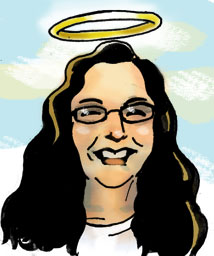
If you take a little time to think about it, you’ll realize you’ve seen haloes other places besides atop an angel’s head. Haloes were originally depicted as flat discs behind an individuals head, not floating above like these days. A flat golden disc is a sun, right? You got it, the Egyptian sun god Ra and Mithras, an ancient pre-Christianity sun god, both are depicted with haloes. So here you have a bunch of pre-Christianity/pagan deities running around with haloes, what’s an emerging religion to do?

That’s right, get themselves some haloes. Pagans, including Buddhists and Hindus, worship deities with haloes, so haloes must be part of their divinity. Once determined that a halo symbolizes sanctity, divinity, and light, all kinds of folks were getting them: Jesus, Mary, saints, popes, emperors, anyone who needs to be shown with the glow of the divine, including angels.

That, combined with a trend towards more realistic details in art, created the floating rings of light above the head.

By the way, when the whole body is surrounded in a glowing aura, for example as Jesus is often depicted, that’s not a halo, it’s a mandorla. Many people associate this full body halo as an indication of power, divine or otherwise. Like this, for example…..

See, he’s got the “glow”. Perhaps he’s got his chi working. Although technically that wasn’t a true mandorla. Mandorlas are almond shaped. But I think you’ll agree that was more fun!

If you have a little time, the Wikipedia entry about haloes is an interesting look at religion influencing art influencing religion. Here’s the link.

And for those of you who suddenly find yourself thinking, I should totally watch the movie “The Last Dragon” (where the clip above came from), let me remind you why that’s not really necessary.

Too cheesy…..
Must navigate away from page…..