1. Out of all the themes for oracle decks, why flowers?
In my work with them, I’ve found that flowers are living sacred geometry, and that they’re completely attuned to vibration and emotion. Simply placing our attention on them and opening up to them allows us to receive an instant energy healing and wisdom infusion that is both gentle and thorough. I’ve also found that they don’t have to be physically present in order for us to receive these benefits: like angels or totem animals, we can draw upon their essence to gain insight and spiritual guidance. Plus, they’re beautiful! So they seemed, to me, the perfect choice.
2. In the introduction to the companion book you mention having spent a year communing with flowers. What did that entail?
I bought a membership to Descanso Gardens, which is a truly magical botanical garden in the foothills of Los Angeles. Then, 2-3 times a week, I spent time with the flowers, relaxing and opening up to their energy one at a time. Once a flower’s gentle wisdom and vibrational signature began to take shape for me, I translated it into English and wrote it down. That was the main research process for my book The Magic of Flowers, which was the precursor to the deck.
3. You discuss the cumulative benefits of working with the Magic of Flowers Oracle, versus perhaps a book. Why is that?
Magical consciousness speaks in the language of symbol, and by working with meaningful imagery, over time, it becomes a part of our own personal energy field. Connecting the wisdom with the images – particularly when the wisdom is relating to your own life – makes inroads into your magical and spiritual intelligence in ways that go beyond the simple accumulation of information.
4. How did you end up working with the artist Anne Wertheim on this?
Barbara Moore – the tarot and oracle acquisitions editor at Llewellyn – got me in touch with her. …And I’m so lucky she did, because I absolutely love the way Anne brought life to my ideas.
5. What influence did she have on the deck?
Besides creating absolutely breathtaking art for every single card, she also helped talk out some of my ideas and helped fine tune my visions in marvelous ways.
 6. What is your favorite piece of art she created for the oracle?
The mermaid card! Also known as the Wisteria card. With every card, I chose images that spoke to my energetic experience of each flower, rather than the purely physical experience of them. So, obviously, wisteria doesn’t grow underwater! But it certainly feels watery, soft, fluid, and ethereal in precisely the way the mermaid card does. It is so wisteria energy! But I have to say that I have a lot of favorites. Lilac, Magnolia, Camellia, Bougainvillea, and Hydrangea are a few of my others.
7. What was the hardest part of creating the Magic of Flowers Oracle?
Before this project, I had never created anything visual before: all my previous projects were traditional books. So learning how to communicate my inner visions clearly was a new challenge for me. But for the most part, the process went surprisingly smoothly.
8. If there is one thing you hope people learn from using the Magic of Flowers Oracle, what would it be?
Always be gentle with yourself. If there’s one thing I’ve learned from the flowers, navigating the changes of life never needs to be harsh, scary, or self-condemning. And in fact, everything always works better we’re sweet to ourselves.
9. Do you have any upcoming projects my readers should be on the lookout for?
Thanks for asking! Yes, sometime in 2016, look for a reference book about the magical properties of trees. The title isn’t set yet, but it may very well be The Magic of Trees.
10. Parting shot! Ask us here at The Magical Buffet any one question.
Oh ok, fun! What are your feelings on My Little Pony: Friendship is Magic? (It’s my favorite show.)
I actually have never watched it. I was never really a My Little Pony gal so I haven’t checked it out. However I DO love cartoons! I get ready for work most mornings with the Powerpuff Girls playing in the background and curl up for naps with Danger Mouse. And then there’s Futurama, Codename: Kids Next Door, Family Guy, Adventure Time, American Dad, Invader Zim…
 About Tess Whitehurst:
An award winning author, feng shui consultant, and intuitive counselor, Tess presents ancient, sacred, and empowering wisdom in a friendly, joyful, and accessible way. In addition to creating the Magic of Flowers Oracle, she’s written six books that have been translated into nine languages, and her articles have appeared such places as Writer’s Digest, Whole Life Times, and Law of Attraction magazine. She’s appeared on morning news shows on both Fox and NBC, and her feng shui work was featured on the Bravo TV show “Flipping Out.” You can learn more at: http://www.tesswhitehurst.com/

 The artwork is striking. The deck contains 32 cards, divided into 4 parts: Emanation, Creation, Formation, and Action. Each part has its own style. There’re more than just images of Santa Muerte, but also Dias de los Muertos imagery, and assorted deities. Did Listrani use this bold style in his previous deck “The Santa Muerte Tarot”? Sadly, I missed out on that one, so I’m unsure.

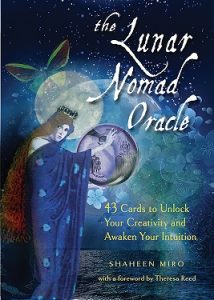 If you follow me on social media and/or have been a long-time reader you know I have a big tarot/oracle deck addiction. To me there really isn’t such a thing as a bad deck, but after a while you start to seek out things that stand apart from the crowd and I have found something truly unique in “The Lunar Nomad Oracle” by Shaheen Miro.
 “The Tarot of Bones” by Lupa. Lupa is a well established Pagan author of works focusing on nature and her first self-published tarot deck is the culmination of her work as a scholar of nature and as an artist. Lupa’s use of animal bone and elements of nature create a whole new approach to the tarot and makes it a must own for tarot collectors and lovers of the natural world.
 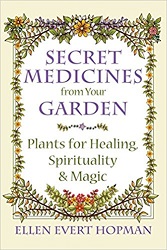 “Secret Medicines from Your Garden: Plants for Healing, Spirituality & Magic” by Ellen Evert Hopman. Reading “Secret Medicines from Your Garden” makes you feel like the author is personally leading you on a wilderness adventure. Hopman regales you with anecdotes from her spiritual journey and herbalism training. This is easily the most engaging book about plants ever.
 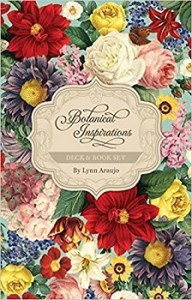 “Botanical Inspirations Deck and Book Set” by Lynn Araujo with art by Pierre-Joseph Redouté. This deck shares folklore, symbolism, and more for each flower or plant. It features absolutely beautiful artwork by Pierre-Joseph Redouté. This is the perfect deck for lovers of oracle style decks and/or fans of flowers.
  Here in the northeast things are taking a definite fall-wards turn. However thanks to the “Botanical Inspirations” deck by Lynn Araujo I’ll be able to enjoy the delicate flowers of spring all year round.
 The lotus flower grows up out of the mud, yet each day as they unfurl and shed the droplets of water, the flower emerges perfectly pristine. For this reason, the lotus symbolizes purity and spiritual transformation. With its flower so distant from its roots below the water, the lotus also represents detachment, a necessary step for spiritual enlightenment. The golden center of the lotus is rarely shown in Zen artwork since it represents the elusive perfection of wisdom. The Egyptian sun god Ra is often depicted with a blue lotus. Because of this association with the sun, the lotus signifies rebirth.
 This makes “Yoga Cats” a great daily oracle and/or a fantastic yoga pose a day deck. Also, let’s be honest. It’s also just fun the thumb through the deck looking at the amusing cats. All together “Yoga Cats” makes a great, multi-purpose deck that just about anyone could find useful.

 A handsome devil of a mage with dark hair, a pointed black beard, and a swirling black cape is offering money to a male witch and an ice cream cone to a young female witch. While he is smiling and pleasant, a pointed tail curls out from underneath his cape and his eyes have a reddish gleam. Each witch has a cat who is trying to pull them away and is being ignored. A volcano smokes in the far background. The mood is ominous but not hopeless.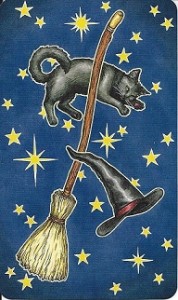
 4. Can you take my readers through the process of how a piece of jewelry goes from being a design to a piece for sale?

 About Gabriela Emma Olivera & Khalama:
 1. “Among the Mermaids: Facts, Myths, and Enchantments from the Sirens of the Sea” by Varla Ventura. As someone who has always loved myths and stories about sirens and mermaids, “Among the Mermaids” was a definite stand out for the year. Not only did Ventura fill the book with lore and legends of merrows, mermaids, and sirens, but the resources section in the back lists books, movies, and shopping. Shopping! Want your mermaid tail?
 3. “The Daemon Tarot” by Ariana Osborne. Based on Jacques Auguste Simon Collin de Plancy’s “Dictionnaire Infernal”, this 69 card deck isn’t just a divinatory tool, but a piece of occult reference. Obviously it cannot be used exactly as a tarot deck, but thanks to a researched and well thought out companion book, you’ll be doing a single card draw or a six card spread in no time.
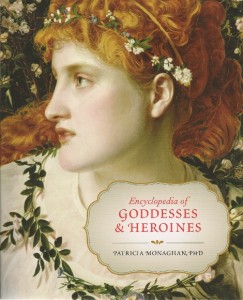 5. “Encyclopedia of Goddesses & Heroines” by Patricia Monaghan. Monaghan published the first encyclopedia of divine females in 1979, and that book has stayed in print in one form or another right up to today. The latest is newly expanded and features more than 1,000 heroines and goddesses from folklore, literature, and religion from around the world. It. Kicks. Ass.
 7. “The Yoga of Cleaning” by Jennifer Carter Avgerinos. Weird, right? Nope. Avgerinos background as both a certified yoga instructor and having worked in the consumer packaged cleaning tools industry for the past several years indeed gives her a unique perspective on these two seemingly divergent topics. She brings them together in a way that, I swear, makes you want to clean.
 9. “The Wisdom of Near-Death Experiences: How Understanding NDEs Can Help Us Live More Fully” by Dr. Penny Satori. There have dozens of books written about near-death experiences, however in my opinion this is the one we’ve been waiting for. Dr. Satori’s book is based off of the UK’s first long term prospective study of near-death experiences and she was awarded a PhD for her research in 2005. That’s right, it’s science. Although the research is grounded in science, Satori also includes many of her experiences from her 17 years as an intensive care nurse. This makes “The Wisdom of Near-Death Experiences” a compelling read.
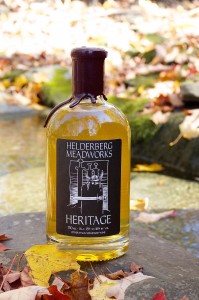 10. Helderberg Mead. 2014 gets to be the year that I fell in love with Helderberg Mead. As Peter Voelker said when I interviewed him about Helderberg Meadworks, “Most mead that you can buy in the wine stores around here either tastes like a low alcohol honey syrup or a nice soft white wine. While there’s nothing wrong with that (I love a nice Vidal Blanc), HMW takes a different approach. We use techniques that would have been used many moons ago and produce a mead that has big, bold and feral qualities to it. We’ve adapted old world methods to modern day sanitation and palettes without catering to any particular group of consumers. This is mead as we think it should be. With that said, there are 2 major differences between HMWs mead and others. The first is our alcohol content, which has a range on the label of 15% to 16%. Our current “Burgundy Wax” batch is at the high side of that range. Most others are from 8% to 11%. The second difference is our use of oak aging. Back in the days before metals were commonly available, oak would have been the preferred storage vessel for nearly all drinks. We have taken this concept and applied it to our mead. The result is a powerful mead (shouldn’t all traditional mead be POWERFUL?) with a whiskey-like nose and great honey flavor without being overly sweet.”