
Hello new year! Now is the perfect time to get your hands on “Your Goddess Year” by Skye Alexander!
 Why? Because this beautifully illustrated book features a different goddess for each week of the year! For instance, you’re reading this during January 1-7, the first week of “Your Goddess Year”. The featured goddess is Sophia, who you learn from this book is less of a goddess and more like Wisdom incarnate. Not too shabby, right? The author gives a brief bit of background on each goddess, why you want to invite, or invoke her, if you will. Also included are instructions as to how you might want to go about doing that.
Alexander does an excellent job of presenting a diverse offering of female deities and women of power. Like who? Hera, Baba Yaga, Pele, Fortuna, Athena, Sekhmet, Oshun, and many more!
If you’re looking to learn more about the divine feminine, “Your Goddess Year” is a fantastic way to do that!
You can learn more here.
Shop your local indie bookstore <---This is an affiliate link to IndieBound, which supports independent bookstores throughout the United States. If you use this link to purchase the book, I will make a small commission at no additional cost to you.
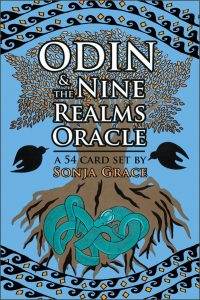 “Odin & the Nine Realms Oracle” by Sonja Grace is a delightful mix of intuitive and traditional deck design. The art is done by the deck’s author/designer and is an inspired mash up of her Norwegian and Native American heritage. The deck features 54 cards of well-known Norse deities like Odin, Freya, and Thor; an assortment of runes, and of course the Nine Realms of Asgard, Midgard, Vanaheim, Jotunheim, Nlflheim, Muspelheim, Alfheim, Svartalfheim, and Hel.
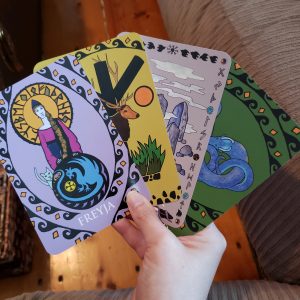 When everything is said and done, “Odin & the Nine Realms Oracle” is a unique and interesting take on the oracle deck. Its obvious audience is anyone interested in Norse mythology, but is wonderful for anyone looking for something different to add to their collection.
 There’s so much more in the world to be considered a “familiar” than your typical black cat. D’Aoust takes a truly global approach to the conversation. Her discussion of Greek belly-talkers and sibyls and the source of their powers was eye-opening. The examination of the role of angels in Judeo-Christianity was something I never considered before as a “familiar” relationship. D’Aoust also looks at fairies, familiars in Chinese legend, and even their appearance in India. I also want to mention that the author’s own artwork is used throughout the book. It’s unusual that the author provides their own art, and in this case helps bring extra vitality to her words.
  In the world of urban legends and cryptozoology it’s hard to proclaim anyone an “expert”, however if I was to try, Linda S. Godfrey would be one. Since 1991 Godfrey has been chronicling the stories of people who claim to have encountered the unusual. With Godfrey, nothing is off the table: goatmen, dire dogs, werewolves, big cats, creatures from other dimensions, and more are open to discussion. What sets her apart is that she does her best to attempt to fact check the stories and present mundane options for what occurs in them. Godfrey openly acknowledges that there is an obvious lack of scientific evidence for these things. The author isn’t a skeptic, she’s reasonable.
 “Beyond the North Wind” spends a lot of time discussing Hyperborea, a land from Greek mythology that was home to a race of giants who lived “beyond the North Wind”. The Greeks thought that Boreas, the god of the North Wind lived in Thrace, and therefore Hyperborea indicates that it is a region beyond Thrace. Unbeknownst to me, Hyperborea is much like Atlantis. There’s much discussion of whether it was a real place, if it is a real place, was it the same as Atlantis and/or other ancient mythological lands, etc. It’s interesting to see all the theories, far-fetched or not, about a land that’s entirely new to me.
 “Self-Love through the Sacred Feminine: A Guide through the Paintings & Channelings of Jo Jayson” is a thoughtful exploration of what it is to identify as a woman. Jayson explores the lives/folklore and wisdom of Guinevere: The Queen, Mariamne of Magdala: The Magdalene, Brighid: Mother Goddess of Ireland, Isis: One Who is All, Mary: The Mother, Jeanne D’Arc: Maid of Orleans, Miriam: The Prophetess, Guan Yin: Mother of Compassion and Mercy, Morgan Le Fey: The Water Spirit, Artemis: Maiden of The Hunt, Kali Ma: The Dark Mother, Inanna: Star of Heaven and Earth, and Grandmother Spider: The Weaver.
 With that in mind you’ll understand why I was excited to read “Joseph Campbell: Correspondence 1927-1987”. This is a never before available collection of written conversations between Campbell and some amazing people, such as Alan Watts, Bill Moyers, Thomas Mann. These letters give insight into Campbell’s relationships, life, and influence on others. Alongside the correspondence are plenty of great photos.
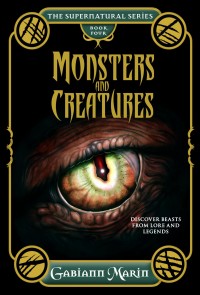 First up we have “Monsters and Creatures: Discover Beasts from Lore and Legends” by Gabiann Marin. This sucker discusses just about any creature you can think of! You’ll find well known creatures, like dragons, mermaids, werewolves, and centaurs. Marin also has loaded “Monsters and Creatures” with tons of lesser known creatures, such as kappas, pookas, kinnaris, and drop bears. (I would tell you about them, but shouldn’t you just buy the book?) At 196 pages it doesn’t go in depth with any of them, but “Monsters and Creatures” offers a great starting point.
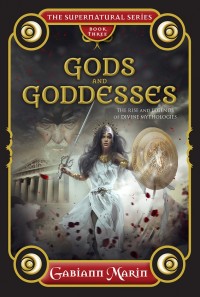 The other book, “Gods and Goddesses: The Rise of Divine Mythologies”, also by Gabiann Marin, follows a similar format. Marin discusses deities with origins in Greece, Egypt, China, Rome, and more. However, she doesn’t just discuss deities of the past, but their existence in modern times. Again, it doesn’t go into great detail, but it’s a fabulous starting point.
 She’s right. In this time of #resistance, Austen’s look at universal spiritual feminism is right on the mark. Respect for the earth, community building, and reclaiming the power womanhood all blend together in “The Heart of the Goddess”. Instead of your typical who’s who of female deities, Austen discusses each goddess from the perspective of a piece of artwork featuring the deity. This allows for a discussion of the origin of the art (geography and date) and with it, the history and culture surrounding the goddess.
 Whereas generally he uses his “gift for comparing cultures, for suddenly making an unexpected leap, but perfectly pertinent to the train of thought”, as Régis Boyer points out in the foreword. This time much of the focus is on the mystery of who is Auberon? By tracing this character’s existence in French, Norse, and Germanic tales we learn much about the difference and similarities of dwarfs and elves throughout time and cultures. What you come away with is that things back then were much more fluid, particularly in terms of physical appearance, than what you find in today’s Dungeons & Dragons books.