10 Questions with Miguel Conner: The Other Nine Questions

Hey! Wondering why there are only nine questions instead of ten? Did you miss question one? Click here to get caught up!

2. What made you decide to start a radio show devoted to discussing Gnosticism?

Ironically, I had just been excommunicated from a Gnostic church for something I hadn’t done (I’m not a 30th level magician…only in the World of Warcraft!). At the same time, I had started listening to an Internet station called Freethoughtmedia.com, mainly an avenue for New Atheism and Humanistic issues. I was feeling isolated so I sent the owner of the station a proposal to produce a handful of shows on Gnosticism—a series of interviews that would educate as well as dispel many misunderstandings on the ancient heretics. He accepted, assuming that the enemy of his enemy was his friend. Before I knew it, I was falling down a deep rabbit hole with Alice and Sophia. And I’m still falling after four years!

3. Your book “Voices of Gnosticism” is a collection of transcripts of interviews from your show, and does a fantastic job of introducing all facets of Gnosticism to the reader. When did you realize, or what made you decide, there would be value in collecting these interviews into a book?

The idea surfaced in the vast expanse of my head and was proposed by several listeners throughout the years. A few stenographers even offered to transcribe the interviews. I never paid much attention, falling into the cynical yet neo-utopian view that less people were reading and cyberspace was the new and true Library of Alexandria. I finally took a small Red Pill when Andrew Phillip Smith approached me with a sound and lucid vision of an Aeon Byte book based my most prolific guests. Since Andrew had been a guest many times, author of several books that had influenced me, editor of The Gnostic Journal who I had written for, and owner of a publishing company, I knew he couldn’t be an Archon and was onto something. The rest is heresy.

4. As an old school music fan, who would sit and write down lyrics to songs by playing second after second on a tape player, starting and stopping, starting and stopping, I know that transcribing from audio to text can take an insanely long time. How long did it take for you to transcribe all these interviews?

It was agonizing! I hated having to think of poor Andrew spending hours transcribing each interview! I know he started with a voice recognition software, but then he got the usual ‘too’s’ instead of ‘to’s’ and so forth, while Greek words came out all Greek to him; so he eventually did it the hard way, but he did an august job. Even then, it took months of us working together to match the vocals of the interviews to the transcripts. It’s not easy getting 60+ thousand words from audio to print, let me inform you! And I would advise for anyone undertaking such a venture to make sure the publisher and author agree on whether to use UK or American English…it will save you a lot of time and headaches and bad jokes based what is considered dirty in each culture.

5. Your interviews contain a wealth of information and you do an excellent job of really getting to the heart of your interviewee’s research. How much independent research did you need to do for these interviews?

I invest large sums of time and effort with each guest, regardless of their status or how much I agree with their premises. For one, I am passionate about all subjects dealing with the occult and comparative religion. I want to learn along with my guests. Furthermore, I understand how much hard work each guest puts into their books, movies or doctrines, so why shouldn’t they get the same respect? Not only do I read their respective work for the interview, I study all of their other efforts and everything I can about the subject at hand (even if I’m comfortably familiar with it). By the time of the interview, I want to be their virtual stalker or single white female.

6. Out of all the interviews you’ve done, do you have a favorite? If so, why does it stand out for you?

Why, this is my favorite interview! Me…me…me!

7. Is it odd for you to now be interviewed? How is the transition from interviewer to interviewee working out for you?

Okay, I admit it! You’re killing me softly with your song! The hunter has become the hunted! I’ve always envisioned myself as a cyber-Socrates, except a million times dumber, midwifing truths from my guests and handing those babies to my listeners. It is my greatest hope that they can nurture these truths into viable spiritual systems that will induce higher states of consciousness.

Besides, what can I say that could ever surpass any of my astral guests who emanate themselves from their Pleromas down into Aeon Byte every week? Uh, I like Pina Coladas and getting caught in the rain?

8. If my readers want to learn more about Gnosticism, where do you suggest they start? I’d recommend your book “Voices of Gnosticism” and certainly the “Dictionary of Gnosticism” by Andrew Phillip Smith, who was kind enough to contribute to my website as well as write a wonderful forward for your book.

Good choice for books, I say, I say! That’s another difficult question, since ultimately Gnosticism is a very personal faith even when you do find those with the same Etch A Sketch mysticism as yours. Gnostics are always the perennial strangers in an estranged land. J. Krishnamurti once said truth is a pathless land. I like to say gnosis is a pathless labyrinth. You just don’t know exactly how the song of Sophia will strike you or what teaching of an Aeon wearing mammal skins will stimulate your Divine Spark. I certainly would suggest that if a person is interested in Gnosticism, they approach it for what it is and not for what it isn’t. Many people enter the Esoterica because they are rebelling against a former religion. They end up roleplaying instead of fully participating in the mystery, their hearts still so filled with negativity that it cannot be filled with light.

Having babbled that sermon, it goes without saying that one should either own Bentley Layton’s The Gnostic Scriptures or Marvin Meyer’s The Nag Hammadi Scriptures. Since modern Gnostics have their usual suspects they propose, I’m going to go ahead and throw a few curveballs: Elements of Gnosticism by Stuart Holroyd because it’s a concise and approachable history of the Gnostics in a little over a hundred pages; The Gnostics: Myth, Ritual & Diversity in Early Christianity by David Brakke because he takes one of the best snapshots of the rise and fall of the Gnostics; The Gnostic Religion by Hans Jonas because he reveals that the socio-political world of the Roman Empire that early Christians and Gnostics struggled in eerily parallels our modern times, and thus why the Gnostic spirit is very important today; Valis by Philip K. Dick because he captured the essence of Gnosticism and translated it into a modern context; and Alice’s Adventures in Wonderland by Lewis Carroll because the story of Alice is the story of Sophia is the story of each one of us.

And definitely watch The Matrix, The Truman Show, Inception, Total Recall, all at the same time and several times, while reading out loud the poetry of William Blake with a Jungian analyst sitting next to you on the couch.

Like I always say on Aeon Byte, you know you have taken the Red Pill when you start writing your own Gospel and living your own myth, as the Gnostics did throughout history even if history erased much of their wonders.

9. What’s next? Do you have any upcoming projects my readers should be aware of?

I have just released the second edition of my futuristic yet very Gnostic-themed vampire saga, Stargazer (available at Amazon!). I’m working on releasing the sequel sometime late this year or early next year. I have a couple of embryonic projects for a scholarly book on the Gnostics, and there is a good possibility Aeon Byte might go completely live soon with callers and 1-800 numbers commercials for Cialis (but I haven’t bitten completely yet). If you include the actual show, writing articles for different periodicals, and making battle plans with Sophia, I don’t even have time to look for where I put those $#%@ Red Pills.

10. Parting shot! Ask us here at The Magical Buffet any one question.

Ah…that feels good! I can ask questions! How come you don’t have a “Gnosticism” category at the Magical Buffet? Is this some sort of prejudice? Hating on the Gnostics feels good but Yaldabaoth forbid we ruffle the feathers of Wiccans so we give them two categories, eh? Don’t think for a second that this sense of persecution is inflating my sense of self-importance! I’m pulling off my microphone and walking off the set! You’re out of order! This court is out of order! Wiccans are out of order! This whole buffet is outta order!

Alas you have caught me Miguel! The Magical Buffet has partnered up with the Wiccans in an effort to suppress information about Gnosticism ever reaching the public at large. Smart ass! You know what? I don’t feel like a jerk anymore for question number one! That’s right? I said it!
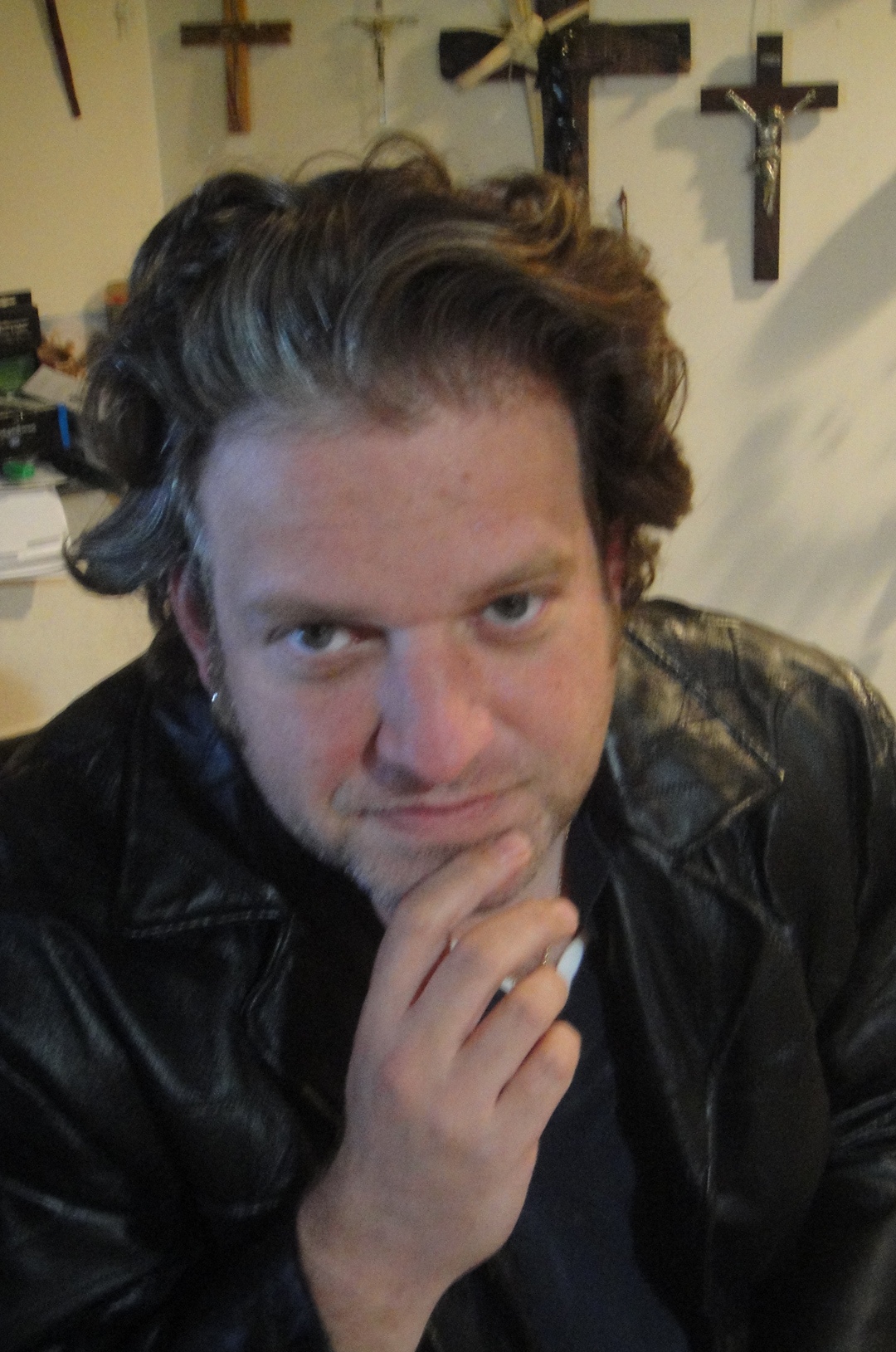
About Miguel Conner:
Miguel Conner is host of “Aeon Byte Gnostic Radio”, the only topical and guest radio show on Gnosticism and its brethren in mystical heresy, ancient and modern. He is the author of the critically acclaimed, popular, and Philip K. Dick-ish vampire epic, “The Queen of Darkness” (re-released as “Stargazer” in 2011). His articles, fiction, and reviews have appeared in such publication as “The Stygian Vortex”, “The Gnostic Journal”, “Houston Public News”, “The Extreme”, “The Cimmerian Journal”, “Examiner” and many others. He lives in the lawful dystopia of Chicago with his family, patiently waiting for the beginning of the world.

Miguel’s website is: http://www.thegodabovegod.com

Where Aeon Byte broadcasts and blog: http://www.aeonbytegnosticradio.com

Voices of Gnosticism Homepage: http://voicesofgnosticism.blogspot.com

Stargazer Novel homepage: http://stargazervampirenovel.blogspot.com

10 Questions with Miguel Conner: Question One

Indeed you’ve read the title correct my friends, this post is only question one of The Magical Buffet’s patent pending ten question interview. Why only one question today? To put it bluntly, because I’m a jerk. Here’s why….

I got an email from Miguel Conner, host of “Aeon Byte Gnostic Radio”, the only topical and guest radio show on Gnosticism. He asked if I had any interest in his new book ” Voices of Gnosticism”, to which I responded, “Hecks yeah” (or perhaps something a bit more professional). After reading the book (So good! Buy it now!), I asked if he would be willing to do a 10 questions interview for The Magical Buffet, to which he responded, “Awwwww yeah” (or perhaps something a bit more professional).

So, how does that make me a jerk? It seems like a mutually beneficial arrangement, what jerk-like qualities are there to this? Well, the very first question I asked in the interview was, “Can you define for my readers what Gnosticism is? I’ll admit that I have a difficult time trying to come up with a brief definition that makes sense to someone who has never encountered it before.”

Miguel knew it wasn’t an easy request, and I knew it too….and it’s why I asked. See? Jerk.

However, my jerk-ish question yielded a wonderful, insightful, and entertaining response….that was two pages long. Thus far I’ve never edited down an interview, and I have no intention of ever doing that, especially to such an important answer. Consider this the background for the rest of the interview. And stay tuned because the other nine answers are not to be missed!

1. Can you define for my readers what Gnosticism is? I’ll admit that I have a difficult time trying to come up with a brief definition that makes sense to someone who has never encountered it before.

Gnosticism is probably harder to define than most religions because it’s still an academic field with vast uncharted territory; and then there is the problem of wading through the oceans of romantic misinformation that both mainstream and occult faiths have drowned the Gnostic ideology in. The Gnostics also loved to push the boundaries of both theology and philosophy–even creating parodies sometimes for their amusement—to the point they shrouded themselves in a cloud of mystery (even if they were actually very open about their belief systems). One thing you can be sure of—if the ink on a scripture was barely dry, the Gnostics would rewrite it; if a mythology or religious narrative was just spoken of, the Gnostics would deconstruct and reconstruct the plot; and if a dogma was conceived, the Gnostics would immediately reinterpret it. And often all three at once!

Stevan Davies, on our interview in Voices of Gnosticism, perhaps gives the best short answer:

“Gnosticism is about discovering the way that God has turned into you, and then realizing that if you can describe how it is that God turned into you, you can reverse the process.”

In his excellent book, The Secret Book of John: Annotated & Explained, Davies further describes Gnosticism as “developmental psychology, a descriptive Middle Platonic philosophy, and a cosmic mythology all rolled into one.”

To wit, unlike most faiths that urge one to find transcendence in the now or salvation in the future, the Gnostics contended that one had to voyage deep into inner and outer origins to either correct certain spiritual traumas or find missed doorways into the timeless dimensions. They believed the greatest origin was, of course, the Godhead. I think the Gnostics would agree with Tom Robbins who wrote “It’s never too late to have a happy childhood.” Although ancient heretics would call it being resurrected into a Christ while still in the flesh, as the Gospel of Philip states. The Gospel of Thomas also puts the Gnostic ethos in good perspective:

The disciples said to Jesus, “Tell us, how will our end come?”
Jesus said, “Have you discovered the beginning, then, so that you are seeking the end? For where the beginning is the end will be. Blessed is he who stands at the beginning: that one will know the end and will not taste death.”

Now the longer answer will be more complicated, and one has to bear in mind that there were many Gnostic schools of thought in history whose doctrines varied. Yet there is a framework that takes time to discern for those who have ears to hear and eyes to see, as Jesus often declares in Gnostic scriptures.

So put on your theological seat belts, here we go:

The Gnostics posited that there was an ultimate existence beyond Heaven and Earth, a primal consciousness that detonated in awareness and rippled out in self-understanding. This Big Bang of supernal imagination and creativity is usually referred to as the Pleroma, the Eternal Realm or the Treasury of Light. The biology of the Pleroma (“fullness” in Greek) consists of Aeons, which although anthropomorphized in their mythos are better understood as modes of thought, firing synapses, or the circuitry of a transmundane motherboard. The Aeons owned such titles as Truth, Love, Forethought, Incorruptibility, etc.

At some point, there is a glitch in the divine mind, a sort of pre-Creation Creation. The severity can fall between something cute, like the Aeon Reason falling in love with and literally bungee divine into the lower realms, to an outright cosmic cataclysm, like universe imploding during God’s first attempt as portrayed in some Kabbalistic traditions. The most prominent cosmology is the fall of the Aeon Sophia (“wisdom” in Greek). The exact details vary depending on the scripture; but she commits the sin of desire, breaking from the harmony of the divine mind and thus plunging into the Void or Chaos. Sophia either becomes pregnant with or tries to hide her negative emotions. The end result is an abortion known as Yaldabaoth or the Demiurge, which the Gnostics commonly equated with the God of the Old Testament. Sophia’s unruly spawn doesn’t waste much time after inventing time, manufacturing his own Bizarro Aeons known as Archons (Greek for “rulers”, but more akin to godlike TSA-agents with very bad dispositions). Then they cut a lot of corners and take long union breaks in order to fashion this wonderful universe The true God has lost his wisdom and wisdom is lost somewhere in a galactic Kennedy airport…who you gonna call?

Whether by the effects of the celestial mind-fart in the Pleroma or by a rescue operation hatched by Sophia to redeem herself, slivers of her essence are mingled into the material world. These Divine Spark, as they are often referred to, generally are housed in humans; although some Gnostic sects believed every living and even unliving thing contained the Divine Spark. The problem is that because of the good cop/bad cop routine of Yaldabaoth and his Archons we have forgotten our ambrosial heritage. Instead of igniting our Divine Spark in order to overcome the powers of darkness and too many astral travel regulations, we have come to believe we’re just overdeveloped apes. In Gnosticism, ignorance in all its forms is considered the greatest of sins and conditions.

From an ethereal borderland, Sophia sings to our Divine Sparks to kindle bright so that we may remember where our true home lies and how to defeat Yaldabaoth. At the same time, the Pleroma sends Aeons clothed in mammal skins–Jesus Christ and Hermes Trismegistus being two of the most exalted ones–who descend into matter to remove the shackles of ignorance with their teachings. This is gnosis, which in Greek means “knowledge”, yet is more akin to a slow-burn acquaintance with the divine mind. Gnosis is taking the Red Pill. Gnosis is discovering you’re in The Truman Show and it’s time to find a more authentic reality. Gnosis is realizing you’ve been incepted and you better get out of the dream within the dream, and into complete wakefulness.

The battle lines are drawn—Sophia, the Aeons wearing mammal skins, and awoken humans on one side; the Demiurge, the archons, and ignorant humans on the other. It doesn’t get more exciting than this!

About Miguel Conner:
Miguel Conner is host of “Aeon Byte Gnostic Radio”, the only topical and guest radio show on Gnosticism and its brethren in mystical heresy, ancient and modern. He is the author of the critically acclaimed, popular, and Philip K. Dick-ish vampire epic, “The Queen of Darkness” (re-released as “Stargazer” in 2011). His articles, fiction, and reviews have appeared in such publication as “The Stygian Vortex”, “The Gnostic Journal”, “Houston Public News”, “The Extreme”, “The Cimmerian Journal”, “Examiner” and many others. He lives in the lawful dystopia of Chicago with his family, patiently waiting for the beginning of the world.

Miguel’s website is: http://www.thegodabovegod.com

Where Aeon Byte broadcasts and blog: http://www.aeonbytegnosticradio.com

Voices of Gnosticism Homepage: http://voicesofgnosticism.blogspot.com

Stargazer Novel homepage: http://stargazervampirenovel.blogspot.com

10 Questions with Joseph Zarzynski

1. I’ve been given to understand that back in the day you researched “Champy”. For my readers who may be unfamiliar, can you tell them a little bit about “Champy”?

I always preferred the term “Champ.” In fact, the word “Champ” was the preferred designation used in Vermont and “Champy” was used on the New York side, generally the lands north of Westport.

Anyhow, “Champ, the mystery creature or monster of Lake Champlain,” is “America’s Loch Ness monster.” For decades, some people at Lake Champlain have reported seeing an unidentified animal in the lake, a USO (unidentified swimming object), you might say. It has been described as serpentine or horse-like head, long neck, large body, a tail and possibly four flippers or appendages. Length, 15-20 ft. long. There are probably several in the breeding colony. They are probably closer to 15 ft. long, maybe even a bit less in length. Unfortunately, no definitive evidence has been uncovered like that unique video footage or a carcass washed up on shore. Still, we can only hope…one day.

2. Was it the search for “Champy” that led to your study of underwater archeology?

I conducted archival research and fieldwork for “Nessie” and “Champ” from 1974 into the early 1990s, about seventeen years. Several things gradually led me to move from cryptozoology to underwater archaeology. First, in 1985, several things happened, hallmark events in underwater archaeology. The TITANIC was found, the Spanish treasure shipwreck the ATOCHA was found, a rare WW2 Wellington bomber was raised from Loch Ness, and Vermont opened an underwater park for divers on their side of Lake Champlain. From those seeds I decided to get into underwater archaeology. Finally, in 1990, I led the team that found the 1758 LAND TORTOISE radeau shipwreck in Lake George, New York. That 1990 discovery was the knife that cut my tie to cryptozoology. In 2001, I got my second Masters degree (University of Leicester in UK), that in archaeology and heritage, so I could become a practicing underwater archaeologist.

3. Although many of my readers may know you from your cryptozoological past, the truly exciting discovery you were a part of wasn’t a creature, it was a vessel, the LAND TORTOISE. What is the LAND TORTOISE?

The 1758 LAND TORTOISE radeau was a British floating gun battery of the French & Indian War (1755-1763). The radeau, French for “raft,” was a strange seven-sided vessel, 52 ft. long x 18 ft. wide. We found it at Lake George on June 26, 1990 during a Klein side scan sonar survey by our team that became known as Bateaux Below. The LAND TORTOISE is today known as “North America’s Oldest Intact Warship.” That term was coined by my colleague, Dr. Russell P. Bellico.

4. How on earth did this giant, essentially a sunken fort of a ship manage to go unnoticed for 232 years?

Well, it rested on the lake bottom, 107 ft. down, in deep water. It was in the middle of the lake in deep water. Advanced technology, a Klein 595 side scan sonar, helped us find the shipwreck. That same technology and other kinds of remote sensing could be applied to “monster hunting.” One day, a well-financed operation at Loch Ness, Scotland may answer the question, is there a Loch Ness “monster.” It will take money, time, and a good team.

5. Once you discovered the LAND TORTOISE the work was done right? You just contacted some state office and went, “We found this awesome, historically important thing. You’ll take it from here, right?”

We contacted the State of New York shortly after our find. Then began the process of acquiring a state permit to study the shipwreck. However, we had no funds whatsoever. So, we found a wonderful underwater archaeologist, Dr. Kathy Abbass from Newport, Rhode Island, that volunteered her services. We then supplemented our six-person team, Bateaux Below, with several skilled divers. From 1991-1993 we studied the one-of-a-kind, deepwater shipwreck. We estimate we put $1 million of volunteer services into that study. In 1995, we got the shipwreck listed on the National Register of Historic Places. In 1998, we got the shipwreck designated a National Historic Landmark, only the 6th shipwreck in American waters that are NHLs. And in August 1994, we opened the radeau as a shipwreck preserve or underwater state park for sport divers. The underwater park is called “Submerged Heritage Preserves,” and the radeau site preserve is known as “LAND TORTOISE: A 1758 Floating Gun Battery.”

6. There is actually a documentary, “The Lost Radeau: North America’s Oldest Intact Warship” that chronicles all of this. At what point did you, and the others who work with you, decide that this process needed to be filmed and shared?

Right after our 1990 discovery, we thought a documentary was possible. Like fine wine, however, we had to wait until John Whitesel and Peter Pepe (Pepe Productions) approached us to collaborate on the project. In late 2005, the award-winning documentary was released. This year, we released a follow up to that documentary called “Wooden Bones: The Sunken Fleet of 1758” (Pepe Productions & Bateaux Below, Inc., 2010, 58 minutes). See www.woodenbones.com.

7. What’s next? You’ve searched for giant lake monsters, discovered North America’s oldest intact warship, where do you go from here?

Like most researchers it is time to write all this up, to publish more reports and new books, and work on more documentary projects. Get the results of the research out. That is what scientists do.

8. Many of my readers are interested in lake monsters, any advice for any of my readers who want to go out looking for “Champy” or “Nessie”?

Yes. Be enthusiastic. Conduct background research first. Enjoy yourself. The search is fun. It will probably be that “Jane” or “John Doe” with a camera in hand that will finally solve the mystery. Thus, getting the word out by organizations like your blog, are important. I can’t wait and I applaud folks who dare to get involved in the search.

9. At this point you must be very familiar with Lake George, New York. Where would you recommend I go for dinner next time I’m in the area?

Ah, there is a great bakery in Lake George, the Lake George Baking Company. It is not dinner, but they sure have wonderful pastries to fortify you as you check out the area’s history and the lake’s beauty. I am a jogging fanatic so I can visit it only once a month or so. It has great coffee, too.

10. Parting shot! Ask us here at The Magical Buffet any one question.

Not a question, but a thank you. Thanks for giving me an opportunity to talk lake monsters and shipwrecks. Great stuff. Good luck and best wishes.

You can learn more about Joseph Zarzynski, Bateaux Below, Inc., and the LAND TORTOISE here and here.

Here is the trailer for “The Lost Radeau: North America’s Oldest Intact Warship”.

You can view more and higher quality trailers here.

Here is the trailer for “Wooden Bones: The Sunken Fleet of 1758”.

10 Questions with Featherscale

1. What is the origin of Featherscale?

(Mike) As far as the name, it’s from Egyptian mythology- Book of the Dead, Maat, a heart and a feather… Go look it up. It’s some neat stuff. I’m not really sure exactly where I lost control of things, but it started off as a solo project- Topaz Stars in a Violet Sky, recorded for the RPM Challenge.

(Tim) I thought the album was great. Made me miss playing music. Mike and I played together off and on for 14, 15 years? A lot of open mics, but never pulled together a long-term project. We played a lot of covers and drinking tunes. We lived together for a couple of years when I was a student, and Mike was punching the clock doing retail.

(Amber) A little over two years ago, Mike posted on Facebook that he was looking for a drummer to expand his musical compositions a bit. Partly in jest, I wrote him back. I hadn’t played out in many years and was very rusty. I remember how nervous I was the first night we got together; I kept dropping my sticks! (wait, ok, I STILL do that!). It was only a short few rehearsals that we really clicked, musically, intellectually, spiritually. If he wasn’t married to a dear friend of mine, and well, if I wasn’t … ummm … let’s just say we work well together.

(Tim) This spring, at Pagan Odyssey, I got a chance to meet this Drummergrrl that Mike had been raving about. Most of the jokes and grief we were giving each other are unrepeatable, and would probably land us in jail in most southern states, but we were all shitfaced around the campsite that first night and I was borrowing guitars to jam a bit with them and a bunch of other friends. Amber, at some point, asked me why I was wasn’t playing anymore, and I realized that the perception that I didn’t have the time was basically bullshit. So, it got me thinking. The next day, they played their gig for the fest, and I was impressed that they made it work as a duo. He was leaning heavily on is loop pedal in order to fill out the sound and it was breaking up the pace of the performance in places. By the end of the set, I basically had decided that I was going to crowbar my way into the band. I’m a jerk like that.

(Mike) A month or so later, the three of us play Beltaine at A Sacred Place, with my buddy Rob on fiddle and guitar. We’re still without a bass player at this point, but this was where Justin came in.

(Justin) I met everyone officially at ASP. I had known Mike for about a year and we had gotten to know each other a little better at Maine PPD, so I had asked him to bring a guitar so we could jam. I met Amber and her coterie of camp followers when my wife Dawn and I arrived, and I met Tim a little later on when he showed up.

(Tim) Justin and I ended up hanging around most of the rest of that day, while Mike was tending his booth and Dawn hers. I think by the end of that couple of hours, we were, as Dawn put it, in the throes of a “bromance”. In addition, “Sex Potatoes.” If you weren’t there, you won’t ever understand, but I say again: “Sex Potatoes.”

(Justin) We got to talking, and Tim asked me to do play sound man for the show they were doing that night. I hadn’t had the chance to do a whole lot musically in a while, so I was pretty pumped to even do sound again. Mike asked me to join them on the last song about 2 hours before the show. I was flattered. The band hadn’t even heard me play. They had no way of knowing if I even knew what to do with it. So that night I did sound and accompanied them on Hail and Farewell.

(Tim) It was informal, off-the-cuff, and he wasn’t even amped or mic’ed, but it was the first time that Featherscale all played together on stage.

(Justin) Later that night came the, now infamous, Featherscale campfire jam. With a bit of Scotch, a bit of Guinness, too little of Tim’s kilt, and far too many horrific jokes, Featherscale began to come into its own. I’m pretty sure it was later the next day when Tim/Mike/Amber asked me to try my hand at bass, and I said “Um, sure! I don’t play bass, but what the hell. I’ll figure something out.”

(Tim) Justin immediately went and traded in a bunch of his guitar gear, and shows up to rehearsal with a complete bass rig. So, at this point, I know I was thinking “even if he sucks, we’re kind of stuck with him.” Well, by the time we had gotten him up to speed on a couple of tunes, I think we all knew that we had found the last team-member.

(Mike) Once all of us get in the room together, we have this amazing chemistry that just takes over and carries us miles beyond what any of us could do on our own. The group really evolved in a way that I don’t think any of us could have predicted, but it’s totally magickal. Really, the whole being greater than the sum and all that.

(Justin) And the rest, as they say, is a fried peanut butter and banana sandwich.

2. How would you describe Featherscale’s sound?

(Amber) I would describe our sound as traditionally modern Celtic rock. Keeps the foot tapping and the beer steins swinging!

(Justin) I’m not quite sure how to answer this. Apart from the fact that our sound changes for different songs, our sound changes depending on our mood. We came dangerously close to making Gallilee a metal ballad, and The Ballad of Thomas Meagher is a Punk/Irish drinking song. Samhain always gives me an October Rust era Type-O-Negative vibe. It’s hard to pin down in a simple phrase, but I’ll try: PaganIrishRockPunkDrinkingSongsToHaveAGoodTime/DieTo. Remember I’m only the bass player.

(Mike) It’s rock. There’s little bits of blues and folk and metal and Celtic trad, but like I said before- Once we all chime in, we end up with something that goes way beyond what we put into it.

(Tim) I’m not sure that we really have a particular “sound” beyond “loud”. I listen to our rehearsal tapes and we change the entire style and approach to the material with surprising regularity, and often by accident. Two of the tracks on the upcoming album are recycled from the first Featherscale album because they are so radically different than the original recordings.

(Amber) Justin with heavy metal, Tim with classical and traditional folk, Mike with rock and metal, and myself creates for surprisingly unified sound.

(Tim) Yeah, I think I can live with calling it “Rock.” I’m still putting a lot of loud grating stuff through my noggin, but I’m also going back to the stuff that I used to listen to before I was so damn hip. Robert Johnson, BB King, Spider John Koerner. I’m rediscovering Julian Cope and a lot of the odd shaped edges of pop, though part of that comes from wanting to figure out how they build certain guitar sounds that I’m secretly coveting.

(Mike) I love loud, overdriven metal and punk stuff, but for me, it’s always been about the song, rather than the style. My all-time favorite acts- Zevon, Cash, Cohen, Pogues… they’re all great storytellers first and foremost. I honestly believe in this idea of a bard having a duty to communicate in a way that people can understand and relate to, so I really look up to bands like the Cure, Oingo Boingo, Pink Floyd, Bowie- Who were able to make revolutionary art, but in a way that was still accessible to the average radio listener.

3. This question is for Justin, who failed to send in an official bio for the Featherscale website and thusly has been stuck with the goofy one Mike wrote for him. Justin, would you like to tell my readers about yourself?

(Justin) The bio on the Featherscale site is entirely true. I had asked Mike not to mention any of that until I could come up with a decently plausible explanation to my whereabouts, and he goes and tells my personal information to everyone on the web! I really feel like I’ve been abused. . . again. And this time by a friend, not someone who I thought was a friend, but an actual friend, who is now someone who I only thought was a friend. Dammit. I play bass. I’m not supposed to be smart. And yes if you must know, I am 216 years old. But you’re only as old as you feel. And I feel like a spry 110 year old.

(Tim) Mike also left out the part about how he killed a man in Reno, just to watch him die.

(Justin) Just Kidding. Thanks for asking. Mike has a very unique sense of humor. And when I saw what he had written after waiting for me to hand in my bio, well, I knew I was in the right band. I have been playing guitar for about 14 years now, and in December it will be 6 months for me playing bass. It was a fun transition. I was playing rhythm guitar in a progressive heavy metal band off and on for 7 or so years and then stopped playing entirely for a few years.

4. For that matter, now that Justin has introduced himself, why don’t you guys each take a turn in introducing yourself to my readers?

(Tim) I never know how to answer this question. I’m utterly fascinating and mysterious. I’m Aquaman in a kilt. I like power tools, hate doing laundry and believe that Monday should be abolished.

(Amber) I’m the lady, and level mind of the group 🙂 Or at least, I keep things rhythmically level. I picked up my first pair of drum sticks when I was ten … well actually, they were chop sticks because my parents didn’t want to invest in such an elaborate, expensive musical instrument collection until I could prove my dedication. Nineteen years later I’m still playing!

(Mike) I’m an artist. Whatever media I can get a hold of- music, paint, wood, clay, whatever. I’ve been Pagan for a long time now- I pretty much found some Wicca 101 book my freshman year of high school and just never looked back. I’m also thoroughly immersed in the western world, so I have a house and a dog, watch TV, work a job, and bitch about politics. Also, I really like jalapeño poppers.

5. On your website you talk about how at a festival the members of Featherscale and your associates did all of the following: performed, facilitated a Bardic Circle, did a storytelling performance, provided campfire entertainment on two nights in addition to the previous mentioned performances, brought three vendors and ran four workshops/classes on Kitchen Witchery, Magickal Tools, Initiatory Lodges, and Sacred Storytelling, provided sound equipment for other performers’ use and ran sound for those performances, and did Tarot and Rune readings! With your group bringing THAT MUCH to the table, have you considered hosting your own festival? Think about it, The Featherscale Festival sounds pretty good, right?

(Tim) OK. Yeah, we did that. Sort of by accident, in fact. It wasn’t until we got to talking after the fact and totaled up everything that we presented that we realized how much stuff we had done at that event, since we had only booked the Fs show with each other’s awareness.

(Justin) There has been some unofficial chatter about a Featherscale festival. Me personally, I would never run a festival. Not my cup of NyQuil. If it did happen, I would have to relegate myself to a helper role – like sound tech, or bouncer.

(Mike) [Tim’s wife] Kate and I have talked about it. Truthfully, Tim is running a fledgling ceremonial order, Amber has school and a 5 year old, and we all work day jobs- I myself do the band full time (which really is a lot of work), run my business full time, and work a mundane job to boot. I also have a short nap penciled in for March. I’m also on the Elder’s Council for A Sacred Place, so I sort of have a hand in running events there anyway. None of us has the inclination to take on yet another project of that magnitude. You know what- forget I said that. Sooner or later we’ll decide to go for broke, but not in the foreseeable future.

(Tim) Fs is sort of an emergent property of “we’re all there anyway”. Mike runs the Haunted Wood and makes all sorts of magickal tools, my wife, Kati runs Antika Nueva, makes jewelry and a line of soaps and salves, and Justin’s wife, Dawn, runs Cucina Aurora, and is a kitchen witch par excellence. Being a vendor sucks a bit, in that festivals are real work, so performing is the part that we look forward to. As for running our own festival, I wouldn’t want the headache. Me, I’ve got enough on my plate running a cult. Organizing a festival would make my head implode.

6. What’s the best thing about being a member of Featherscale?

(Mike) Well, we have a great health plan. Most bands just don’t offer dental and vision these days.

(Amber) Well there truly isn’t only one thing to mention; it’s the whole package that ties it all, brings us all together. We are not just a band, we are a group of very, very close friends. I think I can speak for us all in saying that we’ve found a support structure unlike anything any of us have had before. If the band stopped performing tomorrow, we’d all still be close and in each others lives in a very meaningful dimension.

(Mike) It doesn’t hurt that these are some of my favorite people in the world- When we do festivals, we all set up next to each other, and camp behind the vending booths. We do communal meals and keep an eye on each other like family. I can honestly say there’s nowhere in the world I’d rather be than sitting around the camp passing around the Guinness and Sex Potatoes, playing music and hanging out with these guys here.

(Justin) It’s the harmony. We all participate in writing and arranging the songs. A lot of the stuff we play is based around songs Mike has already written, but when we start to analyze a song in rehearsal, it takes on new life. We make it our own unique sound, whether it wants to or not. It’s quite nice to be able to do that, and be encouraged to do that. At my second practice I was basically told: “You are gonna’ have to be the balance between Mike and Tim, so speak up if you have an idea”. And strangely enough, I have ever since.

(Amber) I never had the opportunity to be so much a part of the music I was taking part in. Who I am as a person, so many of the ways in which I have grown in the last two years, has had a great deal to with being a part of this group of wonderfully talented musical souls!

(Tim) At the risk of waxing horribly bathetic, The best thing is being with friends. I love making music, but frankly, I love my band mates and their kith and kin more. We’re pack. We’re hands, and heads and hearts for each other. We make each other better, more human, more kind. Making music together is bone on bone intimate way below the skin. Being able to criticize without cutting, and fearless enough to call bullshit on each other, and to have love and trust enough in each other to work together to make it all happen is purely Tantric. And when it comes together, the payoff is that we know more about ourselves and each other.

(Mike) Really, spending time with people you care about, working hard at something meaningful and spiritual that you love doing, and being recognized for it- there’s nothing better in life.

7. Your new album is releasing very soon. How would you describe it?

(Mike) If you’ve heard us live, you’ve got some idea what to expect- But it will be a little more sophisticated. There are things we can do in the studio that we haven’t been doing live, so there’s going to be a few surprises. Samhain, for example, we’re looking at some Hammond organ. All in all, there are 10 songs that have never been released, and at least 3 of them, NOBODY’S heard before. We’re also recording the version of Invocation we’ve been doing live, because it’s so radically different than the version on Topaz Stars. Rob McClung from that first ASP show will be laying down some fiddle tracks and helping with the post-production at his studio. We’re also hoping to bring in Jenna Greene for some vocals, and maybe another special guest or two.

8. Does Featherscale have any live performances scheduled? Where can my readers go to see you perform live?

(Mike) The big priority right now is getting the album recorded and ready to drop, but there’s talk of playing a few shows around the NH seacoast over the winter. Mostly, we play festivals- so spring is busy for us. We usually play 2 or 3 Beltaine events, and we’re planning to return to Pagan Pride around New England in the fall. A Sacred Place is also planning a Pagan music festival for June, which should be a good time- I’m actually doing the bookings for that. Featherscale will be there, and we’re [ASP, not FS] also negotiating with some really good performers including a couple nationally touring acts. The best way to keep updated is to join the mailing list or friend us on Facebook. (Update: Featherscale will be performing at Landrock Studios in Rollinsford, NH on February 5, 2011.)

9. I’m a decent singer, any chance I can get a guest spot on the next album?

(Mike) We’ll talk. Have your people call my people and we’ll do lunch. Do people still “do lunch”? I’ve gotta’ quit learning my agent lingo from 80’s movies. What was the question?

(Justin) Absolutely. As long as you have the proper forms filled out in triplicate, and receive authorization from the home office in a timely fashion. And possibly a wet T-shirt contest.

10. Parting shot! Ask us here at The Magical Buffet any one question.

(Mike) Well, I’m clearly a man who knows buffet. If this were video that would have totally been a great sight gag, ’cause I’m a big guy… You know what? The jokes don’t always work. Just roll with it.

(Justin) I’ve been to Chinese buffets before. The after effects were. . . gastrointestinally pyrotechnic. If I frequent The Magical Buffet, my spirit won’t blow up like the Death Star will it?

(Mike) Parting question… How would you rather buy our album? We sell CDs both through our website and through retailers like Amazon.com, plus at live shows and a couple Pagan shops. At the same time, our music is available through iTunes, Napster, and the like. We also don’t get bent out of shape over file sharing- we just ask that the ID3 tags be complete and include our website url. We have a donation button on the site- if you download our music from a P2P network, we’d appreciate a couple bucks, but we’re not going to be jackasses and sue you or anything. So there’s the question- CD, download, or donation?

Justin, if you frequent The Magical Buffet I will turn your spirit inside out and then have it explode, just like that pig lizard in the movie “Galaxy Quest”.

Alas Mike, I am of a dying breed. I love buying actual, physical CDs. I love album cover art, I love liner notes, and I love printed lyrics. I love holding my favorite CD in my hand. Unfortunately our apartment has to bear the weight of my preference in the fact that it has to accommodate the hundreds, perhaps thousands, of CDs that I own. I’ve been trying to buy more music from iTunes and just have it on my iPod Touch, but I sleep better at night rolling over and seeing the CD there on the shelf.

Hey Buffet readers, let’s help Featherscale out with some informal market research! How do you prefer to buy music: CD, download, or donation? Post your answers in the comment section for Mike to review! And thanks for your help!

About Featherscale:
Featherscale blends acoustic and electric sounds to create their own brand of Pagan rock with undercurrents of blues, metal, and just a touch of the Irish drinking songs they grew up with. With influences as diverse as Leonard Cohen, the Pogues, Warren Zevon, and the Ramones, Featherscale will make you move, laugh, and think with their skillfully written tales and heartfelt performance.

Picture if you will – A cool summer night, an open clearing in an ancient wood, and a roaring campfire. Around the fire, people laugh, sing, dance, and share stories and songs. The drinking horn is passed around again and again, and never runs dry. Woodland spirits sneak glances from the wood and the night seems to go on forever. This is Featherscale. Learn more at www.featherscale.com.

10 Questions with Dr. Bob Curran

1. I love your latest book “Man-Made Monsters: A Field Guide to Golems, Patchwork Soldiers, Homunculi, and Other Created Creatures”. I was amazed to find so many different types of “created creatures”! Were you surprised to learn what a vast topic this was?

I suppose the answer to this question is both yes and no. I was well aware that the notion of “created creatures” was prevalent in both folklore and history but I suppose I hadn’t realized just how prevalent. When I was asked to write the book by the publisher, I initially had of course in the back of my mind, the idea of Frankenstein and so forth but as I thought more about it, other ideas began to pop up – the Golem, homunculi etc. Maybe we’ve become so used to the idea of Frankenstein, mainly through popular culture, that a lot of these other ideas get pushed to the side – but they’re still there. The idea of being able to create life for them selves, independent of any Supreme Bring, seems to have intrigued our ancestors down the years and this has manifested itself through the folklore and traditions of groups and civilizations in the past. So it’s not really surprising that the topic is an extremely vast.

2. Your book is a reasonable, respectable 185 pages. With such an interesting and diverse topic to discuss, was it hard to not end up writing a gigantic tomb? Did a lot need to be cut throughout the editing process?

This of course leads on from my first point. Because the idea of life-creation is so fundamental to us, it has generated a great deal of speculation – scientific, literary and folkloric – all as you rightly say very diverse in both scope and nature. Therefore, when I was researching the topic I came up with a massive amount of information and I think, if I had not been limited, I could have written a book which was twice as long. Before I finally submitted it to the publisher I had to go through a fairly rigorous editing process which cut out some rather interesting material which unfortunately had to be sacrificed. And of course I should pay tribute to my publishing editor, Gina, who did a first class job as ever. There’s always the possibility of another book in order to use the edited material you know!

3. In discussing probably the most iconic of man-made monsters, Dr. Frankenstein’s monster, you tell the tale of Giovanni Aldini, Mr. Pass, and George Foster, and how their story may have influenced and informed Mary Shelley when writing “Frankenstein”. It’s such a fascinating tale, have you considered turning your section about the trio into a screen play?

I’m glad you found the story of Giovani Aldini, the tragic George Foster and the mysterious Mr. Pass – possibly one of the influences for Mary Shelley’s “Frankenstein” – so fascinating. I found it so myself, possibly because of the colorful characters and the development of the story itself. In fact I would agree with you that there is the basis there for a novel or a film – all the elements are in place. I think there have been a couple of drama-documentaries made for television but they were very short and perhaps didn’t do full justice to the subject. But yes, turning the section into a screenplay is certainly an idea worth thinking about. Judging by the response I’ve received from some of the readers it would certainly be a hit.

4. When doing research for “Man-Made Monsters”, were you surprised to find so many stories of created creatures linked to religions?

Not really. One of the most fundamental questions which man has faced down the centuries is “Who or what created me?” or much broader terms “How did life – both human and animal – come about?” For many people the answer was linked to some sort of supernatural belief. This has often been linked into the idea of a Creator Being which usually forms the basis of religious ideology. Thus in, say, Judaism and Christianity, the idea that man was created by God “from the dust of the earth” is taken as a fundamental principle and is still accepted by many people today. The question then arises – “Can man also create beings – with or without the help of a Supreme Being?” . The answer in some circles seems to have been “yes” but not as perfectly as those which the Supreme Being had created. This of course led to the fear that the beings so created would be monsters. But the root of that belief and fear lay in a religious perception and I don’t really think that the idea of life-creation can be easily disentangled from religion.

5. Do you think there is something to learn about humanity by studying our history and fascination with creating life outside of the natural order?

I certainly think that there’s something to be learned by studying these legends and beliefs which is why I think I write about them. All these old legends – not just those about the creation of life outside the natural order but also those about vampires, werewolves and other terrors – address very fundamental questions and provide an interpretation of the world which out ancestors used with the information that they had available to them. In this respect, these old stories and legends are in many respects as important as the actual historical documentation that has come down to us because they provide an insight into the thought processes of former times. This is what I try to explore in my books and I think the question is not “Do these things exist or have they happened?” but “Why do we want to believe in them or that they happened?” Many of these so-called “horrors” have continued to fascinate us both in books and film for many, many years. I think if we explore further into any of these subjects, it tells us a bit more about ourselves.

6. Out of the diverse bunch of man-made monsters you discuss in your book, which one is your favorite and why?

I don’t think I have a particular favorite since all of these beings interest me. Of course, I was intrigued by the myth of Frankenstein, simply because it’s so culturally known and I had read Mary Shelly’s iconic book many years ago. As well as that I’d watched all the old Frankenstein black and white films , and it had always intrigued me. But then I was also interested in the Golem and in the works of the early alchemists. And as I dug more deeply, researching the book, I came across more and more interesting things – ancient mechanisms and mechanical beings for example – and as I looked at them, the more my interest grew. So I suppose asking me to choose between them is like asking me to choose between my children – all have their own differences and fascinations so it’s really impossible for me to pick. If I was actually forced to, I would perhaps say Frankenstein, mainly because of the interesting story of Giovanni Aldini, but I’m not really sure.

7. One of my favorite creatures discussed in your book is the Golem. Can you tell my readers a little bit about them?

The Golem springs from Jewish tradition and folklore. Once again it addresses the question – “Can Humanity itself create life?” – which taxed certain of the early Hebrew thinkers. The answer was that Mankind might be able to create life but that it would do so imperfectly. Even God, it was suggested, had created an imperfect prototype – Adam Kadmon – before He actually created Adam. The Golem was a large man-like figure which was created out of clay but had only a limited intelligence. It could only be created by the holiest rabbis, using a formula which had been learned directly from God Himself, through the secret Book of Creation (the Sefer Yetzirah). Part of the formula was to write the word or a number of signs (aleph) emet (meaning “truth”) on its forehead or on a clay tablet which was placed under the figure’s tongue and this would bring it to life. In some cases the word was supposedly written in the rabbis own blood. However, it should be stressed that the word alone would not give life but the accompanying rituals and observances. In order to destroy the Golem, the first aleph was removed leaving met (meaning “dirt” or “inert matter”) whereupon the Golem would crumble and return to dust. A number of extremely holy rabbis allegedly created Golems but not one was really able to control them properly. The most famous Golem was said to have been created by Rabbi Judah Loew ben Bezalel, the Maharal of Prague (c1520- 1609). The creature was created at a time of great Jewish persecutions by Christians in Prague by Rudolph II, King of Bohemia and Holy Roman Emperor and was designed to protect the Jewish community. However, the Golem became too powerful and began to develop a consciousness of its own (as some of them were said to have done) and began to attack the Christian quarter of the city, killing many Christians there. The Marharal was forced to confront the creature on the steps of what is now the Old New Synagogue in Prague. According to one version of the tale, Rabbi Loew tricked the Golem into either bowing down or opening its mouth to sing Psalm 92 (which was being sung when the Golem arrived) and removing the clay tablet. However the Golem did not return to dust but rather remained inert and was stored in the geniza (a place where religious documents are kept) of the synagogue. It is supposedly there to this day. There are many stories around it such as one that in World War II it attacked Nazi soldiers who were going to destroy the synagogue. Indeed today the Chief Rabbi of Prague, Karel Sidon, receives hundreds to requests to visit the geniza of the Old New Synagogue to see if the Golem is there – all of which are refused. However, the Golem is still a figure of Jewish folklore and one which I, like yourself, found particularly intriguing.

8. Swamp Thing: Alex Olsen, Alec Holland, or an elemental entity that mistakenly thinks it’s Alec Holland?

Like yourself, perhaps, I was a fan of DC Comics – I still maintain a great interest in them – and picked up on the Swamp Thing in the early days. I haven’t been following it recently though, although I think it’s still going in various forms. It’s an intriguing entity because it looks at a number of issues. As you quite rightly point out, there were all sorts of entities which were believed in many cultures to lives in the various swamps and marshes of several countries. So it could be places in one of those categories. There were, however, too creatures which lived particularly in parts of America during the 1800s which were said to be the spawn of swamp creatures and runaway slaves. Some were said to be genetic mutations caused by inbreeding amongst settlers in the deep swamplands. Such beings were supposedly prevalent in the Louisiana and Florida swamps and were supposed to attack travelers who came through their area. Later, as cultural referents changed, these became the supposed results of scientific/genetic experimentation which are said to be still there. Even in places such as Michigan and in the Kirtland area of Cleveland, Ohio we find legends of the “Melon Heads” which are said to be the result of experimentation . So these elements also feature in the idea of the Swamp Thing. When we first talked about Man Made Monsters, I talked with the publisher about including such things, even Dr. Jekyll and Mr. Hyde but it was agreed that we would keep it to easily identifiable creatures for this book. But you never know, there may be another book on the subject further along the line and then I may get round to tackling the iconic image of Dr. Alec Holland.

9. What’s your next project my readers can look forward to?

We’re looking at a number of options at the moment. This year I’ve produced about four or five books – some in America, some elsewhere and in a number of languages – and I’m taking a little bit of a breather in the run-down to Christmas and take a bit of time with my family. I’m also doing some comic work – I used to work scripting comics – and book design, so I’m not really idle. But I’m still talking about a new book, particularly with New Page, but I don’t want to say too much as the ideas are still being considered. But one thing I will say – here will be a new book out next year and I think I will be part of an anthology which is coming out from New Page. I’ve been asked to contribute and the contribution is already written. So watch this space!

10. Parting shot! Ask us here at The Magical Buffet any one question.

O.K. Is there really a Santa Claus?

Absolutely, because I believe in justice, mercy, and duty.

Perhaps I should explain, my answer is informed from my reading of “The Hogfather” by Terry Pratchett. In it Death and his granddaughter Susan work together to save the Hogfather or else the sun would not rise. Pratchett’s Death (who speaks all in capital letters) starts:

      WHAT WOULD HAVE HAPPENED IF YOU HADN’T SAVED HIM?
      “Yes! The sun would have risen just the same, yes?”
      NO.
      “Oh come on. You can’t expect me to believe that. It’s an astronomical fact.”
      THE SUN WOULD NOT HAVE RISEN.
      She turned on him.
      “It’s been a long night, Grandfather! I’m tired and I need a bath! I don’t need this silliness!”
      THE SUN WOULD NOT HAVE RISEN.
      “Really? Then what would have happened, pray?”
      A MERE BALL OF FLAMING GAS WOULD HAVE ILLUMINATED THE WORLD.
      They walked in silence for a moment.
      “Ah,” said Susan dully. “Trickery with words. I would have thought you’d have been more literal-minded than that.”
      I AM NOTHING IF NOT LITERAL-MINDED. TRICKERY WITH WORDS IS WHERE HUMANS LIVE.
      “All right,” said Susan. “I’m not stupid. You’re saying humans need…fantasies to make life bearable.”
      REALLY? AS IF IT WAS SOME KIND OF PINK PILL? NO. HUMANS NEED FANTASY TO BE HUMAN. TO BE THE PLACE WHERE FALLING ANGEL MEETS THE RISING APE.
      “Tooth fairies? Hogfathers? Little – “
      YES. AS PRACTICE. YOU HAVE TO START OUT LEARNING TO BELIEVE THE LITTLE LIES.
      “So we can believe the big ones?”
      YES. JUSTICE. MERCY. DUTY. THAT SORT OF THING.
      “They’re not the same at all!”
      YOU THINK SO? THEN TAKE THE UNIVERSE AND GRIND IT DOWN TO THE FINEST POWDER AND SIEVE IT THROUGH THE FINEST SIEVE AND THEN SHOW ME ONE ATOM OF JUSTICE, ONE MOLECULE OF MERCY. AND YET – Death waved a hand. AND YET YOU ACT AS IF THERE IS SOME IDEAL ORDER IN THE UNIVERSE BY WHICH IT MAY BE JUDGED.
      “Yes, but people have got to believe that, or what’s the point – “
      MY POINT EXACTLY.

So yes Dr. Curran, there absolutely really is a Santa Claus.

About Dr. Curran:
Dr. Bob Curran was born and raised in a remote mountain area of County Down in Northern Ireland. Leaving school at 14, he worked in a number of jobs including gravedigger, lorry driver, professional musician, journalist, and even as a scripter of comics. He traveled extensively in many countries before returning home to settle down and work in the Civil Service. Later, he went to University where he obtained degrees in education, history, and educational psychology, whereupon graduating as a teacher.

Although he still teaches, much of his work is now regarding community development within Northern Ireland. In this capacity, he acts as a consultant to a number of cultural bodies within the Province. He deals with cross‐border matters with the Irish Republic, working for the Office of the First and Deputy First Minister of Northern Ireland.

Sitting on a number of cultural committees, Curran has also worked directly as a governmental advisor and as a consultant to several bodies which have been set up by other governments. He also acts as a consultant to a number of tourism companies, giving lectures and conducting tours on many topics of local and national Irish history.

As a writer, Curran has been extremely prolific and has approximately 38 books to his name mainly on the subjects of history and culture. In addition, he has a number of works published in other languages including Japanese, Italian, French, Portuguese (Brazil), Spanish (Spain and Mexico), German, Urdu and Latvian. He has also served as a contributor and consultant to various radio and television programs both for private companies and national networks.

Married and with a young family, Curran continues to live in Northern Ireland on the picturesque North Derry coast, not far from the celebrated Giant’s Causeway.

To see all of his work available from New Page Books, visit their website.

10 Questions with Benjamin E. Zeller

1. To start my readers off on level ground, can you tell them what you mean when you say “new religious movement”?

Generally, a new religious movement (abbreviated as “NRM”) is a religion that has formed in the past 50-60 years. That is a moving target, which means that some groups that were NRMs when scholars first coined the term in the 1970s are really stretching the limits of the word “new” by now. The Nation of Islam, for example, is often considered a NRM, but it was founded in 1931!

Scholars tend to use the term “new religious movement” where many other people would say “cult.” That’s because cult is a pejorative and subjective term. Who says they belong to a cult? Southern Baptists consider Mormons a cult. (But some people consider Southern Baptists a cult too!) The Hare Krishnas, who I study, are often called a cult here in America, but in India they are seen as a traditional religious denomination.

2. How did you end up focusing on these new religious movements instead of more established religions like Judaism and Christianity?

New religions are bellwethers—they are fast-changing and usually led by self-proclaimed prophets or seers who claim to speak directly for the divine. This means that they can respond quickly and straightforwardly to the big issues of the day. Established religions take a longer time to do the same. The vast majority of sociological studies of the past 40 years have shown that the people who join NRMs are normal people. What appeals to them and drives their religious questioning are the same issues that percolate through wider culture. NRMs are the cutting edge, so to speak.

3. What made you decide to examine new religious movements with regards to their relationships with science?

I think that science (and its daughter, technology) is one of the most powerful forces in the modern world, along with religion. Everyone today needs to deal with science, whether they want to or not. And when I looked at NRMs, I found that they all talked about science, often making science a central issue in their theologies.

More personally, I’ve always been interested in both the study of science and religion. I’ve been a science geek since I was a child, and obviously religion is something I’ve decided to study professionally. For me, it was an obvious choice.

4. What can we learn about religion and science from what you discovered in researching these new religious movements’ thoughts on the subject?

I was just teaching a class recently on science and religion, and I started the class by asking the students what came to mind when they heard the phrase “religion and science.” Most of the students said that they thought of controversies and conflicts. But that isn’t the reality on the ground. From my study of new religious movements, what I found was creative tension, not conflict. This creative tension leads to a number of very inventive ways to rectify science and religion in those NRMs. Oftentimes (but not always), creative people and groups have found ways to deal with even sticky issues like evolution or the age of the earth. That’s not to say that there aren’t heated disagreements and conflicts over particular issues. But it’s much more complex than what we might expect from listening to sound bites.

5. The three new religious movements you discussed in your book “Prophets and Protons” were The International Society of Krishna Consciousness, Human Individual Metamorphosis (Total Overcomers Anonymous), and Holy Spirit Association for the Unification of World Christianity; better known by most as Hare Krishnas, Heaven’s Gate, and the Moonies. Many label these organizations as cults, do you find some people become confrontational or offended by your study of these groups?

Well, some members of these groups are offended at being in the same category as the other ones! Remember, no one believes that they belong to a cult. I’ve had Hare Krishna members smirk when I say that I am studying the Moonies, and vice versa. But generally most people have understood that these groups are worth studying. I’ve given all sorts of talks on my research, not just at scholarly meetings but at bookstores and churches and such, and I’ve yet to have anyone tell me that they are offended by my work or that they disagree with my basic premise that controversial religions should be taken seriously and studied.

If I may make a comparison, it is like studying Creationists. One can study why people believe in Creationism without promoting or endorsing their specific religious positions. In fact, I think that these sort of non-mainstream groups need to be studied. We need to understand what power these ideas have, and why people find them attractive. Simply dismissing the odd or controversial is tantamount to the metaphorical ostrich sticking its head in the sand.

6. I hadn’t realized until reading your book that the Heaven’s Gate website was still up on the internet. Personally, I found it quite unnerving to Google “Heaven’s Gate” and BAM! Here’s essentially a website of suicide notes. Do you find it hard when studying a group that essentially killed itself off (literally and figuratively) to separate the academic research from the emotional response to some of what you learn?

Yes, it is difficult. Have you watched the “exit videos”—effectively video suicide notes? (You can find them at http://www.youtube.com/user/1RiverofAngels ) I disagree strongly with the choices they made. But I think it is very important to ask why they made those choices, and to recognize that they were in fact choices. Those suicide notes and videos are so disturbing because the members of Heaven’s Gate really believed in what they were doing, and they come across as rational people. If they were raving lunatics, it would be easier.

I never knew any of the original Heaven’s Gate members (though I did interview a former member, Rkkody, before his suicide a few months after the main ones). That being said, I look at my research as my own way to deal with the emotional response of their actions. We need to understand why they did what they did.

7. I was surprised to find that when choosing to study new religious movements and their relationships with science that Scientology didn’t come up. With its founder having been a prominent science fiction author, the groups’ use of things such as E-Meters and a sizeable internet presence, and with the word “science” almost literally in their name, it would seem like a match made in research heaven. How did Scientology not make the cut?

They were part of the original research, but they denied me access to their archives. My research is historical, and I need full access to their historical and current materials to do my work right. Scientology is at its heart an esoteric tradition, meaning that you need to be an insider to be allowed full access to the materials. Since I had a wealth of sources on the other groups, and my research on Scientology was so limited, I decided to drop them from the final project. I hope one day they open all their religious sources to scholars. That is what the Hare Krishnas and Unification Church have done.

8. The Magical Buffet are big Flying Spaghetti Monster fans! Is the Church of the Flying Spaghetti Monster and its adherents, the Pastafarians, a new religious movement?

Depends on your definition of religion! If you define religion as belief-based, then I am not sure. Do people really—I mean really, really—believe the faith statements promulgated by the Church? Most Pastafarians I’ve met don’t. On the other hand, there are other ways to define religion. Religion can be based on shared values, or community, or self-identification. In those regards, the Church of the Flying Spaghetti Monster is a new religious movement.

9. I greatly enjoyed “Prophets and Protons: New Religious Movements and Science in Late Twentieth Century America”. What’s your next project I can look forward to?

I’m working on two projects. One is a longer study of Heaven’s Gate. The group fascinates me, and I am always looking for a new angle to understand it. The new project tries to understand the relationship of Heaven’s Gate to wider currents in American culture, like conspiracy thinking and apocalypticism. In that way—connecting a controversial group to wider culture—it is a lot like the first book, just more focused on this one group.

The other project is on science as a religion. There are several groups and people I could look at, and I am still mulling over the options. One possibility is to look at social/scientific movements like environmentalism as a new religion. The other is to look to how working scientists engage and respond to religious ideas. Regardless of which direction I take with the research, I will continue to study the nexus of science and religion.

10. Parting shot! Ask us here at The Magical Buffet any one question.

How did you decide on the name “Magical Buffet”?

Ah, that’s right, you weren’t around here for the original Magical Buffet. Initially The Magical Buffet was a monthly online e-zine that focused entirely on religion and spirituality. I became inspired while watching the movie “Big Trouble in Little China” for probably the hundredth time, if not more. A character in the movie, Egg Shen, says, “Of course the Chinese mix everything up, look at what we have to work with. There’s Buddhism, Confucianism, and Taoist alchemy and sorcery. We take what we want and leave the rest…. Just like your salad bar.” That had me realize a lot could be gained by offering up articles introducing readers to as many different ideas as possible, enabling them to “Take What They Want, and Leave the Rest”.

However, I had other interests; music, food, politics, and I realized that those were also communities and that I would have even more fun and potentially more could be gained by my introducing all these different communities, spiritual and otherwise, to each other so The Magical Buffet still seems like an appropriate name for the site. And let’s face it, it’s a cool name.


About Benjamin E. Zeller: Benjamin E. Zeller researches religion in America, focusing on religious currents that are new or alternative, including new religions, the religious engagement with science, and the quasi-religious relationship people have with food. His book, “Prophets and Protons: New Religious Movements and Science in Late Twentieth-Century America” (NYU Press, 2010) considers how three new religious movements engaged science and what they reveal of broader culture. He holds a Ph.D. from the University of North Carolina, and a Masters of Theological Studies from Harvard University. Zeller serves as Assistant Professor of Religious Studies, Coordinator of the Religion and Philosophy Major, and Director of the Honors Program at Brevard College, a private liberal arts college in North Carolina’s Appalachian mountains.

10 Questions with Donald Michael Kraig

1. Congratulations on the release of the revised and expanded third edition of Modern Magick! What changes can readers find with this edition?

Thank you very much. I’m very excited about it, too. I’ve spent the last 18 months working on it and it’s amazing to see that it’s finally come to pass.

The first thing people will notice is the size. It has about 40% new material, and to put it in a format that’s usable it’s gone up from 6” x 9” to 8.5” x 11”. The next thing people will notice is the brilliant new cover. It draws from the original but it is breathtakingly new and modern. About 95% of the art on the inside is brand new, too. If you want to see what my original designs for the artwork looked like, you can find them on my website, www.modernmagick.com.

There are four new forewords. The writers are Lon Milo DuQuette, David Godwin, John Michael Greer, and Chic and Sandra Tabatha Cicero. I’m very grateful for their contributions.

The contents pages have been completely re-done. They are now more thorough, making it easier to find what you’re looking for. The index is new, too. It’s clearer, more concise, and also easier to use. There’s a completely new preface, a new glossary, a new annotated bibliography that focuses on in-print books.

The original eleven chapters have been completely re-written and updated. Nothing has been removed, but everything is presented more clearly and with more up-too-date language. Each of the chapters has extra tips, ideas, new stories and new art. They also have longer self-tests at the end of each chapter, so you can check to see if you’ve grasped the material.

Finally, there is a completely new, 12th chapter. This chapter includes the latest information and rituals on styles of magick that appear to be a strong focus for the future. These styles include Neuro-Linguistic Programming or NLP (most people don’t even realize that much of NLP is magickal), chaos magick, and postmodern magick. As with previous editions, the goal is to make these three systems of magick understandable and usable. I think this is also the first book to show the progressive links between these styles of magick.

This edition of Modern Magick is really a new book combined with a thorough revision of the previous edition. I think it is now a book for the 21st century.

2. Obviously Modern Magick is a popular work, with over 150,000 copies sold and a new third edition, why do you think this book in particular continues to endure?

I think there are several reasons. Quite honestly, I think the cover is one of those reasons. Under my direction, the original cover had a main character designed to look like a strong and powerful person who could be a man or woman of any age. I think a lot of people saw that and on some level thought, “This could be me!” I am very fortunate that the spectacular new cover takes that same concept and makes it even more beautiful and stronger.

The second reason has to do with the original publication date. At the there were several basic types of books on magick available. Some focused on tiny aspects of magick. Some were very basic. Some took a superior attitude and talked down to the reader. Some were just not very good.

Modern Magick was the first truly comprehensive book that started by assuming a reader knew nothing about magick but was intelligent. I never talked down to readers. It was also the first book on ceremonial magick I know of that didn’t look down on Wicca and natural (AKA “low”) magick. I also believe it was the first major magickal book to discuss AIDS. It’s breadth and step-by-step progressive structure made it easy to follow and use. I know of many occult orders and Pagan groups that use it as a training manual.

Third, I believe I was lucky enough to be in the right place at the right time and capable of saying things in the right way. Some time before I wrote the manuscript, I heard that Israel Regardie was going to re-write his massive book, The Golden Dawn. I had met Regardie and corresponded with him, so I wrote again and encouraged him to have his new version follow a more logical order and provide the GD training step-by-step. I knew if he did that I wouldn’t write my book and would use his book as a text for classes I teach. Unfortunately, in the massive new edition he choose to follow the pattern of the original book, making it more of a reference than a study guide. I still recommend Regardie’s works, but it’s difficult to follow them, especially if you’re new to magick. I suggest that if people first study Modern Magick, they can more easily understand the books by people such as Regardie, Crowley, Grant, Bardon, and many others.

The new edition adds so much I’ve learned over the years and uses modern language. It adds concepts that most people didn’t even know about when it was originally published. The result is that Modern Magick is truly modern again. I hope it will help people for decades to come.

3. I loved Appendix Three “The Modern Magick FAQ”. It’s loaded with some fantastic advice. I particularly like T.F.Y.Q.A. Would you mind explaining to my readers what T.F.Y.Q.A. stands for and why it’s so important?

Llewellyn asked me to do a second edition of Modern Magick and I was originally told I could make as many changes as I liked and make it as long as I liked. Unfortunately, this changed due to a variety of constraints. Basically the contents pages were expanded, a few minor typos were corrected and the FAQ was added.

T.F.Y.Q.A. has become a strong part of my thinking. I share it at the beginning of every talk and workshop I present. It stands for Think for yourself. Question authority. Just because I, or someone else, says something or writes a book doesn’t mean that what we share will work for everyone. I’m not saying that we’re trying to deceive. Rather, we’re presenting the material the best we can. For some people it just may not make sense or be workable.

So what I suggest is that when you read something new or attend a workshop, try what the author or leader is presenting. If it works, that’s great! You have something new and useful to use. And if it doesn’t work…well, that’s great, too, because now you know what you don’t have to waste your time with.

This is true even of things that don’t seem to make sense. The British philosopher, Herbert Spencer, said, “There is a principle which is a bar against all information, which cannot fail to keep a man in everlasting ignorance—that principle is contempt prior to investigation.” So try it out and see if it works. We can leave “contempt prior to investigation” to the self-styled “skeptics” who seem to revel in that attitude.

4. What question are you most frequently asked by beginning students of magick?

This actually seems to change from time to time. For a time it will be one question and then it will change to another. Most of those are answered in the FAQ appendix in the book.

I think the question I receive most often these days has to do with a simple word: visualization. Many rituals and spells include the visualization of colors, objects, shapes, entities, etc., and people think this necessarily means you have to “see” what you’re visualization as if it were hanging in front of you. “I try to visualize but I can’t see anything. What can I do?” is a common question today.

While some people can see visualizations easily, or can develop this ability with practice (I include techniques for this in Modern Magick), visualization is a practice that is more than just seeing. It is the creation of something on the astral plane. This is important because what you create on the astral plane eventually manifests on the physical plane. Visualization isn’t only about seeing, it’s about creating.

Some people have a knowing or a feeling that what they’re visualizing is there, and that works fine. This does not mean hope or wish, but actually know or feel that your visualization is there.

Just as we have physical senses, we also have astral or psychic senses. Sometimes one or more of these astral senses is open, and part of what you learn in Modern Magick is how to develop these abilities. If your astral vision were open, you would be able to see what you are creating. But as long as you absolutely know that what you have created on the astral plane is there, your visualization will be a success.

5. Aside from Modern Magick, what are some other resources available to people interested in learning about ceremonial magick?

There are an amazing number of great resources out there. I really like the books by the Ciceros and those from numerous small publishers such as Golden Hoard, Teitan Press, Avalonia, Mandrake, and many others. I like to suggest that people read Modern Magick first as it will give them a basic grounding so they can understand other books.

I believe one of the difficulties Aleister Crowley had is that he really thought he was just a common person. I think it was in his Magick in Theory and Practice where he begins by saying that magick should be studied and practiced by everyone. He follows this with a paragraph in Latin (or maybe it was Greek). I think he expected everyone to know how to read that ancient language. The first books on chaos magick didn’t include banishing rituals. I think that was because the founders of the system expected that of course you’d use the concepts to create a banishing first. Unfortunately, especially here in the U.S., many of the early followers didn’t know that. So if you practice the techniques in MM first, you should have no trouble with other systems.

6. What challenges do you see facing the Pagan, Wiccan, and magickal communities? How can the communities resolve those issues?

I see two major problems today. The first is information overload. Just 20 or 30 years ago it was difficult to find any information. Today there is so much information it is hard to sort out what is good and what is…not so good. Today, if you have a couple hundred dollars, you can publish your own book. You can publish on the internet whatever you want. Some people—I call them IROBs: “I Read One Book” and now I’m an expert—pass off their personal prejudices and fantasies as if they were ancient secrets.

I daresay that many people consult Wikipedia as a source for their information. I like to say that “Wikipedia is a great place to start but a horrible place to finish.” Most people don’t know it, but there are disclaimers almost hidden on their website:

http://en.wikipedia.org/wiki/Wikipedia:General_disclaimer

…Please be advised that nothing found here has necessarily been reviewed by people with the expertise required to provide you with complete, accurate or reliable information…

…Wikipedia cannot guarantee the validity of the information found here.

And yet, people do rely on them. I know of one person who self-published books on the Craft for several years, including attacks on some well-known personalities, because what they wrote years ago didn’t agree with his new ideas.

In the past, people learned magick within a coven or from an occult Order or through a mentor. Today, most people seem to learn through books and on-line. How can we know what is accurate? As we discussed earlier, T.F.Y.Q.A.: Think for yourself. Question authority. Read several authors on a topic and check their sources. And yes, this means question what I write and say, too.

The second major problem is isolation. Emailing or IMing people on line is not personal contact. Working in person with other people and seeing how they do rituals and spells is a great way to learn magick. With the breakdown of the dependency on magick orders and covens, this is now a challenge. But thankfully, there are solutions which do not require people to go back to the old format. Specifically, there are festivals and conventions held all over the world. I strongly encourage people to attend such events. You get a chance to meet people of a like mind, make friends, find vendors for products you need, participate in workshops and rituals, and see what others are doing. Humans are social animals. Festivals and conventions give us a chance to be social. One group that sponsors many international events is the Pagan Pride organization. They help with Pagan Pride Day events all over the world and you can participate by attending or volunteering.

7. As such a well-known “face” of ceremonial magick, do you feel any pressure of being a role-model to beginning practitioners or of representing a belief system to the general population?

In all honesty, I feel very uncomfortable in that position. I have been asked many times to lead groups and have almost always turned it down or relatively quickly turned the group over to someone else to run. I’m not a guru or master. I even feel weird when someone calls me “Mr. Kraig.”

I would much rather walk next to someone and share than walk in front of someone and have them walk behind. I prefer friends to followers. When people running festivals or conventions bring me out, I hear “horror stories” of “big names” who they brought to events and who turned out to be divas or give a workshop and then hide for the rest of the event. I like to meet people and make myself available. I’m having too much fun to make Van Halen-like “no brown M & Ms” demands.

On the other hand, I feel very good about representing our community to those outside of it. I have investigated and practice numerous traditions and can represent our beliefs. I’m also not afraid to say, “I don’t know, but I’ll find out.” People outside of our community often try to group us as a single, monolithic entity. It’s difficult for some to understand that there are many magickal and spiritual paths. As a result of my years of study and being in the middle of a lot of the occult practices over the past two decades, combined with my training in speech at UCLA, with Toastmasters, in retail sales and NLP, I am more than happy—and, I believe, qualified—to represent our community, and have done so many times, including on one of the most popular radio shows in the U.S., Coast-to-Coast AM with George Noory.

To those who would like to represent the community, I would respectfully urge training in both public speaking and study to gain a broad knowledge of what magickal people believe and do.

8. In the preface to the third edition of Modern Magick you mention that for six years you shared a two-bedroom apartment with Scott Cunningham. Which one of you was the roommate that let the dishes pile up in the sink? (I can’t help it, these are things I wonder about.)

Actually, neither of us. For two guys we were surprisingly clean and tidy. He had his bedroom and I had mine, and we each kept our own bedrooms clean. I can be fairly clean in the common area, however Scott probably cleaned more than I did.

Scott also had a unique quality: he could become so focused on his writing (and preparation for writing) that he would forget other things. Sometimes he’d get a glass of water, have a few sips and put it down to go back to work. Later, he’d get another glass, have a few drinks, put it down and go back to work. If I came home late at night I might have to be careful to dodge the maze of glasses he sometimes left around the house!

Of course, he had complaints against me, too, from not laughing at some of his jokes to…well, let’s just say if he came home late he might find me in the living room with a guest in, uh, a “compromising position.”

9. Now that the third edition of Modern Magick has released, what’s the next project my readers can look for?

I actually have a variety of projects I’m currently involved in. I have a divination deck I’m working on that needs just the right artist. I’m hoping that the popularity of this new edition of Modern Magick will spark more interest in my novel, The Resurrection Murders, so I’ll have a good reason to complete its sequel. I’m working on CDs that can help people with Modern Magick, and a DVD Tarot project. I’m also a trained hypnotherapist and certified to teach hypnosis. I’m planning a combination book and CD on hypnosis that will be quite different from anything else out there. I also want to do a book and CD on hypnosis and past lives. Finally, I’m working on a large book that looks at the Pagan spiritual system of pre-Hindu India. I think people are going to love this ancient spiritual system brought forward to modern times. It clearly influenced the Druids, the Celts, the ancient Hebrews, the Kabalists, the ancient Chinese and Tibetans, and many others.

I like to hop around so I don’t know which will be finished first. Retire? What’s that?

10. Parting shot! Ask us at The Magical Buffet any one question.

Hmmm. Okay. Recently, the Republican candidate for Senator from Delaware, Christine O’Donnell, claimed that she had briefly flirted with Witchcraft followed by a brief description that did not apply to Witchcraft at all. Since that time, the mention of Witchcraft has flowed through every news program and by every comic and comedian, and almost consistently with derision. It would seem that all outreach from the Pagan community over the past years has not succeeded or has been quickly ignored.

My question, then, is how do we better represent Paganism, magick, and Witchcraft to those outside of our community so our practices are not misrepresented and we are not the butt of jokes? Imagine what would have happened if Ms. O’Donnell had said she had flirted with Judaism and had a picnic on a blood-stained altar with a Jewish man? The furor would have been immediate and immense, not a joke for Letterman and Leno. What do you think we should do?

I’m certainly not an expert on such matters, but I suspect it may be less about outreach and more about being in your community, not just your Pagan or magickal community. Interfaith dialogues are invaluable, and interesting for religion geeks like myself, but having an open dialogue with other religious communities isn’t the same as being there, in your local community, to celebrate the good and help mitigate the bad. A Witch can be a caricature, a cartoon, a joke. However, the person who happens to be Pagan that volunteers at the local soup kitchen, participates in Autism walks, or helps organize a group to clean up their local park, is a member of the community, and more importantly, a person. Witch jokes aren’t as funny when the Witch is their neighbor and a member of the community. Being a religious minority is a hard path to walk, but from what I’ve seen, the best way to walk it is with a good heart, good intentions, and a good sense of humor. Of course, all of this is easy for me, someone who belongs to no particular magical or religious community to say.

Of course, as my friend Deborah Blake points out, “the problem with this approach is it only works for those who are living openly (out of the broom closet) as witches. You can do all the good deeds you want, and if no one knows you’re a witch, witchcraft doesn’t get any credit.

So maybe add something about how it is important for those who can safely do so to come out of the broom closet and show, by their own example, that pagans and witches are people just like everyone else. The more folks who ‘show up’, the more seriously everyone else will have to take witchcraft as a religion and a lifestyle.”

Consider it added.

About Donald Michael Kraig:
Donald Michael Kraig graduated from UCLA with a degree in philosophy. He has also studied public speaking and music (traditional and experimental) on the university level. He received a fellowship to the University of Southern California where he received a certificate in multimedia, 3D graphics, computer animation and web design, eventually going on to help teach those classes there. As a musician he has performed before tens of thousands of people, including opening for acts ranging from Elton John to Great White.

After a decade of personal study and practice, Don began ten years of teaching courses in the Southern California area. He became a certified Tarot Grandmaster, has been a member of many spiritual and magical groups, and is initiated into several Tantric traditions. He holds numerous advanced certificates in clinical hypnotherapy, including teaching credentials, and is a master practitioner of Neuro-Linguistic Programming. He was the Editor-in-Chief of Llewellyn’s “New Times” magazine and “FATE” magazine, as well as producing and starring on “The FATE Magazine Radio Hour” in Minnesota. Don has lectured all over the U.S. at virtually all of the major festivals and conventions (and many smaller ones) as well as at universities. He has also lectured in Europe. He specializes on topics including Kabalah, Tarot, Magick, Tantra, Hypnosis, Past Lives, The Chakras, The Sri Yantra, Evocation of Spirits, and Sex Magick.

His books include “Modern Sex Magick” and “Tarot & Magic”. His “Modern Magick”, the most popular step-by-step set of instructions in real magick ever published, has sold over 150,000 copies worldwide. A vastly expanded and revised edition of “Modern Magick” has just been published. Just before that his most recent book was an exciting, magick-oriented novel called “The Resurrection Murders”. He has also contributed to several books including “Ecstasy Through Tantra”, “Planetary Magick”,”The Rabbi’s Tarot”, several volumes of “The Golden Dawn Journal” series, and “The Encyclopedia of Magic and Alchemy”. Besides his books and contributions to websites, magazines, as well as appearances on TV, radio shows, podcasts and vodcasts, Don is the editor of Llewellyn’s free, on-line encyclopedia.

You can learn more about Donald Michael Kraig at his website.

10 Questions with Grace Schireson

1. I won’t start by asking, “What is Zen?” I’ve been lead to believe that by asking, Zen will already be lost. So instead, could you explain to my readers the difference between Zen and other branches of Buddhism?

What isn’t Zen? It is the branch of Buddhism that emerged after Buddhism wed Taoism in China. It is said that Zen is not dependent on words or scriptures (as many other Buddhist practices are),and that it is a direct pointing to Buddha as one’s own life. The word Zen actually means meditation. The basis of all Zen practices is meditation rather than studying Buddhist scripture or belief in a system. In Zen you are expected to meditate and just get it with little explanation of what the “it” is.

2. Until seeing your book on the shelf in a bookstore I hadn’t realized that you really don’t hear that much about women in Buddhism, and even less when discussing Zen. How is it that women show up so infrequently in Buddhist texts?

Buddhism emerged from Hinduism. Hindus believe(d) that to be born a woman was a punishment for poor behavior in a previous lifetime. Since you have been doomed to the lower rungs of humanity as a woman, it is hard to understand why/how you might have anything to say. While the Buddha and his emerging religion tried to establish themselves as less superstitious and more egalitarian, considering women as chattel was part of the surrounding culture in India. In China, there were different beliefs about women, but they boiled down to the same treatment—women belonged to their fathers first, their husband’s second, and their son’s third. If they missed having sons, they belonged to their brothers. Because women were historically seen as lesser beings across Asia (and pretty much all over the world), much of this treatment crept into the Buddhist religion. It was difficult for women to get an education, to travel or to be respected as the leader of a community. Buddhist women who did manage to enter training and succeed in teaching a community were later erased by misogynistic monks establishing an all male lineage. In Zen “lineage” became the measure of authenticity. All Zen teachers claimed to trace their teacher’s credentials back to his teacher’s credentials and so on back to the Buddha. This “lineage” myth erased the contributions of women, and coincidentally, established beyond a doubt that men could fully reproduce or single handedly father men, eliminating a need for women at all.

3. What provoked your interest in seeking out the stories of the women who practiced Zen?

When I became ordained by my male teacher I realized I had no idea how to embody the job of Zen priest. There were a few Western teachers for me to emulate, but unlike the rich literature describing the Zen patriarchs, there was almost nothing suggesting the archetype of the female Zen master. Note that the word “master” itself is a gendered word. There is no equivalent engendered female term for female “master” or “mastery.”

4. What can modern Zen practitioners learn from Zen’s female ancestors?

What we call Zen in the West is entirely based on the teachings developed by Asian male monastics. It is as if we were to base the science of developing team spirit entirely on the techniques of Army boot camp. Army boot camp is just one way of training young men, it does not represent a thorough or complete synthesis of motivational training. Currently, the way Zen is taught is from the perspective of male monastic training. It does not include training from married teachers about integrating spiritual training and family life. It does not include training on how to make use of spiritual development in the world of work outside the monastery gates. Currently in the West, more than 50% of Buddhist practitioners are women, and more than 50% of Buddhists adults are married. Wouldn’t it be wise to find relevant training experience? Many female Zen ancestors had been married prior to entering training, many of them practiced within a family setting, and often the female Zen masters needed to support themselves financially through work in the community. This makes the training and teaching of female Zen masters applicable to the style of Buddhism that is evolving in the West with many Zen Buddhist teachers married and working in the world and Zen students and practitioners doing the same.

5. Is there anything that women in particular, Zen practitioners or not, can learn from these women?

The most important learning is the Nike slogan: “Just do it.” How do we tap into our own wisdom and power and not be submerged by only serving as the caregivers or beauty queens we are often programmed to become? We also cannot get lost in anger or woundedness about the fact that women are not given full opportunity. We need to note that this unfairness towards women is still sometimes true, get our shit together and accomplish what it is that matters to us. Throughout history women have used ingenuity and endurance to accomplish amazing things, this should be no less true for those of us today who have both legal and economic power that were unavailable just 100 years ago.

6. Your book, “Zen Women”, is filled with all sorts of fantastic stories about early female Zen practitioners. Do you have a personal favorite?

I love Otagaki Rengetsu who lost husbands, children, family and her home by the time she was 30 years old. After all those losses, she maintained her spiritual practice as her basis, and she transformed her losses into beautiful art. She did not repress her pain, or use positive thoughts to banish it; instead she contained her suffering within the compassionate, concentrated and flexible mind that she generated with her Buddhist meditative practice. This Buddha mind absorbed and transformed her pain suffering from which she produce beautiful poetry that expressed her losses in the most subtle tones. By not fully articulating or describing her own personal story, she invites us to join her where we accept and allow ourselves to be touched and understood. For example in a poem to her children who had died so young she wrote the following poem:

To My Beloved Children

My final message:
Flowers blooming
With all their heart
In lovely Sakurai village.

In this poem she names an historical site, Sakurai village, where a samurai lord said good-bye to his samurai son as they went off to die in battle. And yet, now the place is made lovely by each person—whether infant or samurai—blooming completely as him/herself within the web of human love and loss. All we can do is be completely ourselves, and add our presence, our brief flowering scent to the village which becomes beautified by our being.

7. Since women have sometimes had an awkward history within Buddhism, I’m curious if you’ve seen any criticism of your focus on Zen women?

Yes, there has been criticism, but not from the direction of trying to redeem Buddhism’s past mistakes. I have seen two critical reviews by readers, who both said they had not read the whole book; both criticized the view as “not Zen enough.” Interesting criticism from a layman to a Zen Abbess (me). One critique from a woman, suggested that I had not sufficiently honored the traditional heroic Zen women. Obviously, she did not read the book. I did not spend 10 years of my life studying and writing about these women because I wanted to devalue their contribution.

8. In “Zen Women” you discuss “The Appearance of the Zen Zombie” which discusses what I think may be a common belief about how Zen practitioners, male or female, behave. Can you explain what a “Zen Zombie” is for my readers?

The Zen Zombie is a Zen student or a Zen teacher or practice leader who has decided to eliminate or repress feelings in the interest of trying to be like a Zen person. They walk around in Zen robes, at Zen centers, trying to look beyond feelings and holier-than-thou. Obviously, this is an occupational hazard for all religions. If you want to know what the opposite iteration of Zen practice is, refer back to question 6 and reread how Rengetsu integrated—rather than repressed—painful feelings.

9. Last question, many of my readers spend time pondering how to survive the inevitable zombie apocalypse, but I don’t think any of them have considered a possible Zen Zombie uprising. Any survival tips?

I believe the Zombies have reached their peak strength and are on the decline. But just in case, if you meet any Buddhists who say that feelings don’t matter, and there is NO self, women should run immediately to their nearest chocolate shop or head for your favorite clothing shop for a quick dose of self affirmation. Men may instead select from the following options: sports, watches or cars.

10. Parting shot! Ask us here at The Magical Buffet any one question!

How do you balance the buffet—inclusion of many spiritual options– with encouraging selection of one practice so that spiritual seekers may develop depth and commitment?

Honestly, I don’t. That said, I don’t do anything to hinder or dissuade any of my readers from choosing one practice to explore in depth. I’m fairly certain that many of my readers already have committed to a singular practice, and really only read The Magical Buffet for the rum jokes.

About Grace Schireson:
Abbess Myoan Grace Schireson is the founder and head teacher of the Empty Nest Zen Group, Modesto Valley Heartland Zen Group, and the Fresno River Zen Group. Grace is a Dharma heir in the lineage of the great Shunryu Suzuki-roshi—founder of the San Francisco Zen Center. Grace has practiced Zen meditation for more than 35 years and is author of the book “Zen Women: Beyond Tea Ladies, Iron Maidens and Macho Masters”. In the United States she has undergone her Soto Zen training with Sojun Mel Weitsman-roshi of Berkeley Zen Center—from who she received Dharma transmission from in 2005. Grace also has trained in Rinzai Zen in Japan under Keido Fukushima-roshi, retired abbot of Tofuku-ji Monastery located in Kyoto. She has taught classes on Zen throughout the United States and has also been trained as a clinical psychologist—teaching Asian methods of quieting the mind using techniques suitable for Westerners.

To learn more about Abbess Schireson and Empty Nest Zen, visit their website.

10 Questions with The Gypsy Nomads

1. I find myself having trouble describing your duo’s sound. The best I come up with is that it’s like a French cabaret, populated with fairy folk, performing on a steampunk air ship. How do you describe your sound?

(Samantha) That sounds good to us! We usually call it Gypsy Cabaret Folk Punk, it sounds cliché but it is such a mix of different influences that it does become difficult to pin point. We basically write what comes naturally to us and the combination of both of our life experiences makes it what it is.

2. Now Samantha, you have a background in art and dance. When did you discover singing? Or perhaps the question is, when did you decide to focus on singing?

(Samantha) I started singing at a very early age. I come from a musical family and singing was a normal part of our lives. I sang in the school choir in England and a little when I came to the States. After that I guess I was a closet singer, a “belt-it-out” at home type, using it as a cathartic thing for those soul searching times. Mostly, my stage performances were dance. It wasn’t until 2005 when I started collaborating with Scott that I got back to singing on stage.

3. The other “must be asked” question is for Scott. Readers may recognize you from your time with the punk bands Deep Wounds and Outpatients, how did you evolve from that scene into the music you’re performing now?

(Scott) In the mid `90’s the Outpatients broke up, so after years of playing in punk and metal bands I wanted to do something different. I switched from bass to acoustic guitar and started writing songs. The music that came out was more earthy and melodic. I liked the idea of creating a full sound but with layers of acoustic guitar. It seemed like a natural progression to me. With the Gypsy Nomads it has all come full circle, we play this earthy eclectic music that has a lot of fire and punk energy and attitude. When Samantha and I started writing together everything gelled and it has become this amazing entity. There is a chemistry we have on stage and when we write that is very special and humbling.

4. What kind of process do you use when writing music? As a duo, who breaks a tie if you guys disagree on an idea?

(Samantha) Usually Scott will be riffing on the guitar and when I hear words attached to those riffs I’ll let him know and he’ll just keep repeating it while I write. Then we play around with the arrangement and brainstorm together. I can’t think of an instance when we have disagreed. It doesn’t really happen that way, it‘s more like a flowing of ideas and some stick and some don’t. We’re not overly attached to whose idea it was.

(Scott) Samantha writes all the lyrics and we work on the music together for the most part. Each song takes us on a little journey, it’s a mysterious path the muse guides you on and you never know when an idea for a song will happen. For example, when we were driving through Pennsylvania, Samantha came up with the melody for ‘Yes! I’m French’. We wrote the songs ‘Kaii’ and ‘Le Train’ off of our Eternal Summer CD in a hotel in Kansas. But I do tend to go off on my own to work on instrumentals. For our new CD, Happy Madness, I went away for 4 days, locked myself in a room and wrote the songs ‘Sombrero Cabaret’ and ‘Happy Madness’.

5. On your website readers can see that you tour extensively, playing all kinds of steampunk and fairy events. What have been some of your favorite events to perform at?

(Samantha)Our favorite ones are where the audience is totally into it. When people are jumping around, dancing, singing and just having a great time, we really feed off of that. Ultimately it’s an exchange between us and the audience. We love the scene we’re in, the mix of steampunk, faerie, pagan, sci-fi, geek, freak, cabaret is a great audience because they are as crazy and expressive as we are.

6. I’ve been given to believe that you’re based out of New York and perform all over the United States. Any chance you could show your home state some love and do a few gigs in Albany, NY? Why yes, I live near Albany, why do you ask?

(Samantha) Ah ha! We would love to. I don’t know what it is, but we just love being on the road! I think they call it wanderlust… I traveled a lot as a kid and Scott moved around quite a bit too I guess it’s in the blood. Albany? sure, book it and we’ll be there!

7. The Gypsy Nomads have an aka of Frenchy and the Punk. Which came first, Frenchy and the Punk or The Gypsy Nomads? Was Frenchy and the Punk a designator that your fans gave you, or you gave yourself?

(Samantha) The Gypsy Nomads existed first. The name came from a song Scott had written for his Brocade CD and which was later put on the compilation CD Thread and Stone called “Traveling Band of Gypsy Nomads”. That was one of my favorite songs back then and I spontaneously picked up a tambourine at one of Scott’s shows and danced around to that song. That’s what started the whole thing. So we started calling ourselves “Scott Helland and the Traveling Band of Gypsy Nomads,” a play on the fact that Scott was using live guitar looping so it sounded like there were more people on stage. Then it became “The Traveling Band of Gypsy Nomads” which still felt too long so we shortened it to “The Gypsy Nomads.” Frenchy and the Punk grew out of that, I was born in France and Scott played in punk bands. I think it was someone at a show that said it and it kind of stuck.

8. When you two aren’t working together as The Gypsy Nomads, do you each have solo artistic endeavors that you can tell my readers about?

(Samantha) Yes. I do oil paintings. I’ve been working on a series of Vintage Gypsies which are based on images of mostly women in the late 1800s and early 1900s. I also am working on a book about the adventures of my magickal character, Pupella. It’s been a long process since we are rarely home but it’s almost done.

(Scott) I do pen and ink drawings on parchment paper and sharpie drawings on Fabric, with primarily earthy themes that mix the female form with trees, vines, medieval and celtic symbols, stonework and guitars. I do some gallery shows but most of my drawings are available at our shows. Our stickers t-shirts and pins have our artwork on them and those are all on the website as well as the CDs.

9. What’s next for The Gypsy Nomads?

(Samantha) We shot a DVD this past Spring that we hope to have out before the end of this year. We’ll be touring again in the Fall and early Winter (we’re playing DragonCon in Atlanta in early September, Earth Wariors Festival in Ohio, StrowlerCon in Boston, FaerieCon in Baltimore and SteamCon in Seattle) and then working on new material during the winter months. We’ve also been contacted by a European agency about touring over in Europe.

(Scott) Yeah, what Samantha said! We have done a lot of touring for the Happy Madness CD, but there’s always more to do. We love playing shows and traveling so we’ll probably do the states again in the not so distant future, unless we get wrapped up in writing another record!

10. Parting Shot! Ask us here at The Magical Buffet any one question!

What is the most important ingredient for a magical buffet?

Rum

About The Gypsy Nomads:
Gypsy Celtic Cabaret with tribal and punk elements and an undercurrent of the mystickal. The Gypsy Nomads, also affectionately known as Frenchy and the Punk, channel the spirit of the gypsy sound, lacing it with a cabaret, Celtic and neo-medieval flavor rooted in punk, folk and the vineyards of southern France.

The duo features French-born Brit. Samantha Stephenson, whose vocals have been likened to a cross between Siouxsie Sioux and Edith Piaf, and veteran of the punk scene Scott Helland on guitar. Helland’s innovative live looping technique coupled with Stephenson’s animated percussion produces a sound that makes it hard to believe there are only two people on stage.

Samantha Stephenson, Gypsy Nomads singer and percussionist, studied art at The National Academy of Design and Art Students League in New York City. She began her dance training at the Royal School of Dance in England and performed in dance troupes in Boston and New York and studied and played piano throughout her teens. She also is the creator of Pupella’s Reign, purveyor of magickal wares and the free spirited gypsy Pupella character, who is currently in book mode.

Scott Helland has recorded and appeared on over 25 records and CDs. In the eighties and nineties, he played bass guitar with the bombastic, and now legendary Western MA hardcore punk bands Deep Wound, (which included Dinosaur Jr’s J Mascis and Lou Barlow) and Outpatients with whom he toured with in the US, Canada and South America. The bands released critically acclaimed underground recordings that still sell today to punk record collectors and aficionados of the hardcore music scene here in the U.S, Asia and Europe. The show flyer collages Scott put together in the`80s and `90s have evolved into intricate pen and ink drawings that blanket the covers of his CDs and merchandise. His artwork is exhibited in galleries and is collected around the world.

Their music has been licensed for Indie films and TV including the Oprah Winfrey show and WE TV’s Gothic Wedding show. They have been featured performers at events around the country such as FaerieCon, NYC’s lower east side burlesque club The Slipper Room, the cabaret stage at Philadelphia’s Trocadero Theater, NY’s Brushwood Center, St Louis’ Focal Point Theater, and more. The Gypsy Nomads have shared the stage with Voltaire, Dinosaur Jr, Faun, Dragon Ritual Drummers, Albannah, Coyote Run, Ego Likeness, Wendy Rule, Brian Viglione and the White Elephant Burlesque, Lunar Fire as well as amazing belly dance troupes across the U.S.

Learn more at their website or their official My Space page!

10 Questions with Peggy Rubin

1. Before we launch into discussing the details of your book “To Be and How to Be: Transforming Your Life through Sacred Theatre”, can you first explain to my readers the origins of sacred theatre?

The theatre began as an act to honor and celebrate the ancient gods. For the most part we practitioners of the theatre have forgotten; I know I had. But when my mentor, teacher and friend Jean Houston signed me up to do a presentation on Sacred Theatre at a conference in The Netherlands on Sacred Matter, I remembered the theatre’s original purpose — to celebrate the gods and to celebrate life.

2. How did that original idea of sacred theatre transform into the work you’re doing now?

For that original conference, I considered nine aspects of traditional theatre, and saw how they could be utilized and addressed to reframe human life in terms of a play, or a work of performance art in progress. Those aspects became the nine Powers of Sacred Theatre, and I began to look at individual life in terms of those powers, and began to recognize that as individuals embraced and engaged these powers, they seemed to appreciate their lives more deeply and increase their awareness of creativity and joy, as well as more practical things such as increasing presentation and speaking skills.

3. Could you outline for my readers the way their lives mirror theatre?

Perhaps it is more accurate to say that the theatre mirrors their lives, though since I am so focused on theatre and love it so deeply, one of my friends is fond of saying that for me, rather than theatre providing a metaphor for life, life provides a metaphor for theatre. People enact their lives as stories; they play many different characters in their own lives as well as in the lives of others; they perform on a stage (of the world); they have many different kinds of audiences; they do all this through vocal and physical expression (as actors do); they confront conflict; everything is alive and happening in this precious moment of now (exactly as in the theatre).

4. Your book helps and encourages us to view our lives from the perspective of a theatrical performance of sorts. Are you familiar with the film “Stranger than Fiction”? Could we use the example of Dustin Hoffman’s character Professor Jules Hilbert encouraging Will Ferrell’s character Harold Crick to figure out what kind of story he’s living in as being similar to the ideas expressed in your book?

I’m so sorry, I don’t know the film. And I will be looking for it and seeing it as soon as possible.

5. Can you tell my readers about The Center for Sacred Theatre and the work you do there?

This is where I offer workshops in the Powers of Sacred Theatre, for people who want to look at their lives from this context, and who feel a desire to experience their lives as holy.

6. Although not related to your book “To Be and How to Be”, I think many of my readers would love to hear about your “Book of the Lady Project”. Do you mind sharing some information about that with my readers?

Thank you for asking about this. It’s a project dear to my heart, though it went into abeyance while I completed the book about the Powers. It began with a voice in my head during a Mass at Glenstal Abbey in Ireland; this inner voice said “It’s time to begin compiling a goddess Bible.” As I worked with what this might mean, further inner instructions came, acknowledging that it must never be part of a religion, that it must be open ended, that it must never in anyway deny or put down any form of the male divinity. But that “for our daughter’s sakes,” we needed to open our minds and creative writing and artistry skills to the feminine face of God.

We have worked with this assignment during several years of Sacred Theatre workshops, focusing on nine stages of a woman’s life as a framework for defining the words, liturgies, hymns, praise songs, stories of the sacred feminine to illumine and guide each those stages.

7. Obviously I can’t have a huge Shakespeare fan here and not ask the question. What is your favorite Shakespeare play, and why?

I think my all time forever favorite has to be Hamlet, though when I am studying or watching King Lear, difficult as that play is, it becomes my favorite. And I love Twelfth Night, as the most tender and most perfect comedy.

8. And again, I just can’t resist. What do you feel was the best film version of a Shakespeare play?

I was fascinated with the BBC broadcasts some years ago — of all the plays. They gave me a new respect for the fierce intimacy that is possible when the camera is so near — the audience is literally in your face. I really like Kenneth Branagh’s work, especially Much Ado About Nothing. And Olivier’s Othello was a great achievement.

9. A quick glance at your web site shows you are a very busy lady. What upcoming projects should my readers keep an eye out for?

More work on the Book of the Lady, with a web site that makes it possible for others to contribute their stories, poems, experiences.

10. Parting shot! Ask us here at the Buffet any one question.

If you could change one thing for the better in the whole world, what would it be?

I would make everyone watch the movie “Stranger than Fiction”! Thanks to you Peggy, I am now one person closer to my goal!


Thank you for these amazing and thought-provoking questions, and for the care and attentiveness you show the book.

About Peggy Rubin:
Peggy (Margaret) Rubin is Founding Director of the Center for Sacred Theatre in Ashland, Oregon. Primary activities of the Center include the creation of workshops in Living Life as Sacred Theatre, most often within the context of studies of the Divine Feminine. Peggy has led Sacred Theatre workshops in many locations in the United States, as well as Australia, New Zealand and The Netherlands.

Peggy is also the principal teaching associate of Jean Houston, Ph.D., in Dr. Houston’s worldwide multicultural transformational work and in her schools of spiritual studies. For the past eight years, she has also been a member of the core faculty of the School for Social Artistry, an intensive leadership training program. Working with Jean Houston, Peggy Rubin has presented classes, workshops and trainings throughout the United States, and in Australia, New Zealand, England, Ireland, Sweden, Greece, Egypt, The Netherlands, India, West Africa, Indonesia, Hong Kong, Taiwan, Jamaica, and on behalf of the United Nations Development Programme, in Albania, St. Lucia, Barbados, The Philippines, Kenya, and most recently the Republic of Maldives.

Before joining Dr. Houston’s staff in 1987, Peggy was for 14 years the Public Information and Education Director for the Oregon Shakespeare Festival, one of the largest classical repertory companies in the United States. Before that she was a bank executive for First Western Bank in Los Angeles. She has also been a teacher of English, a freelance writer and editor, an actor and director.

She holds a degree in Fine Arts from the University of Texas, and has taken courses, primarily in Economics, at the University of California at Los Angeles, and in Environmental Studies at Southern Oregon University.

She has studied extensively with Elaine De Beauport, Ph.D., founder of the Mead Institute, leading teacher of humanistic and behavioral applications of current brain/mind research; and with William Emerson, Ph.D., pioneer in the field of pre and peri-natal psychology, and its importance in understanding human development.

For more info visit www.sacredtheatre.org