Father is the First Teacher

By Sara Wiseman

My bathing cap is too tight; it doesn’t hold the cascade of hair that someone’s piled on my head in order to squash it on, pull it tight until it covers my ears. When I take it off later, my hair will be sodden, snarled, and the long strands will catch in the cap, causing me to yelp in pain.

I wear it, because I want to pretend I am immune from the water: that even when I am submerged, my body will be safe from all that scary wetness.

If we wore goggles back then, I’d have put them on, too. But goggles haven’t been invented yet—at least not for child swimmers like me. I squint my eyes tightly against the sun, against the stinging chlorine, against the very large dollop of zinc oxide that has been applied to my nose in precaution against sunburn, and allow myself to descend into the whorling wet that awaits.

It’s summer, I’m at the pool, I’m maybe 4 or 5, and I’m learning to swim.

It’s not an easy surrender.

I gasp, my heart pounds, and I catch sign of myself in reflection: I’m a green-capped alien, the water is dangerously blue, every ripple like a flash of light along the pool’s floor, and I’m hang on to the only safety I know: my father’s arms, my father’s chest, my fathers’ neck, everything sturdy and comforting, covered with blond curling hair.

If he lets go, I’m sure I’ll die.

If I let go, I’m sure I’ll drown.

I’m learning to swim, he thinks.

I’m trying to survive, I’m sure.

My body is rigid with panic, my arms clamped tight around him, and yet we don’t stop. We go deeper: past my knees, past my waist, until I’m up to my neck in water.

And even as we submerge deeper, I hear his voice in my ear: relax, you’re doing fine, it’s okay to let go.

Relax. You’re doing fine. It’s okay to let go.

Which I realize now, many decades later and 12 years after his passing, were the only real lessons I ever needed to learn from him.

The father is also a part of our soul circle; of our primary circle. Many souls are lucky to know our fathers well and long; in this loving relationship, our fathers bestow upon us a trust in the world that cannot be taken away. When our father is here, when our father is in the house, all is right with the world.

Others recall different teachings from their fathers. There may be grave difficulties in the relationship: karmic wounds that are beyond forgiving.

Still others don’t know of their fathers, or their fathers flit in and out of their lives, undependable at best, heart- breaking at worst.

Sinking back into those long time ago memories, I can see other fathers at the pool now, encouraging, berating, training, teaching, ignoring, punishing, present, authentic, cruel, real, loving, gentle.

All those fathers, teaching lessons.

My own father took me continually to deeper depths, letting go of me even as I held on.

Relax. You’re doing fine. It’s okay to let go.

These are the soul lessons I’ve been working on, lately, with nary a swim cap in sight, feet fully on dry land.

You, as daughters and sons of other fathers, will have your own lessons to learn.

We all receive what we need, even on summer day in the pool.

What have you learned, in accepting or rejecting your own father’s teachings? The male energy moves in all of us, whether we are male or female.

It is a part of us, just as everything is a part of us. Take a moment now, and be grateful for what you’ve learned—the lessons your father taught you, and also those lessons he failed to teach. Allow yourself to open your heart to all of it. (Excerpted from “Living a Life of Gratitude”).

About Sara Wiseman:
Sara Wiseman is a spiritual teacher, intuitive and author of six insightful books on spirituality and intuition, including “Living a Life of Gratitude”. She is the founder of Intuition University, hosts the popular radio show Ask Sara, and is a top contributor to DailyOM, InspireMeToday, Aspire and more. Visit her at www.sarawiseman.com

Paradise in Plain Sight: Lessons from a Zen Garden

by Karen Maezen Miller

In the early summer of 1997, my husband and I found ourselves in the backyard of an empty house on a quiet street in Sierra Madre, a suburb of Los Angeles. The backyard was Southern California’s oldest private Japanese garden, an oasis of ponds and pines that had stood mostly intact since 1916. It seemed like paradise with our name written all over it. We knew in our bones that the place could only be ours, and with it, the little house alongside it. The next day we put money down and a month later, moved in.

Once we arrived, we hit the bookstores and local nurseries. We studied up on Japanese gardens: their esoteric architecture, history and symbolism; and the very special way to rake, weed, prune, plant and water. We sought opinions, called in experts, and asked for conservative estimates — ha! — to redo this or that. The more we learned, the more we doubted. It was too much work. We were fools, without the right tools, training, or time. No wonder no one wanted to buy this place but us. It wasn’t paradise, but a colossal pain in the neck.

One day I ran across a single line in a thick book that made it all simple. It told the original meaning of the word “paradise” before it became a mythical ideal, imaginary and unattainable. Before it pointed somewhere else.

The word “paradise” originally meant simply an enclosed area.

Inside the word are its old Persian roots: pairi-, meaning “around,” and -diz “to create (a wall).” The word was first given to carefully tended pleasure parks and menageries, the sporting ground of kings. Later, storytellers used the word in creation myths, and it came to mean the Eden of peace and plenty.

But looking at it straight on, I could plainly see. Paradise is a backyard. Not just my backyard, but everyone’s backyard: the entire world we live in, bounded only by how far we can see.

There was only one thing to do. I began to garden. I got scratched, tired, and dirty. I pouted and wept, cursing the enormity of the task. I was resentful and unappreciative. But when I ventured afield, sidelined by things that seemed much more entertaining or important, I always came back to this patch of patient earth. Time after time I realized that the living truth of life is taught to me right here, no farther than the ground beneath my feet.

Sixteen years later, I do not know the chemistry of soils or the biology of compost. I have not mastered the nomenclature; I do not know the right time or way to prune. What I have learned instead is this: paradise is a patch of weeds.

What loyal friends, these undesirables that infiltrate the lawn, insinuate between cracks, and luxuriate in the deep shade of my neglect. Weeds are everywhere, showing up every day, my most reliable underlings. Weeds keep me going.

The most common weeds in the yard are crabgrass, dandelion, and chickweed. The most common weeds in the world are greed, anger, and ignorance.

Here are ten things to do to spare your garden from stubborn entanglements:

1. Blame no one. Blame is a powerful barrier: like prickly thistle, it spreads pain and disaffection. Blame turns the garden into a menace.

2. Take no offense. Consider the energy we expend to prolong fictional injuries. How hard is it to get over what’s already over? I know: it’s hard. But there’s a way.

3. Forgive. Forgiveness reconciles the rift between self and other. Forgive someone today—forgive yourself today— and feel the rift recede. Suddenly, it’s much easier to move on.

4. Do not compare. Satisfy yourself with what you have in hand. It may not look like much, but this right here is everything.

5. Take off your gloves. A nurseryman once told me, “A real gardener doesn’t wear gloves.” Native intelligence flows through your fingertips, wisdom received in direct connection with the world, telling you know how deep to dig and how hard to pull, when to gather and when to release. Self-defenses make you timid and clumsy.

6. Forget yourself. The world needs a few less people to own their own greatness and few more to own their own humility. When you can face reality without camouflage, yours is the face of compassion.

7. Grow old. It isn’t easy, it’s effortless.

8. Have no answers. In Zen, we don’t find the answers; we lose the questions. It’s impossible to comprehend the marvel of what we are, or to understand the mystery of life’s impeccable genius. Weed out the confusion that comes from trying to understand.

9. Seek nothing. Just for one moment take my word that you lack nothing. Have faith in yourself and the ground where you stand.

10. Go back to 1. The gardener’s job is always just beginning.

See more of Karen Maezen Miller’s beautiful garden and learn more about “Paradise in Plain Sight: Lessons from a Zen Garden” in this four and a half minute video.

About Karen Maezen Miller:
Karen Maezen Miller is a Zen Buddhist priest and teacher at the Hazy Moon Zen Center in Los Angeles. She’s the author of Hand Wash Cold, Momma Zen, and most recently Paradise in Plain Sight. Visit her online at www.karenmaezenmiller.com.

Adapted from the book Paradise in Plain Sight ©2014 by Karen Maezen Miller. Printed with permission of New World Library, Novato, CA.

Moonlight Tarot’s Question Corner: Mystical Answers to Mundane Inquiries

By Angela Kaufman, Moonlight Tarot LLC

The economic turmoil Americans have dealt with since 2008 has had some positive aspects. People are reinventing “career”. People who expected to be taken care of by a regular 9-5 job ‘til retirement do us part are taking inventory of their marketable skills and stepping up the plate in the biz world, taking matters into their own hands. Jared, the Querent for the month of May, is discouraged with his career and thus at an important crossroads. He asks for guidance this month to help reveal what direction he should take next.

Jared is dissatisfied with his current line of work, and wants to start a business as a professional psychic medium. You may wonder why a psychic would consult another psychic and the answer is simple, we all need an objective second opinion. Similarly a hair stylist may let someone else style their hair. Also in psychic reading the perspective of someone removed from the emotions in a current situation can be helpful. Jared is very talented and has always had a good connection to Spirit. He feels compelled to bring his abilities forth after years of experiences.

My initial impression from Jared’s reading is that he is racing. I literally see him in a car zooming down the road frantically, spinning the wheels and cutting corners too closely. I feel the pressure and panic, as if he is rushing a delivery to beat a deadline. Jared is not under a deadline per se but feels mounting pressure at his job, and is feeling burned out and anxious about going to work. Like many Americans, Jared is particularly in tune with the increasing demands the economy has put on those in corporate America. The cards reveal a positive potential flow for Jared if he is able to slow down and proceed with caution.

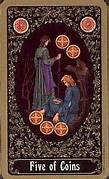
The first card is the 5 of Coins. This card suggests a recent financial hardship, the result of an interpersonal challenge that left him with less of an income or resources than he is used to. Challenged to make up for lost time it is no wonder he perceives the strain. This calamity is a part of the catalyst for Jared’s current situation. There is some dis-assembling and rebuilding going on his life and the road financially is rocky but navigable. Still this is not terrain you want to race through.

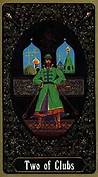
The next card is the 2 of Wands. This is the crucial focal point for Jared at this time. He needs to network more. His talent is a viable foundation but he needs connections from his peers to help pull him out of his shell. In particular he needs to explore ways to get the word out and paperwork, application, and education are all emphasized here. He has the seed of a plan but it is still in the growing phase and the written and planning aspects of his business need not be ignored. He will have a way to go before the final stages because he needs to take the idea he is conceiving and work to give it form. His vision is not yet complete and he will need the help of others to gain confidence and comfort to develop his plan. His reading skills are sharp but his networking, writing and communication skills may need to be further developed to cover the finer points of sole proprietorship. I also feel there is a choice at hand and he is on the fence about this. Knowing what he wants but not yet committed to the action to get it.

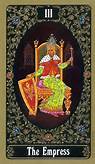
The final card is a Major Arcana card, the Empress numbered 3. This card suggests growth, abundance and success. It suggests he will need to expand his scope and reach. I also feel that female energy, perhaps a literal woman in his life, if not the energy of receptivity and nurturing, are at hand. He needs to work with his plan and nurture it, and the development will be slow but fruitful. The presence of an older woman who is a mentor or guide will also be helpful, someone of a practical earthy nature who can help him gain footing as a business person. The number three will also likely be significant, growth within three months or years or a process involving three major transition phases that are required to build to the point of completion.

This reading was conducted using the Russian Tarot of St. Petersburg. This deck is similar in most ways to the Rider Waite- Smith deck featured last month, as the Major Arcana have the same name and numbers. The Minor cards differ, as Pentacles are Coins, and Wands are Clubs. The basic outline follows the traditional Tarot most familiar with the Waite Smith deck will recognize, but if you have never seen this deck before, novice or veteran Tarot reader, you are in for a treat!

Using this deck is like conducting a reading with 78 Faberge eggs. What the images present in delicate detail the quality of card stock makes up for in sturdiness and even in this complex duality these cards carry the polarized energy of the best of Russian culture- tough as nails, but beautifully intricate. This deck is quite luminous and I favor its artistic quality to that of the Waite Smith deck. The background and borders are black and this brings a striking luminescence to the characters and scenes depicted on each of the fully illustrated cards. The artistic style is detailed and seems inspired by folk art in the tradition of beautiful minute details brought out through careful precision of applied dark and light creating a three dimensional quality that is difficult to find in Tarot art.

The way the colorful images pop out from their black background makes this a handy deck to use when you are learning or advancing intuitive practice. In particular it is reminiscent of the way clairvoyant images appear in my “mind’s eye”, a dark background on which bright and lively symbols suddenly emerge. Using the Russian Tarot of St. Petersburg is a lot like holding a working meditation in your hands. To further this effect, the central “scene” on each card is portrayed in an oval sphere framed by intricate floral design.

It is said that artist Yuri Shakov actually hand painted the miniature scenes on the cards- or at least the ones he contributed to, as the mystique of this deck is enhanced in some ways by the story that Shakov actually died before the deck was complete and the remaining cards were finished by an unknown artist. I do not know the detailed history of this deck but if this is to be taken at face value, I find absolutely no discrepancy among the quality or beauty of the various cards. There are symbols from Russian folk lore worked into the archetypes presented in this deck as well, and it mirrors Russian culture and history. The Devil’s face will bear a resemblance to a prominent historical figure, but don’t take my word, see for yourself! The accompanying booklet also weaves the connection between the artistic interpretations of the various Tarot cards and Russian folk lore, however I have not had the privilege of this comparison as my copy was acquired used without the companion book. This is no deterrent however and speaks well for the continuity of this deck in the world of Tarot as it is easy to use and adapt to without the instruction guide.

There is a stained glass effect from this artwork and the juxtaposition of light and dark gives physical and spiritual depth. The balance of optimism and strife are found in each card as the backdrop balances the bright palette used. This makes it easier to produce cards like Death, the Tower and the Devil for a live audience because the dark and light feel balanced in even the most challenging cards. They really are just too beautiful to be scary and the seriousness implied in their meaning is also not lost on the balance of dark and light in the Sun or 10 of Cups, as each carries a deep dark mystery along with the cheerful elements. The depiction of royalty among the King, Queens and Empress, Emperor etc. is also quite rich and luxurious. Many of the cards look like you could reach in and touch the fabrics, jewels, water or fire. This deck truly is a sensual treat. It helps the reader focus as well to have a plain black background, so that the images convey depth without overbearing confusion.

I chose this deck because this reading was conducted live and this is my default in person deck. I use this deck for in person readings for several reasons- it is a visual delight and feels like a trip through a museum of archetypes, and for its sturdiness. I mentioned the strength and quality of these cards before and it bears repeating. I acquired this deck used in 2009 and it still shows absolutely no sign of wear, bending, weathering, it literally feels like brand new. When clients are apprehensive about shuffling the deck for fear of ruining the cards this deck proves to them instantly they can do no harm. If I didn’t love this deck so much I would be interested in knowing just what measures it would take to destroy one of the cards, but even the thought of this as an experiment seems a sacrilege. It is also easy for clients to relate to the images in this deck as they are classic in some ways but they convey meaning in a way reminiscent of reading a book of illustrated folk tales. The Pentacles being Coins also helps clients grasp the association with work, career and valuables. The cards can be as deep or superficial as you want to make them. If you know the background of the archetypes or Russian lore there is plenty of room to pull deeper and more complex meanings from each card. If you don’t, it is simple enough to see the Five of Coins showing a disheartened couple looking over the rubble of their treasure and “get” the meaning of financial setback.

If there is one minor setback in using this deck it is the size of the cards and relative size of the artist’s detail. I have found that clients with arthritis or small hands struggle with traditional shuffling methods as the cards are a large size. The images, again reflecting the style of Russian folk art, have small details and people with visual impairments will be able to get the basic impression but may miss the finer details in the images. You can accommodate this by using this deck with a magnifying glass- which I don’t, but I do allow time for clients to lift and examine the cards to their liking- and by allowing freestyle shuffling- which I do and the readings are always just as accurate.

Best of luck to Jared as he finds his way to success and fulfillment!

More about this deck as well as purchasing information can be found here:
http://www.usgamesinc.com/Russian-Tarot/
Copyright 1996 U.S. Games Inc. Instruction Book by Cynthia Giles

Interested in being the Querent in next month’s column? Contact Angela at Trionfi78@gmail.com.

About Angela Kaufman:
Angela Kaufman has been exploring divination through Tarot cards for over a decade. She is a Certified Professional Tarot Reader and uses the Tarot and intuition to assist clients in exploring personal growth and development, and in accordance with New York State Law offers readings for entertainment purposes. Angela began providing readings on a professional, “Moonlighting” basis in order to provide affordable readings to those seeking guidance, inspiration and fun.

Angela is also co-author of the new book “Wicca, What’s the Real Deal? Breaking Through the Misconceptions.” (Schiffer Publishing, 2011) and Sacred Objects, Sacred Space; Everyday Tools for the Modern Day Witch (Schiffer Publishing 2013).

For more information on services offered by Moonlight Tarot LLC, visit http://www.moonlighttarotllc.com.

Moonlight Tarot is now part of The Psychic Connection! Check out the profile at: http://thepsychicconnection.net/moonlight-tarot-psychictarot-reader/
New callers register at: https://prodca.click4talk.com/c4a/usignup_page.php?c4a=30236
to receive your first five minutes FREE!

If you prefer a live reading, check out www.cafenolany.com for listing of Tarot events at Café Nola in Schenectady NY

Like Moonlight Tarot on Facebook: http://www.facebook.com/MoonlightTarotLlc

For more related to Tarot and Wicca, check out: Wicca, What’s the Real Deal? At www.wwtrd.webs.com

Ask What is Working for Greater Results

By Jim Donovan

You’ve probably been to business meetings when the person leading the meeting said something like, “Chantal, sales in the Southwest are off 23% from last quarter. Frank, production orders in the Northeast are off 9%. What’s wrong guys?”

At this point both Chantal and Frank begin to defend their position and rattle off a series of “reasons” as to why things are the way they are. Weather delays, late deliveries, the flu, and the economy, are all blamed for the lackluster performance in both cases.

I remember back when I was in door-to-door sales, barely out of my teens, sitting with small groups of salespeople huddled together in diners, continuing on the conversation that started at our mandatory morning sales meeting, about why sales are down.

In these conversations you typically hear every excuse on earth except the one in which people take personal responsibility for the poor sales numbers. If you’ve ever seen the 1992 movie “Glengarry, Glen Ross,” with Jack Lemmon and a cast of other great actors, you may remember the scenes with all the salespeople blaming their lackluster performance on “the leads.” They go on and on about how, if the leads were better, they’d all be selling more.

One of the keys to achieving higher levels of success is to give up blame all together. When you take personal responsibility for the conditions in your life you are then empowered to change them. Until you are willing to do this you remain a victim of circumstances.

The types of meetings described above begin a steady stream of “reasons” (excuses) why things are not better. People begin looking for ways to place blame wherever they can and the entire conversation turns into a negative, finger-pointing exercise that produces little, if any, useful result.

The meetings continue along in this manner, with each department head explaining why business is not better and trying to find someplace to assign blame until, sufficiently demoralized, the managers return to their respective departments vowing to do better, feeling defeated, and sometimes not caring whether or not they do better.

While on the surface this seems quite normal, in practice it does little more than leave people feeling depressed and dejected. Yes, there is value in examining mistakes and learning from them, however, if you accept the centuries old idea that, “our minds move in the direction of our dominant thoughts,” as it was expressed by motivation legend Earl Nightingale, you will soon realize that these meetings cannot possibly result in anything but a negative outcome.

You can beat a problem to death in endless meetings but it will not alter the fact that something is not working. Why would you want to invest any more time in talking about things that do not work?

Yet, that’s exactly what’s taking place in meeting rooms and on shop floors in companies all across America everyday. With a steady barrage of negativity being dispersed at them, it’s no wonder that the level of employee engagement is at an all-time low. One the other side of the coin we have the employees themselves carrying this negative tone throughout the entire organization. These people are, according to Gallup, “The eighteen percent who are actively engaged in spreading ill-will throughout the company.

Simply replacing the “What’s wrong” question, with “What’s working,” will cause your mind to search for things that are going right and, as a result of the law of attraction (like attracts like), you will begin finding more and more things that are working. In the case of discussing strategies and activities, starting with what’s working enables you to build further improvements on a solid foundation that is already producing the desirable results. By focusing brainstorming sessions around what’s working and drilling further into that is what makes achieving quantum results possible.

In business meetings you can use this type of questioning to identify the actions and activities that are producing positive results and build upon that. You may be surprised to learn that some of what you’ve been doing does not work and, most likely, never will. Knowing this enables you to invest your time and resources in those activities that are working and stop wasting valuable assets on those that are not.

A law firm following this procedure, for example, may learn that the pile of money they’ve been sinking into Yellow Page advertising is not paying for itself while their YouTube and social media activity is going gangbusters. Knowing this enables them to reallocate marketing resources where they will do the most good.

If you consider the amount of time spent thinking, worrying and talking about what’s wrong you’ll soon realize it’s one of the most destructive things any organization can do. By changing your focus to what’s working, what’s going right, and what’s positive in a given situation, you’re in a better position to access your best and brightest ideas and take the actions that will produce the results you desire.

Following along this line of thinking, you can make a practice of noticing and commenting when people are doing something right. Be a value finder and, as the late motivational legend Zig Ziglar said, “Catch people doing things right.”

All too often the only time people are recognized at their job is when they’re being criticized for not reaching a goal or making a mistake. Unproductive practices like this contribute greatly to the frustrations and unhappiness people experience at work. I’m not suggesting that you ignore missed revenue targets or allow sloppy work to continue but, when at all possible, focus on what is working and the value the person brings to then organization. We all need to be recognized for the contribution we’re making at work.

Changing the tone of the conversation in the workplace in a more positive direction will go a long way toward increasing employee engagement and, as a result, increase productivity and happiness throughout your organization.

About Jim Donovan:
Jim Donovan speaks regularly to employees and executives at small business and large corporations. He is a frequent media guest and expert source on personal development, business success, and the spiritual laws that develop both. He lives in Bucks County, PA. His website is www.JimDonovan.com.

Based on the book “Happy @ Work: 60 Simple Ways to Stay Engaged and Be Successful”. Copyright © 2014 by Jim Donovan. Reprinted with permission from New World Library.www.NewWorldLibrary.com

Feng Shui Your Love Life

I received this fun, and informative, little video from Tess Whitehurst. In 2 minutes and 30 seconds she manages to drop a lot of Feng Shui knowledge! I think you guys are going to love it!

About Tess Whitehurst:
Tess Whitehurst is the author of “Magical Housekeeping”, “The Good Energy Book”, “The Art of Bliss”, “Magical Fashionista”, and the “Magic of Flowers”. She’s been practicing feng shui professionally in Los Angeles since 2005. Visit her online and sign up for her free monthly newsletter at www.tesswhitehurst.com, read her blog at www.enchantingtheday.blogspot.com, and connect with her on social media at facebook.com/TessWhitehurstAuthor and twitter.com/tesswhitehurst.

Geek Month in Review: April 2014

By JB Sanders

April showers!

Invisible Car
No, really! And it’s being used to help drivers navigate their giant-assed SUV’s, not avoid those bad-guy spies. Check out Land Rover’s video of their prototype. Watch the hood of the car vanish, and show you the road beneath the car. You know, so you don’t run over any bunnies or peasants. Unintentionally.

Glow-in-the-Dark Roads Now Here
The Netherlands has painted the first road with special glow-in-the-dark paint, eliminating the need for streetlights, and supposedly greatly enhancing driver safety. Bet it looks cool, too.

Giant Pyramids in the Middle of Nowhere – Modern Edition
The US military, paragons of strange architecture in the middle of the wilderness, built a strange pyramid building in the 1960’s as part of the antiballistic missile system. It’s weird looking.

European Towns Recreated in China
It’s weird, but it also seems like someone should be making travel plans and taking photos in “Europe”, to fake out all their friends. I’m waiting for someone to shout “challenge accepted!” Anytime…

Babbage’s Great Calculating Engine
Is it just me, or does the plan (in the link) of Babbage’s Calculating Engine look kinda … fractal?

How to Build Your Own Secret Bookcase Door
Yup, step-by-step instructions and photos included. It looks fairly easy. You’ll need your own bookcase, nook, tools, and DIY skills, though.

Acoustically Perfect Below-Ground Theater Unused for 70 Years
Right below a piano store in Boston, the theater closed in 1942 and never re-opened. For a cool $6 million you can probably get it back up and running.

Warhol Works Recovered from 30-year-old Amiga Disks
Did you know that Commodore Computers commissioned Andy Warhol to produce works for the release of the Amiga 1000? Yeah, neither did I. Handy folks have recovered copies of the work from 30-year-old disks, in what is apparently an “obscure format”. Probably something like AmigaPaint files (or whatever that program was called).

Behind the Scenes: 2001, a Space Odyssey
See Kubrick smoking at an acute angle (rotating set), guys in monkey suits (the ape kind), an obelisk, a moonscape set, and more!

About John:
John’s a geek from way back. He’s been floating between various computer-related jobs for years, until he settled into doing tech support in higher ed. Now he rules the Macs on campus with an iron hand (really, it’s on his desk).

Geek Credentials:
RPG: Blue box D&D, lead minis, been to GenCon in Milwaukee.
Computer: TRS-80 Color Computer, Amiga 1000, UNIX system w/reel-to-reel backup tape
Card games: bought Magic cards at GenCon in 1993
Science: Met Phil Plait, got time on a mainframe for astronomy project in 1983
His Blog:http://www.glenandtyler.com/

Mother is the First Beloved

By Sara Wiseman

Years ago, I worked with a gifted hypnotherapist. He was a newbie to the craft, just starting out, and I don’t think either he or I understood the scope of his abilities then.

Suffice it to say I went to places and spaces that were far beyond the price of his introductory sessions!

We worked together in the dank basement room of a rental office downtown, the kind of place where folks set up flimsy folding tables and phone banks, then clear out overnight to whereabouts unknown. A way stop for fly-by-night businesses, filled with all the ghosts of failed dreams, hush and hurry, people in unrest.

My own sessions, however, were deeply productive. I leaned back in a faux leather lounger, closed my eyes, and was transported to amazing places: I saw the Book of Knowledge, a large tome up on a larger table, in which I might turn each page and find yet another picture from my own life, a picture that I might look at, and go deeper still. I found the long path of trees, a winding boulevard of sorts, that we are all somehow destined to walk.

And during these sessions I also descended in, entered deeper, and ended up in a room I had forgotten to remember for a very long time: the living room of the house I lived in when I was perhaps one or two or three.

I found myself very young—my head did not reach the countertop—in small, hot kitchen with the radio on, and my mother, visibly pregnant, dancing. We were listening to the radio, the three of us—my mother me, and my unborn brother in her belly. We danced to the songs of the times, the radio wailing tinny and small.

Everything in the room rushed forth all at once: the speckled, reflective bits of metallic in the kitchen counter top, the thickness of the mug in the sink, the green bottle of Palmolive on the counter, the window opening a back hedge, glossy with broad green leaves. My hands were slightly stick still, as if I’d just eaten lunch.

My mother wore capri pants; the kind that were popular back then, in a bold shade of sea green. In my regression, I saw clearly the way her pants ended in the middle of her calf, and I had the overwhelming thought: she was so very young.

And in my session, I began to cry.

She was so very young.

Not yet 30, on this ordinary day in which she danced to the radio, alone in a small kitchen finishing the dishes from lunch, no one there save her tiny daughter and unborn son.

Mother is the first Beloved. Whether this is good or bad, it is your soul’s agreement upon entering the world. We choose our parents, for reasons that may be unclear to us in this reality, but that our soul understands and accepts as an absolute necessity for growth and expansion in this lifetime.

Mother is the first Beloved, the earth soul that answers the new soul, or the new soul that answers the earth soul, and it is not always clear which soul is calling which. The child chooses the parent certainly; but on a soul level, the parent must also welcome, or at the very least allow, the child.

Sometimes both souls long for each other with ineffable longing, and it is a mutual calling between mother and child.

Your own mother held you in her womb for 10 months; you were created of her body, you ate of her body, you drink of her like some divine feminine version of holy communion. You were sustained by her womb, her breath, her physical self. In this way you were entered into the world.

Sometimes moving in Divine energy of trance and regression, reveals something you need to remember about your first Beloved: in this case, it was the hem of the sea blue capris that helped me understand how young my mother really was when she raised me, how new as a mother, how undeveloped as a person, how young to have moved away from family to the west coast. I saw for the first time how she might have felt spending her days alone in a tiny house, filled with hope and fierceness for her new life and her children.

Mother is the first Beloved; we have known her many times before in the karmic passage of previous lifetimes, and we will know her many times again. She is the person who makes it possible for us to enter the world, whether she is fully evolved or only beginning her journey to consciousness, whether she wanted to welcome us or not.

The firs Beloved gazes at us, holds us to her breast. The first Beloved allows us to live in and of her body. The first Beloved is most times no wise ascended, no saint or master—just a young woman, unsure and unguided, doing her best to bring a new soul into the world.

Close your eyes, and breathe deeply. Go to a place in your mind or your memory, in which you can recall something about your own mother, your first Beloved, when you were very, very young. It may be a special blanket, the way the light falls in a forgotten room, a texture, a color, a smell. Go into this place, and feel everything. Because you were so young, your memory will be two ways: that of a young soul, and that of a soul who has not yet forgotten how to hold the stars in your eyes. Remember it all, and allow yourself to feel gratitude. Learn something new, from this exercise, about your mother, and hold it in your heart. (Excerpted from Living a Life of Gratitude).

About Sara Wiseman:
Sara Wiseman is a spiritual teacher, intuitive and author of six insightful books on spirituality and intuition, including “Living a Life of Gratitude”. She is the founder of Intuition University, hosts the popular radio show Ask Sara, and is a top contributor to DailyOM, InspireMeToday, Aspire and more. Visit her at www.sarawiseman.com

Moonlight Tarot’s Question Corner: Mystical Answers to Mundane Inquiries

By Angela Kaufman, Moonlight Tarot LLC

Choice liberating yet can be overwhelming. If you have ever had equal parts craving for Chinese food and Italian, then you know that ambivalence can feel like a pull in two directions that seem equally satisfying, or at least equally carb loaded. This month’s Querent is looking to intuitive guidance to make a decision that looms larger than simply deciding what to have for dinner, but nevertheless has her feeling conflicted. A woman we will call Rhoda asks for guidance in making a time sensitive decision about selecting her future home. She is choosing between a big apartment complex, and a smaller option. Having never met Rhoda personally, I have no insight into her preference for housing styles. For intuition’s sake, this is a good thing, as the reading can then come direct from Spirit and not my meddling mind trying to think about the best match.

The first impression for Rhoda is the location that seems smaller, more family friendly and feels like a suburban or rural setting, yards, near a small body of water. It feels like a more comfortable and rustic atmosphere. The first card to appear is the 10 of Cups and the scene portrayed in this card matches my impression- a country setting, family together in a yard, and a generally friendly intimate atmosphere. Already I feel the smaller option is more like home for Rhoda. I then get the sense she will sign paperwork with a woman soon, she will make a decision about which she is confident. I get the sense that some initial hesitation presents around a lease of a year or being locked in for a year time with money being tight. The indication I get is that this will be a happy, positive experience and that with careful planning she will make the finances work. Other images I see when doing this reading are a wagon wheel and a grey stone wall, so these may be features associated with this home or as symbols the wheel represents change and movement and the stone wall would be security.

This impression is confirmed by the presence of the Sun and Hanged Man cards, both Major Arcana, suggesting valuable developmental lessons are underway in this transition. I feel the Hanged Man presents a prolonged period of about a year in which it feels like finances are a struggle but a valuable lesson is being learned and important experiences surround Rhoda if she can remain open minded to viewing her options from a different angle. This also echoes the sense of fear of being “locked in” to a commitment. While in this transition Rhoda will be fulfilling an obligation and awaiting another transition in about a year.

The Sun card is a very positive indicator. It suggests optimism and an overall sense of joy. I feel like Rhoda will be happiest in the smaller home and will be successful in making the transition work in her benefit with a little perseverance and patience. She will need to “hang in there” when obstacles arise that have her feeling like she is not in total control but the overwhelming feeling is a positive one for this move. It seems like after the lease expires she will once again be making a move and that this stage is an important first step along the way on her journey. I feel like relationships are developed in this phase and peace of mind cultivated.

About This Month’s Deck

Rhoda’s reading was completed using the Rider Waite or Waite-Smith deck. This 78 card 22 Major/56 Minor Arcana deck’s structure and images are universally recognized as quintessential Tarot. The courts consist of Page, Knight, Queen and King for each of four suits, Wands, Swords, Cups, and Pentacles. Traditional elemental associations are Water/Cups, Earth/Pentacles, Wands/Fire, Swords/Air, but esoteric training in areas where Wands are more associated with Air and Swords with Fire can easily adapt these images. Likewise those of pagan faiths may also ascribe a more spiritual connotation to the traditional “earth” association with the pentacles.

The illustrations display allegory in two dimensional settings. All cards are fully illustrated and the pip cards are full scenes as opposed to simply a picture of two swords for the Two of Swords. In addition to this, traditional Tarot numbering, names, outlines, and connection to universal occult systems from astrology to Kabala, numerology, Judeo-Christian and Classical Pagan belief systems make the Rider Waite-Smith deck an excellent tool for developing Tarot enthusiasts and advanced readers alike.

My understanding of the Tarot evolved from Smith’s portrayal of the archetypes but as a reader I needed to adjust my expectations. When I first received these cards I had a difficult time appreciating the messages conveyed through the colors and images as my taste in art at the time favored more complex, layered styles and I initially found Pamela Colman Smith’s art to be flat. The scenic feeling to the cards emerges from Smith’s background in stagecraft as a set designer. In the learning process, one can imagine the characters forming their interactions on a set stage and this image can stimulate intuition and further help the novice interact with the archetypal energies represented in the cards. The symbolism contains enough mundane elements to make easy connections to realistic events and people, so intuitive discernment can easily transport the King to the role of father, boss, CEO etc. Some may take issue with this as the gender roles are defined based on traditional medieval society and other decks have altered this to be more culture/gender sensitive. These limitations can be overcome through accessing intuition to help the reader discern whether the Queen really represents a woman or a man in a more nurturing role etc.

If you are looking for imagery with complex depth or a variety of colors, you may be in for a shock as Smith’s color scheme is basic, with emphasis on primary colors, bold but with a limited spectrum. One way to work with this color scheme is to develop a connection to the colors and the depth of interpretation offered from their meanings. The color scheme makes it easier to focus on specific energies and becomes familiar the way a common brand logo is instantly recognizable. McDonalds, for instance, doesn’t use a full artistic palette, red and yellow work just fine. This deck is also useful for psychic development and study of the occult. I have come to appreciate the fact that the art work is not so elaborate as to be distracting. As for quality, I have had this specific deck 17 years at least and can still shuffle them without fear of damage. The corners show the tiniest bit of wear, however this may be attributed to my choice to store them in a felt bag rather than in a box.

Another step to becoming comfortable with this deck is finding ways to intuitively connect with images that did not emerge from one’s specific religious system. The symbolism in this deck is rich but like good esoteric tools the power is hiding in plain sight. It can be said that this is exactly what magick is, yet when I first saw the cards I was shocked by the “regularity” of the images. So, if you are looking for a deck that screams fantasy/sci fi, this one may fall short of your expectations, or as the Hanged Man suggests, you may need to alter your view and open your mind. The Waite- Smith deck is a timeless classic with much value to a budding or accomplished Tarot reader. Once you are able to see the spiritual influence in an image of a man suspended from a tree by his ankle, finding the magick and mystery in other mundane settings becomes second nature. Luckily I got past my first impression and came to recognize their mystical nature. The symbolism is easy to learn and this is a deck I would recommend for beginning Tarot students as it is referenced in most Tarot books.

This is also a great deck to use when conducting face to face readings as the images are illustrative without being grotesque. It is also helpful that the settings are medieval so as to provide a basis for explaining the symbolic quality of cards. Just as an audience watching a play, even the difficult scenes are close enough to home to evoke emotional response, but distant enough to be seen as part of a greater story line. This can be very important when a client is nervous about getting a “bad” reading.

I chose this deck because Rhoda’s question was straight to the point and this deck is the common currency of Tarot, and the deck I learned on 17 years ago. For me this deck represents “straight talk” from Spirit and in spite of my initial response to the cards as looking “too mundane” I now find it very helpful to use this deck for exactly the purpose of getting the clear picture of daily life issues. To contrast, I have other decks whose imagery I favor much more artistically but that I don’t view as being as reliable a tool for concrete guidance because they speak to me on a level of higher vibration and in a lens that promotes more spiritual concepts with less anchoring in worldly affairs. It can be said that both aspects carry a connected virtue- that what is spiritual is mundane and vice versa, and I would agree with this, yet in receiving the messages from Spirit and conveying them to a client with greatest ease when practical matters are involved this deck is my universal “taking care of business” deck.

Best of luck to Rhoda as her new life takes shape in this idyllic setting. Remember no matter where you choose to settle down in accordance with NYS law all readings are intended for entertainment purposes only and not substitution for financial, legal, or medical advice.

Interested in being the Querent in next month’s column? Contact Angela at Trionfi78@gmail.com.

This month’s Tarot reading was conducted using the traditional Rider Waite deck. For more information on this deck, please visit http://www.usgamesinc.com/Rider-Waite-Tarot-Card-Deck/. This deck was created by A.E Waite and Pamela Colman Smith and is currently under copyright by US Games Inc, 2012-14.

About Angela Kaufman:
Angela Kaufman has been exploring divination through Tarot cards for over a decade. She is a Certified Professional Tarot Reader and formed Moonlight Tarot in 2009 which would become Moonlight Tarot LLC in 2010. Angela uses the Tarot and intuition to assist clients in exploring personal growth and development, and in accordance with New York State Law offers readings for entertainment purposes. Angela began providing readings on a professional, “Moonlighting” basis in order to provide affordable readings to those seeking guidance, inspiration and fun. Angela is also co-author of the new book “Wicca, What’s the Real Deal? Breaking Through the Misconceptions.” (Schiffer Publishing, 2011) and Sacred Objects, Sacred Space; Everyday Tools for the Modern Day Witch (Schiffer Publishing 2013). For more information on services offered by Moonlight Tarot LLC, visit http://www.moonlighttarotllc.com

Like Moonlight Tarot on Facebook: http://www.facebook.com/MoonlightTarotLlc.com

For more related to Tarot and Wicca, check out: Wicca, What’s the Real Deal? At www.wwtrd.webs.com

Want a chance to get a live Tarot Reading? Check out www.cafenolany.com for listing of Tarot events at Café Nola in Schenectady NY!

Geek Month in Review: March 2014

By JB Sanders

Is it spring yet?

Abstract Art or Model City?
Very cool, very large model of a city — any city. See the 1,100 cars whiz by, the trains, and watch it all in the reflective mirror windows of the skyscrapers.

More details

Floating Cities That Eat Icebergs
Seriously. A couple of French architecture students have plans to create a floating city, population around 800, that lives by eating icebergs that break off from the Arctic.

Secret Structures
See 7 different things built in secret that will just blow your mind, or so this Cracked article claims. Yes, another Cracked article. Coolest thing? Some guy, and his friends, built a massive series of underground temples based on the guy’s dream. When he was ten. And it looks … amazing.

Free Speech
Not as in rights, as in a visual map-based method of communication that doesn’t involve language (or not exactly). It uses pictures instead of words, and then graphical relationships to convey things like time and pronouns. Simpler than it sounds, and far more complicated. It was developed originally as a way for children with autism to communicate — an iPad app takes their strung together images, and converts them into computer speech. Boom, communication. The creator of Free Speech also reckons that it could be used to allow people to learn languages better and faster than traditional methods. Check out his TED talk.

Check out their software here

That’s Not a Watch, It’s an Astronomical Clock
So this Parisian watchmaker has created a watch that shows the orbital positions of the 6 closest planets on its face, as well as telling time. Each of the planets is done in a different precious or semi-precious gem, and you can even set a “lucky day” so that when Earth reaches that point in it’s orbit, you’ll know it’s your lucky day. And all for the low-low price of $245,000. It does look swell.

Steampunk, LEGO(tm), Walking Ship
I think that hits three or four Geek Points. Watch the video to see a very cool use of LEGOs and the remote control.

Food in Tolkien’s Books — With Recipes!
An in-depth article, discussing where Tolkien got his inspirations from (in terms of food), and with splendid links to recipes you can make yourself. It’s literary criticism, history, and food.

First Cybathlon in 2016
A bunch of Swiss robotics firms are set to hold the First Cybathlon in 2016, an event like the Olympics, but for athletes who use advanced prosthetics or other assistive devices. Cyber-doping is encouraged!
Among the events are competitors piloting a virtual plane, using only a brain-device interface (no hands or other operative limbs!); the functional electrical stimulation bicycling race, where athletes with spinal cord injuries use an interface to pedal the bike; a prosthetics leg race; a powered exoskeleton race; a powered wheelchair race; and an arm prosthetic race.
There are no rules limiting the use of technology. If you can build a better prosthetic limb, exoskeleton, or wheelchair — do!

How Big?
Want to see a quick discussion of how big the universe is? It’s like an animated bit of Cosmos. Then they start talking about the multiverse, parallels worlds with different laws of physics, and it all just combines to make your head explode. But in a fun way.

About John:
John’s a geek from way back. He’s been floating between various computer-related jobs for years, until he settled into doing tech support in higher ed. Now he rules the Macs on campus with an iron hand (really, it’s on his desk).

Geek Credentials:
RPG: Blue box D&D, lead minis, been to GenCon in Milwaukee.
Computer: TRS-80 Color Computer, Amiga 1000, UNIX system w/reel-to-reel backup tape
Card games: bought Magic cards at GenCon in 1993
Science: Met Phil Plait, got time on a mainframe for astronomy project in 1983
His Blog:http://www.glenandtyler.com/

Life Organizing: A Completely New Way to Flow with Time

By Jennifer Louden

Do you feel a pull to be present, to match your pace to the fluid and complex world ours has become? If so, the more traditional approaches to managing your life and structuring your days can hog-tie you, forcing you to relinquish the skills most needed in today’s world – like intuition, emotional intelligence, creativity, and big-picture thinking.

I’ve got an alternative. This process, what I call life organizing, is infinitely richer then plotting your days in fifteen-minute increments in your planner. But one warning: change can be frightening, especially at first. I will ask you, over and over, to trust, to loosen your grip on life. I will ask you to stop and feel, to tune in to what you really want and what you really know. The rewards of your courage are limitless – a life that sings, that moves with instead of against.

While a short article isn’t enough space to give all the knowledge, experiences, and thoughts I have about life organizing (I’d need to write a book to do that – and, in fact, I have!), I can provide the basics. Life organizing works in two complementary ways, easily adoptable and adaptable:

1) A life planner that you choose and create. This planner will enable you to discern what you want week by week while gently tracking where your time and energy are actually going, and what might be getting in your way of living a life you love. The life planner’s core is four to six weekly mindful questions that build on and refer to each other, and move you into a deeper mode of awareness and listening.

2) A check-in that consists of five steps and requires as little time as it takes to open the freezer, find the ice cream, and get a spoon.

1. Connect: Breathe deeper, stretch your arms overhead, step outside and feel the breeze on your skin – anything that connects you with the physical world.

2. Feel: Tune into your heart to access information unavailable to your head. Put your attention on your heart, placing your hand there. Recall a time you felt loved and appreciated or loving and appreciative. Linger there for a few seconds.

3. Inquire: Ask a mindful question to open up possibilities you literally couldn’t see before. My favorite: What do I need to know right now? (What if you really didn’t need to know more than the next immediate step?)

What do I want? (Creativity requires being in touch with your undiluted desires. Remember, you don’t have to act on what you want, and wanting doesn’t mean getting.)

What don’t I want? (Sometimes the process of elimination can be less intimidating than naming your desires outright!)

How can I be gentle with myself in this situation? (We can all benefit from asking this many times a day)

4. Allow: Trust that, by connecting, feeling, and inquiring, you’ll hear or see or feel or sense what your next step is—and only your next step. Allowing is about noticing your experience, and opening to your next step.

5. Apply: Action is where the practical and results-oriented parts of you get their due. Without action, without decision, you remain in possibility, which is safe and beautiful but eventually enervating and boring. That doesn’t mean eating the whole elephant in one bite; small steps aren’t just okay; they’re encouraged.

Life Organizing in the Moment in Action

It’s mid-morning, and your plan for the day is already in shambles. You’re reaching for a Diet Coke, hoping it will give you the energy to deal with the next crisis. Then you remember that there’s another way. You make the choice.

Feel your feet connecting with the ground beneath you. Take a deep breath and reach your arms overhead, exhaling with a huge sigh. Put your hand on your heart and recall feeling balanced and flowing. Ask, “What choice feels easiest in this moment?” Visualize bringing this question into your heart, and take a breath or two to infuse it with flow and peace.

Perhaps a brief image of your sister comes to mind, or you hear a refrain of an old song that reminds you of her. Or perhaps you remember the feeling of your sister hugging you. You call her, have a lovely chat, and when you get off the phone, you have new energy —enough to move you forward to the next task awaiting you.

Do you begin to see how this approach flows with life? I’m not proposing you sell your worldly possessions and move to the woods to live in an unheated yurt. I’m not recommending you consult crystals or the I Ching before moving a muscle. What I’m saying is when you think you’re lost, overwhelmed, and without direction, you do “know” what to do to restore your balance and your direction– but it’s a different kind of knowing, one you already possess, and need only be reminded of how to access.

About Jennifer Louden:
Jennifer Louden is the author of “The Life Organizer” and “The Woman’s Comfort Book”. A personal growth pioneer who helped launch the self-care movement, she’s written 4 additional books on well-being and whole living that have inspired women all over the world. Jen believes self-love + world-love = wholeness for all. Visit http://JenniferLouden.com/lifeorganizer for a life organizer app & other useful freebies.

Based on the new paperback edition of “The Life Organizer: A Woman’s Guide to a Mindful Year” © 2013 by Jennifer Louden. Printed with permission of New World Library, Novato, CA. www.newworldlibrary.com