The Geek Month in Review: December 2014

By JB Sanders

Happy Yule!

Alien Fonts
Great article on the fonts and symbols used in the movie Alien, and how they influenced other scifi movies. Bonus points for a tie-in with The Secret Doctrine by Helena Blavatsky.

Touchable Holograms
Yeah, you read that right. Projected images that have haptic feedback — meaning you can feel them. Go ahead and let your brain explode on that one.

Hand-Illuminated, Hand-Bound Copy of the Simallarion
You remember that Tolkien book, the one that is basically lifted from his hand-written notes about the world of the Lord of the Rings, but it is basically unreadable except as a reference work? Yeah, this German art student decides to just go ahead and create a copy of the book by hand. It’s awesome.

Margaret Hamilton, Lead Software Engineer, Project Apollo
Yeah, that headline pretty much tells the whole story, but for the details, read the article.

Interactive 3D Display
Nope, not the same as the link above. This is more like a telepresence version of that toy with all the pins in it that everyone always presses their hand into. Only with color.

Lord of the Rings Partially Explained
Ever wonder how Gandalf got to be so badass that he could go toe-to-toe with a Balrog? Check out the video!

About John:
John’s a geek from way back. He’s been floating between various computer-related jobs for years, until he settled into doing tech support in higher ed. Now he rules the Macs on campus with an iron hand (really, it’s on his desk).

Geek Credentials:
RPG: Blue box D&D, lead minis, been to GenCon in Milwaukee.
Computer: TRS-80 Color Computer, Amiga 1000, UNIX system w/reel-to-reel backup tape
Card games: bought Magic cards at GenCon in 1993
Science: Met Phil Plait, got time on a mainframe for astronomy project in 1983
His Blog:http://www.glenandtyler.com/

Create a Vibration of Prosperity in the New Year!

By Shaman Isabella Stoloff

As the year 2014 comes to an end, and you reflect on this past year, what will you think of? Most of us will dwell on the mistakes or problems we had, or are still having. Very few will look over the past year and say, “Good job my friend”. Instead of beating yourself up over things you cannot change, take a moment and see all the accomplishments you have made, no matter how small. Pat yourself on the back then say, “Well done”! This is the first step in shifting your vibration to become more prosperous.

As a Shaman I teach people to take their power back by focusing their attention on releasing negative self-talk, and falling more in love with themselves. If you want to create more prosperity, then it is important to become more loving with yourself. Create a vibe around you that will increase your magnetism. You know the type of person you enjoy being around right? Someone uplifting and happy, someone who is so secure you can’t help but want to be near them. In the year 2015 you can become that person by listening to your inner guidance.

Most of us are so in our heads it’s hard to get out. We find ourselves in an unstoppable cycle of repetitive patterns. Mentally we go over the same problem trying to find a better solution. Does doing this really help? I feel this is actually what keeps us from finding inner peace. Make a promise to yourself that in the year 2015 you will commit to living in present time consciousness. Let go of the worry, and try something new. Trust that everything will work itself out as long as you stay positive and keep a high vibration. Do this for 30 days and see what happens.

One way I have been able to shift is to listen to my thoughts, and observe how they make me feel. How you feel has a great deal to do with how your life is showing up. When one creates a vibration of love, and safety around them, automatically things begin to get better.

Many times I had to fake it till I made it, but it worked! Each time I shifted my consciousness and vibration around an issue the issue dissolved, and things worked out. Now that’s not to say it was always in my favor, its just that the way I felt about the situation and my perceptions shifted, so I was happier.

It can just be a subtle shift, a little reminder that your thoughts are going in the wrong direction. Then you gently bring your awareness into your body and breathe. Release all that no longer serves you. Find all the things you are grateful for, smile for no reason, sit quietly and find joy in the silence. I know these seem like simple tools for success but they work. Once you can get a handle on your thoughts you will notice your body more, and your intuition will heighten. The importance of having a heightened intuition is learning to trust your inner guidance. As a society we have given our power away for so long that we have begun to not trust ourselves. We need to trust our inner knowing so we can experience happier, prosperous lives.

Everyone is searching for an answer. All of us want the key to success. My feeling is true success comes from deep within. It comes from a place of falling so in love with ourselves that we believe in who we are as individuals, trust our decisions, and know that we deserve the best that life has to offer.

In 2015 learn how to shift the energetics of a situation by shifting your perceptions, and watch your whole life change!

About Shaman Isabella Stoloff:
Shaman Isabella Stoloff is a dynamic leader. She founded the Orange County Healing Center in 2009 and since that time has committed herself to leaving the world a better place. Isabella has been called the Golden Condor and World Ambassador. She has traveled to connect people to their inner wisdom and provide ceremonies for the land. She has a full time practice, writes articles, a YouTube channel, and does guest spots to carry the message of enlightenment. Isabella is a mother and grandmother and understands what is needed today to raise a conscious family. Shaman Isabella feels honored to be on the planet during this time of great awakening. She feels once you empower yourself through positive thought and action you will feel connected and centered. Isabella’s message is to awaken to the light that you are, so you can become the Shaman in your own life. For more info on Shaman Isabella visit www.ochealingcenter.com

The Geek Month in Review: November 2014

By JB Sanders

Is it Turkey Day yet?

Ancient Home Video Games in Your Browser
Want to play your favorite Atari 2600 game from yesteryear? Want to do it without leaving your web browser? Ta da!

Bowling Ball and Feathers Falling in a Vacuum
Wanna see how gravity (mostly) reacts the same to two objects with different weights? Watch the video.

Algae Farm Over Highway Eats Pollution
A French and Dutch design firm has created a prototype algae farm over a highway in Geneva, Switzerland. It eats the CO2 from car and truck exhaust, and could be used to produce biodiesel, green electricity, medication, cosmetics, or even food.

Interact With 3D Models of Space Vehicles Like Iron Man Would
Anyone else remember that scene in Iron Man where Tony Stark (billionaire, philanthropist, genius) is moving the holo projections around like they’re real-world objects, instead of cool bits of light in the air? NASA rocket scientists have developed an app (definitely iOS, possibly others) that uses the smartphone’s camera, a real-world reference marker, and superimposes a full 3D model of a variety of NASA vehicles and satellites into virtual space. Seriously, this is scifi-type future stuff, here. You can turn the “reference marker” (or printed piece of paper with the special pattern) and the 3D model of, say, the Mars Curiosity rover will move with it. You can zoom in on specific details simply by moving the phone closer to the virtual 3D model. The future is here, people.

Search your favorite app store for: “Spacecraft 3D”

Here’s a video, showing off the action:

Island Discovered in the Arctic
No, this isn’t a headline from 1894. No, it is not a story featuring a strange doctor, and his fetish for animal/human hybrids. Nor will there be dinosaurs. Probably. Russian military helicopter pilots, on a return from a supply mission saw an island in the Arctic ocean north of Tiksi (it’s in Siberia). It wasn’t on any maps. So why now? That area is normally covered with ice for much, if not all of the year, until recently. The low-lying island simply wasn’t visible before. Kinda cool that we’re still discovering islands.

Fire-breathing Robot Dragon
And … you already clicked the link, didn’t you? It’s a full-sized (e.g. Huge, for those Pathfinder/D&D folks out there) semi-autonomous walking dragon robot. That breathes fire.

Spiral Undersea City
Apparently some Japanese investors are planning on opening an underwater spiral sea-city by 2030.

Science and Music Combined
Into an awesome show of fire, water, and lightning. All real, no special effects.

Ancient Computer in LEGO
Remember the Antikythera mechanism? That weird series of gears found in a shipwreck, and dated to 1500 BCE? Scientists later figured out, using x-ray tomography, that the mechanism was designed to predict eclipses. And it does. With startling accuracy. Now see how that works, through the wonder of LEGO.

About John:
John’s a geek from way back. He’s been floating between various computer-related jobs for years, until he settled into doing tech support in higher ed. Now he rules the Macs on campus with an iron hand (really, it’s on his desk).

Geek Credentials:
RPG: Blue box D&D, lead minis, been to GenCon in Milwaukee.
Computer: TRS-80 Color Computer, Amiga 1000, UNIX system w/reel-to-reel backup tape
Card games: bought Magic cards at GenCon in 1993
Science: Met Phil Plait, got time on a mainframe for astronomy project in 1983
His Blog:http://www.glenandtyler.com/

Moonphases and Dreamwork

By Dayna Winters

Lunar Energies and Your Dreams

In November, we explored how to derive meaning from dream fragments. This month we’re going to examine the moon phases and how they influence your dreams. We’re also going to examine how you can integrate moon phases when practicing dream incubation. The ancient Egyptians and Greeks believed dreams were of divine origin and that dreams carried messages from the gods to the dreamer. Supplicants sought out answers to mundane and spiritual questions through the practice of dream incubation. For instance, in ancient Egypt, a supplicant would enter into a temple featuring bedchambers; it was here the individual attempted to receive communications from the divine through dreams. The dreamer would focus on a specific question or desire in hopes he or she would receive guidance or prophetic messages from the gods.

The practice of dream incubation was (and remains) ritualistic, sometimes involving the act of fasting, wearing appropriate attire, and prayer to specific deities before sleeping. If the dreamer was uncertain about dream meaning upon waking, the supplicant would then seek out someone knowledgeable about dreams, like a priest or priestess, for assistance in decoding the meaning behind the messages received. With the understanding the moon influences your sleep quality and the type of dreams you have, you can consider tracking the moon cycle to learn more about your dreams and their meaning. You can also use the current phase of the moon in an effort to induce specific types of dreams. For more information on ancient dream incubation practices, see “The Fabric of Dreams: Dream Lore and Dream Interpretation, Ancient and Modern” by Katherine Taylor Kraig.

“The Silver Lady,” 9” X 12,” mixed media, by Dayna Winters

The belief the moon has an influence on human behavior is a long held and widespread belief, and you don’t have to be a magickal practitioner or astrologer to believe in the influential power of moon energies. In 1995, the University of New Orleans gave 325 individuals a questionnaire to discover how many people believed in the power of lunar influence on human behavior. Of the 325 people questioned, 43% believed behavior is influenced by the moon; the belief was held by people in the mental health occupation (more strongly than any other occupational group), including LPNs, master’s clinical psychologists, and social workers.**

The influence of the moon on behavior extends into individual sleep patterns and dreaming. Scientists are now discovering the role the moon has on sleep and dreams. In an article appearing on LiveScience it’s revealed the full moon can negatively affect a person’s sleep quality. The findings of the study were released in the July 2013 issue of Current Biology. Sleep researchers from the Switzerland-based Psychiatric Hospital of the University of Basel have found lunar cycles, even when unseen or when one is unaware of the moon’s current phase, influence one’s sleep patterns. The study reveals a person’s brain activity during deep sleep decreases by as much as 30% when the moon is full. A dreamer takes a longer period of time to fall asleep; the individual can lose up to 20 minutes of sleep on a night when the full moon appears. The individuals participating in the study also had lower levels of melatonin when the moon was at its peak.* In addition, a DailyMail article online reveals the findings of a British study conducted by Psychologist Richard Wiseman suggesting dreams are more bizarre right around the week of the full moon.***

The Phase of The Moon And Their Meaning

There are four phases of the moon: waxing, full, waning, and dark. Even when the moon is not visible, you can still work with the moon’s energies. You can document the moon phase in your dream journal and consider what your dream messages mean when compared to the current moon phase. Here are some of the basic meanings of each moon phase, and how they influence dream interpretations/work. You will also find some of the dream archetypes associated with the various moon phases. For more details about dream archetypes, see “The Esoteric Dream Book: Mastering the Magickal Symbolism of the Subconscious Mind” (Schiffer Publishing).

Waxing: The waxing moon is the first phase in the moon cycle and is therefore associated with beginnings of all kinds. When you view the waxing moon in the sky, it is a crescent shape with the two points facing to the left. The waxing moon gradually increases until it reaches the full moon phase. This moon is therefore associated with abundance, growth, increases, expansion, gains, breakthroughs, and epiphanies. When you have questions about situations/relationships related to all of the latter-mentioned concepts, the ideal time to seek dream-time answers to your question is during the waxing moon phase. Archetypes associated with waxing moon energies include the Fool, Hunter/Huntress, Magician, Wanderer, Priest/Priestess, Healer/Wounded Healer, Weavers, Witch/Sorceress, Mentor, and the Prophet/Mystic.

Full: The waxing moon gradually moves into the full moon phase. Practitioners of magick consider the full moon as achieving the height of power and therefore hosting the most powerful energies of any moon phase. This phase of the moon is ideal for any type of question you want answers to in your dreams, whether the question relates to new beginnings or endings. The full moon is great for dream work related to mundane/spiritual growth, protection, healing, inner reflection, and self-empowerment. Bear in mind the findings that the full moon allows for dreams seeing more bizarre, thus such dreams are rich in metaphors and meaningful symbolism for interpretation. Thus, full moon phase is best for dreams where you are seeking deep, reflective, meaningful answers to your questions. Dream archetypes you can work with during this moon phase include the Judge, Critic, Magician, Hunter/Huntress, Superhumans, Priest/Priestess, Shaman, Healer/Wounded Healer, Weavers, Witch/Sorceress, Messengers, Prophet, Mystic, Father/Mother, and Divine Couple.

Waning Moon: The waning moon appears in the sky as a crescent shape with two points facing right. This phase of the moon is associated with endings of all kinds. As the moon diminishes in its power, the waning moon brings energies appropriate for banishings, clearings, and getting rid of bad habits/relationships/conditions. When entering into dream work during the waning moon, pose questions related to closure, maturation, completion, and the eradication of negative energies/conditions. Archetypes associated with the waning moon include the Magician, Ghosts, Weavers, Witch/Sorceress, Martyr, and Crone/Sage.

Dark Moon: The dark moon is not visible in the night sky, nevertheless its energies are still present. This moon is most ideal when you are looking to have dreams related to self or inner reflection. You can pose questions related to how to get rid of undesirable energies or influences in your life, or how you can improve the physical/spiritual self. Archetypes associated with the dark moon phase include the Devil/Trickster, Monsters, Anomalies, Ghosts, Shaman, Weavers, Witch/Sorceress, Messengers, Prophet/Mystic, and Crone/Sage.

Moon Phase Resources

You can often look up at the night sky and easily see what the current moon phase is, but if you are looking to be more precise with your dream/moon phase associations, there are several resources you can use when documenting moon phases in your dream journal.

Moonconnection.com offers a moon phase calendar tool. You can choose the month, year, and hemisphere before generating a calendar. The calendar is generated based on your time zone as well.

Calculatorcat.com features a widget you can add to any website. The tool gives you the current moon phase, the percentage of the moon being full, the current date, and the time based on your time zone.

FarmersAlmanac.com offers a moon phase calendar with images of the phase of the moon on each calendar day. You can also find out the exact times and dates of full moons and the name of each moon.

Citations
*Choi, Charles. “Bad Sleep? Blame the Moon.” LiveScience. TechMedia Network, 25 July 2013. Web. 2 Dec. 2014. <http://www.livescience.com/38435-full-moon-affects-sleep.html.>

**Macrae, Fiona. “Why You’re More Likely to Have Weird and Wonderful Dreams When There’s a Full Moon.” Daily Mail Online. Associated Newspapers, 27 Mar. 2014. Web. 2 Dec. 2014. <http://www.dailymail.co.uk/sciencetech/article-2590317/Dark-moon-Why-youre-likely-weird-wonderful-dreams-certain-nights.html>.

***Vance, David. “BELIEF IN LUNAR EFFECTS ON HUMAN BEHAVIOR.” Ammons Scientific -. Psychological Reports, 1 Jan. 1995. Web. 2 Dec. 2014. <http://www.amsciepub.com/doi/abs/10.2466/pr0.1995.76.1.32?journalCode=pr0>.

About Dayna Winters:
Dayna Winters is a solitary Witch, author, and artist. She is the co-author of three books written with Patricia Gardner and Angela Kaufman including, “Wicca: What’s The Real Deal? Breaking Through the Misconceptions,” “Sacred Objects, Sacred Space: Everyday Tools for The Modern Day Witch,” and “The Esoteric Dream Book: Mastering the Magickal Symbolism of the Subconscious Mind”, all of which are published by Schiffer Publishing. You can find out more about Dayna and her work at her blog: http://daynawinters.blogspot.com/.

Living Simply…No Matter Where You Are

By William Powers

In 2007, I lived for a season in an off-grid permaculture cabin in North Carolina. No Name Creek gurgled through a lush forest, and I befriended the eclectic neighbors — organic farmers, biofuel brewers, eco-developers. I discovered a sustainable but imperiled way of life, and wrote about in my memoir “Twelve by Twelve: A One-Room Cabin off the Grid and Beyond the American Dream”.

Alas, the book triggered angry questions. “It’s easy,” one Twelve by Twelve reader wrote, “to find minimalism, joy, connection to nature, and abundant time in a shack in the woods. But how the hell are the rest of us supposed to stay sane in our busy modern lives?” This question was the genesis of my new book: “New Slow City: Living Simply in the World’s Fastest City”.

I received — in fact — a hundred variations of this question after lectures and on radio interviews, and always answered by saying I was living 12 x 12 values… but in Queens, New York, the home to which I returned after my time in the cabin. But as each year passed, the reader’s doubt increasingly became my own as overwork, material clutter, and the lack of contact with nature — “civilization,” in short — brought me to a point of extreme unhappiness in Queens. Eventually, I too doubted it was possible to live 12 x 12 in a city, and I felt an urgent need to decamp far from urban life.

Not so fast. As I reached this point, my newlywed wife, Melissa, was offered an excellent job that demanded we stay put in New York City, and I suddenly had no choice but to figure out how to take what I’d learned in the 12 x 12 — about the Leisure Ethic, connecting to nature, and living simply — and somehow make it work in the real-world context of a marriage and two careers.

In an attempt to do this, Melissa and I embarked on an experiment. We sold or gave away 80 percent of our stuff, left our 1,600-square-foot Queens townhouse, crossed the Williamsburg Bridge, and moved into a tiny rental: a 340-square-foot “micro-apartment” — roughly two 12 x 12s — in downtown Manhattan.

Melissa and I approached our thimble of an apartment through the ideas of philosopher Thomas Merton, who called his stark monk’s chambers “the four walls of my new freedom.” We stowed a minimal kit of kitchenware, toiletries, clothing, and books as if equipping a houseboat’s trim hull. It was a refreshing purge; the apartment seems to expand with each tweak.

We began to feel our well-being rise in proportion to what’s been shed. A slim metal table in the kitchen welcomes the cutting board; jackets laze on his-and-her hooks; sandals snuggle in their micro-shoe-apartment beside the door.

Beyond this minimalist freedom, I discovered that being “Slow” is not at all Luddite. Slow means cultivating positive qualities — receptive, intuitive, reflective— instead of the fast qualities so common today: busy, agitated, acquisitive.

I began living and working smarter instead of faster. Borrowing from author and entrepreneur Tim Ferris, I spent my Slow Year practicing two principles at the same time: 80/20 and the Hodgkinson’s Principle.

The 80/20 principle says that we accomplish 80 percent of work results in just 20 percent of our time. Conversely, we more or less waste the other 80 percent of our time on a paltry 20 percent of the results.

Dutifully, I 80/20ed my life and find that the principle holds true. In one particular week, for example, I looked at all the potential work streams — in international consulting, writing, and speaking — that I could pursue, and distilled out that week’s most strategic one in terms of income-to-time-invested and my current level of enthusiasm: a high-end magazine article. Then I overlaid the Hodgkinson’s Principle. Hodgkinson’s says that work expands to fill the amount of time available to accomplish it.

Thus, having chosen the one most critical work activity, I corralled it into a tight timeframe, and found it works: I condensed what might have been five days of work into two!

This approach spawned “reverse weekends” for me, where I worked smarter for two-days and took five-day weekends. This is not a utopian idea. Even Carlos Slim, the world’s richest person, recently called for a 3-day work week and Google is increasingly experimenting in lowering hours and thus increasing employee creativity and efficiency.

Other Slow City tools my wife and I discovered in our year’s experiment are:

• Urban sanctuaries: Melissa and I began spending more and more time in natural and reflective places right in Manhattan, like Central Park’s Ramble and the tip of Pier 45.

• “Living at the third story”: I discovered I only need half my attention on the street level. As the rest of my focus rises up, I notice nut-brown oak branches and green leaves fluttering with white butterflies. An off-turquoise sky. Stretchy clouds. Ciao stress!

• Technology fasting. We “fasted” from our gadgets for stints, disabling our phones and setting email to vacation mode. This helped quality of our relationship because we had more time focused on each other.

• Silent meals. Even in Manhattan’s fine restaurants, we’d sometimes eat in total silence, deeply savor the food, scents, soundscape, and visual beauty of the restaurant in a meditative manner.

Though not everyone will live twelve-by-twelve, all of us can ask: What’s my twelve by twelve? We can find the elusive contours of enough—and live there. Enough is the sweet spot between too little and too much. It starts with each of us creating space to slow down a little and ask the core questions, like: How do we find balance in a world that is changing more quickly than ever before in history? And how can we incubate a New Slow City that’s saner now and fit for the future?

About William Powers:
Born and raised on Long Island, William Powers has worked for over a decade in development aid and conservation in Latin America, Africa, Native North America, and Washington, DC. He is a senior fellow at the World Policy Institute and is on the adjunct faculty of New York University. A third generation New Yorker, Powers has also spent two decades exploring the American culture-of-speed and its alternatives in some fifty countries around the world. He has covered the subject in his four books and written about it in the Washington Post and the Atlantic. An expert on sustainable development, he is a freelance writer and speaker. More information at www.WilliamPowersBooks.com.

Based on the book “New Slow City”. © Copyright 2014 by William Powers. Reprinted with permission from New World Library. www.NewWorldLibrary.com

Moonlight Tarot’s Question Corner: Mystical Answers to Mundane Inquiries

By Angela Kaufman, Moonlight Tarot LLC Your 21st Century Relationship Psychic

Newly in love, and wondering where the relationship is headed, this months’ Querent, pseudonym Jessica, wants to focus on developments in love and romance.

Like so many of us modern gals, I have the sense that Jessica’s attention is diffused into different obligations. To use an analogy her focus is like a television screen with a scene set for love and romance that is flickering as if bad weather were interfering with the signal. Her focus on either current or future love interest is being interfered with by attention being divided, and that when the signals for love and attraction start to surface, something is getting in the way and cutting out the signal. I feel like this relates to more than having a busy schedule, and that there are beliefs or fears that cut in on the signal before the connection has an opportunity to grow as strong as it could. This is a common pattern for women who feel divided between career and family interests.

The cards for your reading are the 7 of Pentacles, reversed, 8 of Wands, and the Chariot, also numbered 7. The fact that 7 repeats indicates Jessica has reached a personal plateau and is receptive to making changes that would invite romance from a place of feeling confident The number 7 indicates progress and momentum that begins to slow down. If in a relationship already this refers to the onset of monotony and routine that can make it difficult to add zest and passion and keep the embers glowing. The first card being reversed suggests old patterns or an influence conflict in a recent relationship that continue to feel in some ways like a burden. It feels like relationships have become a matter of work for some reason or there is an overlap between romance and the workplace- but moreso that workplace obligations and chores have overcome love life. This feels connected to either a recent relationship or recent phase in relationship in which Jessica was doing the majority of the heavy lifting. It doesn’t feel like this issue is quite resolved-either this person is still in present in Jessica’s life or that if this relationship has ended conflict that arose is still presenting as a burden, even on a subconscious level, influencing her ability to move forward. Jessica feels mortgaged to a past relationship and need to either “refinance or sell the house.”

The 8 of Wands suggests growth and progress brought about by keeping an open mind and considering numerous prospects. At the same time however I feel that attention is being pulled in numerous directions that make it difficult to focus on relationships. Many projects underway may take extra effort to keep romance growing or to make it a priority.


Finally the last card is the Chariot which is a very significant card because it speaks to personal growth and development. It echoes the message of feeling stuck in your advancement. I feel like a commitment is eluding Jessica and that is causing stagnation. Jessica is approaching a significant threshold and have a commitment or choice to make but need full conviction in order to make it- and this is something that is not yet solid. A past solid foundation has been damaged and this impacts her sense of stability in romance. Jessica’s soul is calling for integration to move forward. The focus needs to be brought into resolving issues from the past so that closure will free her to make progress as an individual land commit Jessica must resolve to be fully ready for inviting new energy, new awakenings and new passion which means committing to not live in the past and future at the same time.

Best of luck to Jessica and remember no matter where you are in love we could all benefit from sharpening our focus and allowing ourselves to live in the present moment where Tarot readings are intended for entertainment only, but wisdom of Spirit is timeless.

Jessica’s dilemma is very common, as many women are haunted by the energy of past relationships even while striving to invoke new love into their lives. It is for this reason that I have developed an Intuitive Relationship Coaching program to help women release the past, gain clarity, and attract the type of love they have been looking for.

To help you gain clarity and understanding, I am offering a FREE recorded presentation. Join the mailing list to receive the audio presentation 3 Biggest Reasons Single, Professional, Independent Women are NOT Finding the Love they Want. Receive this gift FREE by clicking here and joining the mailing list: moonlighttarotllc.com/free-report/

This month’s Tarot reading was conducted using the traditional Rider Waite deck. For more information on this deck, please visit http://www.usgamesinc.com/Rider-Waite-Tarot-Card-Deck/. This deck was created by A.E Waite and Pamela Colman Smith and is currently under copyright by US Games Inc, 2012-14.

Interested in finding out more about Psychic Readings from Angela Kaufman of Moonlight Tarot LLC, check out the new website moonlighttarotllc.com.

Leaves in the Wind

By Dayna Winters

Leaves in the Wind – Interpreting Dream Fragments

In October we examined the symbolism of house/home structures when such imagery appears in dreams. This month, I’m focusing on how to interpret dream fragments. I’ve often heard someone say, “I don’t remember much about the dreams I have, and of what I do remember, nothing makes sense.” Then, the individual recounts one or two images that seem meaningless. These small dream pieces are fragments of a larger dream or the images might be brief and fleeting visions. What’s important to remember is that even many small remembrances can provide you with plenty of symbolism, all of which you can analyze and use to improve your life physically, mentally, and/or spiritually. Let’s take a look at how to interpret dream fragments to see just how much insight these symbols can provide.

As an example, let’s imagine you have awoken from a long night’s rest only to remember the brief appearance of autumn leaves blowing in the wind. Believe it or not, such a remembrance hosts a wealth of symbolism. If you were to reflect or meditate on the image of the leaves you saw, you might realize an even deeper layer of meaning. The image of leaves on the wind can represent so many things, and what the vision represents for one person may prove to hold a completely different meaning for another. Let’s break down some of the potential meanings to explore this idea in greater depth.

Autumn Leaves by Dayna Winters

Take apart the images for analysis: In the dream fragment, the leaves are blowing in the wind. Here, there are two main symbols, which may not seem like much, but you’ll be surprised at how much meaning they can supply. Take a look at each symbol separately, and then take a look at them together. Much like snowflakes, every leaf is slightly different from the next, thereby symbolizing individuality. The wind is associated with the element of Air, and is therefore suggestive of communication. When viewing both symbols together, the dream might be a suggestion to be more expressive about your personality, or to focus on communicating your individuality to others. In an image of leaves, there is more than one leaf – this could symbolize the gathering/movement of many individuals or a crowd. Consider if a dream like this might mean you should make an effort to “stand out from the crowd.”

Color: If you remember the color of the leaves you see, you can dig even further into dream symbolism. Let’s imagine for this example you see red, orange, and yellow autumn leaves. Red is a color of strength, personal power, and the life force. Sometimes in certain situations, it can represent danger. Orange is a color of attraction. Yellow is a color signifying communication, but in some situations, it can indicate anxiety. What’s more, color symbolism can change when viewed through the lens of different cultural understandings. With the latter color symbolism under consideration, ask yourself, “are you attracting danger in your life or are you perhaps attracting things that empower your personal will and strength? Are you communicating effectively or is something causing you anxiety? Further dream analysis may clarify your questions.

Environment: Autumn signifies seasonal changes, cycles, and transitions. The season hints at the future dark and cold coming of winter, but its yearly return promises a future life cycle as well. The season signifies death, but the potential of rebirth. Thus, your dream might be telling you about events in your waking life relating to endings and new beginnings, cyclical changes, “a coming of age,” or a time of final harvest, whether it is literal or figurative. The environment of the dream can reveal much. Was the sky clear? Was there a storm brewing? Were the autumn leaves blowing in the wind while out of the appropriate season – for instance, was it snowing as well? All of the latter conditions can be interpreted in different ways. What about the direction of the wind? Are the leaves moving about in all directions or one? Is the movement East, South, West, or North? If moving about everywhere, the direction might signify chaos or chaotic energies. If moving in a specific cardinal direction, you might discover additional meaning. Leaves blowing East might signify new situations, conditions, or new beginnings stemming from the conclusion of something else. If the leaves are blowing in the direction of North, it can symbolize a need to ground or to turn inward to tap into your personal power. If the leaves are blowing South, it suggests the direction of the Fire element therefore connoting purification, personal will, ambition, drive, inspiration, and the spark of life. When the leaves are blowing West, it might signify the realm of emotion, the deep subconscious, or the world of spirit. Cardinal directions are also representative of seasons, and could signify a movement from one season to another. East is spring, South is summer, West is autumn, and North is winter. Thus, the dream might hint at the movement of a condition/situation/event from autumn to spring, summer, next autumn, or winter.

Emotion: Consider what emotions the images evoke. Did you feel a sense of peace or happiness? Were you calm or apprehensive? Did the leaves evoke memories, either fond or undesirable? Also note how you felt upon waking. Sometimes dreams produce lingering emotions you carry with you throughout the day. Make a note of your emotions and compare your feelings with those you might be having in certain waking life situations/conditions/events, or relationships. Do you see any potential correlation?

Language: Occasionally dream symbols are a play on words – the images may point to sayings, cliches, or idioms you know. For instance, perhaps your dream of leaves is telling you it is “time to turn a new leaf,” or is a situation about to “leaf out” for you by expanding and “budding?” Perhaps you are in a situation where you should leave, “no leaf unturned,” or are you behaving like another in such a way that it is like you are “taking a leaf out of someone else’s book?” Consider some of the sayings you are familiar with when you are assessing your dream imagery.

Themes: As you review the dream symbols, you might note a running theme. For example, if the leaves in the wind were yellow and spinning around chaotically, you’ll see a commonality in symbols. The wind and yellow are both symbols associated with the element of Air and are therefore connected to the cardinal direction of East, new beginnings, individuality, communication (particularly through sound.) As mentioned earlier, leaves are representative of individuality, but so is the chaotic dispersing of the leaves – the leaves are separated, moving to and fro in an individual way in different directions. Thus, you can see a running theme of communication, individuality, expression, and differences.

Synchronicity: Sometimes dreams are a part of synchronistic occurrences. Synchronicity refers to two or more events that appear connected, related, and meaningful, without an identifiable causal connection: events that seem like more than mere coincidence. For instance, when I began writing this article I knew I would use leaf imagery to explore dream meaning. I came up with the title: “Leaves in the Wind,” after I thought about the image of autumn leaves and windy days. A few days later I encountered one of the myths about the Sibyl in ancient Greece. The story tells of a woman/priestess with prophetic powers, the Cumaean Sibyl, who lived in a cave. She would prophesize people’s fates and document them on oak leaves. The leaves were placed within her cave near the entrance. The Sibyl’s votaries would consult the leaves to prophesize the fate of each individual. Here is where the strange synchronicity comes into play: if a wind blew through the entrance of the cave and dispersed the oak leaves everywhere, scattering them on the wind, the Sibyl would lend no assistance in bringing the original prophetic messages back together again – fantastically, I had no prior knowledge of the latter story when I created the title for this article!

I have given the latter example so you can do the same when you are reviewing dream imagery. If you see leaves in the wind in your dream, pay attention to what goes on, not just in future dreams, but your everyday surroundings. You might encounter leaves actually blowing in the wind, or you could encounter the imagery in myriad ways in your waking life. I absolutely love synchronistic events. I believe they are “sign posts,” telling us to pay attention, that we are on the right path, and that we are where we are meant to be in our lives. Synchronistic events can also serve as confirmation of a higher power and the role it plays in our lives – a subtle reminder that the Universe is responding to your heightened awareness. Indeed, the more you pay attention to synchronistic events, the more such events occur.

Archetypes: It is often quite easy to identify dream archetypes once you assess the symbols you see. For instance, as I spoke of earlier, the Greek Sibyl is a priestess who writes prophesies on oak leaves. If you saw oak leaves, your dream might connote a connection to the prophetess or priestess archetypes. Autumn leaves represent a part of the life cycle where one is aged and has accumulated wisdom via experience as well – thus the imagery connects to the archetype of the Crone. You can find more information on the prophetess, priestess, and other important archetypes and how they relate to dream messages, in The Esoteric Dream Book: Mastering the Magickal Symbolism of the Subconscious Mind (Schiffer Publishing, 2013.)

Leaf Types: The type of leaves you see will give you an indication about the archetype associated with your dream images. Let’s look at a few examples. As we have already mentioned, oak leaves are representative of the Sibyl, but they are also representative of the Oak King. Which archetype is correct? Only you will know by how you connect with the archetype you choose. Perhaps you have an affinity for the Oak King or you feel a deep connection with the archetype of the Sibyl. Your feelings will point the way to choosing the right archetype to examine further.

Since anything can happen in dreams, what if you saw mistletoe leaves? Or grape leaves? Or Laurel leaves? Mistletoe might represent Christmas for one person and the Holly King for another. Grape leaves might suggest an archetype of Bacchus or Dionysus. Laurel leaves might be representative of Apollo. The images you connect with personally when you think of the leaves you have seen are the appropriate symbols for you to consider – there are no wrong or right answers when making symbolic connections.

Questions to ask yourself:

What parts of the dream fragment do I remember?

What colors were present?

In the example of leaves, what type did you see? Can you identify specific elements of the image that will give you more clarity on dream symbolism?

What was the environment like?

How does the dream make you feel?

Have I experienced events in the recent past that relate to the imagery?

Are there any archetypes relating to the images I’ve seen? If so, what do the archetypes symbolize?

Future Steps to Take:

Note if any of your future dreams feature similar imagery. How is it the same? How are the images different?

Keep an eye out for synchronistic events. What do the seemingly connected events mean to you?

About Dayna Winters:
Dayna Winters is a solitary Witch, author, and artist. She is the co-author of three books written with Patricia Gardner and Angela Kaufman including, “Wicca: What’s The Real Deal? Breaking Through the Misconceptions,” “Sacred Objects, Sacred Space: Everyday Tools for The Modern Day Witch,” and “The Esoteric Dream Book: Mastering the Magickal Symbolism of the Subconscious Mind”, all of which are published by Schiffer Publishing. You can find out more about Dayna and her work at her blog: http://daynawinters.blogspot.com/.

The Geek Month in Review: October 2014

By JB Sanders

On to Halloween!

Animated Cake
And no, I do not mean animated as in part of an animated movie. I mean, Disney has a special wedding package for folks getting married at the enchanted castle (Disney World, mind you), and it includes a cake that they project various animations on top of. It looks like the cake itself is showing short little movies.

Not Your Average Zombie Survival Guide
It has all the links, illustrations, and how-to’s you could ask for and more. Just be sure to read, and prep, all this stuff before the actual End of the World.

Paper Airplane Machine Gun
Words you didn’t think would go together, right? Well, engineers can be crazy, and what happens when you put science and crazy together? Mad science. Or I guess, mad engineering.

Soviet Space Image Catalog
Ever wonder what happened to all the photos the Soviets took with all the space probes they got into space? Well, someone else did, too, and they went out and collected them into one handy web page. Plus digital remastering. Want to see the surface of Venus?

Super Geeky LEGOs
Check out this gallery of photos from BrickCon, the largest LEGOs con around.

Cosmic Ray Detector via Distributed Array? Sure, Use Cell Phones
So some kooky scientists realized that the they could “build” a cosmic ray detector using an app on cell phones.

Force Field Umbrella
Ok, not exactly a “force field”, and more like a “field of forced air”. Picture carrying around a very special fan, which blows a field of air around you to not only keep the rain off your head, but also the rest of you.

Working iPhone Built in Minecraft
Yeah, so, we’ll be seeing more and more of these crazy devices in virtual spaces.

Random Island Generator
No, not a giant machine that actually makes islands (although that’s only a matter of time), but a web-based program that creates maps randomly. Useful if you’re building a world and need a few islands pronto.

City Built in Minecraft
Apparently it’s all about the Minecraft this month. Take a virtual tour of a city that took 2 years to build. It has 96 buildings, and the creator plans even more. These are full-sized skyscrapers, people, not some kind of model, they’re functional.

Random Generators, Various
Speaking of tools to generate things, here’s a website with a way to come up with names (in varieties like dwarf, Drow, orc, arabic), treasure, magic items, Giant’s bags, calendars, baubles, cities, and spell books. Enjoy!

About John:
John’s a geek from way back. He’s been floating between various computer-related jobs for years, until he settled into doing tech support in higher ed. Now he rules the Macs on campus with an iron hand (really, it’s on his desk).

Geek Credentials:
RPG: Blue box D&D, lead minis, been to GenCon in Milwaukee.
Computer: TRS-80 Color Computer, Amiga 1000, UNIX system w/reel-to-reel backup tape
Card games: bought Magic cards at GenCon in 1993
Science: Met Phil Plait, got time on a mainframe for astronomy project in 1983
His Blog:http://www.glenandtyler.com/

The Politics of the Brokenhearted

By Parker J. Palmer

In a dark time, the eye begins to see. — Theodore Roethke, ‘‘In a Dark Time’’
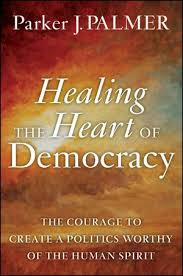
I began this book (“Healing the Heart of Democracy”) in a season of heartbreak — personal and political heartbreak — that soon descended into a dark night of the soul. It took months to find my way back to the light and six years to complete the book. But as I fumbled in the dark, the poet Roethke’s words proved true time and again: my eyes were opened to new insights, and my heart was opened to new life. The evidence will, I hope, come clear as this book unfolds.

In 2004, I turned sixty-five. As I entered my ‘‘golden years’’ and saw how much of that gold was rust, I found myself disheartened by the diminishments that come with age. Family members and friends were failing and dying. Visions I once held for my life were slipping beyond my reach. My body kept reminding me that I am just a tad more mortal than I had imagined I would be. And I was no longer able to ‘‘read’’ American culture as easily as I could when my generation was helping to author it. It was as if I had lost the secret decoder ring I owned when I was a kid, and with it my ability to make sense of twenty-first-century life.

As the shape of my personal life became less familiar and sometimes more frightening, the same thing was happening in American politics as viewed from my vantage point. Dismayed by the state of the nation, I began to feel like a displaced person in my own land. The terrorist attacks of September 11, 2001, had deepened America’s appreciation of democracy and activated demons that threaten it, demons still at large today. Wounded and overwhelmed by fear, we soon went to war against a country that had no direct connection to the attacks. Many Americans seemed willing to abandon their constitutional rights along with our international treaty obligations.2 Some Americans, including elected officials, were quick to accuse protesters and dissenters of being unpatriotic or worse, fragmenting the civic community on which democracy depends.

I am no stranger to this democracy’s moments of peril, which have been precipitated by Democrats and Republicans alike. I lived through McCarthy’s communist witch hunts; the pushback to the civil rights movement; the political assassinations of the 1960s; the burning of our cities; Vietnam, the Pentagon Papers, Watergate; and the electoral debacle of 2000. I have witnessed the rapid erosion of the middle class and the growing power of big money, an oligarchy of wealth, to trump the will of the people. But with fear and fragmentation becoming staples of our national life, and with the haunting sense that our ‘‘booming economy’’ was likely to implode, democracy felt even more imperiled to me in the America of 2004.

As our distrust of ‘‘the other’’ beyond our borders hardened and we began making aliens of each other (a ‘‘we’’ that included me), I fell into a spiral of outrage and despair. How did we forget that our differences are among our most valuable assets? What happened to ‘‘we have nothing to fear but fear itself’’? When will we learn that violence in the long run creates at least as many problems as it solves? Why do we not value life, every life, no matter whose or where? Or understand that the measure of national greatness is not only how successful the strong can be but how well we support the weak?

And where have ‘‘We the People’’ gone — we who have the power to reclaim democracy for its highest purposes, unless we allow ourselves to be divided and conquered by the enemy within and among us?

When things we care about fall apart, heartbreak happens. In my sixty-fifth year, it was happening, again, to me. I soon began to realize that this episode was darker than most of those I had known before: I was descending into depression, my third time down as an adult. Clearly I am predisposed to this form of mental anguish, so I cannot claim that heartbreak was the sole source of my misery. But neither can I attribute the whole of this episode to brain chemistry or genetics. There are times when the heart, like the canary in the coal mine, breathes in the world’s toxicity and begins to die.

Much has been said about the ‘‘voice of depression.’’ It is a voice that speaks despairingly about the whole of one’s life no matter how good parts of it may be — a voice so loud and insistent that when it speaks, it is the only sound one can hear. I know that voice well. I have spent long days and nights listening to its deadly urgings.

Less has been said about the life-giving fact that, as poet Theodore Roethke writes, ‘‘In a dark time, the eye begins to see.’’ During my sojourn on the dark side, it was hard to believe that my vision was growing sharper or to make sense of what I was seeing. And yet as I slowly came back to life, I found that I had gained new clarity about myself, the community I depend on, and my call to reengage with its politics and relearn how to hold its tensions in a life-giving way.

During my recovery, I discovered a book that helped me understand how heartbreak and depression — two of the most isolating and disabling experiences I know — can expand one’s sense of connectedness and evoke the heart’s capacity to employ tension in the service of life. “Lincoln’s Melancholy”, by Joshua Shenk, is a probing examination of our sixteenth president’s journey with depression. What was then called ‘‘melancholy’’ first appeared in Lincoln’s twenties, when neighbors occasionally took him in for fear he might take his own life. Lincoln struggled with this affliction until the day he died, a dark thread laced through a life driven by the conviction that he was born to render some sort of public service.

Lincoln’s need to preserve his life by embracing and integrating his own darkness and light made him uniquely qualified to help America preserve the Union. Because he knew dark and light intimately — knew them as inseparable elements of everything human — he refused to split North and South into ‘‘good guys’’ and ‘‘bad guys,’’ a split that might have taken us closer to the national version of suicide.

Instead, in his second inaugural address, delivered on March 4,1865, a month before the end of the Civil War, Lincoln appealed for ‘‘malice toward none’’ and ‘‘charity for all,’’ animated by what one writer calls an ‘‘awe-inspiring sense of love for all ’’ who bore the brunt of the battle. In his appeal to a deeply divided America, Lincoln points to an essential fact of our life together: if we are to survive and thrive, we must hold its divisions and contradictions with compassion, lest we lose our democracy.

Lincoln has much to teach us about embracing political tension in a way that opens our hearts to each other, no matter how deep our differences. That way begins ‘‘in here’’ as we work on reconciling whatever divides us from ourselves — and then moves out with healing power into a world of many divides, drawing light out of darkness, community out of chaos, and life out of death.

In my experience, the best therapy for personal problems comes from reaching out as well as looking in. Reading about Lincoln as my healing continued, I began to wonder about my own ability to reach across the divides that threaten our Union today, not as an elected leader but as a citizen, a trust holder of democracy. To make this something other than a pious exercise in forced altruism — which always leads me to feel-good failures that end in a pathetic ‘‘God knows I tried!’’ — I needed to find a true point of identity with people whose basic beliefs are contrary to mine.

What do I have in common with people who, for example, regard their religious or political convictions as so authoritative that they feel no need to listen to anyone who sees things differently — especially that small subgroup of extremists who would use violence to advance their views? My own experience of political heartbreak gave me a clue. Perhaps we share an abiding grief over some of modernity’s worst features: its mindless relativism, corrosive cynicism, disdain for tradition and human dignity, indifference to suffering and death.

How shall we respond to these cultural trends that diminish all of us? On this question, I, too, have a nonnegotiable conviction: violence can never be the answer. Instead, we must protect people’s freedom to believe and behave as they will, within the rule of law; assent to majority rule while dedicating ourselves to protecting minority rights; embrace and act on our responsibility to care for one another; seek to educate ourselves about our critical differences; come together in dialogue toward mutual understanding; and speak without fear against all that diminishes us, including the use of violence.

With people who are irrevocably committed to violence, I may never find the smallest patch of common ground. Could I find one with others whose views differ sharply from mine — a small patch, perhaps, but one large enough that we could stand there and talk for a while? I had reason to believe that the answer might be yes. For example, I know of daylong dialogue programs for people who differ on difficult issues like abortion where participants are forbidden from proclaiming their positions on the issue until the last hour of the day. Instead, they are coached in the art of personal storytelling and then invited to share the experiences that gave rise to their beliefs while others simply listen.

Hearing each other’s stories, which are often stories of heartbreak, can create an unexpected bond between so-called pro-life and pro-choice people. When two people discover that parallel experiences led them to contrary conclusions, they are more likely to hold their differences respectfully, knowing that they have experienced similar forms of grief. The more you know about another person’s story, the less possible it is to see that person as your enemy.

Abortion is one of the many issues that generate what some people have called the ‘‘politics of rage.’’ And yet rage is simply one of the masks that heartbreak wears. When we share the sources of our pain with each other instead of hurling our convictions like rocks at ‘‘enemies,’’ we have a chance to open our hearts and connect across some of our great divides.

In this book, the word heart reclaims its original meaning. ‘‘Heart’’ comes from the Latin cor and points not merely to our emotions but to the core of the self, that center place where all of our ways of know- ing converge — intellectual, emotional, sensory, intuitive, imaginative, experiential, relational, and bodily, among others. The heart is where we integrate what we know in our minds with what we know in our bones, the place where our knowledge can become more fully human. Cor is also the Latin root from which we get the word courage. When all that we understand of self and world comes together in the center place called the heart, we are more likely to find the courage to act humanely on what we know.

The politics of our time is the ‘‘politics of the brokenhearted’’ — an expression that will not be found in the analytical vocabulary of political science or in the strategic rhetoric of political organizing. Instead, it is an expression from the language of human wholeness. There are some human experiences that only the heart can comprehend and only heart- talk can convey. Among them are certain aspects of politics, by which I mean the essential and eternal human effort to craft the common life on which we all depend. This is the politics that Lincoln practiced as he led from a heart broken open to the whole of what it means to be human — simultaneously meeting the harsh demands of political reality and nurturing the seeds of new life.

When all of our talk about politics is either technical or strategic, to say nothing of partisan and polarizing, we loosen or sever the human connections on which empathy, accountability, and democracy itself depend. If we cannot talk about politics in the language of the heart — if we cannot be publicly heartbroken, for example, that the wealthiest nation on earth is unable to summon the political will to end childhood hunger at home — how can we create a politics worthy of the human spirit, one that has a chance to serve the common good?

The link between language and empathy was explored by the comedian and social critic George Carlin in his classic minihistory of the various ways we have named the postwar condition of some soldiers:

There’s a condition in combat. Most people know about it. It’s when a fighting person’s nervous system has been stressed to its absolute peak and maximum. Can’t take anymore input. The nervous system has either … snapped or is about to snap.

In World War I, Carlin goes on, ‘‘that condition was called shell shock. Simple, honest, direct language. Two syllables, shell shock. Almost sounds like the guns themselves.’’ By World War II, the name had morphed into ‘‘battle fatigue. Four syllables now. Takes a little longer to say. Doesn’t seem to hurt as much.’’ Then came the Korean War, and the condition became operational exhaustion. ‘‘The humanity has been squeezed completely out of the phrase,’’ Carlin comments. ‘‘Sounds like something that might happen to your car.’’

Then came Vietnam, and we all know what shell shock has been called ever since: post-traumatic stress disorder. Says Carlin,

Still eight syllables, but we’ve added a hyphen! And the pain is com- pletely buried under jargon…. I’ll bet you if we’d still been calling it shell shock, some of those Vietnam veterans might have gotten the attention they needed at the time.

Carlin missed one precursor to shell shock, an important one in the context of this book. During the Civil War, traumatized combatants developed a condition that they called ‘‘soldier’s heart.’’ The violence that results in soldier’s heart shatters a person’s sense of self and community, and war is not the only setting in which violence is done: violence is done whenever we violate another’s integrity. Thus we do violence in politics when we demonize the opposition or ignore urgent human needs in favor of politically expedient decisions.

This book, like the personal journey that helped shape it, does not blink at the darkness laced through American life today. Still, it is full of hope about our capacity to see the light. When I came out of my own darkness back into the light — to the people I love, the work I believe in, the world about which I care — the conflicts within and around me no longer tore me apart. With eyes wide open and a broken-open heart, I was better able to hold personal and political tensions in ways that generate insight, engagement, and new life.

Looking at politics through the eye of the heart can liberate us from seeing it as a chess game of moves and countermoves or a shell game for seizing power or a blame game of Whac-A-Mole. Rightly understood, politics is no game at all. It is the ancient and honorable human endeavor of creating a community in which the weak as well as the strong can flourish, love and power can collaborate, and justice and mercy can have their day. ‘‘We the People’’ must build a political life rooted in the commonwealth of compassion and creativity still found among us, becoming a civic community sufficiently united to know our own will and hold those who govern accountable to it.

In January 1838 — when Abraham Lincoln was twenty-eight years old and the Civil War was twenty-three years off — a prescient Lincoln addressed the Young Men’s Lyceum of Springfield, Illinois, on ‘‘the perpetuation of our political institutions.’’ Exhorting his audience to understand the responsibility to protect American democracy against its enemies, he said:

At what point shall we expect the approach of danger? … Shall we expect some transatlantic military giant, to step the Ocean, and crush us at a blow? Never! All the armies of Europe, Asia and Africa combined … could not by force, take a drink from the Ohio, or make a track on the Blue Ridge, in a Trial of a thousand years.

At what point then is the approach of danger to be expected? I answer, if it ever reach us, it must spring up amongst us. It cannot come from abroad. If destruction be our lot, we must ourselves be its author and finisher. As a nation of freemen, we must live through all time, or die by suicide.

The Cold War made it clear that America was vulnerable to attacks from abroad despite the protection of two oceans, a fact underscored by the events of September 11, 2001. Still, Lincoln’s case holds. If American democracy fails, the ultimate cause will not be a foreign invasion or the power of big money or the greed and dishonesty of some elected officials or a military coup or the internal communist/socialist/fascist takeover that keeps some Americans awake at night. It will happen because we — you and I — became so fearful of each other, of our differences and of the future, that we unraveled the civic community on which democracy depends, losing our power to resist all that threatens it and call it back to its highest form.

Our differences may be deep: what breaks my heart about America may make your heart sing, and vice versa. Protecting our right to disagree is one of democracy’s gifts, and converting this inevitable tension into creative energy is part of democracy’s genius. You and I may disagree profoundly on what constitutes a political failure or success, but we can still agree on this: democracy is always at risk. Government ‘‘of the people, by the people, and for the people’’ is a nonstop experiment in the strength and weakness of our political institutions, our local communities and associations, and the human heart. Its outcome can never be taken for granted.

The democratic experiment is endless, unless we blow up the lab, and the explosives to do the job are found within us. But so also is the heart’s alchemy that can turn suffering into community, conflict into the energy of creativity, and tension into an opening toward the common good. We can help keep the experiment alive by repairing and maintaining democracy’s neglected infrastructure, whose two levels are the primary concerns of this book: the invisible dynamics of the human heart and the visible venues of our lives in which those dynamics are formed.

It is well known and widely bemoaned that we have neglected our physical infrastructure — the roads, water supplies, and power grids on which our daily lives depend. Even more dangerous is our neglect of democracy’s infrastructure, and yet it is barely noticed and rarely discussed. The heart’s dynamics and the ways in which they are shaped lack the drama and the ‘‘visuals’’ to make the evening news, and restoring them is slow and daunting work. Now is the time to notice, and now is the time for the restoration to begin.

For those of us who want to see democracy survive and thrive — and we are legion — the heart is where everything begins: that grounded place in each of us where we can overcome fear, rediscover that we are members of one another, and embrace the conflicts that threaten democracy as openings to new life for us and for our nation.∗


About Parker J. Palmer:
Parker J. Palmer’s writing speaks deeply to people in many walks of life. Author of nine books—including the bestsellers The Courage to Teach, Let Your Life Speak, and A Hidden Wholeness—Palmer is the founder of the Center for Courage & Renewal. His work has been recognized with ten honorary doctorates and many national awards, including the 2010 William Rainey Harper Award, previously won by Margaret Mead, Paulo Freire, and Elie Wiesel.

Excerpted with permission from the publisher, Wiley, from Healing the Heart of Democracy by Parker Palmer. Copyright © 2014

∗In the course of writing this book, I have heard a good deal of debate on the question ‘‘Is the United States a democracy or a republic?’’ My answer is that it is both: we are a representative democracy set in the context of a constitutional republic. I give due attention in this book to the structures of our republic, one of whose most important functions is to protect the rights of individuals and minorities from being overwhelmed by the majority. But my primary focus is on the health of the democratic processes characterized by Lincoln in the Gettysburg Address as a ‘‘government of the people, by the people, for the people.’’

Dream Interpretation for Personal Growth

By Dayna Winters

I’m Dayna Winters, and I have practiced interpreting dreams for well over a decade. Through this column, I will help you explore the messages your dreams convey. Dreams are a form of communication between the subconscious and conscious mind: a way the higher self, universe, or divine uses to communicate. Your nighttime visions are richly embedded with significant symbols, all of which you can explore for personal meaning. Dreams are sometimes precognitive, lending hints about future events. Typically, dreams have multiple layers of meaning even when they are not predictive. Much like the Tarot is a tool for gaining personal and spiritual insight, dreams are a tool you can use to make personal discoveries and epiphanies; And as it is with the Tarot, every interpretation is deeply personal – what one person might get from a dream symbol, another person might derive an entirely different interpretation. And that’s what this column is all about; here, we will explore the fascinating world of dream symbols, and how you can use them to enhance your mundane and spiritual life.

To begin our exploration, lets examine what the appearance of a home/house in your dreams might symbolize. Common dream scenarios involving a house/home include the appearance of a childhood home; being in a strange home you have never seen or been inside before; being in a dilapidated house, and a house that is surprisingly larger than it first appears – one that often possesses secret corridors. The key to understanding house symbolism is to realize a building often symbolizes the self. The home is sacred space, your personal temple, and represents your physical body, and/or your emotional or spiritual state. Each room in a home, the condition of the house, and your familiarity with the interior/exterior of the house, all elicit meaning. Let’s break down each image and explore its meaning in-depth.

Childhood Home – The childhood home is a symbol of your roots and where you came from – the home represents fundamental concepts and beginnings. Dreaming of your childhood home signifies a longing for more innocent times where there is less responsibility and stress. This dream image suggests you either miss something/someone from that time period, or, if you have happy childhood memories, you might “long for the comforts of your childhood home.” If the home of your childhood is a place connected with traumatic experiences, the appearance of the home in dreams might indicate a karmic cycle coming up in your life where you will need to address past issues you have not yet emotionally resolved.

The appearance of your childhood home may also signify a deeply rooted connection to the past, or a desire to return to a former way of being. The important thing to remember if you see your childhood home in a dream and you feel a driving need to return to an old condition, situation, or way of being, is often when you attempt to “go back home again,” or revive a past condition, the experience is never the same, and is sometimes an incredible disappointment. Thus, the appearance of the home of your younger years could suggest a need to carefully consider if you want to revive an old condition, situation, or relationship at all.

On a more positive note, the childhood home might suggest a need to get in touch with your inner child. Remember when you were a kid and everything seemed magical? Remember when every life experience was a new discovery and when your creativity was encouraged? Do you remember the joy you use to find in the simplest of things? The childhood home image is one that might be urging you to bring back the joy in your life, become more creative, have more fun, and to simplify your life.

A Strange Home – The appearance of a strange home in dreams relates to “fish out of water” experiences. In your waking life, whether you know the owner of the home or not, a strange home most likely feels unnatural and uncomfortable for you, at least until you gain your bearings. Thus, a strange home in your dream indicates that you are either uncomfortable/uncertain of a new situation you have recently entered into, or you might soon be faced with a “fish out of water” experience where you are outside your natural environment or comfort zone. If the strange home belongs to a friend or a loved one, then your dream suggests that the situation you face is one where you will be able to recover your sense of comfort/balance relatively quickly. If the home belongs to someone you don’t know, then the recovery of your sense of comfort/balance might not be as simple or possible at all.

If you have entered into the strange home willingly, your dream suggests you are open to new situations, despite your uncertainty about any potential outcomes. If you are dragged or forced into the strange home, the dream suggests quite the opposite – it can signify your unwillingness to participate in new situations or that you have a stubborn nature that making it difficult to embrace new things. If the strange home has some familiar elements (for example, parts of the house’s interior has rooms from your own home), it can indicate that you will be familiar with some, but not all of the elements of a situation/condition/relationship in your waking life, and such familiarity will give you some comfort even though you are really going beyond your personal comfort zone. Being in a strange environment might also indicate an upcoming event where you feel socially isolated. Further, if you consider the strange home as a depiction of the self, this dream signifies a need for personal exploration, or the need to get in touch with the parts of yourself that you intentionally/unintentionally left untended or abandoned, like creative pursuits or hobbies once enjoyed.

A Dilapidated Home – When the home in a dream is run down, it can signal it’s time for self-improvements. The part of the home in need of repair can prove important in determining exactly what parts of your life require attention. For instance, if the entire exterior is run down, but the interior of the home is beautiful, your dream might signify a need to pay more attention to your body – perhaps you need to engage in more exercise, or your subconscious could be telling you it’s time to change up your external appearance with a new wardrobe, look, hairstyle, or image. If the interior rooms of the home are in disrepair, think about what a room symbolizes to you. As an example, let’s say you see a kitchen with broken appliances or the room is empty and in total disrepair. Since the kitchen is a place where you cook nourishing foods, it might be time to re-examine how you are nourishing your body. And since food is transformed into energy once consumed, it might also be time to consider how you nourish your spirit. Now imagine you dream of seeing broken windows throughout the home – this image may signify that it is time for a new view or perspective related to an old condition/situation.

A Larger Home with Secret Corridors – I can’t tell you how many times I have dreamed about a home that, once inside, is far larger than it appears and hosts endless secret corridors. This image represents a need for self-exploration and such a quest will lead to fascinating self-discoveries. If you see rooms and corridors filled with objects of all kinds or hidden storage areas in the home, this symbolizes a time to release unnecessary emotional baggage so you can make room for better things. The secret corridors represent the parts of yourself yet unexplored. In your waking life, if you have ceased being creative or partaking of spiritual practices, such as meditation, ritual, or prayer, the dream of the secret passages in the larger home (temple of the self) suggests a need to return to such practices where personal/spiritual epiphanies await you.

Associated deities – If you want to connect with dream archetypes representing the home, there are a number of deities associated with the hearth. Among such deities are the the Roman goddess Vesta and the Greek goddess Hesta. Also, in the Roman pantheon, there are Lares Domestici and Lares Familiaries, protective deities of the house and family respectively.

Questions to Ask Yourself

In your dream, what was the condition of the home?
Was the house yours or did it belong to someone else?
What primary colors are in the home (colors are highly symbolic and can elicit meaning for you.)
How did you feel about the home; were you comfortable or uncomfortable with the environment?
What rooms did you see and what do those rooms signify for you?
If known, what was the external environment surrounding the house like? For instance, was the home near a body of water (symbolizing the subconscious and deep emotions)? Was it sunny outside or was there a storm on the horizon (indicating potential trouble ahead.)

While it is impossible to cover every dream scenario involving a home in this short column, this article should give you a good sense on where to start when you want to interpret the meaning of house images in dreams. The important thing to remember is the home is a symbol of the self, with the exterior of the building representing the physical body and the home’s interior symbolic of the emotional and spiritual bodies. An examination of home dream imagery in this context can elicit deep, symbolic meaning you can extrapolate and use for personal growth on physical, emotional, and spiritual levels.

About Dayna Winters:
Dayna Winters is a solitary Witch, author, and artist. She is the co-author of three books written with Patricia Gardner and Angela Kaufman including, “Wicca: What’s The Real Deal? Breaking Through the Misconceptions,” “Sacred Objects, Sacred Space: Everyday Tools for The Modern Day Witch,” and “The Esoteric Dream Book: Mastering the Magickal Symbolism of the Subconscious Mind”, all of which are published by Schiffer Publishing. You can find out more about Dayna and her work at her blog: http://daynawinters.blogspot.com/.