Tree Medicine, Magic and Lore: Ash

by Ellen Evert Hopman
illustrated by Will Hobbs

In ancient Europe Ash trees were used to make spear shafts, household crafts, and bows. The proto Indo-European word for Ash gave us the words for spear, lance and javelin in several European languages.

Ash was an important fodder tree for Neolithic farmers. The tender tips and leaves of the European Ash were used as a tea for gout, jaundice, and rheumatism. In winter the branch bark or the bark of the root was employed. Spring gathered leaves were dried for later use as a gentle laxative (the American White Ash is used similarly).
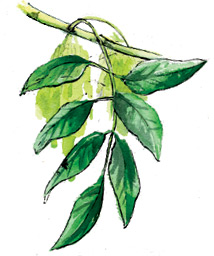
In Greek tradition it was said that Zeus created humans from Ash trees. Yggdrasil was the Cosmic Ash upon which Odin hung for nine days until He discovered the runes. It was also the horse of Odin, who like the mare of Muhammad, bore him to the skies for a glimpse of heaven. On-Niona was the Gaulish Goddess of the Ash groves. The Irish word for Ash, Nion, was also the word for heaven, Nionon. The Icelandic word Aske meant “blaze of great fire”, Ash being one of the best fire woods (especially when burned green!) as well as leading to the fires of enlightenment. Considered a Solar tree, its wood is used for the Yule Log. Druids carved charms from its wood. Ashen divining rods were cut on Summer Solstice. A Druidic Ash wand decorated with spirals was found on Anglesey.

Eating red Ash buds at Midsummer brings protection from sorcery. Witch’s brooms, used for flying, are traditionally made of an Ash pole with Birch twigs and Willow bindings. Ash “draws the flash” and so is used in rain magic.

In Scotland it was believed that carrying the keys, or seeds, brought protection from evil sorcery. Ash sticks were preferred for herding cattle for they were sure not to injure an animal. Snakes were said to avoid Ash trees and their fallen leaves, an adder could be killed by a single blow from an Ashen stick. A circlet of Ash twigs was worn around the neck to heal snake bite. Ash sticks were carried in snake infested woods and according to Pliny, drawing a circle with an Ash wand around a snake would cause it to die.

Ash trees were used in weather forecasting. If the Oak leafed first dry weather would follow. If the Ash leafed first wet weather was forecast. In Lincolnshire, England, it was said that the female Ash, the Sheder, could be used to overpower a male Witch and the male Ash, the Heder, could be used to overpower a female Witch.

In Leicestershire a child with warts was carried to an Ash tree in April or May. A pin would be stuck into the tree then into the child’s wart until pain was felt and then into the tree again and left in the bark. The rhyme “Ashen tree, ashen tree. Pray buy this wart of me ” was recited. In the Highlands of Scotland at the birth of a child a branch of Ash was placed in the fire. The sap which was forced out at the ends was collected in a spoon and fed to the infant.

Children with hernias, weakness, or rickets were passed through a cleft in an Ash sapling, before sunrise, while fasting. The slit in the tree was then bound and as the tree healed, so did the child. If the tree was later cut down the child would be re-injured and so woodcutter’s often found these trees full of nails. In Herefordshire a lock of a child’s hair was pinned to an Ash to cure a bad cough.

about the author:

Ellen Evert Hopman is a Druid Priestess, herbalist and author of “Priestess of the Forest: A Druid Journey”, “A Druids Herbal – Of Sacred Tree Medicine”, “Walking the World in Wonder – A Children’s Herbal” and other volumes. Visit her website for more!

Bibliography
Adams, Barbara Means, Prayers Of Smoke, Renewing Makaha Tribal Tradition; Celestial Arts, Berkeley, CA 1990

Baker, Margaret, Discovering The Folklore Of Plants; Shire Publications Ltd., Aylesbury, Bucks, U.K. 1975

Beith, Mary, Healing Threads, Traditional Medicines of the Highlands and Islands; Polygon, Edinburgh, Scotland, 1995

Brunaux, Jean Louis, The Celtic Gauls: Gods, Rites and Sanctuaries; Seaby, London, 1988

Calder, George (translator), Book of Ballymote: Auraicept Na nEces (The Scholars Primer); Edinburgh, 1917

Carmichael, Alexander, Carmina Gadelica, Hymns and Incantations; Floris Books, Edinburgh 1992

Cunliffe, Barry, The Celtic World; St. Martin’s Press, New York, New York, 1993

Cunningham, Scott, Encyclopedia of Magical Herbs; Llewellyn Publications, St Paul, MN 1986

Ellis, Peter Berresford, Celtic Women; Wm. B. Erdman’s Publishing Company, Grand Rapids, MI, 1996

Erichsen-Brown, Charlotte, Medicinal and Other Uses Of North American Plants; Dover Publications Inc., New York, NY 1989

Evans-Wentz, W.Y., The Fairy Faith In Celtic Countries; Citadel Press, New York, NY 1990

Farrar, Janet and Stewart, The Witch’s Goddess; Phoenix Publishing Inc, Custer, WA 98240

Frazier, James G., The Golden Bough, The Roots of Religion And Folklore; Avenel Books, NY 1981

Friedrich, Paul, Proto-Indo-European Trees; The University of Chicago Press, Chicago, IL 1970

Green, Miranda J., The Celtic World; Routledge, London, 1995

Green, Miranda J., The World of the Druids, Thames and Hudson, London 1997

Grieve, M., A Modern Herbal, Dover Publications Inc., New York, NY 1971

Hoagland, Kathleen, 1,000 Years of Irish Poetry, The Gaelic and the Anglo-Irish Poets From Pagan Times To The Present; The Devin-Adair Company, Old Greenwich, CT 1981

Hopman, Ellen Evert, A Druids Herbal For The Sacred Earth Year; Inner Traditions/Destiny Books, Rochester, VT 1995

Hopman, Ellen Evert, Tree Medicine, Tree Magic; Phoenix Publishers, Custer, WA 1991

Kelly, Fergus, A Guide To Early Irish Law; Dublin Institute for Advanced Studies, Dublin, 1991

Kondratiev, Alexei, The Apple Branch; The Collins Press, Cork, 1998

Lust, John The Herb Book; Bantam Books, New York, 1974

Markale, Jean, The Druids; Inner Traditions, Rochester, VT, 1999

Matthews, Caitlin & John, The Encyclopedia of Celtic Wisdom; Element Books, Rockport, MA 1994

Matthews, John, The Druid Sourcebook; Blanford Press, London, 1996

McNeill, F. Marian, The Silver Bough, Vol. One; William Maclellan, Glasgow, 1977

Meyer, Kuno, Selections from Ancient Irish Poetry; Constable, London, 1959

Moerman, Daniel E., Medicinal Plants Of Native America; University of Michigan Museum of Anthropology Technical Reports, Number 19, Ann Arbor, MI 1986

Mooney, James, History, Myths and Sacred Formulas of the Cherokees; Bright Mountain Books, Ashville, NC 1992

Naddair, Kaledon, Keltic Folk and Faerie Tales; Century Hutchinson Ltd., London, 1987

O’Boyle, Sean, Ogam, the Poet’s Secret; Gilbert Dalton, Dublin, 1980

Rees, Alwyn and Brinley, Celtic Heritage; Thames and Hudson, New York, 1989

Ross, Anne, Pagan Celtic Britain; Columbia University Press, New York, NY 1967

Saintine, X.B., The Myths Of The Rhine; Charles E. Tuttle Co., Rutland, VT 1967 (Reprint of the 1875 edition)

Squire, Charles, Celtic Myth and Legend; Newcastle Publishing Co. Ltd., USA, 1975

Stone, Merlin, Ancient Mirrors Of Womanhood; Beacon Press, Boston, MA 1984

The Wiccan Rede Project: Kerr Cuhulain

A lot of people in the Wiccan community focus on the first part of the Rede: Harm none. There’s nothing wrong with this, but it is an incomplete interpretation. It’s only half of what the Wiccan Rede is all about. The Wiccan Rede is a double edged sword: It cautions you not to harm others, at the same time urging you to be all that you can be.

My Order of Scáthach focuses on both halves of the Wiccan rede. The Wiccan Rede is a cornerstone of our practice in the Order of Scáthach. Harming none is very important, but so is being all that you can be. Wicca is about empowering yourself, so that you can reach for your dreams. If you are not being all that you can be, you’re not entirely living up to the spirit of the Wiccan Rede. The Order of Scáthach insists that it’s members use both halves: We strive to be glorious.

The Wiccan Rede requires Wiccans to use their heads instead of someone else’s list of rules. It requires us to take responsibility for our actions rather than relinquishing this responsibility it to someone or something else. Wicca is not a Zoroastrian system like Christianity having only extremes of light versus dark, good versus evil, right versus wrong. That sort of system is an approach which requires no thought. There are no shades of gray. It is composed of long lists of rules and rigid codes. Our path, unlike the Christian one, is not based on guilt. The Judeo/Christian system can be summarized by the expression “Thou shalt not”. Our system can be summarized by the expression “I will not”: It is based on responsibility, not guilt

The Wiccan Rede is not a rule. It is a statement counseling us to think. Personal responsibility is the basis of the Wiccan ethical system. We must take responsibility for our actions and think about what we are doing. Rules are for training young children to be adults. At some point you must grow up and understand the reasons for the rules. This understanding should replace the rules. Wiccans don’t steal because it is illegal: Wiccans don’t steal because Wiccans understand that stealing is wrong.

About the Author:
Kerr retired from the Vancouver Police Department in November 2005 after serving 29 years with them. He was awarded the Governor General’s Exemplary Service Medal. Kerr’s past job assignments within the VPD include the Emergency Response Team, Hostage Negotiator, Child Abuse Investigator, Gang Crime Unit, and the Mental Health Emergency Services Unit. Kerr is currently working as a police dispatcher for ECOMM for Southwestern BC.

Kerr has been a Wiccan for 39 years and has been involved in anti-defamation activism and hate crimes investigation for the Pagan community since 1986. Kerr was awarded the Shield of Valor by the Witches League for Public Awareness. Kerr is the author of the “Law Enforcement Guide to Wicca”, “Witch Hunts”, “Wiccan Warrior”, “Full Contact Magick” and “Magickal Self Defense”. Kerr has a column on anti-defamation issues and hate crimes on The Witches’ Voice web site called Witch Hunts. Kerr is the former Preceptor General of Officers of Avalon, an organization representing Neo-Pagans professionals in the emergency services (police, firefighters, emergency medical technicians).

To learn more about Kerr, visit his website.

Pukwudgies: Myth or Monster

By Christopher Balzano
(originally appeared on Massachusetts Paranormal Crossroads website; used with permission)

In the Southeastern corner of Massachusetts lies Bristol County, an area known locally as the most haunted place in New England. The energy that sleeps there has been rumored to cause haunted schools, ghostly armies and unexplained suicides and murders. Forested areas of the county have long been known to contain a litany of unexplained animals, from Bigfoot and thunderbirds to large snakes and odd bear-like monsters. For the past forty years cults have flocked there, and their activities, often criminal, have filled the blotters of local law enforcement. Of all the unknown horrors that live in Bristol County, the most feared is not a animal or a ghost or the members of Satanic cults that walk the forests, but a demon only two feet high, and if the history of the area represents the history of our America society, these Pukwudgies are the gatekeepers of our darker side.

The Pukwudgies have haunted the forests of Massachusetts since before the first European Settlers ever thought about setting out for a new land. For centuries they tormented the local Native Americans and crept their way into their creation myths and oral history. They could easily be passed of as legend, and in fact, their physical description is much like mythological creatures from other cultures in other times. The difference is these demons jumped from the page and evolved as the people around them changed, changing from reluctant helpers to evil tormentors. The difference is these demons are still seen by people today.

Most cultures’ mythology has some reference to small monsters that have a strained relationship with humans. In many ways it makes sense. While large monsters have their place in our fears, diminutive creatures find their way into the shadows of our rooms and under our beds. Their names and nature change, but there are always common threads that link them together. Some are called monsters and roam the land looking for human food and kidnapping anyone they can find. Other are called demons, foul spirits that feed of the negative and expose the sins of man. When referring to one, its classification gets blurred and these two words become interchangeable, perhaps showing us how closely associated these monsters are with evil.

Veterans returning home after World War II talked of gremlins tearing apart their planes or getting into jeep engines and causing havoc. The Hindus speak of the Rakshasas or the “Night Wander” who eats human skin and jumps into the dead to possess them. Africans tell stories about the Eloko who lure people with beautiful music only to devour them after they have been bewitched with an ever expanding jaw.

Although passed off as works of fiction and imagination, trolls and dwarfs have existed in people’s fears for centuries. They have become lovable and noble now, but the original stories recorded of these monsters are anything but fairy tales with happy endings. Trolls were notorious for ambushing travelers and destroying whole families on a whim. While some are described as giants with humps and one eye, many older cultures, especially in Scandinavia, described the being as the size of a plump child.

Dwarfs have always been small and their manners much better, but the end result seems to be the same. Like the troll, they are known as metal and stone workers, but unlike their flesh-eating counterparts, dwarves seem to avoid human contact. While they would prefer to be left alone, if impeded upon their work, they become like caged dogs. One variation of the dwarf is the Tommy-Knocker who lives in mine shafts and is sometimes said to be the ghost of miners who have perished in the line of duty and are doomed to work for eternity. They are known to cause cave-ins and fires in the shafts.

Perhaps the most famous of the small nightmare are seen by the Irish. Fairies patrol the roads in Ireland causing problems for any traveler who strays from the path. They live in hills or mounds and dance around fires. If a human comes across their mound or sees their dancing, they are caught and held captive. Even the beloved leprechaun was once a malicious spirit before he was Americanized and transformed into the gold keeper he is today.

Exposure to nature seems to feed these tales, and the more a society depends on the earth for its needs, and the closer the relationship a people have with the natural world around them, the more these stories pop up. In this country, the people the first settlers found had a close, if not friendly, view of small dangers around them. The Cherokee have a mirror image demon known as the Yunwi Djunsti, or little people, that look and talk like Cherokee but are only a few feet high and have long hair that touches the ground. Although most people cannot see them, they are known to throw objects, trip up hunters and abduct people who wander off. In Canada they are known as Mennegishi and look much like the classic alien grey.

The Wampanoag Nation, the dominant Native America tribe in Massachusetts and Southern New England, had a monster who still dominates the landscape they once roamed. The Pukwudgie made its first appearance in the oral folklore of the people of Cape Cod, but recent sightings have forced people to rethink this mythological creature. Standing between two and three feet tall, the Pukwudgie looks much like our modern idea of a troll. His features mirror those of the Native American in the area, but the nose, fingers and ears are enlarged and the skin is described as being grey and or washed-out, smooth and at times has been known to glow.

What makes these monsters dangerous is the multitude of magical abilities they use to torment and manipulate people. They can appear and disappear at will and are said to be able to transform into other animals. They have possession of magical, poison arrows that can kill and can create fire at will. They seem to often be related to a tall dark figure, often referred to in modern times and shadow people. In turn the Pukwudgies control Tei-Pai-Wankas which are believed to be the souls of Native Americans they have killed. They use these lights to entice new victims in the woods so they may kidnap or kill them. In European folklore these balls of energy are know as Will-o-the-Wisps and are said to accompany many paranormal occurrences. Modern paranormal investigators call them orbs, and catching one on film is the gold standard of field research.

Legends of the Pukwudgie began in connection to Maushop, a creation giant believed by the Wampanoag to have created most of Cape Cod. He was beloved by the people, and the Pukwudgies were jealous of the affection the Natives had for him. They tried to help the Wampanoag, but their efforts always backfired until they eventually decided to torment them instead. They became mischievous and aggravated the Natives until they asked Quant, Maushop’s wife, for help. Maushop collected as many as he could. He shook them until they were confused and tossed them around New England. Some died, but others landed, regained their minds and made their way back to Massachusetts.

Satisfied he had done his job and pleased his wife, Maushop went away for a while. In his absence, the Pukwudgies had returned. They again changed their relationship with the Wampanoags. They were no longer a nuisance, but began kidnapping children, burning villages and forcing the Wampanoag deep into the woods and killing them. Quant again stepped in, but Maushop, being very lazy, sent his five sons to fix the problem. The Pukwudgies lured them into deep grass and shop them dead with magic arrows. Enraged, Quant and Maushop attack as many as they can find and crush them, but many escape and scatter throughout New England again. The Pukwudgies regroup and trick Maushop into the water and shoot him with their arrows. Some legends say they killed him while other claim he became discouraged and depressed about the death of his sons, but Maushop disappears from the Wampanoags mythology.

Pukwudgies have been seen at the Ledge in Freetown, Massachusetts.

The Pukwudgies remained however, but something odd happens. The timing of the tales of the monster are a map through the history of the Native Americans relationship with the European settlers. The death of the five sons lines up with the very first settlers, and the flight of Maushop is told along side the changing of attitudes about the new neighbors. The Pukwudgies, always seen in a negative light, become the foot soldiers of the Devil, which may explain their modern connection to shadow people. As more Native Americans began to convert to Christianity, their myths evolved, until the Pukwudgies were responsible for the evil in the village, and the hand of Satan on the tribe.

People who spend time in the forest of New England will tell you Pukwudgies are not symbols, but a real horror that still stalks people. They continue to see them, and as the world develops around them, the monsters remain unchanged and as dark as ever.

Joan was walking her dog through the state forest in Freetown, Massachusetts, on a cold Saturday morning in April when she saw the monster. As she and her dog, Sid, walked down the path, Sid became anxious and strayed a few feet into the woods. Joan followed him in, and stopped short. Her dog was lying completely flat in the leaves, and on a rock ten feet away was a Pukwudgie. She described him as looking like what she would describe as a troll; two feet high with pale gray skin and hair on his arms and the top of his head. The monster seemed to have no clothes, but it was difficult to tell because his stomach hung over his waist, almost touching his knees. His eyes were a deep green, and he had large lips and a long, almost canine nose.

The Pukwudgie stood watching her, staring straight at her with no expression, almost like it was stunned to see her. Joan froze and remembers thinking the air in her lungs had been pushed out. Sid finally came to and ran back towards the trial, dragging Joan who was still holding the leash tightly.

Although the whole exchange took less than thirty seconds, it remains with Joan ten years later. She has not gone back to the forest, but feels that might not be enough. Three times since the event she has woken up to find the demon looking in on her. It has never attacked her or spoken to her, she has merely seen it looking through her bedroom window, staying just long enough for her to notice him. All three times she claims she was fully awake and could move if she had to.

Another man in Framingham, Massachusetts had a experience that forced him to remain away from the woods. Tim was in a forest when he saw a bright orb in front of him. Having investigated the paranormal he was excited and tried to snap a photo with his digital camera. The ball of light disappeared and reappeared a few feet further into the woods. Tim followed, losing the spirit several times before he realized he had traveled more than thirty feet off the path into a thickly wooded area. He became scared and slowly made his way back to the path, only to find a two foot man standing there, walking towards him. He turned and ran, and looking back saw the figure move back into the woods.

Tim reported that what he saw had walked upright and had used its arms to push something aside when he fled to the forest. He had moved with a slight limp, but “like a human”.

The second time Tom saw the Pukwudgies was a few years later in a parking lot near the same forest. He was listening to the radio at almost a whisper and checking his rear view mirror for the friend he was waiting for when he saw the same small figure of a man. Every detail was identical, and the Pukwudgie just stood there watching him. The car turned on by itself and his radio began to get louder. Tim pulled out of the parking lot and took the long way home to try and stop his hands from shaking.

Although the monster seemed content to only frighten Joan and Tim, there are still physical attacks happening. Several people have been assaulted and one person came down with a mysterious illness after seeing them in a cemetery in New Hampshire. Another woman suffered scratches on her arm after following an orb in a forest in Taunton, Massachusetts.

The most disturbing reoccurring attacks might be taking place at the Pukwudgies favorite hunting ground. In the Freetown State Forest there is an hundred foot cliff overlooking a quarry known as the Ledge. There have been many hauntings at this sight, but the most frequent experience is an overwhelming feeling to jump to the rocks and water below. In the folklore of the Wampanoag, the Pukwudgies were known to lure people to cliffs and push them off to their death. There have been several unexplained suicides at the Ledge, often by people who had no signs of depression or mental disease before entering the forest.

Author Bio:
A teacher and folklorist living in the Boston area. He has been investigating the unknown for twelve years and running Massachusetts Paranormal Crossroads, a website dedicated to the paranormal and local folklore of Massachusetts, for more than five. His writing has appeared in such respected publications as “The Haunted Times” and “Mystery Magazine” as well as “Unexplained Paranormal Magazine.” His investigations have been covered by “The Boston Globe”, “The Boston Herald”, “The Standard Times” and “Worchester Magazine” and he has been asked to speak about urban legends and the paranormal at conferences throughout New England. He is a regular on several paranormal radio shows, including “The Ghost Chronicles” and “Spooky Southcoast” and has appeared in documentaries and television specials on the supernatural. He was one of the featured writers in Jeff Belanger’s Encyclopedia of Haunted Places and contributed to the collection Weird Hauntings and the soon to be released, Weird Massachusetts. His writing and research have also been featured in Thomas D’Agostino’s Haunted New Hampshire and Haunted Massachusetts and the recently released Ghostly Tails from America’s Jails.

You can learn more by visiting: Massachusetts Paranormal Crossroads, Ghost Village where he is the news editor, and ParaRelations.

Tree Medicine, Magic and Lore: Apple

by Ellen Evert Hopman
illustration by Will Hobbs

In “the Song Of The Forest Trees”, a thirteenth century Irish poem of wood wisdom, the following trees are identified as not to be burned; “Woodbine, monarch of the forests, Apple, a tree ever decked in blooms of white, Blackthorn, throughout his body…birds in their flocks warble, Willow, a tree sacred to poems, Hazel, spare the limber tree, Ash, rods he furnishes for horsemen’s hands”.


The common Wild Apple was a component of the mixed hardwood forests of the post-glacial Indo-European homeland. The domesticated Apple was probably developed in the southern Caucasus as part of the Neolithic farming revolution and soon spread to Switzerland and Britain. Apples were an important and popular food source being sweet, high in calories, and easy to dry. According to the historian Tacitus, milk, deer, and apples were the main diet of the Germanic tribes.

Apples had magical and religious significance for Celtic, Greek, Slavic, and Germanic peoples. They are so embedded in our cultural imaginations that the Biblical story of Adam and Eve is said to revolve around an apple even though no apples are mentioned in the Bible!

The Apple was one of the Chieftain trees of Ireland, the wanton felling of which meant death to the offender. It was said to shelter both the hind and the unicorn. Scandinavian tradition relates that Loki stole the apples which the Goddess Ithunn had bestowed on the Gods to keep them immortal. When the Gods began to age Loki had to return them.

In English folk tradition warts can be cured by rubbing them with two halves of an apple which are then buried. As the apple decays so will the warts. Cutting down an Apple tree was considered sacrilegious. In Herefordshire it was said that hops would never grow in a felled Apple orchard. A piece of common land could be claimed by fencing it and planting an Apple tree. As long as the yearly crop was taken the landowner maintained his claim. In Yorkshire it was said that one apple must be left on each tree after harvest as a gift for the Fairies. If a bloom appeared on a tree which had already borne fruit it was an omen that someone would die. Wassailing the orchard is an old custom of Twelfth Night. Farming families ate hot cakes and drank cider and then proceeded to the orchard where a cider soaked cake was placed in the fork of an Apple tree. More cider was poured on the cake as a libation and then noise makers were employed, such as pots and pans, to drive away evil spirits. Cider was then sprinkled on orchard and field to encourage the vegetation Fairies.

The Seneca indians used the root of Wild Apples for tuberculosis and malaria. The Meskwaki used it to cure smallpox. Apples are rich in magnesium, iron, potassium, and vitamins C, B, and B2. Peeled apples will help diarrhea, stewed whole apples are laxative. Eating apples oxygenates the blood, cleans the liver, and eases insomnia. Baked apples make a poultice for sore throats and fevers.

Dried apple peel tea taken several times a day eases rheumatic pain. Apple cider restores intestinal flora (especially important after a round of antibiotics), reduces stomach acidity, clears gas, and clears the liver. It is slightly diuretic and helps the kidneys to expel uric acid (four cups a
day is recommended for gout).

Adding garlic and horseradish to apple cider makes a drink that clears skin blemishes, eczema, psoriasis, infections, bone necrosis, tumors, abscesses, and benefits Lupus. The mixture can be applied externally as well. Apple wood is a traditional choice for magic wands and the scent is considered a potent love charm. Associated with immortality and The Summerland, Arthur’s Island of Avalon was said to be covered with Apples. Unicorns are very fond of Apples and may be seen cavorting in the orchard on a misty day.

about the author:

Ellen Evert Hopman is a Druid Priestess, herbalist and author of “Priestess of the Forest: A Druid Journey”, “A Druids Herbal – Of Sacred Tree Medicine”, “Walking the World in Wonder – A Children’s Herbal” and other volumes. Visit her website for more!

Bibliography
Adams, Barbara Means, Prayers Of Smoke, Renewing Makaha Tribal Tradition; Celestial Arts, Berkeley, CA 1990

Baker, Margaret, Discovering The Folklore Of Plants; Shire Publications Ltd., Aylesbury, Bucks, U.K. 1975

Beith, Mary, Healing Threads, Traditional Medicines of the Highlands and Islands; Polygon, Edinburgh, Scotland, 1995

Brunaux, Jean Louis, The Celtic Gauls: Gods, Rites and Sanctuaries; Seaby, London, 1988

Calder, George (translator), Book of Ballymote: Auraicept Na nEces (The Scholars Primer); Edinburgh, 1917

Carmichael, Alexander, Carmina Gadelica, Hymns and Incantations; Floris Books, Edinburgh 1992

Cunliffe, Barry, The Celtic World; St. Martin’s Press, New York, New York, 1993

Cunningham, Scott, Encyclopedia of Magical Herbs; Llewellyn Publications, St Paul, MN 1986

Ellis, Peter Berresford, Celtic Women; Wm. B. Erdman’s Publishing Company, Grand Rapids, MI, 1996

Erichsen-Brown, Charlotte, Medicinal and Other Uses Of North American Plants; Dover Publications Inc., New York, NY 1989

Evans-Wentz, W.Y., The Fairy Faith In Celtic Countries; Citadel Press, New York, NY 1990

Farrar, Janet and Stewart, The Witch’s Goddess; Phoenix Publishing Inc, Custer, WA 98240

Frazier, James G., The Golden Bough, The Roots of Religion And Folklore; Avenel Books, NY 1981

Friedrich, Paul, Proto-Indo-European Trees; The University of Chicago Press, Chicago, IL 1970

Green, Miranda J., The Celtic World; Routledge, London, 1995

Green, Miranda J., The World of the Druids, Thames and Hudson, London 1997

Grieve, M., A Modern Herbal, Dover Publications Inc., New York, NY 1971

Hoagland, Kathleen, 1,000 Years of Irish Poetry, The Gaelic and the Anglo-Irish Poets From Pagan Times To The Present; The Devin-Adair Company, Old Greenwich, CT 1981

Hopman, Ellen Evert, A Druids Herbal For The Sacred Earth Year; Inner Traditions/Destiny Books, Rochester, VT 1995

Hopman, Ellen Evert, Tree Medicine, Tree Magic; Phoenix Publishers, Custer, WA 1991

Kelly, Fergus, A Guide To Early Irish Law; Dublin Institute for Advanced Studies, Dublin, 1991

Kondratiev, Alexei, The Apple Branch; The Collins Press, Cork, 1998

Lust, John The Herb Book; Bantam Books, New York, 1974

Markale, Jean, The Druids; Inner Traditions, Rochester, VT, 1999

Matthews, Caitlin & John, The Encyclopedia of Celtic Wisdom; Element Books, Rockport, MA 1994

Matthews, John, The Druid Sourcebook; Blanford Press, London, 1996

McNeill, F. Marian, The Silver Bough, Vol. One; William Maclellan, Glasgow, 1977

Meyer, Kuno, Selections from Ancient Irish Poetry; Constable, London, 1959

Moerman, Daniel E., Medicinal Plants Of Native America; University of Michigan Museum of Anthropology Technical Reports, Number 19, Ann Arbor, MI 1986

Mooney, James, History, Myths and Sacred Formulas of the Cherokees; Bright Mountain Books, Ashville, NC 1992

Naddair, Kaledon, Keltic Folk and Faerie Tales; Century Hutchinson Ltd., London, 1987

O’Boyle, Sean, Ogam, the Poet’s Secret; Gilbert Dalton, Dublin, 1980

Rees, Alwyn and Brinley, Celtic Heritage; Thames and Hudson, New York, 1989

Ross, Anne, Pagan Celtic Britain; Columbia University Press, New York, NY 1967

Saintine, X.B., The Myths Of The Rhine; Charles E. Tuttle Co., Rutland, VT 1967 (Reprint of the 1875 edition)

Squire, Charles, Celtic Myth and Legend; Newcastle Publishing Co. Ltd., USA, 1975

Stone, Merlin, Ancient Mirrors Of Womanhood; Beacon Press, Boston, MA 1984

Catching Up With Steve

It’s been several months since Steve Kenson was kind enough to talk about gaming with The Magical Buffet. Since then so much has happened that Steve sent us a little note to share with everyone to let us know what he’s been up to and what’s coming next.

Hey Everybody,

It’s been a busy time since I last talked with the Magical Buffet! I’ve made the transition at Green Ronin Publishing from developer to full-time designer, which means rather than overseeing and guiding various projects, I’m primarily writing and designing, which I think are my personal strengths. I’m working with our new Mutants & Masterminds developer, Jon Leitheusser, on a project called “The Supervillain’s Handbook” for a summer release this year. It’s a big book of supervillainy, including hidden lairs, evil schemes, and villain archetypes.

In other exciting news, our “A Song of Ice and Fire Roleplaying” game is back from the printer and shipping to stores! I’m very pleased with how it came out and I’m working with our production department on the forthcoming releases for it, including a Narrator’s Screen (bundled with the adventure “Wedding Knight” written by me) and the big adventure saga “Peril at King’s Landing” as well as a comprehensive guidebook to Westeros. The cover to the Campaign Guide is a great painting of how the Kingslayer got that name.

Also, for any folks who are interested, I’ll be a guest at the Northeast Wars convention in Burlington, VT April 3-5, running M&M and talking about RPGs. It’s a fun convention, so come by if you’re in the area!

About Steve Kenson:
Steve Kenson began freelancing in the RPG industry in 1993. By 1995, he was working full-time as a freelance author and designer on RPGs such as Shadowrun and Earthdawn. He has written for a wide variety of game-lines and published ten novels: seven for the Shadowrun line, two for Crimson Skies, and one for MechWarrior. In 2002, Steve designed the Mutants & Masterminds Superhero RPG for Green Ronin Publishing under the Open Game License. Two years later, he became a line developer with Green Ronin, overseeing the development of the Second Edition of M&M, along with games such as Blue Rose, True20 Adventure Roleplaying, and A Song of Ice and Fire Roleplaying. He’s now a designer with Green Ronin Publishing.

Steve maintains a website at www.stevekenson.com and a LiveJournal at xomec.livejournal.com. He lives in southern New Hampshire with New Age and pagan author Christopher Penczak and psychic reader and counselor and part-time tooth fairy Adam Sartwell.

The Wiccan Rede Project: Lady Passion

Unbound Ethics: Surprising Revelations About The Wiccan Rede
By Lady Passion, High Priestess, Coven Oldenwilde

It’s a little known fact that the Wiccan Rede as we’ve come to know it is a modern invention, for in antiquity, Pagans’ concept of ethics was largely based on folks living up to the four Cardinal Virtues of Prudence, Courage, Temperance and Justice.

The simplicity of the original ‘Rede’ reflected its oldeness: “Eight words the Rede fulfill, ‘An [If] it harm none, do as ye will.” But as an ethical device, this part of ‘the Rede’ is quite problematic. For example, many beginning Seekers wrongly believe that Witches abide by this principle above all else, and that these words form the cornerstone of occult ethics. While “harm none” is an olde concept first published as the philosophy of fictional character Good King Pausol in the 1870s, the “do as ye will” part smacks of specious, modern Crowleyism (i.e., “Do as ye wilt shall be the whole of the Law. Love over Law, Law under Will,” The Book of the Law, 1901). Ultimately, while “harm none” is a goodly aspiration, it is innately impractical — for who but a God/dess can do this?

Eventually, this portion of ‘the Rede’ was superceded by the exhortive: “Bide the Wiccan Law ye must, In Perfect Love and Perfect Trust”. Later, numerous High Priestesses from Amber K to Gwen Thompson expanded ‘the Rede’ to increasingly lengthy and badly-rhymed versions so popularized today on Azure Green.com posters.

Raymond Buckland first referenced a Law of Three-fold Return in a 1968 article for Beyond magazine, but no one knows the origin of the modern, oft-used portion of this: “Ever mind the rule of three, what you send comes back to thee.” Note herein the absence of any threat of a three-fold return against spell casters that everyone now fears.

While Witches are right to instinctively embrace the earliest part of ‘the Rede’ by merit of its lovely antiquity, this has also led them to wrongly assume that if they make a magical mistake Karma or the Gods’ wrath will swiftly smite them thrice for their audacity. And this is simply untrue.

Indeed, the very concept of a three-fold return rather implies either or both a Christian ‘Golden Rule’ and Dharmic/Karmic influence much at odds with ancient Pagan cosmology. (Witches believe both that evil ilk tend to reap what they sow while alive, and in the rather glacial grind of cosmic lessons learned over numerous reincarnations.)

I was taught by a famous High Priestess that the ‘Law of Three-fold Return’ was not an exhortive against Witches’ meddling magic, but meant to serve as a warning to our persecutors to not harm us or receive our triple retribution in self defense.

Such warping of the Rede’s original intent has so pervaded the Craft Community, that many Witches are now prone to avoid working spells for fear that they will inadvertently engender cruel backlash. Despite the fact that this portion of ‘the Rede’ makes little magical sense (since the God/desses are on Witches’ side, why not liberate us rather than figuratively tie our hands behind our backs?), few deeply consider its illogic — inadvertently allowing ‘the Rede’ to become an instrument of oppression to us, rather than one of support. This is a counterproductive shame.

As such a modern invention, ‘the Rede’ should be viewed with more than a bit of skepticism and, therefore, not revered as comprising Witches’ basic magical text (as our Books of Shadows truly are).

The words in the Rede are goodly thought-provokers, goodly phrases to ponder from an ethical perspective. But they are not holy writ, and should never be assumed so. The Rede should never be used to oust anyone from a Coven, as it is not a traditional set of “rules” per se. (Our traditional Books of Shadows have 163 ardanes and numberous Notes and Guidelines to consult when it comes to determining whether or not a deal-breaking ethical breach has occurred.)

*Diuvei and I wrote an entire chapter about Witch ethics in our The Goodly Spellbook: Olde Spells For Modern Problems. Our Coven Oldenwilde abides by the ardanes handed down to us in our Books of Shadows, as well as the four Cardinal Virtues, the latter of which nicely correspond to the four Elements and traditional Witch Powers:

Prudence = Air = The Power To Know (the wisdom to know what to do, when);
Justice = Fire = The Power to Will (the determination to right wrongs, often when someone exerts their Will over anothers’);
Courage = Water = The Power to Dare (the ability to be bold when others feel timid); and
Temperance = Earth = The Power to Be Silent (the ability to be discrete and restrained when need be).

In many ways, Witches have more traditional ethical standards than monotheists do: After all, we don’t have a mere ten commandments to worry about. Indeed, we have hundreds of goodly maxims and reminders with which to check our egos and magical motives.

We should be grateful to our ancestors for leaving us a wealth of timeless treasures to abide by — but avoid elevating more modern models, such as the long version of the Rede, above their true station.

About the Author:
Lady Passion (Dixie Deerman) is a renowned psychic, magical expert, and co-author of the critically acclaimed The Goodly Spellbook: Olde Spells For Modern Problems, Sterling Publishing, NY, NY (Italian translation, Il Libro degli Incantesimi: Antiche Formule Magiche per Risolvere Problemi Attuali, Milan). The Goodly Spellbook has been cited in numerous other books, such as The Temple of High Witchcraft by Christopher Penczak, and Mystical Dragon Magick by DJ Conway.

Lady Passion writes for numerous magazines (NewWitch, Oracle 20/20, etc.), and often works magic for TV studios (Universal, Sci-Fi Channel), production companies (A. Smith & Co., L.A., Trafford Media, England), and series (Extra!, Finding America). Often been featured on BBC London radio, NPR, CNN, Fox, and the Washington Post, etc.

Lady Passion is a Registered Nurse. She has over 30 years of experience finding missing persons, de-ghosting haunted houses, securing dozens of Pagan inmates their religious rights, and teaching the Craft of the Wise to everyone from soccer moms to Mensa members. Folks worldwide consult Lady Passion to fix their magical, medical, and legal problems, and to find out what their future holds. Thousands nationwide have annually attended her public Halloween ritual held since 1995.

For more information about her work, visit: www.oldenwilde.org

Tree Medicine, Magic and Lore: Alder

by Ellen Evert Hopman
illustration by Will Hobbs

Alder thrives in damp areas – wet lands, flood plains, river banks and moist lowlands, the types of places that ancient people commonly sought out for habitation. Ancient Celtic tracks and roads were made of its wood due to its ability to withstand rot. Alder was used in piles for lake dwellings, for water-mill wheels, house foundations, canal locks, milk pails and pipes. There was an ancient Celtic God named Alisanos, the Alder God. Alder was also known as “Bran’s Tree”. Bran is the ancestor God of the Celtic Cult of the Sacred Head. He was a Celtic hero who instructed his followers that after his death his head was to be placed on a pillar so that he could continue to give them counsel. Later they were told to bury his head at the White Mount, the site of the present Tower of London as a powerful talisman of protection.

As long as the head remained buried Alba would be safe from invasion. Arthur made a fatal mistake by digging up the head, the Saxons invaded not long after. But Bran’s sacred birds, the ravens, have dwelt at the site ever since.

Alder makes an excellent charcoal for gunpowder, smith’s fires, and potter’s ovens. It is a tree sacred to Phoroneus, inventor of fire, and to Astarte and Her son, the Fire God. Fresh cut Alder wood turns red as blood. The bark gives a red dye, the twigs a brown dye. The cones make a black dye and the inner bark of the root dies yellow.

Irish tradition states that the first man was created from an Alder, the first woman from a Rowan.

Alder bark is prepared for medicinal use by carefully scraping off the dead outer bark and using the green, living tissue underneath. Alder bark can be simmered in water to make a wash for very deep wounds. The leaves and bark are simmered into a bitter tea for tonsillitis and fever. The leaves are used in poultices to dry up breast milk.

The Penobscot Indians used Alder bark tea to stop cramps and vomiting and in a Seven Herbs formula that was taken before a sweat lodge ceremony. The seven herbs were; Alder bark, Witch hazel twigs, Fir twigs, Cedar branches, Sweet-flag, Prince’s-pine, Lambkill, and Brake. The Mohegan used Speckled Alder twigs in decoctions for sprains, bruises, headache, and backache. The inner bark of Alder is used in poultices to stop swelling. The fresh juice stops itching. Alder bark tea can be used in the vagina as a douche or in the rectum for hemorrhoids.

Alder leaves were once gathered while they were still damp with dew and used to cover the floors of a house plagued by fleas or other insects. Adhering to the leaves the insects died. Alder pollen is a favorite of bees. Grouse eat the leaves, buds and seeds, beaver and rabbit chew the bark.

about the author:

Ellen Evert Hopman is a Druid Priestess, herbalist and author of “Priestess of the Forest: A Druid Journey”, “A Druids Herbal – Of Sacred Tree Medicine”, “Walking the World in Wonder – A Children’s Herbal” and other volumes. Visit her website for more!

Bibliography
Adams, Barbara Means, Prayers Of Smoke, Renewing Makaha Tribal Tradition; Celestial Arts, Berkeley, CA 1990

Baker, Margaret, Discovering The Folklore Of Plants; Shire Publications Ltd., Aylesbury, Bucks, U.K. 1975

Beith, Mary, Healing Threads, Traditional Medicines of the Highlands and Islands; Polygon, Edinburgh, Scotland, 1995

Brunaux, Jean Louis, The Celtic Gauls: Gods, Rites and Sanctuaries; Seaby, London, 1988

Calder, George (translator), Book of Ballymote: Auraicept Na nEces (The Scholars Primer); Edinburgh, 1917

Carmichael, Alexander, Carmina Gadelica, Hymns and Incantations; Floris Books, Edinburgh 1992

Cunliffe, Barry, The Celtic World; St. Martin’s Press, New York, New York, 1993

Cunningham, Scott, Encyclopedia of Magical Herbs; Llewellyn Publications, St Paul, MN 1986

Ellis, Peter Berresford, Celtic Women; Wm. B. Erdman’s Publishing Company, Grand Rapids, MI, 1996

Erichsen-Brown, Charlotte, Medicinal and Other Uses Of North American Plants; Dover Publications Inc., New York, NY 1989

Evans-Wentz, W.Y., The Fairy Faith In Celtic Countries; Citadel Press, New York, NY 1990

Farrar, Janet and Stewart, The Witch’s Goddess; Phoenix Publishing Inc, Custer, WA 98240

Frazier, James G., The Golden Bough, The Roots of Religion And Folklore; Avenel Books, NY 1981

Friedrich, Paul, Proto-Indo-European Trees; The University of Chicago Press, Chicago, IL 1970

Green, Miranda J., The Celtic World; Routledge, London, 1995

Green, Miranda J., The World of the Druids, Thames and Hudson, London 1997

Grieve, M., A Modern Herbal, Dover Publications Inc., New York, NY 1971

Hoagland, Kathleen, 1,000 Years of Irish Poetry, The Gaelic and the Anglo-Irish Poets From Pagan Times To The Present; The Devin-Adair Company, Old Greenwich, CT 1981

Hopman, Ellen Evert, A Druids Herbal For The Sacred Earth Year; Inner Traditions/Destiny Books, Rochester, VT 1995

Hopman, Ellen Evert, Tree Medicine, Tree Magic; Phoenix Publishers, Custer, WA 1991

Kelly, Fergus, A Guide To Early Irish Law; Dublin Institute for Advanced Studies, Dublin, 1991

Kondratiev, Alexei, The Apple Branch; The Collins Press, Cork, 1998

Lust, John The Herb Book; Bantam Books, New York, 1974

Markale, Jean, The Druids; Inner Traditions, Rochester, VT, 1999

Matthews, Caitlin & John, The Encyclopedia of Celtic Wisdom; Element Books, Rockport, MA 1994

Matthews, John, The Druid Sourcebook; Blanford Press, London, 1996

McNeill, F. Marian, The Silver Bough, Vol. One; William Maclellan, Glasgow, 1977

Meyer, Kuno, Selections from Ancient Irish Poetry; Constable, London, 1959

Moerman, Daniel E., Medicinal Plants Of Native America; University of Michigan Museum of Anthropology Technical Reports, Number 19, Ann Arbor, MI 1986

Mooney, James, History, Myths and Sacred Formulas of the Cherokees; Bright Mountain Books, Ashville, NC 1992

Naddair, Kaledon, Keltic Folk and Faerie Tales; Century Hutchinson Ltd., London, 1987

O’Boyle, Sean, Ogam, the Poet’s Secret; Gilbert Dalton, Dublin, 1980

Rees, Alwyn and Brinley, Celtic Heritage; Thames and Hudson, New York, 1989

Ross, Anne, Pagan Celtic Britain; Columbia University Press, New York, NY 1967

Saintine, X.B., The Myths Of The Rhine; Charles E. Tuttle Co., Rutland, VT 1967 (Reprint of the 1875 edition)

Squire, Charles, Celtic Myth and Legend; Newcastle Publishing Co. Ltd., USA, 1975

Stone, Merlin, Ancient Mirrors Of Womanhood; Beacon Press, Boston, MA 1984

Thinking Inside the Box

by Rich Rittenhouse

There is a certain plot that has been used time and time again in teen comedies. It goes something like this: Geeky Boy has a crush on Unobtainable Perfect Girl. Geeky Boy has a platonic friendship with Geeky Girl. Geeky Boy strives and schemes for the affections of UPG, oblivious to the fact that Geeky Girl has a crush on *him*. This goes on until 1) Geeky Boy thinks he is about to get UPG, then gets humiliated by her and her friends and realizes she’s a cruel bitch, or 2) Geeky Boy actually does get inside UPG’s 1980’s pink spandex hot pants, but discovers that despite her Phoebe Cates level of Reagan-era foxiness she’s vapid and/or a cruel bitch (perhaps this realization comes from Geeky Boy hearing UPG dis and/or plan a mean prank on Geeky Girl), or 3) Geeky Boy actually gets in UPG’s pants, but realizes that even though she has big sexy mall hair and screws like a minx, she’s mainstream and superficial and he can’t talk to her about important things like Dungeons and Dragons, Nolan Bushnell, or the new Wall of Voodoo LP. And at long last, Geeky Boy learns what we the late-night Showtime viewing audience have known all along, that the perfect girl for him was right there with him the whole time, and he rushes into the arms of Geeky Girl. Cue credits. Add subplot(s) regarding video game tournaments, a wet T-shirt contest, and/or terminal illness to taste.

The 1981 Tom Moldvay Basic Set is my Geeky Girl.

When I first started my “Retro 80’s D&D” game, it was a sort of stop-gap thing: I really wanted to return to gamemastering, but I was sort of gun-shy from the last RPG I had ran a few years before, a perhaps overly-ambitious superhero campaign that had crashed and burned spectacularly. So I wanted a system that was as simple as possible, just to take some of the work and stress off myself. The idea was that I would start the game using the old pink-box rules, I guess as a sort of nostalgic training wheels, then switch over to 4th Edition Dungeons and Dragons when it came out.

Then a funny thing happened. After a few games, I stopped thinking of it as “My Retro 80’s D&D game” and just started thinking of it as “My D&D game”. The decision to use the old rules started to feel less and less like an ironic experiment or a clever stunt and started to feel more like a sensible way to run a fun game without crap getting in the way. The players, too, had a change of heart. The first session there was some bemused grumbling about why I wasn’t running 3.5…this was totally gone by the next game. The simpler rules took a lot of the work out of the game for the players, and in particular they were all happy to see the back of Attacks of Opportunity, something that had slowed previous games to a crawl with arguments and second-guessing. After Teasop the Halfling finally drove his magic sword Ghostbreaker into Count Vorlock’s heart and ended the first “season” of the game, I asked the players if they wanted to switch over to 4th Edition and it was a unanimous “No”.

And so it goes. For my “new” D&D game I have gone back to the rules we used for my very first D&D game at age 11. The late Mr. Moldvay’s adaptation of Arneson and Gygax’s rules is so simple that even my players that have never played any version of D&D before can learn them within minutes. Of course, in gaining simplicity you loose options, but the older rules are so robust that new stuff can be added on the fly easier. Many of the story elements that the newer rules use feats and prestige classes to model we now simply role-play, often to greater effect than a simple +2 here or +4 there. And now I have the new Goblinoid Games LABYRINTH LORD hardcover that puts a streamlined “retro-clone” version of the old Basic and Expert boxed sets together into one book, so I don’t even have to put any more wear on my battered originals.

I’m probably going to pick up fourth edition, or at least the Player’s Handbook, sooner or later, but right now I’m not in any hurry.

POSTSCRIPT: I never did pick up 4.0.

Author’s Bio:
Rich Rittenhouse is a longtime tabletop RPG player from the rural Midwest. In Rebecca’s opinion, he should be the one with a website.

Annual Golden Oak Winners Announced

I received some exciting news in my inbox yesterday. The 2008 “Oakie” Awards were announced. I’m thrilled to tell you that Magical Buffet contributor and all-around go-to Druid for The Magical Buffet won “Best Academic Book” for “A Druid’s Herbal of Sacred Tree Medicine” (which I loved) and even sweeter is that she won for “Best Druidical Essay” entitled “Female Druids” which appeared right here on The Magical Buffet website. That’s right folks, our website has award winning content. Not surprisingly, it’s content not written by myself.

Congratulations to our friend and supporter Ellen Evert Hopman! You rock!

To read the complete list of winners, click here.

To learn more about Ellen Evert Hopman visit her website!

Stay tuned readers, this month we will be debuting the first of many articles by Hopman!