Fading Into Forgiveness

By John Ptacek

When you go to a movie, you willingly suspend your beliefs for an hour or two. I’m only asking you to suspend them for a few minutes. This has to do with your happiness, so do pay attention.

You don’t exist. At least not in the way you think you do.

Oh, you’re a human being, alright, a physical contraption with a sophisticated brain that guides you step by step through your earthly journey. You had a mother and a father and perhaps a sibling or two. You’re married or you’re not. You have children or you don’t. You eat, sleep, have sex and recreate. One day you will stop breathing and either be incinerated or put into the ground. At your memorial service a lovingly arranged photo collage will capture the story of your life.

But was it really your life?

This sense of propriety is merely an illusion. The “you” that emerges as you rub the sleep from your eyes in the morning is a waking fantasy. While the figure reflected in the dresser mirror – the one sitting on the edge of a bed wearing a sleepy expression – is real, the idea that it is an independently functioning entity with a “you” manning its control center is a delusion. That “you” is pure fiction. “You” don’t control your actions any more than Homer Simpson does because neither of you exists beyond the borders of your imagination.

Since you no doubt fancy yourself to be a freewheeling individual, this can’t come as good news, at least not at first. Such a notion challenges the validity of your most basic assumptions about life.

The idea that there was a “you” controlling your actions was instilled at an early age. You were praised for smiling and burping, and not long after that you were scolded for throwing your food and pulling the dog’s tail. Well what else were you supposed to think after hearing all that contrary feedback except that you were choosing your actions instead of simply acting? It’s an idea that stuck, and since we were all babies once, we all grew up harboring the same illusion.

As you got older, your identity as an independent doer was corroborated by any number of sources. The concept of individual choice serves as the cornerstone of civilized societies, and why shouldn’t it? Lines governing social behavior have to be drawn somewhere, and individual choice is as good a concept as any to draw them around. If you steal someone’s car, you deserve a stay at the graybar hotel.

And then there’s the continuous drone of happiness gurus telling you that “you “should feel good about “yourself,” as if there are actually two of you squeezed into the same body – one enlightened and one clueless – in need of relationship counseling. That this split screen self-image breeds unhappiness seems to be lost on even on our most esteemed self-help experts.

So if you don’t control your actions, then who does? Why, Mother Nature, of course.

Evolution fated everything in its path, including you, who are but one of 5000 mammals within a larger group of 1.7 million known species. Your brain may be more advanced than a monkey’s, but all that extra horsepower doesn’t always translate into brilliance. How bright is it to conclude that human beings somehow subverted the will of the universe and wrested away control of their own destinies? Science fiction is a feeble substitute for science when probing for answers to life’s big questions.

Relatively speaking, of course, you make choices every day. You choose your hairstyle, your brand of toothpaste and the toppings to adorn your pizza. In the absolute sense, however, this is all a bittersweet fairy tale. You may think you’re choosing pepperoni over anchovies, but it’s your genes and environmental conditioning that are doing the choosing for you. There is no “you” apart from these natural building blocks. Free as you are to will what you do, you cannot will what you will. Like most mothers, Mother Nature insists on retaining some level of control over her children.

What’s all this got to do with your happiness? Only everything.

The source of so much of your unhappiness is your entrenched belief that we’re all choosing our behavior, and often choosing poorly. This belief is a stone in your shoe as you hobble through life judging everyone in sight.

You judge smokers for choosing to damage their lungs. You judge adulterers for choosing to destroy their families. You judge drug addicts for choosing to live in abandoned buildings and eat out of dumpsters. You judge distraught mothers for choosing to drown their children. You believe these people consciously chose tragedy over happiness. Of all the choices available to them, these miserable fates were the ones they really had their hearts set on.

And then you point your finger in the other direction. You judge yourself for choosing to eat too much, exercise too little and set your personal goals too low.

You drive yourself up a wall convinced that we’re all squandering our ability to make better choices.

Well now you can drop your distressing theory of human behavior and replace it with a new one: everyone’s doing the best they can with what life has given them.

It’s straightforward, compact enough to slap on your refrigerator as a reminder, and at least as plausible as any theory you’ve dreamed up so far. With that irritating stone removed from your shoe, you’ll discover a lightness in your step. You’ll stroll through life feeling grateful for what you have been given and sympathetic toward those who have been given less. Freed from the bondage of judgment, you will live in a perpetual state of forgiveness.

If all this is a bit too much for you to swallow – and it probably is, given how long you’ve been clinging to the idea that “you” are in control of your life – don’t despair. I’ve got a Plan B that will afford you the same life-enhancing benefits. Adopt the idea that we’re all doing the best we can as a philosophy. Live as if “you” mulled it over and decided it was an idea worth acting on.

About John Ptacek:
My life has been enriched by the teachings of wise men and women, and my essays attempt to demystify these sometimes cryptic teachings so that more may be exposed to their wisdom. They appear on my website, On Second Thought, www.johnptacek.com. I live in Wisconsin with my wife, Kitty.

Geek Month in Review: January 2012

By JB Sanders

Ring in the new year

Ghost Village
I don’t know how geeky this is, but it’s High Ranking Weird. UK Ministry of Defense evacuates a village in England and uses it for pre-Normandy Invasion training. Except the village is still “abandoned” today.

Long Exposure
Photography using long exposure times can be interesting, but usually that time is measured in seconds, at most minutes. Here’s a picture of Toronto with a 365 day exposure:

Random Band Names
I don’t know what the point of this website is, other than the obvious, but it’s cool and geeky, no doubt. John Scalzi, renown scifi author and blogger extraordinaire has created/helped with/designed (?) a random band-naming web thing:

Spiderman Silk
Scientists are genetically modifying silk worms to produce something more like spider silk, which is stronger than steel.

Money quote from the scientists, when asked about concerns that the modified silkworms might escape into the wild: “It’s hard to see how a silkworm producing spider silk would have any advantage in nature.”

Around the World in 5 Minutes
Guy quits his job, grabs his camera and travels around the world, taking pictures. Watch an amazing set of time-lapse photos from his trip.

D&D 5th Edition
Yes, Wizards of the Coast is talking about a new edition of the venerable RPG. Woo!

MakerBot
A real, available-now 3D printer that you can buy off-the-shelf, fully assembled (or as fully assembled as any printer ever is when shipped). Also, they use corn-based plastics which are fully biodegradable, so when you’re done with your doohickey, just toss in your compost heap. Still, it’s $1800 (not including shipping, I presume).

See the CES overview of it here:

And the company’s website here:

One Camera, One Picture, Infinite Focus
Imagine taking a picture, just one, and from that picture being able to refocus on anything in the picture AFTER you’ve taken it. Sound like someone drank a little too much something and then watched that scene in Blade Runner over and over again? Well, not quite. By “refocusing”, I don’t mean having an infinite zoom ability — just the ability to focus on something in the foreground or the background using the same image data. How does it work?

I’ll let the good folks at Ars Technica explain:

Oh, and a real consumer product appeared at CES this month, with a target date later this year to bring out a real product.

Want to see it in action, go here:

Digital Rug
The latest in interactive fabrics — now in a rug!

Apocalypse Later, Surf Now
It’s stunning what you can do with a waterproof camera and some digital effects software. And a boatload of talent, of course.

The Serial Killer Formula
Not a way to write novels or movie scripts. Actual scientists have developed a theory about when a serial killer is likely to kill next, or indeed in some way why they kill. Read on for the math and the neuroscience.

How to Format Your Text for Gibbering Madness
You just know this has to involve Cthulhu in some fashion, and it does! The following are the instructions for how to typeset any text so it looks like it was written by a madman.

Stuff You Don’t Know About Firefly
Infographic describing a whole bunch of fun facts about Firefly you probably don’t know:

About John:
John’s a geek from way back. He’s been floating between various computer-related jobs for years, until he settled into doing tech support in higher ed. Now he rules the Macs on campus with an iron hand (really, it’s on his desk).

Geek Credentials:
RPG: Blue box D&D, lead minis, been to GenCon in Milwaukee.
Computer: TRS-80 Color Computer, Amiga 1000, UNIX system w/reel-to-reel backup tape
Card games: bought Magic cards at GenCon in 1993
Science: Met Phil Plait, got time on a mainframe for astronomy project in 1983
His Blog: http://glenandtyler.blogspot.com

Imbolc/Spring Candle Holder with Velody

Hello my name is Velody and I’m a Craftaholic.

Yes yes I admit it. I love to do seasonally themed items; especially ones that are simple, lower cost and can be done as a family activity.

I had to rack my head a bit thinking about Imbolc and the early part of spring. This is a time of year where I’m out of sync with a lot of the county. I live in Florida so we’ve already left winter completely and are now moving back into Spring temperatures. I asked my peeps on Google + and on Facebook what they associated with Imbolc. I was flooded with many ideas after that.

The idea of white flowers stuck with me and I just couldn’t shake it. I love to work with felt. It’s a very forgiving material, can be inexpensive, and is great for people of all skill levels. What else do we all love? Something pretty to sit on the table or our altars.

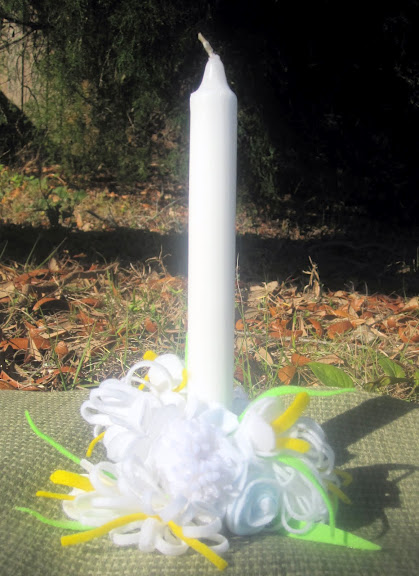
The result of all this pondering is that today I bring you a simple felt flower candle holder.

Warning: Do not leave candles unattended. Styrofoam melts when hot and felt will smolder. This is for decoration or short periods of time under supervision only.
________________________________________

Whatcha Need
• 2 inch Styrofoam ball
• Felt in white, yellow, and green. (Small quantities of the yellow and green)
• White yarn
• Aluminum foil
• Scissors
• Marking pencil
• Taper candle
• Hot glue gun & glue
• 1/2” Clover Pom Pom Maker
________________________________________

What to Do
At its core this is a Styrofoam ball covered in felt flowers with a place to stick the candle. I did 6 different types of flowers and I’ll show you each one. Not all of them are original to me. I promise to show you my inspiration.
First I cut off the bottom of the Styrofoam ball so I had a solid base.

I then used the tip of my scissors to carve out the hole for the candle. I inserted a small piece of aluminum foil into the bottom. This helps to keep the candle nice and tight. I now have the base to attach all of my flowers to.

Iris Like Flower
The first flower is an Iris like flower. I adapted this idea for Cherry Blossom flowers by Creative Jewish Mom.

I started with a strip of 1 1/2” x 6” white felt. I scalloped the edges to make the petals. Not shown in this picture (but it is in the following one) is I found I needed to make the down cuts larger. Only a 1/4” from the edge.

I cut 2 thin pieces of yellow felt about 2 inches long and first glued them to the far left. I then rolled the piece up using hot glue as I went.

I pulled down the exterior petals a bit to shape the flower.

I also cut two thin green pieces of felt and added them to the sides.

Generic White Petal Flower
This flower was also inspired by the Creative Jewish Mom.
First cut out three flower like shapes. One larger than the other two.

For the two smaller shapes add a bit of hot glue to the center and squish the flower together a little.

Now add a large bead of hot glue to the center of the large shape and stick the two squished ones into it. Arrange so it until it looks nice.

White Loopy Flower

This flower is entirely of my own thought.
I took a piece of 6” x 4” white felt and folded it in half. I cut from the fold towards the end in small slits making sure to leave about a 1/2” inch uncut.

I cut two thin pieces of yellow about 3” long.

Now I added some hot glue between the two pieces of felt at the bottom for stability then rolled it from left to right adding hot glue along the bottom edge as I went.

Pom Pom Mums
The only flower I did that doesn’t use felt. This is done by simply making Pom Poms with white yarn. I used my Clover Pom Pom Maker to make mine.

Better than me showing multiple pictures of the steps is this YouTube Video.
How to Use The Pom-Pom Maker Demo by Fran Ortmeyer

Felt Rose
This is a very simple felt Rose. I got the instructions from eHow.com. It just starts by drawing a circle on the felt and then drawing a spiral into the center. Those are the cut lines.

Once the spiral is cut out I started out the outside, glue gun in hand rolling the rose up and gluing as I went.

Filler Flowers
These are another of my own thought and there isn’t much too them. They are circles that I freehand drew and cut out.

I then added a spot of glue and pressed the circle together to make four petals. The blue you see is the marking pencil. I actually liked how it looked so I didn’t try to remove it.

Putting it all Together
I made multiple of each type of flower. The final numbers was:
• 6 Iris Type
• 2 Generic
• 6 Loopy Flowers
• 4 Pom-poms
• 2 Roses
• 7 Filler Flowers
Now I just glued them to the Styrofoam ball as I thought looked nice. I could have fit more also. I think they look best when they are really tight together.

These flowers could be used on all sorts of items, from hair accessories, brooches, bags, wreaths or other home decorations. They’re simple, easy and a great craft for children who can confidently use scissors and/or hot glue.
This could be done with regular craft glue but you would need to secure the flowers while they dry, rubber bands would do the trick.

I’d love to see some of the final projects of others who make these. Let me know by joining into the Flickr group, or posting it to the Facebook Fan Page.

Please come back and check out my blog, Treegold and Beegold. I’m currently working on a cute little sheep tutorial I’ll be debuting soon.

Trusting Intuition

An Excerpt from the 25th Anniversary Edition of Living in the Light by Shakti Gawain

Most of us have been taught from childhood not to trust our feelings, not to express ourselves truthfully and honestly, not to recognize that at the core of our being lies a loving, powerful, and creative nature. We learn easily to try to accommodate those around us, to follow certain rules of behavior, to suppress our spontaneous impulses, and to do what is expected of us. Even if we rebel against this, we are trapped in our rebellion, doing the opposite of what we’ve been told in a knee-jerk reaction against authority. Very seldom do we receive any support for trusting ourselves, listening to our own sense of inner truth, and expressing ourselves in a direct and honest way.

When we consistently suppress and distrust our intuitive knowingness, looking instead for authority, validation, and approval from others, we give our personal power away. This leads to feelings of helplessness, emptiness, a sense of being a victim, and eventually anger and rage — and, if these feelings are also suppressed, to depression and deadness. We may simply succumb to these feelings and lead a life of quiet numbness. We may overcompensate for our feelings of powerlessness by attempting to control and manipulate other people and our environment. Or we may eventually burst forth with uncontrolled rage that is highly exaggerated and distorted by its long suppression. None of these are very positive alternatives.

The true solution is to re-educate ourselves to listen to and trust the inner truths that come to us through our intuitive feelings. Following our inner guidance may feel risky and frightening at first, because we are no longer playing it safe, doing what we “should” do, pleasing others, following rules, or deferring to outside authority. To live this way is to risk losing everything that we have held on to for reasons of external (false) security, but we will gain integrity, wholeness, true power, creativity, and the real security of knowing that we are in alignment with the power of the universe.

In suggesting that our intuition needs to be the guiding force in our lives, I am not attempting to disregard or eliminate the rational mind. The intellect is a very powerful tool, best used to support and give expression to our intuitive wisdom, rather than as we often use it — to suppress our intuition. Most of us have programmed our intellect to doubt our intuition. When an intuitive feeling arises, our rational minds immediately say, “I don’t think that will work,” “nobody else is doing it that way,” or “what a foolish idea,” and the intuition is disregarded.

As we move into the new world, it is time to re-educate our intellect to recognize the intuition as a valid source of information and guidance. We must train our intellect to listen to and express the intuitive voice. The intellect is by nature very disciplined and this discipline can help us to ask for and receive the direction of the intuitive self.

What does it mean to trust your intuition? How do you do it? It means tuning into your “gut feelings” — your deepest inner sense of personal truth — in any given situation, and acting on these feelings, moment by moment. Sometimes these “gut messages” may tell you to do something unexpected or inconsistent with your previous plans; they may require that you trust a hunch that seems illogical; you may feel more emotionally vulnerable than you are used to feeling; you may express thoughts, feelings, or opinions foreign to your usual beliefs; you may follow a dream or fantasy, or take some degree of financial risk to do something that feels important to you.

At first you may fear that trusting your intuition will lead you to do things that seem somewhat hurtful or irresponsible to others. For example, you may hesitate to break a date, even though you need time for yourself, because you fear hurting your date’s feelings. I’ve found that when I really listen to and trust my inner voice, in the long run, everyone around me benefits as much as I do.

People may sometimes be temporarily disappointed, irritated, or a bit shaken up as you change your old patterns of relating to yourself and others. But this is usually because as you change, the people around you are automatically pushed to change as well. If you trust, you will see that the changes are also for their highest good. (If you do break that date, your friend may end up having a wonderful time doing something else.) If they don’t want to change, they may move away from you, at least for a while; therefore, you must be willing to let go of the forms of relationship you have with people. If there is a deep connection between you, chances are good that you will be close again in the future. Meanwhile, everyone needs to grow in his or her own way and time. As you continue to follow your path, you will increasingly attract people who like you as you are and relate to you in a way that feels honest, supportive, and appreciative.

Excerpted from the book Living in the Light – 25th Anniversary Edition ©2011 by Shakti Gawain. Printed with permission of New World Library, Novato, CA. www.newworldlibrary.com

Shakti Gawain is a pioneer in the field of personal growth and consciousness. Her bestselling title Living in the Light was just published in an updated and revised 25th Anniversary edition. Along with Marc Allen, Gawain co-founded New World Library in 1977. She lives in Marin County, California. Visit her online at http://www.shaktigawain.com.

A Magical New Year’s Resolution

by Sandra Kynes

A number of years ago I made the standard New Year’s resolution that began with: “Jeez, I’d better do something to get in shape this year.” Of course, I didn’t actually begin anything for a few months and then I decided that a daily walk would suit me.

At first I ventured out at lunchtime which provided a nice break in the middle of a hectic work day. When summer arrived it became too hot to walk at noon and, for my co-worker’s sake, I didn’t want to smell like a locker room all afternoon. This prompted me to roll out of bed a little earlier in the mornings so I could walk before going to work. It was nice and simple: old clothes, no make-up and I could throw on a hat to hide my hair.

In the beginning it was good “alone” time for me. I would think about anything and everything – big issues and non-issues. Sometimes I’d sort out problems and other times I’d find a few new ones for myself. Because I don’t listen to music while walking, friends have asked, “Isn’t it boring?” Not at all because my thinking time gave way to quiet time, and then I began to observe my surroundings – I mean, really pay attention. That’s when my walks began to deepen my connection with the natural world. What better way to honor Mother Earth than to witness her cycles on a day-to-day basis?

I discovered that spring mornings are abuzz with birds and squirrels scouting for breakfast. And that it’s rather magical when a rabbit sits up to look at me as if to acknowledge a bond between creatures of the dawn. As Earth renews herself, the vitality of life is visible everywhere. One day a tree may be sporting only tiny buds and the next day it seems to have exploded into a verdant green sphere. The month of May brings the lilacs into bloom and my neighborhood becomes awash in a fragrance richer than anything Chanel can put in a bottle

Many summer mornings bring a fresh ocean breeze that ripples through gardens where abundant herbs and vegetables are a reminder of Gaia’s generous bounty. Autumn mornings are frequently softened by thick fog that rolls in from the harbor. The Celts considered a fog, the edge of a forest or a shoreline as betwixt and between places with the potential to reveal unseen realms. On these mornings the world seems cloaked in a sense of mystical wonder that even the crows honor with silence.

At this time of year Canada geese create a spectacle as they form V-shaped ranks in preparation for their journey southward. I am reminded of the ancient bird goddess figurines of southern Europe which were marked with Vs emphasizing the Mother Goddess’s role as life-giver and provider. It’s easy to understand this connection in the ancient mind – to them the V formation of geese and ducks indicated the direction of a water source and plentiful food. I sometimes pause to watch while I ponder my connection to very distant ancestors.

In winter when the trees are bare and the snow piled high the landscape is transformed into a place of stark beauty. In this hushed wonderland I can feel a fragile and ethereal magic surround me like frosty breath. Although footprints reveal signs of busy animal and bird life, the world seems suspended in time as seeds rest underground awaiting their turn to bring forth a new cycle

Sometimes the moon accompanies me on my morning rambles. Luna’s phases are more obvious than Gaia’s and serve to remind me of the phases of my own life. I have been maiden and I have been mother. Now at the threshold of a new phase, I hope to become a wise crone.

What started as a half-hearted resolution to get in shape has blossomed into a deeply meaningful practice for body, mind and spirit. My soul is more acutely in tune with the rhythm of natural cycles and I have a peaceful sense of my place in the greater spiral dance of life. On the rare days that a walk doesn’t fit my schedule I don’t feel guilty about the lack of a workout, but I do wonder what magic I may have missed that morning.

About Sandra Kynes:
Sandra Kynes describes herself as an explorer of Celtic history, myth and magic. Her curiosity has taken her to live in New York City, Europe, England and New England. Spiritually her inquisitiveness has led her to investigate the roots of her beliefs and to study ancient texts such as the “Mabinogion”. One thing she discovered about herself is that she tends to see the world a little differently than most people. She likes finding connections between things and creating new ways and methods for exploring the world, which has been the inspiration for many of her books. A life-long interest in archaeology was deepened during the time she lived in England. Tracking down remnants of stone circles and other ancient sites is a passion she pursues on return visits to the British Isles. Her 7th book with Llewellyn will be published in 2012. To learn more visit her website Celtic Soul and/or follow her on Facebook.

Just Think Happy Thoughts!

by Bob Makransky
(This essay originally appeared in the Magical Almanac Ezine. Used here with the author’s permission.)

Whenever I hear some spiritual guru proclaim that all you gotta do is “just think happy thoughts!”, it makes me want to pop him one upside the head and see how long he can keep on thinking his “happy thoughts.”

Take as an example Miguel Ruiz’s best selling “Four Agreements”, which exhorts readers to “Be impeccable with your word; don’t take anything personally; don’t make assumptions; always do your best.” The degree of profundity or usefulness of this advice is beside the point; it does a disservice to the reader. No effort was made to explain why it’s impossible to be impeccable with your word (in a society based upon lying to other people and yourself); not to take things personally (when all your social training is pointed at inflating your self-importance); not to make assumptions (in a society which discourages thinking for yourself, or thinking at all); or why it’s impossible to do your best (in a society which teaches you to cringe helplessly and wallow in self-pity). In other words, fluffy writing just adds more guilt to the burden of self-hatred which people are already carrying by making people blame themselves, rather than their hypocritical society, for their unhappiness. Fluffy writing may sound soothing because it’s simplistic; but it’s of no real help to anyone.

Who is thinking happy thoughts? The evangelizing proselytizers with their toothpaste-advertisement grins and their used-car-salesman spiels? If those people were truly happy in their hearts, would they be running around trying to make other people like them (in all senses of that word)? Being in denial is not the same thing as being happy. NOBODY (except maybe a few lamas meditating in caves in the Himalayas maybe) can control their thoughts. People can most certainly run away from their issues by distracting themselves, but that is not the same thing as controlling thoughts. It’s like masturbation was in the Victorian age – everybody was doing it while paying lip service to denial; and then feeling ashamed of themselves for being so “perverted”. Similarly, people are being lied to about “just thinking happy thoughts” – and then are made to feel worse about themselves because they are incapable of accomplishing this unattainable feat.

It’s all a lie – this “Positive Thinking” baloney, like so much New Age cant (oh yeah, that’s another one: “never say can’t!”). If you are not happy inside, then 1) it’s impossible to think happy thoughts (unless you’re in denial); and 2) thinking happy thoughts isn’t the way to change your mood in any case (it works the other way around: when you are able to control your moment-to-moment mood – or better said, relax into indifference – THEN your thoughts naturally tend to be happy). What creates your reality is your underlying mood, not what you tell yourself (not your thoughts).

The pundits of Positive Thinking have their cause-and-effect backwards. And they exacerbate people’s problems by blaming them for being unable to control their thoughts – as if society doesn’t heap enough blame and shame on people as it is … now in the New Age people have to blame themselves for being unable to accomplish the impossible. To expect that YOU – l’il ol’ nose pickin’ and pastin’ it under the furniture YOU – should be able to control your thoughts (and then chide yourself when you fail to live up to this ridiculous expectation) is completely absurd. Positive thinking is just another of society’s lies designed to make you feel crummy about yourself.

People need to be told that it’s okay if they are unhappy; that everybody in our society is unhappy, and any appearance to the contrary is just that – an appearance. This is another of our materialistic society’s dirty tricks: constantly telling people “See – those guys over there who bought our useless products are happier than you are! Go for it!” Having us compare ourselves to other people is stupid, since everyone’s karma is so different. And since our superficial society forbids us to talk openly about anything that really matters, we rarely know what anyone else is truly feeling inside in any case.

This is not to say that people don’t have to take complete personal responsibility to get themselves out of the messes they find themselves in. Just that there’s no need to feel guilty for not fulfilling society’s expectations (including being able to “think happy thoughts”), since society’s expectations are impossible to fulfill; moreover, the rewards for fulfilling them aren’t even worth it. This realization is the first step on the spiritual path.

Clue Number 1: Your image of what the spiritual path is all about is wrong – absolutely wrong. Completely off the mark. Not even close. When you finally do get “there”, you’ll realize that the things which you thought were of the essence, aren’t; and the things which are, weren’t part of your thinking at all (they were too subtle, so you overlooked them at the time). What spirituality is all about has to be felt in your heart, not conceptualized. When don Juan finally explained his teachings to Carlos Castaneda (just prior to his leaving him forever, at the end of “Tales of Power”), he told Castaneda that he had been deliberately misleading and sidetracking him all along during the apprenticeship, keeping Castaneda’s thinking mind focused on irrelevancies, and making light of the issues which were indeed the crux. This is because the thinking mind only gets in the way on the spiritual path. The thinking mind is of utmost importance in getting along in society, but it is actually a hindrance in pursuit of the spiritual, which is why don Juan averred that the best sorcerers were either completely stupid or completely crazy. Isn’t it true that in our society the most spiritual people (most open-hearted) are usually either retarded or lunatics?

Clue 2: If you find the spiritual path enjoyable, you ain’t on it. The spiritual path sucks – and don’t let anyone tell you otherwise. Do you suppose St. John of the Cross was just kidding around when he spoke of the Dark Night of the Soul? On the spiritual path, as in the gym, no pain means no gain. Why do you suppose that gurus such as Sri Yukteswar and Gurdjieff and don Juan (and don Juan’s teacher don Julian) were so abusive to their disciples (except for the disciples who were pretty selfless to begin with)? Why do you think don Juan recommended finding a petty tyrant – an oppressor who spits on you and stomps your self-esteem into the mud – as the most important element of spiritual training? Self-importance is not eliminated by having other people envy you or pat you on the back and tell you how great you are; or by having all your fantasies and daydreams come true. It’s eliminated by having your self-images – everything you crave and strive to uphold – trampled into the dirt.

The spiritual path lies in the diametrically opposite direction from the path society has conditioned you to travel. The spiritual path – the deconditioning process – involves prying your grasping fingers loose from everything society has conditioned you to cling to. This is not pleasant at all. Moreover, nobody is going to give you any reward or recognition for your spiritual accomplishments: depending on your karma (people who are pretty selfless to begin with have it easier than the rest of us), probably most people around you will do everything in their power to frustrate you, be jealous of you, or belittle your efforts. As don Juan told Castaneda, “A warrior has no honor, no dignity, no family, no name, no country; he has only life to be lived, and under these circumstances, his only tie to his fellow men is his controlled folly.” Anybody who is really on the spiritual path (unlike the happy-thought thinkers) is usually crucified by society and the people around them.

The point is that the true spiritual path is entered by facing things squarely as they are (not by denying your reality by “thinking happy thoughts” or otherwise running away from yourself); and then by just accepting your situation – giving up the ghost, stopping all the struggling and fuming, getting off your own case and other people’s case and God’s case. There are no shortcuts on the spiritual path. There definitely are techniques; and it is necessary to find congenial techniques which you can practice daily, to focus your intent. But there is no way to change anything by snapping your fingers or taking a workshop or just thinking happy thoughts.

To tell someone who is in great pain to “just think happy thoughts” is like telling someone without legs to just get up and walk. Deconditioning and reconditioning your mindset requires a tremendous amount of time and endurance – it’s not something you can “just do”. It’s also why magicians aver that there is no point in even considering undertaking the task until you are completely desperate. True spiritual growth is basically just a matter of exhaustion, of complete wipe-out, of coming to realize the futility of it all. But there is no way to hurry anything up. No way. The sooner you give up trying, or lying to yourself by “thinking happy thoughts”, the sooner true change will happen.

About the author:
Bob Makransky is a systems analyst, computer programmer and professional astrologer. He lives on a farm in highland Guatemala where he is a Mayan priest and is head of the local blueberry growers’ association. Check out his free downloadable Mayan Horoscope software, free downloadable Planetary Hours calculator, free downloadable Primary Directions / celestial sphere mathematics textbook, complete instructions on how to channel by automatic writing and how to run past life regressions, articles, books, stories, cartoons, etc. etc. at www.dearbrutus.com.

Old Sir Christmas

By John Matthews and Caitlin Matthews from their book The Winter Solstice: The Sacred Traditions of Christmas (used here with the Quest Books permission)

The Birth of Santa Claus

His story is a complex one. Many will know that Santa means saint, and is of modern usage. Others will tell us that the nearest point of origin for Santa Claus – in time, anyway – is St. Nicholas of Patara, a third-century Bishop of Myra, near the present-day village of Demre in Asia Minor. Born in Turkey to a wealthy family around A.D. 270 he became well known for his anonymous gifts to the poor. Tradition has it that he left these offerings in the houses of selected recipients, sneaking in during the night to leave money or food in the shoes or stockings of children – though it is doubtful whether they would have worn either in that hot land, assuming they could afford such luxuries anyway. However, such is the tradition, and it is from this that we derive the custom of hanging stockings by the fireplace, while in various countries such as Austria, Germany, Switzerland, Belgium, and Holland, December 6th, St. Nicholas’s official day, is also Children’s Day, and is considered just as important as Christmas Day itself. In fact, it is only in comparatively recent times that we have conflated the two dates – the 6th and the 25th – making the latter a general festival for the exchanging of gifts.

Good Old Saint Nick

If we go back to the Middle Ages, about 1,200 years after St. Nicholas actually lived, we can see how this might have begun. In the words of Naogeorgus, the author of the Latin Vita Sant Nicolai (Life of St. Nicholas):

The mothers all their children
on the eve do cause to fast,
And when they every one
at night in sense sleep are cast,
Both apples, nuts,
and prayers they bring,
and other things beside,
As caps, and shoes, and petticoats,
with kirtles they hide,
And in the morning found,
they say: “St. Nicholas
this brought.”

This has most of the ideas that we associate with the figure of Santa Claus, but there is another, stranger story told of St. Nicholas, which actually points the way to his true origin far more clearly:

An Asiatic gentleman, sending his two sons to Athens for education, ordered them to wait on the bishop for his benediction. On arriving at Myra with their baggage, theytook up their lodgings at an inn, proposing to defer their visit till the morrow; but, in the meantime, the innkeeper, to secure their effects to himself killed the young gentlemen, cut them into pieces, salted them, and intended to sell them for pickled pork. St. Nicholas, being favoured with a sight of their proceedings in a vision, went to the inn, and reproached the landlord with the crime, who, immediately confessing it, entreated the saint to pray to heaven for his pardon. The bishop, moved by his confession and contrition, besought forgiveness for him, and supplicated restoration of life to the children. Scarcely had he finished, when the pieces reunited, and the resuscitated youths threw themselves from the brine tub at the feet of the bishop; he raised them up, blessed them, and sent them to Athens, with great joy to prosecute their studies.

A.T. Hampson: Popular Customs and Superstitions of the Middle Ages

On one level this story may be regarded as nothing more than a pious anecdote illustrating the sanctity and goodness of the saint. But there is more to it than that. The notion of a person being dismembered and put back together, as portrayed in this tale, again derives from a far older time, and when it is placed in conjunction with certain other factors, a surprising new image begins to appear that has all the characteristics of the traditional Santa without any of its later overtones of bishops and Christianity.

The Gift Givers

In comes I, Old Father Christmas.
Welcome – or welcome not,
I hope Old Father Christmas
Will never be forgot.

The Longparish Mummers’ Play

Santa Claus is really only the latest of many figures which have come to be associated with bringing gifts on the night of December 25th. In France presents are given on New Year’s Day and called entrennes, a name that can be traced back to the strenae, green branches, exchanged between people at the Roman feast of the goddess Strenia. In Sicily it is an old woman named Strina who brings gifts at Christmas, continuing a tradition that began in the days of the Roman Empire.

The figure who stands behind the jolly old man of Christmas is older even than this, however. In fact, his story takes us back to the beginning of recorded history, when some other characters climbed up trees of a different kind, and returned with gifts for everyone. These were not toys or perfume or watches, but messages concerning the year to come, or the turning of the seasons, or the fate of the world. These people were the shamans, who performed the functions of priest, historian and record keeper, scientist, and magician. Of course there were shamans all over the world, and in most cases they performed the same or similar functions, but, for obvious reasons, it is those who originated in the far North – anywhere from Lapland to Siberia– that interest us most in this context. It is these people who often wore bells on their ritual costumes, who shinned up the central polesof their skin tents, and who returned with the gigts of prophecy and wonder from the Otherworlds. Its is to these people that we have to look for the first appearance of the figure who, thousands of years later, evolved into the jolly old man of Christmas himself, Santa Claus.

If we look for a moment at some of those similarities we can catch a glimpse of the evolution of one into the other. If we dip our hands into Santa’s sack – so like the shaman’s bag of tricks – the first thing we find are the bells that jingle on the harness of the eight magical reindeer. Contemporary accounts of northern shamans, including those of the Altaic and Buryat regions of Siberia and those of the Finns and Laplanders, again and again emphasize the importance of bells in their traditional costumes. These form a double function; as noise-makers to announce the presence of the shaman as he enters the spirit world, and to frighten off any unfriendly spirits who might be lying in wait for him. In addition, iron disks representing the sun or curved in the shape of the moon represent the importance solar and lunar rites among these Northern people– and important point in our consideration of the Solstice itself.

Red Robes and Firelight

Reaching into the sack again we find a red robe or cloak, trimmed with white. Many authorities on shamanic tradition have commented on the importance of the color red in the shaman’s costume. This is, on one level, significant of the sacred blood that links all human beings and that is also perceived as a link between humans and animals, and between the shaman and the earth. It is also, of course, a symbol of fire, that most powerful of magical weapons, as well as the gift of warmth and life to all, especially significant in such cold lands as those we are considering here.

Next in the sack we find a burning brand that signifies the eternal light and the warmth without which all life would perish. The shamans possessed this gift of fire, which initially perhaps they alone had the power to kindle (the number of flint fire-lighters found among shamans’ bundles alone is enough to suggest this) and which was a gift they brought to the tribal people they served. It was believed that these gifts were entrusted to them for the people by the gods and spirits of the land. Here, the symbolism of red fire in the white desert of Winter is a vital image. Is it stretching the point too far to see an echo of this in the red and white costume and white beard of a certain other figure? Certainly the importance of these colors throughout the northern world is beyond question.

Dipping into the sack again we find reindeer with bells on their harnesses, who can fly through the sky and cover vast distances in no time at all. This is yet another echo of the shaman’s journey into and through the heavens, in search of the gifts of fire and prophecy. In addition, there is the obvious importance of reindeer to the people of Lapland and Siberia is obvious. To these people the reindeer not only provided a source of food but also skins for clothing and tents, sinews for thread, bones for needles, and, when rendered down, fat for rush lights and
glue to mend pots and fix spearheads in place.

So Santa is an old man dressed in red who comes out of the dark forest of the North on a sleigh pulled by reindeer. It is significant then that the shamans hunted the reindeer, ran with them in spirit Corm, drew their shapes on rocks with red ochre as a means of capturing them, even saw them as a symbol of the newly born sun of Midwinter. A wonderful modern poem speaks of the hunting of spirit deer, who, impervious to the hunter’s arrows, were a symbolic reference point for hunting the real creatures:

A red deer comes over the hill,
Shoot your arrows as you will,
The deer will stand there still!

Alison Mcleay: Solstice

The Shaman in the Tree

Consider the image of the shaman climbing down through the smoke hole of a skin tent with bells jingling, bearing in his hands a red painted wooden reindeer. The shamans saw to it that the sun returned from that point when, at the very edge of the horizon, it dipped and, for a moment, was gone. Then, summoned by the ancient language of the elements, it returned. Sun images were hung on a tree, that also formed the central pole of the tent and represented the axis of the world, the connection which leads to the heavens the final destination of the shaman who was, indeed, the midwife of the sun.

Imagine some of the questions asked of the shaman. As Alison Mcleay put it in her wonderful evocation of the Solstice in a radio broadcast she made in 1985:

Shaman, will the sun be reborn?
Will we have a good harvest?
Will we catch enough fish, will
there be enough meat to eat,
will the reindeer drop enough
offspring to keep us through another year?
What will the new year
bring for us, for me?
Tell us, shaman, make your
journey and bring us the
gifts of your seeing?
You are the bringer of gifts,
the protector, the magician,
the future is yours to see, the
gifts of the future and the past
—tell, us shaman, tell us.

Sacrifices were hung on the living tree: animals, birds, perhaps once even humans, such as Odin hanging on the windy tree of Yggdrasil to bring back the gifts of the runes. Odin’s eight-legged horse Sleipnyr may also be linked with Santa’s sleigh and its eight reindeer. And that song – next out of the sack:

0 the rising of the sun, and the running of
the deer, The playing of the merry organ,
sweet singing in the choir

The Holly and The Ivy

These are old images, stolen by a later time, and reflect two aspects married under the Solstice tree: the running deer who were the totem creatures of many different Northern tribal groups, and the singing of carols in the stone forests of the Christian world. The old ways were not wholly forgotten, not even after the coming of the Christ child, who brought the gifts of light and eternal life to the world, and who received gifts from the wandering wise men – the Magi of biblical and pre-biblical tradition. They too contribute to the image of Santa the gift bringer, and, as we have seen, there is more to them than meets the eye.

About John Matthews:
John Matthews is an international authority on Celtic folklore, the Western mystery tradition, and the Grail legends, and is one of the great culture-bearers of our times. He has written over forty books on the Arthurian legends, esoteric wisdom, and the Grail. His Quest Book “The Winter Solstice” won the Benjamin Franklin Award in 1998. With his wife and frequent coauthor Caitlin, John established the Foundation of Inspirational and Oracular Studies. To visit the author’s website, www.hallowquest.org.uk

Sounds Like Winter

By Marcy Lovitch

Not really “feeling it” this holiday season? Tired of hearing the same old Christmas music wherever you go? Worry not. There’s actually a plethora of wintry and non-denominational treasures that you haven’t heard a million times on Muzac at the mall.

Pop/Rock

Being single at the holidays can be a drag, especially when it’s not by choice. You can take solace in the 80s’ sounding ballad, “Early Winter” by Gwen Stefani,from her 2006 solo album “The Sweet Escape”. It examines lost love as autumn fades into the colder, darker days of winter. On the other hand, if you did the dumping, then assuage your guilt with Taylor Swift, exploring regret, apology and the pain of leaving a relationship in “Back to December”.

Beloved rock songstresses who evoke the contemplative mood of the cold season include Tori Amos with her reflective “Winter,” a beautiful ballad on solo piano with Tori’s soulful lyrics (“Little Earthquakes”, 1992). Equally cool is Sarah McLachlan’s “Wintersong” album featuring 12 tracks about wintertime including a the glistening gems “Wintersong,” “Song for a Winter’s Night” and a cover of the Joni Mitchell classic, “River.”

Ambient Instrumental

If you’d rather chill without lyrics, there are plenty of ambient, new age and solo piano albums to explore. Grab a cup of hot cocoa, a cozy blanket and the beautiful piano solos from Michele de Wilton new release, “Snow Angel”. Tracks like “Snowfall,” “In the Bleak MidWinter” “WinterBlueGreen,” and the story of The Ice Maiden in “Waltz for Gerda and Kay,” will transport you into a winter wonderland for the soul.

Award winning artist and extraordinary voice Seay offers with “A Winter Blessing: Songs for the Season”, a festive, seasonal album celebrating all things winter and the holidays. Filled with Seay’s spectacular vocals, your heart will be filled with magic, love and light.

Beloved international concert pianist Danny Wright offers an evergreen favorite with “An Intimate Christmas”, bursting with both traditional carols and original compositions written for people whose stories moved him to create. If loneliness is what ails you, this album wraps its metaphorical arms around you and brings a quiet solace.

Windham Hill Records’ Winter’s Solstice collections (there are six volumes) offer relaxing instrumental selections from various Ambient, New Age and Jazz artists. Pianists George Winston, Liz Story and guitarist William Ackerman are just a few contributors to this mood-setting music series. It’s the perfect background accompaniment while curled up in front of a fire.

Retro classics

Once you’ve rocked and lulled through the selections above, perhaps you’ll be ready to get back out there in the spirit of the season. Consider revisiting a few of these old faves; so many artists have covered these songs that you can pick and choose your favorite versions.

“Baby It’s Cold Outside,” a pop standard by Broadway and Hollywood composer Frank Loesser never fails to get you in a snuggly, romantic state of mind. Some notable versions include the duet with Ella Fitzgerald and Louie Armstrong; the Bette Midler version (joined by James Caan) from the 1991 film, “For the Boys”, and the pairing of James Taylor and Natalie Cole.

Another timeless standard “Let It Snow” gets a big band-y, jazzy treatment from crooner Michael Bublé. Diana Krall gives the tune a more intimate treatment. For something even slower and more low key, check out John Legend’s cut of the Sammy Cahn/Jule Styne song.

“I’ve Got My Love to Keep Me Warm” by Irving Berlin has been sung by some of the best in the business: Billie Holliday, Judy Garland, Rosemary Clooney and Frank Sinatra, among others. Canadian songstress Lily Frost delivers a stylized, cabaret style version off of her album, “Lily Swings”. But perhaps the best of all is Rat Packer, King of Cool, Dean Martin’s swingy, smooth as silk recording….just press play on that one, and — in no time at all — you’ll be wanting to drag your sweetie – or some lucky stranger – over to the mistletoe.

About Marcy Lovitch:
Marcy Lovitch is a New York-based freelance writer; she is not crazy about Christmas music. She’s a contributor at: http://hiltonshead.blogspot.com/

An Introduction to “The Old Sod”

Excerpt from “The Old Sod: The Odd Life and Inner Work of William G. Gray” By Alan Richardson and Marcus Claridge. Skylight Press, 2011 (reprinted here with permission)

“OK so I’m an old sod, an old bastard, a thousand different kinds of shit if you like, but I am a human being who loved the esoteric Tradition I tried to serve… Perhaps I didn’t do very well with what I’d got but I did my best…”

[letter to Alan Richardson, 19th Sept. 1989]

William G. Gray was a real magician, a kind of primeval spirit who worked his magic as an extension of the Life Force, not as a sop to ego. No-one who met him had any doubt that he was in touch with supra-human sources of wisdom, or that from his home in a dowdy back-street of Cheltenham he was bringing through energies from other dimensions that would one day influence us all. He reeked of psychism like he often reeked of incense, could give you the uncomfortable feeling that he could see right through you and beyond, and had been to places in spirit that we could scarcely imagine. He had powers of low-key prophecy which he often demonstrated, which were often accurate, and he turned some of the convoluted magical systems that had endured for centuries inside-out and upside-down, thus making it simpler for the rest of us to work with Light. Many of the books on magic and the kabbalah which appear today owe a huge if unrecognised debt to his pioneering writing. If nothing else, he was a true original in everything he did. In some ways he was larger than life, and many people were fearful of him. In other ways he had exasperating and unapologetic human quirks which could make him seem very small, depending on where you stood – or sometimes rather appealing if you didn’t get blasted by his ire.

Anyone who ever met Bill Gray must laugh at the books churned out by the self-styled witches, magicians and urban shamans who, a generation later, imagine they are High Priests, mighty adepts, or 21st Century brujos. What empty figures they are in comparison, clutching their amulet-filled power pouches or dream-catchers, communing with their power animals while riding their dainty silver broomsticks through crystal-singing candy-floss Otherworlds where everything is eternally positive and ineffably, irritatingly, nice – and always with at least one eye on achieving a few sound-bites on local tv.

As Bill might have said when asked if they raised any real power: “Raise power? That lot couldn’t raise so much as a good fart between them!”

Yet if there is anything evolutionary about the current urge to revitalise the present by looking at the patterns of the past, and the increasing notions that there are harmonic energies within the Earth and ourselves that can be worked with – whether through green eco-movements, the Celtic Revival or the Wiccan arts – then it is due in no small degree to the work that was done by an old bastard who lived near the bus station in a faded town in Gloucestershire.

At least Bill Gray could raise power. Power that could make your eyes water and your fillings ache, and seep out into the world to change it. That’s what real magicians do. Whether he could always handle it with love or wisdom, is another issue. He made many enemies. Even his friends often winced at his antics. Yet now, a decade after his death, both friends and enemies remain united in their recognition of the fact that – whatever his mortal faults – he was a one-off, and that holy magic flowed through his veins like blood.

Bill was hard. He could intimidate. A real sod at times. He wrote brilliant letters, but when it came to books he often fell out with his editors. Yet they tolerated a lot because they knew that he was in a different league to the other writers on their lists who simply made it up as they went along. Underneath the dense and often abrasive prose, with the alliteration he felt would help get concepts embedded in the readers’ mind, it was quite obvious to them that here was a new level of insight into the theory, practice, philosophy and sheer experience of Magic, and how it impinged upon the world. Here was a real magician.

He seemed to know everything, although he rarely bought a book or plundered the library:

“Do you know why Aleister Crowley spelled magick with a ‘k’?” he asked Alan Richardson once, and the young man perked up because he had read exactly that only days before and saw a rare chance to impress the old mage.

“Actually Bill I do. Not only did he want to distinguish the medieval, supernatural and spiritual art of Magic from mere conjuring, but the ‘k’ referred to the Greek word -”

But Gray wouldn’t let him continue. He had already worked it out himself, intuited it, and proceeded to explain at great length because the lecture was in his head just waiting for an audience. And although it wasn’t exactly what Crowley had said, it was impressively close. All to do with sex.

So for those of who are new to the topic, what do we mean by magic, as practised by real magicians? – regardless of which spelling they use. And why, of all things, did we call his biography The Old Sod?

Bill himself wrote of magic:

Definition of Magic is largely a matter of individual opinion…Fundamentally it remains what it always was: Man’s most determined effort to establish an actual working relationship through himself between his Inner and Outer states of being. By magic, Man shows that he is not content to be simply a pawn in the Great Game, but wants to play on his own account. Man the meddler becomes Man the Magician, and so learns the rules the hard way, for magic is concerned with Doing, while mysticism is concerned with Being.
[Magical Ritual Methods, Helios 1969]

Compare this with Crowley’s:

From the nature of things… life is a sacrament; in other words, all our acts are magical acts. Our spiritual consciousness acts through the will and its instruments upon material objects, in order to produce changes which will result in… new conditions of consciousness.
[The Confessions of Aleister Crowley Bantam Books 1970, page 110]

It was once an art. It was an integral part of Religion. As Bill further explained:

“The word Magic… had root connections with greatness, (Maj) and mastery (Magister), and providing this might be understood in the sense of spiritual development and self-mastery, it seemed a reasonable description of the Path I intended to follow. Orthodox religions of all descriptions rejected Magic as a dangerous rival, yet Magic was inclusive of religion… Religion was collective whereas Magic was individual, and I was all for individualism… I would find my own faith through whatever I might learn of Magic and its practical purposes.”

As to the title The Old Sod

It was partly because he really could be, in the British vernacular, an old sod. That is to say, an extremely awkward character; a bit of a bastard. However it is a term that can be used with admiration and very deep affection also, akin to Americans calling someone an old fart. Second, it also refers to sod as a clump of earth, and has allusions to the pioneering Earth Magic which underlay a lot of his inner work. Bill was aware of both of these usages and grudgingly accepted them. But it never seemed to enter his head that it also referred to his role as the founder of the Sangreal Sodality – the latter word meaning a confraternity of like-minded souls. And beneath these there is perhaps a fourth reason: by calling him this, we could keep him at a slight distance, and not get sucked into the sort of fawning that so often mars the art of biography. We owe the man and his magic a huge debt, and want to repay this as fully and honestly as we can, but we were not totally blinded by his light.

Did Bill have any dark secrets? Well he certainly looked into and possibly explored many dark and secret areas of the psyche, but that is the path of anyone hell-bent on the getting of wisdom. William G. Gray could be and was a mighty magician, but he was also human, with many of the prejudices of his class, age and locale. He lived in Cheltenham for gods sake! and that alone explains much.

Next, to get the current (and tedious) spiritual and political correctness out of the way, Was he sexist, homophobic or racist?

Sexist? No. Not at all. Although hardly what you might call a Ladies’ Man, he could get on extremely well with women, and some – younger ones in particular – often found him immensely charming and loveable. Whatever his faults, none of the younger generation of women ever took him to task for being sexist, although his contemporaries might disagree.

Homophobic? No. We knew a number of gay people in common, who were involved in magical activities, and he never once took issue with their sexuality. In fact he didn’t really understand gay issues much, and the only weak part of his classic Ladder of Lights is when he gives some absurd advice to gay men and lesbian women as to how they might ‘get straight’.

Racist? Well, yes. No denying it. His use of the term ‘Nigerian’ as a euphemism for the obvious became tiresome very quickly. Yes he was a racist – although he modified the term in his later years to ‘racialist’, and this is something that must be looked at in some detail. But right from the start it is worth bearing in mind that one of his most respectful and meaningful encounters in South Africa was with Credo Mutwa, the famous Zulu medicine man, author of Indaba my Children and My People. They got on famously, expressed mutual admiration, and he spoke of it later with great pride. So the issue is not that simple, and we shouldn’t brand and reject him with the bald word ‘racist’ without looking at the whole issue.

For various reasons – legal, moral, literary and magical – we decided that it wouldn’t really be advisable to publish Bill’s autobiography verbatim. So we took the best bits in which he explained things in his own inimitable way, and turned the rest of it into a third person biography in which we could use the memories and comments of those who had known and worked with him. But as he wrote to Marcia Pickands, one of the inheritors of his Magic:

“For gods sake don’t make me out to be any kind of ‘Master-Figure’ with any kind of ‘powers’ or faculties other than those of human understanding. I have simply written what I have seen by the Inner Light afforded me. If this helps others well and good, and if it doesn’t I’m sorry but it’s all I’ve got. What I’ve written is for others to make their own way with and do a lot better than I possibly can. The more they can do with it the happier I’ll be.”
[29th July 1986]

Right then Bill, we won’t make you out to be any kind of Master-Figure as you term it. But you did have talents that went a little further than everyday human understanding; you did have an enormous impact on a wide range of people, either directly or indirectly; you weren’t quite as modest and self-effacing as the above quote might imply; and you could be so bloody difficult that we, who sort of idolised you, will let you have your say in all the important things relating to Magic, but also take this chance to make you listen. Just for once. Blast us to buggery if you want, but be aware that we’ve written according to the inner light that you sparked within us. We are determined to make that light grow. If readers can use it to find their own Holy Grails through the inspiration of your work and example, then we will be more than happy.

Ditch Your Inner Critic

Ditch Your Inner Critic: Five Practical Ways to Stop Beating Yourself Up So your Inner Superstar is Free to Shine

By Amy Ahlers

“If only I were thin enough, rich enough, better-looking…THEN I could stop being so hard on myself.” Have you ever had that thought? If only your circumstances were different you could then magically shift your internal dialogue into an empowering, nurturing, loving one, right? After more than a decade of coaching people from every walk of life, I finally got it: we are hard on ourselves despite our external circumstances.

We beat ourselves up for both the big things and for the tiniest imperfections. And all this punishment isn’t helping us become more successful or to feel more fulfilled or even to get more done.

And who can blame us for being so hard on ourselves? Women have a lot on their plates: careers, romance, kids, health . . . the list goes on and on. We’re supposed to bring home the bacon, fry it up in a pan, have incredible sex with our partners (never letting him forget he’s a man — that is, assuming he is a man), get the laundry and housework done, have healthy, accomplished kids, and a tight butt and perky boobs to boot. And it’s no easier for men. The demands of modern life make us feel like we’re supposed to enjoy being pulled in a million directions at the same time. And that we’re supposed to be as flexible as Gumby on muscle relaxers. But we’re only human.

What would happen if we gave ourselves a break?

First, it is vital that you identify the critical, catty, judgmental voice in your head as your very own Inner Critic. And I’ve got news for you: Your Inner Critic is a Big Fat Liar! She/he tells you Big Fat Lies to try to maintain the status quo and keep you in your comfort zones – even if your comfort zones aren’t all that comfortable.

If you want to take control of your happiness, it’s time to take Your Inner Critic out of the driver’s seat.

Try the five tips below to ditch Your Inner Critic:

Tip One: Identify Your Inner Critic’s Top 10 List of places, situations, and environments where she/he likes to show up and criticize. Is it at work? Social events? In bed? Whenever you look in the mirror? Once you know what circumstances are likely to trigger Your Inner Critic, you can be better prepared to deal with that voice.

Tip Two: Draw, doodle or sketch a picture of Your Inner Critic. Is he pudgy with big glasses? Perfectly pressed in pink? A slob with a cigarette in one hand and a martini in the other? Don’t worry if you think you can’t draw. No one will ever see this but you, so go for it! Having a mental image of the voice that tortures you – particularly a funny image – can instantly take away some of Your Inner Critic’s power.

Tip Three: Get to know Your Inner Critic on a deeper level. Notice what makes him louder, and notice what diminishes her power. What happens if you just yell “Shut up!”? What if you just look her calmly in the eye and reassure her that everything is going to be all right? Maybe he needs a compliment every now and then? After all, Inner Critics need love too.

Tip Four: What are Your Inner Critic’s favorite Big Fat Lies about you? What does he/she say to you over and over? Is it, “You’re a Failure,” “You’re Unlovable,” or “You’re Not Enough?” Your Inner Critic will collect evidence to make the case that you’re not good enough, even twisting things around when necessary. Your Inner Critic will do everything possible to back up those favorite punishing, disappointing, sad stories about you and your worth, so it’s up to you to remember the good stuff about you, no matter how convincing she/he seems.

Tip Five: Do this powerfully simple three step process to see through Your Inner Critic’s Big Fat Lies:
Step One: Ask yourself, “What is my Inner Mean Girl/Inner Critic saying?” Give voice to the Big Fat Lies you are believing. Speak them – get them out of the darkness and into the light so they can be healed. Don’t hold back here . . . rant! Let it out!
Step Two: Close your eyes, take a deep breath, and ask yourself, “What does my Inner Wisdom know?” Sink into the land of your Inner Wisdom’s Truth. This is the place that feels grounded. It feels like home. Really let the Truth wash all over you and disintegrate the Big Fat Lies. Ahhh . . . that feels better!
Step Three: Lock in your Inner Wisdom’s Truth by repeating it (aloud if possible) accompanied by a physical gesture that reinforces the message. My Inner Wisdom has me lightly touch my heart; I have one client who waves his hand as though he were testifying in church and another who touches her belly. This gesture becomes your touchstone, reminding you to step into Truth and feel better.

Shifting your focus to your Inner Wisdom will always bring you in line with your Truth and Compassion, and you will always feel better. As you practice this process more and more, you’ll find your Inner Superstar coming to life.

Here’s the Truth: You are a Superstar.

And I know, because my Inner Wisdom told me so.

About Amy Ahlers:
Amy Ahlers, the Wake-Up Call Coach, is on a mission to wake up your Inner Superstar so you shine bright. She is a celebrated certified success coach, the CEO of Wake-Up Call Coaching, the cocreator of Inner Mean Girl Reform School, and the innovator of many teleseminars such as the Women Masters and the New Man, New Woman, New Life, where she has spoken alongside luminaries such as Marianne Williamson, Neale Donald Walsch, Barbara Marx Hubbard, SARK, Lisa Nichols, Marci Shimoff, Peggy McColl, and many, many more.

Amy has been a featured expert for ABC TV, for The Washington Post, The Huffington Post, the Oakland Tribune, and many radio shows. She received the 2011 Women Who Dare award from Girls Inc. for her work with women in the field of health and wellness, and she leads workshops to inspire women to stop being hard on themselves and to wake up to their true magnificence. Amy resides in the San Francisco Bay Area with her beloved husband, Rob, their beautiful daughter, Annabella, and their relentlessly energetic mutt, Dozer.

Based on the book “Big Fat Lies Women Tell Themselves: Ditch Your Inner Critic and Wake Up Your Inner Superstar” © 2011 by Amy Ahlers. Printed with permission of New World Library, Novato, CA. www.newworldlibrary.com