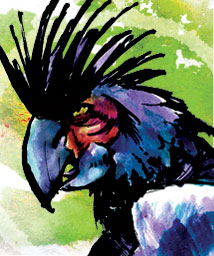
A Love Letter to Froggy

Article by Rebecca
Image by Will Hobbs (www.sirwilliamwesley.com)

Funny thing about kids, you never can guess what stuffed animal they’ll latch onto. It’s rarely what you would suspect. In my case it was a stuffed beagle that I called “Beans” and showed my affection for by repeatedly chewing off his nose. When good friends of mine had a son, my husband and I bought him a teddy bear. Not just any teddy bear, a Brookstone n-a-p teddy bear. This teddy bear is made out of the softest, most cuddly materials available to man. (They don’t carry the exact bear anymore, but here’s a link to a comparable bear.) In fact, as most parents know, that kid was showered in adorable stuffed animals ranging from traditional, like our teddy bear, to traditional, like the stuffed animals his parents cuddled as kids. In that sea of plush cuddlies what does the kid latch onto? A plush frog. He calls him “Froggy” or perhaps “Froggie”. I would ask him, but he is just learning to spell now, no need to add more stress to that process. Now I have nothing against Froggy (Froggie), he was adorable right from the start, even if now the child’s affections have left him a little matted and stinky. Hey, I chewed the nose off of my doll, repeatedly, I’m not judging. All of this is an elaborate introduction to why I’ve decided to discuss the symbolism of frogs and toads.

As you may suspect, I have a very elaborate creative process. One that is sustained primarily by celebrity gossip websites, the television show “Better Off Ted”, and rum. I’ll let you in on the “behind-the-scenes” process for this article. I realized, hey, it has been a while since I wrote about some sort of symbol. I pulled down a big stack of books filled with symbols and started flipping through them. While flipping through my copy of “The Complete Encyclopedia of Signs & Symbols” by Mark O’Connell and Raje Airey I came across an entry for frogs and toads. I immediately went “Froggy!” (or perhaps “Froggie!”) Because anyone who has spent time around little kids knows that you start to talk like them. Thusly, a frog, regardless of how life-like the illustration, or very real it is, they are Froggy (or maybe Froggie). Much the way I and his mother say that we are going to “Eat. Eat.” and “Play. Play.” despite the fact that even the child no longer speaks with that young a voice. So as odd as this may seem, somehow my simple quest to write about a symbol has turned into a bit of an open letter of affection to Jacob…the first little kid that didn’t seem to hate me on sight. (Aunt Rebecca loves you. And as soon as you’re old enough, I will loan you all of my Chow Yun Fat movies, because that’s how much I care. Just don’t tell Mom and Dad.) With that abnormal show of affection out of the way, let’s examine the symbolism surrounding this amphibian that a 3 year-old can’t go to sleep without.

First, since I’ll be looking at both frogs and toads, the obvious question is, what is the difference between frogs and toads. Typing that question into Google brought me to, I swear I’m not making this up, allaboutfrogs.org. They say:

One of the most common questions is, “What is the difference between Frogs and Toads?” Most are surprised to hear that all Toads actually are Frogs!

Hey, I am surprised! Good job allaboutfrogs.org! Armed with this new internet information I will proceed to discuss both frogs and toads. As surprised as I was by allaboutfrogs.org’s info, I am far more surprised at all the different associations for frogs and toads. Who knew frogs had more going for them than plush animals and Kermit?

Let’s start with the general “frogs and toads are bad” angle. Toads, with their habit of avoiding the sun and preference of damp dark places seem an unsavory lot. It doesn’t help that their secretions can be toxic. In European superstition the toad was linked with death, and was often shown in art with a skull or skeleton. The Church, with their 7 Deadly Sins, took frogs and toads (generally associated with fertility in most cultures) and used them in art that personified lust. Art associated with lust shows a naked woman with snakes and toads feeding on her breasts and genitals. It is really just a hop between all that death and evil sexuality to lead straight into the link between frogs and toads and witches and witchcraft. The stereotypical old world “witch” had the skin appearance of a toad. Common folklore lists frogs and toads as familiars of witches and the Devil, and a creature that witches can transform themselves into. During the Great Plague of 1563 dried toads were used as amulets in England when Dr. George Thomson claimed to have cured himself by using one to absorb the “putrefactive ferment”. I can’t help but wonder if good Dr. Thomson thought toads so evil and loathsome that surely they would interact with the vileness of the Plague.

Enough about Medieval Europe and the Church and all those Western hang ups. For much of the world the frog and toad are good things. As you may remember from your school biology lessons, frogs lay many eggs. I don’t quite know how modern man feels about that, but back when humans were just trying make sense of the natural world many eggs equaled fertility. Egypt has Heket (Heqet, Hekit), the frog goddess of birth and fertility. She’s often depicted as an attractive woman with the head of a frog. Frogs like the water, and rain makes the land fertile, thusly frogs are rainmakers. The Chinese and Peruvians used frog images to call up rain showers, and the Mayans and Aztecs viewed the frog as a water deity whose croaking predicted and made rain. The frog was the lord of the earth and represented the curative powers of water for the Celts.

Another basic frog fact is that they go through a transformation: egg, tadpole, and frog. The moon, as we all know, goes through transformations as well, it’s phases. Mix those two things together and you can see how in Japan the frog is associated with lunar eclipses and in China, instead of the “man in the moon”, they have a toad in the moon. It’s believed that from the frog’s natural ability to transform is how it became to be featured prominently in folklore and fairy tales. Kiss the frog and it transforms into a handsome prince or beautiful princess, or conversely, be a misbehaving prince or princess and get changed into a frog. The Chinese and Japanese associate frogs with magic.

However, the Chinese take it up another level. In China the frog is associated with magic and is the face of the moon. Knowing that you can see how the adorable Chinese Moon Frog came into being. He’s the adorable frog with the coin in his mouth that you see in curio shops. The Chinese Moon Frog attracts wealth and longevity. Sometimes the frog has a coin in its mouth which attracts wealth and wards off evil spirits. In an almost perfect blending of all the aspects of frog symbolism, in Roman times frog amulets were used to protect homes and their occupants and to sustain romance and love.

Only time will tell what Froggy (or Froggie) will bring into Jacob’s life. The frog is fraught with perils, but offers up rich rewards. I guess Kermit was right, “It’s not that easy being green.”
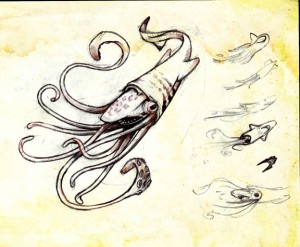
Loving the Lusca

Illustration by Will Hobbs

For some reason I love the idea of giant sea creatures. All those in search of the giant squid shows on the Discovery Channel – watched them. Ditto when they bust out the giant octopus stuff – I’m there. I don’t know what about them that I like so much. Perhaps, oddly, it’s the romanticism of the giant sea creature. I know it sounds funny, but for some reason a giant sea squid makes me think of multi-masted ships getting taken into the briny deep for venturing off the map. The ocean is still so vast that we continually discover new things living there. And that although doubtful, I can still entertain the idea that one day I’ll be watching BBC America news in the morning (because it’s back!) and hear a neutral voice with a British accent explain that a ship has been destroyed off the coast of some country by some giant tentacled thing from the deep.

This brings me to the lusca.

It is said by some, and by some I mean cryptozoology fans and Bahamian tourist websites, that in the blue holes (vertical caves) of the waters off of Andros, which is an island in the Bahamas, you may find the lusca. The lusca seems to generally be described as a giant, massive octopus, but like all creatures that end up of legend, it also has been described as half octopus, half shark, or as a multi-headed creature reminiscent of a dragon.

The scientific community, when feeling generous, will say that perhaps the lusca is an example of a colossal squid, or giant octopus, but since the stories put the size at anywhere between 75 to 200 feet long, most find the idea of the lusca existing in it’s traditional dragonish, shark/octopus, form unlikely.

Of course there will always be those, who like me, keep awaiting the return of the giant mythical sea creature. We have a resurgence in piracy, can the creatures that accompany the pirate mythos be that far behind?

The Harpy

By Rebecca
Illustration by Will Hobbs

Generally when we say harpy, we’re referring to, as Random House Dictionary states, “a scolding, nagging, bad-tempered woman; shrew, or a greedy, predatory person.” Perhaps it’s that innate fear or repulsion that leads to so much trouble when trying to learn about the mythological creature the harpy.

Let’s start with appearance, one source tells me that harpies started out as beautiful goddesses but over time were morphed into nasty creatures, and then others say they started out down right hideous, but have been toned down to the creatures we generally think of when considering the harpy. Therefore, what are we looking at here? Obviously it varies based on artistic interpretation, but at the most basic it’s a woman who from the torso down is bird and has wings large enough to carry her in flight. Sometimes the face is less human in appearance, with bulging eyes and tusks, other times the face is the only human component and the body is entirely bird. (For the record, for me the harpy will always look like the harpy from the movie “The Last Unicorn”.)

Everyone seems to agree that in Greek mythology the harpies were the daughters of Thaumas and Electra. Of course, how many were there? A few sources say two to three: Aello and Octpete, with Celaeno as a later addition. One source goes so far as to say three to four: Aello, Octpete, Celaeno, and a possible extra to make four! No matter the number, harpies make appearances throughout Greek myth, generally harassing, stealing, or killing anything they feel like.

In the Middle Ages an image of a harpy was used on coats-of-arms. It was referred to as the “virgin eagle”. I have many exciting theories on why the harpy was a virgin, all of them would be inappropriate for me to say, and many of which you can guess for yourself.

In an interesting, and more all age appropriate side note, the largest raptor found in North and South America is the Harpy Eagle. Yup, named after the mythological creature. It’s certainly cuter than any version of the mythological harpy I can imagine. On the other hand, it still totally gives me the creeps.


Pukwudgies: Myth or Monster

By Christopher Balzano
(originally appeared on Massachusetts Paranormal Crossroads website; used with permission)

In the Southeastern corner of Massachusetts lies Bristol County, an area known locally as the most haunted place in New England. The energy that sleeps there has been rumored to cause haunted schools, ghostly armies and unexplained suicides and murders. Forested areas of the county have long been known to contain a litany of unexplained animals, from Bigfoot and thunderbirds to large snakes and odd bear-like monsters. For the past forty years cults have flocked there, and their activities, often criminal, have filled the blotters of local law enforcement. Of all the unknown horrors that live in Bristol County, the most feared is not a animal or a ghost or the members of Satanic cults that walk the forests, but a demon only two feet high, and if the history of the area represents the history of our America society, these Pukwudgies are the gatekeepers of our darker side.

The Pukwudgies have haunted the forests of Massachusetts since before the first European Settlers ever thought about setting out for a new land. For centuries they tormented the local Native Americans and crept their way into their creation myths and oral history. They could easily be passed of as legend, and in fact, their physical description is much like mythological creatures from other cultures in other times. The difference is these demons jumped from the page and evolved as the people around them changed, changing from reluctant helpers to evil tormentors. The difference is these demons are still seen by people today.

Most cultures’ mythology has some reference to small monsters that have a strained relationship with humans. In many ways it makes sense. While large monsters have their place in our fears, diminutive creatures find their way into the shadows of our rooms and under our beds. Their names and nature change, but there are always common threads that link them together. Some are called monsters and roam the land looking for human food and kidnapping anyone they can find. Other are called demons, foul spirits that feed of the negative and expose the sins of man. When referring to one, its classification gets blurred and these two words become interchangeable, perhaps showing us how closely associated these monsters are with evil.

Veterans returning home after World War II talked of gremlins tearing apart their planes or getting into jeep engines and causing havoc. The Hindus speak of the Rakshasas or the “Night Wander” who eats human skin and jumps into the dead to possess them. Africans tell stories about the Eloko who lure people with beautiful music only to devour them after they have been bewitched with an ever expanding jaw.

Although passed off as works of fiction and imagination, trolls and dwarfs have existed in people’s fears for centuries. They have become lovable and noble now, but the original stories recorded of these monsters are anything but fairy tales with happy endings. Trolls were notorious for ambushing travelers and destroying whole families on a whim. While some are described as giants with humps and one eye, many older cultures, especially in Scandinavia, described the being as the size of a plump child.

Dwarfs have always been small and their manners much better, but the end result seems to be the same. Like the troll, they are known as metal and stone workers, but unlike their flesh-eating counterparts, dwarves seem to avoid human contact. While they would prefer to be left alone, if impeded upon their work, they become like caged dogs. One variation of the dwarf is the Tommy-Knocker who lives in mine shafts and is sometimes said to be the ghost of miners who have perished in the line of duty and are doomed to work for eternity. They are known to cause cave-ins and fires in the shafts.

Perhaps the most famous of the small nightmare are seen by the Irish. Fairies patrol the roads in Ireland causing problems for any traveler who strays from the path. They live in hills or mounds and dance around fires. If a human comes across their mound or sees their dancing, they are caught and held captive. Even the beloved leprechaun was once a malicious spirit before he was Americanized and transformed into the gold keeper he is today.

Exposure to nature seems to feed these tales, and the more a society depends on the earth for its needs, and the closer the relationship a people have with the natural world around them, the more these stories pop up. In this country, the people the first settlers found had a close, if not friendly, view of small dangers around them. The Cherokee have a mirror image demon known as the Yunwi Djunsti, or little people, that look and talk like Cherokee but are only a few feet high and have long hair that touches the ground. Although most people cannot see them, they are known to throw objects, trip up hunters and abduct people who wander off. In Canada they are known as Mennegishi and look much like the classic alien grey.

The Wampanoag Nation, the dominant Native America tribe in Massachusetts and Southern New England, had a monster who still dominates the landscape they once roamed. The Pukwudgie made its first appearance in the oral folklore of the people of Cape Cod, but recent sightings have forced people to rethink this mythological creature. Standing between two and three feet tall, the Pukwudgie looks much like our modern idea of a troll. His features mirror those of the Native American in the area, but the nose, fingers and ears are enlarged and the skin is described as being grey and or washed-out, smooth and at times has been known to glow.

What makes these monsters dangerous is the multitude of magical abilities they use to torment and manipulate people. They can appear and disappear at will and are said to be able to transform into other animals. They have possession of magical, poison arrows that can kill and can create fire at will. They seem to often be related to a tall dark figure, often referred to in modern times and shadow people. In turn the Pukwudgies control Tei-Pai-Wankas which are believed to be the souls of Native Americans they have killed. They use these lights to entice new victims in the woods so they may kidnap or kill them. In European folklore these balls of energy are know as Will-o-the-Wisps and are said to accompany many paranormal occurrences. Modern paranormal investigators call them orbs, and catching one on film is the gold standard of field research.

Legends of the Pukwudgie began in connection to Maushop, a creation giant believed by the Wampanoag to have created most of Cape Cod. He was beloved by the people, and the Pukwudgies were jealous of the affection the Natives had for him. They tried to help the Wampanoag, but their efforts always backfired until they eventually decided to torment them instead. They became mischievous and aggravated the Natives until they asked Quant, Maushop’s wife, for help. Maushop collected as many as he could. He shook them until they were confused and tossed them around New England. Some died, but others landed, regained their minds and made their way back to Massachusetts.

Satisfied he had done his job and pleased his wife, Maushop went away for a while. In his absence, the Pukwudgies had returned. They again changed their relationship with the Wampanoags. They were no longer a nuisance, but began kidnapping children, burning villages and forcing the Wampanoag deep into the woods and killing them. Quant again stepped in, but Maushop, being very lazy, sent his five sons to fix the problem. The Pukwudgies lured them into deep grass and shop them dead with magic arrows. Enraged, Quant and Maushop attack as many as they can find and crush them, but many escape and scatter throughout New England again. The Pukwudgies regroup and trick Maushop into the water and shoot him with their arrows. Some legends say they killed him while other claim he became discouraged and depressed about the death of his sons, but Maushop disappears from the Wampanoags mythology.

Pukwudgies have been seen at the Ledge in Freetown, Massachusetts.

The Pukwudgies remained however, but something odd happens. The timing of the tales of the monster are a map through the history of the Native Americans relationship with the European settlers. The death of the five sons lines up with the very first settlers, and the flight of Maushop is told along side the changing of attitudes about the new neighbors. The Pukwudgies, always seen in a negative light, become the foot soldiers of the Devil, which may explain their modern connection to shadow people. As more Native Americans began to convert to Christianity, their myths evolved, until the Pukwudgies were responsible for the evil in the village, and the hand of Satan on the tribe.

People who spend time in the forest of New England will tell you Pukwudgies are not symbols, but a real horror that still stalks people. They continue to see them, and as the world develops around them, the monsters remain unchanged and as dark as ever.

Joan was walking her dog through the state forest in Freetown, Massachusetts, on a cold Saturday morning in April when she saw the monster. As she and her dog, Sid, walked down the path, Sid became anxious and strayed a few feet into the woods. Joan followed him in, and stopped short. Her dog was lying completely flat in the leaves, and on a rock ten feet away was a Pukwudgie. She described him as looking like what she would describe as a troll; two feet high with pale gray skin and hair on his arms and the top of his head. The monster seemed to have no clothes, but it was difficult to tell because his stomach hung over his waist, almost touching his knees. His eyes were a deep green, and he had large lips and a long, almost canine nose.

The Pukwudgie stood watching her, staring straight at her with no expression, almost like it was stunned to see her. Joan froze and remembers thinking the air in her lungs had been pushed out. Sid finally came to and ran back towards the trial, dragging Joan who was still holding the leash tightly.

Although the whole exchange took less than thirty seconds, it remains with Joan ten years later. She has not gone back to the forest, but feels that might not be enough. Three times since the event she has woken up to find the demon looking in on her. It has never attacked her or spoken to her, she has merely seen it looking through her bedroom window, staying just long enough for her to notice him. All three times she claims she was fully awake and could move if she had to.

Another man in Framingham, Massachusetts had a experience that forced him to remain away from the woods. Tim was in a forest when he saw a bright orb in front of him. Having investigated the paranormal he was excited and tried to snap a photo with his digital camera. The ball of light disappeared and reappeared a few feet further into the woods. Tim followed, losing the spirit several times before he realized he had traveled more than thirty feet off the path into a thickly wooded area. He became scared and slowly made his way back to the path, only to find a two foot man standing there, walking towards him. He turned and ran, and looking back saw the figure move back into the woods.

Tim reported that what he saw had walked upright and had used its arms to push something aside when he fled to the forest. He had moved with a slight limp, but “like a human”.

The second time Tom saw the Pukwudgies was a few years later in a parking lot near the same forest. He was listening to the radio at almost a whisper and checking his rear view mirror for the friend he was waiting for when he saw the same small figure of a man. Every detail was identical, and the Pukwudgie just stood there watching him. The car turned on by itself and his radio began to get louder. Tim pulled out of the parking lot and took the long way home to try and stop his hands from shaking.

Although the monster seemed content to only frighten Joan and Tim, there are still physical attacks happening. Several people have been assaulted and one person came down with a mysterious illness after seeing them in a cemetery in New Hampshire. Another woman suffered scratches on her arm after following an orb in a forest in Taunton, Massachusetts.

The most disturbing reoccurring attacks might be taking place at the Pukwudgies favorite hunting ground. In the Freetown State Forest there is an hundred foot cliff overlooking a quarry known as the Ledge. There have been many hauntings at this sight, but the most frequent experience is an overwhelming feeling to jump to the rocks and water below. In the folklore of the Wampanoag, the Pukwudgies were known to lure people to cliffs and push them off to their death. There have been several unexplained suicides at the Ledge, often by people who had no signs of depression or mental disease before entering the forest.

Author Bio:
A teacher and folklorist living in the Boston area. He has been investigating the unknown for twelve years and running Massachusetts Paranormal Crossroads, a website dedicated to the paranormal and local folklore of Massachusetts, for more than five. His writing has appeared in such respected publications as “The Haunted Times” and “Mystery Magazine” as well as “Unexplained Paranormal Magazine.” His investigations have been covered by “The Boston Globe”, “The Boston Herald”, “The Standard Times” and “Worchester Magazine” and he has been asked to speak about urban legends and the paranormal at conferences throughout New England. He is a regular on several paranormal radio shows, including “The Ghost Chronicles” and “Spooky Southcoast” and has appeared in documentaries and television specials on the supernatural. He was one of the featured writers in Jeff Belanger’s Encyclopedia of Haunted Places and contributed to the collection Weird Hauntings and the soon to be released, Weird Massachusetts. His writing and research have also been featured in Thomas D’Agostino’s Haunted New Hampshire and Haunted Massachusetts and the recently released Ghostly Tails from America’s Jails.

You can learn more by visiting: Massachusetts Paranormal Crossroads, Ghost Village where he is the news editor, and ParaRelations.

The Bungisngis Mystery

Article by Rebecca
Image by Will Hobbs (www.sirwilliamwesley.com)

It’s always tough to work with creatures of myth that are not from your native culture. You find yourself wondering, what do the people of the country of origin think of this? Alternatively, am I even getting the right information? This is the predicament I find myself in when discussing the Bungisngis.

It seems simple enough; according to my starting point, the Bungisngis is a cannibal giant from Philippine folklore. His top lip is so big that he can pull it over his head (making him the male that can survive that joke about to understand the pain of child birth take your bottom lip and pull it over your head). They say that the hero Suac came along and stole the giant’s club, and used the club to subdue his enemies.

Then I made the mistake of opting to try to learn more. Education is never the answer to these things, I swear! I easily found out that the Bungisngis is a creature of Philippine mythology. It was featured in an episode of “Da Adventures of Pedro Penduko”, which is the third and fourth season of the Filipino fantasy TV series “Komiks”. After that things get a bit more tricky.

The story of Suac (remember Suac, the hero who stole the club?) well from what I see Suac killed a dark giant called Pugut. Pugut is a meat eater, but was more than content to eat a roasted hog, although he did threaten to eat the hunter (and later hero) Suac. Perhaps Pugut is a Bungisngis; you know, Pugut is his name and Bungisngis is his race? Another story with a similar set up has no mention of Pugut or of a Pugut, but instead has the villian as a Bungisngis, or the Bungisngis. There is no mention to his physical appearance, but again he wants to eat cooked meat. Instead of the hero Suac, this tale has a monkey defeat the Bungisngis.

So what did we learn? Well, the Bungisngis is definitely a piece of Philippine folklore. Certainly a meat eater, who would gladly consider eating you if you anger him, but otherwise seems content to eat cooked game animals. Probably a giant. And maybe has the name Pugut.

Of course Wikipedia paints an entirely different picture. According to their entry the Bungisngis is a giant from Filipino folklore, but they list it as having one eye, making it a cyclops, and they describe them as happy and playful…hardly the beast we just talked about.

See what I mean? Sometimes learning more just makes things more confusing.

Mopaditis

Article by Rebecca
Image by Will Hobbs (www.sirwilliamwesley.com)

What happens to us when we die is, in my opinion, one of those questions that we can never truly answer. There’s only one way to get your answer, and trust me, it’s a killer. (Insert rim shot here.) The way people have answered this question has influenced religion, philosophy, and entire cultures. It explains the fascination with the study of the paranormal; it defines the Spiritualist faith. What happens to us after we die is a multimillion-dollar industry, and an intimate puzzle for each human to solve for themselves. There’s the potential for ghosts, poltergeists, spirits, angels, and more. For the Aborigines, there are the mopaditis.

These are the spirits of the dead. They are incorporeal and invisible in daylight. Mopaditis are white in the light of the moon and black in the dark. It is said they still look just like a human, but given their visual temperament, I think it would be hard to say if you actually saw one. A human who encounters a mopaditis will at best experience clammy hands and their hair standing on end, at worst paralysis.

There is a connection between the mopaditis and black cockatoos. A flock of black cockatoos escorts the mopaditis back to its birthplace, all the while crying out, to announce the spirit’s arrival.

Not being from Australia, let alone one of their Aboriginal people, I cannot tell you more, I don’t know it to tell. And the more I think about it, good. The mopaditis are their answer to the question, not mine.

The Misleading Gwyllion

Article by Rebecca
Image by Will Hobbs (www.sirwilliamwesley.com)

In this new age of impish, whimsical, pretty little pixie fairies, like those Amy Brown and NeNe Thomas portray, it’s easy to forget that in times past the fair folk were generally annoying at best, and deadly at worst. The gwyllion of Wales is an interesting example of this.

Gwyllion comes from the Welsh word gwyll, which has a variety of meanings ranging from darkness and gloom to a witch, fairy, or a goblin. When a fairy is wrapped up in the same word as gloom and darkness you know this isn’t a Disney fairy we’re talking about. Gwyllion are generally described as hags with a distinctive cry or laughter. Some describe them as having the appearance of poor old women with oblong four-cornered hats and ash-colored clothes. Frequently they are seen carrying a pot or wooden pan, such as people would use to carry fresh milk.

The gwyllion follow in the well-established tradition of misleading travelers causing them to become lost forever. Seriously, so many creatures of folklore do this that I wonder if they’re unionized! So a lone traveler is out after dark, or in the early morning hours, walking a familiar path. Then he hears the cry of the gwyllion. Suddenly, the path seems unsure. Up ahead he sees an elderly woman walking. She must know the way, the traveler says to himself. He takes off after her, but never catches up. That’s your standard gwyllion encounter.

The gwyllion are known to seek shelter in people’s homes when the weather is bad. If this occurs, you are expected to be polite, offer them clean water, and keep knives and other cutting utensils out of view. Knives, you ask. Yep, unlike the cold iron of most fairy folklore, these guys are driven off by knives. Not being stabbed by them, just seeing them is enough to run them off. Apparently the knife has a superstition attached to it of if you give or receive a knife or scissors it cuts friendship. It also acts like a Cross would to a vampire for gwyllions!

Snake on the Magazine: The Angont

Article by Rebecca
Image by Will Hobbs (www.sirwilliamwesley.com)

The Huron people of America tell the story of the angont. First, if you’re like me, let’s start with who are the Huron? According to my anonymous peeps at Wikipedia.Org, “The Wyandot and Huron are indigenous peoples of North America, known in their native language as the Wendat. Modern Wyandots and Hurons emerged in the 17th century from the remnants of two earlier groups, the Huron Confederacy and the Petun, who were located on the southeastern corner of Georgian Bay in what is now the Canadian province of Ontario before being dispersed by war. Wyandots and Hurons today live in various locations in Canada and the United States.” Now that we’ve taken care of that, what is an angont?


Glad you asked. An angont, or specifically THE Angont, is a huge venomous snake. Well, how big is it? It’s SO big that it can stretch forth from its hiding place, generally caves, lakes, rivers, and old growth forests, and overwhelm travelers, and inflict disease and death upon any that come within its gigantic radius. You’re saying, that’s pretty wicked. I bet people steered clear of any area they thought the Angont was in, didn’t they?

Yes and no. Like all giant death-dealing creatures, it is said that its skin is a potent component for shamanistic magics. Needless to say, ill luck befell anyone who encountered the creature. Even worse, it’s said that talismans made from the Angont’s skin brought the bearer bad luck. Yet, people still sought it out. It’s like an evil plague bearing Unicorn that could casually crush you, and instead of having only healing stories behind its coveted horn, it has terrible tales in regards to using its body parts. Between you and me, I don’t get it.

Look Into My Eyes. No, Lower: The Munuane

Article by Rebecca
Image by Will Hobbs (www.sirwilliamwesley.com)

When discussing creatures of folklore, regardless of how odd they may seem, there is usually some kind of logic buried there. A reason why it is so ugly or a mish mash of different creatures, etc. Then again, occasionally you stumble across one like the munuane.


The munuane’s purpose is fairly common, he’s the animalistic guardian demon of water, the water’s inhabitants, and people who live by the water…assuming they don’t get greedy when it comes to fish. Folklore like this helps discourage people from over fishing, or harassing local residents of water based communities. It is said in South America that a munuane is found wherever the fish are plentiful.

The munuane defends the local residents by use of bow and arrow. It is such a precise shot that it only carries a bow and one arrow. The munuane never misses. Okay, so what is so darn weird you ask? Let me tell you what this demon looks like.

It is a gray haired demon with no teeth, and…its eyes are in its knees! Yep, the master archer lines up its shots with its eyes below the waist! That is one archer extraordinaire.

If you ever find yourself in a position where you have to fight one, go for the eyes, by going for the knees!

Pesky Little Buggers: The Utukku

Today we’re going to talk about the Utukku, these pesky little buggers with animal heads, claws and horns have been popping up through history in various forms since there’s been history; Demon, Vampire, Restless Dead; the Utukku has been in all. So lets start at the beginning…

Lets face it, no one wanted to be a Sumerian, sure their history ranged from the 5th to the 3rd Millennia BC (Yes Millennia) and they probably invented the wheel and, well, writing but for a chunk of that time they were looking north and wishing they could be Akkadians (Hey it was good enough for The Rock) or to the future waiting to be Babylonians. Why did it suck to be Sumerian you may well ask? Easily answered, their religion was far less concerned with praising their numerous, fickle gods as it was distracting them from any involvement with humanity (Pay no attention to that Civilization behind the curtain.). Back in the day, the Utukku were a demon ghostly kind of thing, the spirit of those not properly buried who returned to pester the living. Now remembering that being a Sumerian sucked pester takes on a whole new meaning. These things possessed the living making them commit crimes; they spread disease and sucked the lives out of young children (although that may have been cats).

Now our buddy Dwayne Johnson’s people (aka The Akkadians) believed that there were only seven of these guys running around (see why it was better to be an Akkadian). Admittedly these seven were really really bad. They were the Underworld’s messenger boys and the Akkadian Underworld was not to be trifled with.

The Utukku are still with us, even recently, Prague had figures in white coveralls with tire prints on their backs placed at around the city handing out flyers warning about traffic and pedestrian safety. Trying to use images of the restless dead to help save the living. For more on then check out
http://www.abcprague.com/2007/09/21/utukku-warned-against-dangerous-behaviour-on-the-roads