25 Years of Graceland

What can I say about Paul Simon? First and most importantly, don’t come to my website and bad mouth the man’s music because I will cut you. I. Will. Cut. You. I used to entertain the whimsical notion that somehow we were related because I’m a Simon and he’s a Simon and we both have roots in the Eastern region of the U.S. There’s absolutely no way we are, but I’d still joke about “Uncle Paul”. One of my friends in school called me, and in fact still does, Pauley to reference that my last name at the time was Simon and that I was such a big fan of Paul Simon’s music. I can’t remember when I first heard Paul Simon, that’s how long his music has been a part of my life. Musically speaking, just about the only thing my father and I can agree on is Paul Simon. In fact, at my wedding the father daughter dance was to the song “Still Crazy After All These Years”. (That’s right brides, read this and despair for my father daughter song was SO much cooler than yours.)

It’s hard for me to pick an absolute favorite Paul Simon, but like so many people, his album “Graceland” is damn close to perfection. That is why I was pretty excited for the release of the 25th anniversary edition. It’s amusing. I had put it on my Amazon wish list with the intention of buying a copy for myself and another one for my father for Father’s Day. However, instead my aunt bought a copy for me from my wish list for my birthday leaving us to just purchase one copy for my father. Zany Amazon.com shenanigans. Here’s the deal though, for a really reasonable price, like under $20, you can get the 25th anniversary “Graceland” album which includes 6 bonus tracks and Simon telling the story of “Graceland” AND you’ll get the DVD documentary “Under African Skies” which isn’t some shoddy piece o’ crap thing, it’s done by Joe Berlinger, the guy who did the Metallica documentary “Some Kind of Monster” and a handful of music videos. That’s a hell of a lot of “Graceland” going on, so what’s the big deal?
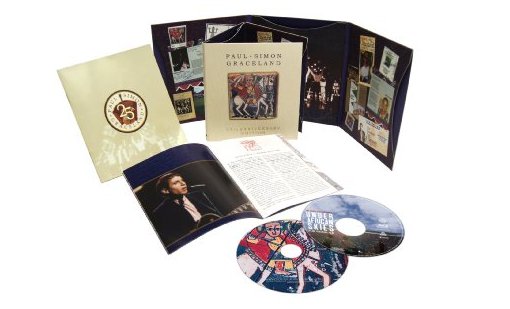
Paul Simon’s “Graceland” is generally credited with introducing African music and musicians to the West. The biggest being Ladysmith Black Mambazo. Many point out that during a time when most American’s experience with Africans was seeing starving children in television ads, “Graceland” introduced America to a jubilant, celebratory people. It’s true that much of the music on “Graceland” is mid or up tempo, although to be honest with you all, I always found the songs on “Graceland” haunting. Lyrically I found they lingered in my mind and the songs still do. Unlike much of the other music I listened to in 1986, Paul Simon’s “Graceland” still speaks as relevantly today as it did the day it was released. A pretty impressive hat trick. Of course, he is Paul Simon. Oh, and if you watch the documentary and hear Simon talk about the level of work he put into writing the lyrics your mind will be blown. I once heard comedian Louis CK talk on Marc Maron’s WTF podcast about when he develops a real strong closing 5 minutes to his routine, the kind that drives the audience wild, he’ll cut it so he’ll be forced to make the rest of the act stronger. Paul Simon kind of worked like that writing the lyrics for “Graceland”. The stuff that survived, whoa.

So obviously I love the album, and was tickled to have the few extra demos and alternative versions that the 25th anniversary version of “Graceland” offered. Here’s the thing though, the documentary “Under African Skies” was a really big deal for me. First, it was incredibly exciting as a fan to see so much footage of the actual recording sessions of Simon in South Africa with all the artists. And the documentary is loaded with interviews, some with unexpected people such as; David Byrne, Oprah, Quincy Jones, Philip Glass, Paul McCartney, and Vampire Weekend. The biggest thing with “Under African Skies” was it opening my eyes to the before now unknown to me controversy that surrounded Paul Simon’s “Graceland”. I was 10 years old when “Graceland” released. I didn’t know about apartheid in South Africa, I didn’t know who Nelson Mandela was or that he was in prison, and I didn’t know there was a cultural boycott that Simon essentially broke when he made “Graceland”. I didn’t know there was a situation. As if that wasn’t enough drama, certain segments of the African American community looked at “Graceland” as Simon basically using Africans. There was a particularly brutal exchange when Simon was doing a Q&A at Howard University and a student was accusing Simon of simply stealing music from African artists. Simon asked the student something like, don’t you think we can share ideas? And the student’s answer was in effect, if it’s with you, no. You think I will cut you? No one talks to my Uncle Paul like that! Forget I will cut you, I will take a sledgehammer straight to the crotch of those parachute pants! There were bomb threats called in to venues Paul Simon was scheduled to perform at while touring with “Graceland”. Bomb threats to Paul Simon shows.

Watching “Under African Skies” gave me a new appreciation of “Graceland” and its role in music, and cultural, history. It’s easy now that we’re on the other side of apartheid to say, well, it worked out so how Simon went about making “Graceland” was okey dokey. I don’t know how 10 year-old Rebecca would have reacted at the time. I suspect in extremes. Either “Everyone leave Uncle Paul alone, he’s the greatest and he knows what he’s doing” or “Oh no! Uncle Paul condones apartheid!’ Adult Rebecca knows that apartheid was absolutely bad, bad, bad, but who am I tell artists in America or Africa how to react in the face of injustice and cruelty. If Simon and his band of truly merry, wonderful South African artists hadn’t thrown caution to the wind, the world may never have known “Graceland”, and in my opinion, that would be a terrible world to live in.

Here’s Paul Simon performing the title track “Graceland” live in Zimbabwe. Back in ’87 Zimbabwe was a more stable location to perform than South Africa. How times have changed, right gang?

And here’s another favorite of mine, “The Boy in the Bubble”. It’s amazing how the lyrics could very well be about today. Even the sound is modern. Uncle Paul is pretty cool.

A Year of Writing Dangerously

“A Year of Writing Dangerously: 365 Days of Inspiration & Encouragement” by Barbara Abercrombie. I had specifically asked for a review copy of this book because I know many people who read The Magical Buffet are professional writers, looking to become professional writers, or are happily dedicated writers in their spare time. However looking at it now I thought, dangerously? A wee bit pretentious aren’t we? Of course on the other hand I found myself thinking, dangerously? How exciting! I couldn’t help but wonder what kind of inspiration and encouragement one finds in a year of writing dangerously. I also found myself wondering if by chance author Barbara Abercrombie was in anyway related or connected to the Abercrombie & Fitch stores, and if so could she get them to turn their damn music down?

Finally I realized that rather than wonder I could do something crazy like, I don’t know, read the book? I swear, I’m a genius. Someone get me a delicious cupcake! In the meantime, let me tell you what I discovered. “A Year of Writing Dangerously” is an infectious book, which I mean in the best way possible. You cannot help but be inspired by it. Each day has an anecdote or one of Abercrombie’s observations, which for me inspired responses ranging from jaw dropping to cheering, and a related quote from an impressive array of writers, we’re talking Tennessee Williams to Anne Rice and more! For those looking for even more from “A Year of Writing Dangerously”, Abercrombie offers 52 weeks of writing prompts at the back of the book. These are little exercises to help you practice like; write about a time you didn’t show up, write down two or three things you know for sure, or write about a time you had to wing it.

But, dangerously? Abercrombie briefly addresses the “danger” in her introduction, but I think days five and six do it better. As to not go totally spoiler-ific you’ll have to buy the book to get the tasty word tortilla that wraps these spice fillings. (Can you tell I’m typing this while waiting for dinner?)

Writing is dangerous because you might get caught.

Sometimes it feels dangerous to know what I really feel. Because if I acknowledge my feelings outside the boundaries of my own heart and mind, if I open up the latch to my subconscious and let those precious secrets leak out, God knows what will happen. I might have to hold myself accountable to these thoughts and feelings. I might have to act upon them. I might have to change. I might have to stop lying to myself and others about what I need and want. I might have to ask for what I need and want. I might have to be a disappointment; I might have to be disappointed; I will disappoint.

Can you say a whispered wow? That’s what I mean by stuff that can make your jaw drop. Oh yeah, now we’re writing dangerously.

Now I’m totally me-o-centric so I wanted to know what the entry is for my birthday, so my husband Jim stepped up and casually did the math (while making dinner) and figured out what day is mine when it’s not a leap year. So as to give you the full idea as to what a day is like here is mine, day 149, “The DVD in Your Head”.

Maybe the essay you’re writing, or the memoir or novel, has now taken up residence in your inner life, like a DVD playing inside your head. Maybe as you go to sleep at night, you’re working on your story, you dream it. And when you brush your teeth in the morning, you’re thinking about it, seeing flashbacks of your own life or your characters hovering behind you. If it’s a book you’re working on, you imagine what the cover will look like. Articles you read in the newspaper or online, things you observe, hear on radio or TV – everything starts to connect to your work.

Maybe you already have a draft of an essay or short story you’ve written that needs to sit for a while for you to get some perspective on it, and you’re looking for the subject of your next one. What you look for you usually find.

Or maybe not. Maybe you’re stuck. But the only way to become unstuck is to keep showing up, to keep writing. And trust that when you do show up, something will be playing in your unconscious.

“The physical act of sitting at your computer writing down words is important of course but your unconscious mind is also doing a lot of work for you. If you show up. If you hold your characters in you mind, if you constantly look at the world for ideas to go into your book.” – Walter Mosley

And that’s “A Year of Writing Dangerously”; Barbara Abercrombie, with the help of others, does her best to encourage, empathize, and inspire you to take on another day of writing.

Ghosts & Spirits Tarot

Since I just got done reviewing “The Secret History of Poltergeists and Haunted Houses: From Pagan Folklore to Modern Manifestations” by Claude Lecouteux I thought now would be the perfect time to take a look at “Ghosts & Spirits Tarot” by Lisa Hunt. I know I seem to be near pants wetting excited over every tarot deck I review, but seriously you guys, “Ghosts & Spirits Tarot” is incredibly impressive. How impressive? Incredibly.

I have to say, I think the masterful Mr. Claude Lecouteux himself would be impressed with the amount of work Lisa Hunt put into “Ghosts & Spirits Tarot” because what you have here is a tarot deck where each card depicts a different spirit, ghost, or liaison between the earthly and spiritual realms from folklore and legend. So yes Lecouteux fans, all the subjects of his books that have been reviewed here on The Buffet are represented in this deck: The Wild Hunt (The Chariot), Vampire (The Hanged Man), Revenants (Six of Cups), and yes party people, even the Poltergeists from the last review (Ace of Swords).

Ace of Swords - Poltergeist

I’m not exaggerating in the slightest when I tell you that I would gasp with surprise and glee with each page turn of the booklet as a treasure trove of creatures and characters were revealed. La Llorona! The Flying Dutchman! Headless Horseman! White Ladies! Each entry has a brief description and bit of context along with a divinatory meaning.

The artwork is perfectly suited to the subject matter and despite the obvious darkness implied, Hunt brings beauty to most of the cards despite the specter of death the hangs around ghosts and spirits. I’m a fan of the Day of the Dead and I became quite smitten with Hunt’s rendering of it for the Ten of Cups.

Ten of Cups - Day of the Dead

And I was swept up by The High Priestess, who in the “Ghosts & Spirits Tarot” is an Enchantress/Sibyl. Hunt’s text brings perfect understanding to what we see in the card.

The most famous oracle of Greek/Roman legend, the Sibyl of Cumae (Italy) guided Aeneus through the land of the dead and enabled him to return to the living. The Sibyl interweaves the energies of past lives and future events. She illuminates the scene where dream-like specters mingle with relics of the past. A pathway provides a passage to clarity and higher understanding. The sparkles indicate a divine presence.

The High Priestess - Enchantress/Sibyl

What else can I say to convince you that “Ghosts & Spirits Tarot” by Lisa Hunt is 100% amazing? How about even though I received a free copy to review I went ahead and bought a second copy so I could get it signed by the artist? Did I mention I found this deck incredibly impressive?

The Secret History of Poltergeists and Haunted Houses

Paranormal enthusiasts! Wake up! Over here! Over here! If you consider yourself a paranormal investigator, a ghost hunter, or an armchair paranormal expert I am about to tell you about THE book you need to read if you want to have real game. We’re talking about separating the boys from the men, the Caspers from the, from the, well I can’t think of the name of some adult type ghost but you get the idea. What we’re talking about my friends is Claude Lecouteux.

Regular Buffet readers know that it is no secret that I adore Claude Lecouteux’s books. It started with “Return of the Dead: Ghosts, Ancestors, and the Transparent Veil of the Pagan Mind”, a rare look at revenants. Then it was “The Secret History of Vampires: Their Multiple Forms and Hidden Purposes”, where indeed Lecouteux revealed all kinds of vampires. Lastly there was “Phantom Armies of the Night: The Wild Hunt and the Ghostly Processions of the Undead”, which was one of my favorite things of 2011 AND inspired me to start a new household tradition! And now Lecouteux offers us “The Secret History of Poltergeists and Haunted Houses: From Pagan Folklore to Modern Manifestations.”

As I’ve come to expect from Lecouteux, the level of research is astounding. The book opens with a thoughtful discussion of “What is a Poltergeist?” His aptitude with medieval texts means that “Poltergeists” is not only filled with stories you’ve probably never read before, but it also allows Lecouteux to track the evolution of belief in, and explanation of, poltergeists. A particular highlight for me is back in the Appendices where you’ll find the debunking of a 1649 instance of poltergeist activity. Also in the Appendices; Exorcismus domus a daemonio vexatae (Rite for the Exorcism of a House Tormented by a Demon) which is how priests would attempt to rid homes of poltergeists in the Middle Ages when poltergeists were considered to actually be the Devil or demonic activity.

I can’t imagine a more thorough text available on the subject of poltergeists and the homes they haunt. Are they spirits, genies, the dead, the Devil, demons, witchcraft, hoaxes, or from psychokinetic abilities? Lecouteux covers all of that as well as the variety of ways people from all eras would attempt to rid themselves of poltergeists. If you’re anybody who is anybody claiming to know anything about the paranormal, you have to read this book. Also, if you’re anybody looking for an insanely fascinating read about the evolution of poltergeists in human culture, you also really should read this book.

The Tarot Playbook

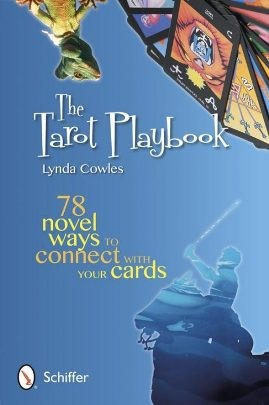
I didn’t quite know what to expect when I received my review copy of “The Tarot Playbook: 78 Novel Ways to Connect with Your Cards” by Lynda Cowles. All I knew was that I was hoping it wouldn’t take itself too seriously. I need not have worried because Cowles has created a whimsical relationship guide to steer you and the tarot deck, or decks, of your choosing to a life long partnership founded on mutual respect, trust, and happiness.

How does it work? By you and your deck working your way through the exercises outlined in the book. You’ll find yourself doing Taroga, which is yoga poses inspired by nine cards drawn from your deck, composing love poetry to court cards, purchasing gifts for your deck, and more! I think the author says it best:

You can’t help but get closer to your deck by trying the activities in this book. But if you’re really serious about this relationship and you want it to last forever – like those beautiful, romantic love affairs you see in the movies every day – you must commit yourself fully, with mind, body, and soul.

What happens when you finish a reading? Chances are you put your deck back in its box/bag/luxury custom-built cradle and go off to do something else. Think for a moment how that makes your deck feel. Would you like it if your friends only hung out with you when they wanted something from you? Even if you’re a professional reader who spends hours every day with your deck, you should still make the effort to spend quality time with it outside office hours. Make sure it knows you love it for who it is – not just what it can do for you.

Take it with you everywhere you go. But don’t just keep it in your bag or pocket – let it see the sights! Lay it on the passenger seat while you’re driving, or buy a special basket for it to sit in when you’re riding your bike. Talk to it about where you’re going and what you can see. Keep it by your side at work and when you go out with your three-dimensional friends for drinks or a bite to eat. Give it a spot on the sofa when you’re watching TV or – better yet – hold it in your hands so you can give it a loving shuffle every now and then. And when bedtime comes, don’t forget to kiss your deck good night. Tuck it under your pillow, safe and sound, and when you wake up in the morning, draw one card to ask it how it slept.

If all of this sounds like madness, you’re starting to get a feel for the contents of this book, wherein you’ll find plenty of irreverent, silly, and downright ridiculous things to do with your cards. But, in all seriousness, time spent with your deck is never time wasted. The most amazing readings can occur when Tarot reader and deck are totally in sync, and isn’t that, after all, what it’s all about?

“The Tarot Playbook” by Lynda Cowles is perfect for both the person new to tarot and the experienced reader. After all, what tarot deck owner wouldn’t want to know how to build a better relationship with their deck?

Sneak Peek at “The Hobbit”

“The Hobbit Tarot” that is. Come on, stick around, the tarot is totally worth reading a few minutes more.

Now let’s get to the main event, “The Hobbit Tarot” by Peter Pracownik and Terry Donaldson. Readers may remember that all the way back in 2010 I was fortunate enough to review the “Imperial Dragon Oracle” that was done by Peter Pracownik and Andy Baggot. I spent some serious time lavishing praise on the art done by Peter Pracownik and mentioning that he did all the fantastic art for the collectible card game “Wyvern”. (You know, like I just mentioned here.) That trend of praise will continue.

Pracownik’s art is so enchanting that I had difficulty picking just a few cards that he illustrated to share. Believe me, it look serious work to narrow it down to five, which may be the most cards I’ve ever scanned to share for a tarot deck ever! I couldn’t help myself! Look at “The Sun”. What a beautiful, darling landscape.

The Sun

Or what about the battle scene depicted on “Judgment”? It looks like it is right out of an ancient book of tales. I mean, if you imagined opening up an old, weathered, leather bound book of ancient tales of yore, that’s absolutely the illustration you would expect to see. Am I right, or am I right?

Judgment

Along those same lines, say hello to the “Knight of Swords”. He would be the hero in the before mentioned illustrated book of ancient tales.

Knight of Swords

Now you can’t have Pracownik do art for you without there being a dragon! Thankfully “The Hobbit” has one.

The Tower

My repeated commenting on how the artist could be illustrating a book of old tales leads me to believe that obviously this is why Pracownik is the perfect choice to do the art for “The Hobbit Tarot”. Tolkien’s work is essentially ancient tales.

Terry Donaldson drew on the rich mythology of “The Hobbit” when writing the accompanying booklet for “The Hobbit Tarot”. For instance “The Sun” isn’t just some random scene, here’s Donaldson’s thoughts on the card:

The road of life leads each of us through our respective Wilderlands. We see Mirkwood in the distance. The forest is where our Companions receive their initiations, teachings, and new skills; where they all become heroes of a sort, by confronting their fears and limitations. On the surface, everything looks so peaceful and welcoming. But we must be ready for the challenges and contradictions that life may throw at us as we move along the road that is our life journey!

Donaldson finds spiritual insight in “The Hobbit” that tarot lovers and Tolkien fans alike should appreciate.

Speaking of fans, I happen to love Wargs, the oversized wolves that appear in Tolkien’s work. So I couldn’t help sharing/boasting that there are two cards featuring Wargs in “The Hobbit Tarot”.

Seven of Wands

And just to prove I’m not a liar, here is a sneak peak at the movie “The Hobbit”.

Spiritual Ecology Mystery Solved

Honestly, I can be a real asshole. Case in point, when I received a copy of “Mystery Teachings from the Living Earth: An Introduction to Spiritual Ecology” by John Michael Greer. I immediately, without a moment’s pause, tossed it aside. Nothing against nature or the earth, I thought, but I didn’t need to read another “hippy” book about how the earth has much to teach us and let’s learn her ways and live on dirt and etc., etc. I get it, nature is an awesome thing, and I do love it from the window seat in my climate controlled home, but I just didn’t need to read another book about it.

Then I don’t know what happened. I kept shuffling the book from one spot to another in the apartment. For a while its spine stared out at me from under our laptop. Then it was bumping my elbow for a few days while I was working at my computer. You get the idea. Somehow this book, no matter where I shoved it, always seemed to end up in my way. As my mom would say, “Like a pile of horse shit, always in the middle of the road.” Finally I decided the only thing left to do was to read the stinkin’ thing.

Holy crap am I glad I did.

There is no peace sign throwing, tie dyed flag waving, hippy jargon to be found in “Mystery Teachings from the Living Earth”. Instead, John Michael Greer uses some of the most basic observable things to be found in nature to explain fundamental principles of modern mystery schools. Consider me very impressed. Many apologies to the venerable Mr. Greer whom I never should have doubted.

Greer breaks down the mystery teachings to seven core principles: The Law of Wholeness, The Law of Flow, The Law of Balance, The Law of Limits, The Law of Cause and Effect, The Law of Planes, and The Law of Evolution. These may sound abstract, but by repeatedly using the familiar setting of a grassy meadow (even this allergy pill junkie can manage reflecting on a grassy meadow) these Laws become easier to understand and to relate with the others. With the addition of an affirmation, a theme for reflection, and a meditation to each Law, these Laws go from being just an informational stepping stone to a mystery practice itself.

After that Greer does an excellent job explaining what magic is like in the Western occult traditions, what it is like, or more precisely, what it should be like to be an initiate in a mystery school, a bit of context of where mystery schools are in the history of spirituality, and lastly an afterword that advises readers as to what to look for in potential mystery schools and suggests a few books.

John Michael Greer’s “Mystery Teachings from the Living Earth” is the best book I ever read for explaining the fundamentals of the Western occult traditions. You could give this book to someone who knew absolutely nothing and they would walk away with a better understanding than most. However this book isn’t just for beginners. Although not an expert or an advanced practioner I suspect that someone like that would find this book a wonderful tune up for their practice. A touchstone to some core principles to breathe a little fresh air into your system. I guess what I’m saying is buy this book, buy it now.

Playing Card Oracles

I am so super fortunate and blessed to have received a review copy of “Playing Card Oracles Divination Deck” by Ana Cortez and C.J. Freeman from U.S. Game Systems.

As the name implies we’re not dealing with a tarot deck here, this deck is a standard deck of playing cards. I should probably go ahead and talk about C.J. Freeman’s art first because when you get the deck it is undoubtedly the first thing you’re going to notice. This is certainly the most beautiful deck of playing cards I’ve ever handled. I honestly find myself at a loss for words as to how to describe them. Freeman’s art draws me in and I find myself genuinely touched by the imagery of many of the cards. Although I have trouble articulating it, there is something in the symbolism that I find in some of the cards that seems to speak to me on some level, and obviously the beauty of many of the cards moves me. I find myself terribly sad that Freeman is referred to in the past tense on the bio card, since that means he is no longer with us. I felt real sorrow to discover his magical work and lose him at the same time. Let’s take a look at the magical art of C.J. Freeman.

10 of Hearts
3 of Spades
7 of Diamonds
11 of Clubs

With such rich artwork it could be easy to overlook the work of author Ana Cortez, but that would be a huge mistake. For as fantastical of a world Freeman created with the art on the playing cards, Cortez has woven an equally grand fascinating tale for the cards to tell. The suits each represent an element and have key concepts, the court cards represent people who play out events revealed by the pips (cards ace through nine), and each individual card has its own meaning. I wouldn’t call it easy or intuitive, but I would call it intriguing and beguiling. The companion booklet also includes a few different spreads to try with the cards.

With the deck came a card explaining that Ana Cortez has also written a full length source book called “The Playing Card Oracles” that serves as an excellent companion to the deck, and is illustrated by C.J. Freeman. That bad boy is already added to my Amazon.com Wish List.

I just realized how I can kind of explain my experience with Cortez and Freeman’s “Playing Card Oracles Divination Deck”. Remember the very first time you opened up your first deck of Rider-Waite Tarot Cards and thumbed through them? That feeling of glimpsing something truly mystical and unknown? That sudden feeling of boundless potential? That’s what I felt when I first open and sorted through the “Playing Card Oracles Divination Deck”. There is real magic in those cards, for those who take the time to learn to use them.

Incoming!

Yep, it’s been a while since something shiny and new has been in this space. Rebecca, what the hell have you been doing? Well, I’ve spent a bunch of time watching my husband play through Prototype on the PS3 again so we can slide neatly into Prototype 2 which I’ve heard good things about, or maybe we’ll go with Mass Effect 3, but we’d want to play through Mass Effect 2 again, we left things with an awkward unresolved love triangle that makes both me and the husband feel uncomfortable. I’m sorry, what were we talking about? Oh, yeah!

I’ve also been catching up on some of the wonderful goodies I’ve been sent to review. Seriously folks, I’m literally buried in them. Okay, not literally. If I were a squirrel I’d totally be buried. A Chihuahua? Probably. One of those adorable Fainting Goats? It’s possible, definitely after I fainted. You get the point though, we’re talking about a lot of stuff. And soon it’s going to be coming at you. I just wanted to warn you guys that it was coming. Normally I try to mix it up a little and maybe some other stuff will sneak in there, (I have some feelers out there. I’ve been networking, pressing some virtual flesh.) but for the moment I have A LOT of reviews. Lots of books and tarot decks, and well, books and, um, tarot decks. Hey! That’s what people send me!

But relax, you know me, these won’t be ordinary reviews. There are going to pictures of unique things, inappropriate language, personal stories that probably shouldn’t be shared, you know, the kind of amateur writing that for some reason keeps you guys coming back for more…..and oddly publishers continuing to send me review copies.

For now, let’s enjoy those adorable Fainting Goats…..

Very Practical Centering

Here’s the thing, I like “Practical Centering: Exercises to Energize Your Chakras for Relaxation, Vitality, and Health” by Larkin Barnett. Quest Books sent me a review copy well in advance of its April release, which I started reading almost immediately. Yet despite my affection for the book and ample time to reflect on it, every time I attempted to put my thoughts to paper (Okay, a Microsoft Word document.) it came out a horrible jumbled mess at best, at worst perhaps the ravings of a mad woman. Sure, ravings of a positive nature, but still not likely what Barnett and Quest Books would hope for when sending a review copy out into the world. So instead of giving a clutter of thoughts that may or may not cohesively flow together, I’m just going to bullet point this bad boy. A practical approach and solution I think.

It’s not all new age, touchy feely stuff. Don’t you worry, there is chakra talk aplenty. But as Kenny Rogers said in “The Gambler”, “There’ll be time enough for your affirmations, when your visual guided imagery is done.” (That’s how they sing it in Sedona, AZ.) The foreword features Dr. Gregory Loewen, a pulmonary oncology specialist, who reassures readers that Barnett is talking some sense.

And to that point, there is real work in here. Massage exercises, stretching, and breathing, lots of focus on your breathing. It’s not just sitting around “visualizing” yourself doing the work, you do the work.

That said, it’s amazingly manageable. “Practical Centering” is broken up into easy to digest sections, and the book itself is a fantastic size to carry in your purse, leave in your nightstand, or put pretty much where ever. Barnett says you can skip around from the start, but honestly I found it good to just sit down and read the book all the way through and then decide what to do. If you’re like me, you’ll soon find yourself at least taking the time to do a few really good full cleansing breaths when taking a break from your desk at work.

But yes, there is talk of chakras, visual imagery, and the mind/body connection….oh my! However you’re not going to feel overwhelmed by a whole new world to take in. Barnett does a great job of keeping things on a need to know basis, telling you what you need to know to get the job done. “Practical Centering” even offers “Recipe Cards” which function like all knowing chakra cheat sheets. If the idea of chakras and the like give you the wiggins (Well honestly I’m surprised to find you reading my website. But do stay, it’s not all chakras and breathing exercises here, I swear!), think of it all as thought exercises that you do in conjunction with the other work.

Larkin Barnett’s “Practical Centering” is truth in advertising. I can’t recall reading a more practical, accessible book on this sort of subject matter.

Here’s the author and Dr. Gregory Loewen, the pulmonary oncology specialist I mentioned earlier, discussing the book.