The Wiccan Rede Project: Lisa Mc Sherry

I am a Wiccan, and I don’t really follow the Rede. I’ll pause now for your shocks of horror to pass, and for you to clean up the drink you just spilled.

Better? Good.

Let me explain a bit. The Wiccan Rede isn’t actually for Wiccans, it’s for Witches. Specifically for Witches who practice outside of the coven structure. No, really. No matter what you read in a book, the Rede has a strange history and uncertain origins, but I can tell you that the founder of Wicca — Gardner — did NOT write it as a long-winded poem. What was generally agreed to was only the eight words: An’ it harm none, do what ye will.

Moreover, he never saw it as a Law. For him, and many early witches, it was a guideline, an ethical precept along the same lines as the Christian Golden Rule. Any ethical person lives in such a way as to not cause harm.

But witches had a bum rap. Because of all of the negative stereotypes, witches had to get more than a little strident about the fact that THEY weren’t evil, and it was very easy to be able to point to the rule that we all follow: harm none. See? We’re just good people who wouldn’t hurt a fly much less cast an evil spell or curse your crops.

As increasing numbers of witches were learning their craft outside of the coven structure, the Wiccan Rede became a tool to govern ethical behavior outside of the group dynamic of the coven, where ethics were regulated as a matter of course. (In any group structure the dynamics are usually subtle and serve to align with one another. This is even truer within a magickal group where perfect love and perfect trust must be given freely, and can’t be with a ‘bad apple’ in the group.)

Having said all of this, I am quick to point out that in no way are my ethics ‘bad’ or even ‘loose’. By any standards.

I’ve been thinking a lot about the Rede this last month, in preparation for this essay. What I’ve come to is that I normally don’t think about it at all. I live it. Perhaps that is a function of having been a witch for nearly 30 years. Perhaps it’s just that I am a normally ethical person for whom moral decisions never arise — no, that is absolutely not true.

In my mundane job, for example, I’m a manager and an executive of our company. A lot of difficult decisions come across my desk every single day. The office place seems to be a natural place for the white lie, the small dissembling, or the kind statement that was totally unmeant. So I have to think about the consequences of my actions, my decisions all of the time. (In a sense, its what I’m paid to do.)

So, I ‘live the Rede’ in that I am constantly judging and evaluating the consequences — intended and unforeseen — of my actions and decision. I just don’t think of it in terms of the Rede (Harm None). What comes up much more intimately is my own personal system of ethics.

As part of my training I created this nearly ten years ago, and it’s a part of what I give my students every single year. Here it is:

1. Never speak falsehood.
2. Bear in mind that the act of withholding the truth is always potentially a lie, and a significant moral decision is required each and every time you do so.
3. The decision to withhold truth should never be based on personal needs.
4. The decision to withhold truth must always be based upon the needs of the person from whom the truth is being withheld.
5. The assessment of another’s needs is a complex act of responsibility; it can only be executed wisely when one operates with genuine love for the other.
6. This assessment must be undertaken with the fact that we tend to underestimate the capacity of another’s strength.
7. Trust is earned, not given.
8. Treat others with the dignity and respect with which you deserve to be treated.
9. Love yourself before all others.
10. Speak thoughtfully, but openly, and do not worry about what others think — it’s your life to live, not theirs.
11. An it harm none, do what you will.
12. Give back more than you take.
13. Walk upon the earth lightly, honor her as your first ancestor.
14. Value yourself and your services fairly when compensation is involved.
15. When given work to do, do it the best you know how.

It’s a system, but in the decade since I developed it I haven’t wanted/needed it to change, although it has dramatically changed my life. You’ll notice the Rede is in there (#11) but its one of an overall piece, not the focus.

As a guideline I’m all in favor of it, presuming that the person following it has thought it through and is conscious of the larger implications. We’re not saints, we’re not perfect. Every single day brings temptations to just pay a little less attention, to let it slide, just this once. . . But any ethical being won’t let that happen consciously.

At the core, the Rede requires a high level of truth and personal responsibility.

Author’s Bio:
Lisa Mc Sherry is the author of “Magickal Connections” and “The Virtual Pagan” (we even interviewed her!). She’s been the primary leader of JaguarMoon Coven, an eclectic Wiccan cyber coven (jaguarmoon.org) for eight years. She hosts a review site for items of interest to the alternative spirituality community at facingnorth.net. A prolific writer, her essays and articles can be found in a variety of publications, including PanGaia and newWitch. In her spare time she enjoys playing with her dog and longtime partner.

To read more of Lisa’s thoughts on the Wiccan Rede click here.

The Wiccan Rede Project: Lyn Bullard-White

When Rebecca asked folks to write about the Wiccan Rede, I had to think for a bit about it. I am more of an eclectic pagan than a true Wiccan, though Wiccan beliefs are a part of my personal belief system. Like many people before me, I started out as a Christian and stumbled into paganism. I’ve pulled beliefs and ideas from across the spectrum. I’ve used everything from high magick and European traditions to eastern mysticism and kitchen witchery to form a belief and magical system that work for me.

I’ve seen the Rede, most often in it’s short version: “Do as ye Will, an ye harm none”. In theory, it’s a wonderful idea. In reality, it’s not entirely possible. The very act of living means causing death and destruction. It probably sounds terribly pessimistic or being doom and gloom, but it’s not. It’s something older than the Wiccan Rede; it’s the natural cycle of life.

A prime example is this: in order to live, we must eat. Whether you are an omnivore or a vegetarian, you cause death or harm to creatures or plants by their consumption. Whether it’s that lovely baked potato or a savory steak, something died to provide your sustenance. The potato plant had to be pulled from the ground to harvest its tubers and the cow had to sacrifice its life to provide meat. In the end, you’ve caused harm. Realistically, it’s how life has worked from the very start.

On a different level, there is the issue of how to deal with a person who hurts others. By definition, a police officer who captures a criminal is causing harm. The officer may have to chase and tackle the person, or he may even have to shoot that person. The criminal may end up in a jail cell. Those things, from the criminal’s point of view, would be considered harm. However, what about the greater good? If the criminal isn’t stopped, even if it means that harm in some form comes to them, then more harm happens to other people that the criminal later goes on to hurt.

Those are some obvious issues. Many more statements could be made about simply living in today’s modern word; gas and energy consumption, the toxic materials in electronics, the conditions the clothes and shoes we wear were created in, animal testing by companies who produce the products we use, and so much more.

I did some research and found out that the word rede comes from middle English and means to council or advise. (thank you, Wikipedia!) If you take the Wiccan Rede as advice, it has some great stuff. The longer version contains a great deal of pagan and magical knowledge. The general principal of the shorter Rede, if taken as a moral rather than a rule, councils us to not cause harm to others and the world around us. That is a beneficial rule to live by. That philosophy has come to us in many forms throughout time. There is the “golden rule” that says to do to others what you would want done to you. That moral has been stated, with far more eloquence, from religions such as Buddhism, Islam, and Christianity (to name a few).

Personally speaking, that viewpoint works better for me than if it were a rule or law. It falls in line with my own personal beliefs, for the most part. From my perspective, the Wiccan Rede is a nice source of wisdom and knowledge but I don’t take it literally or as law. What works for others will, of course, vary. And that’s how it should be!

Author’s Bio (Lyn Bullard-White):
I was asked to write a short blurb about myself and perhaps provide a picture. Being as how I’m not a big fan of being in front of a camera, I think I’ll decline the photo option. As to who I am…I’m a 36 year old mom of three kids. We have cats, fish, and a leopard gecko. I have more plants than anyone living in an apartment probably should have, but that’s okay. I was introduced to other views of the world quite young by having grown up in a haunted house. I formally began studying magic when I was 15 and I’ve been learning and growing since. I’m a a gamer, I love anime and manga, and I read and watch sci-fi and fantasy. That’s me in a nutshell.

A Sufi Rapper?

France has ghettos, there are projects in France. I know it sounds ridiculous to say that, as if you didn’t know. Here’s the thing, until the riots in Paris a few years back, I was totally unaware of this fact. Press reports would say the people involved were from the “deprived Paris suburbs”, but it’s true, that in that moment I realized that Paris is a large city and like most large cities, there is probably some equivalent of what Americans call the “projects”. It was also during this time that I learned that France has a vibrant rap scene. Oddly, the concept of French rap was less shocking than coming to grips with the idea that Paris had “deprived suburbs”. Want to learn more?

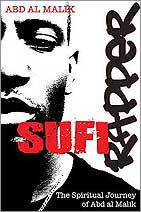
Then I would highly recommend the book “Sufi Rapper” by Abd Al Malik. This book is a great read. It follows the spiritual journey of the author from his beginnings as an aspiring criminal in Neuhof, described as a “difficult” quarter, into becoming a leader in the French hip hop community, and through his discovery and evolution within the Muslim faith. “Sufi Rapper” gives the reader a look at the life of a street hustler and a musician, a history of rap music from the French perspective, and an introduction to many Islamic paths. It’s like he wrote the book for me!

Abd Al Malik’s writing has a lyrical, enchanting quality to it. It shouldn’t be so surprising, coming from a lyricist. Seriously though….

“Despite everything, I cannot help but feel affection toward this father-child. No doubt he also served me as an anti-role model, with his fickleness and libertine habits, whose consequences we suffered. But I have never been able to nurture the slightest feelings of bitterness toward him.”

….if I could write like that I wouldn’t be here blogging to you people, I’d be published and an Oprah pick!

As much as I enjoyed the glimpse into the art of crime and learning about the French hip hop scene, the most fascinating part of “Sufi Rapper” is Abd Al Malik’s evolution into, for lack of a better descriptor, a Sufi rapper. Any person who has been on a spiritual journey, or struggled with finding a place in their faith, will see themselves reflected in this story. Or, if you’re like me, and just nosey about how people practice their faith, you’ll like it too!

Crime, music, religion….I love this book!

The Magician’s God

By Bob Makransky
(This essay originally appeared in the March 2009 Magical Almanac Ezine. Used here with the author’s permission.)

The magician’s conception of God is very different from the Judeo-Christian-Islamic conception. This is not to say that one is right and the other is wrong. On the contrary, a tenet of magic is that what is going on out there in the universe is not anything the human mind can possibly conceive of. Therefore all conceptions (beliefs) are wrong. Indeed, a human conception of God, no matter what it is, has definitely got to be puny in comparison with whatever God really is.

However it is instructive to compare the two conceptions of God since the two versions have different implications for how we should behave in our everyday lives. Emulating God, becoming more Godlike, is the meat and bone of any spiritual practice. How we conceive of God will determine what our spiritual ideal is, and what we are trying to accomplish in our spiritual lives.

To avoid confusion, we’ll refer to the Judeo-Christian-Islamic supreme deity as “God”, and to the magicians’ supreme deity as “the Spirit”.

Most people believe that God cares about them personally. Conventional religions inculcate fear of death, and then teach people to cover over that fear of death with the promise of heaven. People believe that if they do X and Y and Z, then God will be pleased with them and they will go to heaven when they die.

The magician’s path is very different. Magicians know that death is not only inevitable, but is nothing to fear. Death is right there in the background all the time. Magicians learn to feel that they are in the presence of death every minute. There is no salvation. Anything that comes through for them they are going to have to make happen themselves, since the Spirit doesn’t care a rat’s butt about them one way or the other. Use your head: if God cared about you, would He have condemned you to death? Believing that you’re special to God is the acme of self-pity.

Both God and the Spirit are all-powerful and created the universe intentionally. That is to say, creation was no accident, as the materialists would have it. (Even materialistic science has its God concepts. In mathematics it’s called The Axiom of Choice; in biology, Natural Selection; in classical physics, The Second Law of Thermodynamics; in quantum physics, Probability. Any intellectual system which purports to describe the workings of the universe must needs have a decision-making mechanism – a representation of intent.) However the Judeo-Christian-Islamic God is monotheistic: God stands outside of His creation. The Spirit, on the other hand, is pantheistic: the Spirit is everything and everything is the Spirit.

God cares about His creation: “God so loved the world that He gave His only begotten son … .” The Spirit, on the other hand, is utterly detached and indifferent, so that there is no point in worshipping it or praying to it: “The Spirit was so indifferent to the world that it left all sentient beings to figure things out for themselves.”

Since spiritual practice entails emulating the supreme deity, evidently caring is a fundamental part of Judeo-Christian-Islamic practice, whereas being detached and indifferent is essential to magic. Most people need the sense of security (from the magicians’ viewpoint, false sense of security) of believing that God is concerned about them personally. They need to feel that they fit in and belong somewhere. They must believe that they’re not all alone, at the mercy of ineffable, incomprehensible, and wholly impersonal forces of the universe. However, magicians need no such assurance. Indeed, they find such a belief useless baggage which weighs them down.

We all lie to ourselves constantly. For example, we believe that our luck is going to change really soon; or that this person we’re in love with is the most marvelous person on earth; and so on. Really, lying to ourselves is about the only way we can keep on keeping on much of the time. The difference between magicians and most people is that magicians know that they are lying to themselves. An example of a magician’s lie is “you create your own reality.” This is something magicians have to believe, even though they know it’s a lie. (It’s a lie because it’s an intellectual construct, and all intellectual constructs (beliefs) are lies. What’s really going on out there in the universe is completely random, as the Buddhists and quantum physicists assure us. We don’t create our own realities. The usefulness of this particular lie consists in providing a point of reference around which intent can be rallied. Therefore it is a more functional lie for a magician than the belief in going to heaven. The belief in heaven tends to inflate self-pity – glory thought forms such as complacency, self-satisfaction and arrogance – and thereby dissipates intent. To magicians only intent matters, not belief systems or being “right.”) Magicians choose their lies with care. Thus their conception of what the Spirit is, is another carefully crafted lie.

Although the Spirit is too vast to have what might be termed a personality, nonetheless it is correct to say that the Spirit is a trickster. The Spirit is a trickster because the magician’s reality is a reality of trickery, and you create your own reality and your own deity with it.

Magicians have to trick themselves to stay on the magician’s path, else who in blazes would follow it? Magic is a path of utmost responsibility, self-discipline and self-denial. Magic requires being utterly alone and facing up to the truth. No one wants to face the truth; not even magicians.

The Spirit is a trickster because although it will bring us what we want, what we’ve been praying for all along, it usually does this in such a guise that we don’t recognize it for what it is, and we therefore reject it. As an example, more than once I’ve seen the Spirit bring a person a true soul mate when they were on the rebound from a break-up, and still too filled with self-pity to see that this person they met accidentally was the one they were praying for all along.

How many times have I seen the Spirit bring someone their true heart’s desire on a silver platter, yet the person rejected it because they still had too much self-hatred to permit themselves to feel happiness. What keeps us from seeing and grasping the Spirit’s gifts is our own self-pity, which blinds us to everything except how much we’re suffering.

My spirit guides used trickery as their main teaching tool. Now that I’m more or less on my own, I have to trick myself. For many years I fantasized that one day a woman would come into my life and love me and make me happy (this rather asinine fantasy is common among men. I call it the “Claudia” complex after the character in Fellini’s 8 ½). My spirit guides really seized on that one. Every time a likely woman came across my horizon they played it to the hilt: “Oh yes! She’s the one you’ve been waiting for, definitely! Very soon now all your dreams will come true and you’ll find true love!” They encouraged me to make an ass of myself and follow every mirage until it too turned to dust. And in my stupidity and desperation I fell for that ploy every time, even long after I understand intellectually what they were doing and why. They were trying to burn that expectation out of me via exhaustion. They always told me that spiritual growth is mostly a matter of exhaustion, of giving up one’s own will. They were right, but I’m so stubborn and obsessive that it took me a long, long time to burn out. Now that their tricks don’t work on me anymore, I have to trick myself. This is what the technique of Creative Visualization is all about.

The point is that the magician’s deity is a trickster because the magician’s path is a path of trickery. There is no ultimate truth in this. The Christian and Hindu Gods are Gods of love because these paths are devotional paths. Magic, by contrast, is a very rational path – detached and coldly objective. There’s love in it, of course, and joy. Lots of joy, actually. In fact, the joy – the incredible joy – is the only excuse for following the magician’s path, because otherwise it’s a complete pain in the butt. But the principle mainspring to action is intent. What drives magicians forward is the quest for power and freedom.

Although the Spirit is wholly impersonal and indifferent, it nonetheless can be put to use. From the magical point of view, the Spirit is our servant. Every time we desire something, no matter how trivial, we emit an order, a desire line. Desire lines are actual fibers of light which pop out of our navels. They can be considered commands to the Spirit, who immediately starts racing around trying to fulfill our order.

The reason why most people can’t bring their desires to realization is because they have their desire lines tangled up. They don’t really want things to spring into existence the moment they think of them, as happens in dreams. Most people are afraid of taking responsibility for that much power. They would prefer to pretend that they don’t have that much potential control over their own lives and destinies. They prefer to cringe helplessly and wallow in self-pity rather than take on the awesome responsibility of total control over themselves: control over their moment-to-moment thoughts, feelings, and actions.

Most people prefer to believe in fantasies, like that someday God is going to bring them exactly what they desire, with no effort on their part. This is why they need to believe in a God who is outside of themselves, disconnected from them, rather than that they are the Spirit, and whatever situation they find themselves in is their own creation. To change it they’re going to have to change themselves by changing their way of looking at the situation they are in. Average people don’t want to have to do this.

The Judeo-Christian-Islamic God pities us and thus mirrors our own self-pity. The Spirit, on the other hand, is pitiless and can only be commanded by erasing self-pity. Power comes from taking responsibility for our decisions. In particular, this means taking responsibility for the situation in which we find ourselves in the present moment – dealing with the reality of it instead of wishing it would go away.

Taking responsibility means not blaming other people or the Spirit for our own unhappiness, nor trying to slough off our unhappiness on other people around us. Rather, it means understanding that we have deliberately, if unconsciously, chosen the circumstances of our lives, and only we can change them. When we truly understand this in our hearts, when we resign ourselves to this truth and begin to act on it, then we become one with the Spirit.

* Even materialistic science has its God concepts. In mathematics it’s called The Axiom of Choice; in biology, Natural Selection; in classical physics, The Second Law of Thermodynamics; in quantum physics, Probability. Any intellectual system which purports to describe the workings of the universe must needs have a decision-making mechanism – a representation of intent.

About the author:
Bob Makransky is a systems analyst, computer programmer and professional astrologer. He lives on a farm in highland Guatemala where he is a Mayan priest and is head of the local blueberry growers’ association. Check out his free downloadable Mayan Horoscope software, free downloadable Planetary Hours calculator, free downloadable Primary Directions / celestial sphere mathematics textbook, complete instructions on how to channel by automatic writing and how to run past life regressions, articles, books, stories, cartoons, etc. etc. at www.dearbrutus.com

Passover Fun!

It’s that Passover time of year again. Like most very bad Jews, I tend to celebrate with Cosmopolitans and questionably kosher cuisine. The important thing is that I gather with friends and family to share the story of the Jewish people. (Even more important is having fun.) For those of you who missed the animated film “The Prince of Egypt”, or find the phrase, we tell the story of Exodus confusing, let me drop a little knowledge on you.

And by knowledge I mean, quoting what the anonymous folks over at Wikipedia have to say. “Passover is a Jewish holy day and festival commemorating God sparing the Israelites when he killed the first born of Egypt, and is followed by the seven day Feast of the Unleavened Bread commemorating the Exodus from Egypt and the liberation of the Israelites from slavery.

In the story of the Exodus, the Bible tells that God inflicted ten plagues upon the Egyptians before Pharaoh would release his Israelite slaves, with the tenth plague being the killing of firstborn sons. However, the Israelites were instructed to mark the doorposts of their homes with the blood of a spring lamb, and upon seeing this, the spirit of the Lord passed over these homes, hence the term ‘Passover’.”

Not a holiday you would necessarily associate with fun, but my motley crew of quasi-Jews generally manages to pull it off. It’s rare to find quality Passover humor, but thanks to one of my favorite webcomics, “Least I Could Do” I have a little something to share.


© Blind Ferret Entertainment — Read More Least I Could Do At LICD.COM

By the way, for those of you who really had no clue what I meant when I referenced the movie “The Prince of Egypt”, check out the trailer below. Every year I suggest we just rent the movie and order a pizza, and every year I’m vetoed.

The Wiccan Rede Project: Kerr Cuhulain

A lot of people in the Wiccan community focus on the first part of the Rede: Harm none. There’s nothing wrong with this, but it is an incomplete interpretation. It’s only half of what the Wiccan Rede is all about. The Wiccan Rede is a double edged sword: It cautions you not to harm others, at the same time urging you to be all that you can be.

My Order of Scáthach focuses on both halves of the Wiccan rede. The Wiccan Rede is a cornerstone of our practice in the Order of Scáthach. Harming none is very important, but so is being all that you can be. Wicca is about empowering yourself, so that you can reach for your dreams. If you are not being all that you can be, you’re not entirely living up to the spirit of the Wiccan Rede. The Order of Scáthach insists that it’s members use both halves: We strive to be glorious.

The Wiccan Rede requires Wiccans to use their heads instead of someone else’s list of rules. It requires us to take responsibility for our actions rather than relinquishing this responsibility it to someone or something else. Wicca is not a Zoroastrian system like Christianity having only extremes of light versus dark, good versus evil, right versus wrong. That sort of system is an approach which requires no thought. There are no shades of gray. It is composed of long lists of rules and rigid codes. Our path, unlike the Christian one, is not based on guilt. The Judeo/Christian system can be summarized by the expression “Thou shalt not”. Our system can be summarized by the expression “I will not”: It is based on responsibility, not guilt

The Wiccan Rede is not a rule. It is a statement counseling us to think. Personal responsibility is the basis of the Wiccan ethical system. We must take responsibility for our actions and think about what we are doing. Rules are for training young children to be adults. At some point you must grow up and understand the reasons for the rules. This understanding should replace the rules. Wiccans don’t steal because it is illegal: Wiccans don’t steal because Wiccans understand that stealing is wrong.

About the Author:
Kerr retired from the Vancouver Police Department in November 2005 after serving 29 years with them. He was awarded the Governor General’s Exemplary Service Medal. Kerr’s past job assignments within the VPD include the Emergency Response Team, Hostage Negotiator, Child Abuse Investigator, Gang Crime Unit, and the Mental Health Emergency Services Unit. Kerr is currently working as a police dispatcher for ECOMM for Southwestern BC.

Kerr has been a Wiccan for 39 years and has been involved in anti-defamation activism and hate crimes investigation for the Pagan community since 1986. Kerr was awarded the Shield of Valor by the Witches League for Public Awareness. Kerr is the author of the “Law Enforcement Guide to Wicca”, “Witch Hunts”, “Wiccan Warrior”, “Full Contact Magick” and “Magickal Self Defense”. Kerr has a column on anti-defamation issues and hate crimes on The Witches’ Voice web site called Witch Hunts. Kerr is the former Preceptor General of Officers of Avalon, an organization representing Neo-Pagans professionals in the emergency services (police, firefighters, emergency medical technicians).

To learn more about Kerr, visit his website.

The Goddess is in the Details

I recently finished reading Deborah Blake’s latest book “The Goddess is in the Details”, which is releasing in May. What a wonderful read! As Blake points out in her introduction, there are “many books out there for the witch just starting out. Lovingly (or not so lovingly) referred to by many of us [Wiccans/Witches] as ‘Wicca 101’ books.” What has been lacking in the vast Wiccan book marketplace are books that talk more about what it means to be a Witch, the more spiritual and philosophical side of those who call themselves Wiccan. “The Goddess is in the Details” fills the void.

Blake’s book asks, and answers, just about any question you could ask about what it means to be Wiccan. The book is divided into six parts: The Everyday Witch, The Inner Witch, The Outer Witch, The Social Witch, The Practicing Witch, and The Natural Witch. Within those six parts, Blake discusses everything from “The Seven Beliefs at the Heart of Being a Witch” and “Mindful Eating” to “The Witch and Marriage” and “Interacting with Others at Work and Play”. Better still; at the end of each chapter, Blake has “Something to Think About” and/or “Something to Try”. These ask you to consider how you deal with or view the things previously discussed or offers exercises to try to incorporate what you’ve just read into your life.

I tend to think of this book as kind of a “High Priestess in a Box”. Any question you would think to ask a High Priestess, Blake answers. This makes the book an invaluable tool for Solitary practioners, individuals interested in becoming leaders within their respective spiritual communities, and any Wiccan looking to find what it means to be a Witch.

For me though, the best part of this book is the writing style. Deborah Blake and I have interacted frequently since our introduction in September of last year. She is a very warm and wise cracking lady and fortunately, she doesn’t edit her personality out of her writing. This makes the book an engaging read, with a lot of heart, instead of a dull philosophical text.


The Wiccan Rede Project: Raven Digitalis

‘Will’ & the Wiccan Rede
An Extract from “Goth Craft: The Magickal Side of Dark Culture
By Raven Digitalis (used with the author’s permission)

In his book Magick in Theory and Practice (Castle Books, 1991), Aleister Crowley defines magick as “The Science and Art of causing Change to occur in conformity with Will.” This may sound like a very simple and straightforward definition, which it is, but the magician must really dissect what these words mean in order to come to a fuller grasp of the process. I have found Mr. Crowley’s definition to be not too far off from many other occultists’ personal viewpoints, regardless of their level of respect for the guy. To first analyze this statement, we must understand what Crowley meant by “will.” To draw a correlation with modern witchcraft, the final stanza of the fifty-two lined Wiccan Rede is this:

Eight words the Wiccan Rede fulfill:
An’ it harm none, do what ye will.

This is a modification of Crowley’s spiritual principle “Do what thou Wilt shall be the whole of the Law.” This is one of the primary phrases of Thelemic philosophy, which is said to have been delivered by spiritual means to Crowley and his wife while in Cairo, Egypt on their honeymoon.

After his wife Rose began experiencing a number of occurrences in which she channeled arcane spiritual messages, Crowley administered a sequence of tests that showed that Rose possessed information impossible to know without massive amounts of prior research, apparently delivered to her from legitimate external sources. Crowley later identified these sources as the Secret Chiefs (Masters) of the Great White Brotherhood (Lodge), who are seen as a number of ascended masters who uphold evolutionary consciousness on the earth plane.

The height of the Cairo working was Crowley’s instruction to sit in a temple at noon for an hour on three successive days to receive a channeling from an external source himself. It was then that Crowley received a transmission that became known as Liber AL vel Legis (Liber CCXX): The Book of the Law. The book was later researched and declared genuine by a number of occultists. The being that delivered the information identified himself as Aiwass, who became recognized as Crowley’s Holy Guardian Angel.

The cryptic Egypt-centered philosophies delivered in The Book of the Law became the primary teachings of the path of Thelema, the magick of which works to push the practitioner to individually find the way to connect with the higher, cosmic self or God-self, thus uncovering one’s True Will (cosmic destiny) in order to achieve the Great Work: that which we are destined to achieve during our incarnation. Another message delivered in the channelings of Aiwass was “Thou hast no right but to do thy Will,” stating that all things done in life in accordance with one’s True Will are correct and spiritual, while anything done out of line and against one’s will is incorrect and thus sinful.

Like Crowley’s channeled philosophies, the final line of the Wiccan Rede does not mean “go ahead and do whatever the hell you want.” If the Thelemic definition of will is taken into account, it portrays the fact that all acts of magick are part of one’s life-plan and that magickal practitioners help uphold the world in which we exist. This includes 100% personal responsibility for any action one takes. It does not mean pursuing all temptations and pleasures of the flesh; nor does it mean to invite ego or chaos above morality. At the same time, it doesn’t mean to disregard them. It means uncover your destiny and follow it accordingly through conscious thought. One’s destiny is one’s life path; that which is meant to be accomplished. This includes both one’s greater destiny or life’s work as well as every moment of being; that which constructs the bigger picture. Thelemic magicians call the accurate following of one’s True Will the “Great Work.”

Gerald Gardner and Aleister Crowley were in contact whilst developing their own magickal systems: Crowley, the Thelemic magick of the OTO under his leadership, and Gardner, modern Wicca. They exchanged an unknown amount of material that helped one another form their magickal systems. They also interacted with other magicians and witches of the time, who exchanged multiple ideas and traditions between themselves. We do know that Gardner was initiated in Crowley’s OTO. While Gardner and Crowley’s relationship remains more or less ambiguous to this day, it’s speculated that the final lines of the Rede, which are seen in a similar form in Gardner’s Old Laws (Gardner did not write the Rede we are now familiar with), are modifications of Crowley’s input. It has even been speculated that Crowley actually wrote most of Gardner’s original Book of Shadows upon receiving payment to do so! Still others believe that Gerald Gardner modified Doreen Valiente’s writing The Witches’ Creed to form portions of his Old Laws, or that he created lines now integrated in the Rede as a combination of the Creed and the Thelemic Law. Other theorists who do believe Gardner had a strong influence in the creation of the Rede believe that he simply borrowed lines from Crowley’s material in the process of creating modern Wicca. For example, a couple of lines from Crowley’s Gnostic Mass are used word-for-word in the invocation of Drawing Down the Moon. The Drawing Down is accredited to Doreen Valiente, the first Priestess of Gardnerian Wicca.

In the Ostara 1975 issue of The Green Egg periodical, Lady Gwen (Gwynne) Thompson published The Rede of the Wiccæ (which is the Wiccan Rede), attributing the material to her deceased paternal grandmother Adriana Porter, who was said to have gotten it from earlier sources. Is this the origin of the Rede, and if so, how did Ms. Porter compile her material? We do know that Lady Gwen’s version was circulated among members of the New England Covens of Traditionalist Witches (NECTW). Regardless of the text’s origins, which are as of now unknown, the idea of will in both systems remains very much aligned. They are very similar and carry the same message: do the life’s work that you are meant to do.

Author’s Bio:
Raven Digitalis (Missoula, MT) is the author of Shadow Magick Compendium: Exploring Darker Aspects of Magickal Spirituality and Goth Craft: The Magickal Side of Dark Culture, both on Llewellyn. He is a Neopagan Priest and cofounder of the “disciplined eclectic” shadow magick tradition and training coven Opus Aima Obscuræ, and is a radio and club DJ of Gothic and industrial music. Also trained in Georgian Witchcraft and Buddhist philosophy, Raven has been a Witch since 1999, a Priest since 2003, and an Empath all of his life. Raven holds a degree in anthropology from the University of Montana and is also an animal rights activist, black-and-white photographic artist, Tarot reader, and is the co-owner of Twigs & Brews Herbs, specializing in bath salts, herbal blends, essential oils, and incenses. He has appeared on the cover of newWitch magazine, is a regular contributor to The Ninth Gate magazine, and has been featured on MTV News and the ‘X’ Zone Radio program. Visit Raven at www.ravendigitalis.com and www.myspace.com/oakraven.

Magical Buffet Mythology: Toci

Article by Rebecca
Image by Will Hobbs (www.sirwilliamwesley.com)

“The skin of snakes is often a point of curiosity among those who observe them. Unlike many other animals, snakes shed their skin on a periodic basis. While other creatures may simply shed skin cells or hair, a snake actually rids itself of its skin in one continuous piece, a procedure that can be likened to removing a sock. This shedding is not without purpose. Snakes shed their skin to allow for growth, as well as to remove parasites along with their old skin.

Snakes shed when they grow too big for their skin, comparable to the way humans outgrow clothing.” wiseGEEK.com

What about humans? If they shed their skin, do they become Gods? According to the Aztecs, the answer is yes, under the right circumstances. And with that, I give you Toci…..

Toci’s birth into the world is filled with all the markers of a suspense/horror film. Legend has it that way back the Mexica worked as mercenaries for the Culhua. The ruler of Culhua gave his daughter to the Mexica so that she could marry one of the Mexica nobility. Once delivered to the Mexica their primary deity Huitzilopochtli, the god of war, ordered that the woman be flayed and sacrificed. When the Mexica did this, the goddess Toci was born. She became the first female deity to the Mexica. The Mexica were driven from Culhua by the ruler and shortly after founded Tenochtitlan, which later blossomed into the Aztec empire.

From these bloody beginnings came Toci, the Aztec Mother of the Gods, a complex mother/fertility deity that also is identified with war. I assume that’s due to her relationship with the god of war Huitzilopochtli who ordered the sacrifice that culminated with her birth. Toci was worshipped during the harvest. Typically a young girl was sacrificed by tearing out her heart and flaying her. Her skin was later worn by a priest.

Although an older mother deity, Toci is rarely depicted as being aged. She usually has black markings around the mouth and nose and wears a headdress of cotton spools. (These are similar to the Aztec deity Tlazolteotl, who is a goddess of both filth and cleansing, and who is definitely on my list of deities to write about.)

And as further proof that Toci is perfect for some sort of horror/suspense film, I stumbled across “Toci: A Mexica Tale” (could freak you out, click with caution).

The Wiccan Rede Project

As the New Year was approaching, I of course turned my eye towards what kind of content The Magical Buffet could offer its readers in the New Year. I knew I wanted to find a new and interesting way to talk about Wiccans and Witchcraft practioners. I wanted to have a real discussion about the nature of belief and the differences of perspective of its adherents. When discussing other faiths often times publishers, interviewers, etc. compare differing interpretations of religious texts. Of course, as many of you know, there is no one definitive religious text for Wiccans. The faith is so eclectic and adaptable that you can ask 10 Wiccans what is the defining text for their faith and you will get about 20 different answers. Ask me how I know. Then it hit me, there is the Rede.

What is the Wiccan Rede? According to “The Complete Idiot’s Guide to Wicca and Witchcraft” the Rede “was first published in ‘Green Egg Magazine’ in 1975. Lady Gwen Thompson, a witch from the Celtic Tradition, submitted the poem. Her grandmother, Adriana Porter, had given it to her. No one is really sure how old the poem is. Some people believe it was written in the mid 1930s. Others believe that is unlikely, because the word Wicca was not used until the 1960s. No matter how old it is, the Rede remains a central pillar of the Wiccan faith.”

Again, ask 10 different Wiccans and get 10 different answers. Then I thought, would you really get 10 different answers? Well you know, there is only one way to find out. I sent out an email to past contributors to The Magical Buffet and a few friends and asked them if they would be interested in sharing their thoughts on the Wiccan Rede with my readers. Many wonderful people responded. I’m not going to list them all, because I want there to be some mystery, but to name a few: Raven Digitalis (author of “Goth Craft” and “Shadow Magick Compendium”), Thuri Calafia (author of “Dedicant: A Witch’s Circle of Fire”), Lady Passion (co-author of “The Goodly Spellbook”) and many more. My intention is once a month to share an opinion article on the Wiccan Rede.

For those of you unfamiliar with the Rede, we’re not talking about some thick tome of mythology. I’ve seen several versions of the Rede, but when I think of it, I’m always thinking of the version that appeared in “Green Egg Magazine”.

“The Rede of the Wiccae”

Bide the Wiccan laws ye must
In perfect love and perfect trust.

Live and let live-
Fairly take and fairly give.

Cast the Circle thrice about
To keep all evil spirits out.

To bind the spell every time,
Let the spell be spake in rhyme.

Soft of eye and light of touch-
Speak little, listen much.

Deosil go by the waxing Moon-
Sing and dance the Wiccan rune.

Widdershins go when the Moon doth wane,
And the Werewolf howls by the dread Wolfsbane.

When the Lady’s Moon is new,
Kiss the hand to her times two.

When the Moon rides at her peak,
Then your heart’s desire seek.

Heed the Northwind’s mighty gale-
Lock the door and drop the sail.

When the wind blows from the South,
Love will kiss thee on the mouth.

When the wind blows from the East,
Expect the new and set the feast.

When the West wind blows o’er thee,
Departed spirits restless be.

Nine woods in the Cauldron go-
Burn them quick and burn them slow.

Elder be ye Lady’s tree-
Burn it not or cursed ye’ll be.

When the Wheel begins to turn-
Let the Beltaine fires burn.

When the Wheel has turned a Yule,
Light the log and let Pan rule.

Heed ye flower, bush and tree-
By the Lady blessed be.

Where the rippling waters go,
Cast a stone an truth ye’ll know.

When ye have need,
Hearken not to other’s greed.

With the fool no season spend
Or be counted as his friend.

Merry meet an merry part-
Bright the cheeks an warm the heart.

Mind the Threefold Law ye should-
Three times bad and three times good.

When misfortune is enow,
Wear the blue star on thy brow.

True in love ever be
Unless thy lover’s false to thee.

Eight words the Wiccan Rede fulfill-
An it harm none, do what ye will.

That’s it. Yet, this seemingly simple poem lays out the basics of spell casting and the ethics of being Wiccan. Not too shabby for 26 couplets, right? Of course, as mentioned before, ask 10 different Wiccans, get 10 different interpretations. Like any religious text, the Wiccan Rede holds different levels of regard depending on the individual. I hope that you’ll enjoy learning and debating the Rede each month as contributors offer their opinions on the subject.

Welcome to The Wiccan Rede Project.