The Harpy

By Rebecca
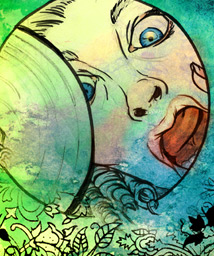
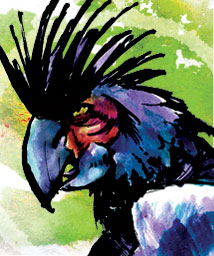
Illustration by Will Hobbs

Generally when we say harpy, we’re referring to, as Random House Dictionary states, “a scolding, nagging, bad-tempered woman; shrew, or a greedy, predatory person.” Perhaps it’s that innate fear or repulsion that leads to so much trouble when trying to learn about the mythological creature the harpy.

Let’s start with appearance, one source tells me that harpies started out as beautiful goddesses but over time were morphed into nasty creatures, and then others say they started out down right hideous, but have been toned down to the creatures we generally think of when considering the harpy. Therefore, what are we looking at here? Obviously it varies based on artistic interpretation, but at the most basic it’s a woman who from the torso down is bird and has wings large enough to carry her in flight. Sometimes the face is less human in appearance, with bulging eyes and tusks, other times the face is the only human component and the body is entirely bird. (For the record, for me the harpy will always look like the harpy from the movie “The Last Unicorn”.)

Everyone seems to agree that in Greek mythology the harpies were the daughters of Thaumas and Electra. Of course, how many were there? A few sources say two to three: Aello and Octpete, with Celaeno as a later addition. One source goes so far as to say three to four: Aello, Octpete, Celaeno, and a possible extra to make four! No matter the number, harpies make appearances throughout Greek myth, generally harassing, stealing, or killing anything they feel like.

In the Middle Ages an image of a harpy was used on coats-of-arms. It was referred to as the “virgin eagle”. I have many exciting theories on why the harpy was a virgin, all of them would be inappropriate for me to say, and many of which you can guess for yourself.

In an interesting, and more all age appropriate side note, the largest raptor found in North and South America is the Harpy Eagle. Yup, named after the mythological creature. It’s certainly cuter than any version of the mythological harpy I can imagine. On the other hand, it still totally gives me the creeps.


The End is Near!

It’s true. The awesome Disinformation Company gave me a copy of their documentary “2012: Science or Superstition” to review. I’m very excited, not only is this the first DVD I’ve ever reviewed, but it came from the folks at Disinfo.com, AND I’m interested in the subject matter. Obviously the end times are upon us.

For those of you who aren’t familiar with the whole 2012 thing, let me sum up. The ancient Mayans created a very complex, advanced, utterly bad ass long calendar. The calendar ends on December 21, 2012. Everyone has an opinion as to what this means, and most of them seem to have a book.

“2012: Science or Superstition” is an hour and a half of opinions from a variety of sources, most notably Graham Hancock, author of “Fingerprints of the Gods”. I don’t want to sit here and outline it for you because I would probably flounder horribly at presenting their research. The introduction to the documentary explains in more detail the Mayan long count calendar and that the end date of December 21, 2012 is generally interpreted to mean one of two things: a date for the beginning of the apocalypse or the beginning of a time of renewal and rebirth of conciousness. (For the record, my theory is that by the time the Mayans realized that their formula for the calendar broke down the last date was so far away that they figured hey, let’s just forget about it. I mean, they were advanced, but they were still just people, and people are more than happy to not deal with annoying and tedious problems that could later be address hundreds of thousands of years later.)

The rest of the film has various authors and scientists presenting their thoughts, theories, and research. My favorite of these individuals was Dr. Anthony F. Aveni, Professor of Astronomy and Anthropology at Colgate University. His insights were razor sharp, laced with skepticism, yet surprisingly thoughtful and considerate in regards to other people’s beliefs. Oddly, it was his insights that are making me reconsider my “The Mayans Got Lazy” theory.

The best part is that you can get the movie on iTunes for only $9.99! You can buy it on Amazon for just a tiny bit more, and it retails at the reasonable price of $19.99.

To learn more, visit the website!

Pukwudgies: Myth or Monster

By Christopher Balzano
(originally appeared on Massachusetts Paranormal Crossroads website; used with permission)

In the Southeastern corner of Massachusetts lies Bristol County, an area known locally as the most haunted place in New England. The energy that sleeps there has been rumored to cause haunted schools, ghostly armies and unexplained suicides and murders. Forested areas of the county have long been known to contain a litany of unexplained animals, from Bigfoot and thunderbirds to large snakes and odd bear-like monsters. For the past forty years cults have flocked there, and their activities, often criminal, have filled the blotters of local law enforcement. Of all the unknown horrors that live in Bristol County, the most feared is not a animal or a ghost or the members of Satanic cults that walk the forests, but a demon only two feet high, and if the history of the area represents the history of our America society, these Pukwudgies are the gatekeepers of our darker side.

The Pukwudgies have haunted the forests of Massachusetts since before the first European Settlers ever thought about setting out for a new land. For centuries they tormented the local Native Americans and crept their way into their creation myths and oral history. They could easily be passed of as legend, and in fact, their physical description is much like mythological creatures from other cultures in other times. The difference is these demons jumped from the page and evolved as the people around them changed, changing from reluctant helpers to evil tormentors. The difference is these demons are still seen by people today.

Most cultures’ mythology has some reference to small monsters that have a strained relationship with humans. In many ways it makes sense. While large monsters have their place in our fears, diminutive creatures find their way into the shadows of our rooms and under our beds. Their names and nature change, but there are always common threads that link them together. Some are called monsters and roam the land looking for human food and kidnapping anyone they can find. Other are called demons, foul spirits that feed of the negative and expose the sins of man. When referring to one, its classification gets blurred and these two words become interchangeable, perhaps showing us how closely associated these monsters are with evil.

Veterans returning home after World War II talked of gremlins tearing apart their planes or getting into jeep engines and causing havoc. The Hindus speak of the Rakshasas or the “Night Wander” who eats human skin and jumps into the dead to possess them. Africans tell stories about the Eloko who lure people with beautiful music only to devour them after they have been bewitched with an ever expanding jaw.

Although passed off as works of fiction and imagination, trolls and dwarfs have existed in people’s fears for centuries. They have become lovable and noble now, but the original stories recorded of these monsters are anything but fairy tales with happy endings. Trolls were notorious for ambushing travelers and destroying whole families on a whim. While some are described as giants with humps and one eye, many older cultures, especially in Scandinavia, described the being as the size of a plump child.

Dwarfs have always been small and their manners much better, but the end result seems to be the same. Like the troll, they are known as metal and stone workers, but unlike their flesh-eating counterparts, dwarves seem to avoid human contact. While they would prefer to be left alone, if impeded upon their work, they become like caged dogs. One variation of the dwarf is the Tommy-Knocker who lives in mine shafts and is sometimes said to be the ghost of miners who have perished in the line of duty and are doomed to work for eternity. They are known to cause cave-ins and fires in the shafts.

Perhaps the most famous of the small nightmare are seen by the Irish. Fairies patrol the roads in Ireland causing problems for any traveler who strays from the path. They live in hills or mounds and dance around fires. If a human comes across their mound or sees their dancing, they are caught and held captive. Even the beloved leprechaun was once a malicious spirit before he was Americanized and transformed into the gold keeper he is today.

Exposure to nature seems to feed these tales, and the more a society depends on the earth for its needs, and the closer the relationship a people have with the natural world around them, the more these stories pop up. In this country, the people the first settlers found had a close, if not friendly, view of small dangers around them. The Cherokee have a mirror image demon known as the Yunwi Djunsti, or little people, that look and talk like Cherokee but are only a few feet high and have long hair that touches the ground. Although most people cannot see them, they are known to throw objects, trip up hunters and abduct people who wander off. In Canada they are known as Mennegishi and look much like the classic alien grey.

The Wampanoag Nation, the dominant Native America tribe in Massachusetts and Southern New England, had a monster who still dominates the landscape they once roamed. The Pukwudgie made its first appearance in the oral folklore of the people of Cape Cod, but recent sightings have forced people to rethink this mythological creature. Standing between two and three feet tall, the Pukwudgie looks much like our modern idea of a troll. His features mirror those of the Native American in the area, but the nose, fingers and ears are enlarged and the skin is described as being grey and or washed-out, smooth and at times has been known to glow.

What makes these monsters dangerous is the multitude of magical abilities they use to torment and manipulate people. They can appear and disappear at will and are said to be able to transform into other animals. They have possession of magical, poison arrows that can kill and can create fire at will. They seem to often be related to a tall dark figure, often referred to in modern times and shadow people. In turn the Pukwudgies control Tei-Pai-Wankas which are believed to be the souls of Native Americans they have killed. They use these lights to entice new victims in the woods so they may kidnap or kill them. In European folklore these balls of energy are know as Will-o-the-Wisps and are said to accompany many paranormal occurrences. Modern paranormal investigators call them orbs, and catching one on film is the gold standard of field research.

Legends of the Pukwudgie began in connection to Maushop, a creation giant believed by the Wampanoag to have created most of Cape Cod. He was beloved by the people, and the Pukwudgies were jealous of the affection the Natives had for him. They tried to help the Wampanoag, but their efforts always backfired until they eventually decided to torment them instead. They became mischievous and aggravated the Natives until they asked Quant, Maushop’s wife, for help. Maushop collected as many as he could. He shook them until they were confused and tossed them around New England. Some died, but others landed, regained their minds and made their way back to Massachusetts.

Satisfied he had done his job and pleased his wife, Maushop went away for a while. In his absence, the Pukwudgies had returned. They again changed their relationship with the Wampanoags. They were no longer a nuisance, but began kidnapping children, burning villages and forcing the Wampanoag deep into the woods and killing them. Quant again stepped in, but Maushop, being very lazy, sent his five sons to fix the problem. The Pukwudgies lured them into deep grass and shop them dead with magic arrows. Enraged, Quant and Maushop attack as many as they can find and crush them, but many escape and scatter throughout New England again. The Pukwudgies regroup and trick Maushop into the water and shoot him with their arrows. Some legends say they killed him while other claim he became discouraged and depressed about the death of his sons, but Maushop disappears from the Wampanoags mythology.

Pukwudgies have been seen at the Ledge in Freetown, Massachusetts.

The Pukwudgies remained however, but something odd happens. The timing of the tales of the monster are a map through the history of the Native Americans relationship with the European settlers. The death of the five sons lines up with the very first settlers, and the flight of Maushop is told along side the changing of attitudes about the new neighbors. The Pukwudgies, always seen in a negative light, become the foot soldiers of the Devil, which may explain their modern connection to shadow people. As more Native Americans began to convert to Christianity, their myths evolved, until the Pukwudgies were responsible for the evil in the village, and the hand of Satan on the tribe.

People who spend time in the forest of New England will tell you Pukwudgies are not symbols, but a real horror that still stalks people. They continue to see them, and as the world develops around them, the monsters remain unchanged and as dark as ever.

Joan was walking her dog through the state forest in Freetown, Massachusetts, on a cold Saturday morning in April when she saw the monster. As she and her dog, Sid, walked down the path, Sid became anxious and strayed a few feet into the woods. Joan followed him in, and stopped short. Her dog was lying completely flat in the leaves, and on a rock ten feet away was a Pukwudgie. She described him as looking like what she would describe as a troll; two feet high with pale gray skin and hair on his arms and the top of his head. The monster seemed to have no clothes, but it was difficult to tell because his stomach hung over his waist, almost touching his knees. His eyes were a deep green, and he had large lips and a long, almost canine nose.

The Pukwudgie stood watching her, staring straight at her with no expression, almost like it was stunned to see her. Joan froze and remembers thinking the air in her lungs had been pushed out. Sid finally came to and ran back towards the trial, dragging Joan who was still holding the leash tightly.

Although the whole exchange took less than thirty seconds, it remains with Joan ten years later. She has not gone back to the forest, but feels that might not be enough. Three times since the event she has woken up to find the demon looking in on her. It has never attacked her or spoken to her, she has merely seen it looking through her bedroom window, staying just long enough for her to notice him. All three times she claims she was fully awake and could move if she had to.

Another man in Framingham, Massachusetts had a experience that forced him to remain away from the woods. Tim was in a forest when he saw a bright orb in front of him. Having investigated the paranormal he was excited and tried to snap a photo with his digital camera. The ball of light disappeared and reappeared a few feet further into the woods. Tim followed, losing the spirit several times before he realized he had traveled more than thirty feet off the path into a thickly wooded area. He became scared and slowly made his way back to the path, only to find a two foot man standing there, walking towards him. He turned and ran, and looking back saw the figure move back into the woods.

Tim reported that what he saw had walked upright and had used its arms to push something aside when he fled to the forest. He had moved with a slight limp, but “like a human”.

The second time Tom saw the Pukwudgies was a few years later in a parking lot near the same forest. He was listening to the radio at almost a whisper and checking his rear view mirror for the friend he was waiting for when he saw the same small figure of a man. Every detail was identical, and the Pukwudgie just stood there watching him. The car turned on by itself and his radio began to get louder. Tim pulled out of the parking lot and took the long way home to try and stop his hands from shaking.

Although the monster seemed content to only frighten Joan and Tim, there are still physical attacks happening. Several people have been assaulted and one person came down with a mysterious illness after seeing them in a cemetery in New Hampshire. Another woman suffered scratches on her arm after following an orb in a forest in Taunton, Massachusetts.

The most disturbing reoccurring attacks might be taking place at the Pukwudgies favorite hunting ground. In the Freetown State Forest there is an hundred foot cliff overlooking a quarry known as the Ledge. There have been many hauntings at this sight, but the most frequent experience is an overwhelming feeling to jump to the rocks and water below. In the folklore of the Wampanoag, the Pukwudgies were known to lure people to cliffs and push them off to their death. There have been several unexplained suicides at the Ledge, often by people who had no signs of depression or mental disease before entering the forest.

Author Bio:
A teacher and folklorist living in the Boston area. He has been investigating the unknown for twelve years and running Massachusetts Paranormal Crossroads, a website dedicated to the paranormal and local folklore of Massachusetts, for more than five. His writing has appeared in such respected publications as “The Haunted Times” and “Mystery Magazine” as well as “Unexplained Paranormal Magazine.” His investigations have been covered by “The Boston Globe”, “The Boston Herald”, “The Standard Times” and “Worchester Magazine” and he has been asked to speak about urban legends and the paranormal at conferences throughout New England. He is a regular on several paranormal radio shows, including “The Ghost Chronicles” and “Spooky Southcoast” and has appeared in documentaries and television specials on the supernatural. He was one of the featured writers in Jeff Belanger’s Encyclopedia of Haunted Places and contributed to the collection Weird Hauntings and the soon to be released, Weird Massachusetts. His writing and research have also been featured in Thomas D’Agostino’s Haunted New Hampshire and Haunted Massachusetts and the recently released Ghostly Tails from America’s Jails.

You can learn more by visiting: Massachusetts Paranormal Crossroads, Ghost Village where he is the news editor, and ParaRelations.

Magical Buffet Mythology: Toci

Article by Rebecca
Image by Will Hobbs (www.sirwilliamwesley.com)

“The skin of snakes is often a point of curiosity among those who observe them. Unlike many other animals, snakes shed their skin on a periodic basis. While other creatures may simply shed skin cells or hair, a snake actually rids itself of its skin in one continuous piece, a procedure that can be likened to removing a sock. This shedding is not without purpose. Snakes shed their skin to allow for growth, as well as to remove parasites along with their old skin.

Snakes shed when they grow too big for their skin, comparable to the way humans outgrow clothing.” wiseGEEK.com

What about humans? If they shed their skin, do they become Gods? According to the Aztecs, the answer is yes, under the right circumstances. And with that, I give you Toci…..

Toci’s birth into the world is filled with all the markers of a suspense/horror film. Legend has it that way back the Mexica worked as mercenaries for the Culhua. The ruler of Culhua gave his daughter to the Mexica so that she could marry one of the Mexica nobility. Once delivered to the Mexica their primary deity Huitzilopochtli, the god of war, ordered that the woman be flayed and sacrificed. When the Mexica did this, the goddess Toci was born. She became the first female deity to the Mexica. The Mexica were driven from Culhua by the ruler and shortly after founded Tenochtitlan, which later blossomed into the Aztec empire.

From these bloody beginnings came Toci, the Aztec Mother of the Gods, a complex mother/fertility deity that also is identified with war. I assume that’s due to her relationship with the god of war Huitzilopochtli who ordered the sacrifice that culminated with her birth. Toci was worshipped during the harvest. Typically a young girl was sacrificed by tearing out her heart and flaying her. Her skin was later worn by a priest.

Although an older mother deity, Toci is rarely depicted as being aged. She usually has black markings around the mouth and nose and wears a headdress of cotton spools. (These are similar to the Aztec deity Tlazolteotl, who is a goddess of both filth and cleansing, and who is definitely on my list of deities to write about.)

And as further proof that Toci is perfect for some sort of horror/suspense film, I stumbled across “Toci: A Mexica Tale” (could freak you out, click with caution).

The Bungisngis Mystery

Article by Rebecca
Image by Will Hobbs (www.sirwilliamwesley.com)

It’s always tough to work with creatures of myth that are not from your native culture. You find yourself wondering, what do the people of the country of origin think of this? Alternatively, am I even getting the right information? This is the predicament I find myself in when discussing the Bungisngis.

It seems simple enough; according to my starting point, the Bungisngis is a cannibal giant from Philippine folklore. His top lip is so big that he can pull it over his head (making him the male that can survive that joke about to understand the pain of child birth take your bottom lip and pull it over your head). They say that the hero Suac came along and stole the giant’s club, and used the club to subdue his enemies.

Then I made the mistake of opting to try to learn more. Education is never the answer to these things, I swear! I easily found out that the Bungisngis is a creature of Philippine mythology. It was featured in an episode of “Da Adventures of Pedro Penduko”, which is the third and fourth season of the Filipino fantasy TV series “Komiks”. After that things get a bit more tricky.

The story of Suac (remember Suac, the hero who stole the club?) well from what I see Suac killed a dark giant called Pugut. Pugut is a meat eater, but was more than content to eat a roasted hog, although he did threaten to eat the hunter (and later hero) Suac. Perhaps Pugut is a Bungisngis; you know, Pugut is his name and Bungisngis is his race? Another story with a similar set up has no mention of Pugut or of a Pugut, but instead has the villian as a Bungisngis, or the Bungisngis. There is no mention to his physical appearance, but again he wants to eat cooked meat. Instead of the hero Suac, this tale has a monkey defeat the Bungisngis.

So what did we learn? Well, the Bungisngis is definitely a piece of Philippine folklore. Certainly a meat eater, who would gladly consider eating you if you anger him, but otherwise seems content to eat cooked game animals. Probably a giant. And maybe has the name Pugut.

Of course Wikipedia paints an entirely different picture. According to their entry the Bungisngis is a giant from Filipino folklore, but they list it as having one eye, making it a cyclops, and they describe them as happy and playful…hardly the beast we just talked about.

See what I mean? Sometimes learning more just makes things more confusing.

Magical Buffet Mythology: Pandora

Article by Rebecca
Image by Will Hobbs (www.sirwilliamwesley.com)

We all know the story of Pandora, or do we? It is a simple one, right? Woman is given box, told never to open it, opens the box, evil shoots out all over the place, except for hope, the end. What if I told you Pandora wasn’t just any woman, but the first woman, and that she quite possibly has been given a retroactive bad wrap, would you click to read more?

Hey, thanks for clicking in! As I was saying, it’s often forgotten or overlooked knowledge that Pandora was the first woman. In Greek myth Hephaestus crafted her body and Athena gave her intelligence (later renditions have all the Olympians giving her gifts which coincides with her name Pandora, given to her by Hermes, which means All Gifted). Pandora, and all womankind that came after, were created in retribution for Prometheus gifting fire to humanity. In later versions, just in case the wicked nature of woman wasn’t enough punishment, Pandora was given a jar (which later still became a box) that held nothing but evils. Zeus gave Pandora to Epimetheus and wouldn’t you know it, she immediately scatters the contents of the jar. The only thing left in the jar was hope.

Still a fairly basic story, right? Let’s delve deeper, shall we? Pandora’s name, although frequently referenced as above to mean All Gifted, has been reconsidered by most scholars to actually translate into Giver of All or All Endowed. This name tends to strip away the Greek gods, doesn’t it? Add in a full jar, always a good symbol of the womb, and you may have some sort of proto-Greek fertility deity. Enter the Greek pantheon and their need for a mythology. Where did woman come from? Why is there evil in the world? And faster than you can say, “Eve picked an apple” Pandora is created by the Gods to be the downfall of man by letting loose a bevy of evils from her jar.

Even if you ignore my overtly feminist rendition of the above paragraph, there are still many things about the myth that are open to interpretation, theory, and opinion. I find it surprising because generally regardless of how simplistic the story is, most mythological/religious texts wrap up loose ends and stop up any gaps. Yet here are a few things about Pandora’s story to consider.

Why is hope still in the jar? It doesn’t escape the jar and enter the world, so is hope held back in the jar for humanity’s benefit or punishment? Essentially, is hope being saved for us, or withheld from us? In order for us to experience the evils of the jar, they had to be freed from the container, so what does it say that hope is still locked away? Of course, hope of what? Everything else in the jar was evil, why was hope in that mix? Was it a blessing trapped in the jar with curses, or was it some sort of evil hope, which we were spared by it being left behind? See what I’m talking about?

Moreover, there is the classic did she jump or was she pushed kind of question. Did Pandora intentionally open the jar, knowing what it contained? Did she open it out of curiosity due to ignorance of its contents? It’s unclear whether Pandora acted with intent to cause harm or not.

Pandora endures, whether it’s as the no good woman who opened up the literal Pandora’s box for the world, a curious woman who accidentally doomed us all, or as a deity commandeered into mortality to serve as a lesson regarding the evils of woman. Pandora and her jar/box are referenced frequently in modern times, more often it seems than Zeus, who commanded her creation, and certainly more than any of the Greek poets who helped establish her story. Perhaps despite her rough lot in life, she’s come out on top.

Mopaditis

Article by Rebecca
Image by Will Hobbs (www.sirwilliamwesley.com)

What happens to us when we die is, in my opinion, one of those questions that we can never truly answer. There’s only one way to get your answer, and trust me, it’s a killer. (Insert rim shot here.) The way people have answered this question has influenced religion, philosophy, and entire cultures. It explains the fascination with the study of the paranormal; it defines the Spiritualist faith. What happens to us after we die is a multimillion-dollar industry, and an intimate puzzle for each human to solve for themselves. There’s the potential for ghosts, poltergeists, spirits, angels, and more. For the Aborigines, there are the mopaditis.

These are the spirits of the dead. They are incorporeal and invisible in daylight. Mopaditis are white in the light of the moon and black in the dark. It is said they still look just like a human, but given their visual temperament, I think it would be hard to say if you actually saw one. A human who encounters a mopaditis will at best experience clammy hands and their hair standing on end, at worst paralysis.

There is a connection between the mopaditis and black cockatoos. A flock of black cockatoos escorts the mopaditis back to its birthplace, all the while crying out, to announce the spirit’s arrival.

Not being from Australia, let alone one of their Aboriginal people, I cannot tell you more, I don’t know it to tell. And the more I think about it, good. The mopaditis are their answer to the question, not mine.

Ancient Feminine Wisdom of Goddesses and Heroines Divination Deck

I’ve always had a good relationship with U.S. Games, one of the go to places for tarot decks, but I just got a new contact there and she sent me a box of goodies to go through and I plan to steadily share it all with The Magical Buffet’s readers!

First up, Ancient Feminine Wisdom of Goddesses and Heroines Divination Deck by Kay Steventon and Brian Clark. This isn’t a traditional tarot deck, hence it being called divination deck.

This is a 78-card deck that’s a veritable who’s who of Greek mythology. I’m not going to lie, I had to bust out my “Bullfinch’s Mythology” for some of the ladies depicted. The deck also comes with an instruction booklet and a spread sheet to help you use the deck for divinatory readings. I could imagine someone using it as a daily quickie reading, much the way you’re encouraged to use the I Ching. Every morning wake up, shuffle, and draw a card to see some portents of what’s to come in your day. Thanks to the attractive art, I also could easily see a Game Master using this deck as a prop for any role-playing games that deals with ancient Greek mythology.

All you Goddess worshippers, yeah, I’m talking to you! This is the deck for you!

Magical Buffet Mythology: Hypnos

Article by Rebecca
Image by Will Hobbs (www.sirwilliamwesley.com)

Listen to the sound of my voice. Or, um, read the words on your screen. You’re getting sleepy. Sleepier. What does hypnosis have to do with Magical Buffet Mythology? Well, not to sound like the father from “My Big Fat Greek Wedding” but hypnosis comes from the Greek word hypnos, and Hypnos is actually the Greek god of sleep…so there you go.

Hypnos’s mother is the goddess of night, Nyx, and his twin brother is Thanatos, a god of death. His three sons, or brothers depending on perspective, are Morpheus, Phobetor and Phantaso, and represent things that occur in dreams. According to some stories he lives in the Underworld along with Hades and his crew, but other stories say he lives in a cave underneath a Greek island and that through that cave flows the river of forgetfulness. Um, don’t plan on me coming to the family reunion, okay?

Hypnos is always depicted as a handsome young man. Sometimes he is naked, sometimes he has a beard and wings at the temples of his head, other times he is clean shaven with wings on his back.

Hypnos biggest claim to fame, aside from getting $.02 every time we say the word hypnosis, is granting Endymion the power to sleep with his eyes open.

Magical Buffet Mythology: The Flying Spaghetti Monster

Article by Rebecca
Image by Will Hobbs (www.sirwilliamwesley.com)

Yes, I have been touched by His Noodly Appendage. And honestly, anyone who has taken a moment to consider the nature of religious belief, scientific inquiry, and the difference between them has probably also felt his presence. That’s right, this month we’re talking about the deliciously delightful Flying Spaghetti Monster.

The Flying Spaghetti Monster looks just the way his name implies, like a ball of spaghetti with eye stalks. There is much debate as to what kind of pasta the FSM is made of, with Westerners leaning towards wheat. Of course, he is rarely seen, leading to the belief that he is invisible. His self proclaimed Prophet, Bobby Henderson, said that the FSM first appeared to him in 2005 as a response to a decision by the Kansas State Board of Education to require the teaching of intelligent design as an alternative to biological evolution. This leads many to think the FSM is a new found deity, but since he appeared to Henderson, the FSM has been traced back further into history, most notably the glory days of pirates. Pirates are in fact the FSM’s chosen people, which is why one of the holy days for Pastafarians is International Talk Like a Pirate Day.

Many claim that the FSM is fake, but a visit to www.venganza.org shows that the FSM has many academic endorsements. Last time I checked, no other deity had academic endorsements! Another moment of validation was in 2007 when three talks concerning the FSM were given at American Academy of Religion’s annual meeting in San Diego.