2009 Esoteric Book Conference

By John Coughlin

The first Esoteric Book Conference in Seattle was a huge success. The organizers (William Kiesel, Michael Kolson, and Catamara Rosarium) were present and on the ball keeping things running smoothly. The only recommendation I would make would be to publicize more since many locals said they were not aware of the event. Still attendance was very good and from all the bags of books I saw people carrying many of the vendors were happy.

I was especially excited that there was such a presence from the UK. Being able to meet with the wonderful folk from Fulgar, Treadwells, and Scarlet Imprint was a real treat. Many of the Immanion Press authors were also in attendance besides the authors there to present.

Vendors and Visitors:
As far as vendors go there was quite a selection of new and used books at the event being sold by Night of Pan Books, Ouroboros Press, Holmes Publishing, the Golden Dawn Trust, Immanion Press, Ars Obscura, Fulgar, ANJA, Feral House, and Waning Moon Publications.

Artists:
I missed the art apart from a quick run through of the room. Artists in attendance were Liv Rainey-Smith, Gabriela Sugier, Bryan Ward, and Orryelle Defensetrate-Bascule.

Presentations:
On Friday Thomas Karlsson, founder of Dragon Rouge led the first official Dragon Rouge magical working on the American continent. Dragon Rouge is a Scandinavian Left Hand Path order which is more well-known in Europe but which has been slowly finding interest in the States. I missed this since I was still traveling over the continent at the time.

Darcy Kuntz was the first to talk at the formal conference. He started with a note that his upcoming title, Temple Magic, was delayed since he had come across some additional photos and artwork to be added. He shared some photos of original Golden Dawn paraphernalia including an original altar top. The formal lecture itself discussed the early history of the Golden Dawn, from the initial stirrings through the Egypt Exploration Fund in 1882 thru the 2nd order Golden Dawn which is based on the Societas Rosicruciana in America (SRIA), touching on some of the mail political points which lead to the first order’s dissolution, such as the debates over the legitimacy of the Gold Dawn Cypher MSS by Waite and others. Darcy is an encyclopedia of information when it comes to the Golden Dawn and the lecture was packed with facts and dates.

Second up was Richard Kaczynski – sadly missed since had to man my table. His presentation was entitled “Occult Blue-Bloods and Black Sheep: How the ‘Social’ part of secret societies Spawned Generations of Spiritual Seekers” where he discussed the influences various 19th century secret societies and key members of those groups have had on each other as well as on newer groups which are still active today.

Third was a panel with Immanion Press (and some of their authors) and Waning Moon Publications (represented by me). We only had an hour so focused on the value of small press in giving voice to books and authors that the commercial publishers would ignore since they would not sell enough to sustain the large print runs such publishers make. Independent publishers tend to not put profit over their interest in manifesting books on topics they feel are important. Hence larger publishers tend to rehash the same 101-type material since the audience is larger and they stick with what they know will sell. Small publishers are more in touch with the needs and interests of their readers. There was not much time left for questions so some break-away discussion was taken outside for those interested. I’d like to see the panel back next year with more time since I would have loved to have heard more from the attendees.

Fourth was a presentation by Robert Ansell of Fulgur entitled “Exploring the Creative Sorcery of Austin Osman Spare’s Magico-Aesthetic” where many photos of Spare’s art were categorized to help define Spare’s methodology, and in particular how spare applied his philosophy of “Neither-Neither” as a basis for that methodology. Of particular interest were how other artists and musicians of the time began to employ some of these methodologies in their own work, and of course how they came to influence Crowley himself.

Fifth up were Peter Grey and Alkistis Dimech from Scarlet Imprint in their presentation entitled “Seven Heads, Seven Veils” where both Peter and Alkistis shared their personal work and revelations with Babalon, each having their own unique approach to their work. While very different in approach it was interesting how ultimately similar conclusions were made regarding the depth of gnosis one experiences with that goddess and how demanding She can be upon those who have the strength to work with Her. I was also impressed at how poetic and candid their presentation was.

Sixth was Thomas Karlsson’s presentation. I missed this presentation but was told by colleagues it essentially was a summary of the work contained in his book Qabala, Qliphoth and Goetic Magic.

The last presentation for Saturday was by Michael Staley, a member of the Typhonian Order. I do not know which one he did on this day but both his Saturday and Sunday presentations explored the work of Kenneth Grant, one on Imagination and Creativity and the other on Initiatory work. Sadly I missed both of these since I had to work.

There were several evening events for those who had purchased the deluxe package but I was too jetlagged and opted for the sweet embrace of Morpheus. These performances were by Elysium Obscura, Danse Perdue (butoh), and theatric ritual of Orryelle Defenestrate-Bascule all which got glowing reviews from those who attended. (Still kicking myself for missing it!)

Sunday seemed to have a larger turn out and I was not able to attend the morning presentations since I had to mind my table. The presentations included:

Dr. Amy Hale examining Ithell Colquhoun’s conception of the numinous and its relationship to her art.

Michael Staley’s second presentation on Kenneth Grant’s work.

Brandy William’s presentation on the Chaldean Oracles and thoughts on how they could be adopted/adapted by modern practitioners.

I was able to attend the next three presentations.

Christina Oakley Harrington of Treadwells gave a presentation entitled “Flesh of my Flesh on the ecstasy of the Page” where she explored the common structure of the grimoires. She noted the power and significance of the physical construct of the handwritten book and how the act of copying a text by hand plays upon the transcriber. She shared her own experience of transcribing a Book of Shadows and how it connected her to the past when the book she was not transcribing was itself being transcribed. I thought her imagery of book as a lover was wonderful and given the nature of the conference it was clear by how many in the audience were nodding and smiling that she was not alone in that colorful association. I know I myself love to play with textures when binding books because the experience of handling a book is very visceral and intimate.

Next was Robert Ansell’s second multimedia presentation, “Bound by the Devil: The Arte of Talismanic books” where he presented and discussed many examples of talismanic books from the late 1800s thru to the 1980s. In examining the power of these books he made the point that an amulet reflects energy while a talisman refracts energy. Turns out many of these talismanic books embraced modern book designs for their time and we were left to ponder where the digital age will take us in that respect, tho at the moment it seemed clear that the book as a physical (not digital) construct was very much of paramount to most of us.
Daniel Schulke, current director of Xoanon Publishing was the next presentation. He discussed the magic of the Charming tradition of folk lore offering many examples their use, many of which are still in use today. Afterwards we were treated to photos of many of the internal books and papers of the Cultus Sabbati, who have many members versed in the art of book binding. This was a real treat.
I missed the music by Eyving Kang & Jessika Kennedy which closed the event since I had to man my table.
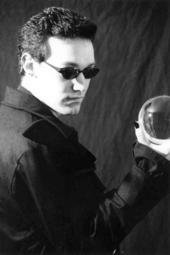
About John J. Coughlin:
John J. Coughlin has been a practitioner of the Occult Arts since the mid-1980’s. In that time he has worked with several groups, although he primarily prefers to walk a solitary, eclectic path. Also associated with the Gothic scene, John has incorporated his personal aesthetics and ideals into his spirituality giving him an often unique perspective. His pivotal work “Out of the Shadows” has lead some to consider him the father of Dark Paganism, given he was the first author to publicly explore that concept.

Preferring to consider himself an “obscure occult writer” due to his distaste for self promotion, John believes those who will benefit from his work will eventually stumble across it when the time is right. Professional writers are cursed with having to sacrifice their integrity to please the majority in order to sell their work to the masses. John does not seek to make a living off his writing and is therefore free to write about what he finds interesting and important regardless of its trendiness or political correctness. Much of John’s work remains in private distribution within the various magical groups with which he works.

Books by John Coughlin: “Out of the Shadows: An exploration of Dark Paganism and Magick”, “Ethics and the Craft”, “A Cthulhian Grimoire of Dream Work” and “Liber Yog-Sothoth”
As a lover and collector of books, John is also the founder of Waning Moon Publications where he produces both hand bound limited edition as and mass produced titles on various occult-related subjects.

More information about John Coughlin as well as his various web-related projects can be found at www.waningmoon.com.

Finding Our Self Esteem and Getting Unstuck on This Path

by Leandra Witchwood

I grew up in a household where my extra efforts where sometimes scoffed at and ridiculed. Growing up this way I naturally believed that my extra efforts were silly and pointless. Even now after years of soul searching, meditation, and empowering myself; I still struggle with my less than healthy self-esteem. I now realize that it was my family’s insecurities mix with my own ability to hang on to the past that helped make me insecure.

I did not appreciate how common this issue is until I took a good look at our American culture. It happened while I was taking my most recent class on progressing in meditation. The instructor commented on how our American mind-set differs from the Tibetan mind-set. She revealed to me how our culture is based on “Your best is not good enough”, instead of “You did your best and that is good. Try it again tomorrow and you will do better.”

I immediately found this enlightening and empowering. It helped me remember that our mindset is not the only mindset available. It was freeing to know that I have the option to change. We don’t always contemplate the messages we receive from family, media, friends, and community. Unfortunately, these messages seep deeply into our psyche doing damage that is tough to mend. Over the past several weeks, I have been contemplating this reality and how one can conquer this subtle oppression.

Someone once told me this, “We are who we think, others think, we think, we are.” Some wisdoms are not always easy to grasp or express and this one defiantly has a “Whoa!” factor. To put it most simply, if we believe in ourselves and express our own inner strengths, others will pick up on this and it will become who we are to them. In turn they will treat is as confident and capable people thus encouraging our own confidence.

Our self-esteem is important in developing ourselves Magickally and spiritually. Recognizably it is counter-productive to achieve proficiency in Magick and spirituality without working on our inner blockages, like low self-esteem. When it comes to learning a spiritual path on your own and performing Magick, your healthy self-esteem is what drives our intentions home. You have to be willing to believe in yourself and your abilities 100%.

When I began this path several years ago, there were very few creditable people offering classes, apprenticeships, coven opportunities, etc. So much of what I learned in the beginning was on my own. Before I was able to find competent teachers with enough experience under their belts I read books, practiced what I read, kept a journal of my experiences and more. From what I can gather not much has changed for many people out there. Many beginners and many of those on the cusp of moving beyond the “101” stage are still limited to learning on their own.

So if we spend so much time practicing alone, reading alone, and learning alone why can’t we find some pride and empowerment in this? Doing so much work and finding the will and dedication without someone encouraging us is not easy. By taking these steps on your own shows you have the inner flicker of your own healthy self-esteem. You don’t have someone around to explain things to you or push further, you tapped into your own personal strength. I feel for people when I read how they feel stuck and can’t progress on their own. I immediately want to jump in and offer encouragement.

I feel we are placed here to help one another ascend. Here are some ways I was able to move forward, find my inner power and confidence. Perhaps you can benefit from the things as well.

1. Read – I don’t mean simply read things published by Pagan authors. Read fiction, periodicals, blogs, and subjects that may not pertain to your practice but have a sense of creativity. Read something that inspires, motivates, and above all challenges you.

2. Listen to Pagan and Spiritual Podcasts –There are so many Pagans out there chatting up the internet. Some you will agree with and some you will not. That doesn’t matter. The point is to open yourself up to other points of view and ideals. This is also a great way to practice non-judgmental listening. If we become too judgmental of how others practice we lose the point. Listen and learn with an open heart and mind.

3. Practice Staying in the Moment – This is a tough one, but it is essential. Breathing is a great way to practice. I found that I am able to adjust my thought patterns and emotions by simply focusing on my breath. Sometimes I will incorporate Yoga breathing techniques, which also seem to be effective.

4. Get Outside – Go camping, take a hike, listen to the birds, watch the clouds, study animals in their habitats without interpretation, or document the growth of your favorite tree or garden. Watch Nature in all her splendor and take time to realize her connections and cycles.

5. Create something – I have a few hobbies and crafts I enjoy from sewing to candle making to making herbal remedies to gardening. I find that when I engage myself in something creative I relax and think. There have been several occasions where I reached critical epiphanies while sewing a ritual robe or cooking up a healing salve.

6. Find a tough and experienced Teacher – I can’t stress this enough… find a tough and experienced teacher. Find someone who has been around for a minimum 10 years, Preferably someone with experience in leading others a public group. When you find someone with experience like this, you are likely to bypass the drama and head games that inexperienced and socially closed leaders tend to indulge. Our Elders are very important and from what I have seen we discredit them too quickly. Make sure the teacher you choose will challenge you mentally, spiritually, and emotionally. Don’t be afraid to ask questions and don’t be afraid to accept the challenge of learning something new. Finding a teacher is not always easy but when you find the right one you will be amazed at your growth.

7. Be Willing to Dedicate – Passive learning never does anyone any good. Personally, I see too much passive learning and engagement from the community. Maybe that sounds a little harsh but it is true. We tend to look for the easy answer and the quick fix. Truthfully, this path is filled with necessary lessons that are difficult but well worth the effort. Without these lessons, we would gain nothing. If we only look for the easy in everything, we end up with a very shallow spirituality. When the tough lessons hit you try your best to recognize where they hit you the hardest and find ways to stick with it. Dedication will deliver a deeper understanding of the spiritual experience.

8. Notice your own patterns – I had a man come to me a few years ago who wanted me to read his cards for him. As soon as I saw him I knew what he was looking for. He wanted to know what was following him around to make him have such bad luck. I also knew he was not willing to know the truth. As I read his cards, the uncomfortable truth was revealed. The cards said to him that he needed to change the way he lived his life and viewed/treated the people in his life. He needed to change his reactions to situations and he needed to release himself from negative redundant processes he had become blind to over the years. He was convinced that someone had cursed him, and that may be true. One of the most basic curses and hard-hitting curses is to bind someone to their own destructive behaviors. So if you feel you are stuck take a look at what you have been doing and perhaps try something new.

9. Don’t Quit – If you quit you fail. I don’t like using this word but I can’t describe it any other way. When you quit no one can help you. If you need to step away for a while then take the time you need, but don’t allow your frustration to drive you to ending your journey.

10. Help Others – There is a certain inner reward for doing something for someone else. Volunteer your time helping rescue wild animals, clearing hiking trails, reading to kids in the library, weeding a community garden, etc. Do it as a distraction, make the effort to give back, and give yourself the time to connect with other people even if they are not from a Pagan path.

These are only a few things we can try to move forward and become more confident within our practice. Through time and dedication, we can look back and see how we have changed. Most of us don’t change over night. Give yourself a break and give yourself some time. Change is usually scary and difficult for many people, but trying your best is all you can do. If you falter, try again. You will do better each time.

Do your best today. Try it again tomorrow and you will do better.

Bright Blessings!

About the Author:
Leandra Witchwood has served her local community as a Minister of Earth-Base Spirituality, an Animal Card Reader, Spiritual Counselor, Leader, Teacher, and much more. Leandra enjoys facilitating Labyrinth walks and educational seminars. She also teaches classes on mediation, Witchcraft, Wicca, and various Magickal techniques. Her spiritual teachings and readings are inspiring and revealing. Leandra is currently writing books and blogs to benefit the larger community.

To learn more, visit:http://leandrawitchwood.blogspot.com/

The Nature of Reality

By Bob Makransky
(This essay originally appeared in the May 2009 Magical Almanac Ezine. Used here with the author’s permission.)

It’s difficult to understand what magic is without understanding the nature of the self and reality. This is not an irrelevant question which is best relegated to Philosophy 101 – meaningless, empty talk which philosophers debate about endlessly to no purpose. Rather, understanding what the self and reality really are cuts to the very heart of magic. It’s a question of everyday life, of where we focus our moment-to-moment attention. It is by scrutinizing this question and not allowing themselves to be fooled by superficial appearances that magicians obtain whatever advantage they have over most people, not by supernormal powers. It’s a sad commentary on the state of our society that the antics of so-called celebrities, and the latest fashions, buzz-words, and gadgets, are much more important to most people than the questions, “Who am I?”, “What am I?”, and “What the hell is going on here?”

A fundamental principle of magic is that reality – what we experience when we are awake – is but a specialized form of dreaming. Dreaming came first evolutionarily, and being awake is a later adaptation, rather than vice versa. We believe that what we experience when we are awake is real. However, it is also true that we believe that what we experience when we are asleep is real – at least while we are still dreaming. It is merely the belief that what we are experiencing is real that makes it real. This seems to be a very difficult point for people to understand. We indeed create our own realities. There is no outside reality impinging upon us, in spite of superficial appearances to the contrary. What we experience as the outside world, or reality, is no more real than the dreams we had last night.

Why then does the world that we experience while we are awake seem so real? This is due to our constant thinking, our constant inner dialogue, which holds our waking reality together for us. If our self-referent thinking stops, so too does our reality.

If you objectively examine the contents of your inventory of habitual thoughts you will discover that most of them consist of thoughts of glory – receiving approval and approbation from other people, and shame – hatred of your looks, your actions, and your feelings. Glory and shame are two sides of the same coin: the me-me-me coin. If you stop thinking these thoughts, then the “me” – the sense of a separated, continuing self who is alternately exalted and debased – ceases as well. When this lower self collapses, so too does the so-called real world.

There are other societies, magical societies, in which people don’t think as much as we do. The reality the members of these societies experience in their daily lives is more magical than ours is. The world of the Mayan Indians of Guatemala is a good example. Freidel-Schele-Parker, in their book Maya Cosmos, contrast the Spanish and Mayan world-views through their respective descriptions of the decisive battle in which Pedro Alvarado defeated Tecun Uman, the leader of the Kiche Mayans, on February 22, 1524:

“According to Alvarado, this was just another battle among many. In a letter to Cortez, he said that several thousand Kiche warriors approached his troops while they were taking a break for food and water. They let the Indians close the distance. Then they attacked and routed the Indian army, pursuing them until they were trapped against a mountain. … He mentioned that one of the Kiche chiefs was killed, but he did not even record his name. The Kiche account is told as if a totally different series of events had unfolded.”

The Kiche Mayan version is a battle between the magic and gods of the Mayan Indians and the magic and gods of the Spanish: the Virgin Mary and her attendant angels. In the Kiche version, Tecun Uman assembled an army of 8000 warriors to oppose the 700-man Spanish army, then he used magic to transform himself into an eagle and flew against Alvarado, but “he could not kill him because a very fair maiden defended him; they were anxious to enter, but as soon as they saw this maiden they fell to the earth and they could not get up from the ground, and then came many footless birds, and those birds had surrounded the maiden, and the Indians wanted to kill the maiden and those footless birds defended her and blinded them.”

Whose version of the battle is correct? The Spanish themselves credited their God and the protection of the Virgin Mary with their stunning victories against overwhelming odds, even if they weren’t able to get the same visual take on the thing that the Mayans got. Modern historians, whose worldview is even less magical than the sixteenth century Spanish view, try to explain the outcome in purely materialistic terms. From the magicians’ point of view, none of these views are correct; or rather, they all are, because people create their own realities based on what their social training and personal experience of the world have led them to expect. The reason why most modern people experience so little magic in their lives is because they’ve trained themselves to be closed-up and insensitive, and to expect life to be routine and dull.

Our constant thinking, and the customary moods and concerns which this thinking conjures up, is a screen which keeps our intuitive perception of the world under wraps. Without this screen the world becomes vivid and magical, teeming with life and meaning. My book Magical Living describes a simple technique for following feelings and for opening ourselves to the magic of the world. When following feelings we shift from the closed-up mindset of thinking awareness into a state of enhanced awareness in which we can feel what plants are feeling, sense emanations of power from the earth, interact with spirits, and so on. The world of enhanced awareness is a world of constant surprises and delight. However you couldn’t balance a checkbook or interview effectively for a job in this state. The point is that what blocks our magical perception of the world is our fear; and our anger; and our fear of our anger; and our anger at our fearfulness; etc. etc. That is our constant inner dialogue. This is the reality which most of us have created for ourselves.

In actual fact, there is nothing out there whatsoever. Reality actually consists of nothingness. Any reality which we perceive is our own invention: a gloss over the basic stuff of the universe, which is void. The Buddhists call this Shunyata, or emptiness. It’s sort of like the fact that a movie is actually colored celluloid with light passing through it. Now if we can go one step further and imagine that even the colored celluloid and light don’t exist either, then we’ve got a picture of what’s really going on. God doesn’t exist; the universe doesn’t exist; existence doesn’t exist. This happens to be the truth; but since truth doesn’t exist either, we may as well just let the subject lay.

Magic, in fact, is the only logical, reasonable, rational worldview since it is completely illogical, unreasonable, and irrational. An important principle of magic is that magic is a false view of reality, since reality can’t be viewed. It cannot be comprehended with the mind, by thinking. It can, however, be glimpsed with the feelings, by direct knowing.

It is important to understand what the self really is if we expect to understand what reality is. The myth of a separated lower self – a body – and the myth of an external reality arise together. These are two ways of looking at the same basic falsehood. In actual fact we are not separated from the world, and the world is not outside of us.

What fools us is our linear view of time. We mistakenly believe that things happen to us, and then we react to them. For example, first we get laid off from our job, and then we feel depressed and helpless. However from the magical point of view, the decision to feel depressed and helpless is primary – is made “first”. The getting laid off is conjured up “later” to justify our feelings of self-pity. Face it: there are lots of options – feelings we could conceivably feel in any given situation. For example, if we get laid off we could just as easily feel relieved, glad that one’s over, hopefully looking forward to a new career. The choice to feel self-pity about what happens to us is always a free choice.

The choice to feel self-pity at the things which happen to us – as if we didn’t bring them to us in the first place – is what creates the illusion of a separated self at odds with an outside reality. What we consider our self is just self-pity. Since this point is the entire basis of magical training, it bears repeating: the lower self is nothing more than self-pity, and when self-pity is eradicated the lower self dissolves also.

If we’re going to understand this point of view we have to get over our prejudice, which is all it is, about time being linear. The fact is that time is not linear. Survivors of near death experiences often report having seen every single event that ever happened to them during their lives flash by them in no time at all. Sometimes they report seeing everything that ever happened to them zip by, but still being able to see each scene discretely, in a few seconds’ time. Others report seeing each individual event of their entire lives in one, complete take. In any case, it would seem that we experience the thought forms of our lives twice: once in linear fashion over a lifetime, and then in a non-linear fashion at the moment of death.

This idea that time can be non-linear is easiest to see in dreams. Dream time is sequential, but not linear in the same sense in which waking time is linear. Dream time doesn’t have the same cause-and-effect inexorability that waking time has. This is because there is less importance in dreams, so everything is more here-and-now. We don’t feel moods and concerns as acutely in dream time as we do when we’re awake because we don’t think so much. Things happen too fast and too intensely in dreams to dwell upon. Everything is just too vivid and too now.

Infants and young children are basically doing what we adults would consider dreaming even while awake. Being awake – and our sense of linear time – are something we learn as we grow up. That’s why it seems to us that childhood lasted forever (while we were still children): because our sense of the passage of time wasn’t yet fully formed. Linear time is a byproduct of our ability to think.

In life-threatening situations, such as while we are having an automobile accident, or during a big earthquake, time slows way down. We can see everything that is happening with great clarity, in great detail, as if it were unfolding in slow motion. This slow motion perception of time is closer to the truth. It is more like dream time perception and less like our normal, everyday, gloss-over-things-quickly-and-superficially perception of time. However, we are incapable of acting in the normal way in this slow motion perception of time because we can’t think. If we are going to act or react in this frame of mind, we can only do so on intent, on our gut-level instinct, not on thought. Therefore the slow motion perception is not as useful in performing all the humdrum tasks of everyday life as is normal time perception; but it is the more useful form of perception in the practice of magic, where decisions have to be made faster than normal thinking allows.

When time slows down enough we lose our sense of separated selfhood and move into altered states of consciousness. Indeed, “timelessness” is how people usually describe such states. Altered states can occur due to shock, psychedelic drugs, or even spirits. Some spirits have the power to temporarily erase our self-pity so that we experience a state of selfless grace. Enlightenment is such a state – people who are enlightened can move into and out of timelessness and selflessness at will, by focusing their attention one way or the other. But even enlightened people don’t exist in a state of nirvana all day long. They have normal lives to lead too, and altered states are not particularly functional in everyday society.

Normal, everyday life is the battleground, the place where the real work has to be done, the place where it all begins and ends. Altered states can be inspiring, can give us a glimpse of the goal we are shooting for, but they are always temporary. The goal is to bring an awareness of timelessness and selflessness into the routines of our everyday lives. We do this by detaching from the self-important, self-pitying me-me-me with its endless fluster of moods and concerns.

The essential tenet of magic is that you create your own reality. This means that the things which happen to us are attracted by our moods and concerns. It’s only by controlling our moods and concerns, our thinking, that we can control our reality. Of course, this is a lot easier said than done. Our moods and concerns have a tremendous momentum of their own. To turn back that tide means to literally rewrite our personal history and to let go of the past; to release our expectations and let go of the future.

There are ways of doing this. One technique in particular, recapitulation, involves reliving our memories to discharge the energy pent up in them. There are also many other techniques for self-transformation. These usually take years and years of dedicated practice before we start seeing concrete results: controlling our realities by controlling our moods and concerns, our moment-to-moment thinking and moods.

The purpose of Creative Visualization is to take a short-cut to creating your own reality, without all the years of work. Creative Visualization is described in detail in my book Thought Forms. The point is that the difference between the magician’s reality and most people’s reality is that the magician makes a thoughtful, informed choice of what his or her reality will be. Most people, on the other hand, accept willy-nilly, unquestioningly, the version of reality inculcated by their society – their parents, teachers, church, government, academia, and the media. Neither is right or wrong, it’s all Shunyata, emptiness; but one choice leads to freedom, and the other leads to slavery.

About the author:
Bob Makransky is a systems analyst, computer programmer and professional astrologer. He lives on a farm in highland Guatemala where he is a Mayan priest and is head of the local blueberry growers’ association. Check out his free downloadable Mayan Horoscope software, free downloadable Planetary Hours calculator, free downloadable Primary Directions / celestial sphere mathematics textbook, complete instructions on how to channel by automatic writing and how to run past life regressions, articles, books, stories, cartoons, etc. etc. at www.dearbrutus.com.

Summer Solstice & Spiritual Meltdown: How to Keep Your Cool When Life’s Hot!

By Lady Passion, HPS, Coven Oldenwilde
(this article also appears in the June issue of Oracle 20/20 magazine, reprinted here with the author’s permission)

I’ve taught magic to folks for 17 years or so, and thus as High Priestess, often born the brunt of pseudo-psychotic rants from those calling themselves sincere Seekers one second, yet who take offense over the flimsiest of pretexts, inexplicably act suspicious, make outlandish, erroneous accusations, and burn the very bridges they previously claimed to want to build with “folks of like mind.”

Although such can happen at any time when people who think they’re mature enough to handle the imbed conditioning or regret that mastering magic provokes in aspirants, I’ve noted that such often happens near or during Litha Sabbat celebrations held every June 21st or 22nd.

Why should this be? Why do tempers flare during a season of freedom, a gathering immersed in natural bliss? Because the Sun’s high in the sky.

Many seem as unaware of the incredible impact that the Sun exerts on their emotions as they are of their prejudices and motivations. Taught as they are that the Earth’s electro magnetic shield protects them from the majority of solar rays, they nonetheless doublethink dismiss their need for ever-higher degrees of sunscreen. They deny the mind blowing might of the Sun’s real exertion, and thus pay it as little heed as they do the sway their birth and rising signs have on their temperament, goals, and actions.

Traditionally, countries wait for winter’s passing to begin or resume war. Heat can make the blood and brain seem to boil. Heat can make you feel crazed, sticky with sweat that seeps unbidden from ever pore, as if your body’s leaking salt tears bemoaning its fate. If enough time passes without relent, flash-point anger can occur, leading to ‘crimes of passion,’ friendship split, or even sparking revolution.

Witches fight an uphill battle to help keep folks sane amidst arbitrary societal demands for money or selfish pursuits. And Covens know that the seasons ebb and flow, sometimes gently, sometimes mutable, even extreme. But other groups may be surprised when the cohesiveness they enjoyed in winter is cast off by one of their number when summer arrives.

When flowers and showers give way to summer doldrums (those ‘dog days’ of steam when the air itself holds its breath and seems too parched to cry out for rain), doubt sets up, begetting recrimination. The group’s work suddenly feels under attack, their accomplishments thrust in jeopardy, and friendships can quickly falter just when folks are supposed to be enjoying Nature again.

Perhaps liberals involved in spiritual groups are particularly vulnerable to letting detractors think what they will — to shrug off insults. And true, if someone nurses their resentments, prefers to not to be disabused of their notions rather than express them in hopes of resolving them, there’s little that truth to the contrary can do to prevent them from crashing in flames.

Of course it’s unfair that a group ever put one person on the hot seat, as such practically guarantees rancor. But private talks often end in traded rants as well, without witnesses as to what was said, and although discussing problems by passing around a talking stick seems egalitarian, things can still deteriorate into focusing on negatives rather than positives.

It’s wise to anticipate arguments, for they will arise. So as summer waxes and tempers threaten to fray, be magically prepared to prevent catastrophic conflict, and use wise ways mitigate their impact.

• When in doubt, don’t. If you feel on the brink of ballistic, enact the Witchy Power to Be Silent. Anger abates with time, and you may end up glad you held your peace, and proud that you didn’t explode over some silly perceived provocation.

• When in doubt, divine. Do a reading and ask the God/desses Pax (peace), Concordia (concord), or Eirene (tranquility) for guidance. Tarot cards and other magical methods may reveal that your ire is baseless, or explain secret stressors responsible for others’.

• Cool down with water and herbs. Bathe in a sachet of lavender buds, chamomile flowers, and basil while imbibing cannabis sativa.

• Promote harmony with food. Serve passionflower tea, apricots, Brazil nuts, ginger, licorice, raspberries, rhubarb, strawberries, and peas.

• Wear cool colors and gems. Becalming colors include blue, green, and pink. Gentle gemstones include aquamarine, iolite, peridot, jade, blue topaz, and rose quartz. Your gem choice should depend on the message you want to send: To evoke tenderness and elicit sympathy, wear lapis lazuli. For love and loyalty, wear sapphire. For friendship, wear turquoise. To prevent emotional hurt, wear a reflective hematite pendant. To prevent confusion or misunderstanding, don’t don mutable stones such as diamond, alexandrite, or agate.

• Wear a protective talisman. A pentagram can protect your feelings with the power of the five Elements. A Hand of Fatima charm is a similar, but filigreed alternative. The 13 symbol Italian Cimaruta can grant even more protection. To prevent a “circular argument”, don’t wear a spiral or round Amorite fossil amulet.

• Play conducive music. Songs in the major modes of Ionian (Sun, scale C-D-E-F-G-A-B-C, to dispel gloom) and Mixolydian (Jupiter, scale G-A-B-C-D-E-F-G, for optimism) or minor Phrygian (Venus, scale E-F-G-A-B-C-D-E, to calm) work wonders.

• Avert fights. Infuse the air with apple or cypress essential oil. Make a bouquet of sky blue aster flowers, pansies, poppies, roses, thyme, tulips, or violets.

• Avoid bickering on Tuesday. Violence is prone on this day sacred to the war God Mars. Foster friendship on Fridays, the day sacred to the love Goddess Venus.

You’ll find a galore of more spiritual solutions in The Goodly Spellbook: Olde Spells For Modern Problems.

About the Author:
Lady Passion is High Priestess of Coven Oldenwilde in Asheville, N.C. & co-author, The Goodly Spellbook: Olde Spells For Modern Problems. She may be contacted via: www.wiccans.org and www.oldenwilde.org.

The Spirit of Youth: A Review of “Spirited”

Often times when reading a book about magical practices I tend towards reading past the how-to and getting to the magic user themselves. I’ve always been described as a people person, but at the end of the day, I’m just nosey and prefer to learn about magic practicing individuals so much more than about the magic they practice. Try saying that line 5 times fast! With this in mind, I must say I truly enjoyed Gede Parma’s book “Spirited: Taking Paganism Beyond the Circle”.

“Spirited” gives me a perspective that I hadn’t encountered before, and that is one of youth. Parma has been a practicing Witch since he was 12 years-old. If “Spirited” is a reflection of his writing skills and insights now, I cannot wait to see what he has to share 20 years from now. Parma’s book is knowledgeable, insightful, full of personal anecdotes, and laced with a passion and idealism that only comes with youth.

“Spirited” covers any topic you could imagine: dealing with peers and schools, performing rituals, solitary practices verses covencraft, Pagan ethics, and more. The thorough nature of “Spirited” paired with the youth of its author provides a perspective making this book useful not only to other teenagers, but to any adult who wants a better understanding of the youth in the Pagan community. I would say this is a must read to anyone who considers themselves a leader in the Pagan community, or is working towards becoming a High Priest or High Priestess.

Happy 100th!

Happy 100th birthday “Rider-Waite Tarot Deck”! Hmmmm….how do you celebrate the 100th birthday of such an important piece of occult history? Could I suggest with the purchase of the “Pamela Colman Smith Commemorative Set”?

This massive set pays homage to Pamela Colman Smith, the artist behind the “Rider-Waite” deck. First, this set includes the “Smith-Waite Centennial Edition Tarot Deck” reproduced directly from the original 1909 “Rider-Waite” deck. Since the “Rider” part of the name was merely there because they were the publishers of the original deck, U.S. Games Systems (the current publisher) dropped the “Rider” and added “Smith”, now giving credit to the two people behind the creation of the deck, Pamela Colman Smith and Arthur Edward Waite.

Another part of the Smith tribute is the book “The Artwork and Times of Pamela Colman Smith” by noted tarot expert and all around bad ass Stuart R. Kaplan. This book is a fascinating look at the life and works of Smith. For someone like myself, who only is familiar with Smith through her contribution to the tarot world, this book gave me an eye-opening look at not only a talented artist, but also a gifted writer and storyteller.

Just to make the set complete, “The Pictorial Key to the Tarot” by Arthur Edward Waite is included in an updated format. To round out the tarot side of things there’s also a tarot spread sheet guide and an organza bag to hold the tarot deck in.

In case that wasn’t enough to dazzle, you’ll also get a 5”x7” photo of Pamela Coleman Smith (who is adorable), three more 5”x7” reproductions of Smith’s art, and six postcards featuring even more of her artwork!

All of this comes in a beautiful, double-sided display case that carries the heft of a serious collection of stuff.

This impressive set is an absolute must for anyone who is serious about tarot, but would also make an interesting gift for an art lover.

To learn more, click here.

The Magician’s God

By Bob Makransky
(This essay originally appeared in the March 2009 Magical Almanac Ezine. Used here with the author’s permission.)

The magician’s conception of God is very different from the Judeo-Christian-Islamic conception. This is not to say that one is right and the other is wrong. On the contrary, a tenet of magic is that what is going on out there in the universe is not anything the human mind can possibly conceive of. Therefore all conceptions (beliefs) are wrong. Indeed, a human conception of God, no matter what it is, has definitely got to be puny in comparison with whatever God really is.

However it is instructive to compare the two conceptions of God since the two versions have different implications for how we should behave in our everyday lives. Emulating God, becoming more Godlike, is the meat and bone of any spiritual practice. How we conceive of God will determine what our spiritual ideal is, and what we are trying to accomplish in our spiritual lives.

To avoid confusion, we’ll refer to the Judeo-Christian-Islamic supreme deity as “God”, and to the magicians’ supreme deity as “the Spirit”.

Most people believe that God cares about them personally. Conventional religions inculcate fear of death, and then teach people to cover over that fear of death with the promise of heaven. People believe that if they do X and Y and Z, then God will be pleased with them and they will go to heaven when they die.

The magician’s path is very different. Magicians know that death is not only inevitable, but is nothing to fear. Death is right there in the background all the time. Magicians learn to feel that they are in the presence of death every minute. There is no salvation. Anything that comes through for them they are going to have to make happen themselves, since the Spirit doesn’t care a rat’s butt about them one way or the other. Use your head: if God cared about you, would He have condemned you to death? Believing that you’re special to God is the acme of self-pity.

Both God and the Spirit are all-powerful and created the universe intentionally. That is to say, creation was no accident, as the materialists would have it. (Even materialistic science has its God concepts. In mathematics it’s called The Axiom of Choice; in biology, Natural Selection; in classical physics, The Second Law of Thermodynamics; in quantum physics, Probability. Any intellectual system which purports to describe the workings of the universe must needs have a decision-making mechanism – a representation of intent.) However the Judeo-Christian-Islamic God is monotheistic: God stands outside of His creation. The Spirit, on the other hand, is pantheistic: the Spirit is everything and everything is the Spirit.

God cares about His creation: “God so loved the world that He gave His only begotten son … .” The Spirit, on the other hand, is utterly detached and indifferent, so that there is no point in worshipping it or praying to it: “The Spirit was so indifferent to the world that it left all sentient beings to figure things out for themselves.”

Since spiritual practice entails emulating the supreme deity, evidently caring is a fundamental part of Judeo-Christian-Islamic practice, whereas being detached and indifferent is essential to magic. Most people need the sense of security (from the magicians’ viewpoint, false sense of security) of believing that God is concerned about them personally. They need to feel that they fit in and belong somewhere. They must believe that they’re not all alone, at the mercy of ineffable, incomprehensible, and wholly impersonal forces of the universe. However, magicians need no such assurance. Indeed, they find such a belief useless baggage which weighs them down.

We all lie to ourselves constantly. For example, we believe that our luck is going to change really soon; or that this person we’re in love with is the most marvelous person on earth; and so on. Really, lying to ourselves is about the only way we can keep on keeping on much of the time. The difference between magicians and most people is that magicians know that they are lying to themselves. An example of a magician’s lie is “you create your own reality.” This is something magicians have to believe, even though they know it’s a lie. (It’s a lie because it’s an intellectual construct, and all intellectual constructs (beliefs) are lies. What’s really going on out there in the universe is completely random, as the Buddhists and quantum physicists assure us. We don’t create our own realities. The usefulness of this particular lie consists in providing a point of reference around which intent can be rallied. Therefore it is a more functional lie for a magician than the belief in going to heaven. The belief in heaven tends to inflate self-pity – glory thought forms such as complacency, self-satisfaction and arrogance – and thereby dissipates intent. To magicians only intent matters, not belief systems or being “right.”) Magicians choose their lies with care. Thus their conception of what the Spirit is, is another carefully crafted lie.

Although the Spirit is too vast to have what might be termed a personality, nonetheless it is correct to say that the Spirit is a trickster. The Spirit is a trickster because the magician’s reality is a reality of trickery, and you create your own reality and your own deity with it.

Magicians have to trick themselves to stay on the magician’s path, else who in blazes would follow it? Magic is a path of utmost responsibility, self-discipline and self-denial. Magic requires being utterly alone and facing up to the truth. No one wants to face the truth; not even magicians.

The Spirit is a trickster because although it will bring us what we want, what we’ve been praying for all along, it usually does this in such a guise that we don’t recognize it for what it is, and we therefore reject it. As an example, more than once I’ve seen the Spirit bring a person a true soul mate when they were on the rebound from a break-up, and still too filled with self-pity to see that this person they met accidentally was the one they were praying for all along.

How many times have I seen the Spirit bring someone their true heart’s desire on a silver platter, yet the person rejected it because they still had too much self-hatred to permit themselves to feel happiness. What keeps us from seeing and grasping the Spirit’s gifts is our own self-pity, which blinds us to everything except how much we’re suffering.

My spirit guides used trickery as their main teaching tool. Now that I’m more or less on my own, I have to trick myself. For many years I fantasized that one day a woman would come into my life and love me and make me happy (this rather asinine fantasy is common among men. I call it the “Claudia” complex after the character in Fellini’s 8 ½). My spirit guides really seized on that one. Every time a likely woman came across my horizon they played it to the hilt: “Oh yes! She’s the one you’ve been waiting for, definitely! Very soon now all your dreams will come true and you’ll find true love!” They encouraged me to make an ass of myself and follow every mirage until it too turned to dust. And in my stupidity and desperation I fell for that ploy every time, even long after I understand intellectually what they were doing and why. They were trying to burn that expectation out of me via exhaustion. They always told me that spiritual growth is mostly a matter of exhaustion, of giving up one’s own will. They were right, but I’m so stubborn and obsessive that it took me a long, long time to burn out. Now that their tricks don’t work on me anymore, I have to trick myself. This is what the technique of Creative Visualization is all about.

The point is that the magician’s deity is a trickster because the magician’s path is a path of trickery. There is no ultimate truth in this. The Christian and Hindu Gods are Gods of love because these paths are devotional paths. Magic, by contrast, is a very rational path – detached and coldly objective. There’s love in it, of course, and joy. Lots of joy, actually. In fact, the joy – the incredible joy – is the only excuse for following the magician’s path, because otherwise it’s a complete pain in the butt. But the principle mainspring to action is intent. What drives magicians forward is the quest for power and freedom.

Although the Spirit is wholly impersonal and indifferent, it nonetheless can be put to use. From the magical point of view, the Spirit is our servant. Every time we desire something, no matter how trivial, we emit an order, a desire line. Desire lines are actual fibers of light which pop out of our navels. They can be considered commands to the Spirit, who immediately starts racing around trying to fulfill our order.

The reason why most people can’t bring their desires to realization is because they have their desire lines tangled up. They don’t really want things to spring into existence the moment they think of them, as happens in dreams. Most people are afraid of taking responsibility for that much power. They would prefer to pretend that they don’t have that much potential control over their own lives and destinies. They prefer to cringe helplessly and wallow in self-pity rather than take on the awesome responsibility of total control over themselves: control over their moment-to-moment thoughts, feelings, and actions.

Most people prefer to believe in fantasies, like that someday God is going to bring them exactly what they desire, with no effort on their part. This is why they need to believe in a God who is outside of themselves, disconnected from them, rather than that they are the Spirit, and whatever situation they find themselves in is their own creation. To change it they’re going to have to change themselves by changing their way of looking at the situation they are in. Average people don’t want to have to do this.

The Judeo-Christian-Islamic God pities us and thus mirrors our own self-pity. The Spirit, on the other hand, is pitiless and can only be commanded by erasing self-pity. Power comes from taking responsibility for our decisions. In particular, this means taking responsibility for the situation in which we find ourselves in the present moment – dealing with the reality of it instead of wishing it would go away.

Taking responsibility means not blaming other people or the Spirit for our own unhappiness, nor trying to slough off our unhappiness on other people around us. Rather, it means understanding that we have deliberately, if unconsciously, chosen the circumstances of our lives, and only we can change them. When we truly understand this in our hearts, when we resign ourselves to this truth and begin to act on it, then we become one with the Spirit.

* Even materialistic science has its God concepts. In mathematics it’s called The Axiom of Choice; in biology, Natural Selection; in classical physics, The Second Law of Thermodynamics; in quantum physics, Probability. Any intellectual system which purports to describe the workings of the universe must needs have a decision-making mechanism – a representation of intent.

About the author:
Bob Makransky is a systems analyst, computer programmer and professional astrologer. He lives on a farm in highland Guatemala where he is a Mayan priest and is head of the local blueberry growers’ association. Check out his free downloadable Mayan Horoscope software, free downloadable Planetary Hours calculator, free downloadable Primary Directions / celestial sphere mathematics textbook, complete instructions on how to channel by automatic writing and how to run past life regressions, articles, books, stories, cartoons, etc. etc. at www.dearbrutus.com

For Those of You with Disposable Income

Swann Galleries of New York is presenting a Fine Books auction on April 2, 2009 featuring Works on Cards & the Occult from the Collection of Stuart R. Kaplan (aka founder of U.S. Games Systems and all around bad ass). Kaplan references many of these works in his book “Encyclopedia of Tarot”. Collection highlights include rare manuscripts and first edition books relating to playing cards and tarot.

LOT 16: Les Cartes a Jouer du XIVe au XXe Siecle: A two-volume, first edition (1906) of an encyclopedic history of playing cards with lavish illustrations in full color.

LOT 17: First edition (1770) of Jean-Baptiste Alliette’s first book, a treatise on divination with regular playing cards.

LOT 18: Group of seven works by Alliette from the 1780s.

LOT 19: First edition of the final volume of Aretino’s dialogues concerning card games and tarot, 1589re.

LOT 20: First edition (1572) treatise on games with reference to tarocchi.

LOT 21: 1526 poem on Italian card game primiera, old vellum loose binding.

LOT 22: Forty-seven engraved plates and maps concerning mythology and esoteric language, and ancient origins of tarot (1787) Pages 365-410 in Volume 8 includes the famous “Du Jeudes Tarot” detailing the ancient Egyptian origins of tarot.

LOT 23: First edition of “Moonchild”, a 1929 novel by Aleister Crowley.

LOT 26: Handwritten notebook, containing over 180 leaves, with original transcribed text from the Hermetic Order of the Golden Dawn, circa 1890s.

LOT 29: Group of eight first-edition volumes signed by famous fortuneteller LeNormand (published 1814-1831).

LOT 32: 18th century handwritten manuscript “English Fortune Tellers”, with astrology diagrams.

LOT 33: Three 1782 volumes by Saint-Martin on the occult philosophy of the Major Arcana.

LOT 34: 19th century manuscript “The Art of Divination by Cards: A Complete Revelation of Destiny by Means of Cards & Tarot”.

You can learn more by going to the Swann Gallery website or by attending the public exhibition from March 28-April 1, 2009 at their physical location of 104 East 25th Street New York, NY.

If anyone were feeling generous, I would happily accept any of these items as tokens of affection and/or admiration from a Magical Buffet fan.

When It’s Just You and the Prince of Darkness, Only an Acme Will Do.

That’s the tagline for the company Acme Wand Supply, LTD. This is truly a website for the spellslinger. Any wand company that has a cowboy wielding a wand on its homepage is going to get me to take a peek.

(from their website)
We here at Acme have been fashioning magic wands, magicsticks, varitas magicas and sceptres since well into the last millennium. We have outfitted some of this world’s most powerful and prestigious wizards and sorcerers, passed and living. Sadly, we cannot reveal the identities of any of our customers, as confidentiality has been key to maintaining the sterling reputation that this establishment possesses in the thaumaturgical realm. Suffice it to say that you have observed the fruits of our labor time and again.

We employ or may contract with craft persons of a broad spectrum of wand-wielding disciplines. For practitioners of Wicca, we are more than happy to supply Wiccan ceremonial objects. If you fly the Faerie path we can outfit you as well.

Our state of the “dark” arts facility is and has been located outside of Lyons, Colorado since its genesis.

While market pressures have forced us to take the regrettable but inevitable step of “going online”, you may rest assured that we will steadfastly resist this insidious trend towards digital wandage. All of our products are and will always remain analog.

Every magic wand piece is built by hand by a single craftsman, and no two are ever alike. Our handcrafted wands are constructed of the finest exotic hardwoods and hardwood burls, sterling silver (with the occasional gold accent,) precious and semiprecious stones, expertly tuned crystals and any other material that the builder or the buyer might specify.

Not only do these guys have a wonderful way with words (“All of our products are and will always remain analog.” Ha!), but they have a way with the “wandage”!

Check this out!

Sorry, I need a moment to catch my breath after partaking in those totally bad ass images. I want one!

The Tell-Me Tarot

I have always loved tarot cards. There’s something just so delightfully arcane and occulty about them. I have loads of decks that I love to thumb through but never use. I own “The Complete Idiot’s Guide to Tarot and Fortune-Telling” by Arlene Tognetti and Lisa Lenard and “The Complete Idiot’s Guide to Tarot Spreads” by Arlene Tognetti and Carolyn Flynn, and I still don’t read tarot. Why? I can never remember the basic fundamental meanings of the cards. Now I know there is this whole school of intuitive tarot reading where you define the cards yourself based on what they seem to mean to you, and I get that, I really do. However my respect for the old school will not allow me to do that without first knowing exactly what Arthur Edward Waite said they meant first…by memory. What is a slave to tradition like me supposed to do? Turn to the “Tell-Me Tarot” created by Arik Eyal and illustrated by Nir Cassuto.

The “Tell-Me Tarot” is a traditional 78-card tarot deck that features whimsical art that plays off the traditional “Universal Waite Tarot Deck” artwork. The big difference between the “Tell-Me Tarot” and other decks is the inclusion on each card of a brief meaning for the card. Why hasn’t anyone thought of this before? It’s so clever!

For instance, a favorite card of mine, Death is explained in Waite’s “The Pictorial Key to the Tarot” as “The veil or mask of life is perpetuated in change, transformation and passage from lower to higher, and this is more fitly represented in the rectified Tarot by one of the apocalyptic visions than by the crude notion of the reaping skeleton. Behind it lies the whole ascent in the spirit. The mysterious horseman moves slowly, bearing a banner emblazoned with the Mystic Rose, which signifies life. Between two pillars on the verge of the horizon there shines the sun of immortality. The horseman carries no visible weapon, but king and child and maiden fall before him, while a prelate with clasped hands awaits his end.

There should be no need to point out that the suggestion of death which I have made in connection with the previous card is, of course, to be understood mystically, but this is not the case in the present instance. The natural transit of man to the next stage of his being either is or may be one form of his progress, but the exotic and almost unknown entrance, while still in this life, into the state of mystical death is a change in the form of consciousness and the passage into a state to which ordinary death is neither the path nor gate. The existing of occult explanations of the 13th card are, on the whole, better than usual, rebirth, creation, destination, renewal, and the rest.”

Obviously the previous definition is describing the art and symbolism of the Waite deck, but still, pretty long and involved. What happens when you draw Death in the “Tell-Me Tarot”? You get the delightful variant art by Nir Cassuto and at the bottom of the card it says “DEATH=TERMINATION & RENEWAL Let go of past patterns, people, or activities in order to allow renewal and personal growth.” How simple is that?

Thanks to the on card definitions, there is no need for the little booklet that comes with most tarot decks. Instead, there are four cards that briefly explain a few spreads and different ways to use the cards.

The “Tell-Me Tarot” is the perfect starter deck for anyone interested in tarot.