Tree Medicine, Magic, and Lore: Cedar

By Ellen Evert Hopman
Illustrated by Will Hobbs

Throughout history the names and uses of Cedar and Juniper have often been confused. The similarities of their bark, berries, and general appearance have made them substitutes for one another in mundane and magical realms. An ancient Greek word for Cedar also meant oar, rudder, rowboat, and canoe. Native Americans used the White Cedar, Arborvitae, for fence posts, boats, canoes, shingles, and to make fire by friction. In modern times Cedar is used for fencing, house wares, and shingles. Cedar chests are usually made from a species of Juniper.

Among the Algonquin Cedar is so sacred that no religious ceremony is done without it. The leaves and twigs are simmered into tea or burned as incense to prepare a ritual space. It is said that Cedar harmonizes the emotions and puts one into the proper state of mind for prayer. Cedar branches are used to cover the floor of the sweat lodge, due to their antiviral and disinfectant qualities. The tea of the young branches helps fevers, rheumatism, chest colds and flu.

The Cherokee tell the story of How The Cedar Tree Became Red. In ancient times there was an evil sorcerer who was very cruel to the people. When he was finally caught they decapitated him, but the sorcerer’s head refused to die.

The head was hung on a different tree branch every night until finally, when hung on a Cedar tree, it expired. The blood of the sorcerer had turned the bark red.

From this story they learned that the Cedar tree could vanquish all evil. Its twigs were burned to repel ghosts and malevolent spirits. Its balsamic fragrance was calming to the senses. And its undecaying wood warded off damp and insects, making it too sacred to be burned as fuel.

In ancient European tradition Juniper was seen as a substitute. The smoke of a Juniper fire was said to drive off the demons of disease. The tea was said to restore lost youth – no doubt because of the berry’s effects on rheumatism, gout and weak digestion.

In Wales Juniper was held so sacred that to cut one down meant certain death to a family member within the year. Sprigs of Juniper were hung in the cowsheds of the Western Isles to protect the cattle.

about the author:

Ellen Evert Hopman is a Druid Priestess, herbalist and author of “Priestess of the Forest: A Druid Journey”, “A Druids Herbal – Of Sacred Tree Medicine”, “Walking the World in Wonder – A Children’s Herbal” and other volumes. Visit her website for more!


Bibliography
Adams, Barbara Means, Prayers Of Smoke, Renewing Makaha Tribal Tradition; Celestial Arts, Berkeley, CA 1990

Baker, Margaret, Discovering The Folklore Of Plants; Shire Publications Ltd., Aylesbury, Bucks, U.K. 1975

Beith, Mary, Healing Threads, Traditional Medicines of the Highlands and Islands; Polygon, Edinburgh, Scotland, 1995

Brunaux, Jean Louis, The Celtic Gauls: Gods, Rites and Sanctuaries; Seaby, London, 1988

Calder, George (translator), Book of Ballymote: Auraicept Na nEces (The Scholars Primer); Edinburgh, 1917

Carmichael, Alexander, Carmina Gadelica, Hymns and Incantations; Floris Books, Edinburgh 1992

Cunliffe, Barry, The Celtic World; St. Martin’s Press, New York, New York, 1993

Cunningham, Scott, Encyclopedia of Magical Herbs; Llewellyn Publications, St Paul, MN 1986

Ellis, Peter Berresford, Celtic Women; Wm. B. Erdman’s Publishing Company, Grand Rapids, MI, 1996

Erichsen-Brown, Charlotte, Medicinal and Other Uses Of North American Plants; Dover Publications Inc., New York, NY 1989

Evans-Wentz, W.Y., The Fairy Faith In Celtic Countries; Citadel Press, New York, NY 1990

Farrar, Janet and Stewart, The Witch’s Goddess; Phoenix Publishing Inc, Custer, WA 98240

Frazier, James G., The Golden Bough, The Roots of Religion And Folklore; Avenel Books, NY 1981

Friedrich, Paul, Proto-Indo-European Trees; The University of Chicago Press, Chicago, IL 1970

Green, Miranda J., The Celtic World; Routledge, London, 1995

Green, Miranda J., The World of the Druids, Thames and Hudson, London 1997

Grieve, M., A Modern Herbal, Dover Publications Inc., New York, NY 1971

Hoagland, Kathleen, 1,000 Years of Irish Poetry, The Gaelic and the Anglo-Irish Poets From Pagan Times To The Present; The Devin-Adair Company, Old Greenwich, CT 1981

Hopman, Ellen Evert, A Druids Herbal For The Sacred Earth Year; Inner Traditions/Destiny Books, Rochester, VT 1995

Hopman, Ellen Evert, Tree Medicine, Tree Magic; Phoenix Publishers, Custer, WA 1991

Kelly, Fergus, A Guide To Early Irish Law; Dublin Institute for Advanced Studies, Dublin, 1991

Kondratiev, Alexei, The Apple Branch; The Collins Press, Cork, 1998

Lust, John The Herb Book; Bantam Books, New York, 1974

Markale, Jean, The Druids; Inner Traditions, Rochester, VT, 1999

Matthews, Caitlin & John, The Encyclopedia of Celtic Wisdom; Element Books, Rockport, MA 1994

Matthews, John, The Druid Sourcebook; Blanford Press, London, 1996

McNeill, F. Marian, The Silver Bough, Vol. One; William Maclellan, Glasgow, 1977

Meyer, Kuno, Selections from Ancient Irish Poetry; Constable, London, 1959

Moerman, Daniel E., Medicinal Plants Of Native America; University of Michigan Museum of Anthropology Technical Reports, Number 19, Ann Arbor, MI 1986

Mooney, James, History, Myths and Sacred Formulas of the Cherokees; Bright Mountain Books, Ashville, NC 1992

Naddair, Kaledon, Keltic Folk and Faerie Tales; Century Hutchinson Ltd., London, 1987

O’Boyle, Sean, Ogam, the Poet’s Secret; Gilbert Dalton, Dublin, 1980

Rees, Alwyn and Brinley, Celtic Heritage; Thames and Hudson, New York, 1989

Ross, Anne, Pagan Celtic Britain; Columbia University Press, New York, NY 1967

Saintine, X.B., The Myths Of The Rhine; Charles E. Tuttle Co., Rutland, VT 1967 (Reprint of the 1875 edition)

Squire, Charles, Celtic Myth and Legend; Newcastle Publishing Co. Ltd., USA, 1975

Stone, Merlin, Ancient Mirrors Of Womanhood; Beacon Press, Boston, MA 1984

Finding Our Self Esteem and Getting Unstuck on This Path

by Leandra Witchwood

I grew up in a household where my extra efforts where sometimes scoffed at and ridiculed. Growing up this way I naturally believed that my extra efforts were silly and pointless. Even now after years of soul searching, meditation, and empowering myself; I still struggle with my less than healthy self-esteem. I now realize that it was my family’s insecurities mix with my own ability to hang on to the past that helped make me insecure.

I did not appreciate how common this issue is until I took a good look at our American culture. It happened while I was taking my most recent class on progressing in meditation. The instructor commented on how our American mind-set differs from the Tibetan mind-set. She revealed to me how our culture is based on “Your best is not good enough”, instead of “You did your best and that is good. Try it again tomorrow and you will do better.”

I immediately found this enlightening and empowering. It helped me remember that our mindset is not the only mindset available. It was freeing to know that I have the option to change. We don’t always contemplate the messages we receive from family, media, friends, and community. Unfortunately, these messages seep deeply into our psyche doing damage that is tough to mend. Over the past several weeks, I have been contemplating this reality and how one can conquer this subtle oppression.

Someone once told me this, “We are who we think, others think, we think, we are.” Some wisdoms are not always easy to grasp or express and this one defiantly has a “Whoa!” factor. To put it most simply, if we believe in ourselves and express our own inner strengths, others will pick up on this and it will become who we are to them. In turn they will treat is as confident and capable people thus encouraging our own confidence.

Our self-esteem is important in developing ourselves Magickally and spiritually. Recognizably it is counter-productive to achieve proficiency in Magick and spirituality without working on our inner blockages, like low self-esteem. When it comes to learning a spiritual path on your own and performing Magick, your healthy self-esteem is what drives our intentions home. You have to be willing to believe in yourself and your abilities 100%.

When I began this path several years ago, there were very few creditable people offering classes, apprenticeships, coven opportunities, etc. So much of what I learned in the beginning was on my own. Before I was able to find competent teachers with enough experience under their belts I read books, practiced what I read, kept a journal of my experiences and more. From what I can gather not much has changed for many people out there. Many beginners and many of those on the cusp of moving beyond the “101” stage are still limited to learning on their own.

So if we spend so much time practicing alone, reading alone, and learning alone why can’t we find some pride and empowerment in this? Doing so much work and finding the will and dedication without someone encouraging us is not easy. By taking these steps on your own shows you have the inner flicker of your own healthy self-esteem. You don’t have someone around to explain things to you or push further, you tapped into your own personal strength. I feel for people when I read how they feel stuck and can’t progress on their own. I immediately want to jump in and offer encouragement.

I feel we are placed here to help one another ascend. Here are some ways I was able to move forward, find my inner power and confidence. Perhaps you can benefit from the things as well.

1. Read – I don’t mean simply read things published by Pagan authors. Read fiction, periodicals, blogs, and subjects that may not pertain to your practice but have a sense of creativity. Read something that inspires, motivates, and above all challenges you.

2. Listen to Pagan and Spiritual Podcasts –There are so many Pagans out there chatting up the internet. Some you will agree with and some you will not. That doesn’t matter. The point is to open yourself up to other points of view and ideals. This is also a great way to practice non-judgmental listening. If we become too judgmental of how others practice we lose the point. Listen and learn with an open heart and mind.

3. Practice Staying in the Moment – This is a tough one, but it is essential. Breathing is a great way to practice. I found that I am able to adjust my thought patterns and emotions by simply focusing on my breath. Sometimes I will incorporate Yoga breathing techniques, which also seem to be effective.

4. Get Outside – Go camping, take a hike, listen to the birds, watch the clouds, study animals in their habitats without interpretation, or document the growth of your favorite tree or garden. Watch Nature in all her splendor and take time to realize her connections and cycles.

5. Create something – I have a few hobbies and crafts I enjoy from sewing to candle making to making herbal remedies to gardening. I find that when I engage myself in something creative I relax and think. There have been several occasions where I reached critical epiphanies while sewing a ritual robe or cooking up a healing salve.

6. Find a tough and experienced Teacher – I can’t stress this enough… find a tough and experienced teacher. Find someone who has been around for a minimum 10 years, Preferably someone with experience in leading others a public group. When you find someone with experience like this, you are likely to bypass the drama and head games that inexperienced and socially closed leaders tend to indulge. Our Elders are very important and from what I have seen we discredit them too quickly. Make sure the teacher you choose will challenge you mentally, spiritually, and emotionally. Don’t be afraid to ask questions and don’t be afraid to accept the challenge of learning something new. Finding a teacher is not always easy but when you find the right one you will be amazed at your growth.

7. Be Willing to Dedicate – Passive learning never does anyone any good. Personally, I see too much passive learning and engagement from the community. Maybe that sounds a little harsh but it is true. We tend to look for the easy answer and the quick fix. Truthfully, this path is filled with necessary lessons that are difficult but well worth the effort. Without these lessons, we would gain nothing. If we only look for the easy in everything, we end up with a very shallow spirituality. When the tough lessons hit you try your best to recognize where they hit you the hardest and find ways to stick with it. Dedication will deliver a deeper understanding of the spiritual experience.

8. Notice your own patterns – I had a man come to me a few years ago who wanted me to read his cards for him. As soon as I saw him I knew what he was looking for. He wanted to know what was following him around to make him have such bad luck. I also knew he was not willing to know the truth. As I read his cards, the uncomfortable truth was revealed. The cards said to him that he needed to change the way he lived his life and viewed/treated the people in his life. He needed to change his reactions to situations and he needed to release himself from negative redundant processes he had become blind to over the years. He was convinced that someone had cursed him, and that may be true. One of the most basic curses and hard-hitting curses is to bind someone to their own destructive behaviors. So if you feel you are stuck take a look at what you have been doing and perhaps try something new.

9. Don’t Quit – If you quit you fail. I don’t like using this word but I can’t describe it any other way. When you quit no one can help you. If you need to step away for a while then take the time you need, but don’t allow your frustration to drive you to ending your journey.

10. Help Others – There is a certain inner reward for doing something for someone else. Volunteer your time helping rescue wild animals, clearing hiking trails, reading to kids in the library, weeding a community garden, etc. Do it as a distraction, make the effort to give back, and give yourself the time to connect with other people even if they are not from a Pagan path.

These are only a few things we can try to move forward and become more confident within our practice. Through time and dedication, we can look back and see how we have changed. Most of us don’t change over night. Give yourself a break and give yourself some time. Change is usually scary and difficult for many people, but trying your best is all you can do. If you falter, try again. You will do better each time.

Do your best today. Try it again tomorrow and you will do better.

Bright Blessings!

About the Author:
Leandra Witchwood has served her local community as a Minister of Earth-Base Spirituality, an Animal Card Reader, Spiritual Counselor, Leader, Teacher, and much more. Leandra enjoys facilitating Labyrinth walks and educational seminars. She also teaches classes on mediation, Witchcraft, Wicca, and various Magickal techniques. Her spiritual teachings and readings are inspiring and revealing. Leandra is currently writing books and blogs to benefit the larger community.

To learn more, visit:http://leandrawitchwood.blogspot.com/

The Wiccan Rede Project: Artemisia Shira Tarantino

by Artemisia Shira Tarantino

The Wiccan Rede, an ethical tenet or basic spiritual principle of Wiccans, came about logically as a means to put into brief context Wiccans’ thoughts and feelings about our moral values and natural way of life. Although the origins of the Wiccan Rede are debatable, the most well known version is the one stated by author and Wiccan High Priestess Doreen Valiente, grandmother to a number of Wiccan traditions, back in the 1960s:

“An It Harm None, Do What Ye Will”

Today, the Rede serves as a backbone to our teachings and practices, helping us to maintain integrity as we perform our rites and magickal workings.

Wiccan Values

Wiccans have a history, however short, of meshing our values with self-love. In Wicca, it is very important for the practitioner to understand and love herself or himself in order to connect fully with the Goddess and the God. Wiccans generally believe that we each represent the Goddess and the God – therefore, we must treat ourselves and each other with respect and reverence.

Freedom is a very important part of Wicca. You may not necessarily hear “freedom” being discussed often in our covens and circles, but in practicing Wicca one must have “free will” in order to accomplish our set goals and manifest our intentions. Censoring our practices in any way inhibits the magick and energy that is so important to our work.

While taking that into consideration, we also have to remember that we need to balance our free will while respecting others, as all are the earthly versions of the Goddesses and Gods (this includes people, animals, and nature).

If I want to practice magick, I must make sure that my intent is to manifest something within my own environment, as opposed to forcing my intent upon another. For instance, if I want to create a positive atmosphere for protection, I will concentrate on bringing those protective gifts from the Universe to me, as opposed to creating an impediment for someone else. Following the Wiccan Rede, I would create a spell or ritual for protection that would surround me, rather than impose a barrier on the person or thing that I feel might harm me.

Magic and Wiccan Ethics

To understand ethics in Wicca, one must first understand magic.

To perform magic, one must have the ability to attune oneself to Nature. This may be as easy as listening carefully to oneself and to the rhythm of the Earth and its cycles, the wind, the atmosphere, animals, and people. This ability may come naturally to some, or may be learned (every person is different). Once one is attune, it is easier to grasp a deeper understanding the wholeness of the Universe (or the Goddess and the God) and all its components. To see through the eyes of others is the beginning of peace.

In Scott Cunningham’s’ Encyclopedia of Magical Herbs, he incorporates a list of eleven magical principles. This list is by far less known than the Wiccan Rede itself, but is an excellent primer to understanding ethics within one’s magical practice:

1. Magic is natural.
2. Harm none – not even yourself – through its use (Cunningham’s version of the Wiccan Rede).
3. Magic requires effort. You will receive what you put into it.
4. Magic is not usually instantaneous. Spells require time to be effective.
5. Magic should not be performed for pay.
6. Magic should never be used in jest or to inflate your ego.
7. Magic can be worked for your own gain, but only if it harms none.
8. Magic is a divine act.
9. Magic can be used for defense but should never be used for attack.
10. Magic is knowledge – not only of its way and laws, but also of its effectiveness. Do not believe that magic works – know it!
11. Magic is love. All magic should be performed out of love. The moment anger or hatred tinges your magic you have crossed the border into a dangerous world, one that will ultimately consume you.

I would also like to add that one should never perform magick on or for someone else without their permission. Even if it is for good – or if you feel it is in their best interest.

Ethics is a very important part of Wicca. While ethics has always been the basis for understanding the principles behind magical workings, Wiccans are just now beginning to discuss ethics on a full scale. There are now a select number of books, essays, and courses that focus specifically on Wiccan ethics. Being ethical takes effort; it cannot be left up to a single statement on paper or summed up in just a few words. It takes practice, compassion, personal judgment and instinct. One must learn to weigh all parts of the story (or spell or ritual) prior to settling on intent.

Alongside the Wiccan Rede, there are other ethical Wiccan tenets which were created to also be incorporated into magical workings and living a magical life, such as The Three-fold Law, similar to Hindu’s Karma, in that everything you do comes back to you three-fold. There is also a fairly new (circa 1974) set of 13 Principles of Wiccan Beliefs set forth by the American Council of Witches, which many covens and Wiccan temples have adapted and use to this day. But no ethical tenet is without its flaws.

An Inherent Flaw

As with people, any moral or value also has its weakness – no matter how good its intention. The short version of the Wiccan Rede states, “An It Harm None, Do As Ye Will.” There are a number of versions of the Rede, as it has been interpreted and re-interpreted. If we were to interpret the statement literally, it means that, as long as you don’t harm anyone, you can do what you will. But the downside of a literal translation leaves moral statements such as this open for loopholes. The Wiccan Rede is only a part of the whole picture. In theory, it sounds good. And on paper it may even represent perfection. But in practice, it is incomplete. One must honor the never ending cycle of giving and receiving. If the Wiccan Rede is the “please,” then where is the “thank you?”

Imagine needing fresh water where you live. Your area has none, but 50 miles north there is a fresh water reservoir. So you build a pipeline channeling the water to you, and now you and your fellow townspeople have fresh water where there was none before. However, that water had to come from somewhere. Little did you know that another set of townspeople 50 miles north had been counting on that water, which you have redirected. You may have more of it, but now they have less of it.

When we tap into the Universe seeking its gifts, even if we abide by the Wiccan Rede, we must remember that while we perform any action, there is a reaction. We must be mindful of this and be prepared to give back energy to the source from which it was borrowed. This is the principal behind what Wiccans call “grounding.”

One cannot perform magick without the use of Nature and the graces of the Goddesses and Gods. Therefore, when performing any kind of magick, one must be thankful for the elements and energies that she or he is borrowing from the surrounding Universe. All elements and energies are recyclable, and what comes from the earth and sky, should eventually return to earth and sky. Once you have raised energy, you must ground that energy and bring it back to its source.

The Wiccan Rede should be used as a jumping-off point, or a starting guideline, to the bigger picture of Wiccan principles and practices. But by the Rede alone one cannot live. Just as the Judeo-Christian ethical tenet The Golden Rule (Do Unto Others as You Wish Them to Do Unto You) does not present a full ethical picture of how to live one’s life, so does the Wiccan Rede lack a full-circle “big picture.”

Personal Responsibility and “The Truth”

A huge difference between Wiccans and the Judeo-Christian culture is where the angle of personal responsibility lay. In the Judeo-Christian culture, a believer is taught to submit to the Almighty One (God) and accept what has been given to them. This, in turn, is eventually taken for what some call “absolute truth” (a fixed, one-sighted and unbendable view of Truth). Interpretation of this ethic leads to define responsibility as falling in the hands of the Almighty One, and not the individual.

On the flip side, due to the importance of free will in magic in Wicca, and a number of other Pagan- or Nature-based religions, an individual is given power by placing more responsibility upon people themselves. It is the belief that the gifts that have been bestowed upon us by Divinity (whether it is the Universe, the God and Goddess, The Great Spirit, etc.) are to be used wisely and in accordance within our ethical framework. Furthermore, due to the recognition and use of free will, which naturally lends itself to individuality, we come upon what is called “relative truth,” a personal perception of the facts based on individual views and opinions. Relative truth enables us to bend reality, which is the very definition of magic. Observing a larger picture of relative truth, we see that there are many versions of what “truth” really is – perhaps as many as there are people in the world. But who is right and who is wrong? Wiccans may say – neither.

This is where the Wiccan Rede comes in. The first part, “An It Harm None…” describes the respect that one must give to others due to our inherent Divinity. And the second part of the Rede,“…Do What Ye Will” – the “free will” part of the statement – shows us that we are all individuals with different perceptions of life. How could one possibly work magic while following someone else’s will, or incorporate a value into our rituals that does not match our own? Throughout the whole process of working magic, people have a deep responsibility to both others (to harm none), and ourselves (to do what is necessary to fulfill our magical intent).

People from all walks of life, whether they believe in absolute truth or relative truth, are flawed. The day that humans are no longer flawed, is the day that we no longer need to create and follow any ethical tenets at all, let alone subscribe to any religion or set of values. Until that day, it is my unending, idealistic hope that we all coexist peacefully and not harm one another, while doing what we will to live our lives as best we see fit.

Peace and Blessed be,
Artemisia Shira Tarantino

Bibliography and References

Cunningham, Scott, Encyclopedia of Magical Herbs. (p. 10)
Valiente, Doreen, Witchcraft for Tomorrow. (pp. 36-46)
Online essay: The Wiccan Rede, A Historical Journey by John J. Coughlin, http://www.waningmoon.com/ethics/rede.shtml (Coughlin also has a book out called Ethics and the Craft)
Online essay: The Wiccan Rede, by Wren Walker, http://www.witchvox.com/va/dt_va.html?a=usfl&c=basics&id=2876
Online essay: That Old Black Magic: Getting Specific about Magical Ethics, Judy Harrow, M.S.,
http://home.att.net/~wiccanhistorian/bos/magickalethics.html

About the Author:
Shira, whose magical name is Artemisia Cybele, is a Witch in the Minoan Tradition (an ancient Crete tradition of the sacred Snake Goddess and Minotaur God), which is a derivative of the Gardnerian path. With a cultural background in Judaism, she has been Pagan all her life and has been a practicing Wiccan since the mid-1990’s – having immersed herself in Minoan studies since 2002. Shira studied under High Priestess Lady Chandara Anath as a member of Circle of the Crescent Moon (Initiation and Dedication), which was one of the original covens affiliated with Temple of the Evening Star [a 501 (c) 3 Wiccan organization] in New York.

Shira is the founder of Handfastings.org, a website that links people in the Pagan and Wiccan communities with ordained officiants. She first conceived Handfastings.org on Beltane of 2004. It is a free service to the community and helps to connect couples and families who are interested in being handfasted (wedded) with Pagan clergy. The website currently lists more than 70 legally ordained officiants from four countries.

Shira is a former instructor at the Woolston-Steen Theological Seminary. She developed core and elective curriculum, and taught Natural Magick 101. Sponsored by the established Aquarian Tabernacle Church, the Woolston-Steen Theological Seminary is one of the first accredited seminaries in the U.S. dedicated to Pagan theology and Wiccan studies – and the first of its kind to offer live online classes with audio/visual teacher-student interaction. Shira was thrilled to have been a part of this unique venture.

An artist and writer, Shira has been a non-profit fundraising and development professional since 1994. She is a former director of development of a number of New York-based non-profits and is now a volunteer consultant for charitable organizations. She is a graduate of the Fashion Institute of Technology where she studied advertising and communications along with fashion design.

Currently affiliated with the Church of Spiritual Humanism for the purposes of ordination, Shira has created Perfect Love Handfastings and is legally registered to perform handfasting ceremonies in New York City. In addition, she has studied Reiki and received her Level 1 attunement from Reiki Master Valerie Gaglione Schott, M.S., R.M.T., IARP of Westchester, NY.

As a Priestess of the Goddess, Shira considers herself to be a student of life and will forever welcome newfound knowledge and fresh experiences during her existence on this good Earth as Mother Gaia sees fit. She is in love with Wiccan ritual and helping to better all creatures of the planet through magic, meditation, love, tolerance, and understanding. She lives in Westchester, NY with her husband, their two cats, and gave birth to their first child early 2009.

The Nature of Reality

By Bob Makransky
(This essay originally appeared in the May 2009 Magical Almanac Ezine. Used here with the author’s permission.)

It’s difficult to understand what magic is without understanding the nature of the self and reality. This is not an irrelevant question which is best relegated to Philosophy 101 – meaningless, empty talk which philosophers debate about endlessly to no purpose. Rather, understanding what the self and reality really are cuts to the very heart of magic. It’s a question of everyday life, of where we focus our moment-to-moment attention. It is by scrutinizing this question and not allowing themselves to be fooled by superficial appearances that magicians obtain whatever advantage they have over most people, not by supernormal powers. It’s a sad commentary on the state of our society that the antics of so-called celebrities, and the latest fashions, buzz-words, and gadgets, are much more important to most people than the questions, “Who am I?”, “What am I?”, and “What the hell is going on here?”

A fundamental principle of magic is that reality – what we experience when we are awake – is but a specialized form of dreaming. Dreaming came first evolutionarily, and being awake is a later adaptation, rather than vice versa. We believe that what we experience when we are awake is real. However, it is also true that we believe that what we experience when we are asleep is real – at least while we are still dreaming. It is merely the belief that what we are experiencing is real that makes it real. This seems to be a very difficult point for people to understand. We indeed create our own realities. There is no outside reality impinging upon us, in spite of superficial appearances to the contrary. What we experience as the outside world, or reality, is no more real than the dreams we had last night.

Why then does the world that we experience while we are awake seem so real? This is due to our constant thinking, our constant inner dialogue, which holds our waking reality together for us. If our self-referent thinking stops, so too does our reality.

If you objectively examine the contents of your inventory of habitual thoughts you will discover that most of them consist of thoughts of glory – receiving approval and approbation from other people, and shame – hatred of your looks, your actions, and your feelings. Glory and shame are two sides of the same coin: the me-me-me coin. If you stop thinking these thoughts, then the “me” – the sense of a separated, continuing self who is alternately exalted and debased – ceases as well. When this lower self collapses, so too does the so-called real world.

There are other societies, magical societies, in which people don’t think as much as we do. The reality the members of these societies experience in their daily lives is more magical than ours is. The world of the Mayan Indians of Guatemala is a good example. Freidel-Schele-Parker, in their book Maya Cosmos, contrast the Spanish and Mayan world-views through their respective descriptions of the decisive battle in which Pedro Alvarado defeated Tecun Uman, the leader of the Kiche Mayans, on February 22, 1524:

“According to Alvarado, this was just another battle among many. In a letter to Cortez, he said that several thousand Kiche warriors approached his troops while they were taking a break for food and water. They let the Indians close the distance. Then they attacked and routed the Indian army, pursuing them until they were trapped against a mountain. … He mentioned that one of the Kiche chiefs was killed, but he did not even record his name. The Kiche account is told as if a totally different series of events had unfolded.”

The Kiche Mayan version is a battle between the magic and gods of the Mayan Indians and the magic and gods of the Spanish: the Virgin Mary and her attendant angels. In the Kiche version, Tecun Uman assembled an army of 8000 warriors to oppose the 700-man Spanish army, then he used magic to transform himself into an eagle and flew against Alvarado, but “he could not kill him because a very fair maiden defended him; they were anxious to enter, but as soon as they saw this maiden they fell to the earth and they could not get up from the ground, and then came many footless birds, and those birds had surrounded the maiden, and the Indians wanted to kill the maiden and those footless birds defended her and blinded them.”

Whose version of the battle is correct? The Spanish themselves credited their God and the protection of the Virgin Mary with their stunning victories against overwhelming odds, even if they weren’t able to get the same visual take on the thing that the Mayans got. Modern historians, whose worldview is even less magical than the sixteenth century Spanish view, try to explain the outcome in purely materialistic terms. From the magicians’ point of view, none of these views are correct; or rather, they all are, because people create their own realities based on what their social training and personal experience of the world have led them to expect. The reason why most modern people experience so little magic in their lives is because they’ve trained themselves to be closed-up and insensitive, and to expect life to be routine and dull.

Our constant thinking, and the customary moods and concerns which this thinking conjures up, is a screen which keeps our intuitive perception of the world under wraps. Without this screen the world becomes vivid and magical, teeming with life and meaning. My book Magical Living describes a simple technique for following feelings and for opening ourselves to the magic of the world. When following feelings we shift from the closed-up mindset of thinking awareness into a state of enhanced awareness in which we can feel what plants are feeling, sense emanations of power from the earth, interact with spirits, and so on. The world of enhanced awareness is a world of constant surprises and delight. However you couldn’t balance a checkbook or interview effectively for a job in this state. The point is that what blocks our magical perception of the world is our fear; and our anger; and our fear of our anger; and our anger at our fearfulness; etc. etc. That is our constant inner dialogue. This is the reality which most of us have created for ourselves.

In actual fact, there is nothing out there whatsoever. Reality actually consists of nothingness. Any reality which we perceive is our own invention: a gloss over the basic stuff of the universe, which is void. The Buddhists call this Shunyata, or emptiness. It’s sort of like the fact that a movie is actually colored celluloid with light passing through it. Now if we can go one step further and imagine that even the colored celluloid and light don’t exist either, then we’ve got a picture of what’s really going on. God doesn’t exist; the universe doesn’t exist; existence doesn’t exist. This happens to be the truth; but since truth doesn’t exist either, we may as well just let the subject lay.

Magic, in fact, is the only logical, reasonable, rational worldview since it is completely illogical, unreasonable, and irrational. An important principle of magic is that magic is a false view of reality, since reality can’t be viewed. It cannot be comprehended with the mind, by thinking. It can, however, be glimpsed with the feelings, by direct knowing.

It is important to understand what the self really is if we expect to understand what reality is. The myth of a separated lower self – a body – and the myth of an external reality arise together. These are two ways of looking at the same basic falsehood. In actual fact we are not separated from the world, and the world is not outside of us.

What fools us is our linear view of time. We mistakenly believe that things happen to us, and then we react to them. For example, first we get laid off from our job, and then we feel depressed and helpless. However from the magical point of view, the decision to feel depressed and helpless is primary – is made “first”. The getting laid off is conjured up “later” to justify our feelings of self-pity. Face it: there are lots of options – feelings we could conceivably feel in any given situation. For example, if we get laid off we could just as easily feel relieved, glad that one’s over, hopefully looking forward to a new career. The choice to feel self-pity about what happens to us is always a free choice.

The choice to feel self-pity at the things which happen to us – as if we didn’t bring them to us in the first place – is what creates the illusion of a separated self at odds with an outside reality. What we consider our self is just self-pity. Since this point is the entire basis of magical training, it bears repeating: the lower self is nothing more than self-pity, and when self-pity is eradicated the lower self dissolves also.

If we’re going to understand this point of view we have to get over our prejudice, which is all it is, about time being linear. The fact is that time is not linear. Survivors of near death experiences often report having seen every single event that ever happened to them during their lives flash by them in no time at all. Sometimes they report seeing everything that ever happened to them zip by, but still being able to see each scene discretely, in a few seconds’ time. Others report seeing each individual event of their entire lives in one, complete take. In any case, it would seem that we experience the thought forms of our lives twice: once in linear fashion over a lifetime, and then in a non-linear fashion at the moment of death.

This idea that time can be non-linear is easiest to see in dreams. Dream time is sequential, but not linear in the same sense in which waking time is linear. Dream time doesn’t have the same cause-and-effect inexorability that waking time has. This is because there is less importance in dreams, so everything is more here-and-now. We don’t feel moods and concerns as acutely in dream time as we do when we’re awake because we don’t think so much. Things happen too fast and too intensely in dreams to dwell upon. Everything is just too vivid and too now.

Infants and young children are basically doing what we adults would consider dreaming even while awake. Being awake – and our sense of linear time – are something we learn as we grow up. That’s why it seems to us that childhood lasted forever (while we were still children): because our sense of the passage of time wasn’t yet fully formed. Linear time is a byproduct of our ability to think.

In life-threatening situations, such as while we are having an automobile accident, or during a big earthquake, time slows way down. We can see everything that is happening with great clarity, in great detail, as if it were unfolding in slow motion. This slow motion perception of time is closer to the truth. It is more like dream time perception and less like our normal, everyday, gloss-over-things-quickly-and-superficially perception of time. However, we are incapable of acting in the normal way in this slow motion perception of time because we can’t think. If we are going to act or react in this frame of mind, we can only do so on intent, on our gut-level instinct, not on thought. Therefore the slow motion perception is not as useful in performing all the humdrum tasks of everyday life as is normal time perception; but it is the more useful form of perception in the practice of magic, where decisions have to be made faster than normal thinking allows.

When time slows down enough we lose our sense of separated selfhood and move into altered states of consciousness. Indeed, “timelessness” is how people usually describe such states. Altered states can occur due to shock, psychedelic drugs, or even spirits. Some spirits have the power to temporarily erase our self-pity so that we experience a state of selfless grace. Enlightenment is such a state – people who are enlightened can move into and out of timelessness and selflessness at will, by focusing their attention one way or the other. But even enlightened people don’t exist in a state of nirvana all day long. They have normal lives to lead too, and altered states are not particularly functional in everyday society.

Normal, everyday life is the battleground, the place where the real work has to be done, the place where it all begins and ends. Altered states can be inspiring, can give us a glimpse of the goal we are shooting for, but they are always temporary. The goal is to bring an awareness of timelessness and selflessness into the routines of our everyday lives. We do this by detaching from the self-important, self-pitying me-me-me with its endless fluster of moods and concerns.

The essential tenet of magic is that you create your own reality. This means that the things which happen to us are attracted by our moods and concerns. It’s only by controlling our moods and concerns, our thinking, that we can control our reality. Of course, this is a lot easier said than done. Our moods and concerns have a tremendous momentum of their own. To turn back that tide means to literally rewrite our personal history and to let go of the past; to release our expectations and let go of the future.

There are ways of doing this. One technique in particular, recapitulation, involves reliving our memories to discharge the energy pent up in them. There are also many other techniques for self-transformation. These usually take years and years of dedicated practice before we start seeing concrete results: controlling our realities by controlling our moods and concerns, our moment-to-moment thinking and moods.

The purpose of Creative Visualization is to take a short-cut to creating your own reality, without all the years of work. Creative Visualization is described in detail in my book Thought Forms. The point is that the difference between the magician’s reality and most people’s reality is that the magician makes a thoughtful, informed choice of what his or her reality will be. Most people, on the other hand, accept willy-nilly, unquestioningly, the version of reality inculcated by their society – their parents, teachers, church, government, academia, and the media. Neither is right or wrong, it’s all Shunyata, emptiness; but one choice leads to freedom, and the other leads to slavery.

About the author:
Bob Makransky is a systems analyst, computer programmer and professional astrologer. He lives on a farm in highland Guatemala where he is a Mayan priest and is head of the local blueberry growers’ association. Check out his free downloadable Mayan Horoscope software, free downloadable Planetary Hours calculator, free downloadable Primary Directions / celestial sphere mathematics textbook, complete instructions on how to channel by automatic writing and how to run past life regressions, articles, books, stories, cartoons, etc. etc. at www.dearbrutus.com.

Tree Medicine, Magic, and Lore: Birch

By Ellen Evert Hopman
Illustration by Will Hobbs

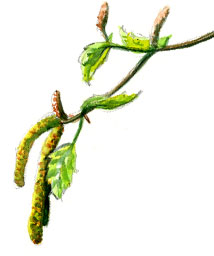
The Birch tree (along with Willow, Aspen, Poplar, and Linden) is one of the quintessentially feminine trees of ancient European culture. Interestingly Birch is also regarded as feminine by Native American nations who have traditionally used her wood for canoes, to make paper, and for carrying bags and prayer baskets.

Birch trees are associated mystically with new beginnings. They are one of the first trees to take hold in an area where the ground has been disturbed and were one of the earliest trees to appear after the retreat of the last Ice Age.

The ancient Indo-European word for Birch is associated with the words; “it shines, glitter, flash, shimmer, brilliance, brightness, white and bright” in several modern languages. Birch has traditionally been known as “the way shower” because of Her bright, white bark. In a dark forest Birch always shows the way.

Birch is generally regarded as a Goddess tree. Use Her energy to put yourself in touch with the feminine aspect of the universe and within yourself. Birch is always practical, clean, and well organized. In some ancient cultures She was regarded as the Cosmic World Tree. Birch trees were used as Shamanic “Sky Ladders” in Lapland and Siberia. With the aid of a trance inducing drum beat one could travel astrally up Her branches into the Sky World.

The Gaelic word for Birch, Beith, is closely related to Bith (existence, enduring, constant) and with Bithe (womanly, feminine). Birch is the traditional wood for the May Pole in Celtic areas and in Wales the May Pole was always made from a living tree.

Birch wood was used in Scandinavia to carve rune sets for divination and in Ireland to carve Ogham inscriptions (the Ogham is the native pre-Roman alphabet whose letters are called by tree names). Twigs of Birch were used to light the sacred Beltaine (May Eve) fires.

Scandinavian couples would celebrate May Day by making love in a Birch forest. Birch forests were sacred to Frigga, Goddess of fertility and love. The legendary Celtic lovers Diarmid and Grainne slept in Birch branch huts as they fled their pursuers. Birch trees and Linden trees were commonly offered as sacrifices in Druidic groves.

Birch leaves taken in tea are laxative as well as healing to mouth sores, kidney and bladder sediment, gout, and rheumatism. A strong brew of the leaves, twigs and bark added to the bath will help eczema, psoriasis, and other moist, skin eruptions. Birch tea is relaxing and sedative. Black and yellow Birch have the best flavor.

Native American herbalists have used a yellow fungus that grows on Birch tops to heal tumors for millennia. Modern medicine has only recently discovered this “wonder drug” for use in cancer treatments.

about the author:

Ellen Evert Hopman is a Druid Priestess, herbalist and author of “Priestess of the Forest: A Druid Journey”, “A Druids Herbal – Of Sacred Tree Medicine”, “Walking the World in Wonder – A Children’s Herbal” and other volumes. Visit her website for more!


Bibliography
Adams, Barbara Means, Prayers Of Smoke, Renewing Makaha Tribal Tradition; Celestial Arts, Berkeley, CA 1990

Baker, Margaret, Discovering The Folklore Of Plants; Shire Publications Ltd., Aylesbury, Bucks, U.K. 1975

Beith, Mary, Healing Threads, Traditional Medicines of the Highlands and Islands; Polygon, Edinburgh, Scotland, 1995

Brunaux, Jean Louis, The Celtic Gauls: Gods, Rites and Sanctuaries; Seaby, London, 1988

Calder, George (translator), Book of Ballymote: Auraicept Na nEces (The Scholars Primer); Edinburgh, 1917

Carmichael, Alexander, Carmina Gadelica, Hymns and Incantations; Floris Books, Edinburgh 1992

Cunliffe, Barry, The Celtic World; St. Martin’s Press, New York, New York, 1993

Cunningham, Scott, Encyclopedia of Magical Herbs; Llewellyn Publications, St Paul, MN 1986

Ellis, Peter Berresford, Celtic Women; Wm. B. Erdman’s Publishing Company, Grand Rapids, MI, 1996

Erichsen-Brown, Charlotte, Medicinal and Other Uses Of North American Plants; Dover Publications Inc., New York, NY 1989

Evans-Wentz, W.Y., The Fairy Faith In Celtic Countries; Citadel Press, New York, NY 1990

Farrar, Janet and Stewart, The Witch’s Goddess; Phoenix Publishing Inc, Custer, WA 98240

Frazier, James G., The Golden Bough, The Roots of Religion And Folklore; Avenel Books, NY 1981

Friedrich, Paul, Proto-Indo-European Trees; The University of Chicago Press, Chicago, IL 1970

Green, Miranda J., The Celtic World; Routledge, London, 1995

Green, Miranda J., The World of the Druids, Thames and Hudson, London 1997

Grieve, M., A Modern Herbal, Dover Publications Inc., New York, NY 1971

Hoagland, Kathleen, 1,000 Years of Irish Poetry, The Gaelic and the Anglo-Irish Poets From Pagan Times To The Present; The Devin-Adair Company, Old Greenwich, CT 1981

Hopman, Ellen Evert, A Druids Herbal For The Sacred Earth Year; Inner Traditions/Destiny Books, Rochester, VT 1995

Hopman, Ellen Evert, Tree Medicine, Tree Magic; Phoenix Publishers, Custer, WA 1991

Kelly, Fergus, A Guide To Early Irish Law; Dublin Institute for Advanced Studies, Dublin, 1991

Kondratiev, Alexei, The Apple Branch; The Collins Press, Cork, 1998

Lust, John The Herb Book; Bantam Books, New York, 1974

Markale, Jean, The Druids; Inner Traditions, Rochester, VT, 1999

Matthews, Caitlin & John, The Encyclopedia of Celtic Wisdom; Element Books, Rockport, MA 1994

Matthews, John, The Druid Sourcebook; Blanford Press, London, 1996

McNeill, F. Marian, The Silver Bough, Vol. One; William Maclellan, Glasgow, 1977

Meyer, Kuno, Selections from Ancient Irish Poetry; Constable, London, 1959

Moerman, Daniel E., Medicinal Plants Of Native America; University of Michigan Museum of Anthropology Technical Reports, Number 19, Ann Arbor, MI 1986

Mooney, James, History, Myths and Sacred Formulas of the Cherokees; Bright Mountain Books, Ashville, NC 1992

Naddair, Kaledon, Keltic Folk and Faerie Tales; Century Hutchinson Ltd., London, 1987

O’Boyle, Sean, Ogam, the Poet’s Secret; Gilbert Dalton, Dublin, 1980

Rees, Alwyn and Brinley, Celtic Heritage; Thames and Hudson, New York, 1989

Ross, Anne, Pagan Celtic Britain; Columbia University Press, New York, NY 1967

Saintine, X.B., The Myths Of The Rhine; Charles E. Tuttle Co., Rutland, VT 1967 (Reprint of the 1875 edition)

Squire, Charles, Celtic Myth and Legend; Newcastle Publishing Co. Ltd., USA, 1975

Stone, Merlin, Ancient Mirrors Of Womanhood; Beacon Press, Boston, MA 1984

Summer Solstice & Spiritual Meltdown: How to Keep Your Cool When Life’s Hot!

By Lady Passion, HPS, Coven Oldenwilde
(this article also appears in the June issue of Oracle 20/20 magazine, reprinted here with the author’s permission)

I’ve taught magic to folks for 17 years or so, and thus as High Priestess, often born the brunt of pseudo-psychotic rants from those calling themselves sincere Seekers one second, yet who take offense over the flimsiest of pretexts, inexplicably act suspicious, make outlandish, erroneous accusations, and burn the very bridges they previously claimed to want to build with “folks of like mind.”

Although such can happen at any time when people who think they’re mature enough to handle the imbed conditioning or regret that mastering magic provokes in aspirants, I’ve noted that such often happens near or during Litha Sabbat celebrations held every June 21st or 22nd.

Why should this be? Why do tempers flare during a season of freedom, a gathering immersed in natural bliss? Because the Sun’s high in the sky.

Many seem as unaware of the incredible impact that the Sun exerts on their emotions as they are of their prejudices and motivations. Taught as they are that the Earth’s electro magnetic shield protects them from the majority of solar rays, they nonetheless doublethink dismiss their need for ever-higher degrees of sunscreen. They deny the mind blowing might of the Sun’s real exertion, and thus pay it as little heed as they do the sway their birth and rising signs have on their temperament, goals, and actions.

Traditionally, countries wait for winter’s passing to begin or resume war. Heat can make the blood and brain seem to boil. Heat can make you feel crazed, sticky with sweat that seeps unbidden from ever pore, as if your body’s leaking salt tears bemoaning its fate. If enough time passes without relent, flash-point anger can occur, leading to ‘crimes of passion,’ friendship split, or even sparking revolution.

Witches fight an uphill battle to help keep folks sane amidst arbitrary societal demands for money or selfish pursuits. And Covens know that the seasons ebb and flow, sometimes gently, sometimes mutable, even extreme. But other groups may be surprised when the cohesiveness they enjoyed in winter is cast off by one of their number when summer arrives.

When flowers and showers give way to summer doldrums (those ‘dog days’ of steam when the air itself holds its breath and seems too parched to cry out for rain), doubt sets up, begetting recrimination. The group’s work suddenly feels under attack, their accomplishments thrust in jeopardy, and friendships can quickly falter just when folks are supposed to be enjoying Nature again.

Perhaps liberals involved in spiritual groups are particularly vulnerable to letting detractors think what they will — to shrug off insults. And true, if someone nurses their resentments, prefers to not to be disabused of their notions rather than express them in hopes of resolving them, there’s little that truth to the contrary can do to prevent them from crashing in flames.

Of course it’s unfair that a group ever put one person on the hot seat, as such practically guarantees rancor. But private talks often end in traded rants as well, without witnesses as to what was said, and although discussing problems by passing around a talking stick seems egalitarian, things can still deteriorate into focusing on negatives rather than positives.

It’s wise to anticipate arguments, for they will arise. So as summer waxes and tempers threaten to fray, be magically prepared to prevent catastrophic conflict, and use wise ways mitigate their impact.

• When in doubt, don’t. If you feel on the brink of ballistic, enact the Witchy Power to Be Silent. Anger abates with time, and you may end up glad you held your peace, and proud that you didn’t explode over some silly perceived provocation.

• When in doubt, divine. Do a reading and ask the God/desses Pax (peace), Concordia (concord), or Eirene (tranquility) for guidance. Tarot cards and other magical methods may reveal that your ire is baseless, or explain secret stressors responsible for others’.

• Cool down with water and herbs. Bathe in a sachet of lavender buds, chamomile flowers, and basil while imbibing cannabis sativa.

• Promote harmony with food. Serve passionflower tea, apricots, Brazil nuts, ginger, licorice, raspberries, rhubarb, strawberries, and peas.

• Wear cool colors and gems. Becalming colors include blue, green, and pink. Gentle gemstones include aquamarine, iolite, peridot, jade, blue topaz, and rose quartz. Your gem choice should depend on the message you want to send: To evoke tenderness and elicit sympathy, wear lapis lazuli. For love and loyalty, wear sapphire. For friendship, wear turquoise. To prevent emotional hurt, wear a reflective hematite pendant. To prevent confusion or misunderstanding, don’t don mutable stones such as diamond, alexandrite, or agate.

• Wear a protective talisman. A pentagram can protect your feelings with the power of the five Elements. A Hand of Fatima charm is a similar, but filigreed alternative. The 13 symbol Italian Cimaruta can grant even more protection. To prevent a “circular argument”, don’t wear a spiral or round Amorite fossil amulet.

• Play conducive music. Songs in the major modes of Ionian (Sun, scale C-D-E-F-G-A-B-C, to dispel gloom) and Mixolydian (Jupiter, scale G-A-B-C-D-E-F-G, for optimism) or minor Phrygian (Venus, scale E-F-G-A-B-C-D-E, to calm) work wonders.

• Avert fights. Infuse the air with apple or cypress essential oil. Make a bouquet of sky blue aster flowers, pansies, poppies, roses, thyme, tulips, or violets.

• Avoid bickering on Tuesday. Violence is prone on this day sacred to the war God Mars. Foster friendship on Fridays, the day sacred to the love Goddess Venus.

You’ll find a galore of more spiritual solutions in The Goodly Spellbook: Olde Spells For Modern Problems.

About the Author:
Lady Passion is High Priestess of Coven Oldenwilde in Asheville, N.C. & co-author, The Goodly Spellbook: Olde Spells For Modern Problems. She may be contacted via: www.wiccans.org and www.oldenwilde.org.

The Wiccan Rede Project: Lisa Mc Sherry

I am a Wiccan, and I don’t really follow the Rede. I’ll pause now for your shocks of horror to pass, and for you to clean up the drink you just spilled.

Better? Good.

Let me explain a bit. The Wiccan Rede isn’t actually for Wiccans, it’s for Witches. Specifically for Witches who practice outside of the coven structure. No, really. No matter what you read in a book, the Rede has a strange history and uncertain origins, but I can tell you that the founder of Wicca — Gardner — did NOT write it as a long-winded poem. What was generally agreed to was only the eight words: An’ it harm none, do what ye will.

Moreover, he never saw it as a Law. For him, and many early witches, it was a guideline, an ethical precept along the same lines as the Christian Golden Rule. Any ethical person lives in such a way as to not cause harm.

But witches had a bum rap. Because of all of the negative stereotypes, witches had to get more than a little strident about the fact that THEY weren’t evil, and it was very easy to be able to point to the rule that we all follow: harm none. See? We’re just good people who wouldn’t hurt a fly much less cast an evil spell or curse your crops.

As increasing numbers of witches were learning their craft outside of the coven structure, the Wiccan Rede became a tool to govern ethical behavior outside of the group dynamic of the coven, where ethics were regulated as a matter of course. (In any group structure the dynamics are usually subtle and serve to align with one another. This is even truer within a magickal group where perfect love and perfect trust must be given freely, and can’t be with a ‘bad apple’ in the group.)

Having said all of this, I am quick to point out that in no way are my ethics ‘bad’ or even ‘loose’. By any standards.

I’ve been thinking a lot about the Rede this last month, in preparation for this essay. What I’ve come to is that I normally don’t think about it at all. I live it. Perhaps that is a function of having been a witch for nearly 30 years. Perhaps it’s just that I am a normally ethical person for whom moral decisions never arise — no, that is absolutely not true.

In my mundane job, for example, I’m a manager and an executive of our company. A lot of difficult decisions come across my desk every single day. The office place seems to be a natural place for the white lie, the small dissembling, or the kind statement that was totally unmeant. So I have to think about the consequences of my actions, my decisions all of the time. (In a sense, its what I’m paid to do.)

So, I ‘live the Rede’ in that I am constantly judging and evaluating the consequences — intended and unforeseen — of my actions and decision. I just don’t think of it in terms of the Rede (Harm None). What comes up much more intimately is my own personal system of ethics.

As part of my training I created this nearly ten years ago, and it’s a part of what I give my students every single year. Here it is:

1. Never speak falsehood.
2. Bear in mind that the act of withholding the truth is always potentially a lie, and a significant moral decision is required each and every time you do so.
3. The decision to withhold truth should never be based on personal needs.
4. The decision to withhold truth must always be based upon the needs of the person from whom the truth is being withheld.
5. The assessment of another’s needs is a complex act of responsibility; it can only be executed wisely when one operates with genuine love for the other.
6. This assessment must be undertaken with the fact that we tend to underestimate the capacity of another’s strength.
7. Trust is earned, not given.
8. Treat others with the dignity and respect with which you deserve to be treated.
9. Love yourself before all others.
10. Speak thoughtfully, but openly, and do not worry about what others think — it’s your life to live, not theirs.
11. An it harm none, do what you will.
12. Give back more than you take.
13. Walk upon the earth lightly, honor her as your first ancestor.
14. Value yourself and your services fairly when compensation is involved.
15. When given work to do, do it the best you know how.

It’s a system, but in the decade since I developed it I haven’t wanted/needed it to change, although it has dramatically changed my life. You’ll notice the Rede is in there (#11) but its one of an overall piece, not the focus.

As a guideline I’m all in favor of it, presuming that the person following it has thought it through and is conscious of the larger implications. We’re not saints, we’re not perfect. Every single day brings temptations to just pay a little less attention, to let it slide, just this once. . . But any ethical being won’t let that happen consciously.

At the core, the Rede requires a high level of truth and personal responsibility.

Author’s Bio:
Lisa Mc Sherry is the author of “Magickal Connections” and “The Virtual Pagan” (we even interviewed her!). She’s been the primary leader of JaguarMoon Coven, an eclectic Wiccan cyber coven (jaguarmoon.org) for eight years. She hosts a review site for items of interest to the alternative spirituality community at facingnorth.net. A prolific writer, her essays and articles can be found in a variety of publications, including PanGaia and newWitch. In her spare time she enjoys playing with her dog and longtime partner.

To read more of Lisa’s thoughts on the Wiccan Rede click here.

Tree Medicine, Magic and Lore: Beech

by Ellen Evert Hopman
illustrated by Will Hobbs

The ancient Indo-European word for Beech has bequeathed us the following words in several modern languages; mug, box, buck (to wash or soak in hot lye or buck) and to eat, nourishes, property, luck, rich, God, and to apportion, giving us a sense of the veneration placed upon this tree by our ancestors.

Beech nuts were rendered into soap and the Beech nut oil was used for cooking and lighting. The smooth grey bark of the Beeches may once have been used to carve symbols, leading to the words for letter, stick for writing, and book in several languages. Ancient Runic tablets were made of Beech wood (the Runes were an ancient Scandinavian magical alphabet). On the Alban and Esquiline hills of Rome there were once Beech groves sacred to the Goddess Diana. Beech nuts were an important food for swine, totem animals of the Celts. There was a Red Beech in Ireland called Ruadbetheach that was the Bile or sacred tree of the O’Connors. Beech was an important medicinal for Native American herbalists. The Cherokee chewed the nuts to pass worms, the Chippewa used the bark for lung problems. The Iroquois used the bark for tuberculosis, in abortive mixtures, and in blood cleansing formulas. The leaves were used in poultices for burns and the Potawatomi used the leaves as a poultice for frostbite. The Rappahannock made a wash for poison ivy from the north side of the bark. The Forest Potawatomi relished Beech nuts as a food. They took advantage of the industry of Deer Mice who carefully shelled the nuts and stored them in hollow logs and trees. The Indians were led to these stores by examining the refuse of the mice, scattered on the snow.

Beech trees aerate the soil and distribute potash through their leaves. All trees will benefit from having a Beech in the vicinity. Beech leaves make an excellent stuffing for mattresses. Animals who thrive on Beech nuts include deer, thrushes, pigeons, bears, martins, squirrels, partridges and turkeys. Beech magic: find a twig of Beech and carve your wish or dream upon it.

Bury it under the full or waxing moon.

about the author:

Ellen Evert Hopman is a Druid Priestess, herbalist and author of “Priestess of the Forest: A Druid Journey”, “A Druids Herbal – Of Sacred Tree Medicine”, “Walking the World in Wonder – A Children’s Herbal” and other volumes. Visit her website for more!


Bibliography
Adams, Barbara Means, Prayers Of Smoke, Renewing Makaha Tribal Tradition; Celestial Arts, Berkeley, CA 1990

Baker, Margaret, Discovering The Folklore Of Plants; Shire Publications Ltd., Aylesbury, Bucks, U.K. 1975

Beith, Mary, Healing Threads, Traditional Medicines of the Highlands and Islands; Polygon, Edinburgh, Scotland, 1995

Brunaux, Jean Louis, The Celtic Gauls: Gods, Rites and Sanctuaries; Seaby, London, 1988

Calder, George (translator), Book of Ballymote: Auraicept Na nEces (The Scholars Primer); Edinburgh, 1917

Carmichael, Alexander, Carmina Gadelica, Hymns and Incantations; Floris Books, Edinburgh 1992

Cunliffe, Barry, The Celtic World; St. Martin’s Press, New York, New York, 1993

Cunningham, Scott, Encyclopedia of Magical Herbs; Llewellyn Publications, St Paul, MN 1986

Ellis, Peter Berresford, Celtic Women; Wm. B. Erdman’s Publishing Company, Grand Rapids, MI, 1996

Erichsen-Brown, Charlotte, Medicinal and Other Uses Of North American Plants; Dover Publications Inc., New York, NY 1989

Evans-Wentz, W.Y., The Fairy Faith In Celtic Countries; Citadel Press, New York, NY 1990

Farrar, Janet and Stewart, The Witch’s Goddess; Phoenix Publishing Inc, Custer, WA 98240

Frazier, James G., The Golden Bough, The Roots of Religion And Folklore; Avenel Books, NY 1981

Friedrich, Paul, Proto-Indo-European Trees; The University of Chicago Press, Chicago, IL 1970

Green, Miranda J., The Celtic World; Routledge, London, 1995

Green, Miranda J., The World of the Druids, Thames and Hudson, London 1997

Grieve, M., A Modern Herbal, Dover Publications Inc., New York, NY 1971

Hoagland, Kathleen, 1,000 Years of Irish Poetry, The Gaelic and the Anglo-Irish Poets From Pagan Times To The Present; The Devin-Adair Company, Old Greenwich, CT 1981

Hopman, Ellen Evert, A Druids Herbal For The Sacred Earth Year; Inner Traditions/Destiny Books, Rochester, VT 1995

Hopman, Ellen Evert, Tree Medicine, Tree Magic; Phoen

The Wiccan Rede Project: Lyn Bullard-White

When Rebecca asked folks to write about the Wiccan Rede, I had to think for a bit about it. I am more of an eclectic pagan than a true Wiccan, though Wiccan beliefs are a part of my personal belief system. Like many people before me, I started out as a Christian and stumbled into paganism. I’ve pulled beliefs and ideas from across the spectrum. I’ve used everything from high magick and European traditions to eastern mysticism and kitchen witchery to form a belief and magical system that work for me.

I’ve seen the Rede, most often in it’s short version: “Do as ye Will, an ye harm none”. In theory, it’s a wonderful idea. In reality, it’s not entirely possible. The very act of living means causing death and destruction. It probably sounds terribly pessimistic or being doom and gloom, but it’s not. It’s something older than the Wiccan Rede; it’s the natural cycle of life.

A prime example is this: in order to live, we must eat. Whether you are an omnivore or a vegetarian, you cause death or harm to creatures or plants by their consumption. Whether it’s that lovely baked potato or a savory steak, something died to provide your sustenance. The potato plant had to be pulled from the ground to harvest its tubers and the cow had to sacrifice its life to provide meat. In the end, you’ve caused harm. Realistically, it’s how life has worked from the very start.

On a different level, there is the issue of how to deal with a person who hurts others. By definition, a police officer who captures a criminal is causing harm. The officer may have to chase and tackle the person, or he may even have to shoot that person. The criminal may end up in a jail cell. Those things, from the criminal’s point of view, would be considered harm. However, what about the greater good? If the criminal isn’t stopped, even if it means that harm in some form comes to them, then more harm happens to other people that the criminal later goes on to hurt.

Those are some obvious issues. Many more statements could be made about simply living in today’s modern word; gas and energy consumption, the toxic materials in electronics, the conditions the clothes and shoes we wear were created in, animal testing by companies who produce the products we use, and so much more.

I did some research and found out that the word rede comes from middle English and means to council or advise. (thank you, Wikipedia!) If you take the Wiccan Rede as advice, it has some great stuff. The longer version contains a great deal of pagan and magical knowledge. The general principal of the shorter Rede, if taken as a moral rather than a rule, councils us to not cause harm to others and the world around us. That is a beneficial rule to live by. That philosophy has come to us in many forms throughout time. There is the “golden rule” that says to do to others what you would want done to you. That moral has been stated, with far more eloquence, from religions such as Buddhism, Islam, and Christianity (to name a few).

Personally speaking, that viewpoint works better for me than if it were a rule or law. It falls in line with my own personal beliefs, for the most part. From my perspective, the Wiccan Rede is a nice source of wisdom and knowledge but I don’t take it literally or as law. What works for others will, of course, vary. And that’s how it should be!

Author’s Bio (Lyn Bullard-White):
I was asked to write a short blurb about myself and perhaps provide a picture. Being as how I’m not a big fan of being in front of a camera, I think I’ll decline the photo option. As to who I am…I’m a 36 year old mom of three kids. We have cats, fish, and a leopard gecko. I have more plants than anyone living in an apartment probably should have, but that’s okay. I was introduced to other views of the world quite young by having grown up in a haunted house. I formally began studying magic when I was 15 and I’ve been learning and growing since. I’m a a gamer, I love anime and manga, and I read and watch sci-fi and fantasy. That’s me in a nutshell.

The Magician’s God

By Bob Makransky
(This essay originally appeared in the March 2009 Magical Almanac Ezine. Used here with the author’s permission.)

The magician’s conception of God is very different from the Judeo-Christian-Islamic conception. This is not to say that one is right and the other is wrong. On the contrary, a tenet of magic is that what is going on out there in the universe is not anything the human mind can possibly conceive of. Therefore all conceptions (beliefs) are wrong. Indeed, a human conception of God, no matter what it is, has definitely got to be puny in comparison with whatever God really is.

However it is instructive to compare the two conceptions of God since the two versions have different implications for how we should behave in our everyday lives. Emulating God, becoming more Godlike, is the meat and bone of any spiritual practice. How we conceive of God will determine what our spiritual ideal is, and what we are trying to accomplish in our spiritual lives.

To avoid confusion, we’ll refer to the Judeo-Christian-Islamic supreme deity as “God”, and to the magicians’ supreme deity as “the Spirit”.

Most people believe that God cares about them personally. Conventional religions inculcate fear of death, and then teach people to cover over that fear of death with the promise of heaven. People believe that if they do X and Y and Z, then God will be pleased with them and they will go to heaven when they die.

The magician’s path is very different. Magicians know that death is not only inevitable, but is nothing to fear. Death is right there in the background all the time. Magicians learn to feel that they are in the presence of death every minute. There is no salvation. Anything that comes through for them they are going to have to make happen themselves, since the Spirit doesn’t care a rat’s butt about them one way or the other. Use your head: if God cared about you, would He have condemned you to death? Believing that you’re special to God is the acme of self-pity.

Both God and the Spirit are all-powerful and created the universe intentionally. That is to say, creation was no accident, as the materialists would have it. (Even materialistic science has its God concepts. In mathematics it’s called The Axiom of Choice; in biology, Natural Selection; in classical physics, The Second Law of Thermodynamics; in quantum physics, Probability. Any intellectual system which purports to describe the workings of the universe must needs have a decision-making mechanism – a representation of intent.) However the Judeo-Christian-Islamic God is monotheistic: God stands outside of His creation. The Spirit, on the other hand, is pantheistic: the Spirit is everything and everything is the Spirit.

God cares about His creation: “God so loved the world that He gave His only begotten son … .” The Spirit, on the other hand, is utterly detached and indifferent, so that there is no point in worshipping it or praying to it: “The Spirit was so indifferent to the world that it left all sentient beings to figure things out for themselves.”

Since spiritual practice entails emulating the supreme deity, evidently caring is a fundamental part of Judeo-Christian-Islamic practice, whereas being detached and indifferent is essential to magic. Most people need the sense of security (from the magicians’ viewpoint, false sense of security) of believing that God is concerned about them personally. They need to feel that they fit in and belong somewhere. They must believe that they’re not all alone, at the mercy of ineffable, incomprehensible, and wholly impersonal forces of the universe. However, magicians need no such assurance. Indeed, they find such a belief useless baggage which weighs them down.

We all lie to ourselves constantly. For example, we believe that our luck is going to change really soon; or that this person we’re in love with is the most marvelous person on earth; and so on. Really, lying to ourselves is about the only way we can keep on keeping on much of the time. The difference between magicians and most people is that magicians know that they are lying to themselves. An example of a magician’s lie is “you create your own reality.” This is something magicians have to believe, even though they know it’s a lie. (It’s a lie because it’s an intellectual construct, and all intellectual constructs (beliefs) are lies. What’s really going on out there in the universe is completely random, as the Buddhists and quantum physicists assure us. We don’t create our own realities. The usefulness of this particular lie consists in providing a point of reference around which intent can be rallied. Therefore it is a more functional lie for a magician than the belief in going to heaven. The belief in heaven tends to inflate self-pity – glory thought forms such as complacency, self-satisfaction and arrogance – and thereby dissipates intent. To magicians only intent matters, not belief systems or being “right.”) Magicians choose their lies with care. Thus their conception of what the Spirit is, is another carefully crafted lie.

Although the Spirit is too vast to have what might be termed a personality, nonetheless it is correct to say that the Spirit is a trickster. The Spirit is a trickster because the magician’s reality is a reality of trickery, and you create your own reality and your own deity with it.

Magicians have to trick themselves to stay on the magician’s path, else who in blazes would follow it? Magic is a path of utmost responsibility, self-discipline and self-denial. Magic requires being utterly alone and facing up to the truth. No one wants to face the truth; not even magicians.

The Spirit is a trickster because although it will bring us what we want, what we’ve been praying for all along, it usually does this in such a guise that we don’t recognize it for what it is, and we therefore reject it. As an example, more than once I’ve seen the Spirit bring a person a true soul mate when they were on the rebound from a break-up, and still too filled with self-pity to see that this person they met accidentally was the one they were praying for all along.

How many times have I seen the Spirit bring someone their true heart’s desire on a silver platter, yet the person rejected it because they still had too much self-hatred to permit themselves to feel happiness. What keeps us from seeing and grasping the Spirit’s gifts is our own self-pity, which blinds us to everything except how much we’re suffering.

My spirit guides used trickery as their main teaching tool. Now that I’m more or less on my own, I have to trick myself. For many years I fantasized that one day a woman would come into my life and love me and make me happy (this rather asinine fantasy is common among men. I call it the “Claudia” complex after the character in Fellini’s 8 ½). My spirit guides really seized on that one. Every time a likely woman came across my horizon they played it to the hilt: “Oh yes! She’s the one you’ve been waiting for, definitely! Very soon now all your dreams will come true and you’ll find true love!” They encouraged me to make an ass of myself and follow every mirage until it too turned to dust. And in my stupidity and desperation I fell for that ploy every time, even long after I understand intellectually what they were doing and why. They were trying to burn that expectation out of me via exhaustion. They always told me that spiritual growth is mostly a matter of exhaustion, of giving up one’s own will. They were right, but I’m so stubborn and obsessive that it took me a long, long time to burn out. Now that their tricks don’t work on me anymore, I have to trick myself. This is what the technique of Creative Visualization is all about.

The point is that the magician’s deity is a trickster because the magician’s path is a path of trickery. There is no ultimate truth in this. The Christian and Hindu Gods are Gods of love because these paths are devotional paths. Magic, by contrast, is a very rational path – detached and coldly objective. There’s love in it, of course, and joy. Lots of joy, actually. In fact, the joy – the incredible joy – is the only excuse for following the magician’s path, because otherwise it’s a complete pain in the butt. But the principle mainspring to action is intent. What drives magicians forward is the quest for power and freedom.

Although the Spirit is wholly impersonal and indifferent, it nonetheless can be put to use. From the magical point of view, the Spirit is our servant. Every time we desire something, no matter how trivial, we emit an order, a desire line. Desire lines are actual fibers of light which pop out of our navels. They can be considered commands to the Spirit, who immediately starts racing around trying to fulfill our order.

The reason why most people can’t bring their desires to realization is because they have their desire lines tangled up. They don’t really want things to spring into existence the moment they think of them, as happens in dreams. Most people are afraid of taking responsibility for that much power. They would prefer to pretend that they don’t have that much potential control over their own lives and destinies. They prefer to cringe helplessly and wallow in self-pity rather than take on the awesome responsibility of total control over themselves: control over their moment-to-moment thoughts, feelings, and actions.

Most people prefer to believe in fantasies, like that someday God is going to bring them exactly what they desire, with no effort on their part. This is why they need to believe in a God who is outside of themselves, disconnected from them, rather than that they are the Spirit, and whatever situation they find themselves in is their own creation. To change it they’re going to have to change themselves by changing their way of looking at the situation they are in. Average people don’t want to have to do this.

The Judeo-Christian-Islamic God pities us and thus mirrors our own self-pity. The Spirit, on the other hand, is pitiless and can only be commanded by erasing self-pity. Power comes from taking responsibility for our decisions. In particular, this means taking responsibility for the situation in which we find ourselves in the present moment – dealing with the reality of it instead of wishing it would go away.

Taking responsibility means not blaming other people or the Spirit for our own unhappiness, nor trying to slough off our unhappiness on other people around us. Rather, it means understanding that we have deliberately, if unconsciously, chosen the circumstances of our lives, and only we can change them. When we truly understand this in our hearts, when we resign ourselves to this truth and begin to act on it, then we become one with the Spirit.

* Even materialistic science has its God concepts. In mathematics it’s called The Axiom of Choice; in biology, Natural Selection; in classical physics, The Second Law of Thermodynamics; in quantum physics, Probability. Any intellectual system which purports to describe the workings of the universe must needs have a decision-making mechanism – a representation of intent.

About the author:
Bob Makransky is a systems analyst, computer programmer and professional astrologer. He lives on a farm in highland Guatemala where he is a Mayan priest and is head of the local blueberry growers’ association. Check out his free downloadable Mayan Horoscope software, free downloadable Planetary Hours calculator, free downloadable Primary Directions / celestial sphere mathematics textbook, complete instructions on how to channel by automatic writing and how to run past life regressions, articles, books, stories, cartoons, etc. etc. at www.dearbrutus.com