Reading the Gnostics

By Andrew Phillip Smith

And he [Jesus] said, “The kingdom is like a wise fisherman who cast his net into the sea; then he drew it up from the sea, full of little fish from below. Among them he found one good large fish. So he threw all of the little fish back down into the sea without regret. Whoever has ears to listen, let him listen.”

This parable, distinctively in the voice of Jesus, is found nowhere in the New Testament. It comes from the Gospel of Thomas, the best known of the ancient writings found at Nag Hammadi, Egypt in 1945. The Gospel of Thomas is overwhelmingly the most famous and most read of the texts found in this cache for two reasons:- it has a good claim to contain sayings of Jesus that are as old and as authentic as those in the canonical gospels, and it is, at least superficially, easy to understand. It is one of nearly fifty different texts or tractates in the Nag Hammadi library, the bulk of which are Gnostic.

Gnosticism was a Christian-related religion that thrived in the second to fourth centuries CE, though its origins may have been a little earlier and it persisted in various forms much later. It emphasised the importance of gnosis—experiential knowledge of the divine—within a framework of myth and ritual. No two texts or Gnostic groups agreed on the details of the Gnostic myth, but it typically involves the following: the supreme, unique God emanates divine beings known as aeons. These form the Pleroma, the fullness of God. However, the youngest of these aeons, Sophia, falls from grace and in doing so creates the material world, which is ruled by her bastard offspring the demiurge, the craftsman of our world, often called Yaldabaoth. The demiurge and his minions create the soul and body of mankind but are tricked into incorporating an element of spirit in the human makeup. Thus humans contain a divine spark which may be nurtured and fanned into a flame. The subsequent history of mankind involves a struggle for the human soul, on the one side the demiurge and his archons, on the other a series of saviours or revealers who teach mankind how to attain gnosis and develop the spiritual seed within them. Abbreviated and simplified in this way, the Gnostic myth is understandable and appealing. However, the original Gnostic texts are more concerned with their individual elaborations of the myths than with clarity, and can be quite obscure.

Not all of the Nag Hammadi texts are difficult to penetrate. The Exegesis on the Soul (despite its awkward title) is a beautiful and straightforward account of the fall of the soul, personified as a young woman who drifts into prostitution and is abused by thieves and adulterers but who eventually repents and returns to her father and, in a daring use of sexual imagery, may couple with the bridegroom in the bridal chamber.

Thunder: Perfect Mind is a striking proclamation by a female voice, which includes fascinating, contrary statements —“I am the whore and the holy, I am the wife and the virgin.” Thunder has been adapted as a musical piece by David Tibet’s Current 93 band, and even into an advertisement for Prada perfume directed by Ridley and Jordan Scott.

The Nag Hammadi Library has popularly been known as the Gnostic Gospels, largely through the influence of Elaine Pagels’ popular and groundbreaking 1979 book The Gnostic Gospels. Nothing in the Nag Hammadi Library closely resembles the gospels in the New Testament, but a few of the works have ‘gospel’ in the title, and Jesus features prominently in some of the other texts. In addition to the Gospel of Thomas, we have the Gospel of Philip, the Gospel of Truth (thought the name has been deduced by scholars) and the Gospel of the Egyptians (though its preferred title is now The Holy Book of the Great Invisible Spirit.)

The Gospel of Thomas is the only one of these to have any claim to reflect the actual teaching or life of the historical Jesus (the study of which is a fraught endeavour in itself. The Gospel of Philip, while quite a different beast to the Gospel of Thomas, is also superficially clear and full of elegant imagery, and includes a few references to Jesus, in many of which he is a mystical or theological figure. The Gospel of Philip itself consists of a series of short section—discourses, sayings, contemplations and extended metaphors—most of which do not explicitly refer to Jesus. Among the nuggets are a statement by Philip the apostle that the cross on which Jesus was crucified was fashioned by Jesus the carpenter. Another is a mysterious miracle in which Jesus threw 72 coloured cloths into a vat at the dye-works of Levi and brought them out all white. Its greatest claim to fame, though, are two brief references to Mary Magdalene. “There were three Marys who walked with the Lord at all times: his mother and his sister and the Magdalene, who is called his companion. So his mother and sister and companion are called ‘Mary.’”

And

“And the companion of the saviour is Mary Magdalene. The Lord loved Mary more than the other disciples and kissed her often on her [mouth].75 The rest of them saw him loving Mary and said to him, “Why do you love her more than us?”76 The saviour replied, “Why do I not love you as I do her? When a blind man and one who can see are both in the dark, they are the same as one another.” These indirectly inspired Dan Brown’s novel The Da Vinci Code, and it is a pity that the work isn’t better known in its entirety.

The Gospel of Truth is a beautiful and highly metaphorical homily quite possibly written by the Gnostic leader Valentinus. The Gospel of the Egyptians, or the Holy Book of the Great Invisible Spirit, is a thoroughly Gnostic myth, full of the complex cosmology so central to Gnosticism. A classic example of what is known as “Sethian Gnosticism”, it is Seth, the third son of Adam and Eve, who is the primary figure of salvation; he is actually “clothed” with Jesus, making Jesus more or less an incarnation of Seth. It is also notable for a sequence of mystical vowels which were chanted by Gnostics.

In other Nag Hammadi texts, Jesus is seen post-resurrection as a bringer of knowledge. In the Secret Book of John, the Saviour gives John the son of Zebedee a revelation which consists of an extensive cosmology. In the Secret Book of James, the disciples are trying to recall what Jesus had taught them and receive a further visitation from Jesus 550 days after the resurrection, Jesus has a similar role in other writings.

Outside of the Nag Hammadi Library, though often included in modern collections, we have the Gospel of Mary and the Gospel of Judas (there are many other apocryphal gospels, such as the Gospel of Peter or the Gospel of Hebrews, which are not actually Gnostic, plus the little-known Gnostic Gospel of the Saviour, which is very fragmentary and owes its title to modern scholars.)

The Gospel of Mary is distinctive in the attention it gives to Mary (probably Magdalene) who has received the most secret teachings of Jesus. The focus on Mary Magdalens’s supposed role as the wife of Jesus has led many to see her as “Mrs Jesus”, but Gnostics saw her as an important figure in her own right, as the disciple who understood Jesus better than any of the others. The recently published Gospel of Judas is unusual in that its story takes place during the lifetime of Jesus, rather than post-resurrection, yet it is typical in its emphasis on the Gnostic myth that Jesus teaches to Judas. Although there are traces of a more positive view of Judas among Gnostics in the writings of the second-century heresy-hunting church father Irenaeus, recent examination of the Gospel of Judas shows that Judas is no hero, but shares the faults of the other apostles and sacrifices Jesus to the false God, Sakla. There are many other references to Jesus in the Nag Hammadi Library, which is a goldmine of alternative early Christianity. The Nag Hammadi Library gives us a different view of Jesus, one whose teaching is more important than his crucifixion. In the Second Treatise of the Great Seth, Simon of Cyrenea is actually crucified in the place of Jesus.

The treasures of the Nag Hammadi Library are extensive, but they must be dug out. In addition to the legions of obscure angelic and demonic names, many Gnostic terms are typically left untranslated from the Greek—words like pleroma, (“fullness,” the divine realm), archons (“petty rulers”, demonic assistants to the demiurge ) or pneumatics (not air-driven Gnostics, but those who have spiritual attainment.) To prevent others from encountering the problems I had in my study of the Gnostics, I put together the first ever Gnostic dictionary. Explore these mystical and fascinating works with A Dictionary of Gnosticism by your side.

About the Author:
Andrew Phillip Smith was born and grew up in Penarth in south Wales in the United Kingdom and took his degree in computer science at the University College of Wales, Swansea. From 1987, Andrew worked in computing in London, including a two-year stint providing technical support for the publishers Harcourt Brace. From 1997-2007 Andrew lived in Northern California near the Sierra Nevada mountain range, where he began his writing career. In his time he has busked on the streets of London playing a small harp, delivered leaflets, worked as a security guard, as a letterpress printer and as a librarian to a private library. He now lives in Dublin, Ireland, with his wife Tessa Finn and his son Dylan.

Andrew is the author of over a dozen books and articles on Gnosticism, early Christianity, and esoterica, including The Gnostics: History, Tradition, Scriptures, Influence and several books in Skylight Paths’ annotated and explained series: The Lost Sayings of Jesus, The Gospel of Philip, and Gnostic Writings on the Soul. In addition to writing, Andrew edits The Gnostic, a small press magazine devoted to Gnosticism in all its forms, and runs Bardic Press, which publishes reprints and niche works in the areas of Gnosticism and early Christianity, Celtic interest, Gurdjieff/Fourth Way, and Sufi poetry.

His interests include Welsh and other Celtic mythology, the Fourth Way, graphic novels, and poetry. He is learning to play the uilleann pipes, Irish bagpipes.

For more information visit: andrewphillipsmith.com & bardic-press.com
Find Andrew Phillip Smith on Twitter @bardicpress and on Facebook

Catching Up With Sandra

Hello Everyone,

Watching the winter Olympics has been a reminder for me of the movement of time and life. In 1980 I had the privilege of being on the first Olympic torch relay team — a support member, not an athlete – which turned out to be a two-week adventure of a life-time. The past week I’ve been reflecting on the road I’ve traveled since Lake Placid.

Like the Olympics and Sabbats many things in life are cyclical but that doesn’t mean we move in circles, otherwise, we’d just be chasing our tails and getting nowhere. Instead, life is more like a spiral. It has a cyclical aspect, but more important are its aspects of movement and growth.

I also think of my writing like a spiral. The cyclic aspect is the beginning: my topic, which is determined by what I want (or need) to explore. The movement and growth come from research and how it all manifests in my life. This has been particularly true with my two most recent books: Sea Magic and Change at Hand.

Sea Magic is about connecting with the energy of the ocean, and you don’t have to be near the ocean to do this. The ocean helps us listen to the voice of our souls. Its power gives us the clarity to see the reason for and to understand our journey through this world.

Change at Hand came about from my long-time interest in palmistry, but of course, there’s a twist. Since becoming a massage therapist and Reiki practitioner I developed physical and energetic sensitivity in my hands. This has been augmented by the study of the chakras and mudras (hand positions) as a yoga teacher. The end result has been a blend of energy work that combines the wisdom of palmistry, Ayurvedic and Chinese medicine and a dash of Jungian psychology. Just now I’m preparing a Change at Hand workshop which should be fun, and I hope informative.

I don’t have details to pass along yet, but some time this spring or summer I will be a guest on an internet radio program. I’m finding Facebook a good place to get the word out. Other goings-on are, of course, yoga. My main mission in life is to get everyone doing yoga because it’s such a wonderful tool for self exploration and empowerment. In addition to personal classes in my own studio, I’m branching out my neighborhood community center with two public classes this spring. And speaking of spring, I can’t wait to get out in the garden.

~Sandra

About Sandra:
Sandra describes herself as an explorer of Celtic history, myth and magic. Her curiosity has taken her to live in New York City, Europe, England and New England. Spiritually, her inquisitiveness has led her to investigate the roots of her beliefs and to study ancient texts such as the Mabinogion. In addition to writing, she is a yoga and meditation instructor, massage therapist and Reiki practitioner. You can learn more at her website and follow her on Facebook.

Witches and Wiccans and Pagans, Oh My: A Report from Pantheacon

By Deborah Blake

Last week I crossed the entire width of the country, leaving behind my beloved cats (and my internet connection) and travelling from snowy upstate New York to sunny San Jose. I made this same trek two years ago for the same reason: to go to Pantheacon.

If you are a Pagan, going to Pantheacon is a little like going to Mecca. There are many (over a thousand, I believe, and maybe multiple thousands) Witches, Wiccans, Pagans and other cool spiritually-oriented folk who decend on the Doubletree Hotel in downtown San Jose in February for four days of workshops, rituals, parties, and socializing, all with a Pagan slant.

If you like that kind of thing, you will love Pantheacon.

I have a confession to make; I am not a social person. (Yes, I hear you all gasp in amazement.) I tend to be overwhelmed by crowds and over-loaded by all the psychic energy that goes with them. You will never find me at a rock concert. But thankfully, Pagan gatherings are an acception to this rule. And Pantheacon, for whatever reason, is the uber-exception. I always come away from it with more energy than I went in with.

There are probably a couple of reasons for this. The first is simple: I get to meet my fans. As an author, I tend to sit and write in a vacuum (no, not an actual vacuum…that would be very difficult). Other than the occasional email or Twitter exchange, I rarely know whether or not my books are having a positive impact on those I write them for. But all that changes at Pcon.

This year, I gave two workshops, one on “Crafting and Casting the Perfect Spell,” and the other on “Witchcraft on a Shoestring.” Both went really well, and I had the great pleasure of meeting a number of folks who read and enjoyed my books. I sold a bunch of the books that are already out, and signed them for people until my hand went numb—an author’s dream! And hopefully, some of the people who came to my workshops who haven’t read my books will now be curious and go take a look. As an author, there is nothing more satisfying than shaking the hand of one of your readers.

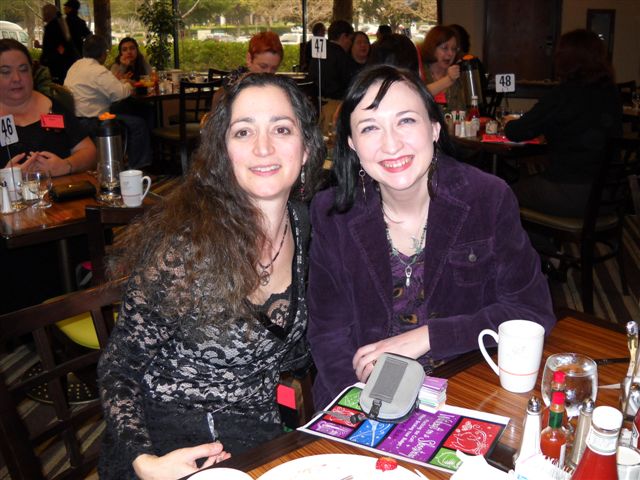
Deborah Blake and Llewellyn Editor Elysia Gallo

But there were other highlights as well. I got to have breakfast with my wonderful editor from Llewellyn, Elysia Gallo (we were supposed to have dinner the night before, but she had problems with her flight—a lot of folks had a hard time getting in because of bad weather across the country). We caught up on personal things and also spent some time discussing the cover colors for book number five, coming out in September. I adore this woman, and we only get to meet in person at Pcon, so I was really jazzed to be able to spend time with her.

Z. Budapest and Llewellyn Editor Elysia Gallo (the closest I'll get to having someone as bad as a Z. Budapest on my website)

Another highlight of the event was my invitation to a surprise 70th birthday party for one of the founders of modern witchcraft, Z. Budapest. (I would have blogged about this earlier…but it was a SEKRIT.) Z’s partner Bobbie had asked me and Elysia to lure Z. away from their room with an invite to have a drink at the bar, so Bobbie could get everything set up for the party. And then, of course, Elysia didn’t make her plane and had to catch a later one, leaving it all up to me. The pressure! But thankfully, I managed to pull it off, and when Z. and I walked back to her room an hour later, she was completely surprised! And Elysia even got there in time to get a piece of cake. Whew. It was a huge honor for me to be included in the company of many of the movers and shakers of the Pagan community, and it was all a lot of fun. (And, of course, there was cake.)

One of my goals this year was to try and attend a ritual workshop. I love my group, Blue Moon Circle, and our rituals are satisfying and magical. But there is something truly wonderful about a LARGE gathering of Pagans all creating magic together, and I hoped to attend a group ritual while at the convention. I decided to go to a Brigid Healing Ritual given by Selena Fox, another major Pagan leader (she spearheaded the fight to get the armed forces to allow the pentacle to be used on gravestones at the Arlington National Cemetery). I have written articles for her CIRCLE magazine, but I’d never had the chance to meet her or see her work.

Let me tell you—the ritual more than met my expectations. Selena did a wonderful job of tying together many different styles and approaches, even going so far as to invite a few other folks (including me) to invoke the Goddess in their own particular way. We did healing work for self, then for others, and then for the planet, and followed up by sending lots of energy to a man who is currently involved in a six-year legal battle for Pagan rights. The whole ritual was fabulous from start to finish, and by the time we were done, I was tingling from head to toe. Afterward, I went up and introduced myself and complemented her on the ritual, and she was wonderfully gracious and kind. (And then I got to hang out with her at Z’s party later, which was a bonus. A very nice lady.)

I also went to an interesting workshop on the dark side of fairy tales, given by new Llewellyn author, Kenny Klein. Kenny was a great speaker, and I got some interesting ideas for possible future novels. Later, I went to the vendors room and bought a copy of his book, THROUGH THE FAERIE GLASS, which he was kind enough to sign for me. I also picked up a few gifts for the Blue Mooners at home, including an ABC Book of Shadows for pal Robin’s kids, and a few cool stones in the shapes of cats and bats and such.

One of the greatest pleasures of Pantheacon for me is sharing the event with my step-daughter Jennifer, also a Pagan (and a member of Blue Moon Circle, although she moved to Miami 5 months ago). Jenn flew out from Florida and met me there, and we got to hang out together when we weren’t doing our separate things. As usual, she helped me with my presentations (I always refer to her as “My Entourage”) and made the entire trip easier and more fun. This year I left early to go visit with family in San Diego, so I missed some of the workshops I would have gone to, and didn’t get to meet everyone I’d hoped to. But all in all, it was a wonderful trip.

I highly recommend Pantheacon to anyone who can make it there. People come from all over the country to learn and laugh and love together in the company of those who feel and believe as they do. I truly believe that it is something that every Pagan should experience at least once in his or her lifetime. And hey, maybe you’ll meet me there some year. Blessed be!

About Deborah:
Deborah Blake is the author of “Circle, Coven and Grove: A Year of Magickal Practice” (Llewellyn 2007), “Everyday Witch A to Z: An Amusing, Inspiring & Informative Guide to the Wonderful World of Witchcraft” (Llewellyn 2008), “The Goddess is in the Details: Wisdom for the Everyday Witch” (Llewellyn2009), and the forthcoming “Everyday Witch A to Z Spellbook” (2010) and “Witchcraft on a Shoestring” (2010). She has published numerous articles in Pagan publications. Her award-winning short story, “Dead and (Mostly) Gone” is included in the “Pagan Anthology of Short Fiction: 13 Prize Winning Tales” (Llewellyn, 2008). Deborah is currently working on her third novel and hopes to find both an agent and a publisher for her fiction soon. Deborah can be found on the web at www.deborahblakehps.com

Crafting the Runes: A Venture into Self-Publishing

by Alaric Albertsson
Also appeared in The Heartland Spiritual Alliance newletter.

As I explained to my acquisitions editor over lunch last year, I needed a set of Anglo-Saxon runes for my next book, “Wyrdworking: The Path of a Saxon Sorcerer”. In addition to the book’s outline and a few sample chapters, I gave her several illustrations for the rune cards I hoped would be sold with the book.

Why cards instead of runes carved into little pebbles or bits of wood? Well, why not? The use of divinatory “rune stones” dates back to the early 1980’s – hardly what anyone would consider an ancient tradition –and I am pretty sure the early Saxons and Scandinavians would have made use of cardstock if they’d had it. Cards suited my purpose. Each rune card would include an illustrated conception of the corresponding passage of the 10th century Old English Rune Poem. One of my goals is to make the runes and their mysteries more accessible for people, and a significant percentage of my target audience is already familiar with the Tarot deck as a divination tool.

The illustrations were provided by Pagan artist Taren Martin. I wanted to work with him on this project not only because of his previous work, but also because he understood my vision. At least a dozen or more rune decks have been published over the years, but the overwhelming majority of these have been decks of the Elder Futhark, which lacks nine of the Anglo-Saxon runes. The decks frequently have illustrations which cannot be supported by the rune lore preserved in any of the Rune Poems. I wanted to create a deck that includes all of the English runes and, more importantly, a deck that remains true to the extant lore.

My acquisitions editor took my proposal back to Minnesota and I returned to Pittsburgh. For the next several months Taren and I continued working on the rune deck. I would send him a vague idea of what I wanted. Sometimes I was not sure of what I wanted, which was extremely frustrating for him. He would put together an image and send it to me, and I would then send it back explaining why that was not quite right. It is a testament to our friendship and to Taren’s enduring patience that I am alive to share this story today.

Meanwhile I continued working on the text for “Wyrdworking”. This book will present traditional Anglo-Saxon magic for our modern world. The chapters will cover herb magic, scrying, galdor and other magic techniques in addition to rune magic. At that time I was focused on the latter, and so the book and the rune deck were parallel projects.

In late spring I learned that the publishing house had rejected the deck. They wanted my book, just not the rune cards.

“But I can’t sell this book without the runes,” I protested to my acquisitions editor. “Thirty years ago I could do it. Maybe twenty years ago. But today every new age store in the United State sells the Elder Futhark. Most people are not going to the trouble to make their own runes when they can buy a set, even if that set is lacking almost a third of the symbols.”

My acquisitions editor, Elysia Gallo, understood and was sympathetic to my plight. In fact, hers was the most lovely rejection letter I have ever received. Unfortunately it was not within her power to overturn the decision. If the rune deck was to become a reality, Taren and I would have to pursue another course.

I was afraid Taren would be discouraged by the news but, if anything, he became even more determined to finish the rune deck. While he moved forward with the remaining cards, I talked to a few fellow authors about the problem. A publisher provides two essential things: capital and distribution. It soon became apparent that the publishers who could give us the distribution we wanted were unacceptable for other reasons. A couple of friends suggested we look into self publishing. The idea was not unreasonable. If we had to distribute and promote the deck ourselves, self publishing would generate much more income per deck sold.

While figuring all this out, I began to realize something else. It was time for me to turn the project over to Taren. I would still help him, but without the accompanying book, the rune deck was his baby. And so the cards became not just “the rune deck”, but the Martin Rune Deck.

In June, while I was at a book signing for “Travels Through Middle Earth” at Aquarius Books in Kansas City, my friend Barbara Criswell showed me Toby Evans’ Chakra Labyrinth Cards. Toby had decided to self publish when she created her chakra deck. I’ll readily admit that I know next to nothing about chakras, but I know a well crafted product when I see one, and Barbara told me that Toby had been very pleased with her printer.

Barbara Criswell is one of modern Paganism’s unsung heroes, so I’m going to sing a bit about her now. This woman has consistently supported the Kansas City metropolitan area’s Pagan community for decades. Twenty years ago when the Heartland Spiritual Alliance and other area organizations were trying to buy a Pagan campsite, Barbara offered space and promotion for fund raising projects to help bolster this monumental project. Around the same time she offered a meeting place for a discussion group known as Spirit Circle, which still convenes to this day. “When Travels Through Middle Earth” was published she threw a cake-and-lemonade party for me at the Heartland Pagan Festival to help promote the book, and then later invited me to speak at Aquarius Books where she showed me Toby’s Chakra Labyrinth Cards. She is a woman who puts her community first, and it is a great honor to be numbered among her friends.

So Barbara put me in touch with Toby Evans, I then introduced Toby to Taren and she introduced him to her printer in Hong Kong. This, of course, was not the end of the story.

The next thing Taren needed was investment capital. Notice how this has become “Taren” instead of “we”? Although I was still involved with the project and deeply supportive, I turned my attention back to “Wyrdworking” and began to devote most of my time to the book. I had signed a contract for the book now; I had a deadline. For the most part, the Martin Rune Deck was in Taren’s hands.

Scott DeRousse provided the investment capital. We had also considered soliciting multiple investors, but making a single payment each month is far preferable to paying back loans to a dozen different people. We now had another partner for the project. Anyone who knows Scott at all knows that he is the ultimate silent partner, but Taren acknowledged him in the accompanying booklet as a man “whose warmth and generosity knows no bounds”. That’s not entirely true; Scott’s generosity does know a few bounds. Fortunately the capital needed fell within that parameter.

I authored the aforementioned booklet. If you have ever bought a Tarot deck, you know the booklet I mean; the tiny brochure with an even tinier font that’s tucked into the box along with the cards. It was a challenge to describe the essential mysteries of the runes on pages only slightly larger than a business card. I do think the booklet gives the average customer enough information to get started, and he or she can always buy “Wyrdworking” when it’s released next year for a more comprehensive coverage of rune magic and divination.

It was just before Yule when Taren received five boxes of the Martin Rune Deck from the printer for his approval. If they were satisfactory, the entire order would be printed and delivered. To describe them as satisfactory would be an understatement; they were all that we had envisioned and more. Taren and I both felt that the final product validated the work and time we had invested in the deck.

The Martin Rune Deck can be used for divination or as a meditation tool. It is now available online through WolfDen Designs. Retailers should contact Taren Martin through the website under the Contact Us link for information about wholesale pricing.

About the Alaric:
Alaric Albertsson is the author of “Travels Through Middle Earth: The Path of a Saxon Pagon”. To learn more about Alaric visit his website.

Spiritual Transformation

By Leandra Witchwood
(This article first appeared on her website, used here with her permission)

We live in a very tense society. We are pulled apart… and we all need to learn how to pull ourselves together… I think that at least part of the answer lies in solitude. ~Helen Hayes

To become spiritual begins we must experience stages of transformation. Some of these experiences are short and fast, while others seem to take forever. More often than not, spiritual transformations are painful and difficult. Nevertheless, these stages are necessary for achieving our ultimate goal in becoming spiritual beings on this plain and the next.

My most recent transformation began about two years ago and is nowhere near an end! I do admit some days change is hard to bear and I wish it would hurry the heck up, but then there are days when it all makes perfect sense and I don’t mind the lag.

It all started with a standard Medicine card reading. The intent is to focus my efforts in the right direction for the day or week depending on the situation and project. I could feel myself becoming unbalanced and disoriented on my path and felt a strong need for some clarity.

I know many of us who specialize in divination do this kind reading for others and ourselves all the time. Usually they are basic, the person in question draws a couple of helpful cards, and we are on our way. I honestly thought that this would be one of those simple readings. As the universe would reveal, I was very wrong.

I remember it clearly; I was sitting at my usual spot in the park over looking the Susquehanna River during my lunch hour, when I pulled a very distinct arrangement of cards. The spread I was doing was intended to show me how to achieve balance through Father Sun and Mother Earth (above and below) . The shock came to me as I revealed my cards. Instead of balance, they spoke specifically of change, and chaos.

First, I pulled Dragon Fly. On the surface Dragon Fly teaches us about Illusion. The story of Dragon Fly talks about how he was once a very powerful Dragon who was tricked by Coyote into the form we know today. When we look at Dragon Fly, we see the Magick bottle up within Dragon Fly through the iridescent shimmer of Dragon Fly’s wings.

Knowing this we also consider Dragon Fly to be a symbol of locked up potential. When we see Dragon Fly in a spread, it tends to mean that the person in question is not living up to his/her true greatness/potential. This blockage is usually evident through some sort of illusion the person places in his/her life.

Dragon Fly is also a symbol for change over time. It takes about 2 years for many Species of Dragon Fly to transform from an egg to an adult Dragon Fly. Therefore, as a reader I recognize that Dragon Fly is telling me that I will be entering into a 2 year transformation. Dragon Fly is also one of the few creatures equally associated with Air and Water.

For me, this card fell in the Mother Earth position. This position teaches us to receive the goodness Mother Earth has to offer through time and patience. This energy is of the Female trinity; Maiden, Mother, and Crone. This ever-changing female energy opens us up to creativity and psychic pathways.

Therefore, from the start of this reading I am told that slow change is coming two fold. I am also told that all seeds require time to germinate and need nurturing before they can grow into their true potential, again two fold.

The next card I pulled is for the Father Sky position. This is of Male energy and Warrior Energy. In this position, we are taught lessons of how to heal, how to move forward, and how to look at things in the material world. This energy is faster and plays a distinct contrast to female energy, which is slower and less analytical.

As I turned my second card to face me, I was dumfounded to see Frog. I was not sure what to make of this spread. I even looked up at my favorite tree for some clarity, but only found the words “accept it” instead.

I thought to myself, “Did I not shuffle properly? There is no way both of these cards could end up next to each other in this spread. However, there they were, and their message was clear.

If you have not guessed, Frog is another symbol for transformation. Frog’s association is with Earth and Water, which is only one of its many links to Dragon Fly. Like Dragon Fly frogs goes through a transformation, but only faster.

I sat back and knew that I needed to expect some serious changes. I knew that at least the next two years would be hard. Change is not always easy and lets face it we humans are not very welcoming of change, especially when the change promises to be BIG! Nevertheless, I was glad to have the warning.

I have moved past the two-year mark of this foretold transformation. I look back and see that so many things have happened. I was laid off from my high paying desk job, began working in the theater as a seamstress, started a business, ended the business, had a baby, developed some really great friendships, and then lost them.

So now, I am here… Where exactly is “here”? I am not sure yet. I know the journey is not over and there are more big changes coming. What I do know is that I have transformed.

What mattered to me before seems superficial. Having a high paying desk job that allows me to buy the latest and greatest is no longer a priority. Instead, I am happy working a low pay job that allows me to be with my family.

Instead of having, a bunch of friendships that are shallow and dare I say it… fake. I now focus on friendships that are meaningful, fulfilling, and pure.

I have to admit that through out these past couple of years I have taken some hard hits, so much that I have almost completely moved myself from my local Pagan Community. I have even shed myself of most Pagan friendships. Through it all, I experienced some severe depression, anxiety, and remorse over the people and things I lost.

Often I found myself alone to wallow in my self-pity, but it is through this solitude I found my strength and myself. Although this journey has been tough, I am walking forward with so much more than I had before. I have learned to listen to my inner voice more closely, which has drastically improved my empathic abilities. I am now more skilled in reading my Medicine cards, especially for others.

I am spending more time worrying about the Earth and my family, rather than worrying about being included in the next big ritual or concert. I have discovered the true character of those who do a very good job of pretending. More importantly, I have discovered my own true character, which surprisingly enough has not changed much. Instead, I have raised my standards.

I am spending more time teaching true seekers who want to learn and grow. I have shed the need to look “good” in the eyes of others and I am now starting to look good to myself. I focus less on the superficial and more on the bigger picture.

Now, I find solitude valuable. I am no longer afraid to be within myself as I find peace and enlightenment.

As much as change stresses us out, it is necessary. If I learn nothing from all I have gained and lost, I at least know that I have not yet reached my full potential and that I have the opportunity to keep going. When I was in the deepest darkest depression morning all I had lost, one thing pulled me through; I always have the opportunity to stand up and move forward.

Through pain, we know happiness and through self-discovery, we evolve. When faced with losing it all we have a choice to make. Do we deviate and weaken on our spiritual path or do we rise above to become our true potential?

In every event and through every trial we have a choice. Everyday, we are empowered to make that choice.

About the Author:
Leandra Witchwood has served her local community as a Minister of Earth-Base Spirituality, an Animal Card Reader, Spiritual Counselor, Leader, Teacher, and much more. Leandra enjoys facilitating Labyrinth walks and educational seminars. She also teaches classes on mediation, Witchcraft, Wicca, and various Magickal techniques. Her spiritual teachings and readings are inspiring and revealing. Leandra is currently writing books and blogs to benefit the larger community.

To learn more, visit: http://leandradraconiswitchwood.blogspot.com/

Merry Christmas to All, and to All a Good Nightmare!

It’s funny how this article from guest author Alice Diehl came about. As I sat at my desk I couldn’t ignore the fact that the holiday season was approaching. The Magical Buffet’s original format generally ignored acknowledging holidays, but with this new blog format it seemed wrong to not acknowledge some holidays as they approach or as they occur. So there it was, Christmas was coming. The question was, what was I going to do about it? Write some heart felt personal piece about Christmas, not going to happen. Talk about the Pagan roots to so many beloved Christmas features, it seems better informed and more talented writers would be addressing that else where. Honestly, I wanted to find the evil opposite of what most websites would do for a Christmas post. I found my mind wandering to some of the bizarre slasher movies set around the holidays. And the rest is history.

I’m friends with Alice from our interactions on the website MyNerdGirl.com (join us there!). I knew she was funny, intelligent, and more importantly a huge fan of horror movies. I asked her to compile a list of her favorite seasonal horror films and I’m pleased to share with you the results.

Hey there Ghouls and Girls! I know you all have that common Christmas picture in your heads, let me set the scene for you: Your stockings are hung by the chimney with care; you’ve just gorged yourself on sugar plums and gingerbread. The children are all nestled in their beds, and in the middle of the night a man with a slight weight problem breaks and enters into your cozy suburban home…lo and behold in this scenario we assume he is bringing gifts upon this midnight clear, but if the modern day world and the advent of film has anything to say about it Santa’s bringing an axe this Christmas!

During a time of the year that promotes togetherness I ask you to cozy up, get the egg nog and cover the kids’ eyes as I count down my top five Holiday Horror treats.

#5: Jack Frost

On the way to his execution a serial killer is genetically mutated into a murderous snowman, who’s only enjoyment comes from seeking revenge on the lawman that took him down.

I gotta tell you kids if you’ve got a phobia of Styrofoam this film is not for you. Who can forget that climatic battle in the end where our killer meets his demise “a la kool-aid acid” chemical peel.

#4: Silent Night, Bloody Night

Let me pull up some key descriptive words: Old Mansion, Mental Institution, Deranged Killer, Weird Townsfolk, and Warhol? If you’re down for decking the halls with a little blood this one is for you. Beyond all the normal horror holiday highlights check this usually unheard of gem out, with appearances by many of Warhol’s Factory superstars as mental institution inmates it makes for a bloody and kooky trip.

#3: Gremlins

It’s a classic…period end of sentence, if you haven’t seen it, it should be on your wish list. I know I’m hoping to find Gizmo in my stocking on Christmas morning. Or possibly Phoebe Cates. (smile)

#2: Black Christmas

Who doesn’t love a film that gives you a reason not to pledge as a sorority sister, or store your decorations in an attic? The film touts a cast of lovely ladies, inappropriate phone calls (who hasn’t savored the holiday punch and dialed some old friends) and that classic scene with Clare’s body propped up in the attic window. Plus, Steve Martin LOVES it…and that takes the cat’s pajamas in my book.

#1: The Shinning

Okay, so this one isn’t exactly holiday themed, no Santa, no holiday meals, but it has all the winter and seasonal essentials. Snow. A ski resort. Family togetherness. I connect with this film on a personal level, having grown up in a small snowy mountain community and having hung out at the local ski resort more times than I can count. It’s an age old question that’s being answered with this film; does all that family time really make for holiday spirit or daddy’s ultimate meltdown?

Honorable x- mass-acre Television Mentions:

Tales from the Crypt “All Through the House”

Buffy the Vampire Slayer “Amends” Season 3, Episode 10.The one where Angel finds his wing, so to speak.

I hope you enjoyed my selections….”Merry Christmas to all, and to all a good nightmare!”

About the Author:
Alice has been a horror movie buff since she was a little girl. Particularly the “Halloween” series. She hopes to be the first scream queen on wheels. She’s also an advocate for LGBT as well the disability communities. Been a nerd since conception. So proud! You can catch her on www.mynerdgirl.com as well her Facebook page.

What We Can Learn From Plants

By Bob Makransky
(This excerpt originally appeared in his book “Magical Living” and was also published in the November 2009 Magical Almanac Ezine. Used here with the author’s permission.)

This young woman knew that she would die in the next few days. But when I talked to her she was cheerful in spite of this knowledge. “I am grateful that fate has hit me so hard,” she told me. “In my former life I was spoiled and did not take spiritual accomplishments seriously.” Pointing through the window of the hut she said, “This tree here is the only friend I have in my loneliness.” Through that window she could see just one branch of a chestnut tree, and on the branch were two blossoms. “I often talk to this tree,” she said to me. I was startled and didn’t quite know how to take her words. Was she delirious? Did she have occasional hallucinations? Anxiously I asked her if the tree replied. “Yes.” What did it say to her? She answered, “It said to me, `I am here – I am here – I am life, eternal life.'”

– Viktor Frankl, Man’s Search for Meaning

What we can learn from plants is how to be joyous. We can’t learn that from other people, usually, because the setup with other people isn’t to be joyous; on the contrary, it is to be fearful, close-hearted, and uptight. Therefore, to learn to be joyous, we have to go to the plants. If we can first learn to be joyous from the plants – who aren’t out to cause us grief – we can then learn to be joyous with our fellow humans.

Of course, the joy we receive from plants doesn’t have all the ego zing of a sexy partner, or a mother’s approval, or the boss’s congratulations; but it’s always there. That’s the nice thing. No matter how horribly our lives are going, or how much rejection other people heap upon us, the plants are always there being happy.

At a nearby airport there is a hedge in front of the entrance for departing passengers, and when the wind blows across the hedge the shrubs wave “Bye bye! Bon Voyage! Feliz Viaje!” to all the passengers. Nobody pays any attention to them, but the plants don’t care. They don’t need people’s acknowledgment and validation to be happy. They’re just there, pouring love out into the world. That’s their job, and the people passing by receive that love whether they’re consciously aware of it or not.

The plants are what keep this from being a hell world. There are no plants in a hell world. The plants in this world are not just the bottom of the food chain; they’re anchoring all of us uptight animals to the earth’s love. They aren’t just the source of all our oxygen; they’re the source of all our joy. They just sit there casting joy out all over the place.

What we can learn from plants is that there is love surrounding us all the time, every minute, had we but the wit to see it, feel it. We are being offered love all the time, but we reject it because we don’t understand that’s what love is. We think love should be zappier, instead of quiet and peaceful and waving in the wind.

The love which plants offer us – the sound of leaves rustling, the smell of pine needles – is all there is. This is not a poetic metaphor: it’s a cold, hard fact of life. If we want / need / desire something to make us happy beyond what the plants offer us, then we’re just out of luck, because that’s all there is. If we can’t find happiness in what’s going on outside our windows right this minute, then we’re just out of luck.

To tune into plants is quite simple. First of all, you must have the conviction that there is indeed something you can learn from plants. You can’t go in there with the attitude that you’re better, smarter, or superior to a plant. We’re all taught that we’re superior to plants, just as we’re taught that we’re superior to other people. And just as we don’t pay much attention to the people we think we’re superior to, we can’t tune into the feelings of plants if we think we’re superior to them. It isn’t hard to overcome this prejudice if we just bear in mind that in the only thing that really matters in life – being joyous unto one’s self – plants have it all over us humans.

Go to the plants every single day, for at least fifteen minutes or half an hour. Go sit out under a tree – perhaps during lunch break. It’s better to make such a space for yourself during the day, as a break from the buzz-buzz, but do it at night if you can’t find time during the day. But go every day, preferably alone, without fail. Make it the most important item on your agenda – that this brief time you take for yourself with the plants is inviolable. If you make such a firm decision – that being joyous is an unalterable priority in your life – then the joy itself will follow naturally.

No specific instructions are needed on where you should go or what you should do there. If there’s some specific tree or woods or meadow that calls your attention, then go there. If not, just go where you feel like going, or where you conveniently can go. Get away from people, if possible, and do what you feel like doing. There is no particular procedure, and you should have no particular expectations. Maybe the plants will start talking to you; if you ask them to nicely, they will. If not, you may never feel anything out of the ordinary except for a subtle feeling of relaxation, a general lightening up of your entire life, as time goes on.

What the plants are offering us is true love, if we take the trouble to avail ourselves of it. They will give it to us whether we feel what they are doing to us or not, whether we are consciously aware of it or not. So don’t worry if you can’t seem to feel with the plants in the beginning. All you have to do is to make a firm commitment to put yourself under their tutelage, and they will find a way to do the rest.

Be assured that the plants are actually acting on you. It takes a while to pick up the thread of what they’re doing to you, but after a while you find they can calm you down and soothe you, no matter what kind of frenzy is going on in your world of people.

In other words, the interactions we have with plants are of a different order than the interactions we have going on with people. We interact with plants on an intuitive level, a feeling level; whereas we interact with other people on a thought form level (of images, expectations, defenses, competition, etc.). Most of us have forgotten how to relate on a feeling level, but the plants themselves will teach us how to do this if we make a serious effort to learn, in a day-by-day fashion.

You can’t expect immediate results, but surely after six or eight months of going to the plants every day you should at least be beginning to understand what the plants are doing to you. When you get to the place where your hiatus with the plants is the high point of your daily routine – the part of your day which you most eagerly anticipate – then you can be said to have arrived: to understand what we can learn from plants.

About the author:
Bob Makransky is a systems analyst, computer programmer and professional astrologer. More of his articles are posted at www.dearbrutus.com. To subscribe to Bob’s free monthly astro-magical ezine, send an email to MagicalAlmanac-subscribe@yahoogroups.com or check it out at http://groups.yahoo.com/group/MagicalAlmanac.

Spicy Italian Ghosts

As Told By Gordie Little

Just a week or so prior to Halloween of 2003, a friend of mine from Clinton County, New York related a story about an Italian kitchen that gave me plenty of food for thought.

The woman’s husband was stationed for two years in the mid-80s at a naval base located on La Maddalena, located between the smaller Italian Island of Sardinia and the French island of Corsica. Photos of the seven-island archipelago reveal an almost idyllic place that is rich in Roman history and spectacular natural beauty. Beside the naval presence, the entire area is a magnet for tourism.

She and her military spouse found a bargain-priced rental house with plenty of room and a wonderful view of the countryside. It had two, spacious bedrooms and a parlor with large, double doors that could be used as a master bedroom and nursery for their little girl. Every window in the well-appointed kitchen was made of stained glass. During the intense tropical storms, my friend learned quickly not to touch the lead with her wedding ring. After being zapped just once, she kept a safe distance.

With their husbands often out to sea, it wasn’t at all uncommon for the wives to spend a few days together. The storms in that region of the world are frightening and they reasoned that there would be comfort in company.

One night, they needed comfort and it had nothing to do with the weather. In all, there were three women in her house. She and her daughter slept in the parlor/bedroom on the right as you enter the building. The other two bedrooms farther down the hall were each occupied by another woman. The bathroom was on the left, located diagonal to the kitchen at the far end of the hallway.

They retired early. My friend was startled awake several hours later by the sound of the big, double doors to her room opening and closing, almost rhythmically. She sat up in bed, watching the long, curved metal door handles move downward as if manipulated by an unseen hand. The doors open and closed in unison.

She was too stunned to scream or move. As she sat there, the doors closed one, last time, followed by audible footsteps away from her room, down the hall, toward the kitchen.

She thought her companions were playing tricks on her. Listening intently, she heard the footsteps stop. Next, she heard the old, refrigerator door open and close several times. Then—nothing.

She crawled under the covers and eventually went to sleep, albeit fitfully until daylight.

The woman in the next bedroom arose shortly after and complained to her hostess about the cats keeping her awake all night. She heard them howling and rummaging around in her room. Entering the bedroom together, the two women found newspapers crumpled into balls all around the bed. The hostess was quick to point out that she had no cats.

The second woman, too, heard footsteps in the hallway, heading toward the kitchen followed by the fridge door opening and closing.

As the women were comparing notes about their fitful night, the third woman came out of the last bedroom, rubbing her eyes and complaining that the others had been playing practical jokes on her for hours.

She accused them of opening and shutting her bedroom door and talking in the kitchen. Her bedroom wall was common with a kitchen wall and she claimed to have heard hushed voices for some time. She couldn’t make out words or sentences, but was a bit frightened and rather frustrated by the sounds, nonetheless.

They were all frightened when learning that none of them had tried to trick the others. They were likewise unable to learn the history of the old house, as their facility with the Italian language left a lot to be desired.

I should point out that in spite of their friendship, none of the women ever came to visit again. Who can blame them?

The ghostly shenanigans continued in that house for some time. My friend recalled that she was awakened by her crying baby late one night and arose to warm a bottle for the little one. As she walked down the hallway, she could see at least two, black silhouettes in the kitchen ahead. The forms were definitely of human shape and size. There was another electrical storm that night and on subsequent nights when she and her husband both saw the kitchen silhouettes.

In the bathroom was a brand new clothes washer. With no warning, it would go haywire, spilling out piles of suds and sending a flood out the bathroom door, diagonally to the end of the hall and into the kitchen. More than once, her husband called in the quintessential “Maytag Repairman,” only to learn that there was nothing wrong with the machine that could be repaired by human hands.

The technician wouldn’t believe their story of the water and suds flowing from the bathroom to the kitchen. “Physically impossible,” he exclaimed in broken English. “The floor doesn’t even slope in that direction.” To prove his point, he placed small rubber balls next to the washing machine and smiled as they all rolled in the opposite direction. They paid him and he left, shaking his head; no doubt wondering what kind of “American nuts” he was dealing with.

This couple’s battle with unwanted spirits ends with a coup de gras. My friend and her husband were embracing in the bathtub together, as couples in love are sometimes wont to do. The translucent, glass doors in front of the tub were closed for privacy, even though there was no one else in the house at the time. Or was there?

Their lovemaking was rudely interrupted by the sound of whistling. They turned their heads and saw a blurry shape glide pass the door.

At that moment a window above the tub exploded from the wall– frame, casing and all–and dropped onto them, scattering shards of glass over their heads and naked bodies.

Fortunately, they were not seriously injured. The man went into the hallway and found nothing untoward. Both front and back house doors remained closed and securely locked.

That moment brought the couple to an epiphany. In the morning, they left the old house, lock, stock and barrel and moved into base housing.

We can only wonder if the present occupants of that Italian house are still plagued by spirited voyeurs and spectral cats.

About the Author:
Gordie Little has spent 36 years in radio; 8 years as a Crime Victims Advocate; and has written 653 weekly newspaper columns for the Press-Republican newspaper in Plattsburgh, NY. He has done more than 700, 90-minute television documentaries in the North Country region of New York State and loves to study all things paranormal and has written “true” ghost stories for many years. His new book, entitled “Ghosts of Clinton County,” was published by North Country Books in Utica, NY and is currently available at many Borders Books, Corner-Stone Bookshop in Plattsburgh, NY, The Crystal Caboose in West Chazy, NY at www.bloatedtoe.com, amazon.com and directly from the publisher.

Successful Spellwork

By Leandra Witchwood
(This article first appeared on her website, used here with her permission)

Lately some of my students have been asking me questions about Magick. Magick is a great subject because it is so personal and yet so universal. Several people can have the same intent and go about achieving it in very different ways, proving that there is no one right way to do things. The variety is stunning and holds special interest to me.

I had a one student ask me a question; I’m sure runs through everyone’s head when it comes to using Magick. Her question to me was, “What makes Magick work and why is it effective for some but not others?”

In my experience, several factors must work in your favor for a spell to be successful. This list of factors varies with each spell and each person, so getting things right is very important and tricky. I think this is where most of us get confused and deterred. The elements we need to work in our favor are not always within our control.

As many of you know a spell is commonly compared to a prayer, yet intensified. There are several elements to consider, like timing, tools, specific intent, location, etc. In addition, there are plenty of “don’ts” we are taught when it comes to spell casting. Who wouldn’t find the task a little daunting? I know I did at first.

I learned that if I follow some simple guides I tend to have great success with spells. Here is a list of things I have found help successfully create and cast spells. I am sharing this with my friends hoping that you can apply these ideals to make your own practice a little more effective.

1. Will. Keep in mind, this is not the same thing as intent. I have learned that I must have a specific desire that drives me to plan and execute a spell. This isn’t as simple as a general need, but strong desire that drives me to work and focus. It needs to be clear and obtainable…

2.Talent and Skill. Some people have a lot of natural talent and some have to work at Magick a little harder. Others have a little of both talent and skill and seem to have no trouble with Magick. It doesn’t matter if you have a little or a lot, just try your best, develop your skills, use your natural talents, and you will be amazed…

3. Patience. Some times we need things right away, but many times what we think is urgent, can wait a little while longer. When we are patient with Magick and ourselves, we can achieve things on a grand scale. You could be going without for many reasons. Maybe there is a lesson you need to learn or you are undermining your own needs and desires. Keep in mind that real life is not like Bewitched, we can’t crinkle our noses and poof we have a basket of apples appear. Sometimes it takes years for your intention to become reality. Maybe your prosperity you are working on now will manifest later when it is a better time. Relax and let things happen, as they need to happen. Plus if you are following a spiritual path there may be certain expectations placed on you in connection to obtaining your need/want.

4. Wiggle Room. Give your energy room to adjust, as it needs. When we allow it to self adjust we allow it to work in the best possible way for our own benefit. Give your energy freedom and room to work. Keeping it contained and too tightly controlled is no way to get what you want and need. Perhaps you think your Magick needs to go right but in fact it should go left in order to be productive and successful in outcome.

5. Trust. This is HUGE! Trust in the energy you call upon as well as your own. If you doubt it, scoff at it, second-guess it, etc., you deplete yourself and the energy. I think the consequences are obvious.

6. Confidence. This next item also goes hand in hand with trust. You must have confidence in the energy you conjure as well as yourself. If you cannot believe that you and the universe have the ability to move and change things, you will get nowhere. Be confident about your work and abilities, and be wary of arrogance. Also feel and know that you are worthy of obtaining what ever it is you conjure.

7. Intent. Clear intent is essential most of the time. Sometimes we don’t know exactly what we need and that is when we leave it in the hands of a greater power, (which is when spell work is more like praying). Magick is not necessarily passive. Magick is usually direct, after all it needs a place to go. Know what you want. State your intentions as clearly as possible. If you intend to come into a large sum of money by winning the lottery then say so. Just a warning… be careful what you wish for… You might get it.

8. Attitude, be positive. A positive attitude is everything. If you are continually negative about your situation, stop it! This is something we all struggle with from time to time. When I find myself down in the dumps, I change my attitude fast and decide to make it a happier day. Much of how things happen to us and what happens to use depends on how we look at things and how we react re-act.

9. Organization, get yourself organized. Organize your thoughts. Organize your tools/materials. (If you need them) Organize the space where you plan to work. Write your spell out and list the things you will do first, second, third, and so on. Also, make sure your space and tools are clean. When you have it all together you can focus and therefore making your spell more effective.

10. Personalization. Make the spell YOURS! Sure you can get ideas from others, why not! Just don’t rely on the work of others (which usually is tailored to that other person’s needs) to work specifically for you. Yes, in some cases it can happen, but not all the time. Make the energy yours, make the intent yours, make the spell yours! Own the energy and live completely in the moment you create.

11. Space. Being cramped or in a place that is too open can be distracting and can hinder your progress. Also, keep in mind other factors of the space, like the temperature of and noise factors. You want to keep your focus.

12. No after thought. When you are done with the spell and you release the energy, forget it! Clean up your workspace and tools, refrain from picking your work apart, analyzing your techniques, questioning the effectiveness, etc. Just let it go. If hours or days later you find yourself thinking about the spell and thinking about it in detail, distract yourself and find something else to think about or do. When we continually think about the energy we send out we end up calling it back to us and taking it away from your goal, thus depleting it of the strength you gave it in the first place.

13.Action outside the spell. Look at your situation before you plan your spell. I like to use “money” as an example when it comes to spell work because we can all relate. If you are sitting down to plan and conduct a spell that will attract more money to your life it is always a great idea to look at why you are low on funds to start.

Could you budget a little better? Do you spend money on needless things or things that are not sustainable? Do you need a budget to organize your spending? Perhaps you could just use some discipline. Once you look at why you have no money explore and decide on a plan of action that will help you keep the money you bring in. There is no use in doing a spell that will bring you more money if you can’t keep it and use it wisely. Take time to identify the things you can do to improve your situation. Then after you cast your spell put these things into action. If you found that you need to follow a budget to control your spending, then create a budget and stick to it. You can even add an element into your spell that will help you establish discipline in sticking to your budget. The point is Magick doesn’t and cannot work if you will not help it and allow it to work.

14. Practice makes perfect. Don’t expect that because you did one spell successfully that you are a pro. Keep up the good work by doing spells as often as your personal energy allows. Perfect your techniques and skills through repetition. You can do simple spells for your friends/family (with permission of course), for your dog, your cat, yourself, etc. Also, give yourself variety by trying different forms and techniques. If you are good at Candle Magick, try Color Magick or elemental Magick next… Variety keeps you fresh and inspired.

The list above, for me, matters in all Spellwork. Of course, there are other things we can add to the list, but I think this is fairly complete. I found that no matter the day, phase of the moon, or the position of the planets I can execute a successful spell by following this guide. Sometimes all the elements fall into place on their own and other times I have to work at them a little more. It all depends on the situation.

About the Author:
Leandra Witchwood has served her local community as a Minister of Earth-Base Spirituality, an Animal Card Reader, Spiritual Counselor, Leader, Teacher, and much more. Leandra enjoys facilitating Labyrinth walks and educational seminars. She also teaches classes on mediation, Witchcraft, Wicca, and various Magickal techniques. Her spiritual teachings and readings are inspiring and revealing. Leandra is currently writing books and blogs to benefit the larger community.

To learn more, visit: http://leandradraconiswitchwood.blogspot.com/

Tree Medicine, Magic, and Lore: Hawthorn

By Ellen Evert Hopman
Illustration by Will Hobbs

“Beware of an oak,
It draws the stroke,
Avoid an ash,
It courts the flash,
Creep under the thorn,
It will save you from harm”

“The fair maid who the first of May
Goes to the field at break of day,
And washes in dew from the hawthorn tree
Will ever after handsome be”

–Ancient British Rhymes

Tradition holds that where Oak and Ash and Thorn are seen to grow together one will be likely to see Fairies. All of these trees are valuable medicinals besides being edible and making excellent firewood, (and building materials and wood for tools with the exception of Hawthorn which must never be felled). The Fairies, being highly intelligent, would certainly frequent these trees.

Another tradition holds that a solitary Hawthorn on a hill, and especially if there is a spring or a well nearby, indicates that a doorway to the land of Faery is close at hand. For this reason Hawthorns are sacred to the Goddess Carnea, wife and mother of Janus, God of entrances and exits. People will deliberately avoid or seek out such a place, according to their predispositions.

One of the duties of a Druid, in the days before television, radio, and newspapers, was to keep an eye on the local Hawthorn tree. The day it first blossomed was reckoned as the official start of summer, the festival of Beltaine, or May Day. Hawthorn blossoms were used to decorate the house and May Pole but it was considered very unlucky to bring them in the home, probably because of their attraction to the Fey Folk.

Hawthorn is woven into the crown of leaves worn by the Green Man, a figure dressed in green leaves and ribbons who symbolizes the return of summer’s verdure. He can often seen dancing through the town in a traditional May Day celebration.

Hawthorns are often chosen as sacred trees near Holy Wells. People leave small bits of cloth tied to such a tree to personify their prayers and needs.

At marriage ceremonies on the Greek isle of Delos, singers and dancers were crowned with Oak, Myrtle, and Hawthorn. Hawthorn blossoms, symbols of chastity, were included in the marriage wreath. Athenian brides once wore Hawthorn blossoms and used them to decorate altars sacred to Hymen, the Goddess of marriage. In Ireland and Celtic Britain newly married couples danced around a Hawthorn tree, to receive its blessing.

Hawthorn is a valuable medicinal whose fall-picked berries and spring-gathered new leaves and flowers are tinctured to make an all-purpose cardiac tonic that benefits virtually all heart conditions.

It is said that to cut down a Thorn tree is so unlucky that the offender is bound to lose his house, his children, or a limb.

about the author:

Ellen Evert Hopman is a Druid Priestess, herbalist and author of “Priestess of the Forest: A Druid Journey”, “A Druids Herbal – Of Sacred Tree Medicine”, “Walking the World in Wonder – A Children’s Herbal” and other volumes. Visit her website for more!


Bibliography
Adams, Barbara Means, Prayers Of Smoke, Renewing Makaha Tribal Tradition; Celestial Arts, Berkeley, CA 1990

Baker, Margaret, Discovering The Folklore Of Plants; Shire Publications Ltd., Aylesbury, Bucks, U.K. 1975

Beith, Mary, Healing Threads, Traditional Medicines of the Highlands and Islands; Polygon, Edinburgh, Scotland, 1995

Brunaux, Jean Louis, The Celtic Gauls: Gods, Rites and Sanctuaries; Seaby, London, 1988

Calder, George (translator), Book of Ballymote: Auraicept Na nEces (The Scholars Primer); Edinburgh, 1917

Carmichael, Alexander, Carmina Gadelica, Hymns and Incantations; Floris Books, Edinburgh 1992

Cunliffe, Barry, The Celtic World; St. Martin’s Press, New York, New York, 1993

Cunningham, Scott, Encyclopedia of Magical Herbs; Llewellyn Publications, St Paul, MN 1986

Ellis, Peter Berresford, Celtic Women; Wm. B. Erdman’s Publishing Company, Grand Rapids, MI, 1996

Erichsen-Brown, Charlotte, Medicinal and Other Uses Of North American Plants; Dover Publications Inc., New York, NY 1989

Evans-Wentz, W.Y., The Fairy Faith In Celtic Countries; Citadel Press, New York, NY 1990

Farrar, Janet and Stewart, The Witch’s Goddess; Phoenix Publishing Inc, Custer, WA 98240

Frazier, James G., The Golden Bough, The Roots of Religion And Folklore; Avenel Books, NY 1981

Friedrich, Paul, Proto-Indo-European Trees; The University of Chicago Press, Chicago, IL 1970

Green, Miranda J., The Celtic World; Routledge, London, 1995

Green, Miranda J., The World of the Druids, Thames and Hudson, London 1997

Grieve, M., A Modern Herbal, Dover Publications Inc., New York, NY 1971

Hoagland, Kathleen, 1,000 Years of Irish Poetry, The Gaelic and the Anglo-Irish Poets From Pagan Times To The Present; The Devin-Adair Company, Old Greenwich, CT 1981

Hopman, Ellen Evert, A Druids Herbal For The Sacred Earth Year; Inner Traditions/Destiny Books, Rochester, VT 1995

Hopman, Ellen Evert, Tree Medicine, Tree Magic; Phoenix Publishers, Custer, WA 1991

Kelly, Fergus, A Guide To Early Irish Law; Dublin Institute for Advanced Studies, Dublin, 1991

Kondratiev, Alexei, The Apple Branch; The Collins Press, Cork, 1998

Lust, John The Herb Book; Bantam Books, New York, 1974

Markale, Jean, The Druids; Inner Traditions, Rochester, VT, 1999

Matthews, Caitlin & John, The Encyclopedia of Celtic Wisdom; Element Books, Rockport, MA 1994

Matthews, John, The Druid Sourcebook; Blanford Press, London, 1996

McNeill, F. Marian, The Silver Bough, Vol. One; William Maclellan, Glasgow, 1977

Meyer, Kuno, Selections from Ancient Irish Poetry; Constable, London, 1959

Moerman, Daniel E., Medicinal Plants Of Native America; University of Michigan Museum of Anthropology Technical Reports, Number 19, Ann Arbor, MI 1986

Mooney, James, History, Myths and Sacred Formulas of the Cherokees; Bright Mountain Books, Ashville, NC 1992

Naddair, Kaledon, Keltic Folk and Faerie Tales; Century Hutchinson Ltd., London, 1987

O’Boyle, Sean, Ogam, the Poet’s Secret; Gilbert Dalton, Dublin, 1980

Rees, Alwyn and Brinley, Celtic Heritage; Thames and Hudson, New York, 1989

Ross, Anne, Pagan Celtic Britain; Columbia University Press, New York, NY 1967

Saintine, X.B., The Myths Of The Rhine; Charles E. Tuttle Co., Rutland, VT 1967 (Reprint of the 1875 edition)

Squire, Charles, Celtic Myth and Legend; Newcastle Publishing Co. Ltd., USA, 1975

Stone, Merlin, Ancient Mirrors Of Womanhood; Beacon Press, Boston, MA 1984