The Evil that Hungry Girl has Wrought

My friend Erin got me started with Hungry Girl by getting me the first Hungry Girl cookbook, cleverly titled “Hungry Girl” by Lisa Lillien. Next thing you know I’m signed up for the email alerts and buying their latest book “200 Under 200”. Curse you Erin! For those of you unfamiliar with Hungry Girl, it’s a website with a sense of humor that talks about trying to eat a low calorie, low fat, high fiber, diet. They email out nutritional information about dishes in restaurants, offer alternative recipes to classic dishes, and let you know about new food products that are out there that taste great and aren’t a sin to indulge in. (Can anyone whose eating those Skinny Cow Truffle ice cream bars give me an amen?)

Thanks to Hungry Girl my husband and I have discovered the joy of soy (Holy crap soy crumbles taste a lot like meat and have no calories and fat when compared to hamburger!), the wonders of Laughing Cow cheese wedges (A whole wedge, the entire thing is only 35 calories?!), and thanks to their product alerts my husband finally found a hot dog he could eat that I won’t beat him up about (Hebrew National 97% Fat Free Beef Franks, only 40 calories per dog and they taste so good!). And it’s that very same hot dog that features in something so wrong, so in violation of the natural order, and yet, is quite tasty.

My husband love hot dogs. Left on his own they would most likely be his breakfast, lunch, and dinner. Before you say it, yes, I’ve seen him eat hot dogs while drinking coffee so hot dogs for breakfast aren’t out of the question. Anyway, on July 16, 2009 (a day that shall now live in infamy) I got my email from the Hungry Girl website. “Yesterday was National Hot Dog Day. Today is National Corn Fritters Day. We’re getting creative and merging the two. Happy Corndog Day, people! ” it started out. And then, the first recipe was revealed, the “Corndog Millionaire Muffins”.

Yes folks, a muffin designed to recreate the taste of eating a corndog. I said to myself, this is too funny, I should email it to my husband. Next thing you know, I’m coming home from work to a piping hot batch of corndog muffins! There they are in the tin, looking like a tasty yellow cake cupcake with hot dogs protruding out of them! “Ack!” I told my husband, “Muffins should not have a wafting aroma of hot dogs about them!”
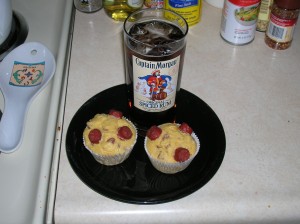
There was a brief discussion as to what to drink with a corndog muffin (Does it pair well with a red wine perhaps?). We decided that only an equally great violation against nature could be paired with this meal. So I made myself a rum and diet caffeine free coke using rum from my $50 bottle of 15 year old Rhum Barbancourt.

It seemed like a sin to use such a good rum for a lowly rum and coke, but boy did it taste good! And the muffins, as wrong and evil as they are, tasted like corndogs. They look freakish and wrong, but they tasted just …. like …. corndogs. They tasted good and at only 160 calories a muffin their appearance is the only thing twisted and wrong.

Want to become your very own Corndog Millionaire by making these muffins? Click here! Want to visit the awesome Hungry Girl website to get great low cal recipes and tips to buying yummy guilt free food? Click here.

The Naughty Shirley

As you will remember from my attempts to master the flaming mojito it was decided that flaming mojitos just weren’t worth the effort or the nasty Bacardi 151 taste. Upon that decision I asked my husband, Jim, what are we going to do with the 151 that’s left? He told me that we would flame drinks again, just not mojitos. And so I foolishly asked, what the heck mixed drinks are you going to set on fire? How about non-alcoholic ones? Ha, how about a Shirley Temple?

He loved the way flaming Shirley Temple sounded. He liked a flaming Shirley Temple Black as a name even better.

I love Shirley Temples! Most of my memories of eating out with my parents as a child involve me being given a sweet Shirley Temple in a cocktail glass with a swizzle stick, just like the adults had. Even now that I’m well past 21 years-old I’ll occasionally order one when I want something that looks like a cocktail but doesn’t have any alcohol.

For those of you who don’t know, a Shirley Temple is a pretty simple drink. My childhood memories are of a glass of 7-Up with the juice from a jar of maraschino cherries with a few of the cherries dropped in. Since we weren’t positive we took a quick peak online and came up with this standard-ish recipe for a Shirley Temple.

Glass.


1oz. grenadine syrup


8oz. ginger ale and add ice


Jim handed the glass to me and I took a sip, minus the cherry to eat, it tasted like the Shirley Temples of my childhood. This is when I pointed out that if he took a shot of Captain Morgan Tattoo rum and added it gently, it would probably make a black layer on top, and then it could be called a Shirley Temple Black (Which is also a drink, with many different recipes ranging from the addition of vodka, kahlua, orange juice, and more).

We added the Tattoo, and sure enough, it made a crimson red drink with a black layer on top. Perfect in appearance for any vampire or goth or goth vampire event.

Now for anyone that hasn’t tried Captain Morgan’s Tattoo, it has an odd spiced flavor to it. Not good for shots or sipping, but I find it okay for rum and cokes. I was concerned as to how my beloved Shirley Temple would taste once we stirred the inky spiced blackness of the Tattoo into it.

The answer….awesome. In fact, you can’t even tell there is any alcohol in it. This could potentially be the most dangerous mixed drink ever because there seriously isn’t even a hint of alcohol to it.

In fact, it tasted so good that neither Jim or I could bring ourselves to light it on fire. Which is probably for the best, I’m running low on pint glasses.

Post Script: After much debate, and suggestions from Greg at What Greg Eats, Jim and I decided to call this drink, Naughty Shirley.

Okay Bourdain, Now I Get It

If you’re like me, you love watching “No Reservations” on the Travel Channel with Anthony Bourdain. And if you do watch, you know that Bourdain has a thing for Vietnam, and even more specifically a Vietnamese noodle soup called pho (pronounced fuh, like duh with an f). Every time he’s anywhere in Vietnam you get treated to watching him and his cohorts slurping down this soup while an elaborate voice over explains why this is the soup to end all soups (I suspect the voice overs are because he doesn’t want to stop eating to discuss.).

Now many of my readers live in large cities and I suspect getting yourself a bowl of pho isn’t too rough if there’s any kind of Vietnamese population where you live. With a little research I found two places about 30 minutes from where I live that serve pho, so I picked the one that had good reviews for its pho and was located somewhere I felt confident I could find. So, at the end of May, for my birthday, my husband took me there for lunch so I could finally try pho.

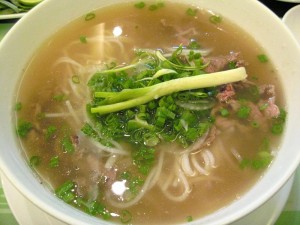
For those of you who are unfamiliar with pho, let me break it down for you, at least in respect to what I had. It’s a very complex broth soup, in the case of what I had, beef broth, that has rice noodles, a variety of onions (yes, there was heart burn, exquisite, delicious heart burn), and since I ordered the pho bo, which is pho with thinly sliced beef, there was a load of thin slices of beef in there. On the side you’re given a variety of things to add to customize the pho to your tastes. I got a plate with fresh bean sprouts, lime, hot peppers and basil, and a small dish that had a spicy chili sauce and I think fish sauce.

Never having had pho before, I first had a few tastes of it without adding anything. It was a yummy soup that tasted exotic and yet oddly familiar. Vietnam meets childhood broth soup. After a few tastes I decided the lime would be good in it and squeezed the wedge into the bowl. Also, since I like bean sprouts I put a bunch of those in right away. Not being able to handle overly spicy food I opted to skip the fresh hot peppers and I didn’t love the idea of fresh basil in the broth so I skipped on that. Since basil is a staple, I’m sure it tastes fine; it just didn’t seem to click for me. I enjoyed the pho like that for a while and then decided it was time to try out the sauces. I tasted both sauces, and the chili sauce was very spicy. I put in a healthy dollop of the fish sauce and a tiny touch of the chili sauce. For me, this is when the soup went from good to awesome. Ironically, my husband doesn’t care for fish sauce, so for him it went from awesome to okay.

And that’s how I enjoyed my pho bo. I thoroughly enjoyed it, but at the same time I couldn’t work up the near fanatical adoration for it that Bourdain possesses. I ate half the bowl and took the other half home. End of story? Guess again.

Once I was home, I kept thinking about the pho bo in my refrigerator. I thought about it so much that despite having a filling dinner I found myself heating up a small bowl of it for a snack later that night. And once it was gone, that’s when it began. I would find pho sneaking into my mind a lot. I found myself looking at the calendar, trying to figure out when I could get down to that restaurant again for more. And that’s when I realized what Bourdain was talking about, pho gets inside you, and I’m not just talking about in your belly when you eat it. It’s combination of home-cooked noodle soup memories from your childhood laced with exotic flavors from another land…it’s a heady mix indeed.

So yes Bourdain, now I get it.

Post Script: I recently got to go back for more pho. This time I had pho tom, which has shrimp instead of beef. Delicious!

The Quest for Fire: Flaming Mojitos in Our Time

I can’t clearly recall when the idea struck my husband and I, but at some point we just went, “We should make flaming drinks for our friends.” And thus began our quest for fire.

It only takes about two seconds with Google to see that most flaming drink recipes have one thing in common, you float a little Bacardi 151 on top. To us this seemed to imply that really, you could light any beverage on fire, as long as you float some 151 rum on top. So then, why flame a zombie or mai tai when we could flame rum drinks we truly love, like mojitos and rum and cokes?

Obviously this was going to require field testing. We went out and bought a bottle of Bacardi 151 (Which by the way, has this awesome warning label telling you that no matter what, do not use it for flaming dishes or drinks. Seriously.) and a fire extinguisher that could accommodate liquid based fires. Then we gathered up a few rum drinking buddies to see what would happen.

For those of you unfamiliar with the mojito, you’ve been missing out. It’s a fairly simple mix. Cut up some lime, toss it in the bottom of a glass with some sugar and mint leaves. Then muddle it, which means pound and mush up the ingredients. You can buy a muddler (a mortarless pestle) for the task, we did on clearance at Pottery Barn, or you can use a wooden spoon handle, which is what we used in the past, or you could try the beater of a hand mixer, which is what the folks at Hungry Girl suggest. After you’ve muddled, add one part light, or white, rum and three parts seltzer and ice. Refreshing!

We ended up making two mojitos, a rum and coke, and a vanilla float (root beer with a shot of vanilla vodka). My husband floated some 151 on top and attempted to make flame.

Only one actually lit. We put out the flames on that one. Obviously the next step was to drink. The person whose mojito actually ignited suggested letting it burn out next time because the 151 tasted pretty strong. Obviously this is what I, the other mojito drinker, and the rum and coke guy thought as well. Of course we still drank them, can’t let rum go to waste after all. My husband’s vanilla float went straight into the sink after one sip. I guess none of us were too surprised that root beer, vanilla vodka, and 151 didn’t mix well.

Although not a roaring success, we had proof of concept. You could flame a mojito. We were now treading paths that had never been navigated before.

The next time we gathered we had new thoughts on how to reliably achieve flame. It appeared that the ice broke up the even layer of 151, so this time we made the drinks without ice. And it worked!

Remembering how we needed to let it burn longer we decided to let that one burn out. Um, not the best plan.

Yep, that would be a busted pint glass.

After that we opted to extinguish the flames after a minute or so. Unfortunately the drinks still tasted as if laced with rocket fuel. Maybe there was a reason that you mostly see shots and mixed drinks that are already a heady mix of boozes lit on fire. Perhaps the reason we had gone where no one had seemed to tread before was because, maybe, just maybe, everyone else was a little smarter.

So what did we learn? A mojito is a perfect, refreshing rum drink that needs no embellishment. That Bacardi 151 tastes pretty crappy. And that spending time drinking nasty, half flamed, rum drinks with friends is a wonderful way to kill a Saturday night.

Has the Miracle Noodle Been Found?

Hey, it’s Rebecca, Greg’s more diet conscious counterpart, here to talk about pasta. Yes, pasta again. Why pasta? Well, let’s face it, pasta is something everyone loves. I don’t think I could trust a person that did not like pasta dishes. Unfortunately, most noodles are high in dreaded carbohydrates and then made worse by poorly considered sauces. Don’t get me wrong; I love me a bowl of nice fat noodles smothered in a rich cream sauce. However, dishes like that should be like Cookie Monster’s cookies…a sometimes food.

What is a noodle fan to do? The common answer has always been to switch to whole-wheat pasta. Despite people’s reaction to many brands, there are good whole-wheat pastas out there; you just have to be willing to eat a few meals of gritty cardboard noodles until you find a brand you like. I mentioned it in my last post here on What Greg Eats, but I’ll say it again. I really like Gia Russa brand. Then I started hearing about this miracle noodle, tofu shirataki.

What makes shirataki so darn special? Well, a 2-ounce serving has only 20 calories and 3 grams of carbs. It even has a little protein to boot. It has no cholesterol, no sugar, and is gluten-free. How is that possible? Well, this is not made out of traditional ingredients. Shirataki noodles are made with filtered water, tofu, and yam flour. The shirataki noodles I tried were purchased at my local grocery store in what I refer to as the “hippy section”. They were with the soymilk and dairy-free cream cheeses. The noodles are in a bag of water. Preparing the noodles was a little odd, but easy. You drain the noodles and rinse them. Then microwave them for one minute and dry them. After that, you use them as you would any cooked noodle.

In my case, we divided the noodles (one package was two servings) into two large bowls. I made a broth with two cans of low-fat low-sodium chicken broth, a splash of low-sodium soy sauce, minced garlic, a pinch of red pepper flakes, chopped mushrooms, and a little spinach. Once the broth was piping hot and the spinach was wilted, I just ladled the broth over the noodles until they were fully covered. Tah-dah!

The real question is how do they taste. The answer is a surprising, pretty darn good. Everyone says tofu has no flavor, but anyone who has tried working with it knows that it does have an odd flavor of its own. You couldn’t taste it in the noodles at all. I even tried one before I put broth on it to check. The noodles were thin, but very elastic. They had al dente firmness and the amusing bounciness of a rubber band. Really, it was quite charming. In addition, it convinced me that these noodles could hold up to a tomato sauce.

For me, tofu shirataki noodles are a gift from the pasta gods, a low fat, low-carb, low-calorie miracle. Hallelujah!

Date Night Pasta

As we all know, Greg loves to eat. Greg loves to eat well, but he doesn’t frequently talk about eating healthy. I do. I annoy Greg with talk of whole grains and vegetarian meals on a regular basis. Greg has kindly allowed me the opportunity to be the angel of healthy eating on your shoulder to his little devil of luxurious dining.

What is a healthy meal? Despite what the media tells you, people have to decide what is healthy for them. For some, fat content is an issue, but sodium is okay, others are strictly looking to lose weight and carb counting is all they care about. For us at home, it’s generally low fat, low sodium, and low carbs. We changed our eating habits at home so we could enjoy eating out guilt free. Just because a meal is without guilt doesn’t mean it has to be without taste, and just because there is no meat, it doesn’t mean it’s not satisfying.

What follows is something I cooked up for an at home date night. The recipe is great for many reasons: one, it’s simple, two; you could easily modify it to suit your tastes (like adding meat or maybe wilting some spinach in it), three, the choice of ingredients. By using black beans in the place of meat you get protein without the fat, also, the red pepper flakes add a bit of spice, which revs up your metabolism. The use of whole-wheat penne pasta makes the dish feel hearty without the carbs of traditional white pasta. (I know many people do not like the taste of whole-wheat pasta, that’s because there are many brands that taste like tree bark, at best. You will need to suck up a few less then stellar pasta nights to find the brand that suits you. Personally, I’m in love with Gia Russa’s Whole Wheat Penne Rigate, www.giarussa.com.) What follows is an excellent sin free meal to start an evening of sin.

Rebecca’s Healthy Date Night Pasta for Two
(the amounts given are general at best; everything used is really a matter of taste preference)

Boil up enough pasta for two servings. I used half of a box of Gia Russa so that I would have leftovers to take to work for lunch.

In a large high sided skillet heat up 2 tablespoons of olive oil.

Once warm, add in minced garlic, I like me some garlic so I did about two and a half teaspoons.

After the garlic has had a chance to cook, add in one, drained 14 and a half-ounce can of diced tomatoes. (You could use fresh tomatoes that you skinned and diced yourself. It would probably taste better, but I’m a lazy girl and canned seems to work fine when you’re just cooking it into a sauce.)

Add in red pepper flakes to suit your taste. I just sprinkled it in without measuring, but a light sprinkle over the entire pan seemed to be just enough to add some heat without killing us.

Toss in fresh chopped basil. I used 5 large basil leaves and thought it was a little wimpy on the basil once I was done, so you may want to go 7 or 8 depending on your feelings about basil.

Stir it all together and allow the tomatoes to cook down some and the flavors to mingle. I gave it a healthy dash of black pepper here too.

Once everything is all warm and mingled together, add in half a can of drained black beans, and stir them in until they’re warm.

When your pasta is done (Gia Russa, 10 minutes to al dente) drain it. Toss the drained penne into your skillet and stir to coat.
Serve it up in bowls with some nice, toasted up whole grain bread. In addition, a glass of red wine is not only a romantic and appropriate accompaniment for this type of meal; it’s also good for your heart’s health. Have a glass with some dark chocolate for dessert and not only are you setting the mood, but you’re helping your blood pressure and battling heart disease!

Hopefully this inspires you to take a fresh look at healthy cooking at home!

For more food talk visit What Greg Eats.

Starr Place

Originally Published at www.whatgregeats.com.

I love eating out, as does my husband. Many married couples have hobbies; our problematic hobby is that we love to go to restaurants. For awhile we were pretty out of control. We would eat out to celebrate. We would eat out because we had a bad day. We would eat out because we were going to be out running errands. We would eat out because we just didn’t want to cook. Fortunately, with some kicking and screaming, almost entirely from me, we have managed to cut back on the eating out. It’s hard and I don’t like it, but unfortunately I’m getting older and my metabolism is slowing down. It’s better to eat healthy at home. Of course, we make exceptions, as we did this past weekend.

I am friends with a wonderful woman in another town about 4 hours away. She has a son in Rhinebeck, NY, which is only an hour and a half away from us. We always joked that when she went to visit her son, we should all meet up there and have dinner. Well, she emailed me to say that she was going to be in Rhinebeck and that her son, who I had been told is a very well liked host and restaurant manager, would be having a soft opening of a new restaurant he is a partner in called Starr Place. Would we like to go? Um, heck yeah. So after getting the okay for the car trip from my physical therapist, we drove out.

We had never been to Rhinebeck, NY but from the little bit I saw, it looks like a wonderful town. Nice enough that we want to go back and visit. Anyway, we enter the Starr Place for its soft opening. A soft opening is essentially a trial run; this one was all friends and family. Or in our case, friends of a family member. The restaurant wasn’t totally done being renovated. There are stairs going up and down, but for this evening, the main floor was the only one in use. The interior decorating was well planned. You can easily wear a suit to this restaurant, or jeans and a button down, and feel equally comfortable. A small dark wood bar sits in front of a beautiful glass and dark wood display of a multitude of spirits. An elegant, well stocked bar is a thing of beauty.

We were seated with the mom, the host/partner’s wife, and a couple of her friends. Everyone there seemed to know the bartender and the wife told our server to have the bartender make her whatever he wanted. An excellent sign. I ordered a cosmopolitan and my husband happily ordered Red Stripe, his all-time favorite beer. The cosmopolitan is the best one I’ve had since Graham’s in Saratoga Springs, NY closed (years ago).

To test the selection we opted to order plentiful appetizers and share. We had the grilled squid with baby arugula and salsa verde, falafel fritters with hummus and pita chips, French bread garlic, extra virgin olive oil and parsley pizza, and an order of fries with olivade (white cheese and olives). They were all very good. The real stand out for me was the grilled squid. Generally I don’t mind squid as long as it’s disguised, generally fried. This was just a generous piece of squid with grill marks. It was smoky and tender, I didn’t mind the fact that my squid appeared to be squid. After that, it has to be the fries with olivade. The fries were light and crisp and the olivade was just yummy.

After much debate and mind changing I settled on ordering the Idaho Brook Trout with lemon caper butter and apple walnut salad. The hubby opted for the cassoulet, which is pork, lamb, sausages, and white beans. Both dishes were delicious, but I think mine was better. I don’t believe I ever had trout before, and despite it not being as fresh as Greg would like, it was wonderful. The lemon butter was subtle and the fish was so flavorful, probably because of the fresh herbs skewered down the middle of it. I was enjoying it terribly when I was struck by a horrible thought. I leaned over to my husband and said, “We came out for tonight and I’m having fish and a salad!” Yes, one of the staple combinations from our healthy home cooking. Of course, our stuff never tastes like this! My husband reassured me that the two cosmos and all the appetizers definitely undid any health value of my entrée.

To be on the safe side, I ordered the chocolate pate for dessert. Sometimes I’m a chocolate person, other times not, but tonight I was and my inner chocolate beast was merrily sated by this dessert. It was two slices of chocolate presented in the way you might present a pate. The chocolate was firm on your fork when you dipped into it, but light like a mousse in your mouth.

The Starr Place has all the makings of your new special night out. The restaurant is elegant, but comfortable, the host is smooth and efficient, the bartender is fantastic, and the chef has obviously got the mad skillz (as the kids would say). If you’re within a two hour radius of Rhinebeck, NY I recommend checking it out once it’s open. You can keep track of that by visiting: www.starrplace.com.

You Got Your Halal in my Kashrut!

The warm, cornmeal-batter smell of fresh fried catfish filled my father’s kitchen. The bubbling grease in the “Fry Daddy” in the corner just set the mood even better. Typical for dinner, my mom asked me, “What do you want to drink?”

“Milk please.”

“We’re having fish, you can’t have milk with fish.”

“What?”

That statement immediately derailed our dinner plans and launched a lengthy discussion as to exactly why I couldn’t have milk with fish. In the end, I had to live with the answer, “just because, it’s not healthy.” It was only a few years later that my parents finally relented that there was no good reason for it. Eventually, my parents gave up on this taboo and the milk jug came out even on fish fry nights.

Later, I came to understand that, even though my family is far from Jewish, this was somehow most likely a holdover from the Kosher requirement to not serve meat and dairy for the same meal.

But really, where do you get these customs? No Pork? (Don’t take away my Bacon!) Specific rules for slaughtering of animals and draining of blood? Eggs for Easter?

Well, here are one man’s thoughts on the matter.

In times past, it was the job of the church to shepherd their flock through the trials and daily tribulations of life’s dangers. In a time when preservative methods, refrigeration and the like were all but non-existent, food quality was a great source of concern for health and wellbeing. Additionally, agriculture was in its young years and not nearly so well developed as today. Many of the best ideas for how to properly tend crops and herds were foreign to the cultures of the time.
And, what better way to get people to behave and follow a code or guideline, than to go ahead and make it the will or direction of God?

Hence was born, the religious restrictions on diet and food consumption.
The restrictions and customs span the world’s religions. Most notably, Judaism has the Kashrut, which defines which foods are “Kosher” and may be eaten (as well as how they must be prepared), but goes far beyond just that. In Islam, you find the Halal, detailing a very similar list of requirements. However, Buddhism and Hinduism have light, less formal requirements. Christianity meanwhile is rich with traditions of its own.
Would anyone believe that it is a coincidence that nearly every religion from the time preceding recorded history to modern times prescribes periods of fasting in the spring and/or the fall?

Fasting during those times serves to conserve food stores for lean months ahead (Fall) or conserves already depleted food stores before Spring crops are harvested. Additionally, the periods of fasting force the body to consume toxins built up in the system and allow organs a period of rest prior too or following time spent consuming a less healthy diet lacking vegetables and other nutrients.
There are agricultural concerns as well. Avoiding unnecessary meat consumption during the Spring helps insure that there is sufficient diversity in the herd for breeding and growth of the herd, as well as protecting mother’s to be from the slaughter.

Specific taboos were developed as well. In some cases, such as Pork, the reason for proscribing the food ‘seems’ clear to most. At a time when most meats were slow cooked over a spit, it was not guaranteed that Pork would reach the necessary temperature to kill the worms which cause the parasitic disease, Trichinosis. Rather than risk this, it was outlawed by the culture.

However, what seems fairly clear for most may not be so simple. An idea gaining popularity among anthropologists is that Pork was forbidden by Middle-Eastern cultures more for the fact that Pigs, in an arid climate, require a great deal of water, and that pigs left to roam free will consume grains and food products valuable to the human inhabitants of that region.

Agricultural basis for food taboos may be more widespread than originally thought too. It’s widely known that devout Hindu’s don’t eat beef. Is this due to the cow being “Sacred” in Hindu culture as most Westerners think? Or was it because in years past large herds were kept that contributed to deforestation and overgrazing, which further contributed to the loss of cultivated lands and growing deserts? Thereby forcing a reduction in herd sizes and making it unfeasible to consume cattle, which were still needed as beasts of burden.

Also, herd quality suffered over time. The tradition of the time was that the visit of an “honored” guest prompted the slaughter of the finest bull in the herd. The loss of this quality genetic material to the herd saw a steady decline in strength and stamina of the animals, making them less suited to the lifting and pulling duties required of them.

Of course, in other cases, the food associated with a particular holiday seems to be a mystery. As a kid, I loved coloring and hunting for Easter Eggs, and along with that, loved the boiled eggs and deviled eggs sure to come later, but, why eggs for Easter?

Well, when Christianity came along it was supplanting many older, less well-structured religions. However, in order to attain the buy-in of the common folk, certain holidays had to be preserved in part, if not in whole. Easter was converted from Ostara, a spring fertility holiday. Eggs, Bunnies, get it? Both are common symbols of fertility.

Sometimes it is necessary to make up a reason to eat a particular food for a Holiday. Every good Jewish child knows that Hanukka celebrates the one day’s worth of Olive Oil that burned for 8 days to light the eternal flame while more Olive Oil could be pressed and prepared. And to celebrate this, Jewish households the world over cook Potato Latke’s in Olive Oil.

Wait a minute…Potatoes? Potatoes come from the New World and were unknown to the Jewish people at the time of the miracle of the oil and for hundreds of years after. However, centuries later, at a time when new food substances were needed to ward off hunger and when it just so happened that the last of the Potato harvests were becoming available, Jewish people needed encouragement to embrace the Potato. Thus was introduced by the Temple, the Potato Latke, “traditional” Hannukah food.

Sometimes though, the foods you eat for your religion are just part of the religion. I can think of no other reason to have Matzo Meal inflicted on you, than a form of penance and remembrance for Passover and a people fleeing oppression and having no time for leavened bread.

Also, as time goes by, the more strange customs, alien to modern society, fall gradually into disfavor (but can still be found somewhere). Feel free to google, placentophagy.

Lastly, the next time you sit down to a traditional dinner or you gaze longingly on that one tasty looking item you can’t have (mmm, bacon), stop to ponder why it is the way it is. If you dig deep enough, you may find that the answers surprise you.

Greg Bullard has driven in all 48 contiguous U.S. States, Canada, Mexico and has been sure to stop for a bite to eat in everyone of those places. He’s almost half as charming as he thinks he is, not quite as conceited as he seems to be and did we mention, he loves food? Visit Greg’s website www.whatgregeats.com.