Dreaming Techniques

Dreams have always fascinated people. That said, I do not go out of my way to read too many books about dreams because they tend to be nothing more than glorified dream dictionaries, and dream dictionaries are of minimal helpfulness. That is why when I was sent a copy of “Dreaming Techniques: Working with Night Dreams, Daydreams, and Liminal Dreams” by Serge Kahili King I just glanced at it and set it aside.

One day while attempting to clean my work area (I operate with a pile-based system. It is inefficient AND messy.) I stumbled upon “Dream Techniques” again. This time I took a moment to read the back cover and realized, this isn’t just a throw away dream dictionary, and I started to read it. I am glad I did.

Most books about dreams stress the importance of keeping a dream diary/journal. Yet never have I encountered an author who has cataloged over 5,000 of his own dreams! King uses his vast collection of dream recollections and combines it with the science available on the subject to help us gain some understanding of our own dreams. “Dreaming Techniques” breaks down dreams into 3 different categories: night dreams, liminal dreams, and daydreams. The fourth part of the book focuses on techniques to work with dreams.

Not only is this a fascinating exploration of dreams, but with its focus on thought experiments and states of consciousness, “Dream Techniques” can prove to be an invaluable resource for magic practitioners as well. “Dream Techniques” by Serge Kahili King was an enriching book that I cannot recommend enough.

You can learn more here.

Shop your local indie bookstore <---This is an affiliate link to IndieBound, which supports independent bookstores throughout the United States. If you use this link to purchase the book, I will make a small commission at no additional cost to you.

Do you enjoy The Magical Buffet? Considering supporting The Magical Buffet on Patreon! For only $5 a month you’ll receive monthly tarot/oracle forecasts, classes, and behind the scenes updates! https://www.patreon.com/magicalbuffet

Dreams & Symbols

I love reference books. Books with titles like, “Encyclopedia of….” or “Dictionary of….”. I “collect” books, but I hoard these kinds of books. For some reason I feel like I can never have too many of them, and in my defense, they all have something unique to offer.

For instance, look at the two books I’m discussing today, “The New Secret Language of Symbols: An Illustrated Key to Unlocking Their Deep & Hidden Meanings” and “The New Secret Language of Dreams: The Illustrated Key to Understanding the Mysteries of the Unconscious”, both by David Fontana. The key word here is “illustrated”. Both books are entirely full color, heavy stock glossy pages filled with wonderful illustrations. These both are more than reference books, they’re coffee table art books.

Fontana has written several books before these about dreams and meditation. He wrote “You Can Understand Your Dreams”, “1000 Dreams”, “You Can Understand Meditation”, and two different tarot decks (“The Wisdom Seeker’s Tarot” and “The Truth Seeker’s Tarot”). I guess what I’m trying to say is, these books pull on a lot of past elbow grease.

I won’t claim that either of these books are revolutionary, however they are well researched, thoroughly indexed, and beautiful.

You can learn more here.

Dream Interpretation for Personal Growth – Images of Abduction in Dreams

By Dayna Winters

Well, the New Year is off to a great start, and I hope everyone is working hard on recording dreams and learning how to interpret them. In fact, last month’s posting was about just that: We explored short and long-term benefits of keeping a dream journal. Since it’s February and the month so many of us associate with passion, this month we are going to explore abduction imagery in dreams. Of course, I know anyone reading this right now just said to themselves, “What the heck does abduction have to do with passion?” I hope you’ll stick with me, as soon all will be made clear!

Defining the term

At first, the sheer word “abduction” is likely to make a person cringe. The term “abduction” can stir up anxiety and evoke emotions like fear, helplessness, and even anger. In the most general and commonly understood sense, “abduction” means to take something or someone away from a situation or location, typically against the individual’s will. According to The Free Dictionary Online, the word “abduction” originates from the Latin abdūcere, a term that breaks down into ab– meaning “away” and dūcere meaning” to lead.” There is a really seedy element to abduction as well in that such an act can involve someone young, innocent, inexperienced, and perhaps trusting; in this case, the individual might not even be initially aware of the abduction taking place until it is too late: For example, in the event a parent abducts a child. Alternatively, the use of the term “abduction” in a physiological sense means to move away or draw away from the midline of the body or to move one limb away from the other.

Interpretation

With the above-mentioned definitions of abduction in mind, let’s dig deeper into what this kind of imagery might mean in dreams. When thinking about the most common meaning of abduction, you need to consider what role one played in the dream to gain greater understanding into what the dream means. You will either be a perpetrator, victim or witness to an abduction in the dream. Each assumed role will illicit different dream symbolism.

Perpetrator: As the perpetrator of abduction, you should consider the give and take elements of your relationships in waking hours. Good questions to ask one’s self include, “Am I taking more than I’m giving,” or “Am I taking someone for granted and perhaps stealing away with their valuable time?” “Is there an uneven level of give in take in any relationships?”

Victim: If you are the victim of abduction in your dream scenario, your dream may be trying to reveal subconscious fears you may not be addressing. It’s time to ask yourself if you have unaddressed anxiety issues, if you are feeling out of control and helpless, or if you are faced with a situation in your waking hours you might not really want to have to deal with or perhaps you are completely ill equipped to handle.

Witness: If you are witnessing abduction, you’re reaction to the scene can reveal much. Are you terrified, worried, anxious, or scared? It’s a dream so anything goes and maybe you were happy about it. Think about the dream imagery in this context. If upset, do you fear unexpected change or feel like the hand of fate is sweeping in and taking over your life? If you were happy, do you wish something would happen so you can get out of a situation that is less than positive?

Physiological sense: If we consider the definition of abduction meaning moving away from the midline of the body or the separation of one limb from the other, abduction imagery takes on different connotations. If moving away from your body, perhaps you are exposing yourself to emotional hurt or you are moving away from your core values. The separation of limbs suggests a part of pairings: this separation may be positive or negative, depending upon the situation in question.

Rape of Proserpina by Shuishouyue

Mythological Archetypes

Myth is abundant with stories of abduction; two examples right off the top of my head include the story of Helen and Troy or the story of Persephone and Hades from the Greek pantheon. In brief, Hades, so desirous of the young maiden Persephone, gets permission from his brother Zeus to steal away with his daughter. Hades abducts Persephone while she is picking flowers in the field and takes her to the Underworld. Demeter, Persephone’s mother, finds out about what happens and grieves the loss of her daughter, so much so, she refused to let anything grow on the earth. Eventually, Zeus relents and allows Persephone to leave the realm of the Underworld, provided she did not consume anything before she left. Zeus sends Hermes to guide Persephone back to the world of the living, but on her way out of the Underworld, she consumes a pomegranate. The consumption of the fruit eventually results in her having to spend a third part of the year in the Underworld with Hades and the remaining months on earth with her mother Demeter. The later story is often referred to as the Rape of Persephone or The Rape of Proserpina (Roman pantheon).

Now, at this point you probably think I’ve strayed extremely far away from my attempt to connect dream imagery of abduction with passion. However, some scholars suggest the myth of Persephone and Hades has some clearly identifiable elements of passion. First, Hades is so desirous of Persephone; he abducts her and takes her away from her mother and the world of the living. While this may seem terrible for Persephone, Jean Shinoda Bolen M.D. in “Goddesses in Everywoman: A New Psychology of Women,” asserts “Persephone is the Underworld aspect of Aphrodite: the Goddess of Love… and both goddesses share the pomegranate as a symbol.” Bolen also explains her belief that once Persephone accepted the pomegranate for consumption, she was volunteering to return to Hades every year. In fact, some scholars suggest the pomegranate represents the woman’s womb and the seeds within. Thus, a relationship that started out with abduction ultimately resulted in a lasting relationship with two willing participants: Hades and Persephone. The story of Hades and Persephone is one representing undesirable, abrupt change, birthing into something new and unexpected. It is also a story representing the transition from innocence to experience. Ironically, the pomegranate is a symbol of abundance, the seeds inside the fruit represent unity, and the fruit is a symbol of unbreakable bonds.

Myth turned into dream interpretation

If you feel the story of Hades and Persephone resonates with you, particularly because you have dreamt about abduction, you should consider the role fate is playing in your life. Just as Persephone had no control over Zeus, who gave permission to Hades to abduct her, it seemed fate was influencing the events in her life. The role of fate might not be negative and perhaps in your waking life you are about to enter into a situation or relationship that you are fated to encounter. The story is symbolic of seasonal changes, cyclical events, spring, and new beginnings followed by a period of chaos. The myth is also a metaphor for the loss of innocence, sexual initiation, and uncontrollable passions.

About Dayna Winters:
Dayna Winters is a solitary Witch, author, and artist. She is the co-author of three books written with Patricia Gardner and Angela Kaufman including, “Wicca: What’s The Real Deal? Breaking Through the Misconceptions,” “Sacred Objects, Sacred Space: Everyday Tools for The Modern Day Witch,” and “The Esoteric Dream Book: Mastering the Magickal Symbolism of the Subconscious Mind”, all of which are published by Schiffer Publishing. You can find out more about Dayna and her work at her blog: http://daynawinters.blogspot.com/.

The Esoteric Dream Book

The ladies have done it again. What ladies? Dayna Winters, Patricia Gardner, and Angela Kaufman of course. You may remember them from “Wicca: What’s the Real Deal?” and “Sacred Objects, Sacred Space”. Those two books were excellent, and their latest book, “The Esoteric Dream Book: Mastering the Magickal Symbolism of the Subconscious Mind” doesn’t disappoint.

As I’ve come to expect, there is a tremendous amount of information in “The Esoteric Dream” and yet you never feel overwhelmed and the book comes in at a svelte 221 pages (including endnotes). For those of you thinking that 221 pages seems like an awful lot, you haven’t heard all that you’ll learn about in this offering.

Let me start by telling you that this isn’t a dream dictionary, and that’s a good thing. As you’ll learn from “The Esoteric Dream Book” (because you’re going to buy it), there is so much more going on in dreams of a personal nature than a one size fits all dream dictionary can hope to cover. That’s not to say there is no space for a good quality dream dictionary in your life, I have a couple, but you need more, and this book is what you need. Now that I’ve told you what you’re not getting, you’re probably more than ready to hear what you are going to get.

You’ll learn how to document and analyze your dreams. There’s a lot of discussion of symbolism, themes, and archetypes. Also how to learn to recognize these things when they pop up in your dreams. Ways to improve the quality of your dreams, including deities associated with dreams and gems for dream enhancement. The tarot archetypes, the Major Arcana primarily like The Fool or The Tower, as they appear in dreams or using them for dream work. And just more!

I feel “The Esoteric Dream Book” is Winters, Gardner, and Kaufman’s most complex book to date, and still the subject matter is presented in a way that is easy to understand. Anyone who is serious about learning to understand their dreams should definitely pick up this book.

(If you’re interested in dreams, you should be reading Dayna Winters’ monthly article here on The Magical Buffet! You can click on the “Dream” category to see her articles so far! And if you HAVE been enjoying her articles already you DEFINITELY should buy this book! She’s one of the authors!)

Connecting the Dots – Journaling and Dream Connections

By Dayna Winters

Let me start by saying Happy New Year! As we enter the year 2015, it is a wonderful time to intensify our exploration of dreams and their meaning. In December, we examined the influence of lunar energies on dreams and dream work. This month, I would like to explore the importance of dream journaling. While the immediate benefits of journaling might seem obvious, there are long-term benefits derived from documenting dreams as well. Journaling allows you to take a look back at the dreams you have had in the last few days, weeks, months, and years. Over the course of time, the analysis of your dreams can reveal the appearance of repetitious archetypes, running themes, the connections between two or more dreams, and may even hint at real life events.

In order to explore this idea further, I will present you with a couple of dreams I’ve had in the past few years. The meaning of the dreams and a connection between the two is, at first, ambiguous. Yet, through analysis you’ll soon discover significant meaning behind the dreams and precisely how both narratives are connected to one another.

Dream #1: About two years ago, I dreamed I was in a row boat in a vast body of water. There was no land in sight and I was all alone. The boat was slowly taking on water. I put my feet up on the seat of the row boat to keep them dry. I didn’t notice the rainbow serpent curled up in the bottom of the boat until it was too late. The snake bit me. The creature was incredibly aggressive and would not let go. I was terrified as I struggled to get away from the snake. Then I awoke.

Rainbow Serpent by Dayna Winters

Dream #2: About six months after I dreamed of the rainbow serpent, I had the following dream where I was watching a scene as if I was outside my body. I could see a mound of earth and knew I was buried beneath it. The grass on the surface of the mound was green. I was terrified at the idea of being buried alive. I could see the mound of earth moving up and down slightly, as if it was breathing. I heard a female voice speak to me. I perceived the voice to be a divine being. The voice said, “Do not worry, you’ll be fine, this is only a rebirth – a resurrection.” Then I awoke.

Dreams Hinting At Real Life Events To Come

What makes the connections between the two dreams under discussion is not immediately evident. However, what is not revealed in the two dreams are real life events that occurred following both dream scenarios. Keeping a dream journal allowed me to take a look back and realize the startling connections. The events are as follows:

About a year and a half after both dreams, I became incredibly ill. The illness came on suddenly and aggressively. I was at the County Fair when I became sick. While there I saw a huge rainbow in the sky. I did not know it at the time, but I had a terrible infection and my condition worsened rapidly. I ended up with sepsis and had to have emergency surgery. Following the surgery I had a lengthy and painful recovery period. While recovering in the hospital, my home was under renovation. My daughter called my husband to tell him that somehow a snake got in the kitchen and just slithered out from behind the stove onto the coffee maker (And no one was pleased to hear this news!).

During recovery I had what I can only call a near death experience – there were moments I felt as if I was outside my body looking on to what was happening to me. I witnessed things that were otherwise impossible to witness given my condition at the time.

Both dreams pointed toward the potential for the occurrence of a terrifying event. What is amazing about the dreams I had was the fact that I got an infection in the exact location where I was bitten by the rainbow serpent I saw in my dream scenario about a year and a half prior to the actual incident. My illness was sudden, as was the strike of the snake, and the infection was rapid and aggressive, just like the serpent. The day I fell ill I actually saw a rainbow in the sky at the County Fair. The snake appearing in the kitchen of my home was yet another strange and amazing (and extremely undesirable) connection. Before and after my surgery, there were moments where I felt outside of myself, as I did in my second dream where a female voice speaks to me and comforts me by telling me that this time period is a resurrection and I am not to worry. Indeed, my surgery saved my life and my recovery time was, without question, life-altering.

What’s amazing is with some research, I found even more remarkable connections between my dream of the rainbow serpent and the divine being speaking to me. I looked up the mythological basis of the Rainbow Serpent in Aboriginal Australia. Scholars suggest a link between the serpent, the cycle of the seasons, and the incredible importance of water in supporting life (Note: In the dream I was surrounded by a body of water and the boat was taking on water. Also note that I attended the County Fair, where my illness began, during the shift of seasons from the end of summer to the early beginnings of autumn – this relates to the shift in the cycle of the seasons association of the serpent). Further research revealed that the Rainbow Serpent, because of its association with water, is considered “a giver of life.” However, the creature is also considered destructive when angry (Note: The snake struck me aggressively in the dream and the infection I ended up with was extremely destructive, destroying surrounding tissue and poisoning my bloodstream, just as if I was actually bitten by a poisonous serpent.) Remarkably, in some stories, the Rainbow Serpent has associations with blood, circulation, and the creature is considered a healer.

It’s important to note that while I was surrounded by a body of “life giving water” and the row boat was taking on the same waters, I removed my feet from it. The removal of my feet ultimately signified a withdrawal from the life giving, watery associations of the serpent and the potential destruction to follow. In fact, being in a boat at all serves as a symbol of a disconnect from the life giving waters; I was not in the water in anyway, but I was physically separated from it.

My research revealed even more incredible connections. According to some stories, the serpent is considered a Creator deity. The creature is told of in “Dreaming,” “The Dreamtime,” or Tjukurrpa myths – in Aboriginal mythos, “Dreamtime” is a real place where all time exists at once, past, present, and future. Dreamtime lies beyond space and time. Interestingly, it is a location one goes to just before being reincarnated (this notion seems to correlate with my dream about rebirth and resurrection.) In the Dreamtime or Dreaming stories of the aborigines, the Rainbow Serpent is described as a creature originating from deep within the earth – one that “pushes up mountains and gorges as it moves upward from deep within Mother Earth.” It is here that the subtle connection between dream one and two become evident (In my second dream I was buried beneath the Earth, and the mound of Earth was pushing upward as if it was breathing.)

In some cultures, the serpent is a symbol of an umbilical cord that connects a being to Mother Earth (Note: this literally connects dream one and dream two together via the suggestion of the serpent being a connection to the Mother Earth or female deity I encountered in my second dream.) In many cultures, the Goddess is associated with serpents, with the snake proving a symbol of immortality, healing, transformation, and fertility. The venom of a snake is thought to have a fiery-like quality – it can therefore serve as a symbol of will, strength, and a purification through a trial by fire.

Synchronistic Events

Even more remarkably, in a synchronistic event, a few days after researching the Rainbow Serpent’s meaning in various cultures and its connection to the Earth Goddess, I casually encountered a news article while browsing on the web. The article told of the recent discovery of a Goddess statue formerly buried by the Spanish Conquistadors because it is a pagan idol. Her name is Coatilcue, meaning “She of the skirt of serpents.” A replica was made of the statue and the item was reburied (Note: the remarkable connection between the serpent dream and the live burial in the second dream where I am addressed by a female deity.) The statue was rediscovered in 1804. Considered repulsive, the item was once again buried. She has since been rediscovered and the statue is now in the National Museum of Anthropology in Mexico City. Once demonized, the statue is now viewed as a work of art.

Repetitious Archetypes and Running Themes

The repetitious archetypes become evident when viewing all of the related information associated with both dreams. Here, appropriate dream archetypes include all images of the Goddess/Divine Beings, serpents, and Medusa, The Magician, The Healer/Wounded Healer, and The Prophet and Mystic are all appropriate dream archetypes to examine. Looking at the following Tarot cards can also provide insightful information: The Magician, The High Priestess, Strength, Death, and the meaning behind Swords, and Pentacles.

The running themes in both dreams become evident and a connection can be made between the two – both dreams refer to life altering events, change, death, rebirth, resurrection, and purification via a trial by fire. The dreams were vivid and lasting, making them easy to remember – thus, the dreams pointed to potential life events of incredible importance. For more detailed information on dream archetypes and themes, see “The Esoteric Dream Book: Mastering the Magickal Symbolism of the Subconscious Mind (Schiffer Publishing, August 2014).”

Dream journaling gives you the opportunity to document the dreams you have for further exploration. You can look to dreams for meaning you can extrapolate and use immediately, and you can use your journal to examine the potential long-term connections you might identify. Had I not documented both dreams, I might not have remembered the details of each dream with such incredible detail and I could have overlooked the connection between the two dream scenarios. Over the course of time, your journal can point to running themes, important dream associations, and potential dream connections that will prove more insightful than you ever imagined.

About Dayna Winters:
Dayna Winters is a solitary Witch, author, and artist. She is the co-author of three books written with Patricia Gardner and Angela Kaufman including, “Wicca: What’s The Real Deal? Breaking Through the Misconceptions,” “Sacred Objects, Sacred Space: Everyday Tools for The Modern Day Witch,” and “The Esoteric Dream Book: Mastering the Magickal Symbolism of the Subconscious Mind”, all of which are published by Schiffer Publishing. You can find out more about Dayna and her work at her blog: http://daynawinters.blogspot.com/.

Moonphases and Dreamwork

By Dayna Winters

Lunar Energies and Your Dreams

In November, we explored how to derive meaning from dream fragments. This month we’re going to examine the moon phases and how they influence your dreams. We’re also going to examine how you can integrate moon phases when practicing dream incubation. The ancient Egyptians and Greeks believed dreams were of divine origin and that dreams carried messages from the gods to the dreamer. Supplicants sought out answers to mundane and spiritual questions through the practice of dream incubation. For instance, in ancient Egypt, a supplicant would enter into a temple featuring bedchambers; it was here the individual attempted to receive communications from the divine through dreams. The dreamer would focus on a specific question or desire in hopes he or she would receive guidance or prophetic messages from the gods.

The practice of dream incubation was (and remains) ritualistic, sometimes involving the act of fasting, wearing appropriate attire, and prayer to specific deities before sleeping. If the dreamer was uncertain about dream meaning upon waking, the supplicant would then seek out someone knowledgeable about dreams, like a priest or priestess, for assistance in decoding the meaning behind the messages received. With the understanding the moon influences your sleep quality and the type of dreams you have, you can consider tracking the moon cycle to learn more about your dreams and their meaning. You can also use the current phase of the moon in an effort to induce specific types of dreams. For more information on ancient dream incubation practices, see “The Fabric of Dreams: Dream Lore and Dream Interpretation, Ancient and Modern” by Katherine Taylor Kraig.

“The Silver Lady,” 9” X 12,” mixed media, by Dayna Winters

The belief the moon has an influence on human behavior is a long held and widespread belief, and you don’t have to be a magickal practitioner or astrologer to believe in the influential power of moon energies. In 1995, the University of New Orleans gave 325 individuals a questionnaire to discover how many people believed in the power of lunar influence on human behavior. Of the 325 people questioned, 43% believed behavior is influenced by the moon; the belief was held by people in the mental health occupation (more strongly than any other occupational group), including LPNs, master’s clinical psychologists, and social workers.**

The influence of the moon on behavior extends into individual sleep patterns and dreaming. Scientists are now discovering the role the moon has on sleep and dreams. In an article appearing on LiveScience it’s revealed the full moon can negatively affect a person’s sleep quality. The findings of the study were released in the July 2013 issue of Current Biology. Sleep researchers from the Switzerland-based Psychiatric Hospital of the University of Basel have found lunar cycles, even when unseen or when one is unaware of the moon’s current phase, influence one’s sleep patterns. The study reveals a person’s brain activity during deep sleep decreases by as much as 30% when the moon is full. A dreamer takes a longer period of time to fall asleep; the individual can lose up to 20 minutes of sleep on a night when the full moon appears. The individuals participating in the study also had lower levels of melatonin when the moon was at its peak.* In addition, a DailyMail article online reveals the findings of a British study conducted by Psychologist Richard Wiseman suggesting dreams are more bizarre right around the week of the full moon.***

The Phase of The Moon And Their Meaning

There are four phases of the moon: waxing, full, waning, and dark. Even when the moon is not visible, you can still work with the moon’s energies. You can document the moon phase in your dream journal and consider what your dream messages mean when compared to the current moon phase. Here are some of the basic meanings of each moon phase, and how they influence dream interpretations/work. You will also find some of the dream archetypes associated with the various moon phases. For more details about dream archetypes, see “The Esoteric Dream Book: Mastering the Magickal Symbolism of the Subconscious Mind” (Schiffer Publishing).

Waxing: The waxing moon is the first phase in the moon cycle and is therefore associated with beginnings of all kinds. When you view the waxing moon in the sky, it is a crescent shape with the two points facing to the left. The waxing moon gradually increases until it reaches the full moon phase. This moon is therefore associated with abundance, growth, increases, expansion, gains, breakthroughs, and epiphanies. When you have questions about situations/relationships related to all of the latter-mentioned concepts, the ideal time to seek dream-time answers to your question is during the waxing moon phase. Archetypes associated with waxing moon energies include the Fool, Hunter/Huntress, Magician, Wanderer, Priest/Priestess, Healer/Wounded Healer, Weavers, Witch/Sorceress, Mentor, and the Prophet/Mystic.

Full: The waxing moon gradually moves into the full moon phase. Practitioners of magick consider the full moon as achieving the height of power and therefore hosting the most powerful energies of any moon phase. This phase of the moon is ideal for any type of question you want answers to in your dreams, whether the question relates to new beginnings or endings. The full moon is great for dream work related to mundane/spiritual growth, protection, healing, inner reflection, and self-empowerment. Bear in mind the findings that the full moon allows for dreams seeing more bizarre, thus such dreams are rich in metaphors and meaningful symbolism for interpretation. Thus, full moon phase is best for dreams where you are seeking deep, reflective, meaningful answers to your questions. Dream archetypes you can work with during this moon phase include the Judge, Critic, Magician, Hunter/Huntress, Superhumans, Priest/Priestess, Shaman, Healer/Wounded Healer, Weavers, Witch/Sorceress, Messengers, Prophet, Mystic, Father/Mother, and Divine Couple.

Waning Moon: The waning moon appears in the sky as a crescent shape with two points facing right. This phase of the moon is associated with endings of all kinds. As the moon diminishes in its power, the waning moon brings energies appropriate for banishings, clearings, and getting rid of bad habits/relationships/conditions. When entering into dream work during the waning moon, pose questions related to closure, maturation, completion, and the eradication of negative energies/conditions. Archetypes associated with the waning moon include the Magician, Ghosts, Weavers, Witch/Sorceress, Martyr, and Crone/Sage.

Dark Moon: The dark moon is not visible in the night sky, nevertheless its energies are still present. This moon is most ideal when you are looking to have dreams related to self or inner reflection. You can pose questions related to how to get rid of undesirable energies or influences in your life, or how you can improve the physical/spiritual self. Archetypes associated with the dark moon phase include the Devil/Trickster, Monsters, Anomalies, Ghosts, Shaman, Weavers, Witch/Sorceress, Messengers, Prophet/Mystic, and Crone/Sage.

Moon Phase Resources

You can often look up at the night sky and easily see what the current moon phase is, but if you are looking to be more precise with your dream/moon phase associations, there are several resources you can use when documenting moon phases in your dream journal.

Moonconnection.com offers a moon phase calendar tool. You can choose the month, year, and hemisphere before generating a calendar. The calendar is generated based on your time zone as well.

Calculatorcat.com features a widget you can add to any website. The tool gives you the current moon phase, the percentage of the moon being full, the current date, and the time based on your time zone.

FarmersAlmanac.com offers a moon phase calendar with images of the phase of the moon on each calendar day. You can also find out the exact times and dates of full moons and the name of each moon.

Citations
*Choi, Charles. “Bad Sleep? Blame the Moon.” LiveScience. TechMedia Network, 25 July 2013. Web. 2 Dec. 2014. <http://www.livescience.com/38435-full-moon-affects-sleep.html.>

**Macrae, Fiona. “Why You’re More Likely to Have Weird and Wonderful Dreams When There’s a Full Moon.” Daily Mail Online. Associated Newspapers, 27 Mar. 2014. Web. 2 Dec. 2014. <http://www.dailymail.co.uk/sciencetech/article-2590317/Dark-moon-Why-youre-likely-weird-wonderful-dreams-certain-nights.html>.

***Vance, David. “BELIEF IN LUNAR EFFECTS ON HUMAN BEHAVIOR.” Ammons Scientific -. Psychological Reports, 1 Jan. 1995. Web. 2 Dec. 2014. <http://www.amsciepub.com/doi/abs/10.2466/pr0.1995.76.1.32?journalCode=pr0>.

About Dayna Winters:
Dayna Winters is a solitary Witch, author, and artist. She is the co-author of three books written with Patricia Gardner and Angela Kaufman including, “Wicca: What’s The Real Deal? Breaking Through the Misconceptions,” “Sacred Objects, Sacred Space: Everyday Tools for The Modern Day Witch,” and “The Esoteric Dream Book: Mastering the Magickal Symbolism of the Subconscious Mind”, all of which are published by Schiffer Publishing. You can find out more about Dayna and her work at her blog: http://daynawinters.blogspot.com/.

Leaves in the Wind

By Dayna Winters

Leaves in the Wind – Interpreting Dream Fragments

In October we examined the symbolism of house/home structures when such imagery appears in dreams. This month, I’m focusing on how to interpret dream fragments. I’ve often heard someone say, “I don’t remember much about the dreams I have, and of what I do remember, nothing makes sense.” Then, the individual recounts one or two images that seem meaningless. These small dream pieces are fragments of a larger dream or the images might be brief and fleeting visions. What’s important to remember is that even many small remembrances can provide you with plenty of symbolism, all of which you can analyze and use to improve your life physically, mentally, and/or spiritually. Let’s take a look at how to interpret dream fragments to see just how much insight these symbols can provide.

As an example, let’s imagine you have awoken from a long night’s rest only to remember the brief appearance of autumn leaves blowing in the wind. Believe it or not, such a remembrance hosts a wealth of symbolism. If you were to reflect or meditate on the image of the leaves you saw, you might realize an even deeper layer of meaning. The image of leaves on the wind can represent so many things, and what the vision represents for one person may prove to hold a completely different meaning for another. Let’s break down some of the potential meanings to explore this idea in greater depth.
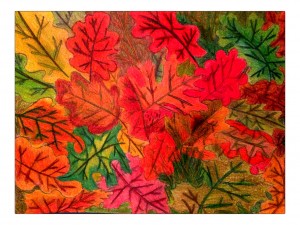
Autumn Leaves by Dayna Winters

Take apart the images for analysis: In the dream fragment, the leaves are blowing in the wind. Here, there are two main symbols, which may not seem like much, but you’ll be surprised at how much meaning they can supply. Take a look at each symbol separately, and then take a look at them together. Much like snowflakes, every leaf is slightly different from the next, thereby symbolizing individuality. The wind is associated with the element of Air, and is therefore suggestive of communication. When viewing both symbols together, the dream might be a suggestion to be more expressive about your personality, or to focus on communicating your individuality to others. In an image of leaves, there is more than one leaf – this could symbolize the gathering/movement of many individuals or a crowd. Consider if a dream like this might mean you should make an effort to “stand out from the crowd.”

Color: If you remember the color of the leaves you see, you can dig even further into dream symbolism. Let’s imagine for this example you see red, orange, and yellow autumn leaves. Red is a color of strength, personal power, and the life force. Sometimes in certain situations, it can represent danger. Orange is a color of attraction. Yellow is a color signifying communication, but in some situations, it can indicate anxiety. What’s more, color symbolism can change when viewed through the lens of different cultural understandings. With the latter color symbolism under consideration, ask yourself, “are you attracting danger in your life or are you perhaps attracting things that empower your personal will and strength? Are you communicating effectively or is something causing you anxiety? Further dream analysis may clarify your questions.

Environment: Autumn signifies seasonal changes, cycles, and transitions. The season hints at the future dark and cold coming of winter, but its yearly return promises a future life cycle as well. The season signifies death, but the potential of rebirth. Thus, your dream might be telling you about events in your waking life relating to endings and new beginnings, cyclical changes, “a coming of age,” or a time of final harvest, whether it is literal or figurative. The environment of the dream can reveal much. Was the sky clear? Was there a storm brewing? Were the autumn leaves blowing in the wind while out of the appropriate season – for instance, was it snowing as well? All of the latter conditions can be interpreted in different ways. What about the direction of the wind? Are the leaves moving about in all directions or one? Is the movement East, South, West, or North? If moving about everywhere, the direction might signify chaos or chaotic energies. If moving in a specific cardinal direction, you might discover additional meaning. Leaves blowing East might signify new situations, conditions, or new beginnings stemming from the conclusion of something else. If the leaves are blowing in the direction of North, it can symbolize a need to ground or to turn inward to tap into your personal power. If the leaves are blowing South, it suggests the direction of the Fire element therefore connoting purification, personal will, ambition, drive, inspiration, and the spark of life. When the leaves are blowing West, it might signify the realm of emotion, the deep subconscious, or the world of spirit. Cardinal directions are also representative of seasons, and could signify a movement from one season to another. East is spring, South is summer, West is autumn, and North is winter. Thus, the dream might hint at the movement of a condition/situation/event from autumn to spring, summer, next autumn, or winter.

Emotion: Consider what emotions the images evoke. Did you feel a sense of peace or happiness? Were you calm or apprehensive? Did the leaves evoke memories, either fond or undesirable? Also note how you felt upon waking. Sometimes dreams produce lingering emotions you carry with you throughout the day. Make a note of your emotions and compare your feelings with those you might be having in certain waking life situations/conditions/events, or relationships. Do you see any potential correlation?

Language: Occasionally dream symbols are a play on words – the images may point to sayings, cliches, or idioms you know. For instance, perhaps your dream of leaves is telling you it is “time to turn a new leaf,” or is a situation about to “leaf out” for you by expanding and “budding?” Perhaps you are in a situation where you should leave, “no leaf unturned,” or are you behaving like another in such a way that it is like you are “taking a leaf out of someone else’s book?” Consider some of the sayings you are familiar with when you are assessing your dream imagery.

Themes: As you review the dream symbols, you might note a running theme. For example, if the leaves in the wind were yellow and spinning around chaotically, you’ll see a commonality in symbols. The wind and yellow are both symbols associated with the element of Air and are therefore connected to the cardinal direction of East, new beginnings, individuality, communication (particularly through sound.) As mentioned earlier, leaves are representative of individuality, but so is the chaotic dispersing of the leaves – the leaves are separated, moving to and fro in an individual way in different directions. Thus, you can see a running theme of communication, individuality, expression, and differences.

Synchronicity: Sometimes dreams are a part of synchronistic occurrences. Synchronicity refers to two or more events that appear connected, related, and meaningful, without an identifiable causal connection: events that seem like more than mere coincidence. For instance, when I began writing this article I knew I would use leaf imagery to explore dream meaning. I came up with the title: “Leaves in the Wind,” after I thought about the image of autumn leaves and windy days. A few days later I encountered one of the myths about the Sibyl in ancient Greece. The story tells of a woman/priestess with prophetic powers, the Cumaean Sibyl, who lived in a cave. She would prophesize people’s fates and document them on oak leaves. The leaves were placed within her cave near the entrance. The Sibyl’s votaries would consult the leaves to prophesize the fate of each individual. Here is where the strange synchronicity comes into play: if a wind blew through the entrance of the cave and dispersed the oak leaves everywhere, scattering them on the wind, the Sibyl would lend no assistance in bringing the original prophetic messages back together again – fantastically, I had no prior knowledge of the latter story when I created the title for this article!

I have given the latter example so you can do the same when you are reviewing dream imagery. If you see leaves in the wind in your dream, pay attention to what goes on, not just in future dreams, but your everyday surroundings. You might encounter leaves actually blowing in the wind, or you could encounter the imagery in myriad ways in your waking life. I absolutely love synchronistic events. I believe they are “sign posts,” telling us to pay attention, that we are on the right path, and that we are where we are meant to be in our lives. Synchronistic events can also serve as confirmation of a higher power and the role it plays in our lives – a subtle reminder that the Universe is responding to your heightened awareness. Indeed, the more you pay attention to synchronistic events, the more such events occur.

Archetypes: It is often quite easy to identify dream archetypes once you assess the symbols you see. For instance, as I spoke of earlier, the Greek Sibyl is a priestess who writes prophesies on oak leaves. If you saw oak leaves, your dream might connote a connection to the prophetess or priestess archetypes. Autumn leaves represent a part of the life cycle where one is aged and has accumulated wisdom via experience as well – thus the imagery connects to the archetype of the Crone. You can find more information on the prophetess, priestess, and other important archetypes and how they relate to dream messages, in The Esoteric Dream Book: Mastering the Magickal Symbolism of the Subconscious Mind (Schiffer Publishing, 2013.)

Leaf Types: The type of leaves you see will give you an indication about the archetype associated with your dream images. Let’s look at a few examples. As we have already mentioned, oak leaves are representative of the Sibyl, but they are also representative of the Oak King. Which archetype is correct? Only you will know by how you connect with the archetype you choose. Perhaps you have an affinity for the Oak King or you feel a deep connection with the archetype of the Sibyl. Your feelings will point the way to choosing the right archetype to examine further.

Since anything can happen in dreams, what if you saw mistletoe leaves? Or grape leaves? Or Laurel leaves? Mistletoe might represent Christmas for one person and the Holly King for another. Grape leaves might suggest an archetype of Bacchus or Dionysus. Laurel leaves might be representative of Apollo. The images you connect with personally when you think of the leaves you have seen are the appropriate symbols for you to consider – there are no wrong or right answers when making symbolic connections.

Questions to ask yourself:

What parts of the dream fragment do I remember?

What colors were present?

In the example of leaves, what type did you see? Can you identify specific elements of the image that will give you more clarity on dream symbolism?

What was the environment like?

How does the dream make you feel?

Have I experienced events in the recent past that relate to the imagery?

Are there any archetypes relating to the images I’ve seen? If so, what do the archetypes symbolize?

Future Steps to Take:

Note if any of your future dreams feature similar imagery. How is it the same? How are the images different?

Keep an eye out for synchronistic events. What do the seemingly connected events mean to you?

About Dayna Winters:
Dayna Winters is a solitary Witch, author, and artist. She is the co-author of three books written with Patricia Gardner and Angela Kaufman including, “Wicca: What’s The Real Deal? Breaking Through the Misconceptions,” “Sacred Objects, Sacred Space: Everyday Tools for The Modern Day Witch,” and “The Esoteric Dream Book: Mastering the Magickal Symbolism of the Subconscious Mind”, all of which are published by Schiffer Publishing. You can find out more about Dayna and her work at her blog: http://daynawinters.blogspot.com/.

Dream Interpretation for Personal Growth

By Dayna Winters

I’m Dayna Winters, and I have practiced interpreting dreams for well over a decade. Through this column, I will help you explore the messages your dreams convey. Dreams are a form of communication between the subconscious and conscious mind: a way the higher self, universe, or divine uses to communicate. Your nighttime visions are richly embedded with significant symbols, all of which you can explore for personal meaning. Dreams are sometimes precognitive, lending hints about future events. Typically, dreams have multiple layers of meaning even when they are not predictive. Much like the Tarot is a tool for gaining personal and spiritual insight, dreams are a tool you can use to make personal discoveries and epiphanies; And as it is with the Tarot, every interpretation is deeply personal – what one person might get from a dream symbol, another person might derive an entirely different interpretation. And that’s what this column is all about; here, we will explore the fascinating world of dream symbols, and how you can use them to enhance your mundane and spiritual life.

To begin our exploration, lets examine what the appearance of a home/house in your dreams might symbolize. Common dream scenarios involving a house/home include the appearance of a childhood home; being in a strange home you have never seen or been inside before; being in a dilapidated house, and a house that is surprisingly larger than it first appears – one that often possesses secret corridors. The key to understanding house symbolism is to realize a building often symbolizes the self. The home is sacred space, your personal temple, and represents your physical body, and/or your emotional or spiritual state. Each room in a home, the condition of the house, and your familiarity with the interior/exterior of the house, all elicit meaning. Let’s break down each image and explore its meaning in-depth.

Childhood Home – The childhood home is a symbol of your roots and where you came from – the home represents fundamental concepts and beginnings. Dreaming of your childhood home signifies a longing for more innocent times where there is less responsibility and stress. This dream image suggests you either miss something/someone from that time period, or, if you have happy childhood memories, you might “long for the comforts of your childhood home.” If the home of your childhood is a place connected with traumatic experiences, the appearance of the home in dreams might indicate a karmic cycle coming up in your life where you will need to address past issues you have not yet emotionally resolved.

The appearance of your childhood home may also signify a deeply rooted connection to the past, or a desire to return to a former way of being. The important thing to remember if you see your childhood home in a dream and you feel a driving need to return to an old condition, situation, or way of being, is often when you attempt to “go back home again,” or revive a past condition, the experience is never the same, and is sometimes an incredible disappointment. Thus, the appearance of the home of your younger years could suggest a need to carefully consider if you want to revive an old condition, situation, or relationship at all.

On a more positive note, the childhood home might suggest a need to get in touch with your inner child. Remember when you were a kid and everything seemed magical? Remember when every life experience was a new discovery and when your creativity was encouraged? Do you remember the joy you use to find in the simplest of things? The childhood home image is one that might be urging you to bring back the joy in your life, become more creative, have more fun, and to simplify your life.

A Strange Home – The appearance of a strange home in dreams relates to “fish out of water” experiences. In your waking life, whether you know the owner of the home or not, a strange home most likely feels unnatural and uncomfortable for you, at least until you gain your bearings. Thus, a strange home in your dream indicates that you are either uncomfortable/uncertain of a new situation you have recently entered into, or you might soon be faced with a “fish out of water” experience where you are outside your natural environment or comfort zone. If the strange home belongs to a friend or a loved one, then your dream suggests that the situation you face is one where you will be able to recover your sense of comfort/balance relatively quickly. If the home belongs to someone you don’t know, then the recovery of your sense of comfort/balance might not be as simple or possible at all.

If you have entered into the strange home willingly, your dream suggests you are open to new situations, despite your uncertainty about any potential outcomes. If you are dragged or forced into the strange home, the dream suggests quite the opposite – it can signify your unwillingness to participate in new situations or that you have a stubborn nature that making it difficult to embrace new things. If the strange home has some familiar elements (for example, parts of the house’s interior has rooms from your own home), it can indicate that you will be familiar with some, but not all of the elements of a situation/condition/relationship in your waking life, and such familiarity will give you some comfort even though you are really going beyond your personal comfort zone. Being in a strange environment might also indicate an upcoming event where you feel socially isolated. Further, if you consider the strange home as a depiction of the self, this dream signifies a need for personal exploration, or the need to get in touch with the parts of yourself that you intentionally/unintentionally left untended or abandoned, like creative pursuits or hobbies once enjoyed.

A Dilapidated Home – When the home in a dream is run down, it can signal it’s time for self-improvements. The part of the home in need of repair can prove important in determining exactly what parts of your life require attention. For instance, if the entire exterior is run down, but the interior of the home is beautiful, your dream might signify a need to pay more attention to your body – perhaps you need to engage in more exercise, or your subconscious could be telling you it’s time to change up your external appearance with a new wardrobe, look, hairstyle, or image. If the interior rooms of the home are in disrepair, think about what a room symbolizes to you. As an example, let’s say you see a kitchen with broken appliances or the room is empty and in total disrepair. Since the kitchen is a place where you cook nourishing foods, it might be time to re-examine how you are nourishing your body. And since food is transformed into energy once consumed, it might also be time to consider how you nourish your spirit. Now imagine you dream of seeing broken windows throughout the home – this image may signify that it is time for a new view or perspective related to an old condition/situation.

A Larger Home with Secret Corridors – I can’t tell you how many times I have dreamed about a home that, once inside, is far larger than it appears and hosts endless secret corridors. This image represents a need for self-exploration and such a quest will lead to fascinating self-discoveries. If you see rooms and corridors filled with objects of all kinds or hidden storage areas in the home, this symbolizes a time to release unnecessary emotional baggage so you can make room for better things. The secret corridors represent the parts of yourself yet unexplored. In your waking life, if you have ceased being creative or partaking of spiritual practices, such as meditation, ritual, or prayer, the dream of the secret passages in the larger home (temple of the self) suggests a need to return to such practices where personal/spiritual epiphanies await you.

Associated deities – If you want to connect with dream archetypes representing the home, there are a number of deities associated with the hearth. Among such deities are the the Roman goddess Vesta and the Greek goddess Hesta. Also, in the Roman pantheon, there are Lares Domestici and Lares Familiaries, protective deities of the house and family respectively.

Questions to Ask Yourself

In your dream, what was the condition of the home?
Was the house yours or did it belong to someone else?
What primary colors are in the home (colors are highly symbolic and can elicit meaning for you.)
How did you feel about the home; were you comfortable or uncomfortable with the environment?
What rooms did you see and what do those rooms signify for you?
If known, what was the external environment surrounding the house like? For instance, was the home near a body of water (symbolizing the subconscious and deep emotions)? Was it sunny outside or was there a storm on the horizon (indicating potential trouble ahead.)

While it is impossible to cover every dream scenario involving a home in this short column, this article should give you a good sense on where to start when you want to interpret the meaning of house images in dreams. The important thing to remember is the home is a symbol of the self, with the exterior of the building representing the physical body and the home’s interior symbolic of the emotional and spiritual bodies. An examination of home dream imagery in this context can elicit deep, symbolic meaning you can extrapolate and use for personal growth on physical, emotional, and spiritual levels.

About Dayna Winters:
Dayna Winters is a solitary Witch, author, and artist. She is the co-author of three books written with Patricia Gardner and Angela Kaufman including, “Wicca: What’s The Real Deal? Breaking Through the Misconceptions,” “Sacred Objects, Sacred Space: Everyday Tools for The Modern Day Witch,” and “The Esoteric Dream Book: Mastering the Magickal Symbolism of the Subconscious Mind”, all of which are published by Schiffer Publishing. You can find out more about Dayna and her work at her blog: http://daynawinters.blogspot.com/.